
Tag Archives: death

Golf and Cognitive Dissonance

The 18th at Simi Hills
The 18th Hole at Simi Hills Golf Course – Simi Valley, California

I took up golf at the tender age of 46. My department at Rocketdyne was having a tournament and they needed bodies to fill up open slots. After a significant amount of badgering, I agreed to participate. To be fair, I had been introduced to golf when I was fifteen. My father had taken it up and he wanted me to enjoy it as he did. Unfortunately, he also wanted me to be right-handed. I’m not. He insisted I would be better off golfing right-handed and I tried, but it wasn’t to be. I felt incredibly awkward and didn’t want to put up with what I perceived to be an inordinately difficult effort to make the switch.

Couple that with the belief (this was back in 1962) that golf was primarily for old farts, and a strong desire to spend time surfing, and I didn’t last long at all. I guess, then, it’s not entirely correct to say I took it up at 46, despite the intervening 31 years before I handled a golf club again. Regardless, I played in the company tournament and spent a little time on the driving range and practice green in preparation. I was hooked—big time!
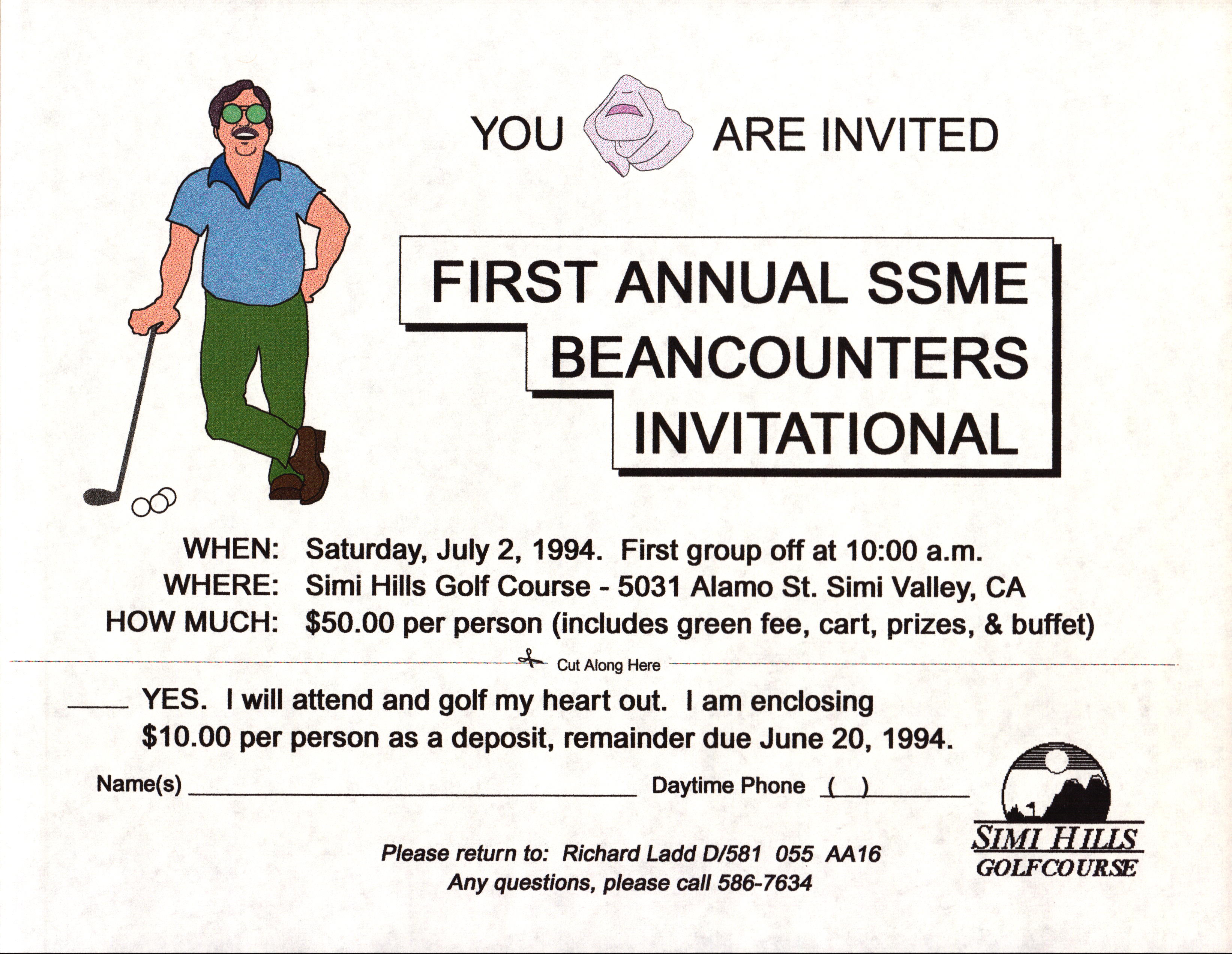
Golf Tourny Invite
Addendum: I thought this might be the flyer I put together for that first tournament but, based on the date, I don’t believe it is, because in July of 1994 I was 47 years old, not 46.

My uncle offered to have a friend make me a set of custom clubs for a very reasonable price, which I did. I quickly discovered, however, golf can be a very expensive sport, especially when you spend all your spare time hitting balls or playing. I could not afford to keep up the pace I was going at. In order to continue, I wrote and published a newsletter for the course I spent all my time at, Simi Hills. None of the articles were based on anything but my own fertile imagination and conjecture, but the General Manager of the course loved it and asked me to do it on a monthly basis, with real information this time.

In exchange for my efforts, he began allowing me to hit as many balls as I wished on the range and I took full advantage of it, frequently hitting hundreds of balls as I perfected my game. Soon I was invited to play with the head pro and the GM and, of course, it was as good as getting hours and hours of free lessons. I got my handicap down to 12 within a fairly short while, no mean feat for a man who was then pushing 50.

As I increased both my physical capabilities and my understanding of the game, I was soon approaching a single-digit handicap. It was then my wife and I decided to adopt. I wasn’t actually too keen on the idea at first, as I had visions of retirement, travel, and lots of golf. However, the desire to be a parent overcame my (very strong) desire to continue playing golf and, once the process began rolling along, it became harder and harder to play or practice. By the time we returned home with our oldest, in 2002, I was 55 and it became very difficult to fulfill my duties as a husband and father and still have time to play golf.

So, why am I telling you all of this? I still watch golf quite a bit and, lately, I’ve been playing a very realistic virtual game (World Golf Tour) online. Also, I have given a lot of thought to the role golf plays and how it jibes with my world view. I am aware there are numerous arguments for golf being a wasteful, indulgent sport of the rich. I am aware golf courses take up a lot of property for the use of, perhaps, not very many people. My best, somewhat informed, guesstimate is that the average full-size course is used by around 350 golfers a day. That’s not very many compared to the numbers using a municipal park or a National or State park. It surely explains why golf is so expensive, as it is a heavily tended and manicured environment.

Many courses, some suggest as many as 40% in the 1990s, were built as a part of a real estate development, and I’m not even going to get into the place Country Clubs play in terms of the exclusivity and expensiveness of golf. A large percentage of golfers are very well off. I suppose, comparatively, I am one of them. Certainly, when I was still employed in an excellent, well-paying job, I had the money to play a couple of times a month and practice several days a week when I wished.

There are, however, significant attempts to bring golf to the less-than-affluent, Tiger Woods’s “The First Tee” likely being the most prominent. Frankly, I don’t believe golf need be an “exclusive” sport. Furthermore, I think it has values to teach, as The First Tee does, that are difficult to find in today’s hyper-competitive environment found in many other sports. Inasmuch as I started so late in life, golf hasn’t taught me so much as it has reinforced in me many values I find important and useful, e.g. integrity, self-assurance, patience, calm deliberation, respect for others, etc. I also found on the golf course a place where everything else in my life melted away for a few hours. I was able to put my job and my responsibilities out of my head for a while; no mean feat for one such as I.

Tiger thanks a Marine
Tiger Thanks a Marine For His Service

There’s one other thought I had – and this whole post (which is somewhat off the top of my head, though I’ve thought about it a lot) was begun with this thought in mind – that bothers/concerns me. The military has long had a close association with golf (see this USGA history) and I have no problem with this. It does, however, lend even more credence to the belief that golf is exclusive because, historically, it has been primarily the Officers who had the time and money to play. That may be changing, but my goal isn’t to analyze the development of golf inside the military. What I am interested in understanding is what it means that every golf tournament now seems to have members of the military ceremoniously tending at least one flag on the course – generally the 18th.

I find myself wondering if this doesn’t, in some small way, signify our becoming more and more a military culture and also, given our penchant for honoring our armed forces for serving, yet never questioning how and why we ask them to serve, if this isn’t a bit backwards. What does it say about us as a society that we don’t seem to question how our military is used, yet now (post-Vietnam) bend over backward to thank them for their service? How do we justify asking them to do what many believe is not in our best interests, yet feel a heartfelt “thank you for your service” is somehow enough to justify our cavalier attitude toward the forces behind their service and sacrifice?

This leads me to other questions, such as are we becoming a sort of Sparta by proxy? Are we a nation that uses its wealth to prosecute wars that are unnecessary and only serve the interests of the truly wealthy and powerful, simultaneously insulating the average citizen from the sacrifices and costs involved? Are we asking the members of our armed forces to kill, fight, and die for no other reason than to preserve our position as the world’s largest consumers of natural resources, then showering them with just enough pomp and circumstance to obfuscate the ugly and horrific reality?

This is where I find cognitive dissonance. As I watched the end of the Greenbrier Classic yesterday, there were two service members tending the pin on the 18th. I am pretty sure I’ve seen this at just about every tournament I’ve watched this year and it seems as though it’s been only recently this has happened regularly. I really love golf as a sport, though I do wonder where it fits in the overall cultural milieu I live in. I hate to see it used as a propaganda tool but, truth to tell, I’m not sure that is what’s happening. What do you think about this? Am I crazy; being too ideological; reading too much into a genuine expression of gratitude? The dissonance is killing me.
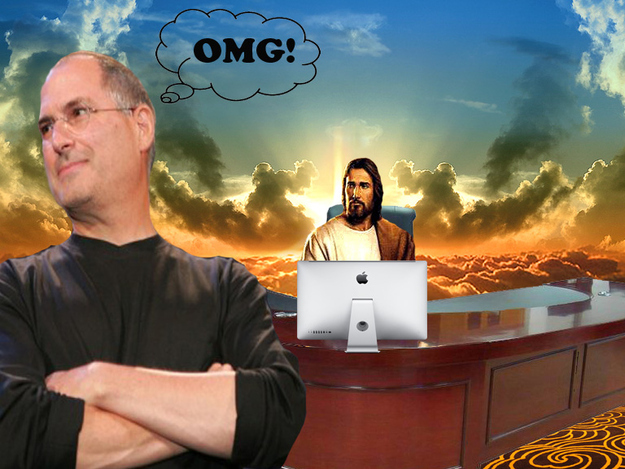

Will You Miss Your Life After You Die?

Steve Jobs in Heaven

No Doubt!

I don’t obsess about death or life after death but I have thought about it a lot over the years. Haven’t you? After all, one of the main consequences our religions offer us for a life well lived is eternal life in heaven once we die. Some offer the eternal antithesis as well and I know that motivates quite a few. An afterlife. Have you ever thought about what that would be like? I’ll bet you have. What really happens after we die? Everyone seems to think about it. With far fewer years ahead of me than are in my rear-view mirror, I have to admit I think of it even more, especially when I try to imagine the consequences of my death if it occurs before my children are adults and well on their way to a truly independent life. It matters because I’ll be 72 when my oldest is 18 . . . and I’ve already outlived my father by nearly six years. Not saying it’s going to happen, but it’s a reasonable alternative and it concerns me at times.

Now to the other side of the void. I’ve often wondered what the allure of life after death is for most people. I have a hard time believing anyone truly understands what eternity or, more accurately, death is . . . or means. Imagining what it’s like to be dead has got to be one of the most difficult intellectual pursuits known. Consider the following. When you wake up after even a very deep sleep, there’s some sense of time having passed, isn’t there? We may not remember precisely what our dreams are – or even that we dreamt at all – but there is some sense that time has passed and all is well. This is not the case if you’re unconscious. When you come out of anesthesia after surgery it’s entirely different. Almost everyone comes out of anesthesia, even after many hours under, with no sense of time having passed. It’s not uncommon for a person to ask when their surgery is going to begin, the sense of the passage of time having been entirely suspended. And they weren’t even dead!

Now try and imagine what it would be like to not wake up, ever. Can you do it? I would argue it can be approached, but I think it takes some time and, most likely, can never be done completely. It’s like imagining being pond scum, only vastly more difficult. The latest evidence and theory seem to point to the universe being around 14 billion (that’s 14,000,000,000) years old. Do you have a sense of loss for not being around most of that time? Yet, I maintain it’s difficult to imagine that same nothingness now that you’ve experienced consciousness. Somehow, we just can’t imagine the absence of everything.

Now, this isn’t a scholarly article. It’s based entirely on my experience, the things I’ve read and observed, and some obvious guessing. I have not been able to interview anyone who’s been dead for, say, 100 years to learn about their experience. Now that would be something! There is ample evidence the only experience they have is that of returning to dust, and only dust. I am, philosophically, a Materialist. I believe the physical world is a necessary prerequisite to the world of ideas, that is thought and consciousness cannot exist without a brain (and it’s attendant system, a body) to “think” it.

I know there are those who believe after (or as) we come into existence we are imbued with an eternal soul, so what happened before we were born (many would say conceived) is of no consequence afterward. I’m not one of them. I think once you’re dead you will not be looking down on your friends and relatives. Maybe there’s a short period of time, while everything is shutting down, you will imagine looking upon your now lifeless body, but I doubt it. I am quite convinced there is no afterlife and we won’t miss our family, friends, or anything else . . . because there won’t be any we to do so.

Much to my consternation, I just can’t imagine how that will feel. 😀

Graphic shamelessly stolen from BuzzFeed in case the link to their pic didn’t work

There Are No Ordinary People

Ordinary PeopleBased on the amount of traffic I’m seeing about the tragedy in Connecticut yesterday, I’m reasonably certain the fallout from this event is not going to soon subside. In fact I’m wondering if, now that the election is over, all the energy that had gone into finding ways to communicate and share in order to affect the outcome of the November contests isn’t looking for another avenue to express itself. We’ll see.

There’s one particular aspect of this tragedy that struck me recently and I wanted to quickly share my feelings about it. It has nothing to do with guns and violence, but it definitely has to do with death and loss. A Facebook (and real life) friend of mine shared this article from the New York Times and, in a comment later, said the following: “Ordinary people are much more courageous than we give them credit for being.”

This reminded me of something that has long intrigued me. I’m curious to know if others have felt the same. I have been to quite a few funerals or memorial services in my life for people I either didn’t know at all or knew very superficially. These include members of my wife’s family, spouses of co-workers, employees at a favorite venue, etc.

One of the things that stands out in my recollection of those experiences is the feeling I always got that I had missed something; that a special person had slipped through my fingers and now I would be forever barred from appreciating their existence and the particular light they shone out into the world.

Now, I know I can’t possibly get to know everyone, yet listening to friends, family, and co-workers reminisce and reflect on the life of the person for whom we were gathered together in memory of, always seemed to leave me with a feeling of incompleteness, of having missed something wonderful and extraordinary.

I’m of the opinion there’s no such thing as an ordinary person.


Memories and Grief

Sp4 Steven Larry Ostroff My friend Steve Ostroff (on the left) just before his untimely death

“Life doesn’t cease to be funny when people die any more than it ceases to be serious when people laugh.” — G.B. Shaw

I have written previously that I am not a journalist and this post is clear evidence of that. My original intent was to publish this on either the Sunday before, or on the Monday of, Memorial Day. However, the subject was a bit emotional for me and I found it difficult to finish until now. I, therefore, offer it as a remembrance. It need not be tied to any particular holiday.

It’s Confusing

Memorial Day – much like Veteran’s Day, Pearl Harbor Day, and many other holidays or special days that commemorate the military or significant days in our nation’s history – almost invariably brings me a storm of mixed emotions. I have enormous respect for those who serve our nation. At the same time, I believe they are most often sacrificed not in defense of our freedom, but in the defense of others – who never serve – and in defense of their fortunes and their “right” to make money incessantly.

This Autumn it will have been 45 years since I had the dubious distinction of being a pallbearer at the funeral of one of my best friends, Steven Larry Ostroff, who was killed in the battle of Ong Thanh on October 17, 1967. He was the first of five classmates of mine who would perish in that unjust, stupid conflict and I was highly conflicted about it.

“I want to be an Airborne Ranger. I want to go to Vietnam. I want to live a life of danger. I want to kill the Viet Cong.”

Steve was by no means an innocent, angelic hero. I remember my brother recounting running into him shortly after he finished either Boot Camp or Advanced Infantry Training. What stuck out for him was Steve’s enthusiasm for battle and his desire to kill. I was a bit put off by hearing that at the time, but not entirely surprised. It was, after all, the mindset the Army wanted in their Infantrymen. It was what they trained them for.

I was just beginning to understand what the war in Vietnam was all about; an understanding that would soon blossom into full-blown resistance and activism in an effort to bring it to a halt. Steve, born 15 days before me, was barely twenty years old when he was killed. During the funeral his casket remained closed. As I remember it, we were under the impression his body was not recovered for a couple of days and his family did not want anyone viewing his remains.

I’m not sure at this point that was the reason, though. Based on the accounts of his death I’ve read recently, it seems more likely to me there wasn’t a whole lot of him left to identify and having what was left on display in an open casket would have been too horrific for his family and friends. The web sites I have found with his information state he was killed by “Multiple fragmentation wounds“.

I clearly remember the grief on his parents’ faces as we went through the acts of remembrance, consecration, and burial. I have always been moved most by the loss experienced by those who have been left behind and it’s especially painful to see parents having to endure the loss of a child. In this case, it was made even more difficult because – if memory serves – Steve was an only child.

Twice-Baked Rye Bread

He and his family lived right across the street from John H. Francis Polytechnic High School, where we both attended, and he and I used to hop the fence to eat lunch at his home. His mother, I believe her name was Sarah, always had hard salami in the house and, if I played my cards right, I could count on enjoying one of my favorite sandwiches, served on Jewish Rye . . . with real garlicky kosher pickles on the side.

We belonged to the same temple, Valley Beth Israel, and became Bar Mitzvah at around the same time. We went to the same Jr. High as well and, as crazy kids and adolescents, we had some good times together, the memories of which have receded well into the background after all these years. This is especially so because we never had the opportunity to reinforce our memories by reliving them and, probably, embellishing them.

When I was in Washington, D.C. years ago, I made a trip to the Wall to see Steve’s name and to reflect on his life and death. I did the same in Sacramento, where there is a memorial to the Californians who perished in Vietnam. Both of these trips were some time ago and both were quite emotional.

What Is Really Going On

I have remained dead-set against every engagement we have indulged in since, but I am hardly anti-military – and here is where the conflict, the cognitive dissonance, comes alive and dances crazily in my head. Steve was a friend of mine and the men and women who continue to serve include friends and family. I know and love many of them, yet I don’t believe they are keeping our country safe; at least not for the most part.

For the most part, I believe they are being used as pawns – as “cannon fodder” – in our ongoing efforts to make the world safe for lucrative investments in natural resources and trading opportunities including, and maybe especially including, the sale of arms and ammunition to just about anyone who has the money to pay for it.

I will continue to honor Steve’s memory, despite his apparent thirst for killing and despite my belief he was not fighting for our way of life or to keep us safe, just as I will continue to honor the men and women who serve today. However, I do so only because I also believe most of those who serve honestly believe they are fighting to defend their country. They believe this because they’ve been told it’s true and I’m not going to hold their naivete and ignorance against them.

Some would argue I should condemn them, based on the principles that ignorance is no excuse and the existence of the duty to refuse to obey unlawful commands. However, I think the situation is far more complex than that and I cannot turn my back on people who have been taken advantage of for so long they have no way of knowing how terribly they’ve been duped.

I feel for them – especially for those who have made the ultimate sacrifice – and I feel for their families. So much of the suffering that takes place due to war and conflict is completely unnecessary and truly counter-productive for all but a very few . . . and those are the ones who also profit the most handsomely from war. They’re the ones who should be shot.


24 August 2015

In preparation for my High School class’s 50th reunion in about six weeks, a classmate was putting together a Vietnam veteran’s collage. As part of the effort he is also creating a memorial to our fallen classmates. In doing research for this tribute, he came across this post and asked me, since I mentioned we had lost six classmates, who the sixth was. He was familiar with only five. I had long thought there were six members of our class who perished in that conflict, but I believe I was wrong. I have made the correction, above.


How Dare I Discuss Religion!

Hawk Circling

My Gateway to Everywhere & Everywhen

Actually, I’m not going to discuss religion here. I’m not even really going to talk about a lack of religion, except to set up what I really want to talk about. Sit still! I’ll get to it shortly.

I was raised a reasonably devout Jew. Brought up in the Conservative “wing” of the Tribe, I spent four years in Hebrew School and am Bar Mitzvah, a son of the commandments. Sometime after I became a man in the eyes of Judaism, however, I began to question the existence of such a thing as G-d (that’s how Jews spell “his” name . . . in English, that is). I can remember laying on the grass in front of our home, staring out at the night sky, and wondering what might be at the end of the Universe. Was there a wall and, if so, what was on the other side? After all, there’s always another side if there’s a wall.

I don’t remember when I became an atheist, which is the best term I can use to describe how I relate to the question of a deity and his – or her – existence. There was no magic moment, forever imprinted on my memory, that marked the occasion. It just, apparently, happened without my actually marking the moment. It did happen, though. Of that there is no doubt. Some time in my early twenties I also became aware of both Hinduism and Buddhism. If I recall, it was the writings of Herman Hesse that first opened my eyes to these philosophies. Shortly thereafter, when I was experiencing a deep depression brought on by the unrequited love I felt for a young woman I was in a relationship with, I encountered a book that would change my life – The Wisdom of Insecurity, by Alan Watts.

Now, before I go on any further I would like you, dear reader, to take a moment and watch this short video. It is a beautiful visualization set to the words of Neil deGrasse Tyson answering the question, “What is the most astounding fact you can share with us about the Universe?” When I watched this I got goosebumps and experienced a moment of bliss so powerful it brought tears to my eyes. I hope it affects you at least fractionally as deeply as it did me. After that I want to share an experience with you.

Neil mentions connectivity, and it’s the essence of my story; an experience I’ve never repeated and likely never will . . . because it isn’t necessary. This happened to me sometime in the Summer of 1990 or thereabouts. I was living on the third floor of a well-kept apartment building, a block from my place of employment. I had a nice one-bedroom apartment, with a balcony overlooking a garden area with a fountain. My view was to the West and there was a hill not far away. It was late in the afternoon on a beautiful, temperate day. The Sun had gone behind the hill and, though I was standing in shadow, the sky was still a bright, luminescent blue.

The situation was reminiscent of many late afternoons I’d spent in Palm Springs when I was a boy, where my family used to spend long holiday weekends in the late 50s and early 60s. The city was hard up against the San Jacinto Mountains to the West and the sun would disappear behind them very early in the day, creating an almost cathedral-like atmosphere as the town rested in shadow, the sky remaining a vibrant, cerulean blue, made even more so by the contrast with the city streets.

As I stood on the balcony I looked up and noticed a hawk lazily circling on the thermals created by the hill and watching it I became more relaxed, beginning to enter a somewhat meditative state. I can’t explain why – perhaps I had seen a program on quantum theory; maybe I’d read an article in Science News; or possibly I’d had a recent conversation with one or more of the scientists I worked with – but I experienced a transition that felt like I left my body. My mind’s eye began to soar above the hawk, out into low Earth orbit, beyond Geosynchronous orbit and, eventually, deep into the cosmos.

I became more and more disassociated from my body, for how long I can’t say (thought it couldn’t possibly have been very long), and came to feel as though every fiber of my being was interwoven with the entire Universe . . . everywhere and everywhen. I experienced a sense of peace and a calmness I had never before quite known, and have yet to experience like that again. The sensation, the feeling I was part of everything that ever existed, or ever would exist, was profound. It has changed me forever.

I earlier mentioned a book by Alan Watts, The Wisdom of Insecurity, which was the catalyst for a life-changing experience and, now that I think of it, that book may have triggered my transformative moment. I had read it at least 15 years prior to this and, perhaps, had read it again. This was not too long after my father’s death and was right around my 40th birthday, so I may have been particularly engaged with contemplating my mortality. I’ve now read it at least three times, the last being when I was diagnosed with a melanoma and was required to once again face the possibility of my death . . . at least until the surgery to remove it was over and the biopsies all came back negative. <whew>

So . . . back to Mr. deGrasse Tyson and his most astounding fact. We are, indeed, stardust (“We are golden, we are billion year old carbon” Thank you, Joni*) and the things we’re made of, on a quantum level, have likely existed since the beginning of time; perhaps before, whatever that might mean. Zen (this is what Alan Watts ultimately wrote about) holds that we are all part of the Godhead (which I interpret to mean the entirety of the Universe) and all that matters is now so, perhaps the nature of time is irrelevant. I don’t know. Mostly I don’t care. My idea of faith is to accept the Universe as unfolding rather nicely all by itself, regardless of what you or I believe. We have but to pay attention – using science, not blind faith – and our understanding can continue growing.

What I have gained from my experience and my reading and contemplating, and what I get out of this marvelous video and this most astounding fact, is that we are very special and very lucky . . . and that we are all connected, intimately, with time, space, and matter (and each other) in a way we have only begun to understand. Is there an afterlife? Frankly, I don’t much care. Mostly, I hope not. Imagine how boring it would be to spend eternity with some of the people who think they’re going to Heaven. If my feelings that day are any indication, beforelife and afterlife have no meaning. There is only now that matters. I believe if you understand this, you can’t possibly fear death and you have no need of an afterlife. So sue me.


* God (or whoever’s in charge of these things) bless you, Joni. You wrote these lyrics and the music, but I’m a rock n’ roll guy at heart and this rendition of your song is the one that floats my boat.

Circling Hawk Pic courtesy of 68photobug


How Dare I Discuss Religion!

Hawk Circling

My Gateway to Everywhere & Everywhen

Actually, I’m not going to discuss religion here. I’m not even really going to talk about a lack of religion, except to set up what I really want to talk about. Sit still! I’ll get to it shortly.

I was raised a reasonably devout Jew. Brought up in the Conservative “wing” of the Tribe, I spent four years in Hebrew School and am Bar Mitzvah, a son of the commandments. Sometime after I became a man in the eyes of Judaism, however, I began to question the existence of such a thing as G-d (that’s how Jews spell “his” name . . . in English, that is). I can remember laying on the grass in front of our home, staring out at the night sky, and wondering what might be at the end of the Universe. Was there a wall and, if so, what was on the other side? After all, there’s always another side if there’s a wall.

I don’t remember when I became an atheist, which is the best term I can use to describe how I relate to the question of a deity and his – or her – existence. There was no magic moment, forever imprinted on my memory, that marked the occasion. It just, apparently, happened without my actually marking the moment. It did happen, though. Of that there is no doubt. Some time in my early twenties I also became aware of both Hinduism and Buddhism. If I recall, it was the writings of Herman Hesse that first opened my eyes to these philosophies. Shortly thereafter, when I was experiencing a deep depression brought on by the unrequited love I felt for a young woman I was in a relationship with, I encountered a book that would change my life – The Wisdom of Insecurity, by Alan Watts.

Now, before I go on any further I would like you, dear reader, to take a moment and watch this short video. It is a beautiful visualization set to the words of Neil deGrasse Tyson answering the question, “What is the most astounding fact you can share with us about the Universe?” When I watched this I got goosebumps and experienced a moment of bliss so powerful it brought tears to my eyes. I hope it affects you at least fractionally as deeply as it did me. After that I want to share an experience with you.

Neil mentions connectivity, and it’s the essence of my story; an experience I’ve never repeated and likely never will . . . because it isn’t necessary. This happened to me sometime in the Summer of 1990 or thereabouts. I was living on the third floor of a well-kept apartment building, a block from my place of employment. I had a nice one-bedroom apartment, with a balcony overlooking a garden area with a fountain. My view was to the West and there was a hill not far away. It was late in the afternoon on a beautiful, temperate day. The Sun had gone behind the hill and, though I was standing in shadow, the sky was still a bright, luminescent blue.

The situation was reminiscent of many late afternoons I’d spent in Palm Springs when I was a boy, where my family used to spend long holiday weekends in the late 50s and early 60s. The city was hard up against the San Jacinto Mountains to the West and the sun would disappear behind them very early in the day, creating an almost cathedral-like atmosphere as the town rested in shadow, the sky remaining a vibrant, cerulean blue, made even more so by the contrast with the city streets.

As I stood on the balcony I looked up and noticed a hawk lazily circling on the thermals created by the hill and watching it I became more relaxed, beginning to enter a somewhat meditative state. I can’t explain why – perhaps I had seen a program on quantum theory; maybe I’d read an article in Science News; or possibly I’d had a recent conversation with one or more of the scientists I worked with – but I experienced a transition that felt like I left my body. My mind’s eye began to soar above the hawk, out into low Earth orbit, beyond Geosynchronous orbit and, eventually, deep into the cosmos.

I became more and more disassociated from my body, for how long I can’t say (thought it couldn’t possibly have been very long), and came to feel as though every fiber of my being was interwoven with the entire Universe . . . everywhere and everywhen. I experienced a sense of peace and a calmness I had never before quite known, and have yet to experience like that again. The sensation, the feeling I was part of everything that ever existed, or ever would exist, was profound. It has changed me forever.

I earlier mentioned a book by Alan Watts, The Wisdom of Insecurity, which was the catalyst for a life-changing experience and, now that I think of it, that book may have triggered my transformative moment. I had read it at least 15 years prior to this and, perhaps, had read it again. This was not too long after my father’s death and was right around my 40th birthday, so I may have been particularly engaged with contemplating my mortality. I’ve now read it at least three times, the last being when I was diagnosed with a melanoma and was required to once again face the possibility of my death . . . at least until the surgery to remove it was over and the biopsies all came back negative. <whew>

So . . . back to Mr. deGrasse Tyson and his most astounding fact. We are, indeed, stardust (“We are golden, we are billion year old carbon” Thank you, Joni*) and the things we’re made of, on a quantum level, have likely existed since the beginning of time; perhaps before, whatever that might mean. Zen (this is what Alan Watts ultimately wrote about) holds that we are all part of the Godhead (which I interpret to mean the entirety of the Universe) and all that matters is now so, perhaps the nature of time is irrelevant. I don’t know. Mostly I don’t care. My idea of faith is to accept the Universe as unfolding rather nicely all by itself, regardless of what you or I believe. We have but to pay attention – using science, not blind faith – and our understanding can continue growing.

What I have gained from my experience and my reading and contemplating, and what I get out of this marvelous video and this most astounding fact, is that we are very special and very lucky . . . and that we are all connected, intimately, with time, space, and matter (and each other) in a way we have only begun to understand. Is there an afterlife? Frankly, I don’t much care. Mostly, I hope not. Imagine how boring it would be to spend eternity with some of the people who think they’re going to Heaven. If my feelings that day are any indication, beforelife and afterlife have no meaning. There is only now that matters. I believe if you understand this, you can’t possibly fear death and you have no need of an afterlife. So sue me.


* God (or whoever’s in charge of these things) bless you, Joni. You wrote these lyrics and the music, but I’m a rock n’ roll guy at heart and this rendition of your song is the one that floats my boat.

Circling Hawk Pic courtesy of 68photobug


Heaven Is Where You Find It?

Where Would You Rather Be?

I just got an email from an organization asking me two questions designed to get my interest in their activities on behalf of preventing any cuts to Social Security. The questions are:

  • Do you want to work until you die?
  • Do you want to eat cat food in your old age?

I pretty much have a strong opinion on the latter question, though the prescription diet one of our cats requires does smell somewhat inviting at times. I’m afraid, though, the lack of variety would disappoint me.

As far as the first question goes, I don’t have quite as clear cut an answer. I’ve always assumed I would work until I dropped. After all, that’s what all the men in my family did; at least all the real men. I managed to disabuse myself of the notion that was a good thing a long time ago. However, I also retained (and continue to retain) a vestige of whatever work ethic I was raised with.

Here’s the thing. I don’t want to “work” work, that is be forced to report to a job I dislike, working with people I don’t care for, and working for people I don’t respect. That would indeed be Hell-on-Earth. At the same time, I want to be engaged, challenged, and – above all else – relevant until my last breath. I can’t imagine doing otherwise. But that involves doing, which is – strictly speaking – working.

So I guess my answer to the first question is “Yes. I do want to work until I die”. I also want my Social Security to be there for me, so maybe he should have asked the question differently. Then again, maybe there aren’t a lot of people out there who see work the same way I do. How about it?

ADDENDUM (as of 27 February 2012)

It’s been over 15 months since I wrote this, and 21 months since my retirement from PWR. I’ve been looking for work and also looking for interesting things to get involved in. I have yet to be terribly successful at the former, but I can’t honestly say I’ve tried as hard as I could. That’s in part due to my desire to spend as much time as I can being a good father to my two young children. I don’t think there are too many people my age who have young children to raise. All of my friends have been grandparents for at least a decade or so.

To hear some people tell it, you would think organizations should be beating down my door to get someone of my age, with my experience, to help them deal with social business transitions and the imminent retirement of the generation (Baby Boomers) I’m in the vanguard of, age-wise. I’m not convinced. I think our cultural affection for youth is still pretty strong and I have my doubts that HR departments or Management in general are all that anxious to hire someone who will soon be 65 years old.

I do believe I have a great deal to offer the right organizations and intend on getting a lot more aggressive about seeking out consulting or contract gigs, and I’m in it for the long haul. After all, my kids are only 10 and 8. Nevertheless, I think it’s going to take a while to break through the prejudice against us old folk. In the meantime, I’m pleased with the progression my writing is taking and I’m grateful for those of you who take the time to read what I have to say.

I assume mine is a bit different than many blogs. According to sysomos, as of June 2010 bloggers over the age of 51 make up only 7.1% of the blogging population. Less than half are male and slightly less than one-third originate in the United States. Without putting too fine a point on it, I figure that means there are likely about 5 other bloggers in my demographic group . . . if that. Since my readership is continuously growing, and no one has yet called me a damn fool, I guess I’ll continue in the direction I’ve been heading; which means an eclectic blend of personal and professional musings. I may have a few surprises in store as well. Just to see if anyone’s really paying attention.