Author Archives: Rick Ladd

About Rick Ladd

Unknown's avatar
I retired over14 years ago, though I've continued to work on and off since then. Mostly I'm just cruising, making the most of what time I have remaining. Although my time is nearly up, I still care deeply about the kind of world I'll be leaving to those who follow me and, to that end, I am devoted to seeing the forces of repression and authoritarianism are at least held at bay, if not crushed out of existence. I write about things that interest me and, as an eclectic soul, my interests run the gamut from science to spirituality, governance to economics, art and engineering. I'm hopeful one day my children will read what I've left behind.

Sometimes It Feels Like Borrowed Time

Today marks, if not a special day on my calendar, at the very least an interesting one in my mind. Today is the fifth anniversary of the day I became older than my father was when he died. Does that seem like a strange thing to be commemorating? I suppose it is. Maybe a little context will make it more intelligible, if not less silly.

For most of my life, up until his somewhat untimely, if not surprising, death I had been told “You’re exactly like your father!” Frequently as an admonition for some behavioral trait I had exhibited. All-too-frequently it was something my mother found neither amusing nor endearing. I also looked like and was built like my father, adding to my perception that I was somewhat predestined to follow in his footsteps. This was exacerbated by our culture, which is based on and continues to exhibit vestiges of primogeniture. Being the first-born son of a Conservative Jewish family, I know I was doted upon and received far more attention than I’m sure I deserved. It also added to the perception of inevitability I both relished and rebelled against.

When my father died in 1984 I had just turned 37. My metabolism, which is now obviously quite unlike my father’s, had yet to change and I was still pretty thin; still physically similar to my father when he died. He was less than two months shy of his 60th birthday and you can bet there were lots of conversations with my mother and my brother over what that turn of events might mean for my and my brother’s future health.

These conversations continued occasionally throughout the years and, as I grew older, it became more and more apparent I was not really “exactly” like my father. Not the least of these revelations was when I reached the age he was at his first heart attack (around 50) and not having one myself! I’m sure that moment was made more important by the memories I had of being the one to recognize the symptoms and driving him to the hospital late at night at over 80 miles an hour, running lots of red lights in the process.
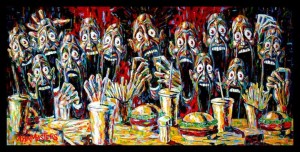
The Last Supper by Arum

Friday the 13th Can Be Very Scary For Some Folks!

So, what anxiety I felt slowly dissipated over the years. However, I had done one thing that set a landmark and, having done so, it was  impossible for me to ignore or deny it. I had entered my father’s birthday into an electronic spreadsheet and subtracted it from the day of his death. By formatting the result as a number I had the exact number of days (give or take ~ 24 hrs) he was here and alive on this planet. I then added that number to my birthday and converted the result into a date. Ironically, the day on which I would match the total time my father had lived occurred on a Friday the 13th. Though not superstitious, I have to admit the date had a little extra “spice” attached to it.

As it turned out, that date – April 13, 2007 – coincided with the first night of the In2:InThinking Conference I was attending. Since the weekend’s classes, seminars, etc. were to take place in the Woodland Hills Hilton’s conference rooms, many of the out-of-town speakers and leaders, as well as all the people who were working on the conference and its many ancillary activities, would stay at the Hilton beginning on Friday night. In addition to being an attendee, I was a co-presenter that year for one of those ancillary activities, but that’s another story.

As part of the package the In2:InThinking Network had negotiated with the hotel, we occupied the Presidential Suite where there was traditionally a big party. The suite was open to all the participants and there was food and drink; a merry time to be had by anyone who wished to show up and be a part of it. Fortunately, partying has always been one of the things I do quite well, thank you very much, and I spent the evening until well past midnight. I was gratified, as were my friends, I didn’t drop dead at the stroke of midnight and, since that day passed, I haven’t thought much about it.

I spent the evening (after which I would be older than my father when he died) drinking and eating and enjoying myself immensely. It was, for me, a two-fold celebration. I was happy to get what was a bit of a monkey off my back and I was happy to have known my father as long as I did. I was happy he and I had squared away our mostly rocky relationship and were well on the road to being friends when he died. I was happy he was my father and I celebrated his life, knowing that he would have wanted me to have a good, long one. I intended then, and continue to expect, to do just that.

Today is five years to the day and, as a special treat – a lagniappe, if you will – it’s also Friday the 13th; just like it was on that day. Even though it became obvious long ago I wasn’t “exactly” like my father, the realities of genetics and the similarities in our personalities always kept the limit of my father’s time on Earth in the back of my mind. It was never an obsession, but it was a bit of a pastime for a while 🙂 I do, occasionally, feel like I’m living on borrowed time which, in many ways, makes every day just that much sweeter.

ADDENDUM: I have long known of the word triskaidekaphobia, which means “fear of the number 13”, but just discovered the existence of a word for “fear of Friday the 13th”, paraskevidekatriaphobia, which is far more specific.



You Can’t Be Trusted!

How many of us have heard those in charge of the organizations we work for complain that the use of some of the newer technology available is a threat to company security? How many are blocked from sites like Twitter or Facebook because – as the argument goes – the risk of compromising company security or inadvertently sharing intellectual property is just too great?

I recall a time when the company I worked for had a policy against bringing cell phones to work if they had a camera, the fear being we would all suddenly start taking pictures of . . . what? . . . papers? . . . hardware? . . . and sell them to the North Koreans, the Russians, or the Chinese. That restriction didn’t last very long and this presentation pretty much sums up why.

The futility of such an attitude, given the ubiquity of smart phones, is almost unworthy of discussion. In addition, much of this hand-wringing is tantamount to closing the barn door after the horses (or one high-level horse) have escaped. I have personally (along with tens of thousands of my colleagues) been subjected to training designed to “help” us not do what some corporate executive did, all designed to convince the government we had learned our lesson and would not do what none of us had any intention of doing in the first place.

I’m confident I could go on about this subject for quite some time and, no doubt, will in the future. However, I really just want to share this wonderful PowerPoint presentation I was recently reminded of. It’s one of those that is somewhat timeless. Hell, it may never quite go out-of-date. I think it’s deserving of a reprise. Please feel free to share. The author placed it in SlideShare, so I’m confident he wants you to see and share it.

View more PowerPoint from normanlamont

On Being an Idiot!

Roles and Privilege

Privilege Allows One To Be a Bystander With Little Consequence

One of the most amazing and wonderful things I dearly love about social media is the serendipity, the seeming randomness of connections, that brings certain things to one’s attention; things you would not otherwise have seen or been aware of. For instance, my friend Trisha shared a link to an excellent post by someone I had never heard of before and likely never would have discovered otherwise. She was enthusiastic about this particular post so, naturally, I had to take a look.

I ended up reading not only the post she pointed me to, but four others that preceded – and were related to – it. The issue Joe was writing about is one that is near and dear to my heart; that of privilege and how little most of us understand its presence and power. He was specifically writing about the privilege that inures to men in a patriarchal society and, even more specifically, about how many men don’t even see the privilege we enjoy and, therefore, become bystanders to (and enablers of) gender-based violence and injustice. You really should read his stuff. Start here!

I was moved to add a rather lengthy comment on his final post and I’m hopeful I made sense to him. Sometimes I have so many thoughts stirred up by posts like Joe’s I have a hard time focusing on a simple, coherent answer. I did have some difficulty with this one, in part because it reminded me of something that happened to me around 25 years ago. It was something that made me feel like an idiot, I think in the same way that Joe refers to himself in his post. I’d like to relate that experience and try to tie it in somewhat to his premise.

Privilege can be seen in many different ways. In matters of race and ethnicity there is the reality of “White privilege”. The essence of any type of privilege is a bit of a paradox, as those who enjoy the privilege have the most difficult time seeing its existence. So it is with White privilege which is, just in case it’s not painfully obvious to you, inextricably intertwined with racism. Furthermore, racism and bigotry are not quite the same things – the former being far more insidious and bound up in cultural norms and social institutions.

But enough of that! I make no pretense to being a scholar or academic and it’s not my intention to delve too deeply into such matters, though I’ll circle back around to it in a bit. In my early twenties (keep in mind I turned 20 years old in 1967) I was very active in the peace and justice movement. I organized, participated in, and many times provided security for numerous demonstrations, marches, and other activities in opposition to the war in Vietnam. In 1973 I was lucky to be chosen as one of 100 people (half from the U.S. and half from Canada) who were to travel to Cuba as guests of the Castro government. I was a member of the sixth contingent of the Venceremos Brigade. Our mission was to work and learn, as well as deliver a shipment of books and educational material.

The group was very diverse; far more so than the anti-war movement – which was primarily white. In addition to left-wing members of the Democratic Party, there were representatives of the Black Panther Party and the Brown Berets. One of my travel mates was a “Pinto” a Chicano who had spent some time in prison. He would later become the only human on which I have seriously used my martial arts skills, but that’s another story. As part of our preparation for the journey to Cuba we received some fairly extensive education in the nature of racism; not from some academic or a tome written explaining it, but rather from those who were at the receiving end of it, the people of color who were part of our group.

We also spent a lot of time looking at and working to understand cultural chauvinism in an effort to not be what so many Americans are capable of . . . insensitive, ignorant, “ugly” Americans. One specific admonition I recall came in the form of a story of a woman who, when looking at a worker struggling to complete a job with simple, human-powered technology, remarked at the quaintness of the scene. It was one that, in reality, was of appalling poverty and destitution, but she saw it through the lens of her “privileged” upbringing and parsed it as “quaint”, which it certainly was not to the person doing the struggling.

Now, to circle back to the event that happened around 25 years ago, and which I mentioned earlier. I bring up some of my experience merely to point out that I had been struggling against my own racism, and confronting that of others, for close to 15 years when this happened and I considered myself reasonably far down the path of understanding and overcoming racism, sexism, and other prejudices I (along with so many of my fellow citizens) had been raised with.

I was at a friend’s house, sitting at a dining table chatting with another mutual friend, a woman named Cheryl. Our friend was (still is) Caucasian; his wife Chinese. They had two kids. Cheryl is Sansei, like my wife, third generation Japanese-American. Cheryl and I were talking about our friends’ two kids and I mentioned how strong I thought the Asian genes were and how obvious their expression was in the children’s facial features. Cheryl cocked her head slightly and looked at me like I was someone different than the Rick she had known for quite a while. She offered how she thought just the opposite; that Caucasian features were strong in both the children.

I don’t remember if I had ever considered it before (probably not), but I was suddenly made aware of how insidiously my belief about race had entered into my view of those children. The reality was that they were a mix of both their parents’ racial and genetic heritage. However, I rather unthinkingly considered them White, with an overlay of Asian. I was stunned at my stupidity and casual, unthinking racism.

There are two main lessons I believe I got out of this. The first is that racism can be very subtle and, for those who have benefited from the privileges that come with it, exceedingly difficult to recognize. The second is that racism and bigotry are not the same thing. They may sometimes be congruent, but not necessarily – and therein lies the difficulty many have. I felt nothing but love for my friends and their children, but I nevertheless brought subtle prejudice to the table when thinking about them. It had little consequence for our relationship but, for me, it carried a great deal of weight in terms of understanding how privilege works.

I’m not even addressing Joe’s issue of how it empowers those who are the beneficiaries to become bystanders and, therefore, enablers of prejudice. I’m only pointing out that privilege and the isms that it flows from run very deep and are often silent and difficult to recognize. Fighting racism, sexism, and other forms of prejudice requires constant vigilance in order to recognize when we’re finding ourselves standing side-by-side with the perpetrators. For me it has been a lifelong battle and I know now it’s far from over. Do you question your beliefs regularly? Do you understand what’s behind your view of the world?


Are You Comfortable With Being Social?

A Child's Trust

Trust. Catch Some!

Funny thing about blogging. Unless someone takes the time to comment, or they subscribe, there’s no way to know who is reading and what interests them. There are lots of tools to figure out where traffic comes from, including a list of the search terms that brought people to my site, but it really doesn’t help me understand as thoroughly as I’d like which of my posts strikes a chord

On the other hand, I’ve been testing the waters with a couple of different styles and I’m working on changing voice as well. So, I’m mostly writing to say what I have to say and it’s kind of like “damn the torpedoes, full steam ahead” . . . “let the chips fall where they may”. That isn’t to say I don’t care. I do. What it does say, though, is I’m not sure who will be interested in what I’m sharing today.

My history with, and interest in, Enterprise 2.0 (now mostly referred to as “Social Business“) has brought me a lot of “friends” I would not otherwise have encountered. When I say “friends” I am referring to people, some of whom I have never met in person, and some of whom I’ve only actually seen once in my life. The person who gave the presentation that appears below is one of the latter, though we’ve communicated in various ways in the past nearly two years.

I first met him at the Enterprise 2.0 Conference in Boston in June of 2010. I didn’t realize it at the time, but later discovered he coined what had become one of my favorite words – folksonomy. I had been arguing for some time that we (Pratt & Whitney Rocketdyne, where I was working) should concentrate less on a formal taxonomy for our explicit knowledge artifacts (meaning paper reports and electronic files) and go with tagging, which would create a useful folksonomy. Actually, I was arguing at the time for developing a hybrid, i.e. providing a “recommended” set of tags, allowing leeway in using them and creating new ones, and occasionally “culling” the list to get rid of the less useful tags while retaining the most useful ones for later use.

At any rate, Thomas has become a valuable source of understanding. I appreciate his insights and only wish I was in a position to attend more conferences and the kinds of presentations from which I can learn other viewpoints about the use of social media, especially for business. While I have some reasonably well-developed concepts and a fairly good understanding, there are so many areas where others have far more experience than I, especially when it comes to the information technology (including IA, Information Architecture) aspects of how it affects people and their relationships.

Below I’ve embedded the presentation Thomas gave at a recent conference on IA, which he just uploaded to Slideshare. Since he uses the same philosophy of presenting that I and many others do, i.e. avoid bullet points wherever humanly possible, use lots of interesting graphics, and talk your butt off, I can’t be quite certain I understand the point(s) behind every slide, but I think I get his drift. In fact, I love the concept of “Social Comfort” as I spent many years working to alleviate the discomfort so many of my colleagues seemed to feel back in the day. I also like his idea of avoiding use of the word “Trust” and – instead – substitute related words that evoke a feeling of trust, e.g. dependable, believable, treasured, consistent, honest, etc.

Going back to my use of the word “friends” for people I don’t really know or, at least, have never met in person. I consider them friends precisely because over time they have shown themselves to be dependable, consistent, honest, etc. That is, I’ve come to trust them based on numerous instances of conversation or reading something they’ve chosen to share not only with me, but with the entire online community. People who are unworthy of our trust don’t stick their necks out very often . . . if at all. The people I consider friends do so repeatedly, which is something I cherish.

I hope you can glean something useful from Thomas’s presentation. I believe I have. Feel free to comment here or to go to Slideshare and comment directly to Thomas if there’s something you don’t get or would like to discuss with him further.

Trust photo by mikebaird


You Do What With That Cigar?

Cigars & Ashtray

Can't Help it. Love the Aroma!

I have a confession to make. I am (nearly) a life-long smoker. I smoked my first cigarette when I was five years old. My best friend “borrowed” two Camels from a pack his father left laying carelessly in the living room. I still remember that first taste of tobacco. It was rich, sweet, and powerful as all get out. Sometime later – I’m not sure how long but it couldn’t have been much – he managed to get hold of some rolling papers and we decided to try rolling our own.

This was in the Summer of 1952. Life was very different back them. Kids roamed around pretty much at will. I wandered from home once when I was even younger and the Police had to take me home, but they never considered arresting my parents for child abuse. It was a different time . . . and we really didn’t lock our front doors.

Our parents didn’t know we did this and I know they would not have approved had they found out, but we were determined to get some tobacco and, for some reason I have no recollection of nearly sixty years later, we had to “liberate” that tobacco from the Thrifty Drug Store in our local shopping center. We somehow managed to find ourselves a can of Prince Albert and were able to make it out of the store undetected. I guess they weren’t thinking too much about a couple of kids “kyping” tobacco.

We made our way to the East end of the parking lot, where there were bushes thick enough to provide cover for our cigarette rolling and smoking. We were excited. We got into the bushes, all a tingly, pleased with our success at shoplifting and looking forward to doing something truly manly, which was every five-year-old boy’s aspiration back then. It wasn’t long before our excitement turned to bitter disappointment; our plans for manliness dashed against the rock-like reality that the manual dexterity of a five-year-old just wasn’t quite good enough to roll a cigarette worth smoking. We didn’t have a pack of papers to experiment with, either. After a couple of failed attempts it was over. Of course this didn’t mean we stopped smoking. It just meant we went back to lifting them from our dads.

My friend’s dad smoked Camels, my dad Pall Malls . . . either of which was just fine with us. I used to wait until my father’s pack was just about empty, then take it. I don’t know what he must have thought. I assumed he would just figure he misplaced it. Probably not; at least not after I did it a few times, but kids are the purest of optimists. Back then the neighborhood boys would climb on the fences between our homes and walk on them to get to each others’ house. It was far more fun, and way more direct, than walking around the block on the sidewalk. However, the workmanship on those fences wasn’t exactly world-class and there was always a capstone or two that came loose. One of them became a hiding place for my tobacco treasure.

Unfortunately, luck was not my friend and my father somehow found that pack of cigarettes. What he did to me would likely qualify as child abuse today, but beating a kid back then was pretty much what discipline was all about. Even strangers could admonish, if not spank, a child who had clearly overstepped the bounds of respectable behavior in public. Needless to say, I got quite a beating over that one.

Now, despite my essentially life-long love/hate relationship with tobacco, I have gone for long periods of time without actually smoking. In fact, I once went for 14 years without smoking tobacco. In the last decade or so I have periodically smoked cigars – not cigarettes. However, I’m one of those people who doesn’t see the point in smoking if you don’t inhale and I get no joy from a cigar if I don’t inhale. Each time I started smoking I fairly shortly reached a point where I didn’t want to continue. It might have taken anywhere from a week to a couple of months before I would be able to stop, but stop I did . . . cold turkey. I have never suffered from withdrawal symptoms either, but I do have to contend with the constant habitual reminders of wanting a smoke. After meals, when getting in my car, during a commercial. There were lots of them.

Regardless, I’ve been able to do it. Stop, that is. The problem I have is, after I’ve gone for a couple of months without smoking I feel like I can have a cigar and generally do. This has always proven to be a mistake, the one cigar almost always turning into dozens more before I can yank myself away from what has by then become mostly a disgusting, unfulfilling habit. This is why I’ve never said I “quit” smoking. I always say I’ve “stopped”.

Glass o'Scotch

Mmmm. Mellow and Peaty!

I’m only bringing this up because I finally stopped again. When I woke up last Saturday, March 24, 2012 (this will be the very first time I’ve actually recorded the day on which I’ve begun a bout of “stopping”) my desire to stop coughing and feeling kind of lousy – all at the mercy of those damn cigars – finally exceeded my desire to pump cigar smoke into my by now suffering lungs. Today is my fourth day and I feel great. I can already take a deep breath without coughing. I’ve suffered those disorienting moments when I would have previously reached for a cigar, but I’ve been able to redirect my desires quickly and it feels tremendous to be in control . . . very consciously in control.

It remains to be seen how long it will be before I seriously consider tempting fate and smoking another cigar. The end of the Summer is the most likely contender, as that’s when I will be spending a weekend at Pismo Beach with a sizable group of friends, one of whom always brings fresh, very tasty, Cuban cigars to share. I guess I’ll cross that bridge when I come to it. For now, I’ve got to get over to Trader Joe’s and grab a fresh bottle of Scotch for later. Can’t stop every little vice now . . . can we?

Cigar photo by X it

Glass o’Scotch photo by chipgriffin


If Russ Ackoff Had Given a TED Talk

I love TED talks. Sometimes I watch them while walking on my treadmill (which I don’t do often enough; walk on the treadmill, that is). Some of them I’ve seen several times and I’m reasonably certain I will watch them again. I recently shared a talk by Alan de Botton on this blog, which I found fascinating and, apparently, so did quite a few others. They are all fascinating.

When I originally started this blog, part of my plan was to discuss Systems Theory and its relationship to Dialectical Materialism, as well as how they affected our relationships, our economics, and our society. For various reasons, I was unable to pursue that particular goal at the time, but it’s why I called this blog Systems Savvy. I now find myself in a position to spend more time researching and thinking about that relationship and its ramifications. In that regard, I want to share what I would consider a fundamental aspect of my understanding of Systems Theory.

We are fortunate that a good friend of mine, Steve Brant, has managed to gather a fairly extensive collection of videos of the man I consider one of the leading thinkers, writers, and doers in the world of Systems Thinking, Dr. Russell Ackoff. The one that follows is a particularly good example, in my less than humble opinion, of what Systems Thinking is and how it should inform our understanding. Actually, let me share Steve’s words that accompany the video on YouTube:

“This presentation is from a 1994 event hosted by Clare Crawford-Mason and Lloyd Dobyns to capture the Learning and Legacy of Dr. W. Edwards Deming. Russ knew Dr. Deming and speaks here about the difference between “continuous improvement” and “discontinuous improvement” as seen through the lens of systems thinking.

“Russ was going to give a TED talk in Monterey, CA in 2005 and had to cancel because he was recovering from eye surgery. If he had given one, this is probably what he would have said… because there’s a powerful and unexpected lesson at the end. Enjoy!”

Rather than say much more about Russ or his research and his teachings, let me just share the video. As time goes by I will share more, as well as my thoughts on how his teachings can be used to help us understand the endeavors I’m most interested in: Knowledge Management; Economics; Social Media, etc. As Steve says, Enjoy!


Hey! Where You From?

Humanist Bumper Sticker

No boundaries. Love all. Serve all.

This is a graphic I put together around eight years ago after seeing some bumper stickers declaring the driver (or vehicle owner) to be a native of California . . . or some other state. It seemed to be somewhat of a trend and I found it a bit stupid and offensive. Today I’m inclined to think it was also nativist, as in anti-immigrant.

I am a humanist and I believe we need to move toward a world that knows no political boundaries and respects all humans as part of the same family. I realize some may see this as a pipe-dream, but I believe it is part of the trajectory of progress that traces back to the days of primitive tribalism. Just as there are very few items remaining that can be made by one person, taking care of our planet and its ecosystems (both natural and human/social) is going to require recognizing our interdependence.

So that was my thinking when I created this graphic. Until such time as we discover life in other star systems, which I’m convinced we will some day; perhaps within my lifetime, I am of the opinion we are all part of the same race of beings and must conduct ourselves with that in mind. I was born in Los Angeles, California . . . but I consider myself a native of Earth and part of a very large and diverse family.


On Being Effective.

It is far better to do the right thing wrong than to do the wrong thing right. – Russell Ackoff

I put this quote in here partly because it’s one of my favorites, from one of my favorite people . . . but also in part because I wanted to test WordPress’s posting capabilities. Much as what happened with posting a picture (WordPress has these quick post capabilities for several different types of content), I really don’t like how it works. I much prefer the regular posting functionality if for no other reason than you can save a draft; something that isn’t available as far as I can tell with the quick posts.


Everybody Needs a Hug Now & Then

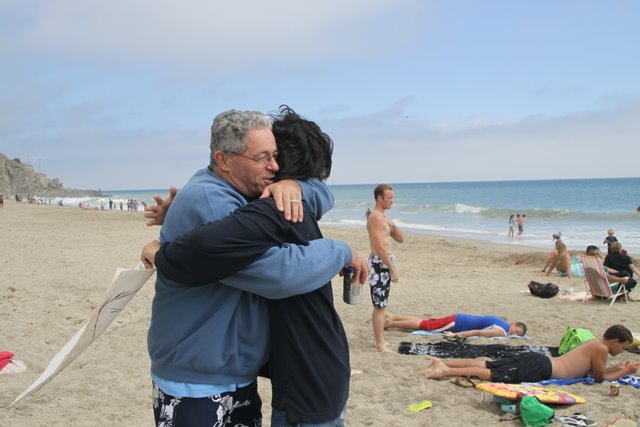
Free Hugs at Sycamore Cove, Calfornia

How Can You Pass up an Offer Like This?

Back in late July of 2010 (actually, Picasa – and my camera – tell me it was on Saturday, July 24, 2010, at 2:45 PM) we were enjoying the Summer weather at Sycamore Cove State Beach here in Malibu, Caifornia. We had camped out in an adjacent site in Point Mugu State Park, which requires a short walk to a sand carpeted tunnel that takes you under the Pacific Coast Highway; very kid safe! I can’t recall if it was with the Indian Guides or the Girl Scouts, but we were there with a bunch other families and a bumptious horde of little girls.

Despite my having recently undergone surgery to remove a Melanoma and a couple of lymph nodes (just to be sure it hadn’t spread, which it hadn’t), I was determined to spend some time on the beach. My wife had purchased both a long-sleeve, UV-resistant shirt and a large umbrella designed to corkscrew deep into the sand. I was able to sit in the shade pretty comfortably and enjoy my children and their friends – and a beer or three – frolic in the surf and sand.

We had been there a couple of hours when this young man and two women came walking by. He was holding a sign that said “Free Hugs”. Most people were ignoring him but, being the old hippie that I am, I just couldn’t resist availing myself of his offer. Frankly, I think those who didn’t (and that was most everyone on the beach) were being disrespectful. Here was a fellow human being who, despite all the fear in this world, was offering to hug perfect strangers.

To tell you the truth, for all I know he could have been pledging a fraternity (though the timing wasn’t right) or working on some sort of thesis or paper (the timing wasn’t terribly propitious for that either). I really didn’t care. It just struck me as the right and decent thing to do. Besides, there is something magical about connecting with strangers in a very human way. Hugging is something we all do. Hell, even male professional golfers hug their caddies nowadays . . . at least after a victory!

Da Kine Hug at Sycamore Cove, California

Notice I am carefully hanging on to my beer!

It’s now well over a year and a half later and I’m still healthy, so I guess he wasn’t carrying any communicable diseases. Don’t think it didn’t cross my mind. Regardless, I think we all can use a hug from a stranger now and again and after surviving my cancer scare I suppose this was just one way of my affirming I’m alive and kicking. Next time you see someone with a sign like this, go ahead a stick your damn neck out. I doubt you’ll be sorry you did.

PS – Just in case you were thinking, “That Rick’s a lying SOB. He just took a picture with the guy for fun”, here’s the pic Linda took shortly after we posed for the one above.


Nearly eight years ago I gave a presentation at a KM Cluster event held at PricewaterhouseCoopers in downtown Los Angeles. The title was “From Wright to Wrong: The Dark Side of Intellectual Property Rights” and in it I took the position that IP protection had hypertrophied to the point it was choking off innovation and providing far more protection than was either necessary or useful. I was able to find a link to the website for the event, but it was so long ago it’s been abandoned and the URL resolves to a GoDaddy Parking site (here’s the link – http://www.kmcluster.com/lax/Past%20Events/LAX_Spring_2004.htm).

The title comes from the story of the Wright Brothers’ defense of their patent for “wing warping” which, like ailerons, allows an airplane to fly straight and level. Their assertion was that they had actually invented the concept of straight and level and they were able to prevail in the Supreme Court, thereby “stunting” further development until after the outbreak of WWI, when the U.S. was desperate to produce airplanes and worked out a deal to overcome the hurdle. I’m busy recrafting the presentation I gave, ironically in part because I posted it to SlideShare and quickly received a call from my former company’s IP attorney asking me to take it down as it contained their logo, which I’m removing as well as updating the info.

I’m pretty sure Mark is being a taste satirical here, and I think he’s kind of making the same point I was. I tied my preso to the concept of knowledge management, especially with respect to freely sharing knowledge and the damaging effect I believe overzealous IP protection has on it. See what you think.

kenbonzon's avatarblog maverick

Anyone who reads this blog knows how much I hate patent laws. I think 99pct of the time they are anti-competitive, corruptive,  impede creativity and innovation and can kill small businesses. I think the ratio of patent law doing a good job protecting company IP vs it being used purely to negatively impact competitors or to troll for un-earned revenue is probably 1000 to 1, or worse.

When I read that Yahoo was suing Facebook my immediate reaction was disdain. As I thought more about it, I came to realize that this case could be the water shed moment that causes enough people to recognize just how horrific  our patent law is.

I am not saying that there is zero value to patents. There are plenty of examples out of the however many patents that have been issued where the patent was put to legitimate use to protect…

View original post 452 more words