Tag Archives: racism

Racism Is Bigger Than Bigotry

In 1973, while preparing to travel to Cuba with the Venceremos Brigade, I underwent extensive political education on race, class, imperialism, and American society. Among the most memorable lessons came from members of the Black Panther Party. They distinguished personal prejudice and bigotry from something broader and more deeply rooted: racism as a systemโ€”something embedded in institutions, laws, customs, economic arrangements, and accepted ways of doing things.

That distinction has stayed with me for more than half a century because it explains something that our ordinary public vocabulary often conceals. Americans commonly use the word racist to describe an openly prejudiced person: someone who uses racial slurs, expresses hatred, refuses to associate with people of another race, or consciously believes one race is superior to another. Those behaviors are certainly manifestations of racism. But when racism is reduced to such behavior, the larger system disappears from view.

The lesson I heard in 1973 belonged to a broader Black Power analysis already articulated by Stokely Carmichael, later known as Kwame Ture, and political scientist Charles V. Hamilton. In their 1967 book Black Power, they distinguished โ€œindividual racismโ€ from โ€œinstitutional racism.โ€ Individual racism, they wrote, is generally visible and attributable to particular people. Institutional racism is more subtle, arising through the operation of established and respected institutions. As they observed, people who would never personally bomb a church or attack a Black family could nevertheless support institutions and officials that perpetuated racial inequality.[1]

For purposes of clarity, I use prejudice to mean a preconceived judgment about a group; bigotry to mean a stubborn and often hostile attachment to such judgments; and discrimination to mean unequal treatment. I use racism more broadly to describe the network of attitudes, practices, institutions, and distributions of power through which racial hierarchy is created or reproduced.

These categories overlap. Psychological definitions often describe racism as a form of racial prejudice, while also recognizing institutionalized racism in schools, health care, employment, law enforcement, and other systems. Sociologists tend to place greater emphasis on racismโ€™s systemic characterโ€”on the way interconnected institutions produce unequal access to resources and unequal life chances.[2]

The point, therefore, is not that personal racism does not exist. It plainly does. The point is that personal bigotry is only one level at which racism operates.

The inadequacy of โ€œIโ€™m not a racistโ€

When someone says, โ€œIโ€™m not a racist,โ€ the statement usually means something like this: I do not hate Black people. I do not use racial slurs. I would not deliberately mistreat someone because of race.

That may be entirely sincere. It is also an answer to the least demanding question.

The larger question is not merely whether I consciously hate anyone. It is whether the institutions I inhabit, support, benefit from, or leave unexamined continue to distribute wealth, security, education, health, opportunity, and punishment along racial lines.

A person can be free of conscious racial hostility and still participate in a racially unequal system. A loan officer may treat every applicant politely while applying standards shaped by decades of discriminatory lending. A real estate agent may never utter a racial slur while steering clients toward different neighborhoods. A school official may care about every child while administering district boundaries created by residential segregation. A physician may sincerely believe in equal treatment while relying on a medical algorithm that underestimates the needs of Black patients.

That is why innocence of intention cannot be the sole measure of racism. Intent matters, but systems also have histories, incentives, routines, and consequences.

Redlining: prejudice converted into geography

Redlining is one of the clearest examples of racism becoming structural.

During the 1930s, federal agencies and local real estate professionals classified neighborhoods according to their supposed mortgage risk. Neighborhoods containing Black residents, immigrants, or other groups regarded as undesirable were frequently given the lowest ratings. Redlining did not merely deny particular individuals a mortgage. It denied credit and investment to entire communities. The federal governmentโ€™s own housing materials acknowledge that the 1938 Federal Housing Administration underwriting manual incorporated racially discriminatory policies.[3]

The consequences extended far beyond the original mortgage decision. Families denied affordable mortgages were less able to purchase homes, accumulate equity, borrow against that equity, finance education, start businesses, or pass property to their children. Neighborhoods denied investment experienced deteriorating housing, weaker commercial development and, in many cases, reduced public and private services.

Meanwhile, families admitted to federally supported suburban housing markets accumulated appreciating assets. Those assets could be inherited. Their neighborhoods acquired stronger tax bases, better-financed services, and reputations that attracted further investment.

No contemporary homeowner needs to have participated personally in redlining for its effects to influence the value of a home, the quality of a school district, the availability of credit, or the inheritance a family receives. The original prejudice has been converted into property, geography, and accumulated advantage.

The Federal Reserve reported that in 2022 the median wealth gap between White families and Black families exceeded $220,000. Redlining alone does not explain the entire gap, and it would be simplistic to pretend that it does. But it demonstrates how discriminatory policy can shape wealth for generations after the openly discriminatory rule has been repealed.[4]

Sundown towns: exclusion without Southern signs

Sundown towns provide another example. These were communities that excluded Black peopleโ€”and sometimes other racial, ethnic, or religious groupsโ€”through ordinances, police enforcement, threats, restrictive covenants, intimidation, or widely understood local custom.

They were not exclusively Southern. The National Park Service notes that sundown towns were more common in the North and West than many Americans realize. For Black travelers, an ordinary road trip could become a calculation about where it was safe to buy gasoline, eat, sleep, or remain after dark. The Negro Motorist Green Book existed in part because the supposedly open American highway was not equally open to everyone.[5]

The disappearance of a threatening sign did not automatically undo the community the sign helped create. Decades of exclusion affected who owned property, who attended local schools, who developed business and political networks, and whose families benefited from rising land values. Later generations could inherit the resulting advantages without personally approving of the original exclusion.

Again, this is the difference between an event and a structure. The event may be over; the structure created by the event may remain.

The double standard in ordinary transactions

Systemic racism is not confined to dramatic episodes of history. It can appear in routine decisions that seem individual and unconnected until they are measured collectively.

Consider employment. In a widely cited field experiment, researchers sent employers fictitious rรฉsumรฉs with equivalent qualifications but different names. Rรฉsumรฉs bearing conventionally White-sounding names received approximately 50 percent more callbacks than those bearing conventionally African American-sounding names. The disparity appeared across industries and occupations, including among employers describing themselves as equal-opportunity employers.[6]

Consider housing. In a national paired-testing study, equally qualified White and minority homeseekers approached housing providers about advertised properties. Blatant refusals had declined, but minority applicants were still told about and shown fewer homes and apartments. A subsequent HUD review found that paired-audit studies consistently detected statistically significant discrimination against historically disadvantaged groups.[7]

Consider appraisals. A 2024 Federal Housing Finance Agency study found that, after controlling for numerous property and appraisal factors, appraisals below the contract price were at least 23 percent more likely in majority-Black neighborhoods than in otherwise similar neighborhoods with no Black residents. The researchers also found evidence that appraisersโ€™ familiarity with a neighborhood could reduce the effect, suggesting that institutional information practicesโ€”not necessarily overt personal animosity aloneโ€”helped produce the disparity.[8]

The pattern is difficult to dismiss:

The same qualifications, but a different name.
The same financial readiness, but fewer homes offered.
A comparable transaction, but a different valuation risk.

No racial slur is required. No one involved has to announce a doctrine of racial superiority. Yet the burden repeatedly falls in the same direction.

Housing becomes education

Housing segregation does not remain a housing issue. It becomes an education issue because American public schools are organized largely by residential location and are financed in part through local property revenues.

The Government Accountability Office has noted that discriminatory history, residential wealth disparities, school district boundaries, and local property-tax financing remain intertwined. Poor, Black, and Hispanic students generally attend schools with fewer resources and worse outcomes. GAO also found that when communities separated from existing school districts to form new districts, the new districts tended to be substantially Whiter and wealthier than those left behind.[9]

A family may say, โ€œWe moved here for the schools,โ€ without harboring conscious racial hostility. But that apparently private choice occurs within a housing and school system whose geography was not created innocently. The issue is not that every family making such a decision is personally bigoted. The issue is that millions of individually understandable choices can reinforce a structure created through exclusion, unequal investment, and inherited property advantage.

Discretion and the racial double standard

Racial inequality also appears where institutions give decision-makers broad discretion.

Researchers examining nearly 100 million traffic stops found that Black drivers were less likely to be stopped after sunset, when darkness made a driverโ€™s race harder to perceive. They also found that police applied a lower evidentiary threshold when deciding to search Black and Hispanic drivers than when deciding to search White drivers.[10]

This does not prove that every police officer is consciously bigoted. Nor does every disparity, by itself, prove discrimination. But when similarly situated people encounter different thresholds of suspicionโ€”and when the pattern persists across a vast number of decisionsโ€”the matter can no longer be reduced to a few identifiable โ€œbad apples.โ€ Training, discretionary standards, supervision, institutional incentives, deployment patterns, and accountability systems all become relevant.

The Justice Departmentโ€™s investigation of Ferguson, Missouri, illustrated this institutional dimension. It found that the cityโ€™s emphasis on generating revenue had shaped police and municipal court practices, systematically violated constitutional rights, and both reflected and exacerbated racial bias. The problem was not simply what individual officers believed privately; it was what the institution rewarded and required publicly.[11]

Racism without an explicitly racial rule

Perhaps the clearest modern example comes from health care.

Researchers examined a widely used commercial algorithm intended to identify patients who needed additional medical attention. The algorithm used prior health-care spending as a proxy for illness. But because less money had historically been spent on Black patients with comparable medical needs, the algorithm interpreted lower spending as evidence that those patients were healthier. Black patients assigned the same risk score as White patients were actually sicker, and the bias reduced by more than half the number of Black patients identified for extra care.[12]

The algorithm did not need to express hatred. Its bias arose from treating an unequal historical outcomeโ€”medical spendingโ€”as though it were a neutral measure of medical need.

That is what โ€œbaked inโ€ means. Yesterdayโ€™s inequality becomes todayโ€™s data. Todayโ€™s data become tomorrowโ€™s decision. A system can reproduce racial inequality while presenting itself as objective, colorblind, and mathematical.

Not every disparity is proofโ€”but every pattern deserves examination

A serious argument about systemic racism should not claim that every difference between racial groups is automatically caused by racism. Such a claim would be intellectually careless.

Evidence matters. We should compare similarly situated people, examine institutional history, identify the operative rules, test alternative explanations, measure outcomes, and look for mechanisms connecting policy to consequence.

But we must be equally careful not to impose an impossible burden of proofโ€”one that recognizes racism only when a person explicitly confesses racial hatred. Systems do not possess private emotions. They reveal themselves through their design, incentives, practices, and patterned outcomes.

The relevant question is not simply, โ€œCan we find a bigot?โ€ It is also, โ€œWhat does this institution repeatedly do, to whom, and why?โ€

From innocence to responsibility

Understanding systemic racism does not require believing that every White person is malicious, that all members of any racial group have identical experiences, or that class, gender, geography, and other forces do not matter. Nor is it a demand for inherited personal guilt.

It is a demand for responsibility.

Guilt asks, โ€œAm I personally a bad person?โ€

Responsibility asks, โ€œWhat have I inherited, what do I participate in, what consequences does it produce, and what am I prepared to change?โ€

โ€œIโ€™m not a racistโ€ can become a form of evasion when it ends the conversation rather than beginning it. It allows a person to treat the absence of conscious hatred as evidence that no further examination is necessary. It turns racism into a question of personal manners and moral self-image while leaving housing, employment, education, policing, health care, and inherited wealth safely outside the frame.

A better response would be: I may not consciously wish to discriminate, but I live within institutions shaped by racial history. I have an obligation to understand how they operate, to listen to those who experience their burdens, to examine evidence rather than defend my innocence, and to support changes when apparently neutral systems produce unjust results.

The distinction I learned in 1973 remains essential. Bigotry is often loud, personal, and recognizable. Systemic racism can be quiet, respectable, procedural, and self-perpetuating. Bigotry may announce itself with an insult. Racism may arrive as a zoning ordinance, an appraisal, an algorithm, a school boundary, a rรฉsumรฉ callback, or a discretionary search.

The opposite of bigotry is not expressing hatred. But the opposite of systemic racism requires more than private tolerance. It requires public justice.

Innocence is not the same as justiceโ€”and โ€œIโ€™m not a racistโ€ is not the same as confronting racism.


[1] Kwame Ture (Stokely Carmichael) and Charles V. Hamilton, โ€œBlack Power,โ€ excerpted from Black Power: The Politics of Liberation (1967), Teaching American History.

[2] American Psychological Association, โ€œRacism, Bias, and Discrimination.โ€

[3] Robert K. Nelson et al., โ€œMapping Inequality: Redlining in New Deal America,โ€ Digital Scholarship Lab, University of Richmond.

[4] Aditya Aladangady, Andrew C. Chang, and Jacob Krimmel, โ€œGreater Wealth, Greater Uncertainty: Changes in Racial Inequality in the Survey of Consumer Finances,โ€ FEDS Notes, Board of Governors of the Federal Reserve System, October 18, 2023.

[5] National Park Service, โ€œThe Green Book: An Historic Context.โ€

[6] Marianne Bertrand and Sendhil Mullainathan, โ€œAre Emily and Greg More Employable than Lakisha and Jamal? A Field Experiment on Labor Market Discrimination,โ€ NBER Working Paper 9873, July 2003.

[7] Margery Austin Turner et al., โ€œHousing Discrimination Against Racial and Ethnic Minorities 2012,โ€ U.S. Department of Housing and Urban Development, June 2013.

[8] Daniel Grodzicki, Sean Cannon, Christopher W. Davis, and Ken Lam, โ€œHome Purchase Appraisals in Minority Neighborhoods,โ€ Federal Housing Finance Agency Working Paper 24-06, November 4, 2024.

[9] U.S. Government Accountability Office, โ€œKโ€“12 Education: Student Population Has Significantly Diversified, but Many Schools Remain Divided Along Racial, Ethnic, and Economic Lines,โ€ GAO-22-104737, June 16, 2022.

[10] Emma Pierson et al., โ€œA Large-Scale Analysis of Racial Disparities in Police Stops Across the United States,โ€ Nature Human Behaviour 4 (2020): 736โ€“745.

[11] U.S. Department of Justice, Civil Rights Division, โ€œInvestigation of the Ferguson Police Department,โ€ March 4, 2015; see also the DOJโ€™s United States v. City of Ferguson case page.

[12] Ziad Obermeyer et al., โ€œDissecting Racial Bias in an Algorithm Used to Manage the Health of Populations,โ€ Center for Healthcare Marketplace Innovation, October 25, 2019; underlying study: โ€œDissecting Racial Bias in an Algorithm Used to Manage the Health of Populations,โ€ Science 366, no. 6464 (2019): 447โ€“453.


You Say You Want a Revolution

I was prepared, and preparing, for a revolution as far back as the late 60s. I was a young man, full of piss, vinegar, and righteous indignation over a war of aggression by my country; a war that had already claimed the life of my best friend. Through my antiwar activities I had become aware of many of the realities of the U.S. that had been hidden from me, especially rampant racism and sexism.

I’m aware many of my fellow citizens have a hard time realizing just how bad things have been in this country. Consider this, and I believe this is pretty much common knowledge: most of the land that comprises the U.S. was already inhabited when the Pilgrims arrived here. Much of the infrastructure of our country was built by slaves or indentured servants, virtually all of whom were kept in appalling living conditions. The fucking White House was built with slave labor. Meanwhile, white people were building generational wealth while systematically preventing POC from doing the same.

Ever hear of Angel Island, where we kept Chinese immigrants from 1910 to 1940? I’m sure you’ve heard of the Japanese detention camps used during WWII. My in-laws were detained at the one in Colorado (Amache) for two years. Many of my wife’s relatives lost everything during those years. The number of horrendous things done by white people to POC is disgusting and worthy of retribution, certainly of derision and disgust. So, why am I bringing all of this up?

Well, As I said, I was prepared decades ago for a revolution in this country. We have been in a class war as long as we’ve existed. However, I came to realize as a straight, white man it wasn’t up to me to decide when and how such an event should be prosecuted. I am somewhat privileged and don’t believe I have the moral authority to ask for the kinds of sacrifice such an endeavor would require.

I am, however, ready to support an effort to free the working class from their servitude to the upper class. I believe capitalism has served whatever purpose it once had (moving us away from feudalism and slavery) and needs to be replaced by, at the very least, a form of democratic socialism. I don’t believe billionaires should be allowed to exist. Having that much money is immoral and should be illegal, IMO. All to say, I’m down with any attempt to upgrade this nation, by any means necessary. I prefer it to be peaceful, but people with far too much money are making that impossible.

Things most likely have to get a lot worse; some of the wealth has trickled down to us and too many of us are either comfortable or convinced wealth and privilege are just around the corner. I don’t believe we can continue along the path we’re following, and it’s not just maga or trump. Capitalism rewards greed and avarice. Money is god! Socialism, OTOH, at least attempts to put people first. That’s what I’d like to see. Who’s on board?


Juneteenth and Passover

NB – Before reading the following post, please be advised it was written with the assistance of Chat-GPT, after a couple of iterations of my asking for a blog post on the subject, and clarifying what it was I looked for. It’s not quite my style, but it gets across the subject I was having a bit of difficulty honing in on. I would likely have been more wordy, so I’m content to leave this up in order to get the gist of my thinking out in the world.

As a former Jew who is now an atheist, I have always been interested in social justice issues and have been an advocate for antiracism for many years. However, it was only in the last few years that I learned about Juneteenth, an American holiday that celebrates the emancipation of African American slaves. As I learned more about Juneteenth, I couldn’t help but compare it to Passover, a Jewish holiday that commemorates the liberation of the Israelites from slavery in ancient Egypt.

At first glance, it may seem like Passover and Juneteenth have little in common. Passover is a religious holiday that is celebrated by Jews all over the world, while Juneteenth is a secular holiday that is primarily celebrated in the United States. Passover has a long history that dates back thousands of years, while Juneteenth is a relatively new holiday that has only been officially recognized by the federal government since 2021. However, as I delved deeper into the meanings behind these holidays, I found that they share a common theme of liberation and freedom.

For Jews, the story of the Exodus is a powerful reminder of the importance of freedom and the need to fight against oppression. The story tells of how Moses led the Israelites out of slavery in Egypt and into freedom, and it is a story that has been retold for thousands of years. During the holiday of Passover, Jews gather with family and friends to retell the story of the Exodus, eat traditional foods such as matzah and bitter herbs, and participate in symbolic rituals such as the Seder. The holiday is a time to reflect on the past and to look towards a brighter future.

Juneteenth, on the other hand, celebrates the emancipation of African American slaves. The holiday commemorates June 19, 1865, which is the day that Union General Gordon Granger arrived in Galveston, Texas, and announced that all slaves in Texas were free. This announcement came two and a half years after the Emancipation Proclamation was signed, and it marked the end of slavery in the United States. Juneteenth is a time to celebrate the end of slavery and the beginning of a new era of freedom and equality.

Despite the differences between Passover and Juneteenth, they share a common theme of liberation and freedom. Both holidays celebrate the idea of breaking free from oppression and moving towards a brighter future. They also emphasize the importance of family and community. For Jews, the Seder is a time to retell the story of the Exodus and to pass down traditions and values to the next generation. For African Americans, Juneteenth is a time to celebrate their heritage and to remember the struggles and sacrifices of their ancestors.

As an antiracist, I find it important to acknowledge the intersectionality of these two holidays. While Passover and Juneteenth have different histories and meanings, they both symbolize the fight for freedom and justice. As a former Jew, I feel that it is important to recognize the role that the Jewish community played in the civil rights movement. Many Jews were active participants in the struggle for civil rights and worked alongside African Americans to fight against racism and discrimination. As an atheist, I believe that it is important to recognize and celebrate the diversity of cultures and traditions in our society.

In conclusion, Passover and Juneteenth are two holidays that may appear to be very different on the surface, but they share a common theme of liberation and freedom. As someone who is no longer practicing Judaism but is committed to antiracism, I find it important to acknowledge the intersectionality of these two holidays and to celebrate the diversity of cultures and traditions in our society. Passover and Juneteenth are reminders that the struggle for justice and equality is ongoing and that we must continue to fight against oppression in all its forms.


I’m Counting On You

Dear GenZ:

I need to tell you something. Although I’m a Boomer, I have a great deal of love and respect for your generation. One reason for this is because my wife and I became first-time, adoptive parents late in life and both our daughters are in your generation. They’re currently 19 and 21. But also because you embody the ideals and aspirations I had as a young man back in the sixties and seventies, when I was an anti-war and social justice activist.

In 1966, shortly after I graduated High School and when the war in Vietnam was heating up, with US troops heading toward an eventual commitment of half a million troops, I joined the US Navy, following in the footsteps of my father and thinking it was the right thing to do. I was medically discharged after only a month and 23 days, but that’s another story that has nothing to do with the point I’m making herein.

When the police rioted in Century City in the summer of 1967, and I was running a small snack shop in downtown L.A., I remember thinking that the police were probably right and dealt with the demonstrators appropriately. I was soon to discover just how mistaken I was. So began my transformation into an anti-war activist.

Without going into too much detail, I’ll just note that I spent about five years organizing, demonstrating/marching, and doing security for others who were protesting the war in Vietnam and racism and sexism in our society. It was pretty much full-time and I only worked to make enough money to allow me to survive while being an activist. My work culminated in a two-month trip in the Spring of 1973 to Cuba, as a guest of the Cuban Government, with the Venceremos Brigade. Shortly after my return I began law school. I was burned out and wanted to get on with my life, which I had neglected in favor of my activism.

I remained politically active to some degree, but not like I had been, especially since U.S. involvement in Vietnam had effectively ended in January of 1973. It was with great dismay that I realized my generation was not merely withdrawing from the activism the war had ignited, but was actively moving to political and economic conservatism. In 1976, the year I graduated with my J.D., Jackson Browne released his album “The Pretender”. The title song contained the following lyrics, which resonated deeply with me. The still do.

I want to know what became of the changes
We waited for love to bring
Were they only the fitful dreams
Of some greater awakening?

The Pretender – Jackson Browne

Just recently, as I was refreshing my memory about the lyrics and what he was saying, I came across a video where he explains a bit about the genesis and meaning of the song. In describing who the pretender is, he says, ” … it’s anybody that’s sort of lost sight of some of their dreamsโ€ฆand is going through the motions and trying to make a stab at a certain way of life that he sees other people succeeding at. So maybe it’s a lot of people of a certain generation who sort of embraced a very material lifestyle in place of dreams that they had that sort of disintegrated at some point.”

I don’t mean to imply, by the title I’ve chosen for this post, that it’s your generation’s responsibility to achieve what my generation so spectacularly (at least apparently) failed at, but rather my hope as I approach the end of my life to see a truly better society, a better world, and a rise in decency and mutual respect among the people of this planet. I’m hoping you will prove to be the generation that achieves that “greater awakening”.


On Comrade Tuckums

I encountered this photo on Twitter today. Call me crazy, but I think Tucker Carlson is the most powerful proof available that, when it comes to issues of meritocracy and fairness in employment, it only matters to a lot of white people when people of color are hired or appointed to positions of respect and value.

Look at how the entire leadership of the Republican Partyโ€”at least in the Senate which, ostensibly, is the more deliberative and balanced chamber in Congressโ€”treated Ketanji Brown Jackson during her confirmation hearings for an appointment to the Supreme Court.

Despite her being the most qualified person EVER in the history of the Court, with the notable exception of three Republican Senators, the entire Republican Senate voted against her being confirmed.

Then we have Tuckums (my favorite name for him, thank you Joy Ann Reid) whose full, working class name is Tucker Swanson McNear Carlson. Tuckums would appear to only be qualified for his position at Fox News due to his bright, shiny whiteness. He’s done absolutely nothing other than bleat out the knuckle-dragging hatefulness that characterizes today’s so-called conservatives.

Comrade Tuckums Carlson
Comrade Tuckums

True to form for a group that has perfected the art of gaslighting and projection, it’s Comrade Tuckums who is the beneficiary of affirmative action; the same kind of affirmative action white folk have been complaining about for decades, all the while benefiting from its unfair application to them and theirs. I’m hopeful someday he will be seen for the fraud he is.


White History Month’s Greatest Hits

I’m not normally fond of using WordPress’s “Press This” function, because it only pulls a few words into my blog from the original post. It’s good because it means anyone wishing to read the article can see it in its entirety as originally published, but it also means I might have to copy some words over to make the post a little more intelligible and to provide some needed context.

Nevertheless, this article is one I consider extremely important . . . for white people to read. As I commented when posting it to Twitter and Facebook: “We may not have invented racism, but we sure as hell have benefited from it these last 3 or 4 centuries. It’s up to us to end it. That’s the real “White Man’s Burden!”

Check this article out. You might want to read more at The Root as well.

After a grueling 28 days of watching corporations, institutions and random white people pretend to care about the legacy of Martin Luther King Jr., Harriet Tubman and that other Black guy with the big part in his afro (I think itโ€™s Booker T. Douglass), we now return to our regularly scheduled program.

Source: White History Month’s Greatest Hits


Racism and Bigotry

I still believe we are misusing the words “racism” and “racist.”

Racism is institutional, systemic, and structural. It’s insidious and buried deep in every aspect of our society and economy. Bigotry is right out in the open.

And this isn’t whitesplaining on my part. This is what I was taught by members of the Black Panther Party and the Brown Berets in 1973. I was, along with 49 of my closest friends, required to go through about 20 hours of cultural and racial sensitivity training before being allowed to travel to Cuba with the sixth contingent of the Venceremos Brigade.

I keep bringing this up because the public now conflates racism with bigotry and, by doing so, gives people an excuse for not looking closer at how they’ve unknowingly embraced or benefited from racism, by merely pointing out their lack of anger or visible anger/hatred toward people of color. “I don’t see color,” or “I have black friends/relatives.” All that means, at the most, is you’re not a bigot. It doesn’t change the centuries of economic and social injustice deeply baked into every aspect of our society.

We need to understand the differences if we’re going to erase racism and its insidious effects.

One other thing I learned from that education, and that has been reinforced in the intervening years, is that white people need to shut the fuck up and listen to people of color when it comes to understanding their lived reality. Because of racism, you don’t know squat about their experiences. Try it. You might be surprised.


Simi Protest (cont.)

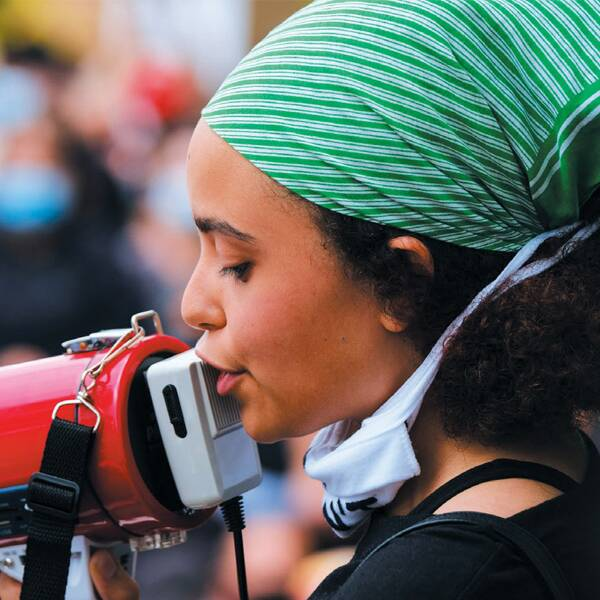
It’s only been a week since the protest and march, which this young woman spearheaded, took place here in Simi Valley. Anyone who’s interested should watch the six minute video in this article, where she explains how the march came about, as well as how City Councilperson and Mayor Pro Tem, Mike Judge, tried to dissuade Mikiiya from doing anything and publicly exposed her to danger. Simi is mos def changing.

Mikiiya Foster During Simi’s BLM Protest/March

Given the reputation Simi Valley has (which is only partly deserved) I’m of the opinion this march marked a watershed moment in the history of our little burgh. Simi Valley is one of the more politically conservative areas in California. It is the home of the Ronald Reagan Presidential Library and Geegaw Emporium, as well as the venue where the police who beat Rodney King were acquitted, sparking some of Los Angeles’s worst riots.

I know many of us have been working to bring about change here in Simi, and it’s been a bit of a slog. There are some really reactionary folk here, and they’re not shy about demonstrating their anger and hatred.

PS – A GoFundMe campaign has been initiated to help Mikiiya get through college. Here’s the link, if you’d care to donate. Any amount would be appreciated, I’m sure. I just donated.


Simi Protests

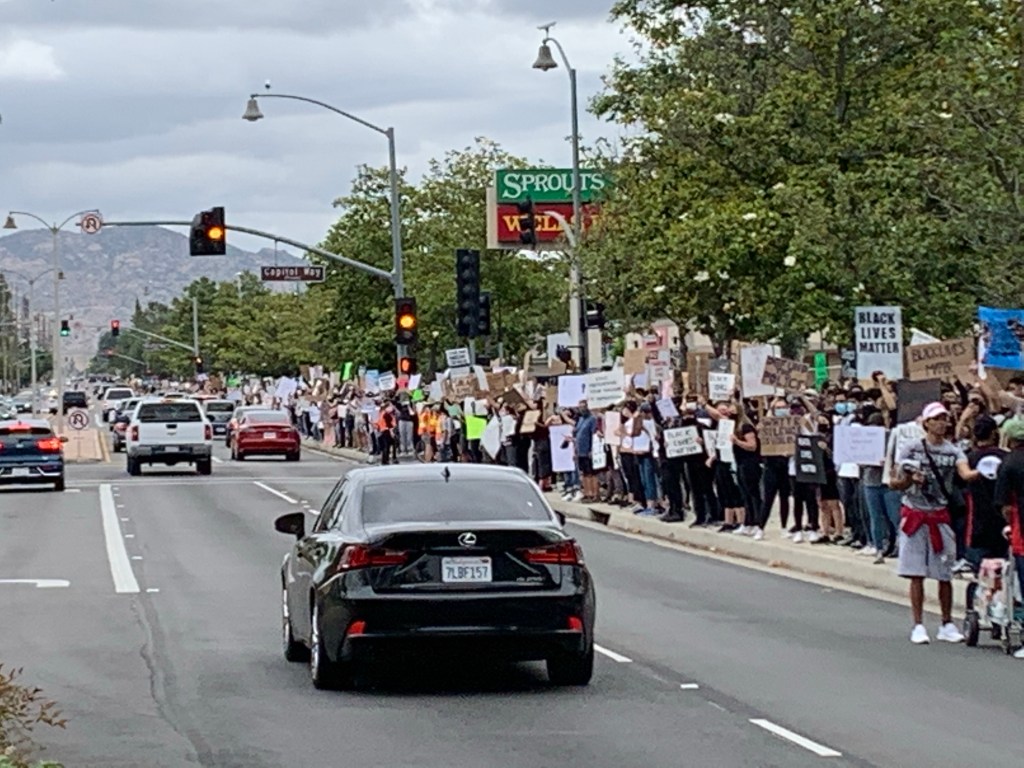
As many of my friends know, I live in Simi Valley, California. Simi is known, perhaps internationally, for two main things: The Ronald Reagan Presidential Library and the Rodney King trial. Although only one of the jurors in that trial was actually from Simi, the city has the reputation of being filled with racists, and it’s not without some basis in fact.

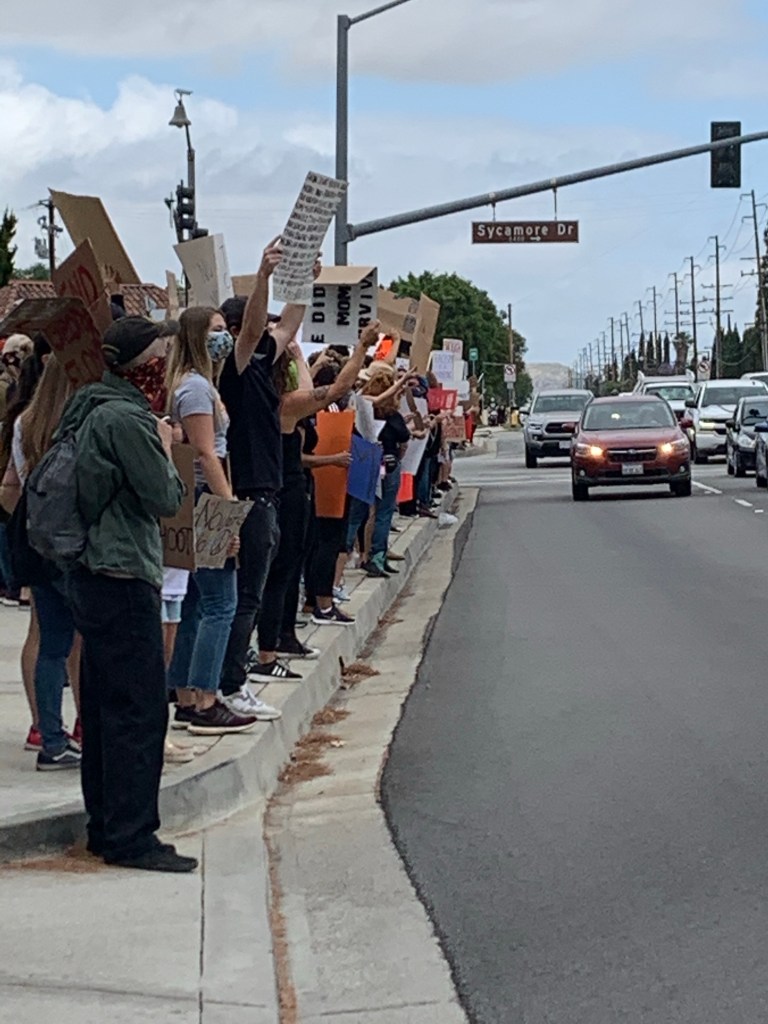
Nevertheless, it’s a beautiful part of the world, just northwest of the San Fernando Valley and I’ve lived here for about 25 years. When I heard that a protest was being planned to support BLM and protest racism and, specifically, the murder of George Floyd, I knew I had to be there (at least for the beginning) to lend my support. I expected 40 – 50 people. Imagine my surprise when I arrived a few minutes early to find hundreds, growing to between one and two thousand by the time the actual march started. Here’s a piece from ABC Eyewitness News’s coverage of the protest.

The young woman highlighted in the article, and her friends who helped with and supported this amazing event, did an exceptional job organizing and conducting what could have been a debacle. Going back to that element of racism here in Simi, there was a contingent of residents convinced this march would end in violence and looting; so convinced they were patrolling the streets around their neighborhoods and posting in local FB community groups that they were “locked and loaded.” It was borderline comical, made tragically unfunny by the ignorant sincerity of these mental midgets. They even tried to disrupt the march with bullhorn wielding propagandists fresh from the (here’s an oxymoron) “Republican Values Center.”

The kids are continuing to organize and, happily, I’m going along for the ride. Were it up to me, I would ask they not go back to school until the election is over in November. We’re going to need a GOTV effort like we’ve never seen before. I don’t have the energy or stamina I once had but, for the first time in my sour, long life I feel assured the torch has not only been passed, but it’s been picked up . . . by millions, it would appear.


Trevor Noah on George Floyd

Thought I would share a couple of videos from Trevor Noah, host of The Daily Show (currently called “The Daily Social Distancing Show.”)

Trevor on How Things are Connected
Trevor on Looting and What Really Matters