Category Archives: The Law

The Right to Stand Up

Thirty-three days from now, Americans will vote in the 2026 midterm elections.

There is an idea I keep returning to as that day approaches: there is an enormous difference between having a right and exercising it.

We are seeing a particularly painful example of that distinction in the case now unfolding at Cornell University.

A woman identified publicly as Jane Doe has filed a civil lawsuit alleging that she was drugged and sexually assaulted by several men at a Cornell fraternity house. Her allegations remain allegations, and the courts will ultimately determine the legal consequences. But there is something important in the act of standing up and saying:

You must hear me.

That is not an easy thing for a survivor of sexual assault to do. Women who report sexual violence have historically faced disbelief, humiliation, retaliation, scrutiny of their own behavior and, sometimes, institutions more concerned with protecting themselves than with hearing the person making the accusation.

I do not suggest that voting is comparable to the experience of reporting a sexual assault. The trauma, personal cost and courage involved are profoundly different.

But there is a principle connecting them:

Rights have little practical meaning when the people who possess them cannot—or do not—exercise them.

A woman may possess the legal right to report an assault, seek an investigation and bring a lawsuit. But if fear, intimidation or institutional resistance keeps her silent, the existence of those rights on paper may accomplish very little.

The same principle, in a very different context, applies to representative democracy.

Americans regularly say that our government derives its authority from “the people.” We call ourselves a representative democracy. We speak reverently about the right to vote.

But there is an unavoidable requirement contained within the idea of representative government:

The people must participate if they expect to be represented.

And voting is especially consequential in a midterm election because Americans are choosing the members of the branch of government that the Constitution deliberately placed alongside the presidency—not beneath it.

Congress is not an advisory committee to the president.

It is a separate and coequal branch of government.

The Constitution divides governmental authority precisely because its authors did not want too much power concentrated in one place. Congress writes laws. It controls appropriations. It conducts investigations. The Senate considers presidential appointments and treaties. Congress can override a presidential veto when the Constitution’s required supermajorities are reached. These are not procedural decorations. They are part of the machinery designed to keep one branch from dominating the others. [1]

That is why congressional elections matter regardless of who occupies the White House.

The question for voters is not simply whether they approve or disapprove of a president.

It is whether they want a Congress capable of performing the constitutional job assigned to it.

Will its members ask difficult questions?

Will they investigate executive actions when investigation is warranted?

Will they exercise independent judgment?

Will they protect Congress’s institutional authority when it conflicts with the desires of a president—including a president of their own party?

Will they remember that their oath is to the Constitution rather than to an individual?

Those questions transcend party.

A Congress that automatically opposes everything a president does is not necessarily fulfilling its constitutional function any better than a Congress that automatically approves everything a president does.

The point of checks and balances is not perpetual warfare between branches.

It is independence.

It is the expectation that legislators will legislate, executives will execute, courts will adjudicate and none will simply surrender its constitutional responsibilities to another.

That system has one indispensable participant who does not occupy an office in Washington.

Us.

The voters.

Throughout American history, enormous effort has been expended determining who gets to be included in that word.

Women fought for generations before the Constitution prohibited denial of the vote on account of sex. Black Americans confronted poll taxes, literacy tests, intimidation, violence and elaborate legal mechanisms devised to prevent them from exercising political power.

Those struggles tell us something important about voting.

People do not work that hard to prevent others from exercising a power that is meaningless.

And yet a democracy faces another danger for which no constitutional amendment can provide a complete remedy:

Citizens can surrender their own power simply by deciding not to use it.

No poll tax is necessary.

No literacy test is required.

No one has to stand in the doorway.

We can disenfranchise ourselves through indifference.

That is what makes the coming election about something larger than the names printed on a ballot.

It is about whether representative government will actually be representative.

It is about whether Congress will reflect the judgment of the electorate or merely the judgment of the portion of the electorate that bothered to participate.

And it is about whether Americans still understand that the constitutional balance of power ultimately depends upon people who are willing to defend it.

The president has enormous power.

Congress has enormous power.

Neither was intended to have unlimited power.

The Constitution does not maintain that balance automatically. Institutions are operated by human beings, and human beings surrender authority as readily as they exercise it. A constitutional power that lawmakers refuse to use can become almost as ineffective as a constitutional power that never existed.

That brings me back to the woman at Cornell.

Her story is not an election metaphor. Sexual assault should never be reduced to one.

But the decision to stand up when remaining silent would be easier illustrates something fundamental about human agency.

At some point, possessing a voice requires deciding whether to use it.

The courtroom and the voting booth are profoundly different places. The burdens imposed upon the people entering them are profoundly different as well.

But both rest upon an elemental assertion:

I have a voice.

I have standing.

What happens to me matters.

And I will not simply leave the decisions to everyone else.

On November 3, Americans will once again possess that choice.

We will disagree about candidates. We will disagree about parties. We will disagree about policies and about the direction of the country.

That disagreement is not the failure of democracy.

It is democracy.

The failure comes when we decide that democracy is somebody else’s responsibility.

The Constitution gave us institutions capable of checking one another, but it did not give those institutions a mind of their own. We choose the people who occupy them.

So the responsibility belongs to us.

Not merely to complain.

Not merely to post.

Not merely to watch events unfold and wonder how government acquired so much power over our lives.

But to participate.

To examine the people asking for our votes.

To ask whether they understand the independence of the office they seek.

To ask whether they will defend the constitutional authority entrusted to that office.

And then—to vote.

Vote because representative government cannot represent people who remove themselves from the process.

Vote because constitutional checks and balances depend upon the people we put in the institutions that exercise them.

Vote because political power that citizens decline to exercise does not disappear. Someone else exercises it.

And vote because generations of Americans fought, organized, marched, litigated, suffered and sometimes died over the proposition that ordinary citizens should have a voice in deciding who governs them.

We inherited that voice.

What we do with it is our responsibility.

Thirty-three days from now, the voting booth will ask each of us a remarkably simple question:

You have a voice. Will you use it?

[1] U.S. Senate, “Checks and Balances.” https://www.senate.gov/artandhistory/senate-stories/checks-and-balances.htm
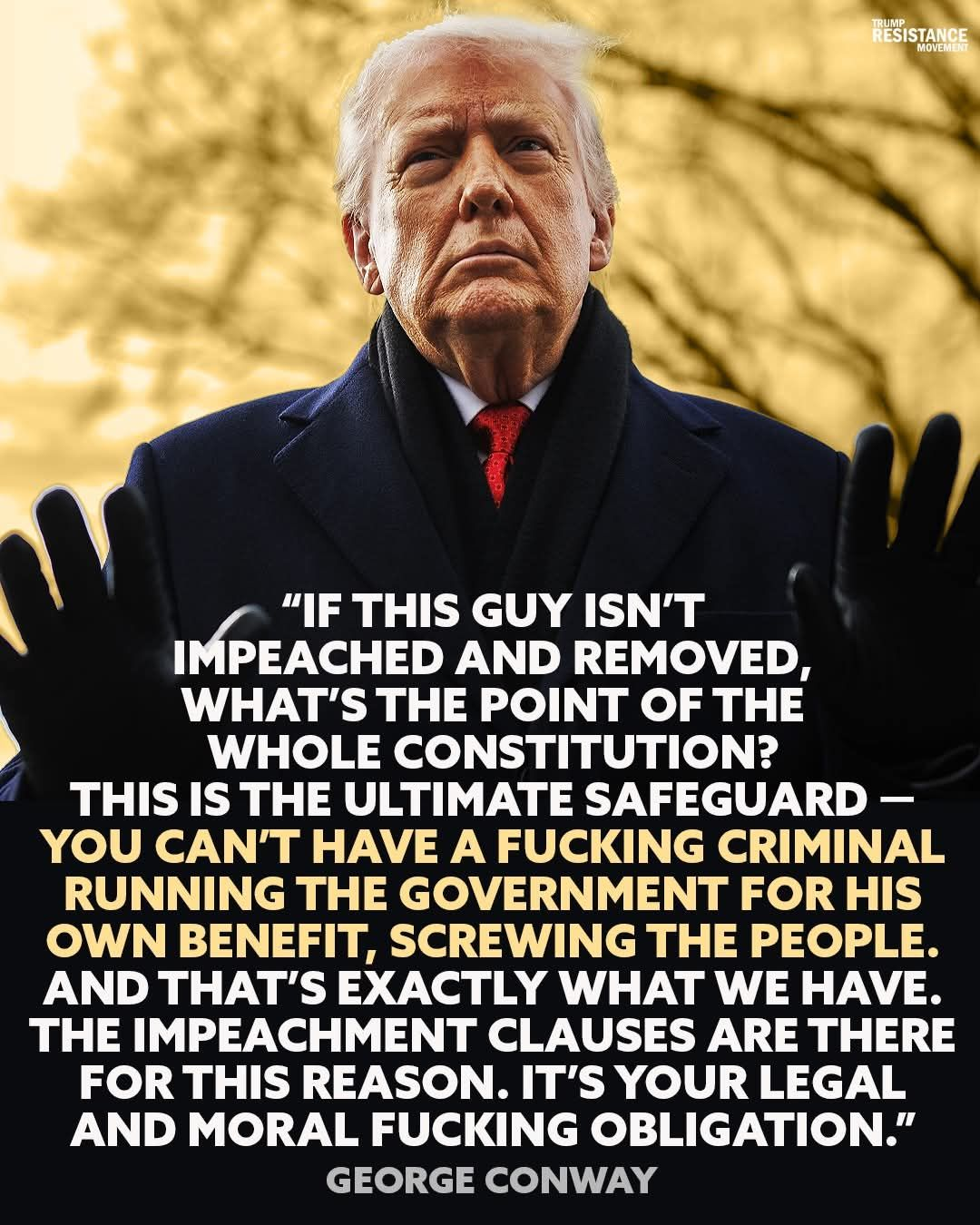

He’s a Murderer

At what point do we have the right to self-defense? This man’s bigotry, misogyny, and hate for “the other”, as well as his ignorance of science, has already caused (either directly or indirectly) the deaths of millions. We can’t afford another day, let alone 3 years, of this idiot’s “leadership”.


Never, Ever, Ever!

I have NOT forgotten about the Epstein files.

I will NEVER forget about the Epstein files.

I will also NEVER forget that Trump is a pedophile and a rapist of children.


Just a Thought

Do you really think we can deal with this insane, delusional administration non-violently? I’m not convinced.


The Quiet Face of Tyranny: How Emil Bove Threatens the Rule of Law

There are monsters among us. They don’t crawl from caves or erupt in public tantrums. No, the most dangerous among them walk calmly through courtrooms and government buildings, armed not with violence but with credentials and legalese. Emil Bove is one such figure—a reminder that authoritarianism often arrives not with a bang, but with a briefcase.

Bove, a former federal prosecutor and now a prominent defender of Donald Trump, argued before the Supreme Court in Trump v. United States that a president could order the assassination of a political rival and be immune from prosecution unless Congress had first impeached and convicted him. Let that sink in. According to Bove, unless Congress acts, a president could unleash the machinery of the state to eliminate his enemies, and the courts would be powerless to intervene.

It is hard to imagine a more grotesque betrayal of the American principle that no one is above the law. Yet Bove didn’t stop there.

In a separate legal context, Bove shockingly instructed that individuals could ignore a federal court order—specifically, a ruling that prohibited the government from rendering hundreds of asylum-seeking men to a prison camp in El Salvador. These were men fleeing violence and persecution, invoking the protections of due process guaranteed under U.S. and international law. But Bove’s message was clear: the courts can be disregarded when inconvenient.

This isn’t legal strategy. This is lawlessness dressed in Armani.

Imagine the consequences if this logic took hold. The courts—our last institutional line of defense against executive overreach—would become ornamental. Their rulings optional. The law itself would be subject to political whim and brute force. And the vulnerable, the voiceless, the targets of state-sanctioned abuse? They would have no recourse. No rights. No hope.

Bove’s contempt for the rule of law reveals the true danger: a legal elite willing to hollow out democracy from the inside, all while claiming to defend it. This is not merely a technical debate among lawyers. This is about whether the United States will remain a constitutional republic, or whether we will slip—quietly, insidiously—into autocracy under the guise of “executive immunity” and “national security.”

In any other era, a lawyer who advised ignoring a court order would be disciplined, sanctioned, maybe disbarred. But in the post-Trump era, such defiance is applauded in certain circles. Bove’s arguments aren’t fringe anymore—they are being mainstreamed in front of the highest court in the land. And the justices, disturbingly, entertained them with far less outrage than the moment demands.

History shows us where this road leads. In Nazi Germany, apartheid South Africa, Jim Crow America—the law was contorted to protect the powerful and persecute the powerless. It always begins with legal justifications for unconscionable acts. Always. Men like Emil Bove provide those justifications. They sanitize the machinery of repression. They make it sound reasonable, even principled.

And they count on us not to notice.

But we must notice. We must resist the temptation to normalize the radical, to accept the obscene as simply another legal argument. We must remember that beneath the surface of constitutional language, Bove is advocating for tyranny: a presidency unbound by law, and a government that ignores the judiciary when it suits its purposes.

There is a reason why we revere the principle of “Equal Justice Under Law.” It is the safeguard of civilization. Without it, we are left with power unchecked, and cruelty unchallenged.

To look at Bove is to see not a villain in the Hollywood sense, but something far more dangerous—a man who knows exactly how the system works and is willing to dismantle it piece by piece. Calmly. Methodically. Legally.

That is why we must be ever-vigilant.

Because when monsters wear suits, when they speak in measured tones and cite precedent as they strip away our liberties, the danger is greater—not lesser. They know how to mask authoritarianism as patriotism, cruelty as strength, and impunity as “executive authority.”

We cannot be passive. We must name the danger. Confront it. Reject it in the courts, in the media, in the halls of Congress, and in the court of public opinion. Emil Bove may be just one man, but he represents a movement of cold, calculated disregard for democratic norms.

It is up to us to remember: when a lawyer tells you the president can murder without consequence, or that you may ignore the courts, they are not defending the Constitution. They are laying dynamite at its foundation.

And if we don’t stop them, history will not be kind to those who looked away.


Due Process? Don’t Make Me Laugh.

There’s a reason we supposedly revere the Constitution in this country—at least, that’s what every flag-waving “patriot” keeps screaming about at school board meetings and on Twitter (sorry, “X”). But I’d like to know: When was the last time any of these self-anointed constitutional scholars actually read the damn thing? Or, for that matter, when was the last time anyone in the Trump administration—especially over at the DOJ—acted like the rule of law applied to them?

Let’s talk about due process—that bedrock idea that the government can’t just do whatever it wants to whomever it wants, whenever it wants. We’ve got the Fifth and Fourteenth Amendments, both pretty clear on the whole “life, liberty, or property” thing not being taken away without, you know, a fair shake. But apparently, “due process” is now just a quaint little phrase, like “all men are created equal” or “no taxation without representation”—nice for speeches, but utterly disposable when it gets in the way of locking up immigrants or crushing dissent.

The Trump Playbook: Due Process, Schmue Process

Remember the family separations at the border? Remember “zero tolerance”? Turns out, due process is just another speed bump for the machinery of cruelty. We watched as people, most of whom don’t speak English and know nothing of our legal system, were herded through sham hearings—sometimes via video conference, sometimes with no lawyer at all. Some never saw a judge. Kids, for crying out loud, defending themselves in court. This is what passes for justice in MAGA-land.

And let’s not forget the DOJ, which, under Trump, became less “Department of Justice” and more “Department of Just Us (If You’re White and Rich).” Look at how they handled peaceful protests—send in the troops, gas the crowds, call anyone with a sign an “antifa terrorist” and pretend the First Amendment is just an optional suggestion. The chilling effect on dissent? That’s not “law and order.” That’s authoritarianism with a Fox News chyron.

Ignorance by Design

It’s not just ignorance; it’s willful, performative ignorance. The Trump crowd knows exactly what they’re doing. They count on people not knowing or caring about “due process” until it’s their own ass in the crosshairs. The cruelty is the point. It’s a feature, not a bug.

And let’s be real: this didn’t start with Trump. But under his administration, the gloves came off and the mask slipped. Suddenly, it was okay to say the quiet part out loud: “We don’t want these people here. We don’t want these people protesting. We don’t want these people voting.” Due process? Only if you’re the right kind of person, with the right kind of bank account, skin tone, or political loyalty.

Why It Matters (And Why We Can’t Give Up)

Look, I’m a 77-year-old white guy who’s been lucky enough to scrape by in this system. But the rule of law isn’t just some abstract principle to hang on a classroom wall. It’s the only thing standing between us and the abyss. When we let due process slide—whether for immigrants, protesters, or anyone else—we’re all in danger.

History has a funny way of repeating itself. I’ve seen what happens when people obey in advance, shrug their shoulders, and say, “Not my problem.” That’s how you lose a democracy—one ignored constitutional right at a time. If you think they won’t come for you, eventually, you’re not paying attention.

We need to demand better—from our courts, from our government, from each other. And we need to remember: due process is not a privilege. It’s a right, for everyone. If we let them take it away from the most vulnerable, it’s only a matter of time before it’s gone for all of us.

So, to the DOJ, to the administration, and to every would-be strongman with a flag pin and a Twitter account: Read the damn Constitution. And maybe, just once, try following it.


Fitting

Did you know Donald John Trump is an impressionist? Here he is, captured by a courtroom artist, doing his impression of Sleepy Joe.


Way To Go, Colorady

Colorado license plate spelling out NO-DKT8TR
Colorado Supreme Court makes the right decision, IMLTHO.

SCOTUS would be crazy not to rule in favor of Smith.

I see the speed with which the Supreme Court has accepted Jack Smith’s request for a hearing on the issue of Presidential Immunity in the January 6 prosecution of Trump as a golden opportunity to cement their “supremacy”, and create a modicum of good will at the same time. It’s kind of a Marbury v. Madison moment for not only the court, but for the entire judicial system.

Maybe they’ll cave, but I think the odds of their taking the opportunity to make a major consequential decision that will inure to the benefit of the judicial system (and the nation) are high.

After I posted the foregoing to Threads, a friend offered his opinion that Clarence Thomas would side with Trump, adding “for starters”. I responded as follows:

Actually, no, I don’t. I suspect he might. There’s lots of evidence to suggest he would do that, but there are long-term, historical reasons why this is a deeply historical opportunity for the court to strengthen the ruling of Marbury v. Madison. If you’re not familiar with the ruling, Britannica explains:

“Marbury v. Madison is important because it established the power of judicial review for the U.S. Supreme Court and lower federal courts with respect to the Constitution and eventually for parallel state courts with respect to state constitutions.“

I may be wrong – perhaps crazy – but what remaining legal spidey sense I have (it’s been over 47 years since I graduated law school) tells me this is a once-in-a-lifetime opportunity to further cement the court’s power to be the final say in matters of constitutionality.

It doesn’t have to be unanimous, though I believe there are powerful and important reasons for the court to rule en banc.

If they pass up this opportunity to strengthen the position (and power) of the court to rule on the constitutionality of both legislative and executive acts, as well as make a decision that seems – prima facie – in line with our country’s stated objectives for existing, I would be surprised. Not necessarily shocked, as they are dominated by RWNJs. However, I think they could write a decision that could conceivably be as momentous as that of Marbury v. Madison. Furthermore, from a political perspective, I think such a decision would serve to blunt some of the criticism certain members of the court have been receiving, though it should in no way negate the egregious performances of those who have accepted bribes from wealthy patrons. That should NEVER go away!


Fani Flames Gym

Just finished reading Fani Willis’s response to Jim Jordan’s ill-conceived attempt to bully her into backing off of her RICO J6 investigation/prosecution. She flames him at least a half dozen times while refuting every position he asserted in his previous demand letter sent to her on August 24.

While it was an eminently enjoyable read given the disgust I feel, and the disdain I have, for the congressman, Fani’s (or her staff’s) approach is readable and succinct. If you ignore the numerous citations—which I would only research if I was intent on answering her letter, which I’m not—the points made are clear, concise, and to-the-point. That she occasionally takes him to the woodshed is a lagniappe.

Don’t take my word for it, read it yourself. Feel free to download it. I’m also including the original letter sent by Jordan to DA Willis for your reading pleasure (see below).