Tag Archives: Constitution

The Right to Stand Up

Thirty-three days from now, Americans will vote in the 2026 midterm elections.

There is an idea I keep returning to as that day approaches: there is an enormous difference between having a right and exercising it.

We are seeing a particularly painful example of that distinction in the case now unfolding at Cornell University.

A woman identified publicly as Jane Doe has filed a civil lawsuit alleging that she was drugged and sexually assaulted by several men at a Cornell fraternity house. Her allegations remain allegations, and the courts will ultimately determine the legal consequences. But there is something important in the act of standing up and saying:

You must hear me.

That is not an easy thing for a survivor of sexual assault to do. Women who report sexual violence have historically faced disbelief, humiliation, retaliation, scrutiny of their own behavior and, sometimes, institutions more concerned with protecting themselves than with hearing the person making the accusation.

I do not suggest that voting is comparable to the experience of reporting a sexual assault. The trauma, personal cost and courage involved are profoundly different.

But there is a principle connecting them:

Rights have little practical meaning when the people who possess them cannot—or do not—exercise them.

A woman may possess the legal right to report an assault, seek an investigation and bring a lawsuit. But if fear, intimidation or institutional resistance keeps her silent, the existence of those rights on paper may accomplish very little.

The same principle, in a very different context, applies to representative democracy.

Americans regularly say that our government derives its authority from “the people.” We call ourselves a representative democracy. We speak reverently about the right to vote.

But there is an unavoidable requirement contained within the idea of representative government:

The people must participate if they expect to be represented.

And voting is especially consequential in a midterm election because Americans are choosing the members of the branch of government that the Constitution deliberately placed alongside the presidency—not beneath it.

Congress is not an advisory committee to the president.

It is a separate and coequal branch of government.

The Constitution divides governmental authority precisely because its authors did not want too much power concentrated in one place. Congress writes laws. It controls appropriations. It conducts investigations. The Senate considers presidential appointments and treaties. Congress can override a presidential veto when the Constitution’s required supermajorities are reached. These are not procedural decorations. They are part of the machinery designed to keep one branch from dominating the others. [1]

That is why congressional elections matter regardless of who occupies the White House.

The question for voters is not simply whether they approve or disapprove of a president.

It is whether they want a Congress capable of performing the constitutional job assigned to it.

Will its members ask difficult questions?

Will they investigate executive actions when investigation is warranted?

Will they exercise independent judgment?

Will they protect Congress’s institutional authority when it conflicts with the desires of a president—including a president of their own party?

Will they remember that their oath is to the Constitution rather than to an individual?

Those questions transcend party.

A Congress that automatically opposes everything a president does is not necessarily fulfilling its constitutional function any better than a Congress that automatically approves everything a president does.

The point of checks and balances is not perpetual warfare between branches.

It is independence.

It is the expectation that legislators will legislate, executives will execute, courts will adjudicate and none will simply surrender its constitutional responsibilities to another.

That system has one indispensable participant who does not occupy an office in Washington.

Us.

The voters.

Throughout American history, enormous effort has been expended determining who gets to be included in that word.

Women fought for generations before the Constitution prohibited denial of the vote on account of sex. Black Americans confronted poll taxes, literacy tests, intimidation, violence and elaborate legal mechanisms devised to prevent them from exercising political power.

Those struggles tell us something important about voting.

People do not work that hard to prevent others from exercising a power that is meaningless.

And yet a democracy faces another danger for which no constitutional amendment can provide a complete remedy:

Citizens can surrender their own power simply by deciding not to use it.

No poll tax is necessary.

No literacy test is required.

No one has to stand in the doorway.

We can disenfranchise ourselves through indifference.

That is what makes the coming election about something larger than the names printed on a ballot.

It is about whether representative government will actually be representative.

It is about whether Congress will reflect the judgment of the electorate or merely the judgment of the portion of the electorate that bothered to participate.

And it is about whether Americans still understand that the constitutional balance of power ultimately depends upon people who are willing to defend it.

The president has enormous power.

Congress has enormous power.

Neither was intended to have unlimited power.

The Constitution does not maintain that balance automatically. Institutions are operated by human beings, and human beings surrender authority as readily as they exercise it. A constitutional power that lawmakers refuse to use can become almost as ineffective as a constitutional power that never existed.

That brings me back to the woman at Cornell.

Her story is not an election metaphor. Sexual assault should never be reduced to one.

But the decision to stand up when remaining silent would be easier illustrates something fundamental about human agency.

At some point, possessing a voice requires deciding whether to use it.

The courtroom and the voting booth are profoundly different places. The burdens imposed upon the people entering them are profoundly different as well.

But both rest upon an elemental assertion:

I have a voice.

I have standing.

What happens to me matters.

And I will not simply leave the decisions to everyone else.

On November 3, Americans will once again possess that choice.

We will disagree about candidates. We will disagree about parties. We will disagree about policies and about the direction of the country.

That disagreement is not the failure of democracy.

It is democracy.

The failure comes when we decide that democracy is somebody else’s responsibility.

The Constitution gave us institutions capable of checking one another, but it did not give those institutions a mind of their own. We choose the people who occupy them.

So the responsibility belongs to us.

Not merely to complain.

Not merely to post.

Not merely to watch events unfold and wonder how government acquired so much power over our lives.

But to participate.

To examine the people asking for our votes.

To ask whether they understand the independence of the office they seek.

To ask whether they will defend the constitutional authority entrusted to that office.

And then—to vote.

Vote because representative government cannot represent people who remove themselves from the process.

Vote because constitutional checks and balances depend upon the people we put in the institutions that exercise them.

Vote because political power that citizens decline to exercise does not disappear. Someone else exercises it.

And vote because generations of Americans fought, organized, marched, litigated, suffered and sometimes died over the proposition that ordinary citizens should have a voice in deciding who governs them.

We inherited that voice.

What we do with it is our responsibility.

Thirty-three days from now, the voting booth will ask each of us a remarkably simple question:

You have a voice. Will you use it?

[1] U.S. Senate, “Checks and Balances.” https://www.senate.gov/artandhistory/senate-stories/checks-and-balances.htm

Due Process? Don’t Make Me Laugh.

There’s a reason we supposedly revere the Constitution in this country—at least, that’s what every flag-waving “patriot” keeps screaming about at school board meetings and on Twitter (sorry, “X”). But I’d like to know: When was the last time any of these self-anointed constitutional scholars actually read the damn thing? Or, for that matter, when was the last time anyone in the Trump administration—especially over at the DOJ—acted like the rule of law applied to them?

Let’s talk about due process—that bedrock idea that the government can’t just do whatever it wants to whomever it wants, whenever it wants. We’ve got the Fifth and Fourteenth Amendments, both pretty clear on the whole “life, liberty, or property” thing not being taken away without, you know, a fair shake. But apparently, “due process” is now just a quaint little phrase, like “all men are created equal” or “no taxation without representation”—nice for speeches, but utterly disposable when it gets in the way of locking up immigrants or crushing dissent.

The Trump Playbook: Due Process, Schmue Process

Remember the family separations at the border? Remember “zero tolerance”? Turns out, due process is just another speed bump for the machinery of cruelty. We watched as people, most of whom don’t speak English and know nothing of our legal system, were herded through sham hearings—sometimes via video conference, sometimes with no lawyer at all. Some never saw a judge. Kids, for crying out loud, defending themselves in court. This is what passes for justice in MAGA-land.

And let’s not forget the DOJ, which, under Trump, became less “Department of Justice” and more “Department of Just Us (If You’re White and Rich).” Look at how they handled peaceful protests—send in the troops, gas the crowds, call anyone with a sign an “antifa terrorist” and pretend the First Amendment is just an optional suggestion. The chilling effect on dissent? That’s not “law and order.” That’s authoritarianism with a Fox News chyron.

Ignorance by Design

It’s not just ignorance; it’s willful, performative ignorance. The Trump crowd knows exactly what they’re doing. They count on people not knowing or caring about “due process” until it’s their own ass in the crosshairs. The cruelty is the point. It’s a feature, not a bug.

And let’s be real: this didn’t start with Trump. But under his administration, the gloves came off and the mask slipped. Suddenly, it was okay to say the quiet part out loud: “We don’t want these people here. We don’t want these people protesting. We don’t want these people voting.” Due process? Only if you’re the right kind of person, with the right kind of bank account, skin tone, or political loyalty.

Why It Matters (And Why We Can’t Give Up)

Look, I’m a 77-year-old white guy who’s been lucky enough to scrape by in this system. But the rule of law isn’t just some abstract principle to hang on a classroom wall. It’s the only thing standing between us and the abyss. When we let due process slide—whether for immigrants, protesters, or anyone else—we’re all in danger.

History has a funny way of repeating itself. I’ve seen what happens when people obey in advance, shrug their shoulders, and say, “Not my problem.” That’s how you lose a democracy—one ignored constitutional right at a time. If you think they won’t come for you, eventually, you’re not paying attention.

We need to demand better—from our courts, from our government, from each other. And we need to remember: due process is not a privilege. It’s a right, for everyone. If we let them take it away from the most vulnerable, it’s only a matter of time before it’s gone for all of us.

So, to the DOJ, to the administration, and to every would-be strongman with a flag pin and a Twitter account: Read the damn Constitution. And maybe, just once, try following it.


Use Every Tool Available!

I am 75 years old. I have been voting since June 4, 1968, my 21st birthday and the day of the California Democratic primary. My introduction to voting was to have the person I voted for assassinated the night I voted for him. I have never missed voting in an election, including any special elections.

I have been a socialist since my first vote so, in reality, I’ve never been able to conscientiously vote for someone who represented my actual views or for the system I would like to see implemented. Sure, there were socialists running for office but, lets’ face it, this is a two-party political system and I’ve never wanted to waste my vote.

My point isn’t to argue the validity of voting for the lesser of two evils or the value of the protest vote. I had my reasons, but I’ve always voted – always, and if you don’t get off your ass and vote I don’t know what to say other than I have no use for you. Not voting is akin to voting for the worst possible choice, IMO, especially when those who support the worst possible choice vote en masse every. damn. time.

Vote, goddam it! Just vote.


Buh Bye, Y’all.

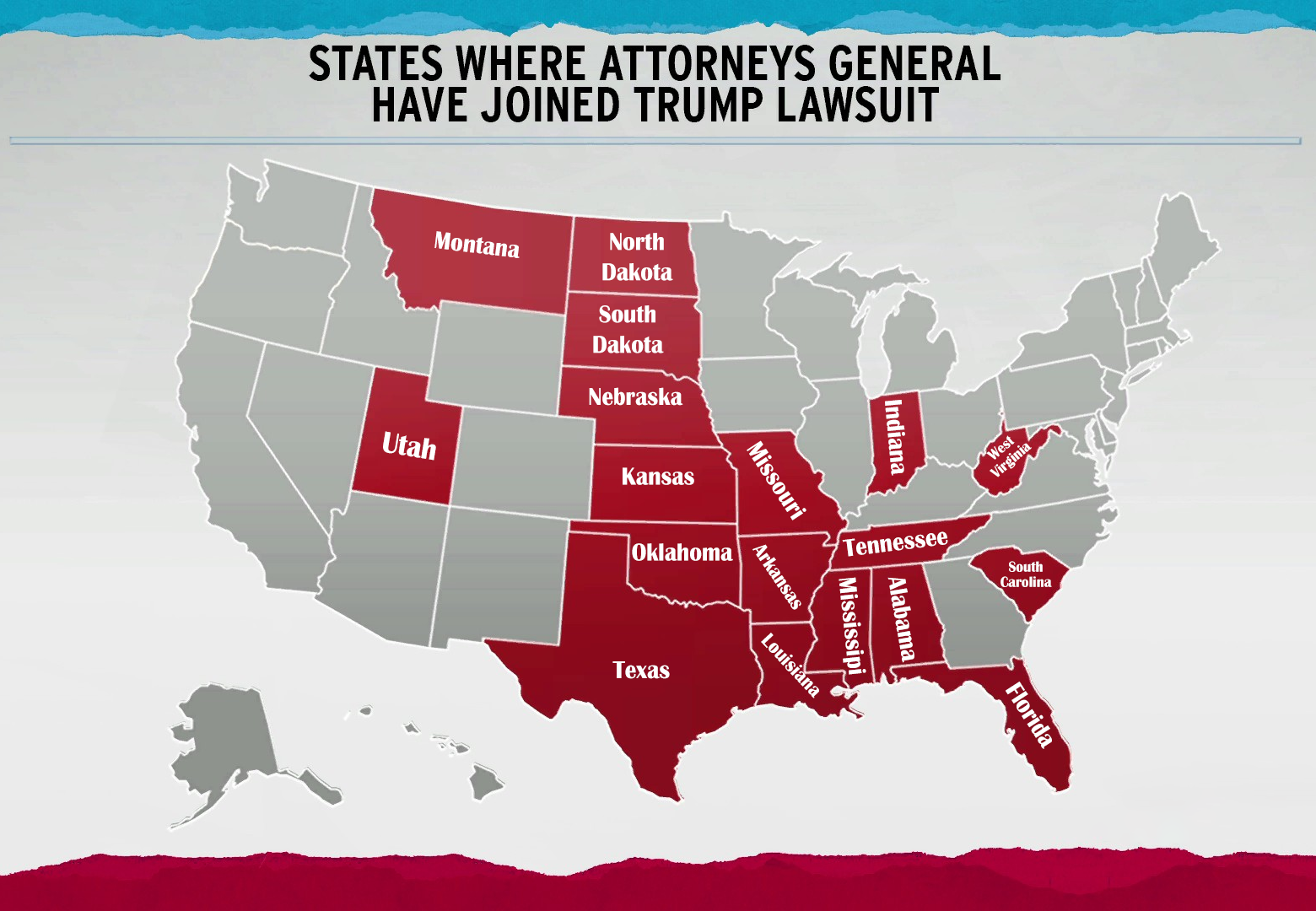
Seventeen states have joined the State of Texas to petition the United States Supreme Court to delay the certification of the results in Pennsylvania, Wisconsin, Michigan, and Georgia, arguing that alleged issues with the votes need to be investigated. While alleging fraud, the lawsuit offers no evidence that fraud has occurred. Instead, they argue that new methods of voting (all of which were approved by State Legislatures) could have resulted in fraud arguing, “The constitutional issue is not whether voters committed fraud but whether state officials violated the law by systematically loosening the measures for ballot integrity so that fraud becomes undetectable.”

What’s disturbing about this lawsuit’s theory of the case is that mail-in voting has been in use for decades, and these alleged “vulnerable” methods of voting have only been expanded in use, not changed in how they’re implemented and exercised.

This is really the height of frivolity and, in my opinion, every one of these Attorneys General should be investigated by their state bar. This is a naked attempt to disenfranchise millions of voters, most of whom are persons of color, aka Democrats. The four states they’re targeting are Michigan, Wisconsin, Pennsylvania, and Georgia. Many have pointed out, and I will as well, they aren’t alleging the same issues in states where Trump won, even though the situation in those states is similar to that of the four targeted states.

I’m not sure if the decision is expected today, though the Electoral College convenes on Monday to officially cast their votes and that will further cement the Biden/Harris victory. I believe the Court will want to render their decision prior to that happening. We’ll see. I’ve been consumed by fixing a health insurance problem I have for my kids, and a bunch of recipes I have to help my 17-year-old shop for and cook/bake, so haven’t been paying attention quite as closely as I normally would. I do expect it will be thrown out. What we don’t know is whether or not the justices will take the opportunity to teach these idiots a lesson in constitutional law. That would be a hoot.


A Little Lawyer Talk

Most people likely have no idea who John Flannery is, even though he’s a fairly well-known, former Federal Prosecutor. I know him from his frequent appearances on The Beat With Ari Melber. Ari is fond of pointing out that John is a bit of a doppelganger for Robert Redford. If you’re interested, here’s his biography at the firm of Campbell Flannery, where he is a senior partner.

John likes to take walks in the morning and record his thoughts about current events, with his primary focus on politics and the law. This is a short video where he discusses Trump’s attempt to hold on to power, as well as the progress of the pandemic we’re suffering from. I think John’s insights are invaluable and quite interesting. Three minutes and fifty-nine seconds of usefulness. Take a listen.


Originalism is Bullshit!

The Founders … Founding.

Amy Coney Barrett considers herself a “Constitutional Originalist.” What, exactly, does that mean? According to Merriam-Webster, it is “a legal philosophy that the words in documents and especially the U.S. Constitution should be interpreted as they were understood at the time they were written.” (https://www.merriam-webster.com/dictionary/originalism)

Think about what that means. If we are to interpret the Constitution based on the realities of the day in the late 18th century, then shouldn’t the only people allowed to vote in national elections be white, property-owning men? What do we make of the 3/5 clause of Article I, Section 2 of the Constitution and how do we reconcile the 14th Amendment (passed in 1868) with the “original” intent of said Article?

In my less than humble opinion, this concept of originalism is as flawed as belief in the Bible being the infallible word of God. Both require one NOT believe in evolution; I don’t here mean biological evolution (which many Bible believers don’t recognize as real) but the natural evolution of society and its economic, political, and general attitudes toward what’s good and just for a people. Our laws, our habits, our customs, our culture, even our morals change over time; sometimes imperceptibly and others rapidly and definitively.

When the Constitution was written, the framers included (Article V) the ability to amend it and, in fact, the first ten amendments—the Bill of Rights—were needed to ensure adoption of the nascent Constitution by some of the States who wanted more guarantees of freedom from unnecessary restrictions on the States and individuals.

Inasmuch as there is a method by which the Constitution can and, in fact, has been amended how can a logical argument be sustained that it must be interpreted in light of the reality of nearly two hundred fifty years ago? This makes absolutely no sense. Two hundred fifty years ago virtually none of the structures, organizations, and technologies we currently enjoy existed. How do we interpret their use and ownership if they weren’t around when the document was written?

Originalism is a sham argument and should be completely ignored. Any jurist taking such a position is, IMLTHO, an intellectually dishonest poseur and should be ignored . . . if not ridiculed. This includes Amy Coney Barrett who, if she had any integrity at all, would not allow this raw power grab and farce of a nomination process to continue.


So Sue Me.

Got my Antifa membership card today.

Count Me In!

Be Safe! ¡Cuidate!

This weekend Trump is threatening mass deportations . . . again! It may not happen. However, if it does here’s some information you or someone you know may want to have available. One of the hallmarks of our nation is the concept of the rule of law, which means nobody is above the law; neither is anyone outside the law. Every “person” enjoys the rights afforded them by the Constitution of the United States. We’re all entitled to due process and the equal application of the law. Know your rights . . . and be thankful we have an organization like the ACLU that fights for them, incessantly. They’re one of five organizations I donate to monthly. Please consider sending them a few bucks to support their work. And please consider sharing this info with someone you know who might benefit from it. Thank you.


So Sorry. No Deathstar This Year

Deathstar

Alas! A Dream Not to be.

As many of you may or may not know, the White House has a system whereby anyone can ” . . . petition the Government for a redress of grievances.” Loosely translated, as it surely is, this means you can ask for just about anything your little ol’ pea-pickin’ heart desires even if what you really mean by “grievance” is “I wanna”. However, there’s a catch or, should I say, a couple of catches.

First of all, you need to create an account at Whitehouse.gov. This is so, regardless of the aluminum foil on your windows and the tin foil hat blocking those priceless brainwaves of yours, the government will be able to track you down and whisk you away in a black helicopter to an undisclosed and unknowable location where people like you can be dealt with appropriately.

OK, so I made that up . . . though it’s true if you’re a member of the Tea Party. Maybe it’s true. More likely, petitioning the government for a redress of grievances is serious business, shouldn’t be taken lightly, and there has to be a way to keep people from signing petitions more than once. This seems eminently reasonable, don’t you think? Never mind. It’s a rhetorical question.

Also, there are two thresholds that must be reached for a petition to be taken seriously. The first is that it must get 150 signatures within 30 days for it to be searchable on WhiteHouse.gov’s site. The second is that it must  reach 25,000 signatures within the next 30 days for it to receive a response, though the administration reserves the right to answer at a lower participation if it deems it appropriate.

Why am I telling you this? Well, actually not because I’m cajoling you to participate. Don’t get me  wrong, I think participatory democracy is important, maybe even essential, but my feeling is this is even more important. No . . . this is a rather long-winded way of sharing my favorite petition with you and, more importantly, the answer it received.

The administration asks that each petition complete the following phrase, “We believe the Obama administration should . . . “. Recently a petition completed that phrase as follows – “Secure resources and funding, and begin construction of a Death Star by 2016” – and received 34,435 signature, reaching the second critical threshold and requiring an answer. The answer was entitled “This Isn’t the Petition Response You’re Looking For” and begins:

The Administration shares your desire for job creation and a strong national defense, but a Death Star isn’t on the horizon. Here are a few reasons:

  • The construction of the Death Star has been estimated to cost more than $850,000,000,000,000,000. We’re working hard to reduce the deficit, not expand it.
  • The Administration does not support blowing up planets.
  • Why would we spend countless taxpayer dollars on a Death Star with a fundamental flaw that can be exploited by a one-man starship?

. . .

You can read the rest, which is well worth your time (especially if you’re a dweebed-out space cadet like I am), at the site. I think it’s a – you’ll pardon the expression – stellar response.