Tag Archives: politics

Racism Is Bigger Than Bigotry

In 1973, while preparing to travel to Cuba with the Venceremos Brigade, I underwent extensive political education on race, class, imperialism, and American society. Among the most memorable lessons came from members of the Black Panther Party. They distinguished personal prejudice and bigotry from something broader and more deeply rooted: racism as a system—something embedded in institutions, laws, customs, economic arrangements, and accepted ways of doing things.

That distinction has stayed with me for more than half a century because it explains something that our ordinary public vocabulary often conceals. Americans commonly use the word racist to describe an openly prejudiced person: someone who uses racial slurs, expresses hatred, refuses to associate with people of another race, or consciously believes one race is superior to another. Those behaviors are certainly manifestations of racism. But when racism is reduced to such behavior, the larger system disappears from view.

The lesson I heard in 1973 belonged to a broader Black Power analysis already articulated by Stokely Carmichael, later known as Kwame Ture, and political scientist Charles V. Hamilton. In their 1967 book Black Power, they distinguished “individual racism” from “institutional racism.” Individual racism, they wrote, is generally visible and attributable to particular people. Institutional racism is more subtle, arising through the operation of established and respected institutions. As they observed, people who would never personally bomb a church or attack a Black family could nevertheless support institutions and officials that perpetuated racial inequality.[1]

For purposes of clarity, I use prejudice to mean a preconceived judgment about a group; bigotry to mean a stubborn and often hostile attachment to such judgments; and discrimination to mean unequal treatment. I use racism more broadly to describe the network of attitudes, practices, institutions, and distributions of power through which racial hierarchy is created or reproduced.

These categories overlap. Psychological definitions often describe racism as a form of racial prejudice, while also recognizing institutionalized racism in schools, health care, employment, law enforcement, and other systems. Sociologists tend to place greater emphasis on racism’s systemic character—on the way interconnected institutions produce unequal access to resources and unequal life chances.[2]

The point, therefore, is not that personal racism does not exist. It plainly does. The point is that personal bigotry is only one level at which racism operates.

The inadequacy of “I’m not a racist”

When someone says, “I’m not a racist,” the statement usually means something like this: I do not hate Black people. I do not use racial slurs. I would not deliberately mistreat someone because of race.

That may be entirely sincere. It is also an answer to the least demanding question.

The larger question is not merely whether I consciously hate anyone. It is whether the institutions I inhabit, support, benefit from, or leave unexamined continue to distribute wealth, security, education, health, opportunity, and punishment along racial lines.

A person can be free of conscious racial hostility and still participate in a racially unequal system. A loan officer may treat every applicant politely while applying standards shaped by decades of discriminatory lending. A real estate agent may never utter a racial slur while steering clients toward different neighborhoods. A school official may care about every child while administering district boundaries created by residential segregation. A physician may sincerely believe in equal treatment while relying on a medical algorithm that underestimates the needs of Black patients.

That is why innocence of intention cannot be the sole measure of racism. Intent matters, but systems also have histories, incentives, routines, and consequences.

Redlining: prejudice converted into geography

Redlining is one of the clearest examples of racism becoming structural.

During the 1930s, federal agencies and local real estate professionals classified neighborhoods according to their supposed mortgage risk. Neighborhoods containing Black residents, immigrants, or other groups regarded as undesirable were frequently given the lowest ratings. Redlining did not merely deny particular individuals a mortgage. It denied credit and investment to entire communities. The federal government’s own housing materials acknowledge that the 1938 Federal Housing Administration underwriting manual incorporated racially discriminatory policies.[3]

The consequences extended far beyond the original mortgage decision. Families denied affordable mortgages were less able to purchase homes, accumulate equity, borrow against that equity, finance education, start businesses, or pass property to their children. Neighborhoods denied investment experienced deteriorating housing, weaker commercial development and, in many cases, reduced public and private services.

Meanwhile, families admitted to federally supported suburban housing markets accumulated appreciating assets. Those assets could be inherited. Their neighborhoods acquired stronger tax bases, better-financed services, and reputations that attracted further investment.

No contemporary homeowner needs to have participated personally in redlining for its effects to influence the value of a home, the quality of a school district, the availability of credit, or the inheritance a family receives. The original prejudice has been converted into property, geography, and accumulated advantage.

The Federal Reserve reported that in 2022 the median wealth gap between White families and Black families exceeded $220,000. Redlining alone does not explain the entire gap, and it would be simplistic to pretend that it does. But it demonstrates how discriminatory policy can shape wealth for generations after the openly discriminatory rule has been repealed.[4]

Sundown towns: exclusion without Southern signs

Sundown towns provide another example. These were communities that excluded Black people—and sometimes other racial, ethnic, or religious groups—through ordinances, police enforcement, threats, restrictive covenants, intimidation, or widely understood local custom.

They were not exclusively Southern. The National Park Service notes that sundown towns were more common in the North and West than many Americans realize. For Black travelers, an ordinary road trip could become a calculation about where it was safe to buy gasoline, eat, sleep, or remain after dark. The Negro Motorist Green Book existed in part because the supposedly open American highway was not equally open to everyone.[5]

The disappearance of a threatening sign did not automatically undo the community the sign helped create. Decades of exclusion affected who owned property, who attended local schools, who developed business and political networks, and whose families benefited from rising land values. Later generations could inherit the resulting advantages without personally approving of the original exclusion.

Again, this is the difference between an event and a structure. The event may be over; the structure created by the event may remain.

The double standard in ordinary transactions

Systemic racism is not confined to dramatic episodes of history. It can appear in routine decisions that seem individual and unconnected until they are measured collectively.

Consider employment. In a widely cited field experiment, researchers sent employers fictitious résumés with equivalent qualifications but different names. Résumés bearing conventionally White-sounding names received approximately 50 percent more callbacks than those bearing conventionally African American-sounding names. The disparity appeared across industries and occupations, including among employers describing themselves as equal-opportunity employers.[6]

Consider housing. In a national paired-testing study, equally qualified White and minority homeseekers approached housing providers about advertised properties. Blatant refusals had declined, but minority applicants were still told about and shown fewer homes and apartments. A subsequent HUD review found that paired-audit studies consistently detected statistically significant discrimination against historically disadvantaged groups.[7]

Consider appraisals. A 2024 Federal Housing Finance Agency study found that, after controlling for numerous property and appraisal factors, appraisals below the contract price were at least 23 percent more likely in majority-Black neighborhoods than in otherwise similar neighborhoods with no Black residents. The researchers also found evidence that appraisers’ familiarity with a neighborhood could reduce the effect, suggesting that institutional information practices—not necessarily overt personal animosity alone—helped produce the disparity.[8]

The pattern is difficult to dismiss:

The same qualifications, but a different name.
The same financial readiness, but fewer homes offered.
A comparable transaction, but a different valuation risk.

No racial slur is required. No one involved has to announce a doctrine of racial superiority. Yet the burden repeatedly falls in the same direction.

Housing becomes education

Housing segregation does not remain a housing issue. It becomes an education issue because American public schools are organized largely by residential location and are financed in part through local property revenues.

The Government Accountability Office has noted that discriminatory history, residential wealth disparities, school district boundaries, and local property-tax financing remain intertwined. Poor, Black, and Hispanic students generally attend schools with fewer resources and worse outcomes. GAO also found that when communities separated from existing school districts to form new districts, the new districts tended to be substantially Whiter and wealthier than those left behind.[9]

A family may say, “We moved here for the schools,” without harboring conscious racial hostility. But that apparently private choice occurs within a housing and school system whose geography was not created innocently. The issue is not that every family making such a decision is personally bigoted. The issue is that millions of individually understandable choices can reinforce a structure created through exclusion, unequal investment, and inherited property advantage.

Discretion and the racial double standard

Racial inequality also appears where institutions give decision-makers broad discretion.

Researchers examining nearly 100 million traffic stops found that Black drivers were less likely to be stopped after sunset, when darkness made a driver’s race harder to perceive. They also found that police applied a lower evidentiary threshold when deciding to search Black and Hispanic drivers than when deciding to search White drivers.[10]

This does not prove that every police officer is consciously bigoted. Nor does every disparity, by itself, prove discrimination. But when similarly situated people encounter different thresholds of suspicion—and when the pattern persists across a vast number of decisions—the matter can no longer be reduced to a few identifiable “bad apples.” Training, discretionary standards, supervision, institutional incentives, deployment patterns, and accountability systems all become relevant.

The Justice Department’s investigation of Ferguson, Missouri, illustrated this institutional dimension. It found that the city’s emphasis on generating revenue had shaped police and municipal court practices, systematically violated constitutional rights, and both reflected and exacerbated racial bias. The problem was not simply what individual officers believed privately; it was what the institution rewarded and required publicly.[11]

Racism without an explicitly racial rule

Perhaps the clearest modern example comes from health care.

Researchers examined a widely used commercial algorithm intended to identify patients who needed additional medical attention. The algorithm used prior health-care spending as a proxy for illness. But because less money had historically been spent on Black patients with comparable medical needs, the algorithm interpreted lower spending as evidence that those patients were healthier. Black patients assigned the same risk score as White patients were actually sicker, and the bias reduced by more than half the number of Black patients identified for extra care.[12]

The algorithm did not need to express hatred. Its bias arose from treating an unequal historical outcome—medical spending—as though it were a neutral measure of medical need.

That is what “baked in” means. Yesterday’s inequality becomes today’s data. Today’s data become tomorrow’s decision. A system can reproduce racial inequality while presenting itself as objective, colorblind, and mathematical.

Not every disparity is proof—but every pattern deserves examination

A serious argument about systemic racism should not claim that every difference between racial groups is automatically caused by racism. Such a claim would be intellectually careless.

Evidence matters. We should compare similarly situated people, examine institutional history, identify the operative rules, test alternative explanations, measure outcomes, and look for mechanisms connecting policy to consequence.

But we must be equally careful not to impose an impossible burden of proof—one that recognizes racism only when a person explicitly confesses racial hatred. Systems do not possess private emotions. They reveal themselves through their design, incentives, practices, and patterned outcomes.

The relevant question is not simply, “Can we find a bigot?” It is also, “What does this institution repeatedly do, to whom, and why?”

From innocence to responsibility

Understanding systemic racism does not require believing that every White person is malicious, that all members of any racial group have identical experiences, or that class, gender, geography, and other forces do not matter. Nor is it a demand for inherited personal guilt.

It is a demand for responsibility.

Guilt asks, “Am I personally a bad person?”

Responsibility asks, “What have I inherited, what do I participate in, what consequences does it produce, and what am I prepared to change?”

“I’m not a racist” can become a form of evasion when it ends the conversation rather than beginning it. It allows a person to treat the absence of conscious hatred as evidence that no further examination is necessary. It turns racism into a question of personal manners and moral self-image while leaving housing, employment, education, policing, health care, and inherited wealth safely outside the frame.

A better response would be: I may not consciously wish to discriminate, but I live within institutions shaped by racial history. I have an obligation to understand how they operate, to listen to those who experience their burdens, to examine evidence rather than defend my innocence, and to support changes when apparently neutral systems produce unjust results.

The distinction I learned in 1973 remains essential. Bigotry is often loud, personal, and recognizable. Systemic racism can be quiet, respectable, procedural, and self-perpetuating. Bigotry may announce itself with an insult. Racism may arrive as a zoning ordinance, an appraisal, an algorithm, a school boundary, a résumé callback, or a discretionary search.

The opposite of bigotry is not expressing hatred. But the opposite of systemic racism requires more than private tolerance. It requires public justice.

Innocence is not the same as justice—and “I’m not a racist” is not the same as confronting racism.


[1] Kwame Ture (Stokely Carmichael) and Charles V. Hamilton, “Black Power,” excerpted from Black Power: The Politics of Liberation (1967), Teaching American History.

[2] American Psychological Association, “Racism, Bias, and Discrimination.”

[3] Robert K. Nelson et al., “Mapping Inequality: Redlining in New Deal America,” Digital Scholarship Lab, University of Richmond.

[4] Aditya Aladangady, Andrew C. Chang, and Jacob Krimmel, “Greater Wealth, Greater Uncertainty: Changes in Racial Inequality in the Survey of Consumer Finances,” FEDS Notes, Board of Governors of the Federal Reserve System, October 18, 2023.

[5] National Park Service, “The Green Book: An Historic Context.”

[6] Marianne Bertrand and Sendhil Mullainathan, “Are Emily and Greg More Employable than Lakisha and Jamal? A Field Experiment on Labor Market Discrimination,” NBER Working Paper 9873, July 2003.

[7] Margery Austin Turner et al., “Housing Discrimination Against Racial and Ethnic Minorities 2012,” U.S. Department of Housing and Urban Development, June 2013.

[8] Daniel Grodzicki, Sean Cannon, Christopher W. Davis, and Ken Lam, “Home Purchase Appraisals in Minority Neighborhoods,” Federal Housing Finance Agency Working Paper 24-06, November 4, 2024.

[9] U.S. Government Accountability Office, “K–12 Education: Student Population Has Significantly Diversified, but Many Schools Remain Divided Along Racial, Ethnic, and Economic Lines,” GAO-22-104737, June 16, 2022.

[10] Emma Pierson et al., “A Large-Scale Analysis of Racial Disparities in Police Stops Across the United States,” Nature Human Behaviour 4 (2020): 736–745.

[11] U.S. Department of Justice, Civil Rights Division, “Investigation of the Ferguson Police Department,” March 4, 2015; see also the DOJ’s United States v. City of Ferguson case page.

[12] Ziad Obermeyer et al., “Dissecting Racial Bias in an Algorithm Used to Manage the Health of Populations,” Center for Healthcare Marketplace Innovation, October 25, 2019; underlying study: “Dissecting Racial Bias in an Algorithm Used to Manage the Health of Populations,” Science 366, no. 6464 (2019): 447–453.

Rethinking America’s Economic Design for True Democracy

The United States does not merely suffer from bad policy. It suffers from a failed political-economic design.

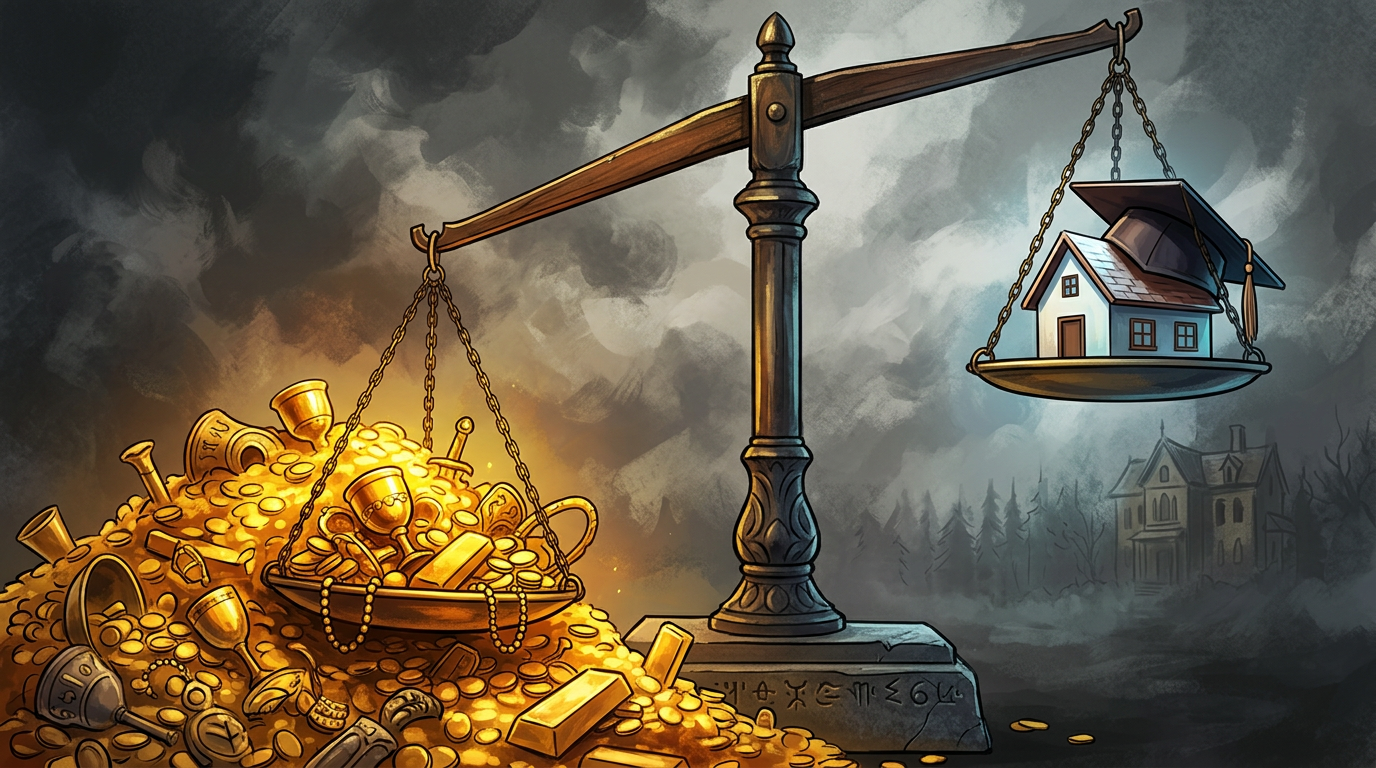
For decades, Americans have been told that the economy rewards merit, innovation, risk, and hard work. That story has become increasingly difficult to defend. Workers produce the goods, deliver the services, build the platforms, staff the hospitals, move the freight, teach the children, care for the elderly, process the data, maintain the infrastructure, and generate the daily activity that becomes Gross Domestic Product. Yet the gains from that collective labor flow disproportionately to owners, executives, financiers, and founders whose legal claims on capital allow them to appropriate wealth far beyond any plausible measure of personal contribution.

This is not an accident. It is not the weather. It is not the invisible hand. It is design.

The American economy is structured by law. Corporations exist because law creates them. Limited liability exists because law grants it. Intellectual property exists because law protects it. Stock markets, mergers, executive compensation, bankruptcy priorities, taxation, labor rights, and campaign finance are all products of public decision. The economy is not separate from government; it is one of government’s largest creations.

That means we are entitled to redesign it.

The central defect in the current system is that it treats labor as an expense and capital as the sovereign. Workers are described as “human resources,” while shareholders are treated as the rightful claimants of the surplus. This reverses moral reality. Labor is not a cost to be minimized. Labor is one of the principal sources of value. A society that depends on workers for production but denies them meaningful power over the distribution and governance of that production is not a democracy in any serious economic sense.

The fortunes of men like Elon Musk, Mark Zuckerberg, and Jeff Bezos are often described as the reward for brilliance. No doubt they are intelligent, ambitious, and consequential. But their wealth was made possible by far more than personal genius. It depended on public roads, public courts, public education, public research, public communications infrastructure, public subsidies, public enforcement of contracts, publicly created corporate privileges, and the labor of hundreds of thousands of people. Their wealth is therefore not purely private achievement. It is socially enabled accumulation.

The question is not whether successful people should be rewarded. The question is whether any democratic society should permit individuals to accumulate economic power so vast that they can shape labor markets, communications systems, elections, public policy, technological development, and even geopolitical outcomes without meaningful democratic accountability.

That is not capitalism as freedom. That is private government.

Reform is no longer enough. A higher minimum wage, better enforcement of labor law, a more progressive tax code, and stronger antitrust policy are all desirable. But they do not reach the root of the matter. They leave untouched the basic architecture: capital commands, labor obeys; owners govern, workers request; profits are privatized, while the social costs of instability, pollution, poverty, ill health, and community decline are pushed onto everyone else.

The United States needs an economic transformation grounded in the principle of economic democracy.

That transformation should begin with a simple proposition: those who create the wealth of the nation must have a real voice in how that wealth is governed and distributed. Workers should have representation on corporate boards. Large firms should be required to share profits with employees. Public investment should generate public equity, so that when taxpayers help create value, the public receives a return. Essential sectors should be governed by public-interest obligations, not merely shareholder return. Monopolies and dominant platforms should be broken up, regulated as public utilities, or converted into stakeholder-governed institutions. Employee ownership, cooperatives, and community wealth-building institutions should become central rather than marginal features of the economy.

We should also create a national social wealth fund: a democratically governed public investment vehicle that holds diversified assets on behalf of the people and pays social dividends or funds universal public goods. If capital ownership is the route through which wealth compounds, then the public must own capital too.

The goal is not to punish success. The goal is to end economic monarchy.

Nor should this argument be trapped in the stale language of “socialism versus capitalism.” That vocabulary is designed to stop thought, not encourage it. It drags every serious discussion of economic democracy back into Cold War reflexes, as though the only choices available to us are unregulated corporate domination or Soviet-style state control. That is a false and impoverished choice.

The better question is this: the economy is already planned. The real issue is who does the planning, for whose benefit, and under what form of accountability.

The existing economy is not “free” in any serious sense. It is governed every day by corporate charters, tax rules, courts, central banks, intellectual-property regimes, labor law, procurement policy, subsidies, bankruptcy rules, financial regulation, and campaign finance structures. These are not acts of nature. They are political choices. They are forms of planning. The tragedy is that they now plan primarily for capital accumulation, shareholder return, executive enrichment, and the preservation of concentrated private power.

A transformed economy would use those same governing tools for different ends: democratic legitimacy, shared prosperity, ecological responsibility, community stability, and the dignity of work. It would recognize that workers are not guests in the economy. They are its builders. It would recognize that public investment should produce public benefit. It would recognize that no republic can remain politically democratic while its economic life is organized around private concentrations of power that rival, capture, and often dominate the state itself.

A democratic republic cannot survive indefinitely with a feudal economy. Political democracy is hollow when economic life is governed by concentrated private power. The ballot gives citizens a voice in government once every few years; the workplace governs their lives every day. If democracy is good enough for the polling place, it is good enough for the economy.

The American question is no longer whether the existing system can be patched. It is whether we have the courage to admit that the system is working exactly as designed — and that the design itself is the problem. We do not need mere reform. We need transformation.


The Quiet Face of Tyranny: How Emil Bove Threatens the Rule of Law

There are monsters among us. They don’t crawl from caves or erupt in public tantrums. No, the most dangerous among them walk calmly through courtrooms and government buildings, armed not with violence but with credentials and legalese. Emil Bove is one such figure—a reminder that authoritarianism often arrives not with a bang, but with a briefcase.

Bove, a former federal prosecutor and now a prominent defender of Donald Trump, argued before the Supreme Court in Trump v. United States that a president could order the assassination of a political rival and be immune from prosecution unless Congress had first impeached and convicted him. Let that sink in. According to Bove, unless Congress acts, a president could unleash the machinery of the state to eliminate his enemies, and the courts would be powerless to intervene.

It is hard to imagine a more grotesque betrayal of the American principle that no one is above the law. Yet Bove didn’t stop there.

In a separate legal context, Bove shockingly instructed that individuals could ignore a federal court order—specifically, a ruling that prohibited the government from rendering hundreds of asylum-seeking men to a prison camp in El Salvador. These were men fleeing violence and persecution, invoking the protections of due process guaranteed under U.S. and international law. But Bove’s message was clear: the courts can be disregarded when inconvenient.

This isn’t legal strategy. This is lawlessness dressed in Armani.

Imagine the consequences if this logic took hold. The courts—our last institutional line of defense against executive overreach—would become ornamental. Their rulings optional. The law itself would be subject to political whim and brute force. And the vulnerable, the voiceless, the targets of state-sanctioned abuse? They would have no recourse. No rights. No hope.

Bove’s contempt for the rule of law reveals the true danger: a legal elite willing to hollow out democracy from the inside, all while claiming to defend it. This is not merely a technical debate among lawyers. This is about whether the United States will remain a constitutional republic, or whether we will slip—quietly, insidiously—into autocracy under the guise of “executive immunity” and “national security.”

In any other era, a lawyer who advised ignoring a court order would be disciplined, sanctioned, maybe disbarred. But in the post-Trump era, such defiance is applauded in certain circles. Bove’s arguments aren’t fringe anymore—they are being mainstreamed in front of the highest court in the land. And the justices, disturbingly, entertained them with far less outrage than the moment demands.

History shows us where this road leads. In Nazi Germany, apartheid South Africa, Jim Crow America—the law was contorted to protect the powerful and persecute the powerless. It always begins with legal justifications for unconscionable acts. Always. Men like Emil Bove provide those justifications. They sanitize the machinery of repression. They make it sound reasonable, even principled.

And they count on us not to notice.

But we must notice. We must resist the temptation to normalize the radical, to accept the obscene as simply another legal argument. We must remember that beneath the surface of constitutional language, Bove is advocating for tyranny: a presidency unbound by law, and a government that ignores the judiciary when it suits its purposes.

There is a reason why we revere the principle of “Equal Justice Under Law.” It is the safeguard of civilization. Without it, we are left with power unchecked, and cruelty unchallenged.

To look at Bove is to see not a villain in the Hollywood sense, but something far more dangerous—a man who knows exactly how the system works and is willing to dismantle it piece by piece. Calmly. Methodically. Legally.

That is why we must be ever-vigilant.

Because when monsters wear suits, when they speak in measured tones and cite precedent as they strip away our liberties, the danger is greater—not lesser. They know how to mask authoritarianism as patriotism, cruelty as strength, and impunity as “executive authority.”

We cannot be passive. We must name the danger. Confront it. Reject it in the courts, in the media, in the halls of Congress, and in the court of public opinion. Emil Bove may be just one man, but he represents a movement of cold, calculated disregard for democratic norms.

It is up to us to remember: when a lawyer tells you the president can murder without consequence, or that you may ignore the courts, they are not defending the Constitution. They are laying dynamite at its foundation.

And if we don’t stop them, history will not be kind to those who looked away.


Americans are Ignorami

Reclaiming the Hammer and Sickle: Symbolism, Struggle, and Systemic Illiteracy

In large part because of my activities in the antiwar and peace and justice movements shortly after I celebrated my 20th birthday, I began reading Marx, Engels, Lenin, Mao, Castro, and Guevara, as well as Black authors and activists like Eldridge Cleaver, Malcolm X, and George Jackson, among others. I was especially fond of reading Lenin’s explanations and defense of the theories of Karl Marx and, to a lesser extent, Friedrich Engels. My interest wasn’t only in their political and economic theories, but also in their general philosophy, which is Dialectical Materialism. I’ve touched on this philosophy somewhat tangentially in some of my previous writings.

I’ve long been both dismayed and somewhat fascinated by the sheer ignorance of my fellow Americans when it comes to understanding what some very important terms and concepts actually represent. I am here referring to socialism, communism, capitalism, and dialectical materialism—perhaps a few other economic, political, and philosophical terms as well.

The hammer and sickle is one of the most enduring symbols of communism and socialist movements, representing the unity and solidarity of industrial workers (symbolized by the hammer) and agricultural laborers (symbolized by the sickle). While it gained prominence in the 20th century as an emblem of the Soviet Union, its roots and symbolism tie back to the broader communist ideas as envisioned by Karl Marx and Friedrich Engels.

Theoretical Foundation: Marx and Engels

Marx and Engels, in works like The Communist Manifesto (1848), envisioned a society where the working class (proletariat) would overthrow the capitalist class (bourgeoisie) to establish a classless, stateless society. Central to this vision was the unification of all laborers—regardless of their specific trades or industries—against the exploitative structures of capitalism. The hammer and sickle perfectly encapsulate this ideal by bringing together two key groups of workers who were often divided in pre-industrial and industrial societies:

  • Industrial Workers (Hammer): Factory workers, craftsmen, and laborers—urban dwellers essential to the mechanized production processes of capitalist economies.
  • Agricultural Workers (Sickle): Peasants and farmers who toiled in rural areas, producing food and raw materials. Often marginalized and exploited under feudal and capitalist systems.

By combining these two tools, the hammer and sickle symbolized the unity of these distinct groups in their shared struggle for liberation and equality.

Historical Context of the Symbol

Although Marx and Engels themselves did not create or use the hammer and sickle as a symbol, their ideas inspired later revolutionary movements that adopted it. The symbol gained prominence with the Bolshevik Revolution in Russia (1917), when the Bolsheviks sought to unite industrial workers and peasants under the banner of communism. The hammer and sickle were officially adopted as part of the Soviet Union’s flag in 1923.

Significance to the Communist Movement

The hammer and sickle became a powerful visual representation of several core ideas in Marxist-inspired movements:

  • Worker Solidarity: It emphasized unity among all exploited classes to overthrow the capitalist system.
  • Class Struggle: It depicted the tools of labor, highlighting the centrality of workers and their productive power in shaping society.
  • Revolutionary Change: It called workers and peasants to action—to seize the means of production and build a socialist society.

Criticism and Evolution

In practice, the unity symbolized by the hammer and sickle was not always realized. Tensions between urban industrial workers and rural agricultural communities persisted in the Soviet Union and other communist nations. Moreover, the symbol became associated with authoritarian regimes, giving it a controversial legacy in modern times.

Still, the hammer and sickle remain potent emblems of worker solidarity and the Marxist vision of a classless society—despite how much interpretations of communism have evolved over time.

The American Context: Weaponized Ignorance

This, however, is where things get more complicated—and more infuriating.

In the American political lexicon, socialism has become a slur hurled without understanding, a catch-all bogeyman meant to stoke fear, not provoke thought. The hammer and sickle, meanwhile, has been reduced in the public imagination to little more than a sinister relic—stripped of context, stripped of nuance, and weaponized in the culture war by people whose understanding of history could fit neatly on the back of a fast-food receipt.

The fact is, most Americans have never seriously studied Marx or Engels—let alone Lenin or Mao—and wouldn’t recognize dialectical materialism if it organized their kitchen pantry and handed them a checklist. We are a people sold the myth that capitalism is not just the best economic system, but the only one consistent with freedom, democracy, and morality. Anything that questions this orthodoxy is treated as heresy, regardless of its intellectual rigor or empirical grounding.

Dialectical Materialism: Not a Manifesto, But a Method

Let’s be clear: dialectical materialism is not a manifesto—it is a method. A way of understanding the world not as a series of isolated events, but as a dynamic, interconnected whole; a recognition that history moves through contradiction, and that the driving force behind historical change is the conflict between classes, between ideas, between material conditions themselves. It is not “communism” as caricatured by reactionaries—it is a framework for grasping the engines of change that shape human societies.

The Real Threat to the Status Quo

And therein lies the real threat to the American status quo: not the hammer and sickle itself, but the idea that working people—whether factory machinists, field hands, or Uber drivers—might recognize their common interests. That they might see through the illusion that their suffering is individual, rather than systemic. That they might stop blaming immigrants, or the unemployed, or “welfare cheats,” and instead aim their righteous anger at the extractive systems that keep them exhausted, precarious, and obedient.

The Struggle Continues

We are long past the time for empty patriotism and red-scare hysteria. We need deep, structural critique rooted in historical knowledge and philosophical clarity. Not to idolize past revolutions, but to learn from them—critically, courageously, dialectically.

The hammer and sickle endures not because it’s fashionable, and certainly not because it’s flawless, but because the struggle it symbolizes has never truly ended. The tools have changed. The fields have changed. But the workers are still here. And the fight—for dignity, for justice, for liberation—remains.


The Trump Vacuum and the Opportunity of Idealized Design


There’s a strange sort of energy in the air these days. You can almost feel it—the wheels coming off the rickety jalopy that is Trumpism. The man himself, once a master of chaos and distraction, is looking more and more like a washed-up carnival barker whose tricks have lost their shine. The legal walls are closing in, the rallies are less electric, and the “movement” has become less about a future and more about clinging to a bitter, grievance-soaked past.

But let’s not kid ourselves: while Trump has been busy turning the federal government into a shell of its former self—gutting agencies, stacking departments with yes-men, and driving out career professionals—he’s also unwittingly created a rare opportunity. Nature, as they say, abhors a vacuum. And what we’ve got, right now, is a vacuum the size of Pennsylvania Avenue.

If you’ve ever read Dr. Russell Ackoff—and if you haven’t, now would be a good time—he talks about something called “idealized design.” The gist? When the system you’ve got is broken, don’t just patch the leaks and slap on another coat of paint. Instead, ask yourself: If the current system disappeared overnight, what would you create to take its place? Not what’s possible within the old constraints, but what’s ideal given what we now know.

Well, look around. Thanks to the Trump wrecking ball, a lot of the old constraints are gone—obliterated, really. Agencies like the EPA, Education, even the Post Office, have been hollowed out to the point of absurdity. The courts are in crisis, the CDC is a shell, and the State Department looks like a ghost town. There’s nothing left to “fix.” So, what if we stopped trying to resuscitate the corpse and started imagining a new body politic altogether?

Here’s the opportunity: We get to ask, “What do we want government to look like, now?” Ackoff would tell us to ignore the nostalgic call for a return to the “good old days.” Instead, let’s design forward. A government that’s transparent, accountable, and explicitly built to serve all its people, not just the one percent or the loudest megaphones. What would a Department of Justice look like if it truly prioritized justice? What about immigration—not as a problem to be “solved,” but as a vibrant source of national renewal?

The Trump era, for all its destruction, has left us with a blank page. The lesson is not to cower in fear or yearn for the status quo ante. It’s to seize the moment, roll up our sleeves, and start sketching out the kind of institutions we wish we’d always had. It’s the ultimate act of resistance: refusing to settle for less than the ideal, and demanding a government worthy of the people it serves.

Let’s not waste the vacuum. Let’s fill it—creatively, bravely, and with the best of what we can imagine.


The Legacy of DOGE

Recently I’ve been studying Generative AI (ChatGPT, et al), and learning how to use it effectively. This is somewhat difficult as I’m not currently employed and haven’t been for about two and a half years. As a result, I have few specific tasks to work on and discover how to implement AI, either to automate or to speed up their completion. Regardless, I’ve subscribed to Quora’s Poe, which is a compilation of bots to which I now have 10,000 points to use every day for the next year. As well, I’ve secured inexpensive access to several other services which allow me to experiment with image creation, reasoning and writing, and general search capabilities.

Today, something I read caused me to wonder what, if any, historical significance there was to the term DOGE, which is performative Nazi Elon Musk’s name for his chainsaw approach to dismantling our government. It would be remiss of me not to point out I’ve believed for virtually the entirety of my adult life (that would be 56 years if you count from age 21) that the government of the United States is in dire need of an overhaul … the economy too! However, what is happening now is NOT what I would consider either an efficient or an effective method of achieving progress.

At any rate, I asked one of the bots to which I have access (Web-search, which costs 15 points per prompt) to explain the word/concept’s history to me. Here’s what I got. BTW – I cross-checked the response with ChatGPT and received very similar responses. The answers I received from the bot are in italics, below. The simple prompts I used are included prior to the answer I received and are in red.


The word “doge” historically represents the title of an elected lord and head of state in several Italian city-states, most notably Venice and Genoa, during the medieval and Renaissance periods. Here are some key points about its historical significance:

  1. Etymology: The term “doge” is derived from the Venetian language, which in turn comes from the Latin word “dux,” meaning leader or duke. This reflects the role of the doge as a leader within the governance structure of these republics.
  2. Role and Governance: The doge was not a monarch but an elected official who governed alongside a complex system of councils. This system included the Great Council, the Council of Ten, and the Senate, which helped to balance power and prevent the abuse of authority. The doge typically ruled for life, although their power was often limited by these governing bodies.
  3. Historical Context: The first doge of Venice, Paoluccio Anafesto, was elected in 697 AD, and the position continued until the fall of the Venetian Republic in 1797 due to Napoleon’s conquests. This long duration highlights the stability and continuity of the doge’s role in Venetian governance.
  4. Cultural Impact: The doges played a crucial role in Venice’s development as a maritime power and cultural center. They were involved in significant events, such as the Fourth Crusade, and presided over periods of territorial expansion and artistic flourishing.
  5. Legacy: The doge’s palace, a symbol of Venetian power and artistry, remains a significant historical site. The title of doge has also transcended its original context, becoming part of modern internet culture through the “Doge” meme and the cryptocurrency Dogecoin, illustrating its lasting influence.

In summary, the word “doge” historically signifies a unique leadership role within the context of Venetian and Genoese governance, characterized by elected authority, cultural significance, and a legacy that continues to resonate today.


The legacy of the word “doge” extends beyond its historical significance in Venice and Genoa, influencing modern culture and language. However, it also carries some negative connotations that have emerged over time. Here’s a closer look at both aspects:

Positive Legacy

  1. Symbol of Governance: The doge represents a unique form of governance characterized by elected leadership and a system of checks and balances. This model has influenced modern democratic systems, showcasing the importance of limiting power and ensuring representation.
  2. Cultural Heritage: The doges were instrumental in Venice’s rise as a cultural and economic powerhouse during the Renaissance. Their patronage of the arts led to significant contributions in architecture, painting, and literature, which continue to be celebrated today.
  3. Modern References: The term “doge” has found new life in contemporary culture, particularly through the “Doge” meme featuring a Shiba Inu dog, which became an internet sensation. This meme has also inspired the creation of Dogecoin, a cryptocurrency that gained popularity in the digital economy.

Negative Connotations

  1. Corruption and Elitism: Over time, the doge’s role became associated with corruption and elitism. As the Venetian Republic evolved, the political system became increasingly oligarchic, with power concentrated in the hands of a few wealthy families. This shift led to a perception of the doge as a figurehead for a corrupt elite rather than a true representative of the people.
  2. Decline of Power: The eventual decline of Venice as a major power, culminating in its annexation by Napoleon, has also tainted the legacy of the doge. The fall of the Venetian Republic is often viewed as a cautionary tale about the dangers of political stagnation and the failure to adapt to changing circumstances, which can be linked back to the governance style of the doges.
  3. Modern Misinterpretations: In contemporary discussions, particularly in political contexts, the term “doge” can evoke images of ineffective leadership or bureaucratic inefficiency. This is especially relevant in satirical or critical commentary on government figures who are perceived as out of touch or overly ceremonial, drawing parallels to the historical role of the doge as a largely symbolic leader.

Conclusion

While the legacy of the doge is rich with cultural and historical significance, it is also intertwined with themes of corruption, elitism, and political decline. These negative connotations serve as reminders of the complexities of leadership and governance, both in the past and present.


I don’t know about you, but the conclusion makes perfect sense to me given what Musk and his merry band of Incelites are doing to dismantle, especially, every department and service that’s designed to help out regular Americans, who are – IMO – victims of an economic system that exploits and steals from them at every turn.


You Say You Want a Revolution

I was prepared, and preparing, for a revolution as far back as the late 60s. I was a young man, full of piss, vinegar, and righteous indignation over a war of aggression by my country; a war that had already claimed the life of my best friend. Through my antiwar activities I had become aware of many of the realities of the U.S. that had been hidden from me, especially rampant racism and sexism.

I’m aware many of my fellow citizens have a hard time realizing just how bad things have been in this country. Consider this, and I believe this is pretty much common knowledge: most of the land that comprises the U.S. was already inhabited when the Pilgrims arrived here. Much of the infrastructure of our country was built by slaves or indentured servants, virtually all of whom were kept in appalling living conditions. The fucking White House was built with slave labor. Meanwhile, white people were building generational wealth while systematically preventing POC from doing the same.

Ever hear of Angel Island, where we kept Chinese immigrants from 1910 to 1940? I’m sure you’ve heard of the Japanese detention camps used during WWII. My in-laws were detained at the one in Colorado (Amache) for two years. Many of my wife’s relatives lost everything during those years. The number of horrendous things done by white people to POC is disgusting and worthy of retribution, certainly of derision and disgust. So, why am I bringing all of this up?

Well, As I said, I was prepared decades ago for a revolution in this country. We have been in a class war as long as we’ve existed. However, I came to realize as a straight, white man it wasn’t up to me to decide when and how such an event should be prosecuted. I am somewhat privileged and don’t believe I have the moral authority to ask for the kinds of sacrifice such an endeavor would require.

I am, however, ready to support an effort to free the working class from their servitude to the upper class. I believe capitalism has served whatever purpose it once had (moving us away from feudalism and slavery) and needs to be replaced by, at the very least, a form of democratic socialism. I don’t believe billionaires should be allowed to exist. Having that much money is immoral and should be illegal, IMO. All to say, I’m down with any attempt to upgrade this nation, by any means necessary. I prefer it to be peaceful, but people with far too much money are making that impossible.

Things most likely have to get a lot worse; some of the wealth has trickled down to us and too many of us are either comfortable or convinced wealth and privilege are just around the corner. I don’t believe we can continue along the path we’re following, and it’s not just maga or trump. Capitalism rewards greed and avarice. Money is god! Socialism, OTOH, at least attempts to put people first. That’s what I’d like to see. Who’s on board?


Paine’s Nightmare

We’re about to find out just how many “summer soldiers and sunshine patriots” have managed to ascend to positions of power and influence in our country.

I fear such knowledge is going to be deeply disappointing and demoralizing. I will be surprised if even half of elected Democrats rise to the occasion. I hope I’m wrong.


Why Are People Giving In?

In his book, “On Tyranny: Twenty Lessons From The Twentieth Century”, the very first lesson Timothy Snyder presents us with is “Do not obey in advance”.


Yet this is precisely what the mainstream media (including MSNBC and even Comedy Central) are doing wrt the “candidacy” of Rapey McEarGotNicked. They’re cravenly removing shows that might “offend” Trumplethinskin, ostensibly in the forlorn hope that if he wins they’ll obtain or retain access to him during his admin, er reign as King of the World.

Another admonition from Snyder; “Be calm when the unthinkable arrives.” Unfortunately, if my admittedly unscientific analysis is correct, this is what far too many of us are doing on the daily. I say this because of a couple of things.


One – Facebook provides a range of reactions for posts and comments. These are “Like”, “Love”, “Care”, “Ha Ha”, “Wow”, “Sad”, and “Anger”. I see lots of people reacting to news of Mango Mussolini’s outlandish “positions” (especially Project 2025) with “Sad” rather than “Anger”. Being sad is debilitating. Being angry is energizing. It can, and should, lead to dogged determination to resist, whereas being sad leads to fear, anxiety, and panicked paralysis.

Two – On Threads which, despite being a META product like FB & IG, doesn’t provide for a range of reactions, I consistently read comments by people who are afraid or uncomfortable. Hardly any are angry at what’s going on with the Treason Weasel’s “campaign”.


What we face with the prospect of another Trump Presidency is objectively horrendous, yet many seem to be paralyzed and incapable of doing anything other than complaining and expressing their fear for the future.


Maybe I’m off base here, but I believe they are doing what Professor Snyder is admonishing us against, i.e. obeying in advance or, to put it more succinctly, giving up.


WE NEED TO DO BETTER. Only 112 days remain for us to educate and fire up the electorate, especially the large chunk of people who don’t ordinarily vote.


PS – I’m a 77-year-old, straight, cis gendered, white male who lives in SoCal, is retired, and has enough retirement income (thank you Social Security & Medicare) to squeak by almost no matter what happens. Nevertheless, I care about my fellow meat sacks and, especially, my two adopted girls. For this reason I will not obey, either in advance or afterward. There’s just too much at stake.

Hasta la victoria siempre. ¡Venceremos!