Can the Court’s decision be considered “bad behaviour”?
Article III. Section. 1. of the Constitution of the United States:
“The judicial Power of the United States shall be vested in one supreme Court, and in such inferior Courts as the Congress may from time to time ordain and establish. The Judges, both of the supreme and inferior Courts, shall hold their Offices during good Behaviour, and shall, at stated Times, receive for their Services a Compensation, which shall not be diminished during their Continuance in Office.” (emphasis supplied)
There exists precedent for impeaching a Supreme Court Justice. Thomas Jefferson requested articles of impeachment against Justice Samuel Chase, who was impeached, but acquitted by the Senate.
Inasmuch as the House of Representatives must present articles of impeachment and the Senate must convict by a two-thirds majority, it’s impractical to believe we could realize such a result. Nevertheless, I have tilted at windmills before and, at times, it is the only way to begin a movement for change.
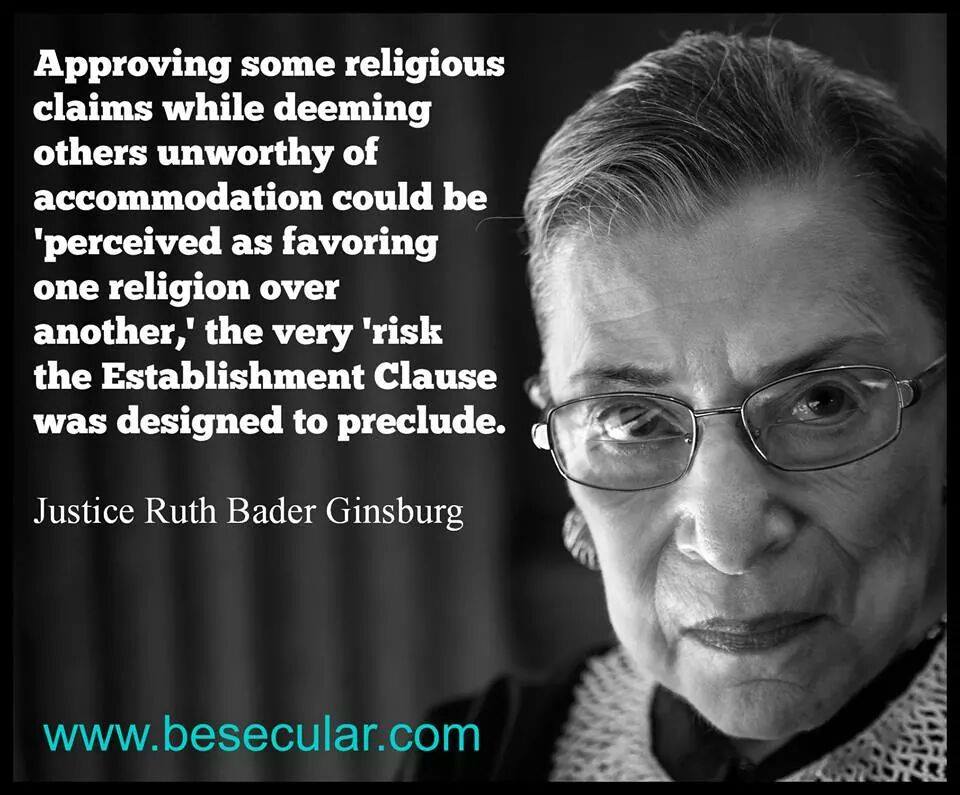
Clearly, the Hobby Lobby case is another in a long line of cases that have been decided by the kind of judicial activism most of those who favored the decisions decried and abjured in many of their writings and during their confirmation hearings, which makes them guilty of perjury in my eyes.
Give it some thought. Call it a BHAG or a stretch goal.
Today we celebrate the service and dedication of all who have worn a uniform of one or more of the armed forces of our country. Let’s be sure we keep in mind their service was – and is – not merely to protect corporate greed and power; neither is it for maintaining the salaries of CEOs nor the dividends and capital gains of shareholders.
Most everyone who serves does so in the belief they are helping to protect their nation – the people who dwell and work within her borders – from enemies both foreign and domestic. Those people are the strength, the vitality from which a healthy nation grows.
In a wonderful piece for Fast Company – “Is Your Company Ready to Make the World a Better Place?“, Marcia Conner reminds us that our obligations are, and must be, greater than to the bottom line. They are to the future of our world, our species, and the entire planet. Let’s honor our service men and women by taking stock of what we do and how it affects the entire system within which we live. Let’s resolve to truly make this world a better, more livable, and healthier environment for all who inhabit her.
The 18th Hole at Simi Hills Golf Course – Simi Valley, California
I took up golf at the tender age of 46. My department at Rocketdyne was having a tournament and they needed bodies to fill up open slots. After a significant amount of badgering, I agreed to participate. To be fair, I had been introduced to golf when I was fifteen. My father had taken it up and he wanted me to enjoy it as he did. Unfortunately, he also wanted me to be right-handed. I’m not. He insisted I would be better off golfing right-handed and I tried, but it wasn’t to be. I felt incredibly awkward and didn’t want to put up with what I perceived to be an inordinately difficult effort to make the switch.
Couple that with the belief (this was back in 1962) that golf was primarily for old farts, and a strong desire to spend time surfing, and I didn’t last long at all. I guess, then, it’s not entirely correct to say I took it up at 46, despite the intervening 31 years before I handled a golf club again. Regardless, I played in the company tournament and spent a little time on the driving range and practice green in preparation. I was hooked—big time!
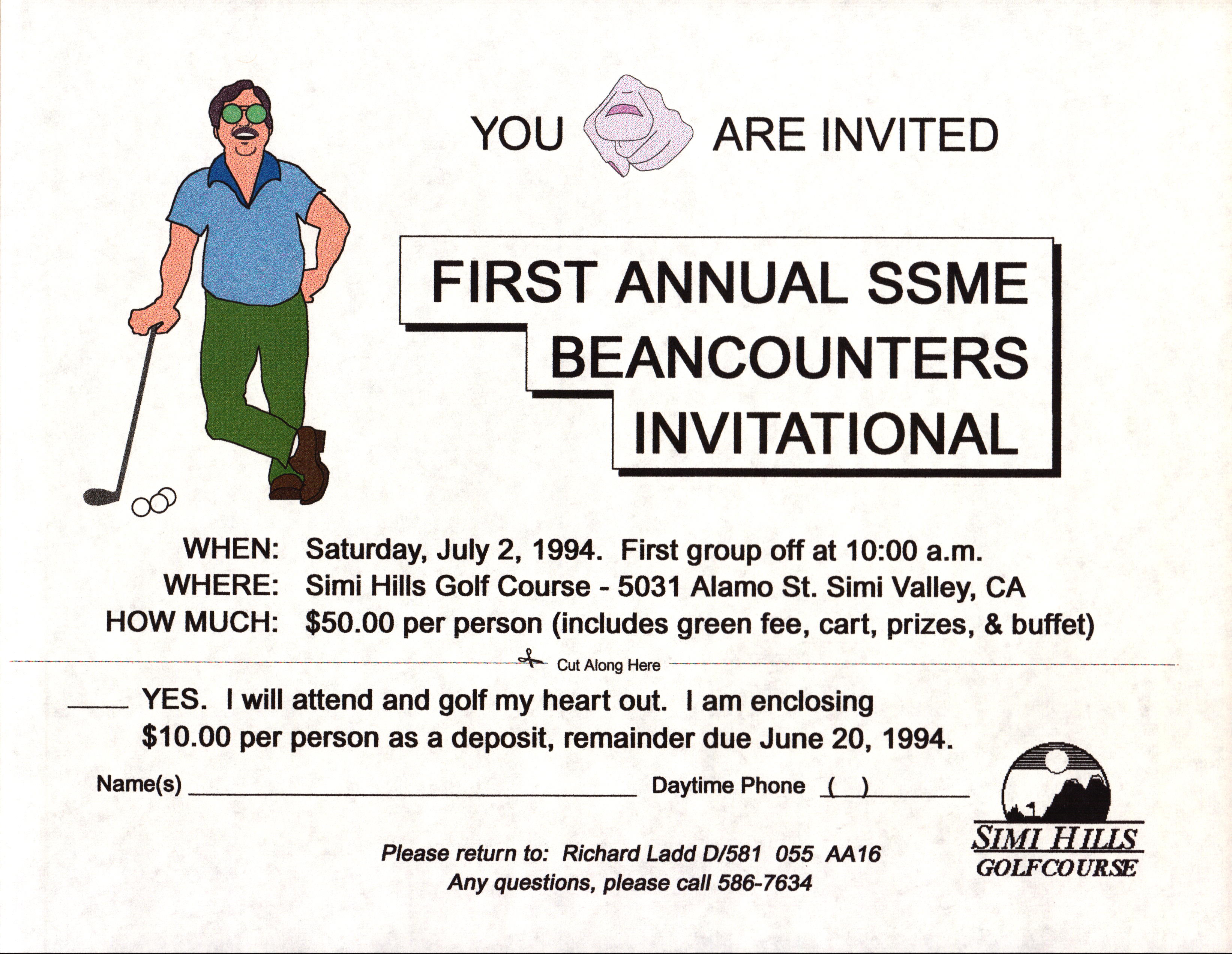
Addendum: I thought this might be the flyer I put together for that first tournament but, based on the date, I don’t believe it is, because in July of 1994 I was 47 years old, not 46.
My uncle offered to have a friend make me a set of custom clubs for a very reasonable price, which I did. I quickly discovered, however, golf can be a very expensive sport, especially when you spend all your spare time hitting balls or playing. I could not afford to keep up the pace I was going at. In order to continue, I wrote and published a newsletter for the course I spent all my time at, Simi Hills. None of the articles were based on anything but my own fertile imagination and conjecture, but the General Manager of the course loved it and asked me to do it on a monthly basis, with real information this time.
In exchange for my efforts, he began allowing me to hit as many balls as I wished on the range and I took full advantage of it, frequently hitting hundreds of balls as I perfected my game. Soon I was invited to play with the head pro and the GM and, of course, it was as good as getting hours and hours of free lessons. I got my handicap down to 12 within a fairly short while, no mean feat for a man who was then pushing 50.
As I increased both my physical capabilities and my understanding of the game, I was soon approaching a single-digit handicap. It was then my wife and I decided to adopt. I wasn’t actually too keen on the idea at first, as I had visions of retirement, travel, and lots of golf. However, the desire to be a parent overcame my (very strong) desire to continue playing golf and, once the process began rolling along, it became harder and harder to play or practice. By the time we returned home with our oldest, in 2002, I was 55 and it became very difficult to fulfill my duties as a husband and father and still have time to play golf.
So, why am I telling you all of this? I still watch golf quite a bit and, lately, I’ve been playing a very realistic virtual game (World Golf Tour) online. Also, I have given a lot of thought to the role golf plays and how it jibes with my world view. I am aware there are numerous arguments for golf being a wasteful, indulgent sport of the rich. I am aware golf courses take up a lot of property for the use of, perhaps, not very many people. My best, somewhat informed, guesstimate is that the average full-size course is used by around 350 golfers a day. That’s not very many compared to the numbers using a municipal park or a National or State park. It surely explains why golf is so expensive, as it is a heavily tended and manicured environment.
Many courses, some suggest as many as 40% in the 1990s, were built as a part of a real estate development, and I’m not even going to get into the place Country Clubs play in terms of the exclusivity and expensiveness of golf. A large percentage of golfers are very well off. I suppose, comparatively, I am one of them. Certainly, when I was still employed in an excellent, well-paying job, I had the money to play a couple of times a month and practice several days a week when I wished.
There are, however, significant attempts to bring golf to the less-than-affluent, Tiger Woods’s “The First Tee” likely being the most prominent. Frankly, I don’t believe golf need be an “exclusive” sport. Furthermore, I think it has values to teach, as The First Tee does, that are difficult to find in today’s hyper-competitive environment found in many other sports. Inasmuch as I started so late in life, golf hasn’t taught me so much as it has reinforced in me many values I find important and useful, e.g. integrity, self-assurance, patience, calm deliberation, respect for others, etc. I also found on the golf course a place where everything else in my life melted away for a few hours. I was able to put my job and my responsibilities out of my head for a while; no mean feat for one such as I.
Tiger Thanks a Marine For His Service
There’s one other thought I had – and this whole post (which is somewhat off the top of my head, though I’ve thought about it a lot) was begun with this thought in mind – that bothers/concerns me. The military has long had a close association with golf (see this USGA history) and I have no problem with this. It does, however, lend even more credence to the belief that golf is exclusive because, historically, it has been primarily the Officers who had the time and money to play. That may be changing, but my goal isn’t to analyze the development of golf inside the military. What I am interested in understanding is what it means that every golf tournament now seems to have members of the military ceremoniously tending at least one flag on the course – generally the 18th.
I find myself wondering if this doesn’t, in some small way, signify our becoming more and more a military culture and also, given our penchant for honoring our armed forces for serving, yet never questioning how and why we ask them to serve, if this isn’t a bit backwards. What does it say about us as a society that we don’t seem to question how our military is used, yet now (post-Vietnam) bend over backward to thank them for their service? How do we justify asking them to do what many believe is not in our best interests, yet feel a heartfelt “thank you for your service” is somehow enough to justify our cavalier attitude toward the forces behind their service and sacrifice?
This leads me to other questions, such as are we becoming a sort of Sparta by proxy? Are we a nation that uses its wealth to prosecute wars that are unnecessary and only serve the interests of the truly wealthy and powerful, simultaneously insulating the average citizen from the sacrifices and costs involved? Are we asking the members of our armed forces to kill, fight, and die for no other reason than to preserve our position as the world’s largest consumers of natural resources, then showering them with just enough pomp and circumstance to obfuscate the ugly and horrific reality?
This is where I find cognitive dissonance. As I watched the end of the Greenbrier Classic yesterday, there were two service members tending the pin on the 18th. I am pretty sure I’ve seen this at just about every tournament I’ve watched this year and it seems as though it’s been only recently this has happened regularly. I really love golf as a sport, though I do wonder where it fits in the overall cultural milieu I live in. I hate to see it used as a propaganda tool but, truth to tell, I’m not sure that is what’s happening. What do you think about this? Am I crazy; being too ideological; reading too much into a genuine expression of gratitude? The dissonance is killing me.
“It is the common fate of the indolent to see their rights become a prey to the active. The condition upon which God hath given liberty to man is eternal vigilance; which condition if he break, servitude is at once the consequence of his crime and the punishment of his guilt.” — John Philpot Curran
I came across an interesting blog post via my Facebook feed today. It’s a personal account of one man’s experiences and some of his thoughts during the Boston bombing and manhunt. The author, Phil Johnson, discusses a few interesting issues, the first of which is the contradictory feelings one has when simultaneously feeling relief you or your friends weren’t affecting by a tragic event, while knowing full-well others have been devastated. He concludes “You can’t really call that luck”, and I agree. It is the dialectic of life, the yin yang of our existence, karma. Poorly understood, I think it leads some to conclude life is a zero-sum game.
He goes on to explain his mental journey from envisioning the perpetrators (especially after seeing a picture of the younger brother, Dzhokhar) as “pure evil” to reading an innocuous tweet of his and thinking “What could be more human that that?” As one who generally believes people are complex and capable of both great good and despicable evil, I found this revelation interesting and somewhat instructive, but hardly new or particularly revealing.
There is one thing he writes about that got my attention, though. Keep in mind I’ve read a lot of personal accounts of the bombing and subsequent activities (you probably have too), so it’s not that I’m dismissive of the personal tragedies experienced. It’s just that this particular issue that kind of lept out at me is something many thoughtful people are discussing, though usually in a slightly different direction than I gleaned from this tidbit. Here’s his paragraph:
“Throughout the day I jumped between Twitter, Reddit, the Boston Globe, and local TV for news. Jeremiah, a PJA developer, wrote a blog post about how social media gave us all our own private situation rooms from which to monitor events, something totally absent during the events of 9/11, when we were still dependent on the mainstream media.”
There are, it seems to me, a whole bunch of important issues contained in this paragraph. One of them is the way our consumption and processing of news and information is being transformed by social media (further encouraged by the alternate realities of the incompetence and disingenuousness of the MSM). In case you didn’t click on the link in the quote of his I’ve provided, consider this other blog post written by a colleague who discusses the communication differences between 9/11 and the five days between April 15 and 19, which I think are truly profound.
However, what I find of greatest interest is sussing out the implications (if any) of the entire City “sheltering-in-place” during the manhunt. I’m not entirely certain how I feel about it. On the one hand, for the period of time everyone was confined to their homes a heavily militarized police force had complete control of the City streets. On the other hand, the people of Boston, Watertown, etc. seemed quite willing to forego a little bit of freedom to expedite the search for a perpetrator they wanted to be caught. So, is their willingness a product of a situation in which most everyone was on the same page regarding the desired outcome, or is it an indication our citizenry is slowly giving control of the streets to law enforcement? Furthermore, is this a good thing or is it something more sinister and less-than-benign?
Some may argue it’s “unpatriotic”, perhaps cynical, of me to question what seems to have been a salutary outcome. However, I’ve never been one to believe the end justifies the means. This is one reason due process of law is so important in this country. It provides, theoretically, a means to ensure all are treated fairly. As well, it’s hard to be sanguine in the face of the possibility we are slowly giving way to the transformation of our nation into a police state. At the pace I’m envisioning, most would not notice and, once in place, would be difficult to convince it had happened. I don’t have a good answer to these questions. Neither do I wish to be paranoid. I do, however, want to explore the implications further. I would like to see others do the same.





 Systems Savvy