Category Archives: Technology

World Modeler Has Me Rethinking Trade Studies

Although I am not trained as a scientist or an engineer, I did spend over 20 years working with engineers and (yes, Virginia) rocket scientists. I also may not be a professional scientist, but I’m a pretty good amateur one, and I like to think that being around all that knowledge and brain power bestowed on me at least a patina of engineer/scientist. I do know I am loathe to make decisions without a great deal of information and as much knowledge as I can locate about the consequences of my decisions.

One of the methods we used to make engineering design decisions is called a trade study, which is  short for trade-off study. It’s essentially a very simple concept, whereby you develop the desired outcomes, e.g. features and capabilities of a system,  schedules and cost structures, break them down into measurable parts, and compare various ways to achieve those outcomes. The process itself is reasonably simple, but the details can become staggeringly complex and frequently overwhelming.

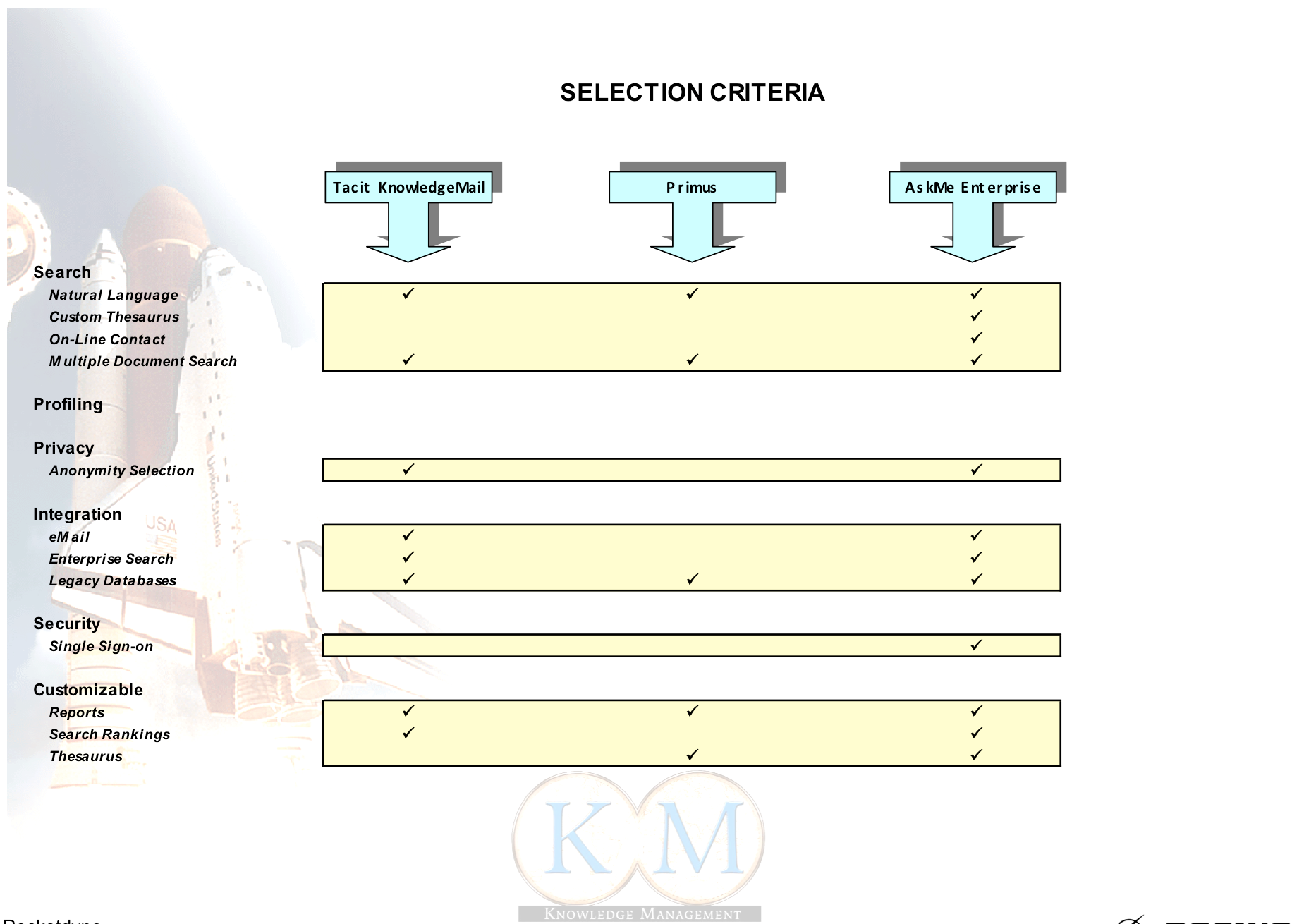
Selection Criteria

Expertise System Trade Study Selection Criteria

As I learn more and more about Decision Science and its derivatives, I look for examples and analogies from previous experience that I can revisit with newfound knowledge and capability and, perhaps, understand a little more clearly or completely than I did back then. I am convinced Decision Science, which embraces the concepts of Decision Engineering and Decision Intelligence, as well as the use of Decision Modeling to pull it all together, is a powerful tool that too few people know about.

One of the things that occurs to me, and I want to throw this out for your consideration, has to do with the remarkable software tool Quantellia has created, called World Modeler. It seems to  me it is to trade studies what AutoCAD is to hand-drawn blueprints. It is so rich in modeling functionality, it just makes every other tool I’ve worked with seem flat, unimaginative, and terribly cumbersome in terms of what we know we’re facing and how we see problems in today’s environment.

Just after the turn of the century (that would be 2001) I conducted a trade study for a software tool, some of the requirements of which were that it would run on our intranet and  was designed to both locate expertise and facilitate the exchange, use, and capture of knowledge in a form that would remain useable for some time to come. In short, one kind of knowledge management system that was being sought after back then.

The trade study I conducted looked at three products and rated them over about a dozen criteria we were interested in. There was no formal weighting and it was a fairly simple, straight-forward comparison of capabilities. A simple effort based on what we knew at the time and the very palty list of vendors who were providing the kind of service we wanted. In fact, as you can see in the accompanying graphic, there were only three . . . and one of them (Primus) was actually — if memory serves — an internal service of Boeing’s developed specifically for airplane mechanics to share information on their service and repair activities worldwide.

With World Modeler, we would have been able to model so much more than just these paltry selection criteria. We could have included in our decision the aggregate likely impact of things we assumed would happen, thereby surfacing possible misconceptions that some had. We could have included connections to IT, HR, and Communications, thereby giving us a clearer picture of the likely impact on the enterprise of implementing the system.

Frankly, in retrospect — and based on the fact that its use steadily declined after my retirement — I’m still not certain it was a good decision, though I had lots of reasons to believe so back then. So, getting back to my point, I think World Modeler is an incredibly powerful tool for an organization to measure the value of many of its decisions before making them. It’s also useful, in my opinion, in a wide array of situations and scenarios. I intend on addressing many of them as time goes by and I become more versed in its capabilities and more comfortable with my understanding of its value to various organizations and situations. You should check it out.


Serendipity Runs Circles Around Causality

Funny how some things seem — given enough time — to come full circle. Although I have always seen patterns and complexity, as well as the intricacies of their interplay, I wasn’t introduced to the concept of Systems Thinking until I worked on the Space Shuttle Main Engine program at (what was then) Rockwell International’s Rocketdyne division. That introduction included being exposed to the thinking of Dr. Russell Ackoff, a recognized authority in the field. I was fortunate enough to spend some time with him, twice in Philadelphia, prior to his death in October of 2009.

Shortly after retiring from Rocketdyne in 2010, I was introduced to Dr. Lorien Pratt of Quantellia, LLC, who showed me a tool her organization had developed called World Modeler. I was excited at what I saw and hopeful I could somehow become involved with Dr. Pratt and her team. However, that was not to be at the time. I was provided the opportunity to more thoroughly investigate the tool, but I had made a conscious choice to refamiliarize myself with Apple products (after over two decades of living in the PC, DOS, and Windows environment) and World Modeler was not written to be run on a Mac. Furthermore, the PC laptop I had wasn’t powerful enough to do the math and drive the graphics required for running models in real time. I was hosed.

Decision Intelligence Technologies

Decision Intelligence Technologies

Finally, about six months ago I was contacted by Dr. Pratt, who asked me if I wanted to assist in writing a paper that described an effort in which they were involved with the Carter Center. I enthusiastically said “Yes!” I’ve done a couple of other things with Quantellia since then but, beginning a few weeks ago, I took on an entirely new and (for me) exciting role as a referral partner.

Right now I’m spending a fair amount of time learning Decision Science in general, and the process and tools Quantellia uses to help organizations understand complex interrelationships and make better decisions based on that understanding. As I’m doing this I watch videos, read blogs and articles, look for original research, and work on presentations that will help me educate others in this important approach to business and organizational operations.

So . . . here’s the full circle part. As I’m looking for definitions, or explanations, of Decision Science and its origins, I Google the term. The first two hits I get are to The Decision Sciences Institute and to Carnegie Mellon University’s Department of Social and Decision Sciences. The third link is to a Wikipedia article on that same Department. In that article, there’s a link to Decision Science, specifically. However, it redirects to an article on Operations Research, which is where Systems Thinking originated. At the bottom of the page is a list of researchers under the heading “See Also”. One of the researchers, unsurprisingly, is Russell L. Ackoff. To me, that’s a combination of serendipity and years of working on better understanding how an understanding of systems can work to the benefit of any organization; actually, anyone.

I’ll be writing a lot more about Decision Science, including my understanding of some of its constituent parts, Decision Intelligence, Decision Engineering, Decision Modeling, and the power and value of our tools, World Modeler and DEEPM (Decision Engineering for Enterprise Project Management). I hope I will be able to clearly explain what it is we have to offer and, more importantly, what everyone has to gain by understanding it. The value exists independently of me or even Quantellia. We’ve just been at it for a while and can apply and employ the discipline both efficiently and effectively. Stay tuned.


Google Glass and ALS

It’s been said the eyes are windows to the soul, and most of us can recognize much from looking into another’s eyes. We can sometimes communicate intricate thoughts and feelings through our eyes. Imagine, though, they were your only window to the world; the only method by which you could communicate, with anyone. Further, what if you were in a position where it was nearly impossible for you to initiate a conversation and, therefore, unless you had a way to get someone’s attention, you had to wait for others to anticipate your needs? Worse yet, once anticipated, that other person would have to use a method requiring them to initiate nearly every aspect of the conversation.

This is precisely the situation for thousands of people suffering from ALS (Amyotrophic Lateral Sclerosis, also known as Lou Gehrig’s disease), MS (Multiple Sclerosis), TBI (Traumatic Brain Injury), or any one of several other conditions that result in the inability to move and talk . . . or write . . . or use sign language.  All they can do is acknowledge your greetings or answer your questions with a wink, perhaps a nod. How would you communicate?

Recently, I had the opportunity to meet someone in that position. His name is Ismail Tsieprati, and he is one of the longest-surviving sufferers of ALS, having had the disease for thirty years. I first met Ismail’s caregiver and wife, Cheryl, at a local Chamber of Commerce networking breakfast. She had recently left a long-time position in corporate training and was looking to establish a web-based business as a training consultant. She asked if I could help her promote her business through social media, and also suggested she help turn some presentations I had done into webinars. I agreed, and we worked together for a short while. As life would have it, before we could finish she was offered a full-time position in corporate training, and I was coming to the painful realization I had been chasing a pot devoid of gold.

We trekked off on our separate trails, as casual business relationships often do, but we remained in occasional contact, through Facebook and comments Cheryl would make in response to one of my sporadic blog posts. One of the several projects I had been working on was editing and proofreading a book – Age of Context – authored by Shel Israel, a longtime author and tech journalist, and Robert Scoble, an authority on bleeding-edge technology and startups.

Toward the end of the project, I was given the opportunity to invite a number of friends to read an early, limited release of the book. In exchange, I asked them to provide an honest review on Amazon.com. Since Cheryl had been one of the people to occasionally comment on my blog, I thought of asking her to read and review the book. She was an excellent prospect because she is not a techie and readily admits to being somewhat befuddled with technology.

It turned out to be a good choice, in more ways than one. Cheryl was one of the few people, of the many to whom I sent a link to the early release, who took the time to write a review—a thoughtful, useful review at that—not merely a quick stab at providing an obligatory yay or nay. She also was hit between the eyes with some of the stuff she read about. Particularly relevant to her was Google Glass. Shel and Robert had devoted an entire chapter to it, and there were numerous references as well throughout the book. I’ll let her explain, in this excerpt from a chapter of the book about their 30-year journey with ALS she and Ismail are working on:

“The greatest fear for people living with ALS is there will be a day when they become “locked in” – so completely paralyzed in the late stages of the disease that even the simplest of muscle movements have been stolen from them and they will be unable to communicate in any way with the outside world.  Those who are “locked in” survive in complete isolation.  They can see and hear everything around them, comprehend everything, think complex thoughts, experience joy, sorrow, and pain, and yearn to communicate with their loved ones and caregivers – to express their feelings, their discomfort, and their desires, but they are hopelessly trapped inside their bodies with no way of communicating with anyone.  For Ismail and me, as well as for others with ALS and their families, overcoming communication barriers and fighting off the “locked in” syndrome is a lifelong battle; an absolutely essential one.  After all, Ismail loves to talk, and he has a lot to say.  He’s not going to let ALS or anything else shut him up!”

                            – Tears, Laughs, and Triumphs: A Thirty-Year Journey with ALS *

* Since this article was first posted, Ismail and Cheryl’s book as been published. It’s final title is “One Blink at a Time.” It can be purchased at Amazon, here.

What struck Cheryl was the knowledge that Glass could recognize eye movement. She was very excited about the possibility of making eyeglasses with eye gaze technology available to Ismail and people in similar situations. Current eye gaze augmentative communication technology involves much larger and more complex systems, which require careful placement and frequent adjustment. Cheryl wanted to talk about it, and I wanted to know more. We met for coffee and, after a bit of discussion, I told her I’d like to write about their situation. We decided I should meet Ismail to better understand his world and I was invited to their home.

Ismail and Stephen Hawking - August 14, 1992

Ismail Tsieprati with Stephen Hawking, Peninsula Hotel, Beverly Hills, California, August 14, 1992
Photo by Lynn Klein

I had mixed emotions about the upcoming meeting. I was to meet Ismail for the very first time, and I was somewhat nervous about the prospect. I had never met someone with ALS, and mostly knew about it through the story of baseball legend Lou Gehrig and one of my favorite theoretical physicists, Steven Hawking.

Cheryl had invited me to lunch. After meeting Ismail and talking to him and Cheryl about this post, I sat down at the dining room table while Cheryl went into the kitchen briefly to dish up the meal and bring it out for us to enjoy. In doing so, she left me sitting alone with Ismail. The silence was deafening. I felt extremely uncomfortable, as I was struggling with how to approach this unique (for me) situation. I had never communicated in this fashion before and it was awkward.

I hadn’t learned the process Ismail and his caregivers use, which involves what they call a “spelling chart”. Ismail can initiate communication in only two limited ways. One is by grinding his teeth, which ensures getting Cheryl’s or his other caregiver’s attention, provided they’re within earshot. The other method is to modulate his breathing so as to trip the alarm on his ventilator. This works at a greater distance than tooth grinding, but likely is more stressful on Ismail.

Once Ismail has someone’s attention, he communicates by using his spelling chart. Everyone who communicates directly with Ismail has memorized this chart, which appears below. Since the chart is in everyone’s head, there is nothing to carry around, set up, or adjust. It’s a quite simple and efficient system, but it’s time consuming and requires patience. This is how it works: The alphabet is divided up into six rows.  Row number 1 is “A-B-C-D,” row number 2 is “E-F-G-H,” and so on. The person talking to Ismail calls out the number of each row of letters until Ismail blinks to select the number of the line containing the letter he wants to use. The person then calls out each letter in the selected row, until Ismail blinks again to select the letter he wants. The person then starts all over again, calling out numbers of rows, then numbers or letters, as Ismail builds words, then sentences, then paragraphs. If Ismail selects number 7, he’s telling the person it is the end of a word or a paragraph.  If he selects number 8, he wants to give the person a number or a date. People can also ask him “yes” and “no” questions. One blink means “yes,” and two blinks mean “no.”

Spelling Chart used for communication

Spelling Chart used by Ismail and his caregivers for communicating.

There are other methods of communication available to people who cannot speak or use their hands. For example, years ago Ismail wrote a screenplay by using an infrared switch attached to his glasses that he operated by blinking his eye.  The switch triggered the selection of letters and numbers on an alphabet grid displayed on a computer monitor. The design of the chart was similar to the one Ismail and his caregivers use today.  Scanning technology highlighted letters one at a time to allow the user to select one. The program had word prediction, which made sentence-building faster, and a voice synthesizer that could speak words he typed or had programmed into the system.  The software program and voice synthesizer were similar to those used by Stephen Hawking.

Since Ismail’s eye blink may eventually grow too weak to be a reliable method of communication, eye gaze is the technology that provides hope for the future for him and others like him.  He has been practicing with an eye gaze system that is a communication device, speech generating device, Windows XP computer, and environmental control unit, all in one. The system allows Ismail to select letters and numbers by gazing at them for a programmable pre-set number of seconds. He can also select icons or images that trigger a voice synthesizer to speak words and sentences for him. The system also has the capability of accessing Windows and the worldwide web. But Cheryl says that Ismail becomes tired after practicing with this system for only a few minutes and grows frustrated trying to navigate around its screens.  It takes time to set up the equipment and reposition it properly every time he moves from one place to another, so the device is bulky and time-consuming to use except for those times he’s sitting in one place.  Although it’s possible to attach the unit to his wheelchair with a special bracket, the machine still needs to be moved out of the way during transfers, then readjusted again.

Enter Glass. What if it had the same total eye-gaze control capabilities that Ismail’s bulkier, less user-friendly equipment has? What if a complex communication, web-surfing, environmental control system could be worn in a pair of eyeglasses and operated by the movement and gaze of an eye? Since Glass contains a built-in display, there would no longer be a need for the much bulkier external devices that are currently used.

“My eye gaze equipment can be slow and tiring,” Ismail says.   “It is difficult and time-consuming to use. I hope there will come a day when technology will improve for many people like me who are paralyzed but want to continue to talk to the world. I hope that day comes soon.”

The question now is not if, but when. It’s also a question of priorities, I suppose. I’m not sure if Glass has the capabilities Ismail and others require, but it surely won’t be long before they’re realized. The other question is, are there developers who have both the skills and the desire to create such an app. Also, Glass is not the only device that can provide the necessary functionality. In addition to wearables like Glass, there are companies working on interpreting brain waves. Emotiv is one of them and they are working on a device called Epoc that currently provides limited capability. Right now, they are concentrating on game playing and some forms of gross manipulation, but it shouldn’t be long before their system (and others like them) become more sophisticated. They are also licensing an SDK for people who wish to write their own systems.

If you have any interest in this kind of thing, there are some golden opportunities out there. Perhaps there isn’t a fortune to be made, but the possibilities of helping tens of thousands of people live more productive and engaged lives despite severe disability are immense and will be, I have no doubt, enormously satisfying.

I Review Age of Context: A Must Read

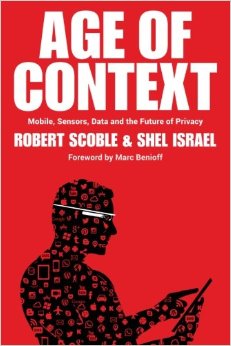
Age of Context Cover

I’m not in the habit of reviewing books, but I have a special interest in this one, not merely because I played a role in its production, but because of what the book means to us culturally and economically. What follows is the review I posted on Amazon.

I have long been enamored of the concept of Systems Thinking, which holds (among other things) that systems cannot be understood absent their context, the interrelationships of components within each system and with other systems of which they are a part (or are a part of them). In my career I have often heard it said “context is king.” I am predisposed to look for the contextual interrelationships in all things I attempt to understand.

It was nearly a year ago when Shel Israel posted a request for help on Facebook. He was looking for people who could serve as fact-checkers for his and Robert Scoble‘s new book. At the time, I responded and suggested I could serve as his proofreader. He accepted. Thus began a wonderful adventure. Soon I was proofing Shel’s columns in Forbes (q.v.) under the general title “The Social Beat”. Most of them were portions of what would become the chapters of this book “Age of Context”.

Since that time, I have proofed nearly every column he’s written related to the book, as well as each chapter that ultimately became this wonderful book. I also outlined at least six of the chapters for the authors to use in interviews and at speaking engagements and, toward the end, ended up checking each hyperlink and compiling them into a single document.

I bring all this up in part to reveal what surely has the appearance of a conflict of interest in my recommending you purchase and read this book. However, the greater part of what I’m revealing is how thoroughly it moved and excited me. I will admit to being a techno-geek, and I am naturally drawn to shiny new things. I am somewhat prejudiced. However, Robert and Shel have carefully scoured the tech world and now present their findings and conclusions, and many of them should fairly knock your socks off. I can’t tell you how many times I practically came out of my seat as I was reading about their discoveries. It made it hard at times to do my job. Frequently, I wanted to add my own comments to what they were explaining. I somehow managed to contain my excitement. It’s their book, after all.

In “Age of Context” you will find dozens and dozens of applications and approaches that seek to more completely understand, and integrate into, various aspects of our lives. Whether in the home, at work, or at play; whether in their approach to health, recreation, designing and building cities, or marketing product intelligently, Robert and Shel bring together (put into context, if you will) what these developments mean and how they can — and most likely will — improve our lives. They also recognize, and in no way gloss over, the important issues of privacy and safety many of these developments raise.

Yes, I am somewhat prejudiced. However, I feel quite safe in saying this is an important book. I don’t care for the term “futurist”, but I’d like to think I can recognize some of the next big things. There are a lot of them in this book. You owe it to yourself to understand the coming storm of innovation and change the authors so presciently offer.

Buy it at Amazon
My Review on Amazon


In the Nick of Time, Siri to the Rescue

Siri

Siri to the rescue!

Siri may be far from perfect, but she is proving to be a boon for me. To be fair, my last phone was an Android (an LG Optimus, actually) and it not only was capable of voice recognition, it also had Swype.

Why this matters to me has to do with the onset of a common malady it turns out ran in my family and is now affecting me quite a bit. I’m talking about essential tremor, which can manifest in several ways; for me it’s in my hands, which sometimes shake rather uncontrollably. This can make it both uncomfortable and time consuming when typing a reasonably lengthy message on a small, smartphone keyboard. Eating with a fork or spoon can be pretty interesting as well.

I used Swype quite a bit on my LG, but the shaking still made it a bit difficult to spell correctly . . . or even choose the correct word when I was presented with choices. The reason I got rid of the Optimus, however, has to do with it having far less memory than I wanted in order for the phone to be truly useful. That is, as a smartphone . . . far more than just a mere telephone.

Even with a mere 16Gb, my new iPhone 4S allows me to have all the apps I need to stay current with my social media friends and platforms. It also allows me to take lots of pics and even use some photo editing apps to mess with them if I like.

So, I find myself using Siri more and more to save time. I still have to make frequent corrections, but I’m learning to speak a little more deliberately as well. I fully expect the technology to continue developing, hopefully to the point where she will even recognize vocal inflection and add exclamation points and question marks when warranted.

Thank you, Siri. Thank you voice recognition developers. You have made my life a lot easier.


Excerpt From “Age of Context” – Sensors

If you want to get a better understanding of where our phones, tablets, autos, goggles, glasses, and medical devices (among many others) will be taking us in the next few years, check out this extract in Forbes from Shel Israel and Robert Scoble‘s upcoming book, Age of Context. This chapter extract is on sensors, the use of which is exploding in dozens of fields and applications world-wide. Were you aware the average smart phone has a total of seven sensors in it, and you probably use every one of them every day?

Shel and Robert (also know as Scobleizer) are writing their second book on the changes they see coming as the result of advances in technology. Their first book, Naked Conversations: How Blogs are Changing the Way Businesses Talk withCustomers, was published over seven years ago (January 2006) and made the case for business blogging. In it they suggested blogs offered businesses something that had long been lacking in their communication with customers — meaningful dialogue. Today we see many businesses carrying on honest, meaningful dialogue with their customers through the use of blogs and, as the authors also suggested, other forms of social media.

They’re also asking for feedback prior to publication. Here’s your chance to put your two cents worth into what I believe will be an important book on technology, culture, and commerce.

To give you an idea of what they’re talking about when discussing sensors, here’s a video with Robert interviewing Yaniv Vakrat, of Primesense, about their sensor capabilities and what they portend for commerce and retail analytics, among other things. Primesense developed the sensor technology used in Microsoft‘s Xbox Kinect.