Author Archives: Rick Ladd

About Rick Ladd

Unknown's avatar
I retired over14 years ago, though I've continued to work on and off since then. Mostly I'm just cruising, making the most of what time I have remaining. Although my time is nearly up, I still care deeply about the kind of world I'll be leaving to those who follow me and, to that end, I am devoted to seeing the forces of repression and authoritarianism are at least held at bay, if not crushed out of existence. I write about things that interest me and, as an eclectic soul, my interests run the gamut from science to spirituality, governance to economics, art and engineering. I'm hopeful one day my children will read what I've left behind.

Occupy Communities

The title for this post comes from a session my friend, Trisha Liu, has proposed for this June’s Enterprise 2.0 Conference in Boston, MA. I came across it the other day quite serendipitously while checking a few Twitter streams on my iPad as I waited for my car to be washed. The title caught me eye immediately as anyone who knows me will understand, especially when read in its entirety, viz “Occupy Communities: Social Media Training for the 99%”. If you have a moment please visit the page and, if you agree it’s a great idea, leave a comment saying so.

Despite the call to my base political instincts, upon reading Trisha’s idea there were several reasons her proposal resonated with me. Foremost, Trisha is addressing the fear of adoption of social tools for business (i.e. inside the organization, behind the firewall, and dedicated to facilitating the business processes that carry the enterprise forward in its mission). I spent many years at a staid old aerospace company beating my head against a wall of resistance fueled by this fear. She refers to it as “SoMe-itis” and breaks it down into the following components:

  • Shock: “Help!! My company wants me to ‘be social’!”
  • Split personality: “Do I have to be a nerd/extrovert/Millennial to ‘be social’?”
  • Dry mouth: “How do I choose what to ‘say’ in social media?”
  • Anxiety: “What if I say something dumb?”
  • Low self esteem: “Will people care about what I have to say?”
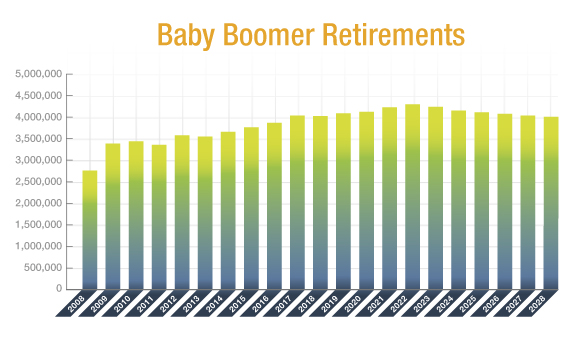
Baby Boomers Eligible for Retirement

This "Crisis" is NOT Going Away

Additionally, although I am interested in, and have dealt with, all of these issues people face in the course of introducing a social tool into the workplace, there is one of them I’m currently more interested in than others; that’s the second one she lists. Even more specifically, one of my main interests centers on the question “Do I have to be a Millennial to ‘be social’?” I even tweeted Trisha and asked her if I could use her proposal as a basis for a portion of my business model:

https://twitter.com/#!/rickladd/status/164839087180742656

A friend told me recently he’s been hearing more and more concern from large organizations about the upcoming wave of retirements from my generation – Baby Boomers. He is not alone. A decade ago, when I first started doing Knowledge Management work for Rocketdyne, one of the most important issues we wanted to address was the looming wave of Boomers who would be reaching retirement age and the threat that posed for the collective knowledge of our organization. As a company that designed, manufactured, tested, and flew the world’s most sophisticated rocket engines (including the Atlas, Delta, and Space Shuttle Main Engines), each of which had long histories and service lives (as systems, not as individual units), continuity of our knowledge was of paramount importance. Those of us who were actively pursuing KM were very concerned we would fall below a critical level of skill and jeopardize the safety of the Astronauts who flew the Space Shuttle.

Unfortunately, although lots of lip service was paid to the “looming” problem – as well as a lot of time and money likely heading off (in retrospect) in the wrong direction, turning that massive ship around was virtually impossible. Now that the program is over and there was nothing already in the pipeline to replace it, my alma mater is bleeding talent on a regular basis. I suspect there are lots of organizations facing this “crisis” as well. I’d love to be able to help them out . . . and here’s my business model (at least a portion of it; I’ve other things in the works as well).

With the growing number of Baby Boomers set to retire – or even partially retire (like I have) – and not reaching a crescendo for another decade, the issue we once dealt with as a Knowledge Management problem I now believe is one of acceptance of social media inside the firewall, i.e. the development and use of communities, facilitated by tools and leaders trained in their use as a knowledge transfer process. We spent many years finding and categorizing hard-copy and digital media. We’ve spent countless hours and dollars on exit interviews and video recording of retiring employees. All the time we kept saying tacit knowledge (the knowledge people carry around in their heads) was something like 80% of the actionable and useful knowledge possessed by an organization.

I have argued for some time that social media IS the new knowledge management. Although it’s now a bit old, I have a presentation on SlideShare I originally prepared for my cohort at CSUN‘s Tseng College, shortly after I finished a Masters program in KM. Sadly, though not surprisingly, the program no longer exists. I believe this is partly because they failed to recognize the power of social media to do what KM really needed to do. As practiced, in my experience KM was far more like Library Science. What is happening now is a sea change, a phase shift that employs technology capable of connecting people in real-time, while also providing a level of archival, indexing, and search capability that allows for historical knowledge discovery as well.

However, I’ve also experienced a high level of resistance to accepting what I consider to be inevitable. I can only speak for the aerospace industry, but I struggled to implement social business capabilities for nearly a decade and, as far as I can tell, my former organization is still fairly resistant to the possibilities it provides. This is the issue I believe others are encountering as well, and it is what Trisha’s presentation is all about. A more specific interest of mine is in gaining acceptance from the group of people who will be retiring within the next decade or so. I believe it’s important to engage older, soon-to-be retiring employees in the use of social business tools, not to “pick” their brains, but to provide a forum for interaction with their younger employees, within the tool (embedded within the processes they are currently employing, if possible), so their knowledge can be slowly transferred to those who will follow in their footsteps.

As a Baby Boomer who is entirely comfortable with the use of these kinds of tools and the behaviors that must exist in order for them to be effective, I believe I have a unique perspective to offer organizations who wish to engage their “more mature” employees. Many of them think they are incapable of understanding them or that you have to be young to employ them. Worse still, many have been influenced by the media’s depiction of tools like Twitter, Facebook, and YouTube such that they are currently incapable of seeing the value in micro-blogging, status posting, and video sharing to an organization’s ability to improve how they get things done. I – and, I’m sure, many others like me – can reach these employees far more easily than their younger colleagues, if only because we have the same generational backgrounds and have (or have dealt with) similar fears and anxiety.

This is why I believe Trisha’s presentation is important. It may not address the more sophisticated aspects many in the Enterprise 2.0 (or Social Business, whatever we wish to call it) world are concerned with as they mature and evolve their theory and practice, but it does directly address what I believe is a core issue with the effective use of these tools in our various organizations. Without acceptance, I am convinced the tools and practices that facilitate the sharing and use of “The Corporate Memory” will remain on the periphery of the enterprise and likely chew up more time and money than they’re worth and, in doing so, become more of an anchor than a sail. My goal here is not to delve too deeply into the many nuances of this issue – e.g. Tacit vs. Explicit knowledge, cultural change, the role of Executive leadership, etc. I will save that for further posts. However, I do think acceptance is a huge millstone hanging from the neck of many an organization. Am I too pessimistic? What do you think?

Graph Courtesy of InContext


Chillaxin . . . sin Robaxin.

Takin' it easy

No Me Jodas, Chico!

This is one of those days when I really haven’t felt like doing much of anything. I did chop up and remove the Bougainvillea that’s been outside the Living Room window for 15 years and has finally outlived its usefulness. However, I enjoyed the company of my neighbor and close friend Marty while doing so, along with a couple of beers and at least two shots of Scotch. In fact, he lent me the big jaw clippers I used to chop up the thickest parts of that damn beautiful yet thorny vine!

I also translated the first “Social Menu” I’ve ever seen, which was in the form of a .jpg file and was in Danish – forcing me to actually type out the text in to Google Translate rather than merely copy and paste it and, I’ll admit, I spent some time on a very serious post I’ll publish soon. Sometimes it’s necessary to be thoroughly incorrigible . . . and today just happens to be that day. Maybe it was five beers and a few shots of Scotch. Who’s counting?

Photo Courtesy of ¿Se Escucha?


To The Moon, Alice!

Moon Colony

Some Day This Should be all Ours

The other day a friend of mine posted an interesting item on his blog, Global Neighbourhoods (love that other side of the pond spelling) and asked on Twitter if anyone had read it. I saw the tweet because it was ported over to my Facebook news feed. I answered I hadn’t, but would shortly . . . which I did. Shel makes an interesting point that, regardless of how one may feel about Newt Gingrich – and we both agree we wouldn’t vote for him even if Hell froze over – his idea about establishing a colony on the Moon isn’t such a bad one. Consider that President Kennedy’s call to put a man on the Moon preceded an unprecedented growth in innovation through the technologies that needed to be developed in order to accomplish the feat required by the Apollo program.

Shel goes on to ask that we think about what such an endeavor might mean for us, regardless of the situation we are in right now. As he says:

“It seems to me, that what makes us unique from other animals is that our entire history is based on going beyond what we have done. Before we consider the benefits or catastrophes, we simply have to see if we can do it.

“Why should man walk on the moon? Because some day, we can build a colony on it? What will we do then? Look around and see what else we can do, where else we can go, we can learn more about the moon, and thus about the earth and our universe and how life got to here and anywhere else that it might exist.

“And yes the cost is huge at a time when people are losing their homes. But to me, the cost is an investment, one that will create a great many new jobs that may be more appealing than the manufacturing our current president seems to be focused upon.

“What we learn along the way will give the world new technology that is likely to pervade into computing, science, medicine, earth sciences, the classroom and places that we cannot yet imagine.”

I responded the next day in a comment. As of the date of this posting, it still says it’s waiting moderation but, hopefully, by the time most read this it will have been posted. Suffice it to say I agree with Shel’s assessment of the technologies it will create and that it is an investment. I also have another, long-standing reason I believe we should go back to the Moon and establish a permanent presence there, which I have set forth in my comment. I have also written about it several times in various posts on this blog. I encourage you to read Shel’s post. Tell him I sent you.

Photo Courtesy of Dallas1200am


A Quick Quora Quest

The Coastline of Atlantis

How Long Was The Coast of Atlantis?

I had to test posting this here directly from Quora . . . because it’s there (here) and I could . . . and it worked!

OK, so I’m not a Software Engineer. Heck, I’m not even an Engineer, but I did sleep in a Holiday Inn a few times; plus, I worked with Rocket Scientist, Engineers, and Mechanics for over two decades, so I know a little bit about the animal. I also worked in Project Management, including some software development and IT architecture efforts.

This is a really good – and entertaining – analogy of the problem posed in the question. Make sure you read the comments as well, because there are some add-ons that extend the analogy to include other issues not raised directly by the author of the answer. There are 80 answers to the question, but read the top one; the one that got well over 3500 votes. Read the others as well if you want to. Far be it from me to tell you what to do. While you’re at it, if you haven’t been to or heard of Quora before, you might want to check it out.

Engineering Management: Why are software development task estimations regularly off by a factor of 2-3? 80 answers on Quora

Why are software development task estimations regularly off by a factor of 2-3?

Photo shamelessly stolen from Professor Tomasz Zastawniak


TED, Alain de Botton, and Atheism 2.0

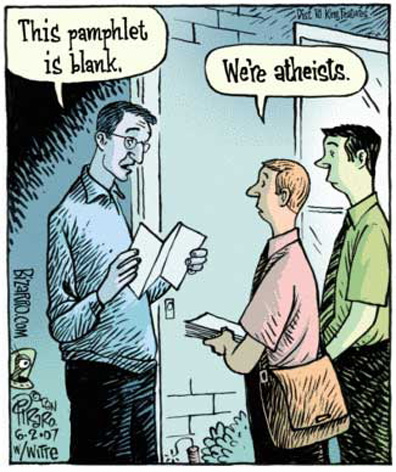
Atheists Proselytizing

Atheists Proselytizing

I recently was pointed to a wonderful TED Talk, which I’m sharing here, that brilliantly addresses an issue I have struggled with for years. This issue can best be understood in several concepts that Alain discusses in this talk, which I’ll leave you to in a moment. I’ll come back to this, and other, issues regarding faith, religion, morality, ethics, community, etc. in later posts no doubt.

I have what I think is a very simple, very open attitude toward religion or, more accurately (because religion is an entirely different animal from . . .), faith and how we should exercise it ourselves and respect it in others. What you believe in terms of a higher power is really none of my business and should in no way affect my relationship with you. It seems to me that how we live our lives, not what we say we believe or have faith in, is the most important discriminator in how well we can work together in pursuit of common goals. The only thing that can botch any chance of our having a relationship is if you insist that your belief is superior and, therefore, I must accept it to be truly worthy. Pull that on me and I become stone deaf.

A respected Law Professor of mine once said if he had to choose between someone without what he would consider the “right” politics, but who was nevertheless a good person, and one who had the “right” politics, but was lacking in the humanity department, he would always choose the former. I believe we can replace the word “politics” with “religion” and it is equally true. I am far more interested in how you treat other people and your relationships, whether business or personal, than I am in what you believe in.

Getting back to the video, Alain addresses his concept of atheists better understanding the good things religion has inspired people to create and bringing into our lives. He points out how community, art, and music – among other things – are lacking amongst atheists – as a group; and I think he’s right. As a group, I believe ethics and rational morality play a big role in how we see the world. I often say that if the only thing making you a good person is your fear of being punished in an afterlife, you really need to think about your priorities. For me, being a good person and living an ethical, honest life is reward in and of itself. However, we have few ways (I have none) of enjoying community in how we view our place in the cosmos . . . because there aren’t any.

I’ll let the video speak for itself. Check it out. It’s excellent on the subject. I plan on watching it again soon.


You Can’t Hold on to Anything

Beauty and Death

Coveting Kills

I was reminded by a post from one of my Facebook friends that we lose many things in our lives by trying too hard to hold on to them. Many years ago I  had a girlfriend who had been a high-fashion model, working runways and some of the glitzier magazines of the day, including Cosmopolitan, Town & Country, etc. I met her through our mutual activity in the anti-war movement, including our work with the Vietnam Veterans Against The War. She had gone to Vietnam several times as a USO entertainer.

She was, as she put it, getting a little “long in the tooth’ and her modeling days were pretty much over (she was seven years older than me and I was approaching 30). She was constantly worrying about how old she looked, spending what I thought was an inordinate amount of time on her makeup and hair, especially if we were going out. One day it dawned on me just how much the constant worry was causing her to accelerate the aging process. Through the act of worrying she was actually making herself look older. I told her that and, frankly, I don’t think it made much of a difference to her. She was caught up in a “death spiral” of concern for losing something it’s impossible to hang on to.

It – as so many things do – also reminds me of the lessons I learned from reading Alan Watts‘ Book “The Wisdom of Insecurity“, the most important of which is that there is no such thing as security and absolutely anything can be snatched from you at any time; including your health, life, etc. Alan points out the futility and self-destructiveness of trying to hang on to things and the paradoxical value of “letting go”. He bases his teachings on those of Zen Buddhism. Currently, I’ve read the book three times over the years . . . and each time it has either drastically changed how I saw things or comforted me in my acceptance of things I couldn’t change. I recommend it highly.


Health News – Neuroscientists Find That Status within Groups Can Affect IQ

NOTE: This is the first time, to my recollection, I’ve posted directly from Posterous. I’m not sure how I want to deal with this, but thinking I’d rather share a link to the article than the whole damn thing. Nonetheless, this is a fascinating look at how social status can affect intellectual performance, which points out yet again the impossibility of understanding anything well in isolation from the system – or environment – within which it exists and operates. My comments from Posterous are at the end.

PASADENA, Calif.—Our cognitive abilities and decision-making skills can be dramatically hindered in social settings where we feel that we are being ranked or assigned a status level, such as classrooms and work environments, according to new findings from a team of researchers from the California Institute of Technology (Caltech) and four other institutions.

The finding flies in the face of long-held ideas about intelligence and cognition that regard IQ as a stable, predictive measure of mental horsepower.

“This study tells us the idea that IQ is something we can reliably measure in isolation without considering how it interacts with social context is essentially flawed,” says Steven Quartz, professor of philosophy at Caltech and one of the authors of the new study, which appears in the current issue of Philosophical Transactions of The Royal Society B. “Furthermore, this suggests that the idea of a division between social and cognitive processing in the brain is really pretty artificial. The two deeply interact with each other.”

“You may joke about how committee meetings make you feel brain-dead, but our findings suggest that they may make you act brain-dead as well,” says Read Montague, director of the Human Neuroimaging Laboratory and Computational Psychiatry Unit at the Virginia Tech Carilion Research Institute and corresponding author on the paper.

To investigate the impact of social context on IQ, the researchers divided a pool of 70 subjects into groups of five and gave each individual a computer-based IQ test. After each question, an on-screen ranking showed the subjects how well they were performing relative to others in their group and how well one other person in the group was faring. All of the subjects had previously taken a paper-and-pencil IQ test, and were matched with the rest of the group so that they would each be expected to perform similarly on an IQ test.

At the outset, all of the subjects did worse than expected on this “ranked group IQ task.” But some of the subjects, dubbed High Performers, were able to improve over the course of the test while others, called Low Performers, continued to perform below their expected level. By the end of the computer-based test, the scores of the Low Performers dropped an average of 17.4 points compared to their performance on the paper-and-pencil test.

“What we found was that sensitivity to the social feedback of the rankings profoundly altered some people’s ability to express their cognitive capacity,” Quartz says. “So we get this really quite dramatic downward spiraling of one group purely because of their sensitivity to this social feedback.” Since so much of our learning—from the classroom to the work team—is socially situated, this study suggests that individual differences in social sensitivity may play an important role in shaping human intelligence over time.

During the computer-based test, about a third of the subjects underwent brain scans, using functional Magnetic Resonance Imaging (fMRI). This type of imaging allows scientists to track increases in oxygenated blood flow, indicating heightened activity, in the brain. At the start of the test, researchers observed increased activity in all the participants in a brain region called the amygdala, which is associated with fear and emotional arousal. Among High Performers, that activation decreased over time, while it remained steady in Low Performers.

“What is causing the Low Performers to be hindered by the social context is something for follow-up studies, but certainly the suspicion is that it’s a dimension of personality that is driving the difference,” Quartz says. That dimension could be neuroticism, the tendency to worry or to ruminate about social information. “The pattern of activity that we see originally in both groups, but especially in the low-performing group, is quite similar to the pattern of activity you see in studies looking at the neuroscience of neuroticism.”

The researchers also tracked activity in the nucleus accumbens, a part of the brain involved in the processing of rewards. They observed elevated activity in the nucleus accumbens when a subject’s rank within the group increased. “That shows that the task was motivationally important to people,” Quartz says. “When they saw their rank go up, that was a reward.”

The idea for the new study came, in part, from a study published in 1999 in which researchers from Emory University examined social rank—a strong and extremely motivating signal among primates. It has long been known that even monkeys that have never met before can quickly sort themselves based on social standing within the group. The Emory researchers isolated low-ranking rhesus monkeys and taught them a learning task. They found that in the presence of high-ranking group members, the monkeys who had learned the task acted as though they were not familiar with it.

“Social rank isn’t as well understood in humans,” Quartz says. “So we wanted to see what would happen when social rank becomes salient in a group of humans, as it does in most real-world learning environments. We wanted to see if this has an effect on the expression of IQ.”

Throughout the 20th century, IQ was used in different arenas as a way of sorting or classifying people into niches. Because people believed it to be a more abstract notion of cognitive ability, it was thought to have strong predictive validity of mental capabilities even from age six. But IQ was always measured in social isolation. “That reflects a long tradition of intellectual history, of considering rationality and cognition to be this isolated process,” Quartz says. “But one of the things that we’re learning more and more in social neuroscience is the role of our social contexts and the social adaptation of the brain.” Understanding the role social context plays and its differential impact on the brain may ultimately help educators and others to design more effective learning environments.

The present study found some unexpected trends, including the tendency for female subjects to be more affected than males by the implicit signaling of social status during the test. Although all of the subjects scored similarly on the paper-and-pencil IQ test, 11 of the 14 Low Performers on the ranked group IQ task were female, while 10 of the 13 High Performers were male. Due to sample size limitations, additional studies are needed to validate the finding and to investigate possible causes.

In addition to Quartz and Montague, additional authors on the paper, “Implicit signals in small group settings and their impact on the expression of cognitive capacity and associated brain responses,” are Kenneth Kishida of Virginia Tech Carilion Research Institute, Dongni Yang of the Baylor College of Medicine, and Karen Hunter Quartz of the University of California, Los Angeles. Montague is also affiliated with the Wellcome Trust Centre for Neuroimaging in London. The work was funded by the Wellcome Trust Principal Research Fellowship, the Kane Family Foundation, and the National Institutes of Health.

# # #

Written by Kimm Fesenmaier

Deborah Williams-Hedges
626-395-3227

The part of this I find fascinating, even though I’m tempted to point out I’ve always found meetings a bit mind-numbing, is the apparent systemic nature of IQ and overall cognitive ability, and it’s (again apparent; more research is in order) cultural sensitivity. The apparent gender bias, for instance, tracks well with much previously observed behavior. I suspect there would be other, similar results in the future related to less generic (genderic?) aspects of culture as well. Vewy intewesting!


Atlas Slugged

The Republican Candidates

Republican Primary Candidates Pose

This is a wonderful analysis of the competing approaches and philosophies of Mitt Romney and Newt Gingrich. You can read the entire article, but I find the final paragraph says volumes about what this year’s election means, and the direction our country is going in. Click on the link at the bottom for the entire article. Here’s that final paragraph:

“We’ll find out this election whether the Republican vision of an unfettered capitalism—one that redefines ‘socialism’ as not state ownership of the means of mass production but any government involvement whatsoever in the social and economic life of the country (including saving the auto industry)—is one that the public accepts anymore. Pundits have argued that the central question of the campaign is how much government we want. It’s more profound than that. The question of this election is what it means to be a country—whether we’re 300 million free agents who happen to be roaming the same piece of real estate or if any of us is ever bound by a social compact.”

via Atlas Slugged.


Giving this a test drive on my iPad

iBooks Author

iBooks and iBooks Author

Giving this a test drive on my iPad. Apple just released the updated version of iBooks today. They seem to be adding textbooks as I look. I’m downloading a free version of “Life on Earth: An Introduction” to see what it’s like. Text books are $14.99 or less!

NB – I posted this using HootSuite. Wasn’t sure how it would come out and I’m not enitrely happy with the result, but I’m editing it so I can keep it here.

UPDATE:

After installing the free textbook “Life on Earth: An Introduction”, I opened the book to see what it looked like. It started with a video that only played the audio and, when done, I found myself stuck in the app with nothing more than a grey, linen-like background and no discernible way to exit the app. I’m not sure how I eventually got out of it, but I did. I invoked the book again and this time the video played nicely. When it was done a table of contents appeared and started to skim the book. There is lots of interactive content available. However, after tapping on one of the numerous videos I was completely dropped out of the app (a problem that happens all-too-frequently with my iPad, I’m afraid) and, when I returned I was brought back to the very beginning, having to listen to the introduction again. I resumed my exploration and once again had problems with a video not playing properly, leaving me with that dismal grey screen again. This time I shut down the device and started it again. I assume that’s the equivalent of a cold boot.

After exiting the app entirely, I just started it up again. Unfortunately, although it brought me to the page I had left from, no sooner did it load then it dropped me back to the grey screen of death. At least I’ve been disabused of the notion that Apple’s just might be far superior to PCs. Sometimes I find myself sorry I didn’t spend my money on something else. I’m not pleased at this point. What I’ve seen of the textbook I have is exciting and makes me wish I was a few decades younger, as I think learning in school would have been far more interesting had I access to this type of book. Now I just need to figure out why the damn thing keeps dropping me out so thoroughly.


I Can Be This Boring. Really!

How many incredibly boring presentations have you sat through? How many times have you either missed just about everything that was presented because it was impossible to concentrate or you desperately wanted to get up and leave, only to remain because you didn’t want people to think you were uninterested in the subject or disrespectful of the presenter? As a former employee (now retired) of a large aerospace organization, I can tell you I have struggled mightily to stay awake through many a presentation consisting of literally dozens of bulleted PowerPoint charts being read, word-for-word, by the presenter, usually an Engineer . . . as a class not well-known for being the most exciting of speakers.

There is nothing quite so boring as a presentation where the person standing in front is reading the words you are quite capable of reading yourself, much faster than they can be spoken. As pointed out by both Edward Tufte and Richard Feynman, this kind of presentation is not only boring, but can be quite dangerous when used to convey (or obfuscate) critical information needed to make a life-and-death decision, such as those made with respect to both the Challenger and the Columbia disasters.

Admittedly, most presentations don’t convey life-and-death information, and I’m surely not implying they be given the same weight and import. However, there’s usually a reason, frequently a very good one, a presentation is being given and people are spending a portion of their precious time attending it. In that spirit and, thanks to Gil Yehuda and a Facebook share, I give you: