Monthly Archives: February 2012

Are You, or Should You be, Shopping Local?

Shop Simi Valley First Logo

My City's Logo for Encouraging Local Shopping

There are several commercial “movements” gaining steam nowadays expressing the desire of smaller communities to get residents spending more of their money at local, usually small, businesses. Small Business Saturday’s Facebook page has almost 3 Million “Likes”. My city of Simi Valley has spent a fair amount of money promoting the concept. Locally it’s called “Shop Simi Valley First“. Unfortunately, the money that was used to create the website and other marketing efforts to support it has now dried up, possibly never to return. On the bright side, some of our citizens created a Facebook page for them and it’s approaching 1K “Likes”. It might increase now that the “official” effort is unfunded. I think this is a good thing and here’s why.

For the last year or so I have been gently pushing the city, and local small businesses, to recognize the power available to them in the use of social media to market themselves, as well as to create connections that just haven’t been possible in the past. I think, when it comes to marketing – especially in terms of encouraging local residents to patronize small businesses in our city – the connectivity and mutual support provided by services like Facebook, Twitter, and Yelp may prove a decisive factor in reasonable, if not substantial, growth.

As I see it, local small businesses can use these services not merely to promote themselves individually but, as long as there’s no conflict of interest, they can also promote each other. Here’s what I imagine happening.

Let’s say you have a restaurant that serves a reasonably upscale clientele. You know there is a certain demographic that’s not terribly likely to frequent your business. Maybe they’ll patronize your place on special occasions, but not regularly. Would it be a bad thing to give props to other eating establishments more desirable or affordable to those people? Would it threaten your business or might it not actually result in your being recognized as more friendly and approachable? I’m betting the latter is more likely.

Perhaps you own a clothing store, a dry cleaners, or you’re a Dentist or other professional or service provider. I see no reason why you can’t agree with other businesses to post on each others’ Facebook pages once in a while, sharing what you have to offer or special deals you’re running at the time. Frankly, I haven’t worked out all the details in my head yet. I’ve tried to work with local businesses and the City to encourage this type of practice using social media but, much like my experience at Pratt & Whitney Rocketdyne, I’ve met a lot of inertia and resistance to change, even in the face of impending closure or bankruptcy. Part of it is a lack of understanding and part of it is a lack of resources, but the result is the same. Nothing much is happening.

What I envision happening is essentially two-fold. The first thing is that participating businesses benefit from the following of the other businesses on whose Facebook pages they promote themselves. This increases the likelihood of their being noticed by a larger group of residents. Secondly, it also increases the chances people in outlying areas will become aware of local businesses, thereby increasing the possibility people from neighboring cities may drive on over and patronize our local businesses a bit more frequently.

Does this make sense to you? What do you think about promoting local small business and how well do you think the use of social media platforms like Facebook, Twitter, and Yelp can increase awareness of certain types of businesses? I’d sure like to see a more coordinated, concerted effort at making it happen.


Can I See You Now?

Reading Glasses

Life Savers for a Bibliophile

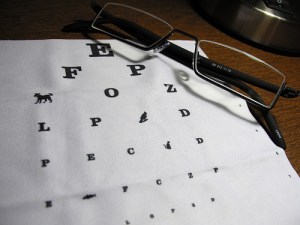
A little while ago I wrote about one of the “interesting” challenges I’m facing as I grow older. I was reminded the other day of another challenge; one that’s been around for a while but is taking on a slightly new dimension.

I have been wearing bifocals since I was about 40. Many people need glasses early in life, but almost everyone eventually suffers from Myopia as they age and need reading glasses. At the beginning I really didn’t need much more correction but, since reading was so important to me and an exercise I indulged in quite frequently, I decided to forego them in favor of full size spectacles. I did have a very slight astigmatism, which my lenses corrected for, but I would have been fine without them. This way, however, I didn’t have to wear something around my neck or have to continuously reach for a case to take out – and replace – my glasses in order to read.

As the years went by, I reached a point where my astigmatism was such that I needed the regular lenses as well and by then I was used to wearing glasses all day long; had been for years. I never even considered contact lenses as I didn’t think the extra work was worth it for whatever convenience (and vanity) it might afford. I even had a special pair of glasses made specifically with only my regular prescription, which I used exclusively for practicing and playing golf.

About a year or two ago, while I was driving (a car, not a golf ball) I happened to look at what I thought were a couple of birds flying in an amazingly tight formation. I remarked to my wife about the incredible closeness in which those two birds were flying. She looked at me like I was a bit nuts and pointed out there was only one bird. It wasn’t long before I realized my vision had finally begun to deteriorate a little more.

Unfortunately, by then I no longer had vision insurance and I just wasn’t prepared to spend a lot of money on a new prescription and new glasses. I resolved to deal with it for as long as I could, but I’m getting tired of seeing every star and planet in the night sky with a small companion to its lower left. The Moon is now a somewhat featureless circle too. The other day, while driving to pick up my daughter from gymnastics, I noticed two women jogging closely together as I glanced down a side street I was passing. I knew there was really only one person, as they were both wearing the same exact clothing. I guess it’s about time to fix this before I become dangerous.

Photo via Flickr by Mr. T in DC


A Collection of Memorable (and Useful) Quotes

Air Quotes

"Thus Quoteth Zarathustra"

I’m always thinking of ways in which I can post things that are interesting and, hopefully, useful to those of you who take a little precious time out of your day to visit my blog. I’m a big fan of quotes and, rather than throwing a few out here and there – at least for right now – I just discovered my friend, Euan Semple has a nice collection of them on his website. So, I thought I would share them with you.

I find there is much wisdom to be gained from well-selected quotes of famous, and not-so-famous, people. Euan’s are really good. So, please take a moment and click on this link. You won’t regret it. My thanks to Euan for sharing his latest update of the page on Facebook.

Here’s one of my favorites: “There is nothing so useless as doing efficiently that which should not be done at all.” – Peter Drucker

Photo from All For Hymn


Strange Retirement Pastimes

A Whimsical Mailbox

Beam That Junk Mail Down Scottie

Being semi-retired (or, as I like to think of it, part-time retired) has its advantages. It is, however, a strange time for me and, I imagine, for most people who find themselves suddenly idle or at least not having to be somewhere every weekday. After so many years of working, not having to do anything in particular is a bit on the weird side.

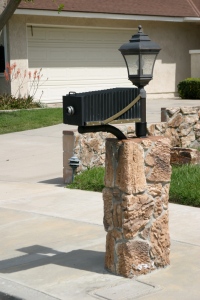
To tell the truth, I have been looking for something useful to do almost since the day I left Rocketdyne, but I have taken some time to – shall we say – smell the roses. One of the things I did was to find myself driving around local neighborhoods looking for, and taking pictures of, interesting curbside mailboxes. This happened because we had a nice brick mailbox built for our house and I suddenly developed an interest in them. I never much bothered looking before.

Camera Mailbox

Smile! You're on Candid Mailbox

So I started driving around looking for exemplars of particular types, e.g. brick, wood, stone, and especially whimsical ones. I discovered it was a gold mine and before I knew it I had close to two hundred pictures of various types of mailboxes, all suburban, curbside ones. What to do with them? I considered several things. Creating a coffee table book; writing an illustrated ebook; etc., as well as using the collection to develop a useful taxonomy, thereby getting some practice at the type of organization necessary to do it right.

Then someone suggested I create a blog and share the pictures. Well, since I already had a blog (this one!) on WordPress, I thought that was a great idea and I created “Going Postal”. So, here I’m sharing a couple of pictures of my favorites, along with the link to my other blog. I’ve still got lots of pictures, I’ve been sent a half dozen by friends and even a person I don’t know, and I expect I’ll get out there again and take a few more. I’ve seen some more interesting mailboxes lately.

I am also using the blog to sort of memorialize this suburban icon, as I am fairly convinced mail as we know it will soon disappear. It just makes too much sense. If most people are like me they throw away much of what they get and we all know it’s just a huge waste of paper. Anyway, I discuss my prognostication a bit on Going Postal. You can read it there if you like.


The Autumn of My Life

To every thing turn, turn, turn, there is a season turn, turn, turn . . .

Autumn Leaves

The Beauty of Autumn

These words – originally from Ecclesiastes, made into a song by Pete Seeger, and as I first heard them sung in 1965 by The Byrds – are beginning to resonate for me more deeply than ever before. At almost 65, I am now well into the Equinox of my life. I am beginning to look back at what I’ve accomplished, what I think it means, and how I wish to apply what I’ve learned to what remains of my time on this planet.

Lest you think I’m being melancholy, I’m not . . . though I will admit to occasionally feeling as though time has slipped by far too fast. However, I have a trick I use to deal with that and I’ve been doing it so long I really don’t think about it much any more.

I’m of the opinion the feeling that time has slipped by far too fast is a low-level form of self-pity. That trick I mentioned is something I used to do many years ago when I sensed I was feeling sorry for myself. I would pick a day, perhaps six months or a year ago, and try to recreate all the things I had done or experienced in the intervening time. I never made it to “today” because I always got bored from “reliving” all those things I had already done. Nowadays, I don’t even have to go through the exercise. I only need to remind myself of its efficacy.

Maybe it is because I’ve had a pretty interesting life, full of wonder . . . and not a little strangeness as well . . . but I’d like to think just about everyone experiences a great deal of variety and special things in their life, if only they could (or would) take the time to appreciate them. Unfortunately, too many of us dwell on the past and obsess over the future, ensuring we are incapable of simply enjoying today.

I often make reference to a book by Alan Watts, “The Wisdom of Insecurity”. I do this because its message is inordinately precious and timeless. It has done for me what I suppose many turn to the Bible for; given me strength and succor when I’ve needed it most. The first time I read it was when I was a young man and a woman I was deeply in love with cast me aside after several months of an intense relationship. Back then I was not in great control of my emotions and was capable of spectacular heights and abysmal depths of feeling. By the time I finished the book I was at peace and had learned the value of letting go; a powerful lesson which has remained with me all these years.

The last time I read it was a couple of years ago while awaiting surgery to remove a Melanoma from my lower back; uncertain if it had spread and not knowing if the time remaining with my wife and two young children would be short. Though at first I cried for what it might mean to my family, especially my girls, both of whom had already lost two fathers (biological and foster), it helped me find the strength to go very quickly to acceptance, greatly minimizing denial and depression, and skipping anger and bargaining entirely.

I am also reminded of these words from the Frank Sinatra version of “It was a very good year”:

 “But now the days grow short, I’m in the autumn of the year
And now I think of my life as vintage wine from fine old kegs
From the brim to the dregs, and it poured sweet and clear
It was a very good year.

Yes, it is the Autumn of my life, but the season is a wonderful one, full of color and change. It’s also a season of harvest and of festivals celebrating the fruit of ones labors. For me, I’m beginning to use it as a time to take stock of all I’ve experienced and accomplished.

Because my wife and I adopted two young girls, the oldest when I was 55 years old, I am in no position to sit back and allow myself to ferment (though I still enjoy various grains in such a state), as I might have done in retirement were it not for my girls. I still have an absolutely wonderful life and am looking forward to at least a couple more decades of activity, learning, and experiencing this incredible journey I feel so fortunate to be on. If you’re willing, I will share my harvest with you and I hope you will see fit to share a bit with me as well. Thanks for reading.


Occupy Communities

The title for this post comes from a session my friend, Trisha Liu, has proposed for this June’s Enterprise 2.0 Conference in Boston, MA. I came across it the other day quite serendipitously while checking a few Twitter streams on my iPad as I waited for my car to be washed. The title caught me eye immediately as anyone who knows me will understand, especially when read in its entirety, viz “Occupy Communities: Social Media Training for the 99%”. If you have a moment please visit the page and, if you agree it’s a great idea, leave a comment saying so.

Despite the call to my base political instincts, upon reading Trisha’s idea there were several reasons her proposal resonated with me. Foremost, Trisha is addressing the fear of adoption of social tools for business (i.e. inside the organization, behind the firewall, and dedicated to facilitating the business processes that carry the enterprise forward in its mission). I spent many years at a staid old aerospace company beating my head against a wall of resistance fueled by this fear. She refers to it as “SoMe-itis” and breaks it down into the following components:

  • Shock: “Help!! My company wants me to ‘be social’!”
  • Split personality: “Do I have to be a nerd/extrovert/Millennial to ‘be social’?”
  • Dry mouth: “How do I choose what to ‘say’ in social media?”
  • Anxiety: “What if I say something dumb?”
  • Low self esteem: “Will people care about what I have to say?”
Baby Boomers Eligible for Retirement

This "Crisis" is NOT Going Away

Additionally, although I am interested in, and have dealt with, all of these issues people face in the course of introducing a social tool into the workplace, there is one of them I’m currently more interested in than others; that’s the second one she lists. Even more specifically, one of my main interests centers on the question “Do I have to be a Millennial to ‘be social’?” I even tweeted Trisha and asked her if I could use her proposal as a basis for a portion of my business model:

https://twitter.com/#!/rickladd/status/164839087180742656

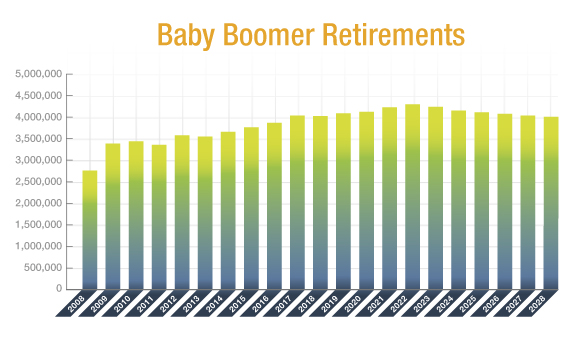
A friend told me recently he’s been hearing more and more concern from large organizations about the upcoming wave of retirements from my generation – Baby Boomers. He is not alone. A decade ago, when I first started doing Knowledge Management work for Rocketdyne, one of the most important issues we wanted to address was the looming wave of Boomers who would be reaching retirement age and the threat that posed for the collective knowledge of our organization. As a company that designed, manufactured, tested, and flew the world’s most sophisticated rocket engines (including the Atlas, Delta, and Space Shuttle Main Engines), each of which had long histories and service lives (as systems, not as individual units), continuity of our knowledge was of paramount importance. Those of us who were actively pursuing KM were very concerned we would fall below a critical level of skill and jeopardize the safety of the Astronauts who flew the Space Shuttle.

Unfortunately, although lots of lip service was paid to the “looming” problem – as well as a lot of time and money likely heading off (in retrospect) in the wrong direction, turning that massive ship around was virtually impossible. Now that the program is over and there was nothing already in the pipeline to replace it, my alma mater is bleeding talent on a regular basis. I suspect there are lots of organizations facing this “crisis” as well. I’d love to be able to help them out . . . and here’s my business model (at least a portion of it; I’ve other things in the works as well).

With the growing number of Baby Boomers set to retire – or even partially retire (like I have) – and not reaching a crescendo for another decade, the issue we once dealt with as a Knowledge Management problem I now believe is one of acceptance of social media inside the firewall, i.e. the development and use of communities, facilitated by tools and leaders trained in their use as a knowledge transfer process. We spent many years finding and categorizing hard-copy and digital media. We’ve spent countless hours and dollars on exit interviews and video recording of retiring employees. All the time we kept saying tacit knowledge (the knowledge people carry around in their heads) was something like 80% of the actionable and useful knowledge possessed by an organization.

I have argued for some time that social media IS the new knowledge management. Although it’s now a bit old, I have a presentation on SlideShare I originally prepared for my cohort at CSUN‘s Tseng College, shortly after I finished a Masters program in KM. Sadly, though not surprisingly, the program no longer exists. I believe this is partly because they failed to recognize the power of social media to do what KM really needed to do. As practiced, in my experience KM was far more like Library Science. What is happening now is a sea change, a phase shift that employs technology capable of connecting people in real-time, while also providing a level of archival, indexing, and search capability that allows for historical knowledge discovery as well.

However, I’ve also experienced a high level of resistance to accepting what I consider to be inevitable. I can only speak for the aerospace industry, but I struggled to implement social business capabilities for nearly a decade and, as far as I can tell, my former organization is still fairly resistant to the possibilities it provides. This is the issue I believe others are encountering as well, and it is what Trisha’s presentation is all about. A more specific interest of mine is in gaining acceptance from the group of people who will be retiring within the next decade or so. I believe it’s important to engage older, soon-to-be retiring employees in the use of social business tools, not to “pick” their brains, but to provide a forum for interaction with their younger employees, within the tool (embedded within the processes they are currently employing, if possible), so their knowledge can be slowly transferred to those who will follow in their footsteps.

As a Baby Boomer who is entirely comfortable with the use of these kinds of tools and the behaviors that must exist in order for them to be effective, I believe I have a unique perspective to offer organizations who wish to engage their “more mature” employees. Many of them think they are incapable of understanding them or that you have to be young to employ them. Worse still, many have been influenced by the media’s depiction of tools like Twitter, Facebook, and YouTube such that they are currently incapable of seeing the value in micro-blogging, status posting, and video sharing to an organization’s ability to improve how they get things done. I – and, I’m sure, many others like me – can reach these employees far more easily than their younger colleagues, if only because we have the same generational backgrounds and have (or have dealt with) similar fears and anxiety.

This is why I believe Trisha’s presentation is important. It may not address the more sophisticated aspects many in the Enterprise 2.0 (or Social Business, whatever we wish to call it) world are concerned with as they mature and evolve their theory and practice, but it does directly address what I believe is a core issue with the effective use of these tools in our various organizations. Without acceptance, I am convinced the tools and practices that facilitate the sharing and use of “The Corporate Memory” will remain on the periphery of the enterprise and likely chew up more time and money than they’re worth and, in doing so, become more of an anchor than a sail. My goal here is not to delve too deeply into the many nuances of this issue – e.g. Tacit vs. Explicit knowledge, cultural change, the role of Executive leadership, etc. I will save that for further posts. However, I do think acceptance is a huge millstone hanging from the neck of many an organization. Am I too pessimistic? What do you think?

Graph Courtesy of InContext


Chillaxin . . . sin Robaxin.

Takin' it easy

No Me Jodas, Chico!

This is one of those days when I really haven’t felt like doing much of anything. I did chop up and remove the Bougainvillea that’s been outside the Living Room window for 15 years and has finally outlived its usefulness. However, I enjoyed the company of my neighbor and close friend Marty while doing so, along with a couple of beers and at least two shots of Scotch. In fact, he lent me the big jaw clippers I used to chop up the thickest parts of that damn beautiful yet thorny vine!

I also translated the first “Social Menu” I’ve ever seen, which was in the form of a .jpg file and was in Danish – forcing me to actually type out the text in to Google Translate rather than merely copy and paste it and, I’ll admit, I spent some time on a very serious post I’ll publish soon. Sometimes it’s necessary to be thoroughly incorrigible . . . and today just happens to be that day. Maybe it was five beers and a few shots of Scotch. Who’s counting?

Photo Courtesy of ¿Se Escucha?


To The Moon, Alice!

Moon Colony

Some Day This Should be all Ours

The other day a friend of mine posted an interesting item on his blog, Global Neighbourhoods (love that other side of the pond spelling) and asked on Twitter if anyone had read it. I saw the tweet because it was ported over to my Facebook news feed. I answered I hadn’t, but would shortly . . . which I did. Shel makes an interesting point that, regardless of how one may feel about Newt Gingrich – and we both agree we wouldn’t vote for him even if Hell froze over – his idea about establishing a colony on the Moon isn’t such a bad one. Consider that President Kennedy’s call to put a man on the Moon preceded an unprecedented growth in innovation through the technologies that needed to be developed in order to accomplish the feat required by the Apollo program.

Shel goes on to ask that we think about what such an endeavor might mean for us, regardless of the situation we are in right now. As he says:

“It seems to me, that what makes us unique from other animals is that our entire history is based on going beyond what we have done. Before we consider the benefits or catastrophes, we simply have to see if we can do it.

“Why should man walk on the moon? Because some day, we can build a colony on it? What will we do then? Look around and see what else we can do, where else we can go, we can learn more about the moon, and thus about the earth and our universe and how life got to here and anywhere else that it might exist.

“And yes the cost is huge at a time when people are losing their homes. But to me, the cost is an investment, one that will create a great many new jobs that may be more appealing than the manufacturing our current president seems to be focused upon.

“What we learn along the way will give the world new technology that is likely to pervade into computing, science, medicine, earth sciences, the classroom and places that we cannot yet imagine.”

I responded the next day in a comment. As of the date of this posting, it still says it’s waiting moderation but, hopefully, by the time most read this it will have been posted. Suffice it to say I agree with Shel’s assessment of the technologies it will create and that it is an investment. I also have another, long-standing reason I believe we should go back to the Moon and establish a permanent presence there, which I have set forth in my comment. I have also written about it several times in various posts on this blog. I encourage you to read Shel’s post. Tell him I sent you.

Photo Courtesy of Dallas1200am


A Quick Quora Quest

The Coastline of Atlantis

How Long Was The Coast of Atlantis?

I had to test posting this here directly from Quora . . . because it’s there (here) and I could . . . and it worked!

OK, so I’m not a Software Engineer. Heck, I’m not even an Engineer, but I did sleep in a Holiday Inn a few times; plus, I worked with Rocket Scientist, Engineers, and Mechanics for over two decades, so I know a little bit about the animal. I also worked in Project Management, including some software development and IT architecture efforts.

This is a really good – and entertaining – analogy of the problem posed in the question. Make sure you read the comments as well, because there are some add-ons that extend the analogy to include other issues not raised directly by the author of the answer. There are 80 answers to the question, but read the top one; the one that got well over 3500 votes. Read the others as well if you want to. Far be it from me to tell you what to do. While you’re at it, if you haven’t been to or heard of Quora before, you might want to check it out.

Engineering Management: Why are software development task estimations regularly off by a factor of 2-3? 80 answers on Quora

Why are software development task estimations regularly off by a factor of 2-3?

Photo shamelessly stolen from Professor Tomasz Zastawniak