Author Archives: Rick Ladd

About Rick Ladd

Unknown's avatar
I retired over14 years ago, though I've continued to work on and off since then. Mostly I'm just cruising, making the most of what time I have remaining. Although my time is nearly up, I still care deeply about the kind of world I'll be leaving to those who follow me and, to that end, I am devoted to seeing the forces of repression and authoritarianism are at least held at bay, if not crushed out of existence. I write about things that interest me and, as an eclectic soul, my interests run the gamut from science to spirituality, governance to economics, art and engineering. I'm hopeful one day my children will read what I've left behind.

Can Men Be Feminists?

What a Feminist Looks Like Hint: It Doesn’t Mean You’re Feminine 🙂

I hope this is a question many men have asked themselves. It’s important to understand and come to a useful resolution about this, as I think there are many men who support women’s equality but are somehow intimidated by the thought of being seen as a feminist. Let me say it right up front. I am not only a feminist; I have been one since the early 1970s. It’s important for men to understand what being a feminist means, because it has nothing to do with being feminine, which I think is why many men might cringe somewhat at the thought.

The Oxford English Dictionary, online edition, defines a feminist as “a person who supports feminism”, and Wikipedia defines feminism as follows: “. . . [A] collection of movements and ideologies aimed at defining, establishing, and defending equal political, economic, and social rights for women. In addition, feminism seeks to establish equal opportunities for women in education and employment”. As a movement, feminism is complex and – for the most part – understanding its history isn’t important to the issue of whether or not men can (or should) be feminists. On the other hand, one of the reasons for this post is to share a short video that addresses one of the more egregious historical responses to the struggle of women for suffrage, i.e. to gain the right to vote.

One of the main reasons I have been so supportive of women’s rights almost as long as I’ve been able to vote is my belief, as Dr. Martin Luther King, Jr. famously said, “Injustice anywhere is a threat to justice everywhere”. Then there’s also this little thing called the Golden Rule, “Do unto others as you would have them do unto you”. I like to think the meaning of these two maxims – and so many like them – is that inequality is not a good thing. Since the very essence of feminism is, as stated above, the goal of establishing “equal political, economic, and social rights for women”, it seems to logically follow it is something anyone – even men – of good conscience must support. Let’s take it a little further, though. Let’s ask ourselves who these women are who wish equality. We don’t have to look very far for they are our mothers and grandmothers; our sisters, nieces, and cousins; our girl friends and wives. In short, they are all women, everywhere. Why would we not support feminism and thereby be feminists?

This November 6th we are going to make a choice in the trajectory our nation will follow for the succeeding four years, almost certainly a lot longer since one or more Supreme Court Justices is likely to retire. The Republican Party, through its most important representatives and through its actions, has made it clear they wish to return to a level of patriarchy that makes women second-class citizens and, in some respects, returns them to the status of chattel. Although the party has tried to move the national conversation away from the highly-charged term “War on Women”, the reality is a victory for Mitt Romney would be a “Disaster for Women“. It is imperative for not only women to understand what’s at stake but, perhaps, even more important for men to understand because they have a tendency to be somewhat timid when it comes to supporting these basic rights of women (should read merely “people”).

Today I came across a wonderful short video that recounts the struggle of a group of women who protested for the simple right so many of us take for granted – the right to vote – and were severely punished for their temerity. This was less than a hundred years ago, when Woodrow Wilson was President. Less than 100 years ago! There are far too many of us who either haven’t registered to vote or, in our apathy or despair, won’t take the time to vote. This is not a good thing. As Plato said, â€śOne of the penalties for refusing to participate in politics is that you end up being governed by your inferiors.” The struggle for the right of women has come too far to now go backward. Here is the video I want you to see. I hope you’ll share it as well. It’s very powerful.

And get out there this November and VOTE! 

Photo from Douche, Bag and Shoes


Defining Knowledge Management

KM Wordle

KM Wordle (courtesy of Information Architected)

As long as I can remember, I have always looked for smarter and better ways to do things. Some people have described this propensity as lazy, but I don’t think working smart is really laziness. I like to think of it as a form of conservation. Of my energy! Additionally, working smart means you can be more productive; accomplish more in the same amount of time. No one should have to defend spending energy on making things easier and more efficient and effective.

I say this because this proclivity ultimately led me to the concept of Knowledge Management (KM) in the mid-90s and changed the trajectory of my career (late as it may have been) rather dramatically. Actually, KM had been around for as long as humans had the need to ensure hard-won lessons were passed down from generation to generation. However, as I was beginning to encounter it back then, it was being transformed by the proliferation of the personal computer and the expansion of the Internet and the capabilities it provided. These developments fairly exploded with the advent of Web 2.0 capabilities; the interactive web, and this ultimately led me to what has been called Enterprise 2.0 (now being referred to as Social Business).

Beginning around 1996 I began working with a small group of KM people at Boeing Propulsion and Power, a division of The Boeing Company, to apply these concepts to our various rocket engine programs. Shortly thereafter, I was appointed as the KM Lead for the Space Shuttle Main Engine Team, the largest of our then current contracts. From the very beginning it proved difficult to succinctly explain what Knowledge Management was. Although human beings have been sharing what they learn since time immemorial (it’s part of what makes us so unique), it proved exceedingly difficult to “define” KM. That is to say, it didn’t easily allow one to create a 30-second elevator speech.

I have therefore decided to offer a collection of definitions and explanations, culled from the best minds available on the subject, as discovered by me – through my research, experience, and education. I’m going to publish it as an ongoing project with the intention of adding to it, either by my own hand or through the input of those who find their way here. As it turns out, this is a somewhat convoluted process since so many have tried to define KM for over a decade. In doing just a little research I’ve come across lots of attempts to do the same thing I’m doing here, with varying degrees of success. Even my old friend, Luis Suarez, has an important collection. Unfortunately, one the main collections he refers to is no longer in existence (at least his link is broken). ‘Tis a bother.

Truth to tell, few of these are offered as definitive (which is kind of ironic, don’t you think?) by practitioners. I believe that’s because the practice is at once pervasive and deeply contextual. It’s just plain hard to pin down to a single or even a single set of practices or behaviors, or processes, etc.

I also want to include the sage words of Frank Miller, taken from a paper – I = 0 (Information has no intrinsic meaning) – he published in October of 2002. You really should read the paper if you want to understand his premise, which I think is really valuable if you want to get a grasp of what knowledge sharing (as opposed to knowledge management) is about:

This is a vexed issue. KM is, sadly, deeply embedded in most modern literature connected with the productivity of intangible assets. Yet this paper tries to make clear that when subjected to critical analysis, KM is an untenable notion. Knowledge (i.e., what people know) simply cannot be captured or managed, and hence the term Knowledge Management is inappropriate. Worse still, the language of KM suggests that knowledge is a commodity capable also of being processed, delivered, transmitted etc when it is not. Whilst knowledge sharing is an acceptable concept, the notion of knowledge management is, at best, dubious!

Please feel free to offer your own definitions, take issue with anything I’ve posted, or point me to others who you think deserve to be part of the conversation and I’ll do my best to edit it in to the body here. Thanks.

Definitions

Knowledge Management  is a field that takes concepts of Library Science & Pedagogy and, utilizing the latest trends in Information Technology, seeks to facilitate the capture, transfer, and useful application of the collective knowledge of an organization or group. – Rick Ladd

The purpose of knowledge management is to provide support for improved decision making and innovation throughout the organization. This is achieved through the effective management of human intuition and experience augmented by the provision of information, processes and technology together with training and mentoring programmes.

The following guiding principles will be applied 

  • All projects will be clearly linked to operational and strategic goals
  • As far as possible the approach adopted will be to stimulate local activity rather than impose central solutions
  • Co-ordination and distribution of learning will focus on allowing adaptation of good practice to the local context
  • Management of the KM function will be based on a small centralized core, with a wider distributed network David Snowden

Knowledge Management is the discipline to enable individuals, teams, organizations and communities, more collectively and systematically capture, store, share and apply their knowledge, to achieve their objectives. – knowledge-management-online.com

Knowledge management (KM) comprises a range of strategies and practices used in an organization to identify, create, represent, distribute, and enable adoption of insights and experiences. Such insights and experiences comprise knowledge, either embodied in individuals or embedded in organizations as processes or practices.Wikipedia

Knowledge management refers to strategies and structures for maximizing the return on intellectual and information resources. KM depends on both cultural and technological processes of creation, collection, sharing, recombination and reuse. The goal is to create new value by improving the efficiency and effectiveness of individual and collaborative knowledge work while increasing innovation and sharpening decision-making. – Steve Barth


Thanks For The Boost Rocketdyne!

Atlantis Ascends

Atlantis Ascends on Three SSMEs

Before I go any further, I want to explain why I use only the name Rocketdyne in the title of this post. During the time I worked there, it was owned by Rockwell International, The Boeing Company, and Pratt & Whitney – a Division of United Technologies. The video was produced by Pratt & Whitney Rocketdyne (PWR), but the flights and the engines depicted are from those three organizations, as well as others that preceded them. In reality, they are from the people of Rocketdyne; those folks who worked tirelessly to help boost humans and human artifacts into space and out into the cosmos. Without them, none of this would have been possible.

It’s important to note that Rocketdyne engines have powered virtually every American astronaut, with the exception of those who have ascended on Russian vehicles, into Low Earth Orbit and beyond. A large portion of the robotic exploration of the Solar System and its planets have depended on Rocketdyne’s engines to get to their destinations. The Hubble telescope owes its usefulness to the Space Shuttle, and the Apollo Moon explorers were returned from the surface of the Moon thanks in large part to Rocketdyne engines. Simply put, our Space Program would not exist were it not for Rocketdyne propulsion.

Now PWR has just released a new video and I would like very much to share it. I don’t know if others will get from it what I do. After all, I worked there, on the Space Shuttle Main Engine program, for over two decades. I could not watch the Shuttle ascend off the launch pad without having to choke back a tear or two every time. As a matter of fact, watching old launches still excites the hell out of me. I am proud. So sue me.

Even if you don’t resonate with the “hurling humans into space” part, the sheer taming of all that power should give you a little bit of a chill. Or you’re dead. Who knows?

Here is PWR’s latest release entitled “Proud”:


The Debates: S/S & Medicare Off The Table?

Social Security Cards

Truly a Lifesaver for My Family

I am 65 years old. An old fart. A geezer. An alta cocker. Two years ago I accepted an early severance package from the company I was working for, in part because of my eligibility to receive Social Security and Medicare. They played a big role in my decision to accept the package, which wasn’t mandatory. There were other reasons, but I did the math and decided not to pass it up.

I have worked since I was sixteen years old (I’m one of those whose first job was at a McDonald’s) and, save for a couple of years I spent screwing around, I’ve been putting money into both these retirement programs most of my life. How, and in what manner, they get screwed with by either Mitt Romney or Barack Obama is of paramount importance to me, not just because of how my family and I will be affected, but how it will affect those who come after me.

I just learned that the questions to be asked in the first debate have been announced and neither of these programs are currently planned to be discussed. WTF? Virtually everyone in the country will be affected by any changes to them. Whether it’s making what those of us currently receive more difficult to obtain or diminished in value or changing the entire structure for those who have yet to reach a certain age, it’s important to know what the candidates plan on doing.

My concern is with both candidates. We all know what Mitt Romney and Paul Ryan want to do. However, The Huffington Post three days ago ran an article entitled “Obama May Do Social Security Reform During Lame Duck Session, Senate Democrats Worry

Well, you can make a difference by telling Jim Lehrer to include Medicare and Social Security in the debates. Thanks to AARP, all you have to do is Go Here and fill out the form. You’re a leftie. You know the drill. I did it. I also tweeted about it, posted about it on FB, and sent an email message to about 50 of my closest friends, a half dozen of whom have already done the same.

This is an exceptionally important issue for all of us, even those Tea Bagging dipshits who don’t know which side of their toast the butter’s on. Do you want your retirement to be left to the vagaries of the market, especially when you know it’s crooked as hell and likely will steal much of your savings from you? Maybe we can fix it in the next decade, but I sure as hell wouldn’t be holding my breath. Hell, before I was 30 (that’s more than three and a half decades ago) I thought there was going to be a revolution in this country. Actually, there kind of was, but it went in the opposite direction from where I thought it would.

Think about it; then do something about it. Send a message. We want Romney and Obama to talk about how they plan to deal with Medicare and Social Security. Act like your future depended on it. Until we achieve a more just economy (hint: Socialism), this is the best thing we’ve got. Here’s the link again. Take it from me. These two programs are extremely valuable and important.


More Softiness!

Yesterday I posted my thoughts about empathy and kind of wondered aloud why I find it easy to get so deeply immersed in a fictional drama that I can be moved to tears; sometimes to really distressful levels of sadness and grief. At the end of that post I wrote:

I want to understand what is moving me when this happens. On some levels it seems patently ridiculous to get so emotionally involved in a fiction story. On the other hand, perhaps it is really what makes us human. I’m wondering if someone with a more classical education than I have knows more of the thinking humans have brought to the subject. I’m sure some in the Arts (especially the Theater Arts) have tackled it. I’ll have to do more research. In the meantime, I’m glad there’s plenty of tissue in the house.

As it turns out, thanks to a friend I discovered an interesting answer through a wonderful TED talk by VS Ramachandran, a Neuroscientist who has studied the functions of mirror neurons. It would seem there is overwhelming evidence we humans are more closely connected than I was hinting at.

In his talk he says, “There is no real independent self, aloof from other human beings, inspecting the world, inspecting other people. You are, in fact, connected not just via Facebook and Internet, you’re actually quite literally connected by your neurons.” I find this resonates in many ways with my understanding of Systems Dynamics, Quantum Theory, and Zen and goes a long way toward answering my question. Frankly I find it a meaningful addition to my understanding, but still find myself wondering why it manifests itself so powerfully in some . . . and not at all in others. After all, the world is filled with people who are anti-social in varying degrees of severity from mild conduct disorders to outright sociopathy or APSD.

Regardless, there is much value in this talk. He speaks of the wonders of the human brain and, with respect to the issues I raised yesterday, uses words like imitation and emulation, ultimately winding his way to empathy. Rather than repeat any of his talk, I urge you to listen to it. There’s at least one very cool surprise a little more than halfway through. At less than eight minutes, it’s really engaging. Here’s the video. I’d love to hear what others think of this:


On Being a Softie

Suspension of Disbelief

To Open Up And Believe

The willing suspension of disbelief. What a powerful, magical, and exceedingly frightening thing it can be – at least for me. Not always, though. It’s been quite a while since my last venture into the genre but, a long time ago – in a galaxy far, far away – I read a lot of Science Fiction. Reading it can’t possibly be enjoyable if you aren’t able to suspend your ability to think critically. Nevertheless, I enjoyed the hell out of what many an author hated being called Sci-Fi.

I’m normally somewhat cynical and am a fairly skeptical person, so I’m continuously surprised at how easily I can get sucked into a compelling story, especially if the characters are even moderately complex. I think it actually frightens me to realize how deeply I have disappeared into many a television drama.

This tendency has no doubt been exacerbated by my becoming a father at the ripe old age of 55, when my wife and I culminated a decision we had made a couple of years earlier and traveled to the People’s Republic of China to adopt our first child. We repeated the process four years later and, at the tender age of 59, I once again became a new father.

I now find myself immersed in shows where children are involved (it happens far more often than one might think) and I can’t help but identify with the parents, which sometimes brings me to tears – occasionally racking sobs of grief.

It has always been this way. I’ve been told the men in my family – many of them – were blubberers. Though I couldn’t have been older than five or six at the time, I recall the first time I saw my father cry. He had just received news that my Bubbie Jennie, his mother, had died. He hadn’t seen much of her since moving to Southern California. She had remained in Chicago, where both my parents were born. It was eerie, and not a little unsettling to see my father, a young boy’s tower of strength and resolve, break down like that.

It was made more difficult because I had only met her once, when she came to visit for a week, and she was unfamiliar to me. On the other hand, my maternal grandparents lived with us and I felt a strong emotional tie to them I could not summon up for her. She was by Bubbie, though. My mother’s mother was just Grandma.

I frequently ask myself, however, why I am so deeply and painfully drawn into these stories. I’m not entirely certain I have the answer, but I’m pretty sure it’s not so much the story itself as it is the relationship those stories bear to my own life.

Dictionary.com defines empathy as follows: the intellectual identification with or vicarious experiencing of the feelings, thoughts, or attitudes of another. That seems pretty straight-forward, yes? I am a fairly empathetic person and I tend toward the second part of that definition, i.e. I feel the pain of others vicariously. However, I don’t think this captures the essence of what is happening when I am fully immersed in a story.

Perhaps it’s too fine a point and the distinction isn’t all that great, but it seems to me what’s really happening is I’m overlaying the experience in the story onto my own life. I’m not so much experiencing the feelings of another as I’m experiencing the feelings I would have were I to be in that situation. I don’t think they’re the same. Then again, maybe that’s the mechanism that actually facilitates empathy.

This is a minor conundrum that comes to me most every time it happens and, usually, I forget about it within a minute or two. Lately I decided to try and get a descriptive handle on it and this is my first attempt.

Empathy is a valuable and deeply human trait. It is one of the five traits listed as characteristic of emotional intelligence which, in turn, is seen by many as a valuable business and leadership skill. It’s important to understand and to cultivate in order that we may better understand the people in our lives, whether at work, play, or home.

I want to understand what is moving me when this happens. On some levels it seems patently ridiculous to get so emotionally involved in a fiction story. On the other hand, perhaps it is really what makes us human. I’m wondering if someone with a more classical education than I have knows more of the thinking humans have brought to the subject. I’m sure some in the Arts (especially the Theater Arts) have tackled it. I’ll have to do more research. In the meantime, I’m glad there’s plenty of tissue in the house.


Rocketdyne Gets Snubbed Again!

Endeavour's Final Mission

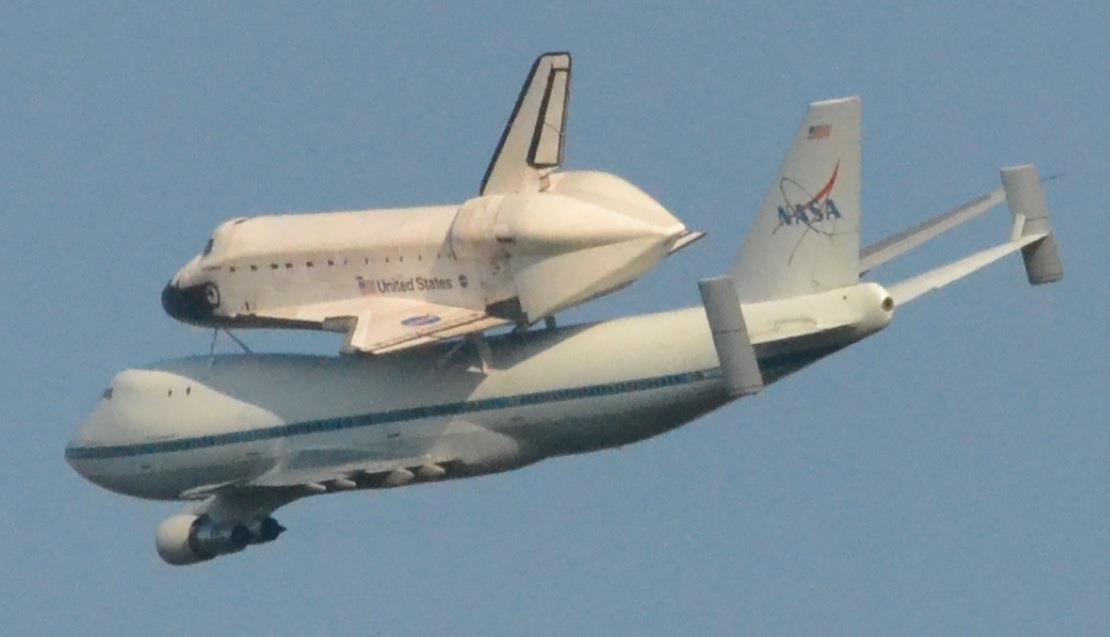
The SCA, Endeavour (OV-105), and chase plane shortly after departing Edwards AFB

I must admit to being a little mystified that NASA hasn’t chosen to fly over and salute Rocketdyne today. Every main engine that powered every Shuttle flight into orbit was designed, manufactured, and assembled primarily at the Canoga Avenue campus. I know they couldn’t fly over every place where components were made in the country, but they’re flying over the freaking Hollywood sign and Universal Studios! Rocketdyne’s campus is just a few miles to the Northwest of those locations. How hard would it have been?

I have often lamented the fact that Rocketdyne never saw fit to advertise itself much. Whenever there was a launch of an Atlas or Delta vehicle, the vehicle manufacturers and integrators always had their names and logos prominently displayed. I am willing to bet very few people in this country even recognize the name Rocketdyne. Do they know every American Astronaut (other than those who’ve flown on Russian missions) was lifted into space by a Rocketdyne engine? I doubt it.

Mercury, Gemini, Apollo. All those flights were powered by Rocketdyne engines. The Lunar Excursion Module (LEM) was powered off the Moon’s surface by a Rocketdyne engine. The Space Shuttle Orbiters would never have made it to LEO were it not for the Space Shuttle Main Engines. The SRBs (Solid Rocket Boosters – or Motors, SRMs) only burned for 126 seconds before separation from the vehicle stack. The Main Engines continued burning for approximately six more minutes, depending on the mission. The SSME was – and still is, as far as I’m aware – the only reusable and fully throttleable rocket engine ever designed and flown.

Anyway, today marks what for me is a very sad day. It should be sad for all of us, IMO. This is the final flight (albeit strapped to the back of the SCA, a specially modified 747) of the last of the Orbiter Vehicles that served us for well over two decades and, unfortunately, we currently have nothing to replace it. The ISS is still on orbit, but we now have to hitchhike there aboard Russian rockets. There’s really no way to tell how long it will be before we return to space.

It also reminds me that I was put out to pasture, though nobody’s suggested ensconcing me in a museum 🙂 I didn’t realize how much retirement would affect me. I’ve enjoyed having time to be with my children, who are eight and eleven. I’ve also enjoyed working at building a modest service business supplying social media marketing for small businesses. However, in this economy that has turned out to not be a very useful business model and, once again, I find I must reinvent myself. Today I’ve decided to wallow a bit in my grief. Grief for the symbolic end of the Shuttle program, on which I labored for over two decades and grief for the symbolic end of my usefulness as a human being, which is what retirement sometimes feels like.

Rocketdyne Logo

The Original Rocketdyne Logo

One more thing. In my opinion Rocketdyne deserves better. I know people whose entire lives were dedicated to the space program. They worked tirelessly; lived and breathed the concept of space travel and exploration. And those engines played a major role in putting Endeavour (OV-105) on orbit. Just sayin’.


Good Bye Endeavour

Endeavour (OV-105)

Endeavour flying over Stennis Space Center on her way to Los Angeles

Space Shuttle Endeavor (OV-105) is on the way to her new job at the California Science Center. She is scheduled to arrive at LAX on Friday after completing a flyover of several landmarks, including The Griffith Park Observatory and Disneyland (Disneyland?). I’m conflicted over whether I should drive to Griffith Park or, perhaps, to Malibu – where she is also scheduled to fly over. Parking could be a real pain.

As a young man I used to go to LAX, park in the lot of the Proud Bird Restaurant, and walk down Aviation Blvd. to the East end of the runway. I could stand there and watch the planes come in for a landing, at times only a hundred feet or so over my head. It was exhilarating. Maybe I’ll do that.

I spent nearly half of my adult life working on the Space Shuttle Main Engine (SSME) program at Rocketdyne in Canoga Park, California. I grew up in the San Fernando Valley and have vivid memories of the many rocket engine tests that took place in the Santa Susana Mountains to the West of where I lived. I would go outside and could hear the roar and see the sky lit up. Those engines helped take us to the Moon. It was magical.

I came to Rocketdyne quite by accident and, even after I started as a temp (what they called a “Job Shopper”) working on the return to flight efforts after the Challenger disaster, it took a while for me to realize I could work there. Not being an Engineer, it somehow never crossed my mind that I could find a place in the organization. I ended up spending 21 years there – in a 23 year period (taking two years off in an ill-fated attempt to return to a family business) – working primarily on the SSME program. Endeavour was the replacement vehicle for Challenger, so I am somewhat emotionally tied to her. Half my working life!

In 2010, I accepted an offer of early retirement, which was made to those of us who were sixty years of age or over because the Shuttle Program was coming to an end. It wasn’t quite over, and I had always joked that I would be the one to turn the lights out at the end. I expected to work until I dropped dead, maybe around 80. It didn’t work out that way. I still miss being a part of the space program and seeing Endeavour on her last flight is dredging up a flood of emotion I’m not sure I’m prepared to handle.

Thankfully, she’ll be very close by and I can take my two girls to see her. Fare thee well, Endeavour. I am eternally thankful I was able to play a small role in your voyages. I wish you well on this, your final mission.

Photo Courtesy of Mike Malinzak


Our Grief Was NOT a Cry for WAR

Our Grief

We Weren’t Looking for Retribution; Merely Justice

I can’t let today pass without saying a word or two about the tragic events of eleven years ago today. Unlike most Americans, at least as far as I can tell, these events were tragic to me for many reasons. I am somewhat ashamed to note the many people who mourn the loss of those nearly 3000 who died as a direct result of the attacks of 9/11, yet seem to show little or no feeling toward the loss of lives that came about as a result of the actions the United States and other nations took in seeking vengeance for these attacks.

I don’t wish in any way to denigrate the innocent victims of these heinous acts, and I am especially mindful of the hundreds of first-responders who lost their lives performing the duties they were sworn to in order that others might live. I respect and honor their devotion and the sacrifices they made – and continue to make – on our behalf.

Nevertheless, in the wake of this tragedy we engaged in two wars – at least one of which was entirely unnecessary – and was, indeed, a war of aggression based on lies and deception.

While it’s impossible to get an accurate figure, an average assessment of the number of Iraqi civilian deaths — based on numerous estimates — indicates there have been at least several hundred thousand civilian deaths alone (cite). There have been over 4400 U.S. deaths and 32,000 wounded in Iraq (cite). The death toll in Afghanistan is so muddled it’s difficult to determine how many civilians have been killed as the result of our activities and how many might have been killed by the Taliban regardless. There have been over 3,000 coalition deaths (over 2,000 U.S.) and approximately 24,000 wounded. In addition, over 14,000 Afghan security forces personnel have been killed (cite).

Our nation’s cry is “Never Forget”, and we won’t. We shouldn’t. However, we must always be mindful that great injustice was done in the name of those who perished on this day. We should also continue asking questions not only about why we did what we did, but what actually happened on 9/11. I doubt the truth has yet to be told. Keep your eyes and ears open.


Let Me Wipe This Egg Off My Face

Egg on my Face

Taking my Punishment for Being Hasty

Two day ago I came across a graphic that was shared on Facebook and decided it was worthy of writing a blog post. Not so much because of the graphic, but because it gave me the opportunity to test out explaining an observation I have been making lately. Unfortunately, the graphic I chose to illustrate the theory turned out be photo-shopped and wasn’t real. I am sorry I chose to perpetuate it. I should have been more careful and for that I am deeply regretful. Not because the photo did any harm to the Romney campaign; inasmuch as it quite easily (based on past experience) could have been true, the damage is minimal, but because it served to compromise my integrity, which is something I work very hard to not do.

Exhibit B

Exhibit B

Exhibit A

Exhibit A

So . . . I wish to be very clear here. I am sorry I published it. It’s not real. For those reading this who are uncertain of the controversy, I herewith submit the photo I was bamboozled by, which I have labeled Exhibit A, alongside the photo from Zazzle, labeled Exhibit B, which was the main piece of evidence that convinced me I had been mistaken. There were a couple of people who pointed me to the official Romney website store, which stated the following, “All Products are Made in the USA”. However, these are politicians we’re talking about here and, as far as I’m concerned (whether it’s the Romney campaign or the Obama campaign), the only thing that proves is it says “All Products are Made in the USA”. ¡Punto, final, y redondo!

The ironic thing about this particular post is that, until two days ago the busiest single day I had experienced on this blog was slightly over two years ago. It was from a post I wrote thanking the gentleman who found my iPad after I had left it behind during a medical crisis involving my youngest daughter. I’ve had days that came close, but my post of two days ago more than doubled the number of readers I’ve had in a single day. A Pyrrhic and bitter accomplishment at this point.

I doubt any apology will be accepted by some and that’s OK. I could have just let it go. In fact, I apologized immediately on Facebook and even pointed out the fallacious button on a local Facebook group devoted to discussing local politics and business but, partly because the most active people tend to be politically active as well, sees its fair share of discussion on national issues. Now I’d like to offer a little explanation.

I wanted it to be true! Yes, I admit it. To be honest, I think electing Mitt Romney as our next President would be disastrous. I can find a lot of things to be pissed off at Barack Obama (and the Democratic Party, for that matter) about, but at least there has been a reasonable amount of social progress during his administration. As well, he inherited an economy strapped by two unfunded wars, a giant Medicare pharmacy giveaway, and some of the stupidest tax policies designed to benefit the wealthiest of all Americans at the expense of most ordinary Americans. So, I won’t, at this point, go into much detail as that isn’t my purpose in this post. I just want to point out a few things that made it easy for me to believe the Romney campaign would have their buttons made in China.

  1. More than 10,000 torch-bearers during the 2002 Winter Olympics, which Romney holds up as one of his crowning business achievements, were contracted out to a brutal dictatorship in Myanmar (Burma). Read about it here.
  2. Senate Bill 3364, the “Bring Jobs Home Act”, which provides up to a 20% tax credit for bringing businesses back to the U.S. and denies tax deductions for outsourcing expenses incurred in relocating a business outside the U.S., was blocked by Republican Senators. More here.
  3. Romney has not only been labeled by his former Republican primary opponents as a “Vulture” Capitalist, the National Venture Capital Association has specifically disowned him as one of them (though it’s killing them to do it). His company, Bain Capital, is well-known for its role in shipping jobs overseas.

Let me sum up. I published a photo of a Romney-Ryan campaign button that was inauthentic. I used it to make a point about what I see as more evidence that Republicans “project” their own shortcomings and insecurities on others. I wanted to believe the button was authentic. There is substantial reason for me to have believed that. I have a bit of egg on my face. I am sorry. Mitt is still a jerk. Don’t vote for him. I trust I’ve made virtually everyone happy now. 🙂