
Category Archives: Systems Thinking

Why Would We Wish to Waste So Much Talent & Investment?

Atlantis ascending - STS-27

Atlantis Powers to Orbit

As long as I worked at what is now called Pratt & Whitney Rocketdyne we referred to NASA and the Air Force as our “customers”. For nearly twenty years I worked on the Space Shuttle Main Engine program and we always called NASA our “customer”. In the last few years of my employment there, when my awareness of – and interest in – social media brought me to learn as much as I could about what was available and how it might be of benefit to my company, I began arguing for a different approach. I believed, still do, that the real customers of companies involved in space exploration are the American people, those who pay the taxes that were used to pay our salaries. I still believe this is the case, and I still await the evidence of an enlightened approach to engaging them.

In the meantime, I just received an email request to take action and I want to pass it on in the hope some of you who read this will consider taking action; very simple, virtual action. I believe it is imperative for the human race to establish not merely a technological presence in space, but a strong cultural presence as well. I don’t believe it has to be dominated by the United States. In fact, I would prefer it be an international, world-wide effort to ensure the long-term survival of our species. Nevertheless, what is currently happening here is the gradual wasting away of our talent and our industrial base to continue leading the effort. I will no doubt write more about this as it is near and dear to my heart.

What follows is the text of the email, which comes from the website I’m asking you to visit and consider using to send a letter of support to the President, your U.S. Senators, and your Congressional Representative. I’m also including the link below the text so you might take action if you’re so inclined.

I’m concerned about the future of the United States’ role in space. Investments in our nation’s space programs will have a direct impact on our future economic strength and ability to remain a space-faring nation on the cutting edge of technology. I urge you to make a strong commitment to maintaining the U.S. as the unsurpassed leader in space.

For decades, U.S. leadership in space has been recognized across the globe. However, that position is perishable, and continued national leadership will be vital for our future. Therefore:

  • It is important to establish a long-term national space strategy that factors in civil, national security and commercial interests in space. Our national strategy must also cut across all agencies that have a stake in space. Without a national strategy, America risks a future where the workforce and industrial capacity needed to maintain U.S. leadership and competitiveness in space is seriously – and in some cases irreversibly – degraded.
  • It is important for our future global competitiveness, leadership and innovation in space that budgets and funding remain stable and robust. Appropriate funding must accompany strategic goals to meet established objectives and sustain a strong and progressive space industry.
  • It is important to support policies that maintain a healthy and vibrant space industrial base that employs technically-skilled American workers. Modernizing our nation’s export control policies – so that U.S. industry can compete on a level playing field – is one step in the right direction.
  • It is important to recognize that the space industrial base drives technological development important to our economy and national security. Our national strategy must identify and seek to preserve the space capabilities critical to meeting our national goals.

The United States stands at a critical juncture between past accomplishments and future ambitions in space. The rest of the world is not waiting. Yet there is uncertainty about the future of U.S. leadership in space; our workforce is facing upheaval and layoffs and the U.S. space industrial base is at the brink of losing our competitive and innovative edge.It is absolutely critical that our nation’s decision-makers work together to show the leadership needed to keep our space efforts robust. I urge you to make addressing these issues a national priority.

Here is the link to send this letter. Thanks for considering it – http://www.spaceleadership.org/

Why Are Some Large Enterprises So Darn Stupid?


Can you believe they blocked this?

Watch out for that fly

I worked for over two decades at a very large (and exceedingly ponderous) corporation. Actually, I worked at three of them without every leaving the location I originally hired in at. Although I worked at a company called Rocketdyne, it was a division of Rockwell International when I hired in. It was later sold to The Boeing Company and, in 2005 was purchased by United Technologies and became a part of its Pratt & Whitney family.

Each one of these organizations were not only capable of, but repeatedly dabbled in a level of bureaucratic numbskullery that I still find hard to fathom. I have yet to have it explained to me – at least in a way I can understand – why large for-profit organizations engage in activities that are guaranteed to hinder their ability to perform well or that cost far more than is reasonable. Frankly, I’m not sure anyone who’s directly involved in them can explain why it’s so, because I’ve never known anyone who said it was their job to slow down or squash anything . . . yet that’s exactly what happens in many instances.

The other day I watched a video shared with me and others by Euan Semple. I would link to the video, but it’s been removed by the user. I guess it was meant to just make the point for Euan mostly. Anyway, shortly after looking at it I came across a three-year-old email I had sent to a colleague. The video Euan shared was made by a student. It’s quite simple and shows how many of the social sites this college student wished to go to during the course of a day were blocked by the school’s policies. Maybe you’re thinking that isn’t such a bad thing, but I’m of the belief that people should be trusted first, as most are trustworthy. Should they betray that trust, then there might be consequences based on their situation. Spending 15 minutes on Facebook catching up with friends and family is not the same as spending an hour or two trading stocks online or visiting pornography sites. Wholesale domain blocking does not exhibit any level of trust at all and tends to alienate the majority of people who want access when they need it, but will not normally abuse the privilege.

Now to the rediscovered email. I’ll let it speak for itself. The episode which sparked it is not terribly important in my opinion, though it was important enough for me to memorialize and share it with a colleague whose mission was (and is) to steer the organization from simple-minded, one-size-fits-all policies and procedures. This is, I think, what it evidences. I hope you don’t think it too petty of me to point it out. I think this approach still dominates the thinking of the corporate world, as well as academia, as evidenced by the video Euan shared. What follows is my email.

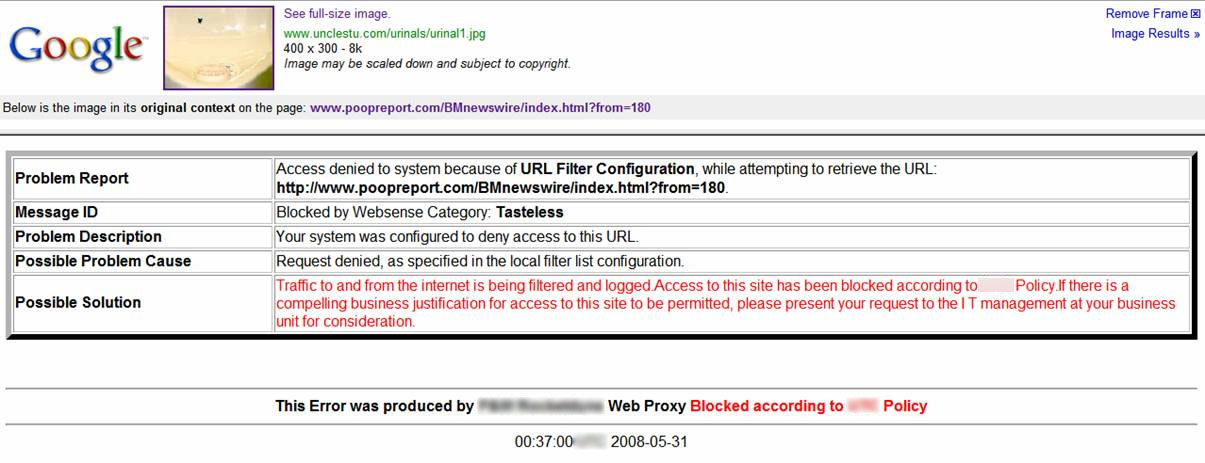
I don’t know what to make of this. Well . . . actually, I kinda do. It’s kind of funny, yet somehow a bit infuriating. Allow me to explain. As you may or may not recall, the men’s room near my cubicle was recently finished and re-opened. One of the features they installed is those waterless urinals. I’ve only seen them once before, and each time I go in I make note of the name of the company – thinking to find them on the Internet so I can read something about the science behind them. Also, each of the urinals has a bee painted on them and I wanted to see if I could find something quickly about why (though I suspected I already knew). At any rate, I finally remembered to investigate both (after several weeks of forgetting as soon as I got back to my computer) and found what I wanted and decided to just click on Google images as well. The first picture was of a urinal with a fly – not a bee – painted in the sweet spot.

I decided to take a close look and clicked on the picture. Although I was able to see the picture, even open the full-size image, the website it was on (which appears in a lower frame in Google images) was blocked by Websense. What I find remarkable, ironic, asinine, stupid, foolish, and probably a dozen more useful adjectives is the category they chose to block it under – “Tasteless”. Tasteless!!!! Is there some sort of absolute scale on which that quality can be measured? It was probably the name, but what if the website was about caring for infants or puppies or god knows what? This I find not a little insulting. What children they think we are! Let’s not forget the further irony that I could, for all their blocking, see the image. Perhaps I should sue for negligent infliction of emotional distress. Here they made an attempt to insulate me from something as tasteless as this, and I was nevertheless forced to look at a painted fly in a vitreous porcelain urinal due to the incompetence of Information Technology and UTC Policy. I hope I recover. I hope I can sleep tonight.

There! I got it off my chest. Please realize this email was sent approximately 3 years ago, so some things (like Google’s positioning of images and their associated sites) have changed. If Euan’s friend’s example is any indication, however, other things haven’t changed at all. I don’t think this bodes well for any organization seeking to do its best work. My experience says it hinders creativity and innovation, as it blocks people from following leads and decreases whatever chances might exist for serendipity and loose ties to open up new avenues and approaches to solving problems.


The Evolution of Lean: A Timeline

It is exceedingly frustrating to realize what a putz you are . . . at least it is for me. I struggle with how and what to blog, and yet miss some of the more obvious things I can post about. For instance, Dan Keldsen posts a link in Facebook to an article conveying a timeline of the history of Lean Manufacturing. This line, however, is entirely textual and Dan writes – parenthetically – “(need a graphic of this… hmm)”. Reading this I was reminded of a graphic I put together several years ago at the request of one of the Manufacturing Engineers at Pratt & Whitney Rocketdyne, William “Bill” Garrison. I was able to find it in short order (kudos to my PKM, IMO) and sent it to Dan. I then posted it in FB and, within a very short time received a comment from another friend, Robert Lavigne. I had also had an email conversation with Dan and he mentioned a product that produced graphical timelines, BEEDOCS.

The Evolution of Lean

The Evolution of Lean: A Timeline

Click on Graphic for Larger Version

At any rate I’ve now spent a fair amount of time thinking about the history of lean and the purpose and efficacy of graphical timelines; something I actually have contemplated quite a bit over time. I’ve also checked out the software’s website and, after another comment or two between Rob and I, he suggests the subjects are “still worthy of a blog entry and a link to your insights about the new product”. I find myself thinking he’s right so here we go. I hope this is what he had in mind. I’ll consider it an “aha” moment if I’m right.

So, here’s the real post. The article Dan linked to (see my link to it, above) is a bit more detailed and the earliest event evidencing lean in the timeline is fully 440 years ago, which causes Dan to lament over the seeming inability of many to just continue using the stuff that’s worked for centuries, eh wot? I can only nod in stupefied agreement. What appears above, in the form of a graphic representation, is an overview of the history of lean manufacturing. It’s heavy on the Toyota Production System (TPS), but there’s actually a lot of non-Toyota information in it as well. We didn’t want it to be too busy.

Now, as far as the software goes, I am surely in no hurry to purchase it at this point, but it does look like it provides some useful and interesting functionality. They point out the concept grew from Attorneys asking for timelines for use in trials and now is used by “Film makers, museum curators, professors, novelists, grad students and business leaders”. The timelines look beautiful and varied and the concept of using 3D (I don’t think real 3D, but film & television-like) makes the timelines visually appealing. It’s only $65 for Mac OS X Leopard and, for many, seems a small price to pay if you’re in the market for really good timelines.

That’s my story and, well, you know the rest. Thanks to Rob for prodding me. Thanks to you, whoever you are, for reading this far 🙂

UPDATE: I neglected to point out there’s a bit more to this timeline than mere events. It also points to the correlation between time, reduction in cost, and reduction of Cycle Time. Probably pretty obvious, but felt compelled to point it out just so you don’t think I’m stupid. It’s bad enough I think it.


Companies Should Pay Attention to Former Employees

Today, my friend (I consider anyone I can have a decent, useful conversation with on Twitter a friend) Kelly Kraft (@KRCraft) posted a blog asking the question “How much and what kind of a relationship do you have with former employees?” Her experience is much different than mine, though I think her conclusions make perfect sense for any organization contemplating doing as her former org did. The question is not – in my mind and, I think, in Kelly’s – whether or not to have ongoing relationships. Rather, it is what kind of relationships, and how extensive (or intimate), will they be?

KM Through Social Media

Over eight years ago, in response to a perceived need for understanding (and locating) the depth and breadth of expertise at Rocketdyne Propulsion and Power (then a division of Boeing’s Space & Communications business unit – whew!), I did some research and found a company that provided a tool that was a predecessor of many of the social media offerings of today. In my opinion they were way ahead of their time. The tool was called AskMe Enterprise and it offered profiles, Q&A threads (including forwarding, commenting by others, feedback as to quality and efficacy), file and link uploading and sharing, etc. We later had a customization added that provided for posting Lessons Learned and, about four years ago, they added a blogging capability.

Unfortunately, the larger percentage of our workforce (especially leadership and management) adamantly refused to participate. This wasn’t unexpected, however disappointing it may have been, and we continued to use the tool and work on building acceptance by example and through its ever-growing usefulness. Many years ago, I suggested we consider finding a way to stay connected with the constant flood of experienced Engineers, and others, who were retiring or moving on to other pastures. Inasmuch as we had a history of bringing some of those people back as contractors, I thought we might be able to find an inexpensive method of remaining in contact with the majority who didn’t return.

The proposal I thought made the  most sense was to provide retirees with a secure connection to our network and, as compensation for being available for questioning within AskMe, perhaps covering the cost of their Internet connection. I don’t believe anyone took this idea seriously and it essentially died on the vine.

Intellectual Property & Communication

Now here comes Kelly, pointing out how valuable her former organization, Exact Software, has found maintaining continuous relationships with former employees can be. She also addresses the issue of what kinds of relationships make sense for different types of employees. Specifically, she notes the difference between outward-facing, highly engaged employees as opposed to somewhat sequestered, internally focused employees like many of the Engineers I worked with. She is, however, right on the mark suggesting each of them can be successfully engaged.

For instance, she points to her own experience as an Implementation Consultant for Exact and the work she did in the years since, noting there probably isn’t a great deal the enterprise needs to do to engage her. She is also, I believe, referring in part to her use of Twitter to stay in touch. My Engineer friends are not terribly likely to engage using Twitter (or blogging, or anything else that public for that matter). There are considerations of IP protection they can’t afford to ignore, as well as governmental restrictions like ITAR that, contravened, will surely bite them in the ol’ behind. This can be, and has been, quite expensive and can be done somewhat inadvertently.

Nevertheless, as Kelly points out, there are numerous ways in which an enterprise can stay in touch, and engaged, with its former employees. In Rocketdyne’s case – especially – with those employees who have retired and are not working for another company. She is also pointing out, in my opinion, that CRM (or SCRM) isn’t just for sales and marketing to dun customers with either. Social Media have many applications. Many of them are useful for engaging with an enterprise’s customers, but many are also valuable for engaging one’s own employees (current and former). The lunches and parties sound pretty cool, too.

PS – The article she credits me with was a few paragraphs of my opinion of what Hutch Carpenter (VP of Product at Spigit@bhc3) had to say at his blog, “I’m Not Actually a Geek” (which he really is, but you didn’t hear that from me).


Has Knowledge Management Been Bad For Us?

In the world of Knowledge Management, we frequently talk about at least two different types of knowledge we deal with. The first is explicit, or codified, knowledge (stuff that’s captured and, hopefully, readily accessible in some useful form); the second is tacit, or tribal, in-the-head, “between the ears” knowledge. For most of my nearly 15 years of knowledge management practice in the aerospace business I have noted we spend an incredible amount of time, energy, and money working on the former.

At the same time we have continually asserted the vast majority of useful knowledge was the latter. I had a graphic that showed the ratio of explicit to tacit knowledge at 19 to 1, but it’s no longer accessible. So I created this one from a graphic in the public domain and added text in Photoshop. While the ratio shown here isn’t nearly what I believe reality provides, it does give a glimpse of how much remains under the surface when comparing the two types of knowledge. Actually, I found another available graphic that shows the ratio as a little greater than the one I put together, and it also lists more details of what types of knowledge comprise each of these two main categories.

For me, this is huge! In fact, where I come from we tended to use an adaptation of the Pareto principle, i.e. an 80-20 distribution, so this graphic helps make my point a fortiori. Now let me get to my point. Last Wednesday (12 May 2010), Rob Paterson published a wonderful post at the FASTforward blog entitled “Have books been bad for us?”, where he discusses the question of whether or not the web is making us stupid, as well as his belief the opposite is true. He argues that books have actually stunted our ability to innovate and create new knowledge. You really have to read the whole post, but here’s a sample I like:

But with the book comes authority. With the advent of the book, much of knowledge development stopped. Only the in group was allowed to play. What mattered was not observation. Not trial and error. Not experiment. Not sharing. But authority. Most of the accepted authority were texts that had no basis in observation or trial and error. Ptolemy, St Augustine and Galen ruled.

Rob goes on to argue, rather than making us stupid, the web is providing us with the kinds of information and knowledge connections we used to have before the book removed the more communal ways in which most of our collective knowledge was arrived at in the past.

So, here’s where I find an analogy to the work I’ve been doing for some time. Much of of what we call Knowledge Management (at least in my experience) seems to spend an inordinate amount of time and expense on dealing with the 20% (or 5%, depending on who you listen to) of an enterprise’s knowledge that is explicit. We work on organizing share drives, federating search capability, and scanning and rendering searchable (through OCR) much of our paper-based, historical information. I’m sure there are other ways in which explicit, recorded information is analyzed and organized as a function of a knowledge management activity.

But I think we’re missing the point about the real value of knowledge. If, in fact, the largest (by far) percentage of an enterprise’s useful knowledge is locked between the heads of its employees and, if (as we frequently say about tacit knowledge) much of it can’t be accessed until it’s required, why are we not spending more of our limited funds on facilitating the connection and communication, as well as the findability and collaborative capabilities of our employees?

I’m not suggesting there isn’t value to content management, smarter search capabilities, etc. I am saying, however, that I think most organizations are missing the boat by not spending more of their resources on the thing that offers to connect their people; to create organizational neural pathways that promise to be far more beneficial to the overall health of the company in terms of product innovation and design, manufacturing processes, customer relations, project management, etc. (or on and on). I am speaking of Enterprise 2.0, on which I will have a lot more to say in future posts.

The problems we face with acceptance are monumental. People in organizations that have traditionally been hierarchical and within which silos and fiefdoms emerge, turf wars and power struggles go on, and people are both kept in the dark and made afraid for their jobs hasn’t exactly set the stage for the trust required to do any kind of knowledge management effort. Nevertheless, if we’re going to participate in the struggle, we ought to be shooting for the things that are going to prove the most valuable – in both the short and the long run.

I’m a book lover myself. My reverence for books is almost stupid, actually, but I’ve worked hard on overcoming it. Unlike Rob, I no longer wonder. I see the web, and the enterprise and its internal network, as the future of our group intelligence and knowledge. What do you see?


Saying “I Don’t Know” Will Set You Free

If you’ve ever been in sales, I’m willing to bet you know it’s never a good thing to pretend you know something you don’t. Unless you’re making an opportunistic, one-off sale and you don’t really care about any relationship with your customer, it’s far better to admit ignorance and pledge to get an answer ASAP. Frankly, I think it’s always the best tactic regardless of your relationship; it’s just plain ethical and, a bit ironically, smart.

Most people know when they’re being fed a load of crap and pretending to know something of which you are ignorant can open up so many cans of worms it’s hard to define all the consequences. One of the major ones, however, is never being believed no matter what you say. Not a good thing, whether in sales or elsewhere.

Anyway, this came up again for me today because of a tweet by @wallybock, who pointed me to an article in the New York Times’ Corner Office section. The post is entitled “What’s Wrong With Saying ‘I Don’t Know‘?” It’s a good interview of Rachel Ashwell, founder of Shabby Chic and, besides her admonition to not be afraid of admitting ignorance, there’s a wealth of good business (and life) advice in her words.


Behind The 8-Ball . . . or Hand me The Hammer & I’ll Fix This.

Now that I’ve had a little while to work with my new iMac, I’m beginning to come down from the techno-induced stupor I’ve been in and am thinking about what this all means to me. I’ve also been thinking about what it should mean for many people who work in corporate America, where I have been laboring for the past two decades and more.

Let me explain what I’m getting at. From the first day I started working at what was then Rockwell International’s Rocketdyne division (formerly North American Rockwell), I was stuck using technology that was already a little behind the eight-ball. Back then (1987) there wasn’t much in the way of personal computers, but they were developing rapidly. I went from an IBM 8086 to an 8088 to an AT and, finally to Windows and on and on. As time wore on the level of state-of-the-artiness of the available technology I had available at work, unfortunately, fell further and further behind.

Now, this isn’t about the battle that took place between IT (formerly MIS) and Engineering for many years, and how it affected the development of the first LAN in the company (hint – it wasn’t pretty), but rather about the level of security and, perhaps, paranoia that built up over the years with respect to the use of computing resources.

Part of the problem for my line of work was the very real issue of the International Traffic in Arms Regulations (ITAR) which, sometime after we were purchased by the Boeing Company, was painfully and expensively learned after an inadvertent and ignorant violation of the Regs (another story this really isn’t about). This lesson required some education and was fairly easily addressed once understood.

I think I need to throw in a caveat here. I am not an IT person. I have absolutely no formal IT education. I am merely a business person who has worked with (mostly) micro-computers – now called PCs – for close to thirty-five years. I have participated in or led efforts in knowledge management and Enterprise 2.0 for Pratt & Whitney Rocketdyne, and I was instrumental in bringing in our first web-based social system over 7.5 years ago. I have also been the project manager for that terribly under-used application all this time as well. My point here is I may not use language that’s accurate, but I know the kinds of functionality available and I know all of it is – from a corporate point of view – there to serve the business.

What I’m concerned with is the application of a one-size-fits-all mentality to the provision of information technology to a company’s workforce, as well as the imposition of blanket security regulations that serve to cripple an organization’s ability to keep abreast of developments in that same technology. This becomes increasingly important as more capability moves out into the cloud (this includes micro-cloud environments, i.e. inside the firewall capability that utilizes cloud-like architecture.)

I have tried to argue, to no avail – I’m sure others will recognize this particular kind of frustration – for the identification of power users who could be provided with, for lack of a better term, beta capabilities they would exercise and learn about. These people would provide a cadre of workers who are constantly looking at new ways to improve communication, collaboration, and findability. People who’s job, in part, is to find newer and better ways to get things done. In my eyes, this is a no-brainer, and I have to say with the speed things are changing nowadays, I think this kind of approach is even more important.

I recognize it is difficult to get large organizations to move rapidly. One doesn’t turn a battleship on a dime. Nevertheless, it is conceivable to me (much more so now than a decade ago) a small group of people could help any organization understand – at the very least – how work gets done, how workers are communicating and collaborating with each other across various boundaries, and how knowledge is being shared in a timely and useful fashion. I also think, daring as it may seem to some, that paying attention to – and preparing to learn from – the processes that are changing the way we do these things can position a company competitively to be a player, rather than an also-ran. I quite certain failing to do so leaves you with the situation I grew used to; a company with computing resources and experience years behind state-of-the-art. In marketplaces where this can change dramatically in under a year, I think that’s unconscionable.

Have any of you experienced this situation? Does it resonate at all? Am I totally off-base or do you think this would be a viable approach for large organizations to engage in?


Transportable Medical Records

Being at the Doctor’s office (routine visit) reminds me of a pet peeve. I am all in favor of any move toward digitizing and sharing my medical records with my providers; present & future. I hope that our sensitivity – I might allege hypersensitivity – over medical privacy isn’t crippling us from moving forward with an effort to save us from repeatedly filling out the same histories every time we go and for every new provider. Just a thought!

Rick

Posted via email from rickladd’s posterous


From the Frying Pan, Into the . . . ?

Last week, during the remaining few hours of a two-day Novations class in Project Management, I received a couple of somewhat disconcerting emails. The first one, from the President of the company, was a notification a “Voluntary Separation Program” was being offered to all employees (well, almost all) who would be 60 years of age or older on May 15, 2010. This was announced as the latest step in many that have been taken to prepare the business for the challenges presented by the ending of the Space Shuttle Main Engine program and by the changes announced recently by NASA. I can’t say it was a surprise. The second email was from HR. It contained the (again, not startling, but nevertheless uncomfortable) news that I was (being close the 63 years old) eligible for the program.

Now, I had not – until that point – seriously considered leaving the company. I have been there for a total of over 23 years (cycle time; I worked my first year as a temp and left for two years to join a somewhat ill-fated yet necessary attempt to rejoin a family business) and had every intention of remaining at least another 15. Furthermore, as the lead for a team charged with changing the way we did business, with special responsibility for the use of social media, I was excited about the challenges we faced and the opportunities that presented. Suddenly, I felt very old and somewhat useless. It was not a comfortable feeling at all.

I have since spent a great deal of time thinking about what this means to me and, as a result of this thinking, I have decided to take the offer. In fact, I signed the papers yesterday declaring my intent to do so. While it isn’t the most lucrative of offers they could have made, it will give me about six months in which to plant the seeds of my next career, a career I intend on pursuing with a vengeance. I am also old enough to retire, which will increase the time I have before I need to start dipping into our savings. One last course available to me is filing for social security, something I would rather wait until I am 66 to do so I can receive the full amount.

So . . . what am I going to do with this breathing space. Well, my friend Luis Suarez has hinted at some of it in his post of today, “When This All Gets Cool, It’s All about The People and Your Passion“, and it’s even in my profile on Facebook, where I said “I am most interested in using today’s Internet based social computing technology to further the interests of my company and, not incidentally, humanity as well. I see no reason the two interests can’t converge. Do you?” It looks like I won’t be doing it to help my company, but I’m confident I can find other companies interested in what I do. Possibly, the most exciting thing about this change in career, though, is it will allow me the time to work with schools, community-service organizations, and other types of enterprise that can benefit from my passion about social computing and the promise they hold for doing the right things.

This is the journey I am now embarking on and I’m literally bursting with enthusiasm for it. I believe it will be a large part of the experience I will chronicle in this blog. I will continue my long association with my friends and colleagues in the Enterprise Thinking Network, many of whom will continue (unless there are further, massive layoffs) with Pratt & Whitney Rocketdyne. In fact, I am scheduled to co-present a workshop with Johnnie Pourdehnad, long-time associate of Russell Ackoff’s, and an adjunct professor at the University of Pennsylvania, where he also serves as the Associate Director of ACASA (Ackoff Collaboratory for the Advancement of Systems Approaches). This will be in April, before I have officially left the company (scheduled separation date is no earlier than May 14), at this year’s In2:InThinking Forum – an event you should consider attending if you are interested in new ways to view the world and the work we all do. I recommend it highly.

At any rate, thanks to a fairly extensive network I have built over the years in order to increase my value to my current organization (Hmm. Guess that didn’t work all that well, but it has had the side benefit of being useful to me professionally), I have already begun seeking out new adventures and new ways in which I can be of service. Maybe I’ll even be able to make a decent living at it! I you have any ideas of what some of those things can be, please don’t be shy. Let me know. I promise I’ll get back to you.


Inclusion: Bad for Diamonds; Oxygen for Innovation

In a response to a tweet from @MartijnLinssen, I noted that inclusions are bad for diamonds, but good for innovation and business in general. I think Martijn posted that particular tweet in response to a question I had posted about the use of the terms “consultant” and “expert”. I think too much time is spent on figuring out ways to exclude people from anything other than the roles we’ve pigeon-holed them in. This seems to be the default mode of Human Resource departments, i.e. find a job title and wrap it around a “belly button”. Once you’ve accomplished that task, you have an employee ready to fit into the pre-ordained mold you’ve created; the cog in your machine, if you will.

This seems to miss the reality that all of us are far more complex than a title can contain expression for. In my over twenty years at Pratt & Whitney Rocketdyne I have seldom performed tasks that were directly in alignment with the title I held. Part of the reason for this is I was always looking for new and innovative ways of getting things done and, to their credit, my management never (or seldom) discouraged me from doing so. I don’t think I’m all that unique. I happen to believe everybody has hidden skills and talents an organization can – and should – tap in to. We should encourage, no, assist everyone to reach their fullest potential. We should create an environment where everyone can contribute to the growth and sustainability of their organization, whether their contribution is small or large. To do anything else is more than foolish. It’s wasteful and destructive. Our people are, indeed, our most valuable asset – especially in a knowledge-based economy. An asset we can ill afford to ignore.