Tag Archives: Food

My Comfort Food of the Fifties

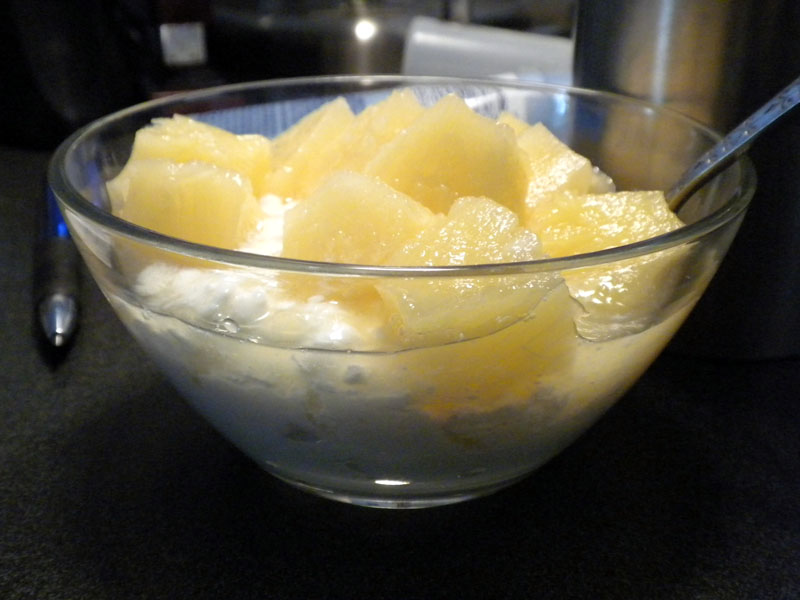
Pineapple & Cottage Cheese

Pineapple Chunks and Cottage Cheese – Lots of Juice

I grew up in the San Fernando Valley during the 1950s, a time many have suggested was idyllic here in the U.S. While we know that’s far from the truth, it was a time when we didn’t lock our doors and kids were allowed to stay out past dark; at least in Panorama City, where I lived. I traveled between our house and my friend’s house around the other side of our block not by sidewalk, but by cinder block fences and back yards.

It was, indeed, a much simpler time; if not in general, at least for a kid. Or so it seems to me. I don’t recall parents being worried about pedophiles or kidnapping or one of dozens of concerns expressed by today’s parents. In fact, most adults I came into contact with wanted the kids out of the house; the more frequently and longer the better. Kids were, after all, better seen than heard and the best way to keep them quiet was to send them away, preferably outdoors.

I got to thinking about this because yesterday I treated myself to one of my oldest comfort foods, which also reminded me of just how simple some things were. My comfort food – this particular one, that is – consists of two ingredients: Pineapple chunks and cottage cheese. I did change them a wee tad, due to the needs of my diet and the availability of items that didn’t exist back then. I used pineapple in its own juice instead of heavy syrup and low-fat cottage cheese instead of plain old whole milk cottage cheese.


Franco-American Spaghetti

Seasoned ground beef mixed with this stuff made for one happy boy back then.

I was in heaven and made three substantial servings out of the can of pineapple and the tub of cottage cheese I purchased. It’s gone, and I’m sated. I find myself now thinking about another comfort food – also pedestrian by current standards – that I enjoyed as I was growing up back then. My mother used to brown a pound of ground meat, seasoning it with lots of garlic powder, then mix it in with a can of Franco-American Spaghetti. I introduced my oldest daughter to it a while back and, in the process, managed to raise my blood pressure dramatically due to the very high salt content of the spaghetti.

Regardless, she loved it and I’ll probably do it again . . . I just won’t eat so much, or so I’m telling myself.

I have other favorite comfort foods – good, garlicky kosher pickles for one, but these two are biggies, and they really do bring me a modicum of comfort; perhaps especially because I can’t indulge in them very often any longer. I don’t mean to sound like a marketer here, fishing for comments, but I’d be interested in hearing about other people’s favorite comfort foods. I’m sure there’s a huge variety.


How To Shop

Clothing for entering a blast freezer This is what I should have been wearing!

Many years ago, when I was in the wholesale food business with my father and brother, we got a new customer who sold to many high-end restaurants. Many would recognize the names of these famous Hollywood eateries, all of which were very successful and (bonus) somewhat recession-proof. This was a very good thing for us, as it provided a substantial boost to our gross income. I became the schlepper; the one who had to drive around every morning and pick up the items our new customer needed to service his clientele. I did not mind. I was young and full of energy and truly enjoyed arising very early in the morning to greet the day.

My job meant driving around every morning, picking up the items that had been ordered and getting them to our customer’s location, where they would be either stored temporarily prior to delivery, or further prepared for later  delivery to their customers. Generally, three days of the week required me to enter as blast freezer that was forty degrees below zero; so cold that it had no solid doors, merely thick plastic curtains as a safety measure, ensuring no one could be accidentally locked in. The freezer was huge and the doors big enough to accommodate a large forklift laden with several palettes of product.

Continue reading


No Pun Intended? Yeah. Right.

WARNING!

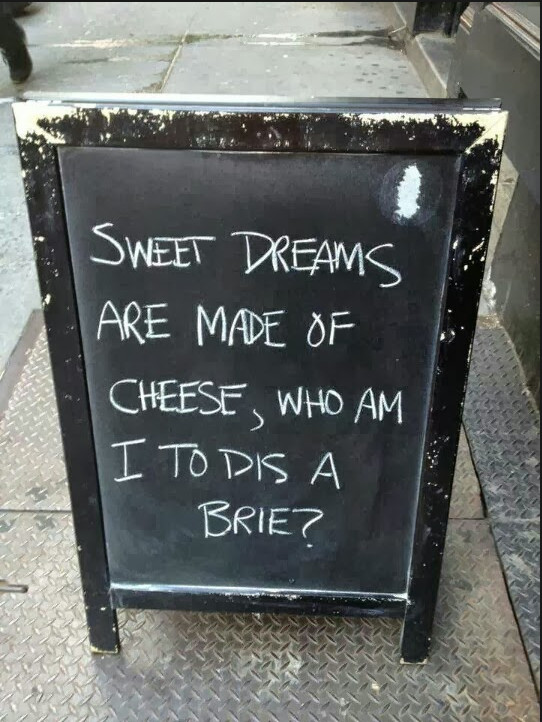
What follows is in no way meant to be a treatise on the subject. I really just wanted to share one instance I found entertaining and clever and perhaps say a word or two about the genre. I was, however, reminded just how pervasive this form of humor/wit is and a bit overwhelmed by the quantity (if not the quality) of examples available. Please forgive me.


Food Pun

From the ever-so-delightful world of food puns

I came across this graphic and shared it with my friends on Facebook. It has proven to be quite popular, which makes me wonder about the reasons we call puns (or plays on words) the lowest form of humor, yet they seem to be universally enjoyed . . . even when they’re real groaners. I think this one is quite clever, though.

Oscar Levant once suggested “A pun is the lowest form of humor—when you don’t think of it first.” I find great wisdom in that observation. Nothing evokes groans so much as a pun. Sometimes it seems the most clever ones are rewarded with the loudest groans; perhaps from jealousy. Who knows?

Wikipedia tells us the pun, “also called paronomasia, is a form of word play that suggests two or more meanings, by exploiting multiple meanings of words, or of similar-sounding words, for an intended humorous or rhetorical effect.” In its own, inimitable fashion, the entry goes on, and on, and on, describing everything from humorous puns, to rhetorical puns, to scientific and computing puns. Click on the link, above, and you’ll see what I mean.

A long time ago, in a galaxy far, far away I had friend who said he wanted to be the Chairman of the Revolutionary Committee to Purge Punsters – after the revolution, of course. He suggested his first trial would be against himself. People who really like punning are strange birds indeed.

I find it quite fascinating there is so much time and energy given to knocking puns, yet we seem to spend an equal amount of time making and enjoying them – and there’s no end to the availability of high (low?) quality puns out there. More food puns? Here are a few:

  • The history of cheese is full of holes, but it’s interesting in its own whey
  • At breakfast, the hacker downloaded cornflakes via his cereal port
  • Those who eat candy with both hands are ambi-dextrose
  • When the cannibal showed up late to the luncheon, they gave him the cold shoulder
  • Old colanders never die, they just can’t take the strain anymore
  • Those who forget the pasta are condemned to reheat it

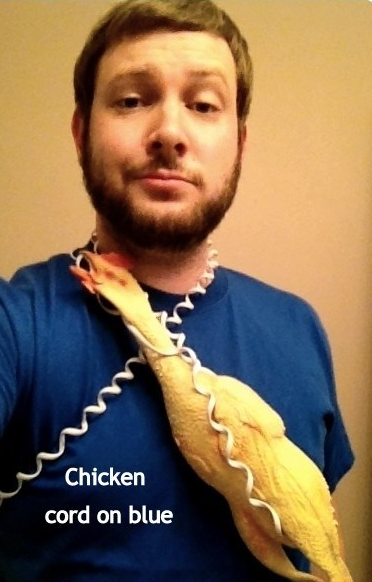
I found hundreds of these, as well as quite a few visual puns. Actually, most of the visual ones rely on words to help them out, as the following (it truly is bad; I know) attests:

Chicken Cord on Blue

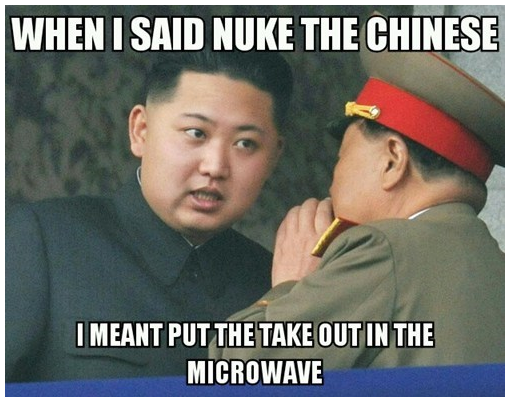
Here’s a bit of a crossover pun I encountered. I found it searching specifically for food puns and I guess it is one. However, it also brings a bit of politics and current affairs into the mix.

Warm up the Chinese

Finally, here’s one I rather like despite it having absolutely nothing to do with food:

Big Fan

For good or bad, I’m quite certain I could go on for a very long time and not exhaust the material that’s out there, but I want to circle back to the item that precipitated this post in the first place, and leave you with the song that inspired it. So, here’s Annie Lennox singing Sweet Dreams. Enjoy!


The Prime Discriminator is Within

Edward Ladd & Sons

Company Jacket created by Cat’s Pyjamas

As an opening aside, I find it an interesting statement about the immediacy of the Internet that I would hesitate to share an article or blog post I encountered because it’s more than a week since it was published. Nevertheless, I did hesitate when I came across this particular article in Fast Company. I ended up sharing it on my Facebook Fan page and I’m going to share it here, with a little bit of personal annotation.

Many years ago, when I was in my family’s wholesale food business, I realized what I found to be a very sobering fact. As long as we weren’t manufacturing or producing anything, the only way to stand out from the crowd was to provide service over and above everyone else. Anyone can buy and sell items that are readily available and this was surely true of food. We could break the ice with price, but that was ultimately a losing proposition as the customers we sold to would inevitably leave us for someone offering a lower price.

However, not everyone could provide exceptional service. As a result, we were constantly thinking of ways in which we could provide value that others didn’t even think of. One way to do this is to just be available. When a restaurant runs out of product for whatever reason – whether it be unexpectedly busy days or flat-out stupidity in anticipating certain inevitably busy days – always being there and coming through was one way to stand out.

But that wasn’t enough. I think the real discriminator was the mind-set that our relationship with our customers was more than just seller-buyer; it was that of partners. Such a mindset had us thinking as though we were in their shoes and, frequently, it made enough of a difference in how we anticipated their needs and even helped them understand their needs in ways they weren’t always capable of. I think it worked pretty well while I was there.

So when I read this article today I was both intrigued and somewhat satisfied. I never thought of what we were doing as anything other than providing good service. I didn’t realize it was providing a special customer experience. Back then, as the article points out, customer experience wasn’t what it is today, but in our little corner of the world – in the kind of business we were engaged in at the time – it was what we were providing.

Now, it seems, it’s what everybody needs to do . . . and I agree. Here’s a quote from the article I’m referencing:

You don’t have to take my word for this. Over the last five years we’ve been running a study in which we ask consumers to rate the customer experience at companies they do business with. What we can now prove is that customer experience correlates to loyalty. Specifically, it correlates highly to willingness to consider for another purchase, willingness to recommend, and reluctance to switch to a different provider. In other words, if you want that next sale, if you want good word of mouth, and if you want to keep your customers, it’s unlikely that anything else you do matters more than delivering a superior experience.

Indeed!

Here’s the link. You can read the whole thing at Fast Company. It’s well worth it, even if it is almost two weeks old.

http://www.fastcompany.com/3000350/why-customer-experience-only-thing-matters

Enjoy


365 Days of Thanksgiving

The Simpsons Enjoy Thanksgiving

Memories of Thanksgiving Past

So I’m Not a Journalist

I suppose I should have written this prior to the holiday, but it really is a retrospective and, frankly, I hadn’t thought about it much before yesterday’s celebration. Please forgive me. I’m working on developing an editorial calendar. It’s on my to-do list. Maybe next year I’ll be more sophisticated, but this year I’m just me.

Thanksgiving has always been my favorite holiday and now another in a long line of them is in the books. It has always been a time of family, but in my case (and surely for many others) the nature of family has changed many times over the years. I’ve now experienced 65 Thanksgiving dinners. Actually, when I was younger we used to eat around 3:00 and by 6:00, when hunger returned to my growing body, I would frequently return to the table for a large second helping, but I’m not including those in the meal count; just the years.

Remaining, Yet Partial Memories

Of course, I don’t remember most of these dinners, though small portions (unlike my plate) do remain, considerably diffused by time and intervening circumstance. When I was a young boy there were dinners that included cousins, friends, and sometimes distant family, many of whom were my age and with whom I would play catch or, later on, watch football. As a young man, I recall several years when the meal was dominated by highly contentious political arguments over Vietnam, Israel/Palestine, and general economic theory. My father and I did not see eye-to-eye on many of the prevailing issues of the day and the dinner table was frequently where these differences came to a head, sometimes resulting in someone leaving the room . . . usually the old man.

Yesterday was the first time in a few years both my brother and sister were out of town and, coupled with the absence of my parents (both of whom are amolderin’ in the grave), I had no immediate family with which to spend the holiday. This also had a salutary effect, as it allowed my wife, children, and me to spend the day with her family with a total absence of guilt or argument over which location would be best. In the past, we have spent the day with one side and the evening with another. I like staying in one place best.

Holiday Exceptionalism Lost

The biggest thing that’s changed for me is the really special feeling of the day is no longer there. Don’t get me wrong. I still love the holiday and always enjoy being with family. Nevertheless, after all these years the excitement has worn off and, even worse, the food (which once was so special) has succumbed to a level of scrutiny I never brought to the table before. I’m wondering if this isn’t related to my being an older father of two young children, both of whom require lots of attention and neither of whom yet appreciate the wonders of a full Thanksgiving meal. Maybe I’m just jaded. By the way, my love of Pumpkin Pie does not seem to have diminished, so there’s something to be thankful for!

What It’s Really About

I’m reasonably certain what has happened is I now try to think of each and every day as one for which to give thanks. Since I am no longer religious, and have neither that type of community nor prayer to remind me of the blessings I receive, I make a conscious effort to do it in other ways. One of those is when I stare out at the night sky, which I do frequently, and contemplate how lucky I am to be here and, even better, to be conscious of being here. Thinking about the virtual infinity of the universe, it’s vast emptiness and tremendous violence, its humbling grandeur and beauty, I am always appreciative of the planet I live on and the amazing luck of the draw that I’m here and know it.

I’m also thankful I was born into a reasonably intact family, in a country as developed as the United States (regardless of the problems we have been, and are now, experiencing) and that I have lived a very interesting, exciting, and full life filled with challenges, setbacks, and triumphs. Thanksgiving tends to pale in comparison and I’m not sure that’s a bad thing. How was your Thanksgiving?


For Restaurants Engagement Has Always Been on the Menu

Engage!

Make it so!

Everyone and her aunt – at least those in the social media world – is talking about engagement nowadays. For instance, just a few weeks ago Brian Solis posted “The Rules of Social Media Engagement” on his blog. Ten days ago, Laurel Papworth wrote “7 Levels of Social Media Engagement” at socialmediatoday. Way back in January of 2010 Jason Falls wrote a rather scathing review of the concept in social media explorer entitled “What is Engagement And How Do We Measure it?”

Now, I’m far from an expert in this field. I have no training in marketing, PR, or advertising, though I have pretty extensive experience in sales, having spent many years in the wholesale food business doing just that (lots of cold calling on people who were already buying from someone else, actually). However, since embarking on my new career as a social media marketing strategist and bottle-washer, I do have some thoughts about what “engagement” means to me.

I’m of the opinion the use of “engagement”, in today’s rapidly changing social media fueled world, means a shift away from broadcasting one’s message out through print media, email blasts, websites, etc. toward a model that invites dialogue and conversation. I believe the difference is fairly well expressed in the concepts of “outbound” and “inbound” marketing. As I said, though, I’m a bit of a novice at this, so maybe I’m just full of hot air myself.

Nevertheless, I do have a fair amount of experience with the restaurant business, having eaten at lots of them, as well as managed a couple, and sold lots of product to many. I learned all about service from the restaurant business. I learned how to make people not only comfortable, but happy they did business with me.

So . . . what do I mean by the title of this piece? I am doing some low-level reputation management and I have some Google alerts set up to let me know when some of the businesses I’m working with, or am interested in, are being discussed. Today I got one that led me to read a couple of reviews of a particular sports bar I would like to have as a client. One of the reviews mentioned how the owner walked around and talked to each of the tables where people were eating, drinking, and watching a game. The author of the review also suggested this was no longer the norm, which was why it stood out. Also mentioned was the author’s belief this wasn’t just a cursory walk-around, but a genuine conversation; an “engagement” with the people that pay his rent and his employee’s salaries.

It made me realize the best, most successful restaurants have always done something like this. They make their customers feel as though they are eating with friends, that they matter, and their comfort and satisfaction matter. It’s not something that goes on a checklist of things to do. It’s natural (at least with the best of owners and managers) and – which it always was for me – fun and fulfilling. It’s also a way to get immediate feedback and to address problems before they get out-of-hand.

Engagement is important, and social media provides ways for most anyone in business to participate as never before possible. However, as many also point out, it’s important to be genuine and it helps if you really care. Successful restauranteurs understand this in their bones. Their success proves its value as well. Have you figured out how to genuinely engage with your customers?


The Ubiquity of Communication

Don't bother me.
The guy has it tough, yeah?

The other night I was sitting in the family room and our (formerly) male cat, Zack, was sitting on my lap enjoying me showering affection on him. As I’m petting him I’m talking and, mostly, using his name and telling him how much I love him and what a good cat he is . . . and he is, perhaps, one of the best cats I’ve encountered in my life. He is one of those cats that craves human company and follows us around the house seeking it. He’s really a great cat.

I was just relaxing, no doubt getting as much out of giving affection as Zack was out of receiving it, and I found myself thinking about how I communicate with him. He clearly knows his name, or does he? He responds when I call him, frequently by loping over from wherever he might be to receive a quick pet or a scritch. However, he’ll do that pretty much regardless of whether I’m saying his name or using some other term of endearment – and there are many, including just cooing at him in stupid, abject drooly-talk.

He seems to recognize all of them, so is he responding to his name, one of his many nicknames, some blathering expression of unbridled affection, or just the sound of my voice, which he no doubt also associates with food? Actually, given that I’m not really engaging him in meaningful conversation, does it really matter? He seems to always get the message. Maybe it’s just that he’s a slut for affection. I know all about that :).


Enterprise 2.0 Conference Still Percolating in my Head

Almost three weeks ago I had the good fortune to attend my first Enterprise 2.0 Conference, in Boston, MA. My attendance, though highly sought after (by me) for over a year (as a representative of the company I just “retired” from), was still somewhat serendipitous, and relied heavily on the generosity of Susan Scrupski, the Executive Director (or, as she is wont to describe herself, the Concierge) of the 2.0 Adoption Council.

This was a new experience for me and I had no knowledge of what, exactly, had taken place in previous conferences – other than what generally takes place at most conferences. There was one major difference this event was going to mean for me. For well over a year I had been accumulating “friends” through my use of social media, especially Twitter. I had never met any of these people face-to-face, yet many of them I felt I knew reasonably well and, in fact, quite a few of them I believed I could trust – at least as much as I would trust any colleague I had ever worked with. Now I was going to have the opportunity to spend some face-time with them, rubbing (and bending . . . over numerous beers) elbows for over three days.

A little over a month ago I posted about the possibilities of building relationships virtually and argued that face-to-face meetings, though valuable, were not necessarily the sine qua non of meaningful, trusting, and useful relationships. I was primarily addressing business relationships and, especially, the necessary interplay of colleagues – peripherally touching on sales and arms-length transactions as well.

I haven’t changed my thoughts on the value of virtual contact and the ability to have meaningful relationships without meeting face-to-face . . . but I surely had to think deeply about it after Boston. Here’s why. My first full day there I made it to the all-day Black-Belt practitioner’s session a couple hours late, due to several snafus I experienced with Boston’s public transportation. I entered a room with no less than 60 or 70 people seated at round tables facing the front of the room as a presentation was being given. I managed to find an empty space, sat down, and immediately started searching the room for “familiar” faces. I soon spotted two people I had become “friends” with via their blogs and, especially, through numerous conversations we’d had on Twitter – Luis Suarez and Mary Abraham (@elsau and @VMaryAbraham, respectively).

I was able to recognize both of them despite the fact I had never seen them in person and only knew what they looked like based on their avatars. This in and of itself should be a good indication of authenticity, now that I think about it. At any rate, as soon as there was a break I moved over to their table and was greeted with the warmth and enthusiasm reserved for old friends. I’m not sure I can adequately express the feelings I had right then and, frankly, it’s taken me this long to sort out my feelings and what I think I learned from the entire experience. I’m not quite certain I’ve processed it all yet, but I’m finally able to complete enough of my thoughts to get a blog out.

Later that evening, after the day’s conference activities were completed, Luis, Mary, and I sat in M. J. O’Connor’s (in the hotel where the conference was taking place) drinking Blue Moons, getting to know each other a bit better, and sorting through the day’s experience. I know that Luis has been to many of these conferences and, as one of the most vocal and prolific proponents I know of in favor of social media, he’s no doubt met many people over the years he had previously only know through virtual media. I don’t think it was the same for Mary and I know it wasn’t the same for me. This was the first time I had come face-to-face with people I had grown to know through Twitter, blogging, Facebook, etc. It was truly a wondrous experience.

Seriously, I’m still not entirely over the whole thing. Consider this. It was the first time in my life I attended a conference for my own benefit. Previously, I attended numerous conferences, but always as an employee of Rocketdyne (in all its incarnations during my career there). Before that, I was in small businesses and I don’t recall ever attending any conferences, so no experience on that level. Now let me bring this back to what I think I learned from this particular level of the experience.

It is possible to conduct business and to build a solid, trusting relationship with people you have never met. It is, however, far preferable to have some kind of face-to-face meeting at some point in time in order to solidify the relationship. Of course, now that I’ve written these words I realize I haven’t communicated with either Luis or Mary since returning to Southern California from Boston. Then again, it’s only been three weeks (almost) since the conference began and, given the intensity of the experience, I don’t suppose that’s so out of the ordinary. I took a week out of my life to attend and had a lot of catching up to do once I returned. Couple that with the death of my last (and favorite) uncle a week ago, I suppose it makes sense.

Oops! I’ve managed to digress, so let me return to my last thought. I believe people who wish to work together virtually can enhance the quality of their relationships by having at least occasional in-person meetings with their colleagues. However, I don’t think it’s a matter of the ability to experience body language, eye contact, etc. so many people assert as the most important aspects of human connection, as much as it’s just the informal, off-hand, and emergent conversations and interactions that can only happen during the course of an afternoon or evening spent together. This should include, if possible, sharing a meal or sitting in a pub and bending elbows over a pint or three of some good beer, ale, etc.

As I said, I haven’t entirely processed how I feel about this or what I think I’ve learned, but I’ve waited long enough to write something down about the experience. I plan on posting at least twice more on what I got out of the conference. My next post will be more of a compilation of the many posts others far more knowledgeable than me have written since the conference was over. Following that, I intend on discussing an issue of Enterprise 2.0 I think is missing from the equation; namely some of the design principles of Web 2.0 I think E2.0 should be emulating and that I don’t see at present. Stay tuned.