Tag Archives: Knowledge Management

Occupy Communities

The title for this post comes from a session my friend, Trisha Liu, has proposed for this June’s Enterprise 2.0 Conference in Boston, MA. I came across it the other day quite serendipitously while checking a few Twitter streams on my iPad as I waited for my car to be washed. The title caught me eye immediately as anyone who knows me will understand, especially when read in its entirety, viz “Occupy Communities: Social Media Training for the 99%”. If you have a moment please visit the page and, if you agree it’s a great idea, leave a comment saying so.

Despite the call to my base political instincts, upon reading Trisha’s idea there were several reasons her proposal resonated with me. Foremost, Trisha is addressing the fear of adoption of social tools for business (i.e. inside the organization, behind the firewall, and dedicated to facilitating the business processes that carry the enterprise forward in its mission). I spent many years at a staid old aerospace company beating my head against a wall of resistance fueled by this fear. She refers to it as “SoMe-itis” and breaks it down into the following components:

  • Shock: “Help!! My company wants me to ‘be social’!”
  • Split personality: “Do I have to be a nerd/extrovert/Millennial to ‘be social’?”
  • Dry mouth: “How do I choose what to ‘say’ in social media?”
  • Anxiety: “What if I say something dumb?”
  • Low self esteem: “Will people care about what I have to say?”
Baby Boomers Eligible for Retirement

This "Crisis" is NOT Going Away

Additionally, although I am interested in, and have dealt with, all of these issues people face in the course of introducing a social tool into the workplace, there is one of them I’m currently more interested in than others; that’s the second one she lists. Even more specifically, one of my main interests centers on the question “Do I have to be a Millennial to ‘be social’?” I even tweeted Trisha and asked her if I could use her proposal as a basis for a portion of my business model:

https://twitter.com/#!/rickladd/status/164839087180742656

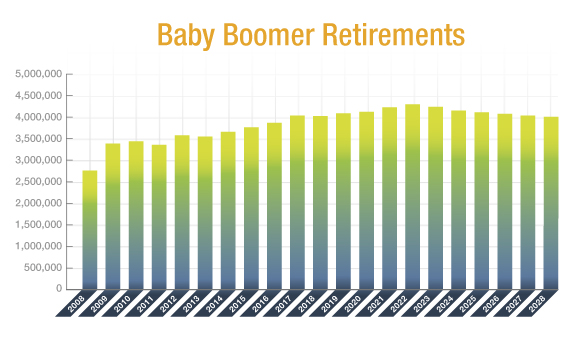
A friend told me recently he’s been hearing more and more concern from large organizations about the upcoming wave of retirements from my generation – Baby Boomers. He is not alone. A decade ago, when I first started doing Knowledge Management work for Rocketdyne, one of the most important issues we wanted to address was the looming wave of Boomers who would be reaching retirement age and the threat that posed for the collective knowledge of our organization. As a company that designed, manufactured, tested, and flew the world’s most sophisticated rocket engines (including the Atlas, Delta, and Space Shuttle Main Engines), each of which had long histories and service lives (as systems, not as individual units), continuity of our knowledge was of paramount importance. Those of us who were actively pursuing KM were very concerned we would fall below a critical level of skill and jeopardize the safety of the Astronauts who flew the Space Shuttle.

Unfortunately, although lots of lip service was paid to the “looming” problem – as well as a lot of time and money likely heading off (in retrospect) in the wrong direction, turning that massive ship around was virtually impossible. Now that the program is over and there was nothing already in the pipeline to replace it, my alma mater is bleeding talent on a regular basis. I suspect there are lots of organizations facing this “crisis” as well. I’d love to be able to help them out . . . and here’s my business model (at least a portion of it; I’ve other things in the works as well).

With the growing number of Baby Boomers set to retire – or even partially retire (like I have) – and not reaching a crescendo for another decade, the issue we once dealt with as a Knowledge Management problem I now believe is one of acceptance of social media inside the firewall, i.e. the development and use of communities, facilitated by tools and leaders trained in their use as a knowledge transfer process. We spent many years finding and categorizing hard-copy and digital media. We’ve spent countless hours and dollars on exit interviews and video recording of retiring employees. All the time we kept saying tacit knowledge (the knowledge people carry around in their heads) was something like 80% of the actionable and useful knowledge possessed by an organization.

I have argued for some time that social media IS the new knowledge management. Although it’s now a bit old, I have a presentation on SlideShare I originally prepared for my cohort at CSUN‘s Tseng College, shortly after I finished a Masters program in KM. Sadly, though not surprisingly, the program no longer exists. I believe this is partly because they failed to recognize the power of social media to do what KM really needed to do. As practiced, in my experience KM was far more like Library Science. What is happening now is a sea change, a phase shift that employs technology capable of connecting people in real-time, while also providing a level of archival, indexing, and search capability that allows for historical knowledge discovery as well.

However, I’ve also experienced a high level of resistance to accepting what I consider to be inevitable. I can only speak for the aerospace industry, but I struggled to implement social business capabilities for nearly a decade and, as far as I can tell, my former organization is still fairly resistant to the possibilities it provides. This is the issue I believe others are encountering as well, and it is what Trisha’s presentation is all about. A more specific interest of mine is in gaining acceptance from the group of people who will be retiring within the next decade or so. I believe it’s important to engage older, soon-to-be retiring employees in the use of social business tools, not to “pick” their brains, but to provide a forum for interaction with their younger employees, within the tool (embedded within the processes they are currently employing, if possible), so their knowledge can be slowly transferred to those who will follow in their footsteps.

As a Baby Boomer who is entirely comfortable with the use of these kinds of tools and the behaviors that must exist in order for them to be effective, I believe I have a unique perspective to offer organizations who wish to engage their “more mature” employees. Many of them think they are incapable of understanding them or that you have to be young to employ them. Worse still, many have been influenced by the media’s depiction of tools like Twitter, Facebook, and YouTube such that they are currently incapable of seeing the value in micro-blogging, status posting, and video sharing to an organization’s ability to improve how they get things done. I – and, I’m sure, many others like me – can reach these employees far more easily than their younger colleagues, if only because we have the same generational backgrounds and have (or have dealt with) similar fears and anxiety.

This is why I believe Trisha’s presentation is important. It may not address the more sophisticated aspects many in the Enterprise 2.0 (or Social Business, whatever we wish to call it) world are concerned with as they mature and evolve their theory and practice, but it does directly address what I believe is a core issue with the effective use of these tools in our various organizations. Without acceptance, I am convinced the tools and practices that facilitate the sharing and use of “The Corporate Memory” will remain on the periphery of the enterprise and likely chew up more time and money than they’re worth and, in doing so, become more of an anchor than a sail. My goal here is not to delve too deeply into the many nuances of this issue – e.g. Tacit vs. Explicit knowledge, cultural change, the role of Executive leadership, etc. I will save that for further posts. However, I do think acceptance is a huge millstone hanging from the neck of many an organization. Am I too pessimistic? What do you think?

Graph Courtesy of InContext


Fittingly for Halloween, I’ve Become Invisible

Am I That Transparent?

Am I That Transparent?

Does Retirement Make You Disappear?

When I accepted an early retirement from the company I  had worked at for well over two decades, I did so because I knew both our business and the economy in general were shrinking. I knew, because of my position in the enterprise Program Management Office (actually, an attempt at a Project Portfolio Management Office, as I recall), there were going to be layoffs and I had reason to suspect I might be one of them. There were lots of good reasons to believe so, not the least of which was my propensity to push for the use of social media to both enhance internal communications and to better market an organization that had never really marketed itself (have you ever heard of Rocketdyne? You have and don’t even know it. See if you recognize any names here). Neither of these positions had proved all that popular amongst either the leadership or the rank and file.

I was also over two and half years into the demographic the offer was made to (everyone 60 and over) and whether they meant to or not, they were telling me I was getting long in the tooth and, perhaps, they wanted me to move over for younger blood. At least that’s how it felt. They may not have meant it that way but it felt a bit like they were telling me, regardless of my service or anything I had previously done for the organization, I was no longer needed and, perhaps, no longer wanted. Again, that’s pretty much how it felt.

For those, and many other, reasons I accepted the severance package they offered after some little deliberation and a lot more financial analysis to see just how tenable my position would be. I have often referred to their offer as a gold-leafed handshake; not exactly gold-plated and hardly a golden handshake. It amounted to about a half year’s salary. Fortunately, my wife and I had scrupulously saved and forsaken a lot of things we might otherwise have spent money on over the years in order to build up a reasonably large nest egg. With the knowledge it would be years before we had to sell the house and live out of our vehicles, and knowing the skills and capabilities I possessed stood me well in the business community, I took the plunge and accepted the offer.

Shortly after leaving I started looking around for the possibility of finding an organization that could use my services and wasn’t in the position my previous company was in; that is, they were hiring rather than laying off. I posted a few resumes with some very large companies and was even asked to apply for a position with a very large tech company that provided many of the tools – or types of tools – I had been learning and evangelizing at my previous place of employment. Unfortunately, nothing panned out and I didn’t much feel like spending more time than necessary beating my head against a wall, especially given the continuing deterioration of the economy.

Mind If We Stay In Touch?

Now, I’ve written before about the need – as I see it – for companies such as the one I retired from to stay in touch with former employees. I had proposed a method of doing so at least seven years ago when I suggested we provide access to our internal expertise location/sharing tool (an early, proprietary social media tool) for retirees who wished to remain engaged on an as-needed basis after they left. It seemed a small investment to make and I knew there were lots of former employees who, despite their retirement, would have welcomed being asked to throw in their two-cents worth on an important issue. We made rocket engines, for crying out loud, and our engines had propelled virtually every American astronaut since the very beginning of the Mercury project. Nobody I knew really wanted to totally stop being a part of that kind of awesomeness.

Needless to say, my proposal fell on deaf ears. Ironically, although the aerospace industry designs and manufactures some of the most technologically advanced products in the world (in our case, the Space Shuttle Main Engine, numerous other rocket engines, and some pretty cool energy products involving what we called “extreme engineering“), their embrace of computer technology is almost always way behind the curve. This is not necessarily so in terms of engineering computing, but is most definitely the case when it comes to business processes and internal communications. It was a source of mildly aggravating bemusement for over twenty years, but more of that at a later date.

Back To The Grind . . . Eventually

Back to this ongoing communications thing. I have come to realize, despite the over two decades I spent at Pratt & Whitney Rocketdyne, my departure has made me completely transparent to the company. Many of the people I used to talk with daily, even those who are Facebook friends, haven’t said word one to me. I guess it’s kind of a cultural thing. Once you’ve retired and are presumably out of the workforce, you just don’t exist anymore. Unless, of course, I were to play golf with the company golf club. Then, at least for the duration of the game and the drinking afterward, I would exist in perpetuity. There are, as well, a few notable exceptions. Several people with whom I worked closely have remained in contact with me and I am deeply appreciative of our ongoing relationships.

Speaking of cultural mores, I suppose this is a logical extension of how we treat older people in general. We are, after all, a culture that exalts youth and all of its frivolity and mundane inanity. I suppose I should have known this would happen and, truth to tell, I’ve really been enjoying this retirement thing. I know it can’t last; we don’t really have enough money to maintain a decent standard of living and still be able to send our two young girls to college in 8 and 11 years from now. However, I’m just about ready to return to working at something that will take close to a full-time effort. Right now, though, I still feel a bit like the Invisible Man.

Photo shamelessly linked from Monsterland


The Hell It’s Not About The Tools!

Hand Axes

What Would Lizzie Borden Do?

I had lunch a while back with a former colleague from Pratt & Whitney Rocketdyne. He is also a fellow cohort member from my Masters in KM program, from which we both graduated in late 2009. We have worked together extensively. After eating we were discussing the situation at my former (and his current) place of employment, which is a bit unclear at this point.

As I shared my thoughts about the value (as I see it) of using social media to increase the organization’s capabilities (you know, the innovative, collaborative, communicative ones), he said something he had said to me over and over while I was still a colleague . . . “It’s not about the tools!”

Now, essentially I agree with him – at least to a point. Tools are, by themselves, absolutely useless unless they’re used to get things done in the manner for which they were designed. Even better, if you can figure out how to use them creatively they can be even more powerful. Try pounding a nail into a stud with your bare fist, though, and then tell me it’s not about the tools.

Nevertheless, this argument is valid when taken in the context of an organization where people think that throwing tools at a problem will somehow, magically I guess, solve the problem confronting them. I have personally seen this happen quite a bit and, in fairness to my friend, it did seem to be a common occurrence at our place of employment.

On the other hand, we’re probably all aware of situations where the simplest of tools served an organization well in dealing with a particularly difficult situation. This can only happen, I think, when the people confronting the situation are open and honest about what they’re facing and how it’s affecting the processes and people who are tasked with dealing with it.

This means they have to be able to think both critically and creatively. Too often people get to thinking in predictable ways and they pigeonhole the problem, thereby confining their possible solutions to the things they’re familiar with and have previous knowledge of. This usually leads to failure.

The thing about tools, though, is that they frequently give us the ability to use a bit of lateral – or even sideways – thinking. In the case of social tools such as Jive or Socialcast or Yammer, we’re also given the possibility of working together and sharing our information and knowledge in ways not previously possible.

A perfect example of how not to do it is the way in which the company I used to work at shared their knowledge of rocket engine design and manufacture. It was always the case that younger Engineers would send email requests to their older counterparts, requesting information on design intent or material properties or manufacturing techniques, etc. The older colleague might spend days researching and crafting an answer, which would then be sent back to the requester in an email.

The problem with this was that access to all this wonderfully useful information was now confined to the two (sometimes a few more, depending on who was included initially) people engaged in the conversation. Usually, within a short while the information and knowledge so thoroughly and carefully created was lost; frequently even to the original person asking the question. This was because there was no useful method by which email could be easily searched.

Nowadays we can do much better. We have tools, applications, and systems available to us that provide functionality like instant broadcasting (micro-blogging), collaborative creation (wiki, even Google docs), and ubiquitous indexing and search. There is, in my opinion, no excuse for not taking advantage of as many of these tools as is reasonably affordable – taking into consideration the culture of an organization and its tolerance for experimentation and change. Frankly, from what I’ve experienced and from what I learn from friends and others who are engaged in community organization and leadership, there are ways to introduce, champion, and develop these kinds of tools in just about any organization.

So I would wish to characterize the use of tools just a bit differently. I would say it most definitely IS about the tools, but it’s just not entirely about the tools. Having functionality available that was not possible five or ten years ago can change things dramatically. However, it doesn’t happen overnight. It takes a conscious effort and, sometimes, dramatic changes in the culture of an organization. Nevertheless, the pain associated with change is usually ameliorated by the newfound capabilities the change brings; the possibilities of developing innovative processes and organizational structures and of increasing both the efficiency and effectiveness of those things we engage in. If anyone tells you it’s not about the tools, as if to say they aren’t important, ask them when was the last time they combed their hair with a fork!


Obvious to Him . . . Perhaps?

The Obvious?

Euan Semple is a friend of mine; at least in the sense we are “friends” on Facebook and we are “connected” and have engaged in an email conversation on LinkedIn. I also follow him on Twitter and read his blog (somewhat infrequently, I must confess). I know he’s read my blog at least once because he commented on a post of mine. We have not yet met face-to-face, nor have we had an actual conversation where we could hear each other’s voices (each others’ voice?), say . . . over the phone or with Skype.

This morning I came across an item on my Facebook wall from him. It was a link to a video of his Do Lecture, shared through his blog, “The Obvious?”. I don’t see too many things from Euan in Facebook, so it caught my attention. I clicked on it to open a tab with the link so I could view it later. Many times I don’t end up viewing the item I’ve set aside, but this time I did. I’m very glad too. You can listen yourself here.

Euan is probably best known for his introduction of forums, blogs, and wikis to the BBC and now spends his time advising organizations on how to integrate these and other “social” applications into their businesses. You can learn more about Euan from his blog or from his website.

As I’m writing this I see one of his friends has commented on the original Facebook post. She says she finds his talk bitter sweet, because he says what she’s been saying too . . . to no avail. I have to admit to feeling the same way, though I did manage to get some traction in changing the organization I spent nearly a quarter century with.

Euan clearly knows what makes an enterprise tick. He also is keenly aware of the numerous ways in which traditional organizations and management waste time and energy and, actually, hinder progress in most every enterprise that’s built on the traditional, hierarchical business model we’re all so familiar with.

I strongly suggest you listen to his lecture yourself. It’s only about a half-hour and it’s quite enlightening and entertaining. He’s a wonderful storyteller. I actually took some notes while I was listening – which is not like me at all – and here are some thoughts that stood out. I’d sure be interested in hearing any of yours.

Euan points out that fear of messiness is troubling. I forget his exact word, but I wrote down the thought it triggered for me, and that was fear of messiness stifles creativity and, therefore, innovation. In addressing the fear that using social media would get out of control, he reasonably points out we still need middlemen to make sense of all the data and information out there. I have heard the people I believe he’s talking about referred to as curators or gardeners. He goes on to point out what we don’t need are gate-keeping middlemen who add no value at all.

He makes quite a few points about culture and how best to deal with the inevitable resistance and fear one encounters when even talking about social media. One of them is a reference to the concept of Trojan mice, i.e. unobtrusive, small things that generate change through their adoption and use. Another comes from one of the few slides he used with words – “Easier to build a tool for the community than a community for the tool” – though he expresses a bit of distaste for the way many view communities. Here he points to the difference between conscripts and volunteers and, for me, invokes the value of emergence, that communities spring up from recognized, shared needs and desires, not from the dictate of management.

I think my favorite thing he talks about is the dreaded ROI argument; one I was beaten about the head and shoulders with for many years, both in terms of knowledge management and later regarding the use of social media (which I have argued elsewhere is what KM is really about; surely the kind of KM I’m most interested in!) to connect people. In a sense, it’s what the entire lecture is about, but he offers up what he calls a Scotsman’s tip about ROI – “Keep the I really small and no one will give you shit about the R”. I got a kick out of that.

So, please take a half hour of your time (plus however long it took you to read this far) and check his lecture out. It’s quite good. It helped me get to know Euan a little better, as well as reinforced my thoughts about so many things I don’t know where to begin. It is, indeed, bitter sweet for me as well.


Craft Work is Knowledge Work


Steady Hands Make for Good Soldering

Soldering Jewelry


I’ve been following the action at #TUG2010 (Traction Users Group), reading and retweeting lots of good stuff from @rotkapchen, @vmaryabraham, @jackvinson, and @lehawes. Jack Vinson tweeted “Craft work can become knowledge work. Making it visible. narrating it. He added the hashtag for observable work, #owork, as well – indicating that was the concept he was associating it with.

My initial reaction to what Jack wrote, however, was to the implication that craft work isn’t normally knowledge work, which I don’t think is an accurate statement. Let me also say I’m not sure if Jack actually authored those words or if he was merely reporting them from the presenter at the user’s group preso he was attending and tweeting from. So I’m not taking issue with Jack. Actually, I’m not even interested in who said it; I just want to address the concept of craft work as knowledge work.

I believe all work is knowledge work. Sure, there are different levels at which the knowledge exists or asserts itself, but there’s always some component that involves knowledge; at least if it’s done by a human being. So it is with craft work, assuming I’m using the term in the same sense as Jack or whoever is using it, that is work manifested in tangible items, such as wallets or hydroelectric dams. I think of it as things like welding, carving, painting, growing, etc.

All of these things require a fair amount of tacit (in the head, as we sometimes refer to it) knowledge. As far as the concept of making this kind of knowledge visible goes, I think a lot of it gets transferred that way . . . usually in a mentor or apprenticeship kind of relationship. Making some of it more “visible” can make it more accessible, but there are necessarily limitations.

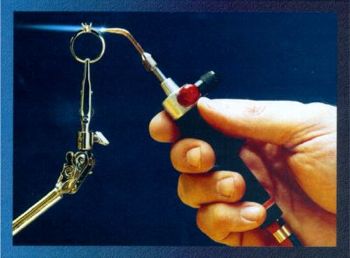
An instance of this from my life comes from many years ago when I was a jewelry bench worker. The place I was at made very high-end gold and silver shadow-box cuff links and they require some interesting soldering. I melted an awful lot of precious metal before I learned to recognize the colors, smells, and sounds that hinted I was almost at the right temperature and had to back the flame off. I believe what I gained from that experience was knowledge; hence, I was engaged in knowledge work, albeit at a lower level than, say, when I worked on the Space Shuttle Main Engine team.

Maybe the exigencies of saying something in less than 140 characters played a role in it coming out the way it did, but I felt the need to at least record my thoughts. I believe what Jack (or whoever actually made the statement) meant was that making craft work visible increases its accessibility and, therefore, its likelihood of being more easily transferred or learned. It doesn’t thereby become knowledge work, however. It already is and always has been knowledge work. Anybody disagree? Did I misunderstand Jack or the message he was conveying from the presenter?


It’s Getting Chilly, or How I’m Planning on Doing Some Cold-Calling

Well, I’ve finally decided to go out in earnest and get some clients. I don’t think I’ve mentioned much (if anything) about what I had hoped to do with my life after leaving Rocketdyne and, frankly, it was a bit amorphous in my mind for some time as well. I keep looking for ways in which the knowledge I’ve gained over the years can be put to good use for others. I’m beginning to see some fairly clear outlines of just how I might be able to do that. It isn’t all about “clients” either.

Today I met with the Principal of my youngest daughter’s school, Sycamore Elementary in Simi Valley; on Friday I am meeting with the Principal of my other daughter’s school, Vista Elementary also in Simi. I decided a while back I wanted to see if I could bring something to the table that might improve the educational system . . . some small but significant contribution I might offer that would take advantage of my Knowledge Management, Social Networking/Computing experience, as well as my overall skill set acquired from well over four decades of business experience.

Today’s meeting was a bit of serendipity, actually. I take my children to school every morning, dropping the older one off first, then dropping my youngest off on the way back home. Today I also walked the youngest in and watched her play a bit before class started. I then went into the office to talk to the Principal. My intent was to have essentially the same conversation I had with the Principal at Vista. After all, it resulted in an appointment to delve further into the issues. All that I could have asked for. I discovered today was the one day out of only a few in which she has set aside some time to have coffee and a chat with whichever parents happened to show up. Lucky for me!

Double lucky . . . the President of the PTA was there as well. She was very interested in what I suggested which, btw, was that I learn how they do “business” with an eye toward discovering ways they can take advantage of new tools, services, and techniques that might relieve them of any pain they’re experiencing. I know they’re experiencing it. You can’t be paying attention and think the schools and their ancillary organizations aren’t suffering from any number of headaches and problems which would improve the educational experience for students, teachers, parents, and administrators alike if they could be even partially solved.

So that’s what I offered to give to both schools. I have suggested I can afford to put in at least four hours a month per school and I am both willing and eager to do so. I plan on taking the same attitude to commercial and industrial establishments as well. I believe there are lots of ways in which social computing can be put to good use for small, medium, and large businesses. I also believe there are a lot of people out there who are holding themselves out as Social Media “Experts”. I am not doing that. I’m merely saying I think I can help – first and foremost – understand what kinds of problems any particular organization has that they want to address. Only then can they even think about what tool, service, process, or technique might serve to do so.

In order to drum up business that will actually make me income, I have developed my first piece of “Collateral” to leave behind after visiting the organizations I offer my services to. Anyone who is following me on Twitter, is my friend in Facebook, is connected with me through LinkedIn, reads this blog, or connects with me in any one of numerous other ways probably knows I’ve shared a few presentations I’ve given in the past – when I was still an employee of Rocketdyne. They can be found on Slideshare, here. I want to share what I’ve done in creating a brochure to leave behind after an initial conversation with a prospect. My intent is not for this brochure to introduce me, but rather to serve as a reminder of the conversation I expect to have with whoever it is I’m discussing these things with.

I know, from my years of pursuing knowledge in this field, through literally hundreds of conversations on the subject, and from following and reading the work of dozens of people whose intelligence I have nothing but the deepest respect for, that almost anyone; every process; every business; yes, even every institution – up to, and including, those of government at any level – could be improved through the intelligent application of social computing. Of course, every situation is different. The City Council here in Simi surely would neither benefit from, nor require, the same thing that might benefit the U.S. Senate, and a small restaurant surely doesn’t require the same capabilities that a large manufacturing or distribution enterprise would find helpful.

So . . . that’s my story, and I’m sticking to it. Below are the two pages of a three-fold brochure I’m going to get printed shortly and start bringing with me as I literally knock on doors. It’s not the only method I intend on using, but it gets me out of the house, and that’s a good thing. I’d be interested in any feedback those of you who might read this post have to offer. I’m a work in process. Aren’t we all?

Click on Image for Larger (Legible) Version

Click on Image for Larger (Legible) Version

P.S. – Special thanks are due to my friend Luis Suarez, who was kind enough to look over what I had done and make some very useful observations and suggestions. Thank you so much, Luis. You are one of those people whose presence I value dearly.


Companies Should Pay Attention to Former Employees

Today, my friend (I consider anyone I can have a decent, useful conversation with on Twitter a friend) Kelly Kraft (@KRCraft) posted a blog asking the question “How much and what kind of a relationship do you have with former employees?” Her experience is much different than mine, though I think her conclusions make perfect sense for any organization contemplating doing as her former org did. The question is not – in my mind and, I think, in Kelly’s – whether or not to have ongoing relationships. Rather, it is what kind of relationships, and how extensive (or intimate), will they be?

KM Through Social Media

Over eight years ago, in response to a perceived need for understanding (and locating) the depth and breadth of expertise at Rocketdyne Propulsion and Power (then a division of Boeing’s Space & Communications business unit – whew!), I did some research and found a company that provided a tool that was a predecessor of many of the social media offerings of today. In my opinion they were way ahead of their time. The tool was called AskMe Enterprise and it offered profiles, Q&A threads (including forwarding, commenting by others, feedback as to quality and efficacy), file and link uploading and sharing, etc. We later had a customization added that provided for posting Lessons Learned and, about four years ago, they added a blogging capability.

Unfortunately, the larger percentage of our workforce (especially leadership and management) adamantly refused to participate. This wasn’t unexpected, however disappointing it may have been, and we continued to use the tool and work on building acceptance by example and through its ever-growing usefulness. Many years ago, I suggested we consider finding a way to stay connected with the constant flood of experienced Engineers, and others, who were retiring or moving on to other pastures. Inasmuch as we had a history of bringing some of those people back as contractors, I thought we might be able to find an inexpensive method of remaining in contact with the majority who didn’t return.

The proposal I thought made the  most sense was to provide retirees with a secure connection to our network and, as compensation for being available for questioning within AskMe, perhaps covering the cost of their Internet connection. I don’t believe anyone took this idea seriously and it essentially died on the vine.

Intellectual Property & Communication

Now here comes Kelly, pointing out how valuable her former organization, Exact Software, has found maintaining continuous relationships with former employees can be. She also addresses the issue of what kinds of relationships make sense for different types of employees. Specifically, she notes the difference between outward-facing, highly engaged employees as opposed to somewhat sequestered, internally focused employees like many of the Engineers I worked with. She is, however, right on the mark suggesting each of them can be successfully engaged.

For instance, she points to her own experience as an Implementation Consultant for Exact and the work she did in the years since, noting there probably isn’t a great deal the enterprise needs to do to engage her. She is also, I believe, referring in part to her use of Twitter to stay in touch. My Engineer friends are not terribly likely to engage using Twitter (or blogging, or anything else that public for that matter). There are considerations of IP protection they can’t afford to ignore, as well as governmental restrictions like ITAR that, contravened, will surely bite them in the ol’ behind. This can be, and has been, quite expensive and can be done somewhat inadvertently.

Nevertheless, as Kelly points out, there are numerous ways in which an enterprise can stay in touch, and engaged, with its former employees. In Rocketdyne’s case – especially – with those employees who have retired and are not working for another company. She is also pointing out, in my opinion, that CRM (or SCRM) isn’t just for sales and marketing to dun customers with either. Social Media have many applications. Many of them are useful for engaging with an enterprise’s customers, but many are also valuable for engaging one’s own employees (current and former). The lunches and parties sound pretty cool, too.

PS – The article she credits me with was a few paragraphs of my opinion of what Hutch Carpenter (VP of Product at Spigit@bhc3) had to say at his blog, “I’m Not Actually a Geek” (which he really is, but you didn’t hear that from me).


Enterprise 2.0 Through The Eyes of a Friend

I have been a KM practitioner for over a decade, and one of the principal reasons we have given for using KM principles is the need to keep from reinventing the wheel. So, in that spirit, rather than write my impressions of the Enterprise 2.0 Black Belt Workshop here at the Enterprise 2.0 Conference in Boston, I’m merely going to point to the blog of my friend @VMaryAbraham, since she has taken copious notes and already put them online.

This will make up for the fact that I accidentally set my alarm for 6:51 pm (most of my timepieces are set to 24 hr time) and got about an hour later than I had planned, coupled with a public transport nightmare, that had me over two hours late to today’s inaugural session.

So without further ado, here’s the link to Mary’s (award-winning, I might add) blog – Above and Beyond KM – http://aboveandbeyondkm.com/2010/06/learn-from-the-e2-0-vanguard-part-3.html

P.S. – unfortunately, WordPress does not fully support the iPad yet, and publishing a blog is a bit problematic. One problem; I can’t make the URL to Mary’s blog an actual hyperlink. I’ll have to fix that as soon as I have access to a regular computer. In the meantime, if you want to read Mary’s notes you’ll have to copy and paste the URL into your browser. Sorry about that.


Older People Aren’t as Dumb as you Think, Kid

Whenever most people talk about technology and people my age, it amazes me how many assume we can’t set the time on a VCR (remember those?) or that our view of IM is that it’s a tool primarily useful for young teenagers to plot their escape from under their parents’ watchful eyes. Perhaps, as a generalization this is somewhat true, but it’s not really a correct depiction of how we more “mature” folks use and view technology. The reality is far more complex.

As someone who struggled for well over two decades to bring the latest technology into a large, ponderous, and eminently cautious aerospace company, I have encountered all types of people, from foot draggers (lots of them) to early (and enthusiastic) adopters. Obviously, my favorite is the latter but the challenge really presents itself in the former. One thing I found is that things aren’t always as they seem either.

For instance, I was working with a person who was the Director of a newly formed organization. He was nearing the end of his career, which had been very successful. He was a wonderful person; friendly, helpful, and full of joy and excitement for his job and the work of others. He was very supportive of using newer technology yet, despite continuous efforts to engage him in instant message conversations (our offices were quite a ways apart), he never responded to me. Frustrating!

One day I happened to be in his office to talk with him for a while. As I was sitting there he was composing an email. It was then I realized why he wouldn’t answer my IM communication attempts. He used what an old friend of mine used the call the “search and destroy” method of typing; what most call “hunt and peck”. Carrying on an IM conversation for him would be like talking with a very bad stutter and it just didn’t leave him with a warm fuzzy, so he did the best thing for him. He opted out.

So be careful how you categorize or pigeonhole people. This very successful individual had spent a long career doing just fine without IM. As much as I believe it was a superior tool for communication and that it served to enhance our ability to share (I sometimes now think of it as a stunted form of micro-blogging) information and knowledge, virtually all of his career had proceeded rather nicely without it. I knew I had to accept this and make adjustments.

He retired within a year and I, for one, was very sorry to see him go. Keep in mind there are many more wonderful people in your organizations like him – to one degree or another. Don’t shortchange them or your company by selling them short just because they don’t see the use of technology exactly like you do.


Has Knowledge Management Been Bad For Us?

In the world of Knowledge Management, we frequently talk about at least two different types of knowledge we deal with. The first is explicit, or codified, knowledge (stuff that’s captured and, hopefully, readily accessible in some useful form); the second is tacit, or tribal, in-the-head, “between the ears” knowledge. For most of my nearly 15 years of knowledge management practice in the aerospace business I have noted we spend an incredible amount of time, energy, and money working on the former.

At the same time we have continually asserted the vast majority of useful knowledge was the latter. I had a graphic that showed the ratio of explicit to tacit knowledge at 19 to 1, but it’s no longer accessible. So I created this one from a graphic in the public domain and added text in Photoshop. While the ratio shown here isn’t nearly what I believe reality provides, it does give a glimpse of how much remains under the surface when comparing the two types of knowledge. Actually, I found another available graphic that shows the ratio as a little greater than the one I put together, and it also lists more details of what types of knowledge comprise each of these two main categories.

For me, this is huge! In fact, where I come from we tended to use an adaptation of the Pareto principle, i.e. an 80-20 distribution, so this graphic helps make my point a fortiori. Now let me get to my point. Last Wednesday (12 May 2010), Rob Paterson published a wonderful post at the FASTforward blog entitled “Have books been bad for us?”, where he discusses the question of whether or not the web is making us stupid, as well as his belief the opposite is true. He argues that books have actually stunted our ability to innovate and create new knowledge. You really have to read the whole post, but here’s a sample I like:

But with the book comes authority. With the advent of the book, much of knowledge development stopped. Only the in group was allowed to play. What mattered was not observation. Not trial and error. Not experiment. Not sharing. But authority. Most of the accepted authority were texts that had no basis in observation or trial and error. Ptolemy, St Augustine and Galen ruled.

Rob goes on to argue, rather than making us stupid, the web is providing us with the kinds of information and knowledge connections we used to have before the book removed the more communal ways in which most of our collective knowledge was arrived at in the past.

So, here’s where I find an analogy to the work I’ve been doing for some time. Much of of what we call Knowledge Management (at least in my experience) seems to spend an inordinate amount of time and expense on dealing with the 20% (or 5%, depending on who you listen to) of an enterprise’s knowledge that is explicit. We work on organizing share drives, federating search capability, and scanning and rendering searchable (through OCR) much of our paper-based, historical information. I’m sure there are other ways in which explicit, recorded information is analyzed and organized as a function of a knowledge management activity.

But I think we’re missing the point about the real value of knowledge. If, in fact, the largest (by far) percentage of an enterprise’s useful knowledge is locked between the heads of its employees and, if (as we frequently say about tacit knowledge) much of it can’t be accessed until it’s required, why are we not spending more of our limited funds on facilitating the connection and communication, as well as the findability and collaborative capabilities of our employees?

I’m not suggesting there isn’t value to content management, smarter search capabilities, etc. I am saying, however, that I think most organizations are missing the boat by not spending more of their resources on the thing that offers to connect their people; to create organizational neural pathways that promise to be far more beneficial to the overall health of the company in terms of product innovation and design, manufacturing processes, customer relations, project management, etc. (or on and on). I am speaking of Enterprise 2.0, on which I will have a lot more to say in future posts.

The problems we face with acceptance are monumental. People in organizations that have traditionally been hierarchical and within which silos and fiefdoms emerge, turf wars and power struggles go on, and people are both kept in the dark and made afraid for their jobs hasn’t exactly set the stage for the trust required to do any kind of knowledge management effort. Nevertheless, if we’re going to participate in the struggle, we ought to be shooting for the things that are going to prove the most valuable – in both the short and the long run.

I’m a book lover myself. My reverence for books is almost stupid, actually, but I’ve worked hard on overcoming it. Unlike Rob, I no longer wonder. I see the web, and the enterprise and its internal network, as the future of our group intelligence and knowledge. What do you see?