Tag Archives: Learning

Craft Work is Knowledge Work


Steady Hands Make for Good Soldering

Soldering Jewelry


I’ve been following the action at #TUG2010 (Traction Users Group), reading and retweeting lots of good stuff from @rotkapchen, @vmaryabraham, @jackvinson, and @lehawes. Jack Vinson tweeted “Craft work can become knowledge work. Making it visible. narrating it. He added the hashtag for observable work, #owork, as well – indicating that was the concept he was associating it with.

My initial reaction to what Jack wrote, however, was to the implication that craft work isn’t normally knowledge work, which I don’t think is an accurate statement. Let me also say I’m not sure if Jack actually authored those words or if he was merely reporting them from the presenter at the user’s group preso he was attending and tweeting from. So I’m not taking issue with Jack. Actually, I’m not even interested in who said it; I just want to address the concept of craft work as knowledge work.

I believe all work is knowledge work. Sure, there are different levels at which the knowledge exists or asserts itself, but there’s always some component that involves knowledge; at least if it’s done by a human being. So it is with craft work, assuming I’m using the term in the same sense as Jack or whoever is using it, that is work manifested in tangible items, such as wallets or hydroelectric dams. I think of it as things like welding, carving, painting, growing, etc.

All of these things require a fair amount of tacit (in the head, as we sometimes refer to it) knowledge. As far as the concept of making this kind of knowledge visible goes, I think a lot of it gets transferred that way . . . usually in a mentor or apprenticeship kind of relationship. Making some of it more “visible” can make it more accessible, but there are necessarily limitations.

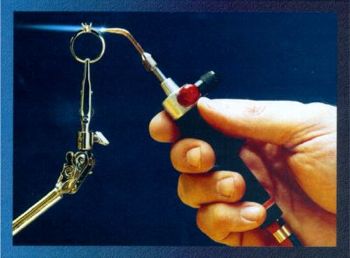
An instance of this from my life comes from many years ago when I was a jewelry bench worker. The place I was at made very high-end gold and silver shadow-box cuff links and they require some interesting soldering. I melted an awful lot of precious metal before I learned to recognize the colors, smells, and sounds that hinted I was almost at the right temperature and had to back the flame off. I believe what I gained from that experience was knowledge; hence, I was engaged in knowledge work, albeit at a lower level than, say, when I worked on the Space Shuttle Main Engine team.

Maybe the exigencies of saying something in less than 140 characters played a role in it coming out the way it did, but I felt the need to at least record my thoughts. I believe what Jack (or whoever actually made the statement) meant was that making craft work visible increases its accessibility and, therefore, its likelihood of being more easily transferred or learned. It doesn’t thereby become knowledge work, however. It already is and always has been knowledge work. Anybody disagree? Did I misunderstand Jack or the message he was conveying from the presenter?


New Book (Posthumously Published) by Russ Ackoff

Russ was such a good storyteller, this book has got to be a great read.`

Amplify’d from www.triarchypress.com

a triarchy press publication

Cover of 'Memories' by Russell L. Ackoff

Memories
by Russell L. Ackoff

Foreword by Peter Senge
Publication Date: 21 October 2010
No of pages: 120

Book type: Paperback
Print ISBN: 978-0-9565379-7-3
List Price: £16 (approx. $20)

Russ was an incisive, lifelong critic of the modern organizational form. He saw its limitations and argued for radical redesign. He was an advocate for major re-visioning and processes of change that started with helping people see what they truly valued and where they truly wanted to get – and then working backwards to see what it would take to get there.

Peter Senge, from his Foreword to Memories

Russel L. AckoffWhen he died late in 2009, Russ Ackoff left two unpublished manuscripts. Memories is the first of these – a collection of stories drawn from his life experience, selected by Russ because they stood out in his memory as instances where he learned something. As he says in his Preface, “Life is a series of relationships formed and dissolved”. For Russ, the important principles and qualities around which his work was centred – clear-sightedness, looking at the bigger picture, working backwards towards solutions, radicalism – crossed over into most, if not all, other aspects of his extraordinary life. The stories in Memories focus on the human side of life and, in so doing, they demonstrate how many of the skills and attributes that are fundamental to professional success are found in personal experience.

In this book, Russ draws from his experiences of serving in the US army during World War II; of bringing up a young family; of encountering different cultures whilst working abroad. From analyzing birth rates in India, to a fireside chat with the Queen of Iran, to introducing theme parks to the US, the stories collected in Memories lay bare the workings of a number of well-known businesses and other organizations – and the people who run them. They describe common attitudes, behaviours and assumptions, which, if left unchallenged, can destabilize or even destroy an organization.

The book shows how thinking systemically leads to real organizational improvements in a variety of academic and workplace settings and – just as important – how failure to do so can be both personally embarrassing and damaging to the organization. Each story is used to illustrate a belief, principle or conclusion central to Russ’s theories of Systems Thinking and Design Thinking. And each of them is told with his customary generosity, wit and wisdom.

Memories is available in paperback or in a hardcover Collector’s Edition.

Read more at www.triarchypress.com


It’s Getting Chilly, or How I’m Planning on Doing Some Cold-Calling

Well, I’ve finally decided to go out in earnest and get some clients. I don’t think I’ve mentioned much (if anything) about what I had hoped to do with my life after leaving Rocketdyne and, frankly, it was a bit amorphous in my mind for some time as well. I keep looking for ways in which the knowledge I’ve gained over the years can be put to good use for others. I’m beginning to see some fairly clear outlines of just how I might be able to do that. It isn’t all about “clients” either.

Today I met with the Principal of my youngest daughter’s school, Sycamore Elementary in Simi Valley; on Friday I am meeting with the Principal of my other daughter’s school, Vista Elementary also in Simi. I decided a while back I wanted to see if I could bring something to the table that might improve the educational system . . . some small but significant contribution I might offer that would take advantage of my Knowledge Management, Social Networking/Computing experience, as well as my overall skill set acquired from well over four decades of business experience.

Today’s meeting was a bit of serendipity, actually. I take my children to school every morning, dropping the older one off first, then dropping my youngest off on the way back home. Today I also walked the youngest in and watched her play a bit before class started. I then went into the office to talk to the Principal. My intent was to have essentially the same conversation I had with the Principal at Vista. After all, it resulted in an appointment to delve further into the issues. All that I could have asked for. I discovered today was the one day out of only a few in which she has set aside some time to have coffee and a chat with whichever parents happened to show up. Lucky for me!

Double lucky . . . the President of the PTA was there as well. She was very interested in what I suggested which, btw, was that I learn how they do “business” with an eye toward discovering ways they can take advantage of new tools, services, and techniques that might relieve them of any pain they’re experiencing. I know they’re experiencing it. You can’t be paying attention and think the schools and their ancillary organizations aren’t suffering from any number of headaches and problems which would improve the educational experience for students, teachers, parents, and administrators alike if they could be even partially solved.

So that’s what I offered to give to both schools. I have suggested I can afford to put in at least four hours a month per school and I am both willing and eager to do so. I plan on taking the same attitude to commercial and industrial establishments as well. I believe there are lots of ways in which social computing can be put to good use for small, medium, and large businesses. I also believe there are a lot of people out there who are holding themselves out as Social Media “Experts”. I am not doing that. I’m merely saying I think I can help – first and foremost – understand what kinds of problems any particular organization has that they want to address. Only then can they even think about what tool, service, process, or technique might serve to do so.

In order to drum up business that will actually make me income, I have developed my first piece of “Collateral” to leave behind after visiting the organizations I offer my services to. Anyone who is following me on Twitter, is my friend in Facebook, is connected with me through LinkedIn, reads this blog, or connects with me in any one of numerous other ways probably knows I’ve shared a few presentations I’ve given in the past – when I was still an employee of Rocketdyne. They can be found on Slideshare, here. I want to share what I’ve done in creating a brochure to leave behind after an initial conversation with a prospect. My intent is not for this brochure to introduce me, but rather to serve as a reminder of the conversation I expect to have with whoever it is I’m discussing these things with.

I know, from my years of pursuing knowledge in this field, through literally hundreds of conversations on the subject, and from following and reading the work of dozens of people whose intelligence I have nothing but the deepest respect for, that almost anyone; every process; every business; yes, even every institution – up to, and including, those of government at any level – could be improved through the intelligent application of social computing. Of course, every situation is different. The City Council here in Simi surely would neither benefit from, nor require, the same thing that might benefit the U.S. Senate, and a small restaurant surely doesn’t require the same capabilities that a large manufacturing or distribution enterprise would find helpful.

So . . . that’s my story, and I’m sticking to it. Below are the two pages of a three-fold brochure I’m going to get printed shortly and start bringing with me as I literally knock on doors. It’s not the only method I intend on using, but it gets me out of the house, and that’s a good thing. I’d be interested in any feedback those of you who might read this post have to offer. I’m a work in process. Aren’t we all?

Click on Image for Larger (Legible) Version

Click on Image for Larger (Legible) Version

P.S. – Special thanks are due to my friend Luis Suarez, who was kind enough to look over what I had done and make some very useful observations and suggestions. Thank you so much, Luis. You are one of those people whose presence I value dearly.


Companies Should Pay Attention to Former Employees

Today, my friend (I consider anyone I can have a decent, useful conversation with on Twitter a friend) Kelly Kraft (@KRCraft) posted a blog asking the question “How much and what kind of a relationship do you have with former employees?” Her experience is much different than mine, though I think her conclusions make perfect sense for any organization contemplating doing as her former org did. The question is not – in my mind and, I think, in Kelly’s – whether or not to have ongoing relationships. Rather, it is what kind of relationships, and how extensive (or intimate), will they be?

KM Through Social Media

Over eight years ago, in response to a perceived need for understanding (and locating) the depth and breadth of expertise at Rocketdyne Propulsion and Power (then a division of Boeing’s Space & Communications business unit – whew!), I did some research and found a company that provided a tool that was a predecessor of many of the social media offerings of today. In my opinion they were way ahead of their time. The tool was called AskMe Enterprise and it offered profiles, Q&A threads (including forwarding, commenting by others, feedback as to quality and efficacy), file and link uploading and sharing, etc. We later had a customization added that provided for posting Lessons Learned and, about four years ago, they added a blogging capability.

Unfortunately, the larger percentage of our workforce (especially leadership and management) adamantly refused to participate. This wasn’t unexpected, however disappointing it may have been, and we continued to use the tool and work on building acceptance by example and through its ever-growing usefulness. Many years ago, I suggested we consider finding a way to stay connected with the constant flood of experienced Engineers, and others, who were retiring or moving on to other pastures. Inasmuch as we had a history of bringing some of those people back as contractors, I thought we might be able to find an inexpensive method of remaining in contact with the majority who didn’t return.

The proposal I thought made the  most sense was to provide retirees with a secure connection to our network and, as compensation for being available for questioning within AskMe, perhaps covering the cost of their Internet connection. I don’t believe anyone took this idea seriously and it essentially died on the vine.

Intellectual Property & Communication

Now here comes Kelly, pointing out how valuable her former organization, Exact Software, has found maintaining continuous relationships with former employees can be. She also addresses the issue of what kinds of relationships make sense for different types of employees. Specifically, she notes the difference between outward-facing, highly engaged employees as opposed to somewhat sequestered, internally focused employees like many of the Engineers I worked with. She is, however, right on the mark suggesting each of them can be successfully engaged.

For instance, she points to her own experience as an Implementation Consultant for Exact and the work she did in the years since, noting there probably isn’t a great deal the enterprise needs to do to engage her. She is also, I believe, referring in part to her use of Twitter to stay in touch. My Engineer friends are not terribly likely to engage using Twitter (or blogging, or anything else that public for that matter). There are considerations of IP protection they can’t afford to ignore, as well as governmental restrictions like ITAR that, contravened, will surely bite them in the ol’ behind. This can be, and has been, quite expensive and can be done somewhat inadvertently.

Nevertheless, as Kelly points out, there are numerous ways in which an enterprise can stay in touch, and engaged, with its former employees. In Rocketdyne’s case – especially – with those employees who have retired and are not working for another company. She is also pointing out, in my opinion, that CRM (or SCRM) isn’t just for sales and marketing to dun customers with either. Social Media have many applications. Many of them are useful for engaging with an enterprise’s customers, but many are also valuable for engaging one’s own employees (current and former). The lunches and parties sound pretty cool, too.

PS – The article she credits me with was a few paragraphs of my opinion of what Hutch Carpenter (VP of Product at Spigit@bhc3) had to say at his blog, “I’m Not Actually a Geek” (which he really is, but you didn’t hear that from me).


Enterprise 2.0 Conference Still Percolating in my Head

Almost three weeks ago I had the good fortune to attend my first Enterprise 2.0 Conference, in Boston, MA. My attendance, though highly sought after (by me) for over a year (as a representative of the company I just “retired” from), was still somewhat serendipitous, and relied heavily on the generosity of Susan Scrupski, the Executive Director (or, as she is wont to describe herself, the Concierge) of the 2.0 Adoption Council.

This was a new experience for me and I had no knowledge of what, exactly, had taken place in previous conferences – other than what generally takes place at most conferences. There was one major difference this event was going to mean for me. For well over a year I had been accumulating “friends” through my use of social media, especially Twitter. I had never met any of these people face-to-face, yet many of them I felt I knew reasonably well and, in fact, quite a few of them I believed I could trust – at least as much as I would trust any colleague I had ever worked with. Now I was going to have the opportunity to spend some face-time with them, rubbing (and bending . . . over numerous beers) elbows for over three days.

A little over a month ago I posted about the possibilities of building relationships virtually and argued that face-to-face meetings, though valuable, were not necessarily the sine qua non of meaningful, trusting, and useful relationships. I was primarily addressing business relationships and, especially, the necessary interplay of colleagues – peripherally touching on sales and arms-length transactions as well.

I haven’t changed my thoughts on the value of virtual contact and the ability to have meaningful relationships without meeting face-to-face . . . but I surely had to think deeply about it after Boston. Here’s why. My first full day there I made it to the all-day Black-Belt practitioner’s session a couple hours late, due to several snafus I experienced with Boston’s public transportation. I entered a room with no less than 60 or 70 people seated at round tables facing the front of the room as a presentation was being given. I managed to find an empty space, sat down, and immediately started searching the room for “familiar” faces. I soon spotted two people I had become “friends” with via their blogs and, especially, through numerous conversations we’d had on Twitter – Luis Suarez and Mary Abraham (@elsau and @VMaryAbraham, respectively).

I was able to recognize both of them despite the fact I had never seen them in person and only knew what they looked like based on their avatars. This in and of itself should be a good indication of authenticity, now that I think about it. At any rate, as soon as there was a break I moved over to their table and was greeted with the warmth and enthusiasm reserved for old friends. I’m not sure I can adequately express the feelings I had right then and, frankly, it’s taken me this long to sort out my feelings and what I think I learned from the entire experience. I’m not quite certain I’ve processed it all yet, but I’m finally able to complete enough of my thoughts to get a blog out.

Later that evening, after the day’s conference activities were completed, Luis, Mary, and I sat in M. J. O’Connor’s (in the hotel where the conference was taking place) drinking Blue Moons, getting to know each other a bit better, and sorting through the day’s experience. I know that Luis has been to many of these conferences and, as one of the most vocal and prolific proponents I know of in favor of social media, he’s no doubt met many people over the years he had previously only know through virtual media. I don’t think it was the same for Mary and I know it wasn’t the same for me. This was the first time I had come face-to-face with people I had grown to know through Twitter, blogging, Facebook, etc. It was truly a wondrous experience.

Seriously, I’m still not entirely over the whole thing. Consider this. It was the first time in my life I attended a conference for my own benefit. Previously, I attended numerous conferences, but always as an employee of Rocketdyne (in all its incarnations during my career there). Before that, I was in small businesses and I don’t recall ever attending any conferences, so no experience on that level. Now let me bring this back to what I think I learned from this particular level of the experience.

It is possible to conduct business and to build a solid, trusting relationship with people you have never met. It is, however, far preferable to have some kind of face-to-face meeting at some point in time in order to solidify the relationship. Of course, now that I’ve written these words I realize I haven’t communicated with either Luis or Mary since returning to Southern California from Boston. Then again, it’s only been three weeks (almost) since the conference began and, given the intensity of the experience, I don’t suppose that’s so out of the ordinary. I took a week out of my life to attend and had a lot of catching up to do once I returned. Couple that with the death of my last (and favorite) uncle a week ago, I suppose it makes sense.

Oops! I’ve managed to digress, so let me return to my last thought. I believe people who wish to work together virtually can enhance the quality of their relationships by having at least occasional in-person meetings with their colleagues. However, I don’t think it’s a matter of the ability to experience body language, eye contact, etc. so many people assert as the most important aspects of human connection, as much as it’s just the informal, off-hand, and emergent conversations and interactions that can only happen during the course of an afternoon or evening spent together. This should include, if possible, sharing a meal or sitting in a pub and bending elbows over a pint or three of some good beer, ale, etc.

As I said, I haven’t entirely processed how I feel about this or what I think I’ve learned, but I’ve waited long enough to write something down about the experience. I plan on posting at least twice more on what I got out of the conference. My next post will be more of a compilation of the many posts others far more knowledgeable than me have written since the conference was over. Following that, I intend on discussing an issue of Enterprise 2.0 I think is missing from the equation; namely some of the design principles of Web 2.0 I think E2.0 should be emulating and that I don’t see at present. Stay tuned.

Enterprise 2.0 Through The Eyes of a Friend

I have been a KM practitioner for over a decade, and one of the principal reasons we have given for using KM principles is the need to keep from reinventing the wheel. So, in that spirit, rather than write my impressions of the Enterprise 2.0 Black Belt Workshop here at the Enterprise 2.0 Conference in Boston, I’m merely going to point to the blog of my friend @VMaryAbraham, since she has taken copious notes and already put them online.

This will make up for the fact that I accidentally set my alarm for 6:51 pm (most of my timepieces are set to 24 hr time) and got about an hour later than I had planned, coupled with a public transport nightmare, that had me over two hours late to today’s inaugural session.

So without further ado, here’s the link to Mary’s (award-winning, I might add) blog – Above and Beyond KM – http://aboveandbeyondkm.com/2010/06/learn-from-the-e2-0-vanguard-part-3.html

P.S. – unfortunately, WordPress does not fully support the iPad yet, and publishing a blog is a bit problematic. One problem; I can’t make the URL to Mary’s blog an actual hyperlink. I’ll have to fix that as soon as I have access to a regular computer. In the meantime, if you want to read Mary’s notes you’ll have to copy and paste the URL into your browser. Sorry about that.


Do I Really Have to Look at Your Ugly Mug?

My Babies

No Rights Reserved. So There!!

I had a great lunch with two former colleagues (and continuing friends) at a superb Korean restaurant today; one I never would have gone to on my own merely because it was in a location I just wouldn’t have thought of stopping to eat in. Then again, for many years I haven’t been the type of person who goes out much for lunch. I used to bring my lunch and eat at my desk and continue screwing arou . . . er . . . working. So, during the conversation we got to talking about one of my favorite subject, which is how important is face-to-face contact . . . really?

Lots of people I know insist face-to-face meetings are, hands down, the best way to conduct meetings. They believe the numerous signals that can’t be communicated virtually are so important to understanding and communication that without them too much is lost. To them, conducting meetings virtually is not useful enough to justify engaging in often. To some, it is of no value at all unless it includes a voice connection (at the least) as well. I’m not sure I agree with them. Actually, I don’t agree with them at all. I am in the opposite camp.

Now, don’t get me wrong. I’m all in favor of face-to-face meetings. After all, you can’t go out drinking together if you aren’t actually together. Nevertheless, in today’s environment and, perhaps, regardless of how much the economic situation improves, travel is expensive in all kinds of ways. There’s the money spent on the travel and lodging itself. There’s the lost productivity while stuck in airports or overcoming jet lag. There’s the societal costs associated with the resources used to fly jets, drive cars, etc, etc. There’s being away from one’s family and the pressure that brings. There’s the cost of bringing souvenirs home for your kids that will often as not end up under the couch within a couple of days, not to be seen for a while (and surely not missed).

I just don’t buy the argument that being able to read facial expressions and body language are all that important. Perhaps when negotiating a complex contract, where there’s a bit of gamesmanship going on, it’s absolutely necessary. However, in the kinds of arms-length transactions that make up the bulk of the activity people travel to conduct, we can usually presume a desire to achieve the same, or similar, results – can’t we? I have a lot of relationships these days with people I have never met in person. I’ve seen still pictures (mostly avatars), but nothing else of them. Frankly, I don’t even know for sure it’s what they look like. Yet, there are ways in which trust is attained; built up in thin, seemingly tenuous layers of  engagement; in the sharing of innocuous details of one’s activities and interests, etc. Some of my “virtual” friends I feel closer to than I do to many of my “analog” friends.

This I attribute to the richness of communication that generally emerges with the proper use of a good social system. For instance, Twitter allows me to engage with people on several different continents. Over time, I know (and I can reasonably confirm it to be true) where they work, what they do, what they like, and – especially – what they think about things I like to think about. Over time I can determine whether or not they keep their word; that is, how trustworthy they are. In communication and collaboration, nothing is more valuable in my opinion than trust.

I want to repeat my position here. I am not suggesting meeting people in person is not valuable or that we can do away with it. I do believe, however, if we found ourselves in a situation where we needed to work with someone we just wouldn’t have the opportunity to sit in the same room with . . . it wouldn’t be all that terrible. I’m going to Boston next month to attend the Enterprise 2.0 Conference. Frankly, my main reason for going is to meet – in person – at least a dozen people I have been interacting with for various periods of time who I have grown to trust and respect. I wasn’t going to go, despite my desire to meet up with these new friends. Fortunately, one of them (@ITSinsider, aka Susan Scrupski) made me an offer I just couldn’t refuse. Had I not been able to attend in person I still would have continued my relationships with these friends, and I believe they would have grown and improved.

So. I kind of hope I’ve gored someone’s ox. Otherwise, why do I reveal myself this way? Who’s going to join the fray? Virtually speaking.


Older People Aren’t as Dumb as you Think, Kid

Whenever most people talk about technology and people my age, it amazes me how many assume we can’t set the time on a VCR (remember those?) or that our view of IM is that it’s a tool primarily useful for young teenagers to plot their escape from under their parents’ watchful eyes. Perhaps, as a generalization this is somewhat true, but it’s not really a correct depiction of how we more “mature” folks use and view technology. The reality is far more complex.

As someone who struggled for well over two decades to bring the latest technology into a large, ponderous, and eminently cautious aerospace company, I have encountered all types of people, from foot draggers (lots of them) to early (and enthusiastic) adopters. Obviously, my favorite is the latter but the challenge really presents itself in the former. One thing I found is that things aren’t always as they seem either.

For instance, I was working with a person who was the Director of a newly formed organization. He was nearing the end of his career, which had been very successful. He was a wonderful person; friendly, helpful, and full of joy and excitement for his job and the work of others. He was very supportive of using newer technology yet, despite continuous efforts to engage him in instant message conversations (our offices were quite a ways apart), he never responded to me. Frustrating!

One day I happened to be in his office to talk with him for a while. As I was sitting there he was composing an email. It was then I realized why he wouldn’t answer my IM communication attempts. He used what an old friend of mine used the call the “search and destroy” method of typing; what most call “hunt and peck”. Carrying on an IM conversation for him would be like talking with a very bad stutter and it just didn’t leave him with a warm fuzzy, so he did the best thing for him. He opted out.

So be careful how you categorize or pigeonhole people. This very successful individual had spent a long career doing just fine without IM. As much as I believe it was a superior tool for communication and that it served to enhance our ability to share (I sometimes now think of it as a stunted form of micro-blogging) information and knowledge, virtually all of his career had proceeded rather nicely without it. I knew I had to accept this and make adjustments.

He retired within a year and I, for one, was very sorry to see him go. Keep in mind there are many more wonderful people in your organizations like him – to one degree or another. Don’t shortchange them or your company by selling them short just because they don’t see the use of technology exactly like you do.


Has Knowledge Management Been Bad For Us?

In the world of Knowledge Management, we frequently talk about at least two different types of knowledge we deal with. The first is explicit, or codified, knowledge (stuff that’s captured and, hopefully, readily accessible in some useful form); the second is tacit, or tribal, in-the-head, “between the ears” knowledge. For most of my nearly 15 years of knowledge management practice in the aerospace business I have noted we spend an incredible amount of time, energy, and money working on the former.

At the same time we have continually asserted the vast majority of useful knowledge was the latter. I had a graphic that showed the ratio of explicit to tacit knowledge at 19 to 1, but it’s no longer accessible. So I created this one from a graphic in the public domain and added text in Photoshop. While the ratio shown here isn’t nearly what I believe reality provides, it does give a glimpse of how much remains under the surface when comparing the two types of knowledge. Actually, I found another available graphic that shows the ratio as a little greater than the one I put together, and it also lists more details of what types of knowledge comprise each of these two main categories.

For me, this is huge! In fact, where I come from we tended to use an adaptation of the Pareto principle, i.e. an 80-20 distribution, so this graphic helps make my point a fortiori. Now let me get to my point. Last Wednesday (12 May 2010), Rob Paterson published a wonderful post at the FASTforward blog entitled “Have books been bad for us?”, where he discusses the question of whether or not the web is making us stupid, as well as his belief the opposite is true. He argues that books have actually stunted our ability to innovate and create new knowledge. You really have to read the whole post, but here’s a sample I like:

But with the book comes authority. With the advent of the book, much of knowledge development stopped. Only the in group was allowed to play. What mattered was not observation. Not trial and error. Not experiment. Not sharing. But authority. Most of the accepted authority were texts that had no basis in observation or trial and error. Ptolemy, St Augustine and Galen ruled.

Rob goes on to argue, rather than making us stupid, the web is providing us with the kinds of information and knowledge connections we used to have before the book removed the more communal ways in which most of our collective knowledge was arrived at in the past.

So, here’s where I find an analogy to the work I’ve been doing for some time. Much of of what we call Knowledge Management (at least in my experience) seems to spend an inordinate amount of time and expense on dealing with the 20% (or 5%, depending on who you listen to) of an enterprise’s knowledge that is explicit. We work on organizing share drives, federating search capability, and scanning and rendering searchable (through OCR) much of our paper-based, historical information. I’m sure there are other ways in which explicit, recorded information is analyzed and organized as a function of a knowledge management activity.

But I think we’re missing the point about the real value of knowledge. If, in fact, the largest (by far) percentage of an enterprise’s useful knowledge is locked between the heads of its employees and, if (as we frequently say about tacit knowledge) much of it can’t be accessed until it’s required, why are we not spending more of our limited funds on facilitating the connection and communication, as well as the findability and collaborative capabilities of our employees?

I’m not suggesting there isn’t value to content management, smarter search capabilities, etc. I am saying, however, that I think most organizations are missing the boat by not spending more of their resources on the thing that offers to connect their people; to create organizational neural pathways that promise to be far more beneficial to the overall health of the company in terms of product innovation and design, manufacturing processes, customer relations, project management, etc. (or on and on). I am speaking of Enterprise 2.0, on which I will have a lot more to say in future posts.

The problems we face with acceptance are monumental. People in organizations that have traditionally been hierarchical and within which silos and fiefdoms emerge, turf wars and power struggles go on, and people are both kept in the dark and made afraid for their jobs hasn’t exactly set the stage for the trust required to do any kind of knowledge management effort. Nevertheless, if we’re going to participate in the struggle, we ought to be shooting for the things that are going to prove the most valuable – in both the short and the long run.

I’m a book lover myself. My reverence for books is almost stupid, actually, but I’ve worked hard on overcoming it. Unlike Rob, I no longer wonder. I see the web, and the enterprise and its internal network, as the future of our group intelligence and knowledge. What do you see?


Saying “I Don’t Know” Will Set You Free

If you’ve ever been in sales, I’m willing to bet you know it’s never a good thing to pretend you know something you don’t. Unless you’re making an opportunistic, one-off sale and you don’t really care about any relationship with your customer, it’s far better to admit ignorance and pledge to get an answer ASAP. Frankly, I think it’s always the best tactic regardless of your relationship; it’s just plain ethical and, a bit ironically, smart.

Most people know when they’re being fed a load of crap and pretending to know something of which you are ignorant can open up so many cans of worms it’s hard to define all the consequences. One of the major ones, however, is never being believed no matter what you say. Not a good thing, whether in sales or elsewhere.

Anyway, this came up again for me today because of a tweet by @wallybock, who pointed me to an article in the New York Times’ Corner Office section. The post is entitled “What’s Wrong With Saying ‘I Don’t Know‘?” It’s a good interview of Rachel Ashwell, founder of Shabby Chic and, besides her admonition to not be afraid of admitting ignorance, there’s a wealth of good business (and life) advice in her words.