Tag Archives: sharing

The Hell It’s Not About The Tools!

Hand Axes

What Would Lizzie Borden Do?

I had lunch a while back with a former colleague from Pratt & Whitney Rocketdyne. He is also a fellow cohort member from my Masters in KM program, from which we both graduated in late 2009. We have worked together extensively. After eating we were discussing the situation at my former (and his current) place of employment, which is a bit unclear at this point.

As I shared my thoughts about the value (as I see it) of using social media to increase the organization’s capabilities (you know, the innovative, collaborative, communicative ones), he said something he had said to me over and over while I was still a colleague . . . “It’s not about the tools!”

Now, essentially I agree with him – at least to a point. Tools are, by themselves, absolutely useless unless they’re used to get things done in the manner for which they were designed. Even better, if you can figure out how to use them creatively they can be even more powerful. Try pounding a nail into a stud with your bare fist, though, and then tell me it’s not about the tools.

Nevertheless, this argument is valid when taken in the context of an organization where people think that throwing tools at a problem will somehow, magically I guess, solve the problem confronting them. I have personally seen this happen quite a bit and, in fairness to my friend, it did seem to be a common occurrence at our place of employment.

On the other hand, we’re probably all aware of situations where the simplest of tools served an organization well in dealing with a particularly difficult situation. This can only happen, I think, when the people confronting the situation are open and honest about what they’re facing and how it’s affecting the processes and people who are tasked with dealing with it.

This means they have to be able to think both critically and creatively. Too often people get to thinking in predictable ways and they pigeonhole the problem, thereby confining their possible solutions to the things they’re familiar with and have previous knowledge of. This usually leads to failure.

The thing about tools, though, is that they frequently give us the ability to use a bit of lateral – or even sideways – thinking. In the case of social tools such as Jive or Socialcast or Yammer, we’re also given the possibility of working together and sharing our information and knowledge in ways not previously possible.

A perfect example of how not to do it is the way in which the company I used to work at shared their knowledge of rocket engine design and manufacture. It was always the case that younger Engineers would send email requests to their older counterparts, requesting information on design intent or material properties or manufacturing techniques, etc. The older colleague might spend days researching and crafting an answer, which would then be sent back to the requester in an email.

The problem with this was that access to all this wonderfully useful information was now confined to the two (sometimes a few more, depending on who was included initially) people engaged in the conversation. Usually, within a short while the information and knowledge so thoroughly and carefully created was lost; frequently even to the original person asking the question. This was because there was no useful method by which email could be easily searched.

Nowadays we can do much better. We have tools, applications, and systems available to us that provide functionality like instant broadcasting (micro-blogging), collaborative creation (wiki, even Google docs), and ubiquitous indexing and search. There is, in my opinion, no excuse for not taking advantage of as many of these tools as is reasonably affordable – taking into consideration the culture of an organization and its tolerance for experimentation and change. Frankly, from what I’ve experienced and from what I learn from friends and others who are engaged in community organization and leadership, there are ways to introduce, champion, and develop these kinds of tools in just about any organization.

So I would wish to characterize the use of tools just a bit differently. I would say it most definitely IS about the tools, but it’s just not entirely about the tools. Having functionality available that was not possible five or ten years ago can change things dramatically. However, it doesn’t happen overnight. It takes a conscious effort and, sometimes, dramatic changes in the culture of an organization. Nevertheless, the pain associated with change is usually ameliorated by the newfound capabilities the change brings; the possibilities of developing innovative processes and organizational structures and of increasing both the efficiency and effectiveness of those things we engage in. If anyone tells you it’s not about the tools, as if to say they aren’t important, ask them when was the last time they combed their hair with a fork!


Facebook and Family. Another Plus

Isadore Edward Wladofsky

My dad during training, circa 1943

My last post was about how Facebook has made it easier for me to remember birthdays and, because of that, send my salutations and good wishes to people I respect and care for. It was meant to be a little bit light-hearted, but not too much. Recently, I’ve had occasion to think about another element of my personal life Facebook has enhanced. For Memorial Day this year I replaced my profile picture with one of my long-deceased father. It was taken at Great Lakes United States Naval Training Center, sometime during his training as a Radioman. Subsequently, he served aboard Liberty ships and LSTs (Tank Landing Ships) and was a participant in at least one of the notorious Murmansk runs. As somewhat of a side note, as a result of researching links to include in this paragraph I discovered that my father was likely in what is referred to as the U.S. Navy Armed Guard, a special group of sailors tasked with defending U.S. and allied merchant ships during WWII.

He never talked about his experiences in much detail, but I know first-hand he never again slept all that well. I learned at a very early age not to be within striking distance if I was asked by my mother to wake him up! I would gingerly grab a foot, shake a bit, then quickly back toward the door. I do know he also acted as somewhat of a ship’s journalist and cartoonist, as he had saved copies of the newsletters he wrote and published. I also know he was quite familiar with Morse code.

So, back to the point of this post. As a result of my putting the picture up (I’ve put it here as well), my niece – my brother’s youngest daughter – saw and commented on the picture and the few words I posted about why I put it up. She commented “Very cool Ricky…I knew he was involved somehow with World War II but I never knew specifics. Thanks for sharing :)”, to which I responded mentioning how I was glad I could share what I remembered before I’m gone as well. She then said “I agree! It is a shame that I never got to meet him, but I always love hearing stories about him, no matter that they are second hand :)”.

It then occurred to me that, despite the problems we’ve all had with Facebook, especially around issues of privacy, I have never connected with my family as completely as I’m able to do through it. I have managed to scan old photos of relatives and share them with my family. Many of them had never seen, and never would have seen, any of them save for my placing them on my wall. I know there are other ways in which I could share and, believe me, I’ve tried many. However, nowhere does such a large group of my family spend time than on Facebook.

I don’t wish to defend anything untoward that Facebook does, and I have no doubt they’ve overreached in some areas. I can’t image serving a customer base of some 3/4 of a billion users without something being amiss now and again, so don’t color me surprised or even terribly offended. I am also not interested in getting into a discussion of how you or someone you know has been wronged by the service or any of their numerous applications. I believe there are more useful forums for that kind of a conversation.

I merely wish to point out the slightly unappreciated capability Facebook has given me (just me, that’s it) to connect with family and friends that I otherwise would likely not have. As social media expands and becomes more useful and sophisticated, I have no doubt there will be rough spots and mistakes (possibly some very big ones) will be made. But, to use an old adage, I don’t wish to throw the baby out with the bathwater. I still like what I’m getting out of the offering . . . and the price is right in my wheelhouse 🙂


Do You “Like” Me?


I Sure Do Like This!


One of the easiest ways to use Facebook is to “like” the things you actually take the time to read, unless of course either you don’t like what you read or you take even longer to post a comment and engage in conversation. Most of the time you’re probably skimming through stuff your friends or the Fan Pages you’ve “liked” are posting.

You might want to consider clicking the like button for those posts. It’s simple, quick, and goes a long way to let people know you’re actually paying attention. This is especially true of Fan Pages because the admins of those pages have access to Facebook Insights, a set of analytics that tells them if they’re reaching their audience or not. Feedback is one of the things that social is all about, most frequently in the form of some kind of engagement, e.g. comments to blogs, re-tweets, etc.

Clicking on the “like” tag is surely one of the best ways to engage with your friends and the brands and stores you care about. Give it a try. You’ll like it!


I’m OK, You’re a Pathological Techno-Geek

You won’t go wrong reading the entire review, but in the interest of brevity I am herewith sharing the author’s final paragraph. It’s a couple days old. Sorry :)

Amplify’d from www.boston.com
Boston.com

Antisocial media

An MIT professor and psychologist argues our modern wired lifestyle is damaging us and our relationships, but she may be a bit premature


January 16, 2011

But, suppose human nature is more malleable than her psychological model allows. Suppose the Internet is devising a self that is social in new ways that include intimacy, but that also find real human value in thinly spread connections. Turkle’s observations raise disturbing issues, but her theoretical framework so colors her conclusions that, although her book will spark useful debate, it settles less than she seems to think. The changes our technology is bringing are challenging our conceptual frameworks for understanding those changes, including the psychological standpoint Turkle takes as secure.

David Weinberger is a senior researcher at Harvard’s Berkman Center for Internet & Society. He can be reached at self@evident.com.
© Copyright 2011 Globe Newspaper Company.

Read more at www.boston.com


Craft Work is Knowledge Work


Steady Hands Make for Good Soldering

Soldering Jewelry


I’ve been following the action at #TUG2010 (Traction Users Group), reading and retweeting lots of good stuff from @rotkapchen, @vmaryabraham, @jackvinson, and @lehawes. Jack Vinson tweeted “Craft work can become knowledge work. Making it visible. narrating it. He added the hashtag for observable work, #owork, as well – indicating that was the concept he was associating it with.

My initial reaction to what Jack wrote, however, was to the implication that craft work isn’t normally knowledge work, which I don’t think is an accurate statement. Let me also say I’m not sure if Jack actually authored those words or if he was merely reporting them from the presenter at the user’s group preso he was attending and tweeting from. So I’m not taking issue with Jack. Actually, I’m not even interested in who said it; I just want to address the concept of craft work as knowledge work.

I believe all work is knowledge work. Sure, there are different levels at which the knowledge exists or asserts itself, but there’s always some component that involves knowledge; at least if it’s done by a human being. So it is with craft work, assuming I’m using the term in the same sense as Jack or whoever is using it, that is work manifested in tangible items, such as wallets or hydroelectric dams. I think of it as things like welding, carving, painting, growing, etc.

All of these things require a fair amount of tacit (in the head, as we sometimes refer to it) knowledge. As far as the concept of making this kind of knowledge visible goes, I think a lot of it gets transferred that way . . . usually in a mentor or apprenticeship kind of relationship. Making some of it more “visible” can make it more accessible, but there are necessarily limitations.

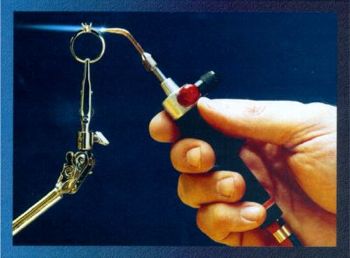
An instance of this from my life comes from many years ago when I was a jewelry bench worker. The place I was at made very high-end gold and silver shadow-box cuff links and they require some interesting soldering. I melted an awful lot of precious metal before I learned to recognize the colors, smells, and sounds that hinted I was almost at the right temperature and had to back the flame off. I believe what I gained from that experience was knowledge; hence, I was engaged in knowledge work, albeit at a lower level than, say, when I worked on the Space Shuttle Main Engine team.

Maybe the exigencies of saying something in less than 140 characters played a role in it coming out the way it did, but I felt the need to at least record my thoughts. I believe what Jack (or whoever actually made the statement) meant was that making craft work visible increases its accessibility and, therefore, its likelihood of being more easily transferred or learned. It doesn’t thereby become knowledge work, however. It already is and always has been knowledge work. Anybody disagree? Did I misunderstand Jack or the message he was conveying from the presenter?


It’s Getting Chilly, or How I’m Planning on Doing Some Cold-Calling

Well, I’ve finally decided to go out in earnest and get some clients. I don’t think I’ve mentioned much (if anything) about what I had hoped to do with my life after leaving Rocketdyne and, frankly, it was a bit amorphous in my mind for some time as well. I keep looking for ways in which the knowledge I’ve gained over the years can be put to good use for others. I’m beginning to see some fairly clear outlines of just how I might be able to do that. It isn’t all about “clients” either.

Today I met with the Principal of my youngest daughter’s school, Sycamore Elementary in Simi Valley; on Friday I am meeting with the Principal of my other daughter’s school, Vista Elementary also in Simi. I decided a while back I wanted to see if I could bring something to the table that might improve the educational system . . . some small but significant contribution I might offer that would take advantage of my Knowledge Management, Social Networking/Computing experience, as well as my overall skill set acquired from well over four decades of business experience.

Today’s meeting was a bit of serendipity, actually. I take my children to school every morning, dropping the older one off first, then dropping my youngest off on the way back home. Today I also walked the youngest in and watched her play a bit before class started. I then went into the office to talk to the Principal. My intent was to have essentially the same conversation I had with the Principal at Vista. After all, it resulted in an appointment to delve further into the issues. All that I could have asked for. I discovered today was the one day out of only a few in which she has set aside some time to have coffee and a chat with whichever parents happened to show up. Lucky for me!

Double lucky . . . the President of the PTA was there as well. She was very interested in what I suggested which, btw, was that I learn how they do “business” with an eye toward discovering ways they can take advantage of new tools, services, and techniques that might relieve them of any pain they’re experiencing. I know they’re experiencing it. You can’t be paying attention and think the schools and their ancillary organizations aren’t suffering from any number of headaches and problems which would improve the educational experience for students, teachers, parents, and administrators alike if they could be even partially solved.

So that’s what I offered to give to both schools. I have suggested I can afford to put in at least four hours a month per school and I am both willing and eager to do so. I plan on taking the same attitude to commercial and industrial establishments as well. I believe there are lots of ways in which social computing can be put to good use for small, medium, and large businesses. I also believe there are a lot of people out there who are holding themselves out as Social Media “Experts”. I am not doing that. I’m merely saying I think I can help – first and foremost – understand what kinds of problems any particular organization has that they want to address. Only then can they even think about what tool, service, process, or technique might serve to do so.

In order to drum up business that will actually make me income, I have developed my first piece of “Collateral” to leave behind after visiting the organizations I offer my services to. Anyone who is following me on Twitter, is my friend in Facebook, is connected with me through LinkedIn, reads this blog, or connects with me in any one of numerous other ways probably knows I’ve shared a few presentations I’ve given in the past – when I was still an employee of Rocketdyne. They can be found on Slideshare, here. I want to share what I’ve done in creating a brochure to leave behind after an initial conversation with a prospect. My intent is not for this brochure to introduce me, but rather to serve as a reminder of the conversation I expect to have with whoever it is I’m discussing these things with.

I know, from my years of pursuing knowledge in this field, through literally hundreds of conversations on the subject, and from following and reading the work of dozens of people whose intelligence I have nothing but the deepest respect for, that almost anyone; every process; every business; yes, even every institution – up to, and including, those of government at any level – could be improved through the intelligent application of social computing. Of course, every situation is different. The City Council here in Simi surely would neither benefit from, nor require, the same thing that might benefit the U.S. Senate, and a small restaurant surely doesn’t require the same capabilities that a large manufacturing or distribution enterprise would find helpful.

So . . . that’s my story, and I’m sticking to it. Below are the two pages of a three-fold brochure I’m going to get printed shortly and start bringing with me as I literally knock on doors. It’s not the only method I intend on using, but it gets me out of the house, and that’s a good thing. I’d be interested in any feedback those of you who might read this post have to offer. I’m a work in process. Aren’t we all?

Click on Image for Larger (Legible) Version

Click on Image for Larger (Legible) Version

P.S. – Special thanks are due to my friend Luis Suarez, who was kind enough to look over what I had done and make some very useful observations and suggestions. Thank you so much, Luis. You are one of those people whose presence I value dearly.


By Way of Thanks, This is for you Troy.

Whenever we talk about using social media inside the firewall (Enterprise 2.0) or even talk about people on the Internet using Facebook, making purchases, providing feedback and reviews on products and services, etc., one of the major issues that comes up is that of trust. I think about trust a lot, because it’s absolutely necessary for any virtual team to be able to work together. I’ve discussed this somewhat in other posts regarding the need for face-to-face meetings, etc.

So . . . trust is really important to me because it’s really important to the things I believe need to happen in business for us to move into the next phase shift (paradigm, level, incarnation, whatever you wish to call it). I’m bringing this up because I had the most extraordinary experience over this past weekend that I think is related to trust – at least, it makes me think of trust when I reflect on what happened. Surely, it shouldn’t have been so extraordinary and maybe some of you will disagree that it was out of the ordinary (which, after all, is what extraordinary means, hmmm?). So . . . let me share with you what was an incredible experience for me.

I was in San Francisco for my oldest daughter’s eight annual reunion of the families we traveled to China with to adopt our children. We were staying at the Hilton Union Square; a very nice and very crowded hotel. We were only there for Friday evening through Sunday – a grueling road trip from just North of Los Angeles and Friday night we were attending a dinner at the home of one of the families in our group who live near my old stomping ground of Haight-Ashbury (actually, that was back in 1967 and might be the setting for a few posts in the future).

We had just finished getting something from our car, which was parked on the 8th floor of one of the towers, and I was waiting for my wife with our children in the elevator vestibule. I knew she would be a moment and I had just sat down. My youngest was pretty wired and she started spinning around when she lost her balance, hitting her face right on the edge of the table between the two chairs my oldest and I were sitting in. She started crying immediately. I pulled her up from the floor and saw lots of blood on her teeth, gums, and lips. Just then my wife arrived and I left her holding our daughter while I went downstairs to see if there was a Doctor available in-house. I found a security guard, who came upstairs with us and immediately offered to give us a ride in the hotel limo to the ER at St. Francis Memorial.

When we arrived at the hospital and were almost immediately show into a room where both a Doctor and Nurse attended to my daughter, I suddenly realized I had left my iPad somewhere other than in the waiting room. As it turned out I had left it on the floor in that vestibule. In my haste to get my daughter to the ER, I set down the iPad and never thought about it until she was receiving the medical attention she needed. Now I had to fight the urge to panic, as I had become very attached to that device. As well, I hadn’t really done what I should have to secure my data and private information and all the possible ramifications were swimming through my head. Nevertheless, I concentrated on making sure my girl was OK, though I managed a phone call to hotel security to ensure it wasn’t in the limo or the vestibule where we had been.

Now . . . having said all that, this really isn’t what the story is about; at least it has little to do with the point I wish to make here (other than to set the stage). Another thing I had done was decide to leave my BlackBerry in our hotel room, thinking I really wouldn’t want – or need – to talk to anyone on the phone. After all, I had my iPad and could essentially communicate via email, twitter, facebook, and sms to just about anyone I knew or cared about.

One more thing. As it turned out, our daughter had split her lips a bit and scratched her upper gums, but she didn’t need stitches and her teeth were fine. All we needed was an ice pack and, of course, the assurance of the Doctor that she was not in need of any surgery or other procedures to ameliorate any permanent damage <whew!>

So . . . now we had a ride back to the hotel (generously provided by Hilton Security), but we didn’t have the address to the house we were going to and, at that point, nobody seemed to be answering their phone. My wife had her cell, but she doesn’t have email on it and my BlackBerry had the address in one of the emails I could access with it. I was forced to go up to the room and, when I arrived, I found there was both an email and a voicemail from the person who had found my iPad and was anxious to return it to me. I was floored! Both my wife and I were certain I’d never see it again.

To make a long story longer (just kidding), I was able to hook up with this person and the following morning we met in the lobby and I got my iPad back. This blog post is, ultimately, my way of thanking him in the only way he would allow me. I offered him a reward, but he wouldn’t even let me take my hand out of my pocket. He did let me give him a hug when we parted and I hope we will stay in touch. I hope I’m wrong, but it seems to me there aren’t enough people like him around these days.

Now I need to tell you who he is. His name is Troy Maragos. He is the Director of Compassion Ministry and Local Outreach at the Harvest Bible Chapel Niles. I need to thank him publicly and, even more, because I am not a religious person, I need everyone to know how much I value (and trust) the kind of person this man is. When I was in my first year of law school, one of my professors said something that has stuck with me over the years (decades, actually; over three of them). He said “If I had to choose between a person who had the right politics but no humanity, and a person with the wrong politics but who had humanity, I’d pick the latter every time.”

This experience points out a somewhat analogous situation, I think. Here is a man who’s religion is not only different than the one I was born to (I was raised as a Jew and I am bar mitzvah), but who has religion as his occupation; surely something anathema to my own non-religious life. Nevertheless, he demonstrated the humanity I always seek in people. He was not merely selfless, but relentless in seeing the right thing was done.

I have a huge amount of respect for that and I am deeply thankful our lives crossed at the time they did. I want to wish him the best and hope he finds success in all he does. The world needs more people like him, in my opinion.


Companies Should Pay Attention to Former Employees

Today, my friend (I consider anyone I can have a decent, useful conversation with on Twitter a friend) Kelly Kraft (@KRCraft) posted a blog asking the question “How much and what kind of a relationship do you have with former employees?” Her experience is much different than mine, though I think her conclusions make perfect sense for any organization contemplating doing as her former org did. The question is not – in my mind and, I think, in Kelly’s – whether or not to have ongoing relationships. Rather, it is what kind of relationships, and how extensive (or intimate), will they be?

KM Through Social Media

Over eight years ago, in response to a perceived need for understanding (and locating) the depth and breadth of expertise at Rocketdyne Propulsion and Power (then a division of Boeing’s Space & Communications business unit – whew!), I did some research and found a company that provided a tool that was a predecessor of many of the social media offerings of today. In my opinion they were way ahead of their time. The tool was called AskMe Enterprise and it offered profiles, Q&A threads (including forwarding, commenting by others, feedback as to quality and efficacy), file and link uploading and sharing, etc. We later had a customization added that provided for posting Lessons Learned and, about four years ago, they added a blogging capability.

Unfortunately, the larger percentage of our workforce (especially leadership and management) adamantly refused to participate. This wasn’t unexpected, however disappointing it may have been, and we continued to use the tool and work on building acceptance by example and through its ever-growing usefulness. Many years ago, I suggested we consider finding a way to stay connected with the constant flood of experienced Engineers, and others, who were retiring or moving on to other pastures. Inasmuch as we had a history of bringing some of those people back as contractors, I thought we might be able to find an inexpensive method of remaining in contact with the majority who didn’t return.

The proposal I thought made the  most sense was to provide retirees with a secure connection to our network and, as compensation for being available for questioning within AskMe, perhaps covering the cost of their Internet connection. I don’t believe anyone took this idea seriously and it essentially died on the vine.

Intellectual Property & Communication

Now here comes Kelly, pointing out how valuable her former organization, Exact Software, has found maintaining continuous relationships with former employees can be. She also addresses the issue of what kinds of relationships make sense for different types of employees. Specifically, she notes the difference between outward-facing, highly engaged employees as opposed to somewhat sequestered, internally focused employees like many of the Engineers I worked with. She is, however, right on the mark suggesting each of them can be successfully engaged.

For instance, she points to her own experience as an Implementation Consultant for Exact and the work she did in the years since, noting there probably isn’t a great deal the enterprise needs to do to engage her. She is also, I believe, referring in part to her use of Twitter to stay in touch. My Engineer friends are not terribly likely to engage using Twitter (or blogging, or anything else that public for that matter). There are considerations of IP protection they can’t afford to ignore, as well as governmental restrictions like ITAR that, contravened, will surely bite them in the ol’ behind. This can be, and has been, quite expensive and can be done somewhat inadvertently.

Nevertheless, as Kelly points out, there are numerous ways in which an enterprise can stay in touch, and engaged, with its former employees. In Rocketdyne’s case – especially – with those employees who have retired and are not working for another company. She is also pointing out, in my opinion, that CRM (or SCRM) isn’t just for sales and marketing to dun customers with either. Social Media have many applications. Many of them are useful for engaging with an enterprise’s customers, but many are also valuable for engaging one’s own employees (current and former). The lunches and parties sound pretty cool, too.

PS – The article she credits me with was a few paragraphs of my opinion of what Hutch Carpenter (VP of Product at Spigit@bhc3) had to say at his blog, “I’m Not Actually a Geek” (which he really is, but you didn’t hear that from me).


Enterprise 2.0 Conference Still Percolating in my Head

Almost three weeks ago I had the good fortune to attend my first Enterprise 2.0 Conference, in Boston, MA. My attendance, though highly sought after (by me) for over a year (as a representative of the company I just “retired” from), was still somewhat serendipitous, and relied heavily on the generosity of Susan Scrupski, the Executive Director (or, as she is wont to describe herself, the Concierge) of the 2.0 Adoption Council.

This was a new experience for me and I had no knowledge of what, exactly, had taken place in previous conferences – other than what generally takes place at most conferences. There was one major difference this event was going to mean for me. For well over a year I had been accumulating “friends” through my use of social media, especially Twitter. I had never met any of these people face-to-face, yet many of them I felt I knew reasonably well and, in fact, quite a few of them I believed I could trust – at least as much as I would trust any colleague I had ever worked with. Now I was going to have the opportunity to spend some face-time with them, rubbing (and bending . . . over numerous beers) elbows for over three days.

A little over a month ago I posted about the possibilities of building relationships virtually and argued that face-to-face meetings, though valuable, were not necessarily the sine qua non of meaningful, trusting, and useful relationships. I was primarily addressing business relationships and, especially, the necessary interplay of colleagues – peripherally touching on sales and arms-length transactions as well.

I haven’t changed my thoughts on the value of virtual contact and the ability to have meaningful relationships without meeting face-to-face . . . but I surely had to think deeply about it after Boston. Here’s why. My first full day there I made it to the all-day Black-Belt practitioner’s session a couple hours late, due to several snafus I experienced with Boston’s public transportation. I entered a room with no less than 60 or 70 people seated at round tables facing the front of the room as a presentation was being given. I managed to find an empty space, sat down, and immediately started searching the room for “familiar” faces. I soon spotted two people I had become “friends” with via their blogs and, especially, through numerous conversations we’d had on Twitter – Luis Suarez and Mary Abraham (@elsau and @VMaryAbraham, respectively).

I was able to recognize both of them despite the fact I had never seen them in person and only knew what they looked like based on their avatars. This in and of itself should be a good indication of authenticity, now that I think about it. At any rate, as soon as there was a break I moved over to their table and was greeted with the warmth and enthusiasm reserved for old friends. I’m not sure I can adequately express the feelings I had right then and, frankly, it’s taken me this long to sort out my feelings and what I think I learned from the entire experience. I’m not quite certain I’ve processed it all yet, but I’m finally able to complete enough of my thoughts to get a blog out.

Later that evening, after the day’s conference activities were completed, Luis, Mary, and I sat in M. J. O’Connor’s (in the hotel where the conference was taking place) drinking Blue Moons, getting to know each other a bit better, and sorting through the day’s experience. I know that Luis has been to many of these conferences and, as one of the most vocal and prolific proponents I know of in favor of social media, he’s no doubt met many people over the years he had previously only know through virtual media. I don’t think it was the same for Mary and I know it wasn’t the same for me. This was the first time I had come face-to-face with people I had grown to know through Twitter, blogging, Facebook, etc. It was truly a wondrous experience.

Seriously, I’m still not entirely over the whole thing. Consider this. It was the first time in my life I attended a conference for my own benefit. Previously, I attended numerous conferences, but always as an employee of Rocketdyne (in all its incarnations during my career there). Before that, I was in small businesses and I don’t recall ever attending any conferences, so no experience on that level. Now let me bring this back to what I think I learned from this particular level of the experience.

It is possible to conduct business and to build a solid, trusting relationship with people you have never met. It is, however, far preferable to have some kind of face-to-face meeting at some point in time in order to solidify the relationship. Of course, now that I’ve written these words I realize I haven’t communicated with either Luis or Mary since returning to Southern California from Boston. Then again, it’s only been three weeks (almost) since the conference began and, given the intensity of the experience, I don’t suppose that’s so out of the ordinary. I took a week out of my life to attend and had a lot of catching up to do once I returned. Couple that with the death of my last (and favorite) uncle a week ago, I suppose it makes sense.

Oops! I’ve managed to digress, so let me return to my last thought. I believe people who wish to work together virtually can enhance the quality of their relationships by having at least occasional in-person meetings with their colleagues. However, I don’t think it’s a matter of the ability to experience body language, eye contact, etc. so many people assert as the most important aspects of human connection, as much as it’s just the informal, off-hand, and emergent conversations and interactions that can only happen during the course of an afternoon or evening spent together. This should include, if possible, sharing a meal or sitting in a pub and bending elbows over a pint or three of some good beer, ale, etc.

As I said, I haven’t entirely processed how I feel about this or what I think I’ve learned, but I’ve waited long enough to write something down about the experience. I plan on posting at least twice more on what I got out of the conference. My next post will be more of a compilation of the many posts others far more knowledgeable than me have written since the conference was over. Following that, I intend on discussing an issue of Enterprise 2.0 I think is missing from the equation; namely some of the design principles of Web 2.0 I think E2.0 should be emulating and that I don’t see at present. Stay tuned.


Love (I mean LOVE) my iPad, but . . .

My new BFFIn the over two decades I worked at Rocketdyne I never had anything near “state-of-the-art” technology available to me. This isn’t surprising. After all, most – if not all – large companies have security issues they must deal with, and by the time they’ve fully tested any hardware or software they’re going to roll out to the enterprise and then support, quite a bit of time necessarily has passed. In a world that changes as rapidly as tech, that pretty much ensures nobody will be using the latest thing.

So, thanks to one of those occasional confluences of events we sometimes refer to as serendipity, after leaving Rocketdyne and as I was getting ready to travel to the Enterprise 2.0 Conference in Boston, MA, I decided to give myself a 63rd birthday present and purchase an iPad. I resolved to take it with me to the conference instead of a laptop, convinced the experience would be worth whatever inconvenience it created. More about that in a moment.

Although I went to the Apple store with the intention of purchasing the 16 gig, wi-fi model, I discovered they didn’t have any. While I was talking to the guy from whom I had purchased our two iMacs, he went to the back of the store to check on availability and discovered someone had canceled their purchase of the 64 gig, 3G model. Well . . . it was my birthday after all and, with very little hesitation, I decided to pull the trigger and spend the extra few hundred dollars. I’m glad I did, especially for the 3G model. I also just got in under the wire for AT&T’s $29.99 per month unlimited plan. Unless they’ve changed (and I’ve not seen it either way) that plan is no longer available for new users.

My plan for the conference was to take my iPad and my Bluetooth keyboard with me. I had already tested and confirmed it worked fine (though I didn’t have a stand for the iPad yet). I was hoping to be able to both live tweet from the sessions, and to blog here as I took some time to reflect. Unfortunately, halfway to the airport I realized I had left the keyboard at home. Now I was constrained to use the built-in, virtual, touchscreen keyboard. The challenges were increasing dramatically. So . . . here’s what I learned so far.

From my perspective, although manageable, the keyboard kind of sucks. It is very sensitive which, for many purposes, is just fine. However, for typing it is what I can only describe as unforgiving. If I don’t hold my hands somewhat rigidly over the keyboard, I am very likely to barely touch a key that isn’t the one I want to touch. For a touch typist this is very annoying. After all, it’s the ability to touch a keyboard that makes it possible to type without looking. Interestingly (and not a little ironically), the graphical representation of the keyboard shows the little nipples on the F and J keys! What’s that all about? They serve no purpose I can discern. Not only can’t you feel them, you can’t touch those keys without invoking them . . . so what’s the point?

The keyboard is also (if I’ve measured and calculated correctly – no guarantee here) approximately 20% smaller than my iMac’s keyboard, measuring from left to right on one set of keys. I’m not even bothering to measure other portions of the several keyboards available, depending on what you’re doing, as the scale is fairly consistent throughout. Let me just say the keyboards need some work, in my opinion. For instance, to get to the hashtag (all important when tweeting from something like a conference and, yes, I know many apps provide the ability to insert hashtags, but you still have to initiate their use) requires two keystrokes just for it to appear, then another to actually use it. This is but one of the combinations I find somewhat cumbersome. I find this unacceptable and I’m hopeful Apple will be able to provide a more useful set of keyboards once they realize how this works. Then again, maybe my experience is not mainstream enough and they just won’t care.

OK, enough of the difficulties. Overall, I had a great experience with my iPad. I used it everywhere; that’s where the 3G capability proved invaluable, even if it is AT&T. (For the record, my wireless experience – which spans well over ten years – is entirely with Verizon, dating back to when it was AirTouch here in California. Although my experience with AT&T is less than a month old, I can read!)

Two examples: On the first day of the conference I was pretty unclear on the best way to get there from my hotel, which was about six miles away in Chelsea. I was able to take the hotel shuttle to the airport, but from there I had to take the Silver Line bus to within walking distance of the Westin Boston Waterfront, my final destination. I got off at the wrong station and was unsure of the best way to get to the hotel. I invoked the maps and charted a pedestrian course to the hotel, holding the iPad flat in front of me and just following the directions it gave me. Worked like a charm.

The TV of my childhood

Small, tall, and Black & White

The second example is more fun and, since the hotel wi-fi wasn’t available, the 3G capability was invaluable. I needed to participate in a telecon and GoToMeeting with two colleagues in Philadelphia and a potential client in Austin.  I went in to M. J. O’Connor’s (an Irish pub in Boston – imagine that!) where the hostesses were kind enough to allow me to sit in a closed area that was reasonably quiet. I called into the telecon and, because I have a Bluetooth earpiece, I was able to lay my BlackBerry down and use it to provide a bit of an angle for the iPad, on which I had logged into the meeting space. As I was sitting there, for a moment I thought back to my childhood of dial telephones, party lines, and tiny black and white television screens in gigantic consoles. I was living the future I once visited in my imagination! I could have done virtually the same with a laptop, but the angle of the iPad made me feel as though I was peering through a kind of wormhole into this amazingly clear and colorful, collaborative space. It was magical.

That’s some of my experience over the last few days. Next up, some of my thoughts about Enterprise 2.0 and the conference, as well as some personal experiences and impressions.