
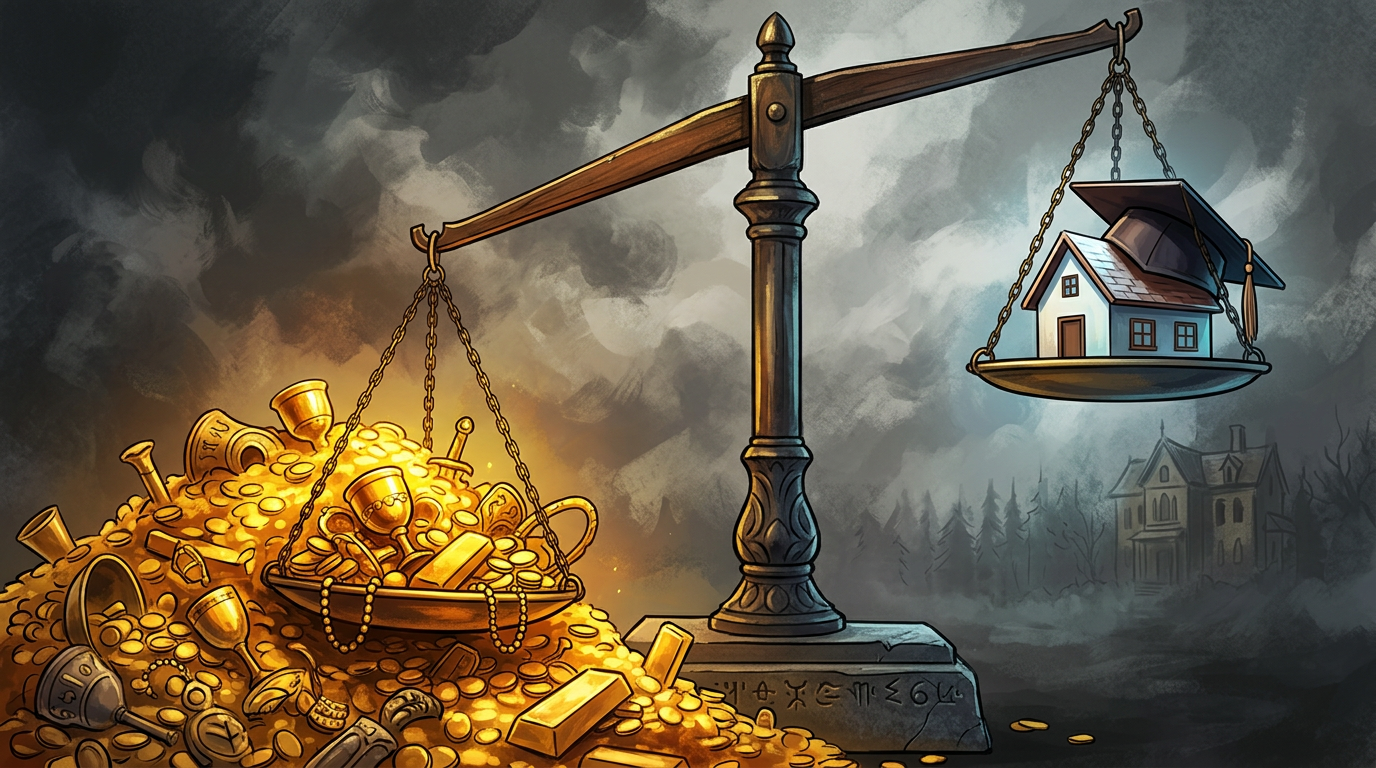
The United States does not merely suffer from bad policy. It suffers from a failed political-economic design.
For decades, Americans have been told that the economy rewards merit, innovation, risk, and hard work. That story has become increasingly difficult to defend. Workers produce the goods, deliver the services, build the platforms, staff the hospitals, move the freight, teach the children, care for the elderly, process the data, maintain the infrastructure, and generate the daily activity that becomes Gross Domestic Product. Yet the gains from that collective labor flow disproportionately to owners, executives, financiers, and founders whose legal claims on capital allow them to appropriate wealth far beyond any plausible measure of personal contribution.
This is not an accident. It is not the weather. It is not the invisible hand. It is design.
The American economy is structured by law. Corporations exist because law creates them. Limited liability exists because law grants it. Intellectual property exists because law protects it. Stock markets, mergers, executive compensation, bankruptcy priorities, taxation, labor rights, and campaign finance are all products of public decision. The economy is not separate from government; it is one of government’s largest creations.
That means we are entitled to redesign it.
The central defect in the current system is that it treats labor as an expense and capital as the sovereign. Workers are described as “human resources,” while shareholders are treated as the rightful claimants of the surplus. This reverses moral reality. Labor is not a cost to be minimized. Labor is one of the principal sources of value. A society that depends on workers for production but denies them meaningful power over the distribution and governance of that production is not a democracy in any serious economic sense.
The fortunes of men like Elon Musk, Mark Zuckerberg, and Jeff Bezos are often described as the reward for brilliance. No doubt they are intelligent, ambitious, and consequential. But their wealth was made possible by far more than personal genius. It depended on public roads, public courts, public education, public research, public communications infrastructure, public subsidies, public enforcement of contracts, publicly created corporate privileges, and the labor of hundreds of thousands of people. Their wealth is therefore not purely private achievement. It is socially enabled accumulation.
The question is not whether successful people should be rewarded. The question is whether any democratic society should permit individuals to accumulate economic power so vast that they can shape labor markets, communications systems, elections, public policy, technological development, and even geopolitical outcomes without meaningful democratic accountability.
That is not capitalism as freedom. That is private government.
Reform is no longer enough. A higher minimum wage, better enforcement of labor law, a more progressive tax code, and stronger antitrust policy are all desirable. But they do not reach the root of the matter. They leave untouched the basic architecture: capital commands, labor obeys; owners govern, workers request; profits are privatized, while the social costs of instability, pollution, poverty, ill health, and community decline are pushed onto everyone else.
The United States needs an economic transformation grounded in the principle of economic democracy.
That transformation should begin with a simple proposition: those who create the wealth of the nation must have a real voice in how that wealth is governed and distributed. Workers should have representation on corporate boards. Large firms should be required to share profits with employees. Public investment should generate public equity, so that when taxpayers help create value, the public receives a return. Essential sectors should be governed by public-interest obligations, not merely shareholder return. Monopolies and dominant platforms should be broken up, regulated as public utilities, or converted into stakeholder-governed institutions. Employee ownership, cooperatives, and community wealth-building institutions should become central rather than marginal features of the economy.
We should also create a national social wealth fund: a democratically governed public investment vehicle that holds diversified assets on behalf of the people and pays social dividends or funds universal public goods. If capital ownership is the route through which wealth compounds, then the public must own capital too.
The goal is not to punish success. The goal is to end economic monarchy.
Nor should this argument be trapped in the stale language of “socialism versus capitalism.” That vocabulary is designed to stop thought, not encourage it. It drags every serious discussion of economic democracy back into Cold War reflexes, as though the only choices available to us are unregulated corporate domination or Soviet-style state control. That is a false and impoverished choice.
The better question is this: the economy is already planned. The real issue is who does the planning, for whose benefit, and under what form of accountability.
The existing economy is not “free” in any serious sense. It is governed every day by corporate charters, tax rules, courts, central banks, intellectual-property regimes, labor law, procurement policy, subsidies, bankruptcy rules, financial regulation, and campaign finance structures. These are not acts of nature. They are political choices. They are forms of planning. The tragedy is that they now plan primarily for capital accumulation, shareholder return, executive enrichment, and the preservation of concentrated private power.
A transformed economy would use those same governing tools for different ends: democratic legitimacy, shared prosperity, ecological responsibility, community stability, and the dignity of work. It would recognize that workers are not guests in the economy. They are its builders. It would recognize that public investment should produce public benefit. It would recognize that no republic can remain politically democratic while its economic life is organized around private concentrations of power that rival, capture, and often dominate the state itself.
A democratic republic cannot survive indefinitely with a feudal economy. Political democracy is hollow when economic life is governed by concentrated private power. The ballot gives citizens a voice in government once every few years; the workplace governs their lives every day. If democracy is good enough for the polling place, it is good enough for the economy.
The American question is no longer whether the existing system can be patched. It is whether we have the courage to admit that the system is working exactly as designed — and that the design itself is the problem. We do not need mere reform. We need transformation.


Leave a Reply