Author Archives: Rick Ladd

About Rick Ladd

Unknown's avatar
I retired over14 years ago, though I've continued to work on and off since then. Mostly I'm just cruising, making the most of what time I have remaining. Although my time is nearly up, I still care deeply about the kind of world I'll be leaving to those who follow me and, to that end, I am devoted to seeing the forces of repression and authoritarianism are at least held at bay, if not crushed out of existence. I write about things that interest me and, as an eclectic soul, my interests run the gamut from science to spirituality, governance to economics, art and engineering. I'm hopeful one day my children will read what I've left behind.

Superbowl Commercial You Won’t See

Beautiful, well-done video with a powerful message.

I’m preparing a couple of posts on Decision Science, but they take a little bit of research and more careful writing than I can muster in one sitting at this point.

In the meantime, I really think this video needs to be seen. Changing the name of a football team is not much to ask, considering how much has been – and continues to be – taken from the peoples native to this land. We have a long way to go to make up for the almost successful genocide. This seems a small thing to ask, even though it involves a Sunday activity that’s surely more popular than Church.

Isn’t it time?


Serendipity Runs Circles Around Causality

Funny how some things seem — given enough time — to come full circle. Although I have always seen patterns and complexity, as well as the intricacies of their interplay, I wasn’t introduced to the concept of Systems Thinking until I worked on the Space Shuttle Main Engine program at (what was then) Rockwell International’s Rocketdyne division. That introduction included being exposed to the thinking of Dr. Russell Ackoff, a recognized authority in the field. I was fortunate enough to spend some time with him, twice in Philadelphia, prior to his death in October of 2009.

Shortly after retiring from Rocketdyne in 2010, I was introduced to Dr. Lorien Pratt of Quantellia, LLC, who showed me a tool her organization had developed called World Modeler. I was excited at what I saw and hopeful I could somehow become involved with Dr. Pratt and her team. However, that was not to be at the time. I was provided the opportunity to more thoroughly investigate the tool, but I had made a conscious choice to refamiliarize myself with Apple products (after over two decades of living in the PC, DOS, and Windows environment) and World Modeler was not written to be run on a Mac. Furthermore, the PC laptop I had wasn’t powerful enough to do the math and drive the graphics required for running models in real time. I was hosed.

Decision Intelligence Technologies

Decision Intelligence Technologies

Finally, about six months ago I was contacted by Dr. Pratt, who asked me if I wanted to assist in writing a paper that described an effort in which they were involved with the Carter Center. I enthusiastically said “Yes!” I’ve done a couple of other things with Quantellia since then but, beginning a few weeks ago, I took on an entirely new and (for me) exciting role as a referral partner.

Right now I’m spending a fair amount of time learning Decision Science in general, and the process and tools Quantellia uses to help organizations understand complex interrelationships and make better decisions based on that understanding. As I’m doing this I watch videos, read blogs and articles, look for original research, and work on presentations that will help me educate others in this important approach to business and organizational operations.

So . . . here’s the full circle part. As I’m looking for definitions, or explanations, of Decision Science and its origins, I Google the term. The first two hits I get are to The Decision Sciences Institute and to Carnegie Mellon University’s Department of Social and Decision Sciences. The third link is to a Wikipedia article on that same Department. In that article, there’s a link to Decision Science, specifically. However, it redirects to an article on Operations Research, which is where Systems Thinking originated. At the bottom of the page is a list of researchers under the heading “See Also”. One of the researchers, unsurprisingly, is Russell L. Ackoff. To me, that’s a combination of serendipity and years of working on better understanding how an understanding of systems can work to the benefit of any organization; actually, anyone.

I’ll be writing a lot more about Decision Science, including my understanding of some of its constituent parts, Decision Intelligence, Decision Engineering, Decision Modeling, and the power and value of our tools, World Modeler and DEEPM (Decision Engineering for Enterprise Project Management). I hope I will be able to clearly explain what it is we have to offer and, more importantly, what everyone has to gain by understanding it. The value exists independently of me or even Quantellia. We’ve just been at it for a while and can apply and employ the discipline both efficiently and effectively. Stay tuned.


Quit the Bragging, California!

it’s marvelous – and ominous – at the same time. While much of the United States has been enduring extreme cold temperatures and hard Winter weather, those of us on much of the West Coast (certainly here in Southern California) have been enjoying unseasonably warm weather. I think it’s been in the mid-seventies to mid-eighties for at least a month and we’re now approaching the “dead” of Winter with no end in sight.

A Week's Weather

Another week of unseasonably warm Winter weather

If this continues, it does not bode well for those of us who live in this neck of the woods. The reason. Drought. According to the California Department of Water Resources, we are now into what may be the third year of drier than normal conditions. They point out it’s a bit too early to conclude this year will be as dry as the previous two, as half of the previous years that started out this dry ended by catching up to normal at the end of the season. They also point out, even if there’s plenty of seasonal rain, it still won’t compensate for low soil moisture and depleted water storage.

So . . . while we’re enjoying the weather here, especially when contrasted to what the Polar Vortex has wrought to our East, it’s important to keep in mind what it means in the long run. It doesn’t matter if you believe in climate change, anthropogenic or not. We are now into our third year of drought in the West, and this wonderful weather may come at a far higher price than I care to contemplate. There’s no reason to brag about it.


Something Borrowed – Something Blue

I got married for the first time (there have been only two) in my early thirties; somewhere around 1980 to be inexact. It was a self-organized, backyard party held at the home of friends in Venice, California. We were living in Playa del Rey at the time. I was just reminded I wore a turquoise bowling shirt a friend loaned me that he had recently  purchased second-hand from Aaardvark’s Odd Ark in Venice.

Turquoise Wedding/Bowling Shirt

My Turquoise Wedding/Bowling Shirt

I have a lot of slides from the wedding. Of course, they’ve been sitting in a binder for the last three decades, which is about how long ago I divorced my first wife (who, btw, remains a friend but who I see very infrequently and always at an event involving my brother’s family, as she was close to my SIL and her family). I have no desire to go out and spend money to have photos made of these, but I did try to scan one of the slides that shows me in the shirt. It didn’t work too well, so I went around the house looking for enough clear backlighting to snap a pic with my iPhone 4S. I offer it herewith.

I’m sharing this because it is somewhat indicative of the kind of relationship, wedding, and marriage (despite its having ended) Alina and I had. In our case, it was the Groom who wore – in one garment – something old, something new, something borrowed, and something blue.


The Aesthetics of Recycling

I may have netted a dollar after this trip, but at least I got out of the house. I got $6.36 and had to travel about 10 miles. You do the math. – at Simi Valley Recycling Center

View on Path


First Post From Path – a Test

This is just a test to see how Path posts to WordPress, which I just hooked it up to. – with Linda at Casa de Ladd

View on Path


Seen a Spaceship Lately?

Have you ever watched the International Space Station pass by in orbit? I don’t know about you, but there’s something majestic, even magical for me just watching it fly overhead. A bright object moving at nearly 5 miles a second appears very fast, even at a distance of hundreds of miles away, and it is awe-inspiring to look up and know there are humans aboard. Several years ago I remember seeing the Station, a Soyuz capsule, and the Space Shuttle all pass overhead as they moved toward a rendezvous and docking. During that mission there were something like a dozen people silently flying by far above my house.

Since my retirement from Rocketdyne, and the cancellation of the Shuttle program, my interest has drifted away some. After all, there’s nothing quite like watching a large, powerful vehicle’s engines roar to life and lift it off the pad into orbit in less than ten minutes. The Station is almost invisible by those standards. It’s already up there and it’s passage is almost mundane. There’s no smoke and fire. It’s swift, but it’s silent.

Recently, I decided to add an app to my phone so I could find out when the Station was flying overhead. Not sure why my interest returned, but it did. The app I chose is called ISS Spotter. It’s free and has everything I need to observe the station. Here are the three views I use the most, though there are settings and a help screen available as well. The first one shows the Stations position and direction of travel (along the thick yellow line) from above and against a map of Earth. It also shows (the blue dot) your location; in this case, near Los Angeles. It has a couple of other bits of functionality, but they’re not relevant to this post.

Orbital map of ISS

Map shows current orbital position in real time

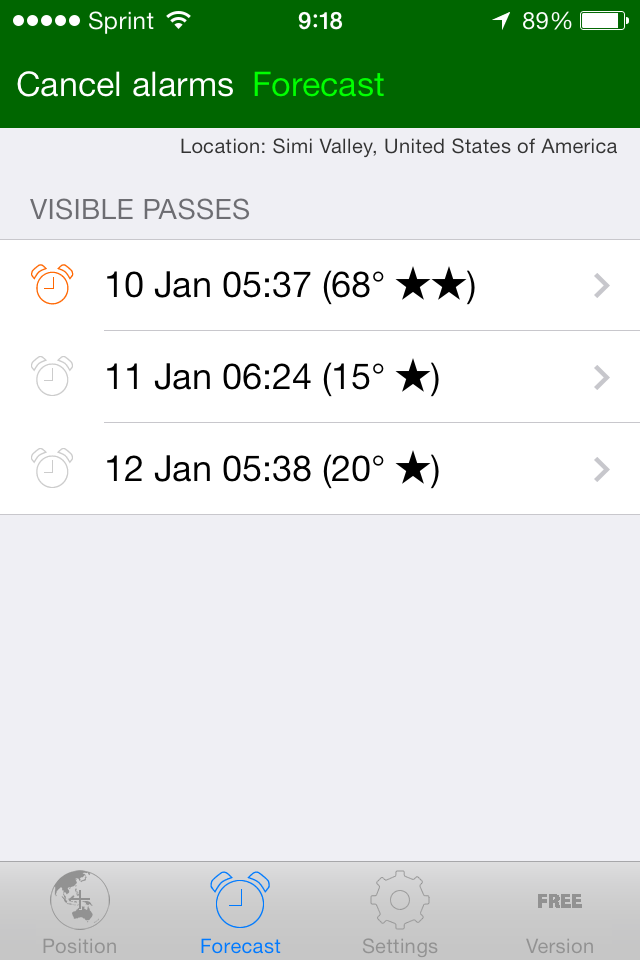
The second view shows upcoming passes over your location (which, btw, it determines automatically using your phone’s GPS, though you can also customize it on the setting page [not shown] if you know your coordinates [and you care]). I use the auto setting and it works just fine. It even adjusts if I’m somewhere else. There are other settings available for time prior to passage for alarms, minimum peak elevations, and others. There’s also a star rating to help you decide how much effort you may want to exert getting outside to view the pass. One star means a pass you might find meh, while three stars indicates even the Magi might be impressed. Note, the next one I’m planning on getting outside for has two stars. As you can see on this page, it will be at a visible altitude (at its highest) of 68° and will shine at a magnitude (visible on the third view, below) of -2.9.

ISS pass notification and alarms

Automatic listing of visible passes in next 7 days with settable alarms

The third view provides everything you need to know to actually find the station, even if you don’t make it out when it first appears. You can also see here that this pass will last a total of six minutes and thirty-eight seconds. Plenty of time to freeze your ass off if you’re anywhere affected by the Polar Vortex, which I’m not.

Compass view of Forecast Screen

Compass view provides direction, maximum elevation, magnitude, and more

I had forgotten, but I got an alarm this morning just in time to go out around 0630 and watch it pass. There were two things that struck me as I stood out in the backyard. When I first spotted it, the Station was well out over the Pacific and, minutes later, it was well over Nevada as I went back inside. In the approximately three minutes I spent observing, that orbiting outpost of humanity and science traveled nearly a thousand miles. The other thing, and it happens every time I observe it silently passing by overhead, was I could swear I was able to make out her warp nacelles.


Google Glass and ALS

It’s been said the eyes are windows to the soul, and most of us can recognize much from looking into another’s eyes. We can sometimes communicate intricate thoughts and feelings through our eyes. Imagine, though, they were your only window to the world; the only method by which you could communicate, with anyone. Further, what if you were in a position where it was nearly impossible for you to initiate a conversation and, therefore, unless you had a way to get someone’s attention, you had to wait for others to anticipate your needs? Worse yet, once anticipated, that other person would have to use a method requiring them to initiate nearly every aspect of the conversation.

This is precisely the situation for thousands of people suffering from ALS (Amyotrophic Lateral Sclerosis, also known as Lou Gehrig’s disease), MS (Multiple Sclerosis), TBI (Traumatic Brain Injury), or any one of several other conditions that result in the inability to move and talk . . . or write . . . or use sign language.  All they can do is acknowledge your greetings or answer your questions with a wink, perhaps a nod. How would you communicate?

Recently, I had the opportunity to meet someone in that position. His name is Ismail Tsieprati, and he is one of the longest-surviving sufferers of ALS, having had the disease for thirty years. I first met Ismail’s caregiver and wife, Cheryl, at a local Chamber of Commerce networking breakfast. She had recently left a long-time position in corporate training and was looking to establish a web-based business as a training consultant. She asked if I could help her promote her business through social media, and also suggested she help turn some presentations I had done into webinars. I agreed, and we worked together for a short while. As life would have it, before we could finish she was offered a full-time position in corporate training, and I was coming to the painful realization I had been chasing a pot devoid of gold.

We trekked off on our separate trails, as casual business relationships often do, but we remained in occasional contact, through Facebook and comments Cheryl would make in response to one of my sporadic blog posts. One of the several projects I had been working on was editing and proofreading a book – Age of Context – authored by Shel Israel, a longtime author and tech journalist, and Robert Scoble, an authority on bleeding-edge technology and startups.

Toward the end of the project, I was given the opportunity to invite a number of friends to read an early, limited release of the book. In exchange, I asked them to provide an honest review on Amazon.com. Since Cheryl had been one of the people to occasionally comment on my blog, I thought of asking her to read and review the book. She was an excellent prospect because she is not a techie and readily admits to being somewhat befuddled with technology.

It turned out to be a good choice, in more ways than one. Cheryl was one of the few people, of the many to whom I sent a link to the early release, who took the time to write a review—a thoughtful, useful review at that—not merely a quick stab at providing an obligatory yay or nay. She also was hit between the eyes with some of the stuff she read about. Particularly relevant to her was Google Glass. Shel and Robert had devoted an entire chapter to it, and there were numerous references as well throughout the book. I’ll let her explain, in this excerpt from a chapter of the book about their 30-year journey with ALS she and Ismail are working on:

“The greatest fear for people living with ALS is there will be a day when they become “locked in” – so completely paralyzed in the late stages of the disease that even the simplest of muscle movements have been stolen from them and they will be unable to communicate in any way with the outside world.  Those who are “locked in” survive in complete isolation.  They can see and hear everything around them, comprehend everything, think complex thoughts, experience joy, sorrow, and pain, and yearn to communicate with their loved ones and caregivers – to express their feelings, their discomfort, and their desires, but they are hopelessly trapped inside their bodies with no way of communicating with anyone.  For Ismail and me, as well as for others with ALS and their families, overcoming communication barriers and fighting off the “locked in” syndrome is a lifelong battle; an absolutely essential one.  After all, Ismail loves to talk, and he has a lot to say.  He’s not going to let ALS or anything else shut him up!”

                            – Tears, Laughs, and Triumphs: A Thirty-Year Journey with ALS *

* Since this article was first posted, Ismail and Cheryl’s book as been published. It’s final title is “One Blink at a Time.” It can be purchased at Amazon, here.

What struck Cheryl was the knowledge that Glass could recognize eye movement. She was very excited about the possibility of making eyeglasses with eye gaze technology available to Ismail and people in similar situations. Current eye gaze augmentative communication technology involves much larger and more complex systems, which require careful placement and frequent adjustment. Cheryl wanted to talk about it, and I wanted to know more. We met for coffee and, after a bit of discussion, I told her I’d like to write about their situation. We decided I should meet Ismail to better understand his world and I was invited to their home.

Ismail and Stephen Hawking - August 14, 1992

Ismail Tsieprati with Stephen Hawking, Peninsula Hotel, Beverly Hills, California, August 14, 1992
Photo by Lynn Klein

I had mixed emotions about the upcoming meeting. I was to meet Ismail for the very first time, and I was somewhat nervous about the prospect. I had never met someone with ALS, and mostly knew about it through the story of baseball legend Lou Gehrig and one of my favorite theoretical physicists, Steven Hawking.

Cheryl had invited me to lunch. After meeting Ismail and talking to him and Cheryl about this post, I sat down at the dining room table while Cheryl went into the kitchen briefly to dish up the meal and bring it out for us to enjoy. In doing so, she left me sitting alone with Ismail. The silence was deafening. I felt extremely uncomfortable, as I was struggling with how to approach this unique (for me) situation. I had never communicated in this fashion before and it was awkward.

I hadn’t learned the process Ismail and his caregivers use, which involves what they call a “spelling chart”. Ismail can initiate communication in only two limited ways. One is by grinding his teeth, which ensures getting Cheryl’s or his other caregiver’s attention, provided they’re within earshot. The other method is to modulate his breathing so as to trip the alarm on his ventilator. This works at a greater distance than tooth grinding, but likely is more stressful on Ismail.

Once Ismail has someone’s attention, he communicates by using his spelling chart. Everyone who communicates directly with Ismail has memorized this chart, which appears below. Since the chart is in everyone’s head, there is nothing to carry around, set up, or adjust. It’s a quite simple and efficient system, but it’s time consuming and requires patience. This is how it works: The alphabet is divided up into six rows.  Row number 1 is “A-B-C-D,” row number 2 is “E-F-G-H,” and so on. The person talking to Ismail calls out the number of each row of letters until Ismail blinks to select the number of the line containing the letter he wants to use. The person then calls out each letter in the selected row, until Ismail blinks again to select the letter he wants. The person then starts all over again, calling out numbers of rows, then numbers or letters, as Ismail builds words, then sentences, then paragraphs. If Ismail selects number 7, he’s telling the person it is the end of a word or a paragraph.  If he selects number 8, he wants to give the person a number or a date. People can also ask him “yes” and “no” questions. One blink means “yes,” and two blinks mean “no.”

Spelling Chart used for communication

Spelling Chart used by Ismail and his caregivers for communicating.

There are other methods of communication available to people who cannot speak or use their hands. For example, years ago Ismail wrote a screenplay by using an infrared switch attached to his glasses that he operated by blinking his eye.  The switch triggered the selection of letters and numbers on an alphabet grid displayed on a computer monitor. The design of the chart was similar to the one Ismail and his caregivers use today.  Scanning technology highlighted letters one at a time to allow the user to select one. The program had word prediction, which made sentence-building faster, and a voice synthesizer that could speak words he typed or had programmed into the system.  The software program and voice synthesizer were similar to those used by Stephen Hawking.

Since Ismail’s eye blink may eventually grow too weak to be a reliable method of communication, eye gaze is the technology that provides hope for the future for him and others like him.  He has been practicing with an eye gaze system that is a communication device, speech generating device, Windows XP computer, and environmental control unit, all in one. The system allows Ismail to select letters and numbers by gazing at them for a programmable pre-set number of seconds. He can also select icons or images that trigger a voice synthesizer to speak words and sentences for him. The system also has the capability of accessing Windows and the worldwide web. But Cheryl says that Ismail becomes tired after practicing with this system for only a few minutes and grows frustrated trying to navigate around its screens.  It takes time to set up the equipment and reposition it properly every time he moves from one place to another, so the device is bulky and time-consuming to use except for those times he’s sitting in one place.  Although it’s possible to attach the unit to his wheelchair with a special bracket, the machine still needs to be moved out of the way during transfers, then readjusted again.

Enter Glass. What if it had the same total eye-gaze control capabilities that Ismail’s bulkier, less user-friendly equipment has? What if a complex communication, web-surfing, environmental control system could be worn in a pair of eyeglasses and operated by the movement and gaze of an eye? Since Glass contains a built-in display, there would no longer be a need for the much bulkier external devices that are currently used.

“My eye gaze equipment can be slow and tiring,” Ismail says.   “It is difficult and time-consuming to use. I hope there will come a day when technology will improve for many people like me who are paralyzed but want to continue to talk to the world. I hope that day comes soon.”

The question now is not if, but when. It’s also a question of priorities, I suppose. I’m not sure if Glass has the capabilities Ismail and others require, but it surely won’t be long before they’re realized. The other question is, are there developers who have both the skills and the desire to create such an app. Also, Glass is not the only device that can provide the necessary functionality. In addition to wearables like Glass, there are companies working on interpreting brain waves. Emotiv is one of them and they are working on a device called Epoc that currently provides limited capability. Right now, they are concentrating on game playing and some forms of gross manipulation, but it shouldn’t be long before their system (and others like them) become more sophisticated. They are also licensing an SDK for people who wish to write their own systems.

If you have any interest in this kind of thing, there are some golden opportunities out there. Perhaps there isn’t a fortune to be made, but the possibilities of helping tens of thousands of people live more productive and engaged lives despite severe disability are immense and will be, I have no doubt, enormously satisfying.


How To Shop

Clothing for entering a blast freezer This is what I should have been wearing!

Many years ago, when I was in the wholesale food business with my father and brother, we got a new customer who sold to many high-end restaurants. Many would recognize the names of these famous Hollywood eateries, all of which were very successful and (bonus) somewhat recession-proof. This was a very good thing for us, as it provided a substantial boost to our gross income. I became the schlepper; the one who had to drive around every morning and pick up the items our new customer needed to service his clientele. I did not mind. I was young and full of energy and truly enjoyed arising very early in the morning to greet the day.

My job meant driving around every morning, picking up the items that had been ordered and getting them to our customer’s location, where they would be either stored temporarily prior to delivery, or further prepared for later  delivery to their customers. Generally, three days of the week required me to enter as blast freezer that was forty degrees below zero; so cold that it had no solid doors, merely thick plastic curtains as a safety measure, ensuring no one could be accidentally locked in. The freezer was huge and the doors big enough to accommodate a large forklift laden with several palettes of product.

Continue reading


Jesus Laughed at Your Sins

The Laughing Jesus - Click to Enlarge

The Laughing Jesus – Click to Enlarge

As those of us who “celebrate” Christmas begin the long awaited and incredibly drawn-out windup to the denouement of the shop ’til you drop for Jesus season, we’re beginning to encounter articles about who he was and what kind of man he might have been.

Reading these reminded me of my favorite depiction of The Man, drawn by Fred Berger, which appeared in an article written by the Harvard Divinity School Theologian, Harvey Cox. It was published in the December 1969 issue of Playboy Magazine and was entitled “For Christ’s Sake”.

This picture has stuck in my mind all these years because it was the first time I had seen or read about Jesus as an actual human being, not some poor schmuck hanging from a cross. Given the biblical account of his life I knew about, it made perfect sense to me he was a radical revolutionary. Still does. Today, however, I’m afraid what most people think about when it comes to Christmas is gifting . . . and decorating. I can’t believe how many people are plotzing over getting their decorations up. They don’t want to wait until Thanksgiving is over; they want it NOW! Jesus must be twirling in his grave at about 42K RPM.