Author Archives: Rick Ladd

About Rick Ladd

Unknown's avatar
I retired over14 years ago, though I've continued to work on and off since then. Mostly I'm just cruising, making the most of what time I have remaining. Although my time is nearly up, I still care deeply about the kind of world I'll be leaving to those who follow me and, to that end, I am devoted to seeing the forces of repression and authoritarianism are at least held at bay, if not crushed out of existence. I write about things that interest me and, as an eclectic soul, my interests run the gamut from science to spirituality, governance to economics, art and engineering. I'm hopeful one day my children will read what I've left behind.

Why crowdsourcing works

“Love the metaphor of creativity as an import-export business. Cognitive diversity, FTW. The value found in crowdsourcing – as well as the reason it is so valuable – seems to me to argue for the value we have long sought through knowledge management, made more powerful through the use of the connective power of social media harnessed for use by the enterprise . . . meaning, fundamentally, its people.”

Hutch Carpenter's avatarI'm Not Actually a Geek

CrowdCrowdsourcing is a method of solving problems through the distributed contributions of multiple people. It’s used to address tough problems that happen everyday. Ideas for new opportunities. Ways to solve problems. Uncovering an existing approach that addresses your need.

Time and again, crowdsourcing has been used successfully to solve challenges. But…why does it work? What’s the magic? What gives it an advantage over talking with your pals at work, or doing some brainstorming on your own? In a word: diversity. Cognitive diversity. Specifically these two principles:

  • Diverse inputs drive superior solutions
  • Cognitive diversity requires spanning gaps in social networks

These two principles work in tandem to deliver results.

Diverse inputs drive superior solutions

When trying to solve a challenge, what is the probability that any one person will have the best solution for it? It’s a simple mathematical reality: the odds of any single person providing the top answer are low.

View original post 1,005 more words


Helping to Create a Virtuous Cycle

CJAs in Liberia

Community Justice Associates Working in Liberia

In a previous post I mentioned some work I had done for Quantellia involving the Carter Center’s efforts in Liberia to strengthen the country’s legal system. I have not been at liberty to discuss the effort until a couple of weeks ago, when Quantellia announced the work and their findings. Of their work, the Carter Center says:

Since 2006, building on its long history of engagement in Liberia, The Carter Center has been implementing an access to justice project in Liberia in response to these critical needs and invitations by the government.  Governed by a Memorandum of Understanding with the Ministry of Justice, and in partnership with the Ministry of Internal Affairs, the National Traditional Council, and other stakeholders, the Center works in four areas with the aim of helping to create a working and responsive justice system consistent with local needs and human rights, paying special attention to rural areas and the needs of marginalized populations. ¹

One of those four areas mentioned is “Improving Access to Justice”, and Quantellia was tasked with building a decision model showing the efficacy of sending Community Legal Advisers (CLA), now called Community Justice Advisers (CJA) out into remote, underserved communities by providing them training, support, and motorscooters. These CJA are paralegals and they are tasked with helping both plaintiffs and defendants gain access to the formal justice system which, in many locales, lags behind the people’s use of customary justice.

I want to share the results of that work here. I’m very pleased and proud with the role I was able to play in the final document. The agreement was that I would do research and write a first and second draft, at the least. Also part of the agreement was that I would not receive credit, which I was quite happy to accept. I am, therefore, grateful the authors saw fit to acknowledge my efforts in a footnote. It’s far more than I expected; a lagniappe.

Here’s a link to the World Modeler Blog, where you can read Quantellia’s announcement regarding the project. Although both the paper and the video are available there, I’m also including a link directly to the paper (here) and embedding the video below.

I have often said I thought I would find it hard to find something to do that would be as exciting and fulfilling as working on the manned spaceflight program — specifically the Space Shuttle Main Engine — which I did for over two decades before my (somewhat early) retirement. After all, working with many of the world’s best rocket scientists does have its perks (or perqs), especially intellectually, and being a part of humanity’s effort to venture out into space is something I feel borders on the sacred. Working on this project provided me with those feelings as well and was both challenging and fulfilling. The video and the paper are, in my opinion, very well done and beautifully presented. I am proud to have been a small part of it.


I am, of course, very supportive of Quantellia’s vision and the products and services they have to offer. In fact, in case I haven’t mentioned it elsewhere, I began an association with them as a referral partner at the beginning of this year. If you’re dealing with complexity and would like to hear how we can help you realize your goals more effectively, drop me a line. I’m easy to find.


World Modeler Has Me Rethinking Trade Studies

Although I am not trained as a scientist or an engineer, I did spend over 20 years working with engineers and (yes, Virginia) rocket scientists. I also may not be a professional scientist, but I’m a pretty good amateur one, and I like to think that being around all that knowledge and brain power bestowed on me at least a patina of engineer/scientist. I do know I am loathe to make decisions without a great deal of information and as much knowledge as I can locate about the consequences of my decisions.

One of the methods we used to make engineering design decisions is called a trade study, which is  short for trade-off study. It’s essentially a very simple concept, whereby you develop the desired outcomes, e.g. features and capabilities of a system,  schedules and cost structures, break them down into measurable parts, and compare various ways to achieve those outcomes. The process itself is reasonably simple, but the details can become staggeringly complex and frequently overwhelming.

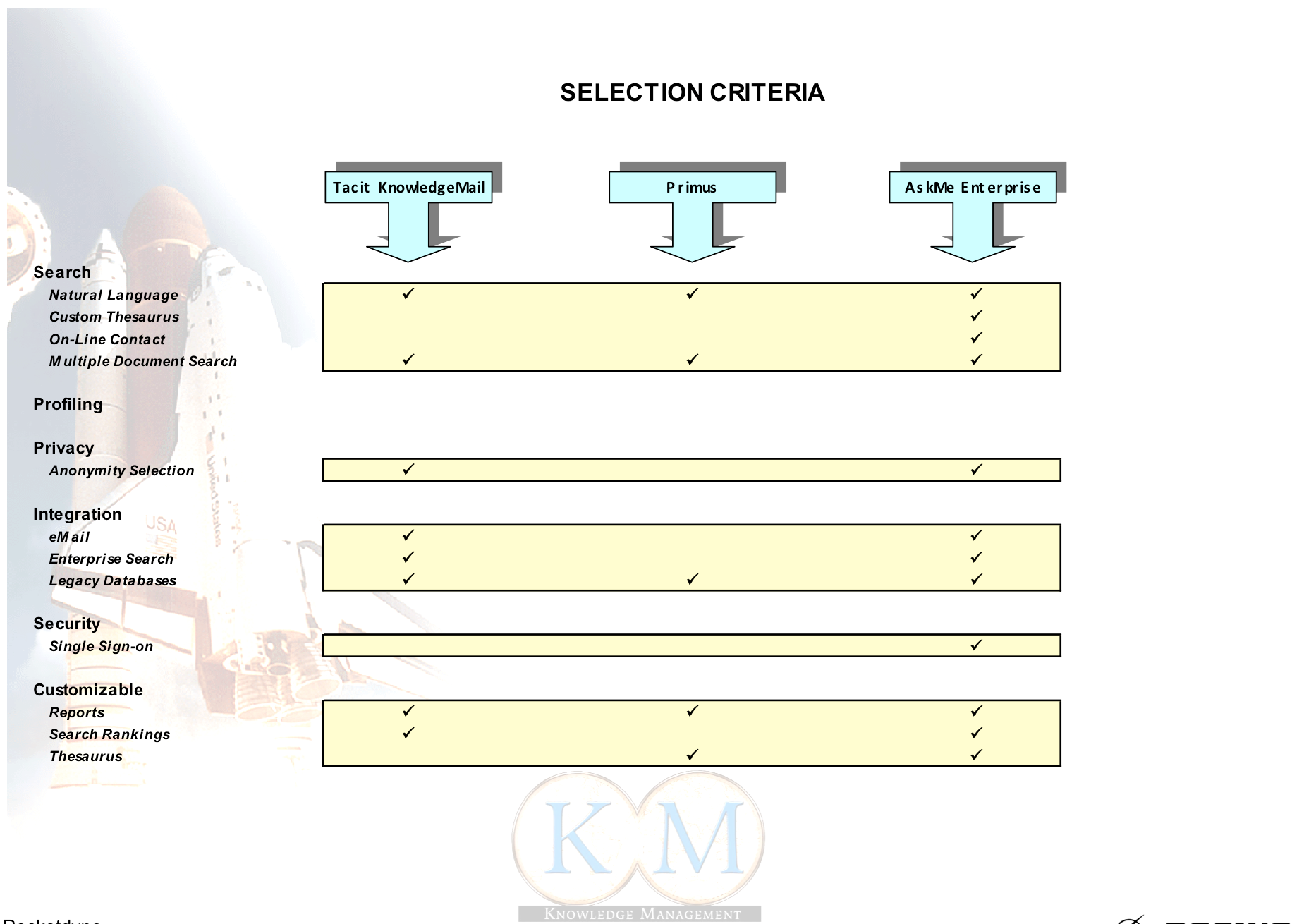
Selection Criteria

Expertise System Trade Study Selection Criteria

As I learn more and more about Decision Science and its derivatives, I look for examples and analogies from previous experience that I can revisit with newfound knowledge and capability and, perhaps, understand a little more clearly or completely than I did back then. I am convinced Decision Science, which embraces the concepts of Decision Engineering and Decision Intelligence, as well as the use of Decision Modeling to pull it all together, is a powerful tool that too few people know about.

One of the things that occurs to me, and I want to throw this out for your consideration, has to do with the remarkable software tool Quantellia has created, called World Modeler. It seems to  me it is to trade studies what AutoCAD is to hand-drawn blueprints. It is so rich in modeling functionality, it just makes every other tool I’ve worked with seem flat, unimaginative, and terribly cumbersome in terms of what we know we’re facing and how we see problems in today’s environment.

Just after the turn of the century (that would be 2001) I conducted a trade study for a software tool, some of the requirements of which were that it would run on our intranet and  was designed to both locate expertise and facilitate the exchange, use, and capture of knowledge in a form that would remain useable for some time to come. In short, one kind of knowledge management system that was being sought after back then.

The trade study I conducted looked at three products and rated them over about a dozen criteria we were interested in. There was no formal weighting and it was a fairly simple, straight-forward comparison of capabilities. A simple effort based on what we knew at the time and the very palty list of vendors who were providing the kind of service we wanted. In fact, as you can see in the accompanying graphic, there were only three . . . and one of them (Primus) was actually — if memory serves — an internal service of Boeing’s developed specifically for airplane mechanics to share information on their service and repair activities worldwide.

With World Modeler, we would have been able to model so much more than just these paltry selection criteria. We could have included in our decision the aggregate likely impact of things we assumed would happen, thereby surfacing possible misconceptions that some had. We could have included connections to IT, HR, and Communications, thereby giving us a clearer picture of the likely impact on the enterprise of implementing the system.

Frankly, in retrospect — and based on the fact that its use steadily declined after my retirement — I’m still not certain it was a good decision, though I had lots of reasons to believe so back then. So, getting back to my point, I think World Modeler is an incredibly powerful tool for an organization to measure the value of many of its decisions before making them. It’s also useful, in my opinion, in a wide array of situations and scenarios. I intend on addressing many of them as time goes by and I become more versed in its capabilities and more comfortable with my understanding of its value to various organizations and situations. You should check it out.


Superbowl Commercial You Won’t See

Beautiful, well-done video with a powerful message.

I’m preparing a couple of posts on Decision Science, but they take a little bit of research and more careful writing than I can muster in one sitting at this point.

In the meantime, I really think this video needs to be seen. Changing the name of a football team is not much to ask, considering how much has been – and continues to be – taken from the peoples native to this land. We have a long way to go to make up for the almost successful genocide. This seems a small thing to ask, even though it involves a Sunday activity that’s surely more popular than Church.

Isn’t it time?


Serendipity Runs Circles Around Causality

Funny how some things seem — given enough time — to come full circle. Although I have always seen patterns and complexity, as well as the intricacies of their interplay, I wasn’t introduced to the concept of Systems Thinking until I worked on the Space Shuttle Main Engine program at (what was then) Rockwell International’s Rocketdyne division. That introduction included being exposed to the thinking of Dr. Russell Ackoff, a recognized authority in the field. I was fortunate enough to spend some time with him, twice in Philadelphia, prior to his death in October of 2009.

Shortly after retiring from Rocketdyne in 2010, I was introduced to Dr. Lorien Pratt of Quantellia, LLC, who showed me a tool her organization had developed called World Modeler. I was excited at what I saw and hopeful I could somehow become involved with Dr. Pratt and her team. However, that was not to be at the time. I was provided the opportunity to more thoroughly investigate the tool, but I had made a conscious choice to refamiliarize myself with Apple products (after over two decades of living in the PC, DOS, and Windows environment) and World Modeler was not written to be run on a Mac. Furthermore, the PC laptop I had wasn’t powerful enough to do the math and drive the graphics required for running models in real time. I was hosed.

Decision Intelligence Technologies

Decision Intelligence Technologies

Finally, about six months ago I was contacted by Dr. Pratt, who asked me if I wanted to assist in writing a paper that described an effort in which they were involved with the Carter Center. I enthusiastically said “Yes!” I’ve done a couple of other things with Quantellia since then but, beginning a few weeks ago, I took on an entirely new and (for me) exciting role as a referral partner.

Right now I’m spending a fair amount of time learning Decision Science in general, and the process and tools Quantellia uses to help organizations understand complex interrelationships and make better decisions based on that understanding. As I’m doing this I watch videos, read blogs and articles, look for original research, and work on presentations that will help me educate others in this important approach to business and organizational operations.

So . . . here’s the full circle part. As I’m looking for definitions, or explanations, of Decision Science and its origins, I Google the term. The first two hits I get are to The Decision Sciences Institute and to Carnegie Mellon University’s Department of Social and Decision Sciences. The third link is to a Wikipedia article on that same Department. In that article, there’s a link to Decision Science, specifically. However, it redirects to an article on Operations Research, which is where Systems Thinking originated. At the bottom of the page is a list of researchers under the heading “See Also”. One of the researchers, unsurprisingly, is Russell L. Ackoff. To me, that’s a combination of serendipity and years of working on better understanding how an understanding of systems can work to the benefit of any organization; actually, anyone.

I’ll be writing a lot more about Decision Science, including my understanding of some of its constituent parts, Decision Intelligence, Decision Engineering, Decision Modeling, and the power and value of our tools, World Modeler and DEEPM (Decision Engineering for Enterprise Project Management). I hope I will be able to clearly explain what it is we have to offer and, more importantly, what everyone has to gain by understanding it. The value exists independently of me or even Quantellia. We’ve just been at it for a while and can apply and employ the discipline both efficiently and effectively. Stay tuned.


Quit the Bragging, California!

it’s marvelous – and ominous – at the same time. While much of the United States has been enduring extreme cold temperatures and hard Winter weather, those of us on much of the West Coast (certainly here in Southern California) have been enjoying unseasonably warm weather. I think it’s been in the mid-seventies to mid-eighties for at least a month and we’re now approaching the “dead” of Winter with no end in sight.

A Week's Weather

Another week of unseasonably warm Winter weather

If this continues, it does not bode well for those of us who live in this neck of the woods. The reason. Drought. According to the California Department of Water Resources, we are now into what may be the third year of drier than normal conditions. They point out it’s a bit too early to conclude this year will be as dry as the previous two, as half of the previous years that started out this dry ended by catching up to normal at the end of the season. They also point out, even if there’s plenty of seasonal rain, it still won’t compensate for low soil moisture and depleted water storage.

So . . . while we’re enjoying the weather here, especially when contrasted to what the Polar Vortex has wrought to our East, it’s important to keep in mind what it means in the long run. It doesn’t matter if you believe in climate change, anthropogenic or not. We are now into our third year of drought in the West, and this wonderful weather may come at a far higher price than I care to contemplate. There’s no reason to brag about it.


Something Borrowed – Something Blue

I got married for the first time (there have been only two) in my early thirties; somewhere around 1980 to be inexact. It was a self-organized, backyard party held at the home of friends in Venice, California. We were living in Playa del Rey at the time. I was just reminded I wore a turquoise bowling shirt a friend loaned me that he had recently  purchased second-hand from Aaardvark’s Odd Ark in Venice.

Turquoise Wedding/Bowling Shirt

My Turquoise Wedding/Bowling Shirt

I have a lot of slides from the wedding. Of course, they’ve been sitting in a binder for the last three decades, which is about how long ago I divorced my first wife (who, btw, remains a friend but who I see very infrequently and always at an event involving my brother’s family, as she was close to my SIL and her family). I have no desire to go out and spend money to have photos made of these, but I did try to scan one of the slides that shows me in the shirt. It didn’t work too well, so I went around the house looking for enough clear backlighting to snap a pic with my iPhone 4S. I offer it herewith.

I’m sharing this because it is somewhat indicative of the kind of relationship, wedding, and marriage (despite its having ended) Alina and I had. In our case, it was the Groom who wore – in one garment – something old, something new, something borrowed, and something blue.


The Aesthetics of Recycling

I may have netted a dollar after this trip, but at least I got out of the house. I got $6.36 and had to travel about 10 miles. You do the math. – at Simi Valley Recycling Center

View on Path


First Post From Path – a Test

This is just a test to see how Path posts to WordPress, which I just hooked it up to. – with Linda at Casa de Ladd

View on Path


Seen a Spaceship Lately?

Have you ever watched the International Space Station pass by in orbit? I don’t know about you, but there’s something majestic, even magical for me just watching it fly overhead. A bright object moving at nearly 5 miles a second appears very fast, even at a distance of hundreds of miles away, and it is awe-inspiring to look up and know there are humans aboard. Several years ago I remember seeing the Station, a Soyuz capsule, and the Space Shuttle all pass overhead as they moved toward a rendezvous and docking. During that mission there were something like a dozen people silently flying by far above my house.

Since my retirement from Rocketdyne, and the cancellation of the Shuttle program, my interest has drifted away some. After all, there’s nothing quite like watching a large, powerful vehicle’s engines roar to life and lift it off the pad into orbit in less than ten minutes. The Station is almost invisible by those standards. It’s already up there and it’s passage is almost mundane. There’s no smoke and fire. It’s swift, but it’s silent.

Recently, I decided to add an app to my phone so I could find out when the Station was flying overhead. Not sure why my interest returned, but it did. The app I chose is called ISS Spotter. It’s free and has everything I need to observe the station. Here are the three views I use the most, though there are settings and a help screen available as well. The first one shows the Stations position and direction of travel (along the thick yellow line) from above and against a map of Earth. It also shows (the blue dot) your location; in this case, near Los Angeles. It has a couple of other bits of functionality, but they’re not relevant to this post.

Orbital map of ISS

Map shows current orbital position in real time

The second view shows upcoming passes over your location (which, btw, it determines automatically using your phone’s GPS, though you can also customize it on the setting page [not shown] if you know your coordinates [and you care]). I use the auto setting and it works just fine. It even adjusts if I’m somewhere else. There are other settings available for time prior to passage for alarms, minimum peak elevations, and others. There’s also a star rating to help you decide how much effort you may want to exert getting outside to view the pass. One star means a pass you might find meh, while three stars indicates even the Magi might be impressed. Note, the next one I’m planning on getting outside for has two stars. As you can see on this page, it will be at a visible altitude (at its highest) of 68° and will shine at a magnitude (visible on the third view, below) of -2.9.

ISS pass notification and alarms

Automatic listing of visible passes in next 7 days with settable alarms

The third view provides everything you need to know to actually find the station, even if you don’t make it out when it first appears. You can also see here that this pass will last a total of six minutes and thirty-eight seconds. Plenty of time to freeze your ass off if you’re anywhere affected by the Polar Vortex, which I’m not.

Compass view of Forecast Screen

Compass view provides direction, maximum elevation, magnitude, and more

I had forgotten, but I got an alarm this morning just in time to go out around 0630 and watch it pass. There were two things that struck me as I stood out in the backyard. When I first spotted it, the Station was well out over the Pacific and, minutes later, it was well over Nevada as I went back inside. In the approximately three minutes I spent observing, that orbiting outpost of humanity and science traveled nearly a thousand miles. The other thing, and it happens every time I observe it silently passing by overhead, was I could swear I was able to make out her warp nacelles.