Category Archives: Food-Cooking-and Eating

Shopping During the Apocalypse

While looking for something else, I stumbled upon this piece I wrote going on four years ago. It holds together, so I thought I would share it even though its current relevance is questionable. It was written in April of 2020. Consider it an historical document. :0)

I admit it. I’ve gone shopping during our state’s (California) lockdown. For groceries; only groceries. It’s difficult to lay in a month or so’s supply of perishables like bananas (which my youngest thrives on), eggs, and milk. Things like that.

In the past, B.C.V., before Corona Virus, shopping for us was pretty ad hoc. Although we made lists, we had separate ones for Trader Joe’s, Vons, and Smart & Final. We also shopped occasionally at Sprout’s, Stater Brothers, Ralph’s, and a local mom and pop called Green Acres. We would go at least three, sometimes four times a week to pick up fresh produce, dairy, and re-stock our cupboard and freezer. Actually, I forgot to mention Costco which, last time I went (just before the State was locked down) was a freaking nightmare.

So, I’m now basically shopping only once a week, but there are some things we’d like to have available that generally aren’t carried by all of the stores, which is why we normally go to more than one during any given week. This is making it a bit difficult to hold down the trips to only one. In the past week, I went three times.

Inasmuch as I’m nearly 73 years old and have numerous comorbidities (none of which are acute, but they’re active and I take meds for two of them) I’m reluctant to leave the house. However, I’m even more reluctant to expose my wife or daughters to the danger of infection. My oldest has had lung issues when she was a toddler and my understanding is the disease can leave survivors with impaired lung function. I would rather risk my health than hers . . . or my other daughter’s . . . I’ve had a wonderfully rich, often exciting life and they’ve got a long way to go. My wife’s lungs are worse than mine, so I don’t have to balance anything with the decision for her to stay indoors.

I was pleased last week to find that Trader Joe’s, like most local markets, was reserving one hour each morning for those considered more vulnerable. The way they have approached it is to form two lines; one for the elderly, immuno-compromised, and pregnant women (they say nothing about pregnant men; guess that would be another story!) and one for everyone else. They only allow twenty shoppers at a time in the store so, each time the 20 who were shopping are finished, a worker sends in 10 from each line. Last week I was handed a disinfectant wipe upon entry, which I used to clean the cart handle and my hands.

The store was stocked to the gills. I had never seen it so full of just about everything they normally carry. Lots of fresh veggies and fruits, frozen food almost spilling out of the cases, eggs fully loaded, and plenty of dairy, meat, etc. Lots of alcohol as well. I was in and out in about 15 minutes. The lack of crowding means it’s easy to maintain distance from other shoppers. It also makes checking out go quickly and smoothly.

This past Monday, when I returned for my weekly trip, I wasn’t handed a wipe, though I’ve become adept at not touching my face until I return home, unpack and put away the groceries, and ever so thoroughly wash my hands . . . after which I can scratch every damned phantom itch that was plaguing me from the moment I entered the store! I also wore a mask this time, which I found in the garage. It’s an N95, which I purchased about a year ago, when I was doing some woodworking and needed to ensure I wasn’t inhaling sawdust as I was sanding my project. I did feel a wee tad guilty about having the kind of mask that HCWs are having a hard time finding these days, but I got over it.


50s Kitchen Chic

This photo and its caption were posted by a friend on FB. I both commented on it and shared it with my FB friends, saying: “This is a Mom kitchen to me. I never knew my paternal grandparents and my maternal grandparents lived with us. Our kitchen wasn’t precisely like this, but it was similar. We had a ‘breakfast nook’ that was partially built-in and, if memory serves, it was turquoise and pink, which was all the rage in the 50s. My strongest memory is of eating breakfast and listening to my mother’s favorite radio show, Don McNeill’s Breakfast Club, which originated in Chicago, where both my parents were born and raised.”

I actually grew up in three different places. Panorama City from a year and a half old until I was seven. Then Palms (West L.A.) for a year, then North Hollywood on the border of Sun Valley until I left home. Although I frequently noted my disappointment my family issues couldn’t be resolved in a half hour like Donna Reed’s did, I really had a great childhood, all things considered. I consider myself luck; some may say privileged … and they’d get no argument from me. Hardly wealthy, yet reasonably comfortable.


Hot Diggity

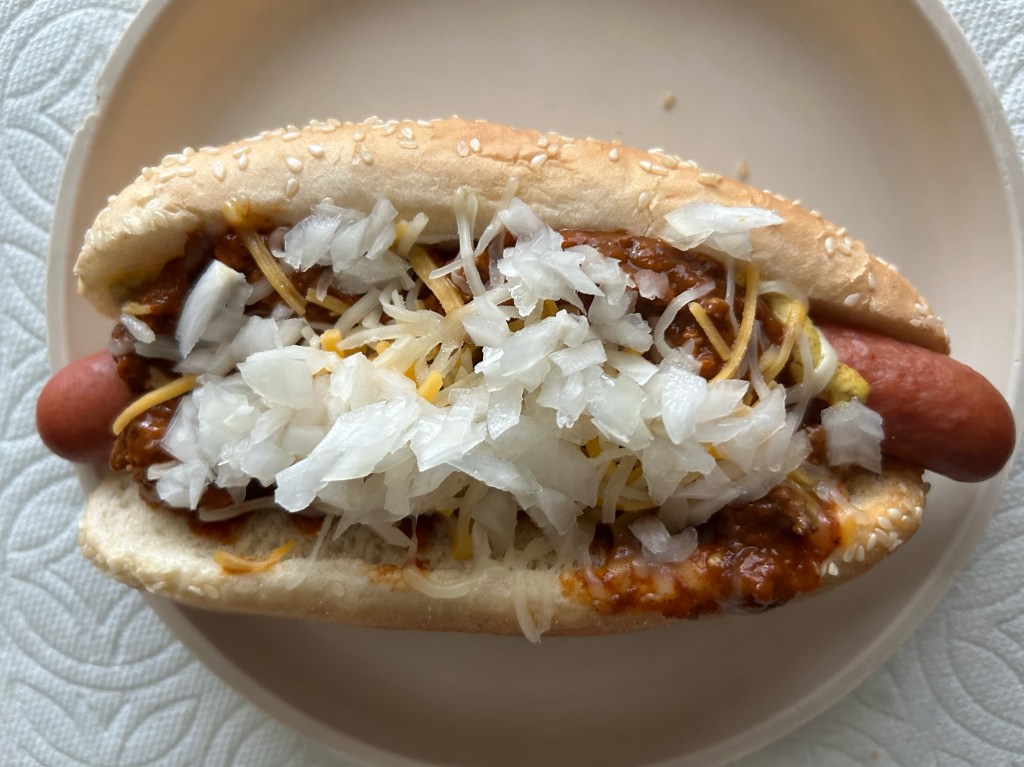
Perfect hurriquake lunch. Hoffy all-beef, natural casing hot dog, Francisco seeded bun, Gulden’s spicy brown mustard, Hormel chili (no beans), Trader Joe’s Mexican cheese blend, and freshly chopped onion.

I’m calling this a cHilary dog.

The Classic Chili Cheese Dog

A Different Kind of Foodie

Like many a young American, my very first job, that is the first one I got paid for, was at a McDonald’s in Arleta, CA. I was sixteen years old and had just earned my driver’s license. This was in the Summer of 1963 and my father had bought me a used ’57 Chevy – my dream car. On my first day I did nothing but make milkshakes. On the second day I bagged french fries. Then the manager discovered I knew how to work the cash register and to make change, a skill I learned in Junior High when I worked in the student store. From then on I worked the window, taking and fulfilling orders. I had nightmares involving endless lines of people who ate every meal there (at least lunch and dinner; McDonald’s didn’t serve breakfast in 1963) every day. These dreams were based, in part, on the fact there were several customers who did eat there every day. It was a frightening thought.

My second job was as a bus boy at Pancake Heaven, which no longer exists but was just around the corner from the McDonald’s I cut my working teeth on. I eventually became a fry cook there for a while and learned how to make breakfasts, for the most part. At least, that’s all I can barely remember. Actually, one specific skill I recall learning was how to hide mistakes with garnish; a slice of orange or a sprig of parsley. I also worked at Mike’s Pizza on Van Nuys Blvd. for a while. The only thing I remember about that job was sneaking out a bottle of Chianti in a trash can filled with the sawdust I was responsible for changing out every few days so the floors were reasonably clean.

The Summer before I graduated High School, which was actually the Summer after I should have graduated High School, I worked as a “bus boy” at Pacific Ocean Park (POP). My job was to walk around the pier on which the park was built and scoop trash into one of those self-opening dust pans and empty it into one of the larger trash bins that were placed all over the “park”. It actually had nothing to do with food or food service, other than that most of the trash was created by people who had purchased something to eat and were too damned lazy to deposit the trash in a receptacle themselves.

I didn’t work in or around food service again until 1973, when I tended bar at the Ash Grove in Los Angeles, where I was raising money for my upcoming trip to Cuba with the 6th contingent of the Venceremos Brigade. I had studied Hapkido with Ed Pearl, the owner of the club. It was a favorite target for anti-Castro Cubans and was burned down for the third and final time shortly after I worked there. I don’t think we had a liquor license; only a beer and wine license, so tending bar wasn’t quite as intellectually challenging as it would have been had I been required to remember dozens of mixed drinks, but it was a busy venue and I enjoyed my time there.

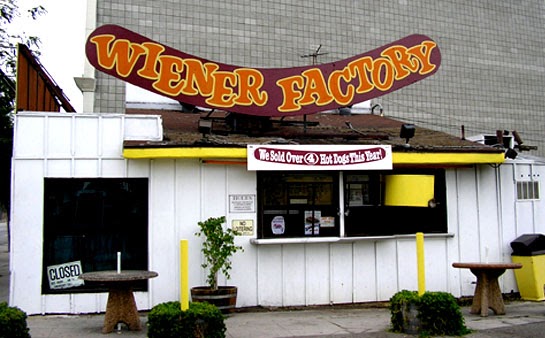
Shortly after returning from Cuba, in my first year of law school, I secured a position as a “wiener clerk” at The Wiener Factory in Sherman Oaks, CA, where I served up the finest hot dogs, knackwurst, and polish sausage to ever cross a taste bud. Even though they closed on December 31, 2007 (>15 years ago) it’s still talked about as the top example of how a hot dog should be presented to the discriminating public. I loved it there. PS – Click on the link and you might find my posthumous review of the place, which I posted almost 13 years ago.

I didn’t work in food service again until sometime in the mid-nineties. I had left my job at Rocketdyne to rejoin my brother in a family wholesale food/restaurant supply business our father had started when I was 13. After less than two years it wasn’t going well and I decided to leave and fend for myself. One of my customers was Les Sisters Southern Kitchen in Chatsworth, CA. The owner at the time, Kevin Huling, was working his butt off and wanted to be able to take a day off during the week. I offered to run the place for him on Wednesdays and, until I returned to Rocketdyne, I managed the restaurant once a week. My favorite day was when I had to wait on tables. I made quite a bit more money than I did from just managing the place (hint: tips!).

In addition to all these jobs, my father was working at the Grand Central Market in downtown Los Angeles when I was born. He worked at Faber’s Ham Shop, which was a stand in the market that sold lunch meats and fresh chickens. He liked to refer to himself as a butcher, but my birth certificate lists his occupation as “Food Clerk”. I remember my mother taking me shopping there when I was about five years old. We took Pacific Electric’s Red Car on the Red Line that stretched from San Fernando, running right through Panorama City, where we lived, to downtown L.A. My father put me in a far-too-large, white butcher’s coat, and put a Farmer John paper campaign hat on my head, stood me on a milk crate and had me selling lunch meat for an hour or so. I learned my first three words of Spanish behind that counter, which were “¿Que va llevar?” literally “what are you going to carry?”, but was more loosely translated as “what’ll you have?” or “what can I get for you?”

Later on, specifically right after I handed over every check I received for a Bar Mitzvah gift to my father so he could buy a truck, he went out on his own. He became the broken wienie king of Los Angeles, buying (essentially) mistakes from packing houses and selling them to his old boss, as well as to other small markets scattered throughout the greater Los Angeles area. Until his death in 1984, I spent virtually every school holiday being his “swamper” on his route or—later on—delivering and selling on my own as part of the business. Somewhere around 1994 I left my job at Rocketdyne to rejoin my brother in the family business, once again selling almost exclusively to restaurants.

My point is, I have no formal training in the culinary arts, but during a rather large portion of my life until I was around 50, I spent quite a bit of time working in jobs and being in businesses that involved food; at times merely delivering it and at other times preparing and serving it. I know my way around a kitchen and I know quite well how to operate a successful food business. It’s not easy. People can be real assholes when they’re hungry, and people who cook can be real prima donnas, so learning to satisfy your customers can be a painful experience. It is, however, quite rewarding when it works out. I think you have to genuinely like people in order to do it well.


My Sandwich Chef

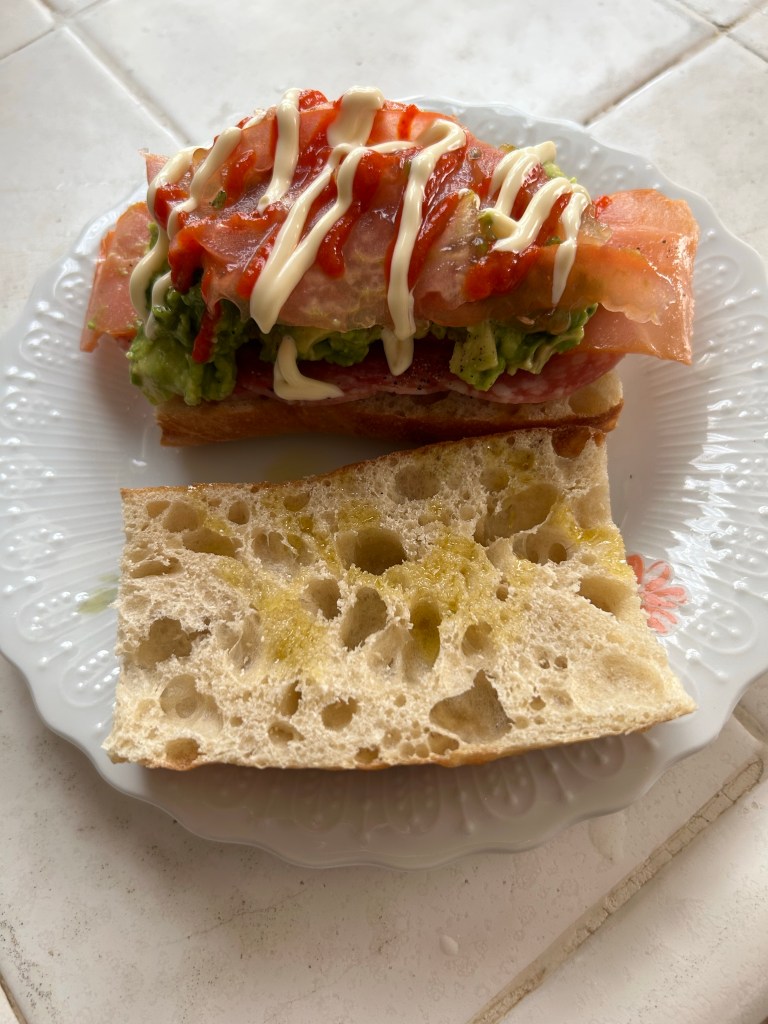
My almost 22-year-old daughter has been inventing in the kitchen, based on whatever’s available in the house, interestingly diverse meals. “Whatever’s available” is almost always a variety of foods drawn from the tastes of her parents (my wife and me) who are descendants of Eastern European Jews and Japanese.

What Do You Think?

I think this sandwich is an interesting example. It consists of a sliced chunk of Trader Joe’s organic baguette drizzled with extra virgin olive oil, a few slices of dried Italian salami, a slice of LASCCO Nova lox, smashed avocado, sliced tomato, laced with Sriracha and Japanese Kewpie mayonnaise.

Sound good to you? It’s not quite my cup o’ tea, but it looked interesting enough I wanted a picture. Note as well, she’s always considering presentation, in addition to flavor.


In Memory of Laverne & Shirley

How many of my friends know what a schlemiel or a schlimazel is? These two words came up quite frequently in my youth. The simple explanation I received to help me understand the difference between the two is as follows (btw, mazel mean “luck” in Yiddish):

A schlemiel is a person who, while walking through a large, mostly empty dining room with a bowl of hot soup, nevertheless manages to spill the soup. A schlemazel is the person on whom the soup lands, perhaps the only one in the entire room.


My Life as a Wiener Clerk

Sometime in my first year of law school I had the opportunity to work at a place called The Wiener Factory. It was located just west of Kester on Ventura Blvd. in Sherman Oaks. Owned by a former stock broker turned English teacher, it was one of the truly iconic places in the San Fernando Valley to get a hot dog or other type of sausage (knackwurst, polish). The dogs all had natural casings, so they snapped when you bit into one. We also used egg bread buns that were steamed prior to placing a dog in them and the mustard was Gulden’s, slightly thinned with a bit of pickle juice. We did not serve French Fries; instead we served hot German potato salad and coleslaw.

I worked for the original owner, whose name I can only remember as Gene. He had a way with words, as evidenced by the walls, which were covered with graffiti. The entire inside of the place was filled with different pithy sayings and slogans, many of which he had invented himself (I think; who knows?). The only two I can remember are “Please tell us how long you want us to hold the onions” and “We may be contumacious, but we’re never revocatory.” They were all amusing. However, were you to step out in the back where the bathrooms were located, it was a different story. There, the graffiti was raunchy and risqué, bordering on the profane. It was not something you were likely to encounter very often in your life. It was, after all, the early seventies.

The Wiener Factory after it closed.
Da Kine!

We served them with mustard, relish, and onions, mustard and sauerkraut (one of my all-time favorites), mustard, chili, cheese, and onions, and two that were oddballs at the time – red cabbage and cheese and coleslaw and cheese. Lately, I have been purchasing Hoffy all-beef, natural casing wieners and they are reminiscent of the Vienna dogs we served back then and that I used to buy in 10-pound bags when I was working with my father in the wholesale meat business.

This morning I got nostalgic. I had been eating kraut dogs intermittently for some time, but the thought of a coleslaw and cheese dog has been invading my consciousness with increasing frequency. Since I had to make a stop at Vons to pick up some items for a dinner we’re making for some friends tonight, I checked out what was available coleslaw-wise. There was some at the service deli, but it was early and they weren’t quite up and running and I didn’t feel like waiting. However, I was able to find a tub of it in one of the stand alone deli cases where they provide salads, cold cuts, cheeses, and other items one might want.

I don’t have any egg buns, but I do have hot dog buns and I also have some Gulden’s mustard and some cheddar cheese slices. So I used a paring knife to further slice the cheese into bits (impossible to grate a slice of cheese). I nuked the dog, then the bun with the dog in it and the cheese on top (I had already drawn a thick thread of mustard at the bottom of the bun) and, finally, topped it off with a generous helping of coleslaw.

Of course it wasn’t exactly as I remembered (is anything?) but it was close enough … and it was heavenly. I’m going to do it again. Tonight, though, is reserved for Italian Wedding Soup that Linda made for our friends. We’re taking a big pot of it over to their place and serving it with pepperoncinis, stuffed olives, and fresh garlic bread.


I’m Not a Chef, But …

My very first job, that is the first one I got paid for, was at a McDonald’s in Arleta, CA. I was sixteen years old and had just gotten my driver’s license. My first day I did nothing but make milkshakes. My second day I bagged french fries. Then they discovered I knew how to work the cash register and to make change. From then on I worked the window, taking and fulfilling orders. I had nightmares involving endless lines of people who ate every meal there (at least lunch and dinner; McDonald’s didn’t serve breakfast in 1963) every day. These dreams were based, in part, on the fact there were several customers who did eat there every day. It was a frightening thought.

My second job was as a bus boy at Pancake Heaven, which no longer exists but was just around the corner from the McDonald’s I cut my working teeth on. I eventually became a fry cook there for a while and learned how to make breakfasts, for the most part. At least, that’s all I can barely remember. I also worked at Mike’s Pizza on Van Nuys Blvd. for a while. The only thing I remember about that job was sneaking out a bottle of Chianti in a trash can filled with the sawdust I was responsible for changing out every few days so the floors were reasonably clean.

The Summer before I graduated High School, which was actually the Summer after I should have graduated High School, I worked as a “bus boy” at Pacific Ocean Park (POP). My job was to walk around the pier on which the park was built and scoop trash into one of those self-opening dust pans and empty it into one of the larger trash bins that were placed all over the “park”. It actually had nothing to do with food or food service, other than that most of the trash was created by people who had purchased something to eat and were too damned lazy to deposit the trash in a receptacle themselves.

I didn’t work in or around food service again until 1973, when I tended bar at the Ash Grove in Los Angeles, where I was raising money for my upcoming trip to Cuba with the 6th contingent of the Venceremos Brigade. I had studied Hapkido with Ed Pearl, the owner of the club. It was a favorite target for anti-Castro Cubans and was burned down for the third and final time shortly after I worked there. I don’t think we had a liquor license; only a beer and wine license, so tending bar wasn’t quite as intellectually challenging as it would have been had I been required to remember dozens of mixed drinks, but it was a busy venue and I enjoyed my time there.

Shortly after returning from Cuba, in my first year of law school, I secured a position as a “wiener clerk” at The Wiener Factory in Sherman Oaks, CA, where I served up the finest hot dogs, knackwurst, and polish sausage to ever cross a taste bud. Even though they closed on December 31, 2007 (15 years ago) it’s still talked about as the top example of how a hot dog should be presented to the discriminating public. I loved it there. PS – Click on the link and you might find my posthumous review of the place, which I posted almost 12 years ago.

I didn’t work in food service again until sometime in the mid-nineties. I had left my job at Rocketdyne to rejoin my brother in a family wholesale food/restaurant supply business our father had started when I was 13. After less than two years it wasn’t going well and I decided to leave and fend for myself. One of my customers was Les Sisters Southern Kitchen in Chatsworth, CA. The owner at the time, Kevin Huling, was working his butt off and wanted to be able to take a day off during the week. I offered to run the place for him on Wednesdays and, until I returned to Rocketdyne, I managed the restaurant once a week. My favorite day was when I had to wait on tables. I made quite a bit more money than I did from just managing the place (hint: tips!).

In addition to all these jobs, my father was working at the Grand Central Market in downtown Los Angeles when I was born. He worked at Faber’s Ham Shop, which was a stand in the market that sold lunch meats and fresh chickens. He liked to refer to himself as a butcher, but my birth certificate lists his occupation as “Food Clerk”. I remember my mother taking me shopping there when I was about five years old. We took Pacific Electric’s Red Car on the Red Line that stretched from San Fernando, running right through Panorama City, where we lived, to downtown L.A. My father put me in a far-too-large, white butcher’s coat, and put a Farmer John paper campaign hat on my head, stood me on a milk crate and had me selling lunch meat for an hour or so. I learned my first three words of Spanish behind that counter, which were “¿Que va llevar?” literally “what are you going to carry?”, but was more loosely translated as “what’ll you have?” or “what can I get for you?”

Later on, specifically right after I handed over every check I received for my Bar Mitzvah gift to my father so he could buy a truck, he went out on his own. He became the broken wienie king of Los Angeles, buying (essentially) mistakes from packing houses and selling them to his old boss, as well as to other small markets scattered throughout the greater Los Angeles area. Until his death in 1984, I spent virtually every school holiday being his “swamper” on his route or later on delivering and selling on my own as part of the business. Somewhere around 1994 I left my job at Rocketdyne to rejoin my brother in the family business, once again selling almost exclusively to restaurants.

My point is, I have no formal training in the culinary arts, but during a rather large portion of my life until I was around 50, I spent quite a bit of time working in jobs and being involved in businesses that involved food; at times merely delivering it and at other times preparing and serving it. I know my way around a kitchen and I know quite well how to operate a successful food business. It’s not easy. People can be real assholes when they’re hungry, and people who cook can be real prima donnas, so learning to satisfy your customers can be a painful experience. It is, however, quite rewarding when it works out. I think you have to genuinely like people in order to do it well.

Not For The Faint of Heart

I’ve heard it said many times that growing old is not for the faint of heart. This past Sunday I had an experience that brought that saying home. It was hardly the first time I’ve experienced something that threatened my health or slapped me upside the head with my mortality, but it was sufficiently different that it definitely got my attention.

My wife had decided to make homemade shrimp/pork wontons. She had spent some time getting all the ingredients for the filling and our daughters and I had filled and formed a little over 50 wrappers. We decided to cook them outside on the side burner of our Weber Silver-C gas grill, using a cast iron dutch over and peanut oil. I wasn’t quite sure it would get hot enough, but it definitely did. In fact, no sooner did I start deep frying then I had to turn the flame down a bit.

I was only able to fry four or five at a time, so it took a while and I was standing still for the entire time, using metal tongs to flip the wontons over so they would cook the meat, veggies, and seasonings thoroughly without burning the wrapper. During that time I barely moved a thing other than my arms and hands.

The tops of my feet had been feeling a little strange for the past couple of days, but I hadn’t paid really close attention to them. I finished and went inside, sat down, and enjoyed our meal with the family. Shortly after I finished eating, I happened to look at my feet, as they really were feeling weird. To my horror, not only were my feet swollen, but my ankles were as well. Where I could normally see tendons and veins, there was nothing but stretched out skin.

I recalled this was a symptom of possible congestive heart failure and I know I have a history of moderately high blood pressure and two years ago was also diagnosed with atherosclerosis of the aorta. I was concerned. My first response was to ensure I drastically limited my salt intake and I decided to see how I did after a night’s sleep.

When I woke up the next morning, my feet were a little less swollen. I sent a message to my doctor and am awaiting a response. I really hate the term, mostly because it’s used so frequently by anti-vaxxers and science deniers, but yesterday I decided to do some of my own research. As a result, in addition to limiting my salt intake (something I wasn’t being careful enough about) I wore a pair of knee-high socks to bed and placed a couple of pillows at my feet to elevate them over my heart.

When I awoke this morning, the first thing I did was remove the socks to look at my feet. To my relief, they had pretty much returned to normal. I could see all the tendons and veins that normally stood out rather conspicuously. I’m still waiting for my doctor and will consult with him, but I think I have a fairly good idea of what I need to do to ensure this doesn’t happen again. This is definitely not something to ignore or sweep under the rug. The body does not heal or remain healthy by ignoring what it’s telling you and this was a cry to do something different. That I will!

PS – The condition I experienced is called edema. As a result of looking into it and posting something about it on Facebook, I learned the adjective form of the word, which is edematous.


Is It Sauce or Is It Gravy?

food plate restaurant dinner
Photo by Anna Tarazevich on Pexels.com

I have always thought of the topping we’re most used to putting on pasta as sauce; generically spaghetti sauce, though we might differentiate between marinara and meat sauce. During the early 80s, when I was living in Playa del Rey, CA I recall a friend from Boston who referred to it as gravy. I had never heard that term used before and I was intrigued.

Never thought about it too much, but every once in a while I would wonder what it was all about. Gravy or sauce. Now I’ve spent my fair share of time in the kitchen and I know my way around, but I’m hardly a trained chef or a connoisseur. I’m just someone who enjoys eating and knows how to have fun cooking many of the things I like to eat.

Recently, I decided to “do my own research” and have discovered there is no simple answer to the question. Suffice it to say, for the most part gravy is used to refer to a thickened liquid made from the drippings of cooked meat or vegetables, while sauce is made separately from the item it is poured over or served with. Gravies are usually served hot while sauces can be served either hot or cold.

It seems clear to me, however, there is a lot of overlap and wiggle room for classifying something as either a sauce or a gravy and, rather than present an entire treatise on it, I’m going to share a couple of links to articles or sources I’ve encountered whilst doing the aforementioned “research”. I have to add that writing this has made caused me to crave a nice, steaming plate of pasta with my favorite kind of sauce/gravy poured all over it (that would be a meat sauce, say a nice bolognese.)

This page runs down a bit of the history of Italian immigrants to the U.S. and how their use of the words has evolved as they assimilated. The author points out how contentious the distinction has become. There’s quite a bit of fun history and speculation here.

This next page is from a source in India for hospitality workers to educate themselves. It’s got an interesting table setting forth the differences between gravies and sauces. It does not go into any arguments that exist regarding the difference; it’s just a decent source for understanding their components.

This blog post goes into what appears to be an ongoing argument over what to call the stuff that in Italy is referred to as sugo. The author also provides information about Italy and Italian-Americans, as well as recipes from salads to desserts.

Now I need to go out and find something to satisfy my craving for Italian. As a Ukrainian-Moldovan-German-Jewish-American, it’s not part of my heritage but my father’s best friend was a DeBiase and I spent a few of my early years eating homemade pasta (Rigatoni is my fave) or Lasagna, garlic bread, and fresh from the oven Pizzelle (Anise cookies) most every Sunday when we lived near each other in Panorama City, CA.

Pizzelle (Yum!)