Category Archives: humor

The Art of Putting: Or, How to Turn the Green into Your Frenemy

Ah, putting—a small word for an enormous source of joy, frustration, and the occasional golf-induced existential crisis. If driving is the glamorous star of the show and iron shots are the dependable character actors, putting is that quirky sidekick who can steal the whole scene… or ruin it entirely. It’s an art form, a science, and sometimes a cruel joke. But fear not! With a little humor, some pseudo-wisdom, and a lot of practice, you too can learn to navigate the treacherous terrain of the green.

Reading the Green: The Golf Detective’s First Case

The first step in putting is reading the green, which is essentially a Sherlock Holmes-level investigation into the subtle mysteries of gravity and grass. Is the green sloping left to right? Right to left? Are there hidden bumps that could send your ball off course, like a toddler with a sugar rush? Stand behind the ball and take a good, long look at the terrain. Squinting dramatically, like you’re in a sports movie, is optional but highly recommended for effect.

Walk around the putt’s line, crouch a bit (a great excuse to stretch those hamstrings), and try to visualize the path your ball will take. If you’re on a course where the greens are as smooth as polished marble, congratulations! If you’re dealing with something that resembles your uncle’s backyard, well, let’s just say you’ll need to be extra creative.

Grain: The Green’s Personality (and Mood Swings)

Now, let’s talk about grain. If the green were a person, the grain would be its personality—sometimes calm and agreeable, other times erratic and rebellious. Grain refers to the direction in which the grass grows. If you’re putting with the grain, the ball will roll faster, almost as if the green is giving you a gentle nudge of encouragement. Putting against the grain, however, is like trying to run through molasses while carrying a backpack filled with bricks.

To figure out the grain, look at the grass. It often appears shinier when you’re looking with the grain, and darker when you’re against it. Another trick is to look at the hole itself—if one side of the cup is slightly ragged, the grain is growing in that direction. Yes, the cup itself is tattling on the green’s mood. Use that information wisely, like a golf gossip.

Speed, Aim, and the Elusive Perfect Stroke

Once you’ve read the green and considered the grain, it’s time to actually putt. No pressure, right? The key here is finding the right balance of speed and aim. Too fast, and you’ll blow past the hole like a Formula 1 car on a joyride. Too slow, and you’ll end up short, staring at the ball as it rolls to an anticlimactic halt. (This is the golfing equivalent of sending a text and immediately regretting it.)

Practice your stroke with confidence, even if deep down you’re questioning every life decision that brought you to this point. Focus on a smooth, consistent motion. And remember: putting is as much about feel as it is about technique. Channel your inner Zen master. Or, if that fails, channel your inner stubborn mule and refuse to give up until the ball goes in.

The Final Word (and Hopefully, the Final Putt)

Putting is a test of patience, precision, and your ability to laugh at yourself when things go awry. Sure, it’s frustrating, but it’s also deeply satisfying when you finally sink that tricky ten-footer. So embrace the challenge, enjoy the process, and remember: even the pros miss putts sometimes. But hey, at least you’re not on national television when it happens.


At The End Of The Day

I prompted Poe’s chatbot, “Assistant”, with the following. Its response seems almost like it enjoyed doing this.

“Write a corporate pep talk of at least 300 words that sounds reasonable, but is nothing more than corporate gibberish.”


Team:

As we embark on the next fiscal quarter, it’s imperative that we synergize our verticals and double down on our core competencies to truly unlock cross-functional scalability. The paradigm shifts in our industry demand an agile mindset, and we are uniquely positioned to leverage our robust infrastructure to capitalize on emerging opportunities. Now is the time for us to think outside the box, lean into our KPIs, and disrupt the status quo with unprecedented velocity.

 Our mission is clear: we must amplify our operational bandwidth while maintaining a laser-sharp focus on customer-centric deliverables. This is not just about meeting expectations—it’s about exceeding them at every touchpoint. By fostering an ecosystem of innovation and embedding a culture of excellence into our DNA, we can achieve a seamless alignment between our strategic objectives and ground-level execution.

 Remember, success in today’s dynamic landscape is not a linear journey. It’s about embracing iterative growth, harnessing actionable insights, and pivoting proactively when faced with volatility. Let’s not forget the power of collaboration—our ability to break down silos, ideate collectively, and drive end-to-end solutions will define our trajectory as market leaders.

 I urge each of you to take ownership of your deliverables and approach challenges with a growth mindset. Let’s circle back to our organizational north star and ensure that every touchpoint in our value chain is optimized for maximum impact. The low-hanging fruit is ours to harvest, but we must also keep an eye on the blue-sky opportunities that will future-proof our success.

 In closing, I want to reiterate that our greatest asset is you—the people who make this organization thrive. Together, let’s move the needle, operationalize our vision, and deliver unparalleled value to our stakeholders. The sky is not the limit—it’s just the beginning. Let’s make it happen!


SNL’s 50th & Paul McCarney

Somewhere in my garage there’s a box with a tape of the very first Saturday Night Live, when Don Pardo referred to the ensemble cast as “The Not for Ready for Prime Time Players”. I haven’t watched the show much in the past 10 years, but I made sure the 50th Anniversary Special was recorded in my YouTube TV subscription.

Unfortunately, this last bit was not recorded. I just watched it now and it’s wonderful, despite Paul’s aging voice. This was always one of my favorite medleys of theirs. I miss the strings, which I still heard (in my head) while listening to this.


Fitting

Did you know Donald John Trump is an impressionist? Here he is, captured by a courtroom artist, doing his impression of Sleepy Joe.


Deming and Rocketdyne

Sometime in late January of 1987, almost one year to the day after the Space Shuttle Orbiter Challenger was destroyed as it ascended to orbit, I was assigned by the temp agency I was using at the time to begin work on the Space Shuttle Main Engine team at Rockwell International’s Rocketdyne Division in Woodland Hills, CA.

Prior to that fateful date I had, with one exception, never worked at a company with more than a dozen employees. My family’s wholesale food business, at its peak, was only my father, brother, me, and one employee and most of the numerous jobs I had held over the previous 20 years or so were similarly small.

Rocketdyne employed several thousand people, most of whom labored at our campuses in Woodland Hills and Canoga Park, CA. It was a division of Rockwell International, which employed over 100,000 people world-wide. It was a jarring transition to go from small (really small) businesses to a multi-national aerospace conglomerate. However, having been somewhat of a space-cadet, i.e. enthusiast most of my life, I was thrilled with the opportunity.

A year later on 1 February 1988, I was hired to work in Engineering Computing on the Flight Ops team – a position I would not have dared to dream of filling. Nevertheless, there I was helping our nation’s space program get back on track. It was truly a dream come true.

At the same time, I was becoming aware of the unique way in which large organizations conduct themselves. Some of it wasn’t pretty. I first encountered the business philosophy of W. Edwards Deming soon after I was officially hired as I was lucky enough to have a colleague who was a student of his. Deming had written a book (he wrote many) in which he laid out a fourteen-point explication of his concept of TQM (Total Quality Management).

I was enamored of his positions, as they coincided with my growing understanding how things worked in virtually any organization. I had long been someone who looked for and found ways in which to improve the processes and procedures of any organization I was involved with, and Deming’s philosophy made a great deal of sense to me.

At the same time, I was becoming increasingly aware of the reality that many companies, including Rocketdyne, were honoring those principles in their breach, not their adherence to them. As I was studying Deming’s 14 points I began to realize just how thoroughly many of the managers I encountered were oblivious to the virtues Deming laid out.

Somewhere around 1990 I decided to see if I could capture the differences between what Deming offered and how Rocketdyne was actually doing things. I captured Deming’s 14 points and then created Rocketdyne’s 14 counterpoints. I’ve kept them over the years and am here sharing my understanding with two screenshots of those differing points of view. Please keep in mind not all managers were as controlling as the worst of them. I was lucky to work under the supervision of several truly wonderful managers in my nearly quarter century of employment there. Regardless, I think my analysis was reasonable, even after over 34 years. You?


How About It, Men?

Every man who denigrates the Barbie movie should be required to watch this powerful soliloquy as many times as necessary to get it through their thick, manscaped heads that we (men, that is) need to be supportive of women’s equality (and, I might add, bodily autonomy).

Women DO hold up (more than) half the sky. Why TF wouldn’t we want them by our side, not behind us? With us, as equals.

Let’s try matriarchy for a couple thousand years, MK? It’s only fair. I, for one, would welcome it. Women deserve it, IMO.


Way To Go, Colorady

Colorado license plate spelling out NO-DKT8TR
Colorado Supreme Court makes the right decision, IMLTHO.

I Was Just Passing The Time

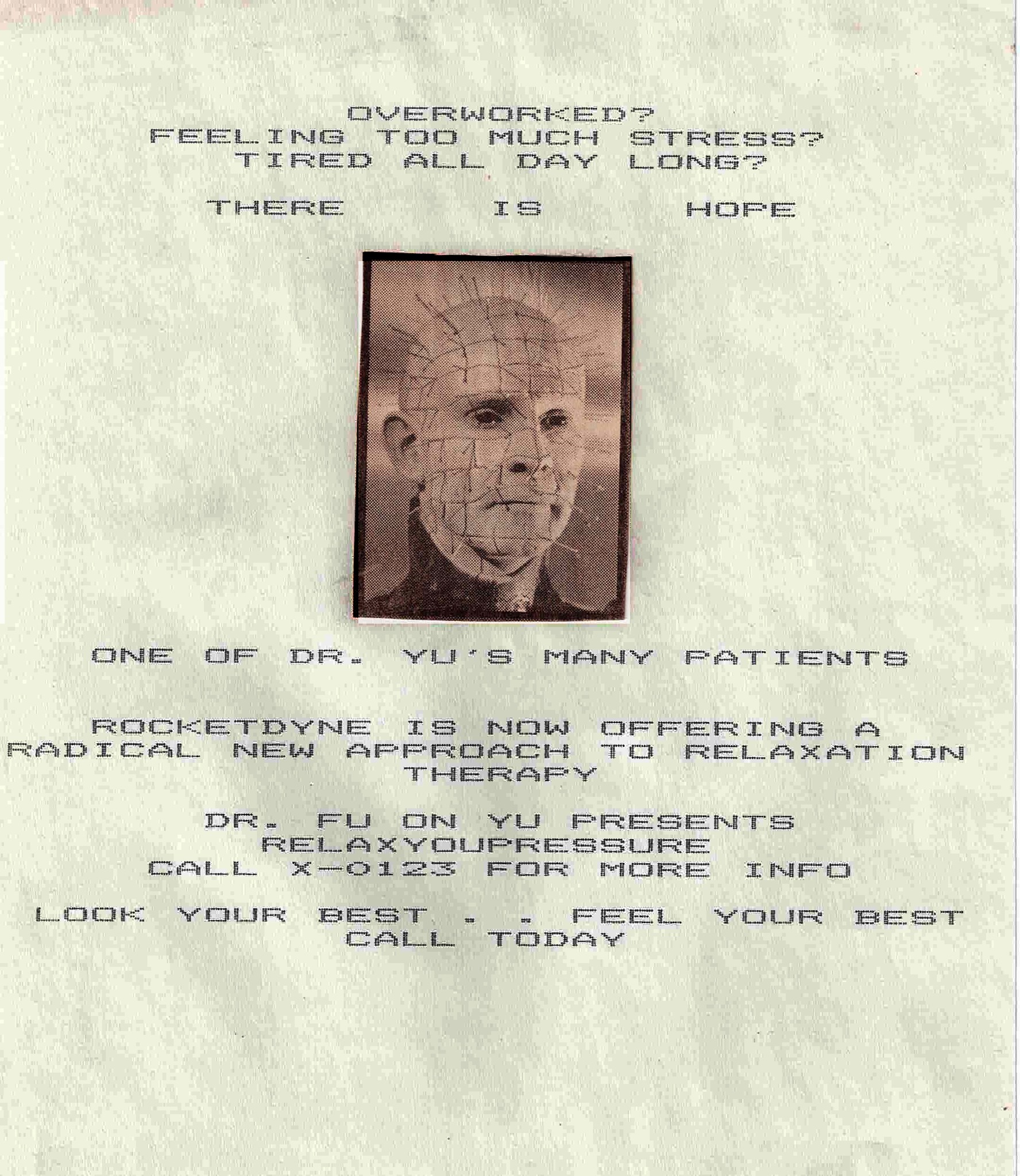
When I first ended up at Rocketdyne (it was serendipity, not a conscious move) I was gobsmacked knowing I was working on the Space Shuttle Main Engine program, with bonafide rocket scientists and engineers. It was 1987, almost exactly one year since Challenger exploded and I was working on the FMEA/CIL (Failure Modes and Effects Analysis/Critical Items List) in anticipation of the shuttle’s return to flight. There were frequent dead times while I waited for an engineer/scientist to bring me their work so I could input it into the format we were using to present the information.

I was just going through a folder I found stashed away that’s chock full of some of the things I created back then while I was bored. Keep in mind we only had dot matrix printers and early IBM PCs. I’m pretty sure we were using IBM XTs running Intel 8088 processors. Anyway, here’s one of the things I put together to assuage my boredom back then.


Angel Does Pelé

Here’s a video of Angel playing soccer (or a reasonable facsimile thereof) with herself. Between this and her scattering toys all over the house—even outside in the backyard—we’re getting worried about her. We think she may have ADOG. Hopefully, the Vet has meds available to help her out.

Scoooooooooooore!

Bois (NOT) to Men!

Tucker Carlson, Ben Shapiro, and whoever-the-hell the other misogynist numbskull is on this video are raging examples of right-wing snowflakes and “less than” men. Talk about being triggered. This is what happens to bois who think tanning their nuts will somehow add to what little masculinity they might serendipitously possess.