Category Archives: Personal

Can I Get an Amen?

Amen Corner at Augusta National Golf Course

The word “Amen” isn’t confined to prayer, though it’s generally closely related.

Yesterday I was inducted into one of several local Rotary clubs here in Simi Valley, CA. The name of this club is Simi Sunrise and, not coincidentally, it meets at 7:00 am every Thursday at the Grand Vista Hotel. I had some trepidations about joining an organization such as Rotary International, best explained by the question a friend asked me when informed of my desire to join; “Aren’t they a really conservative organization?”

Truth to tell, I wasn’t entirely sure they would accept me, especially since this is a fairly conservative city I live in and I’ve made it abundantly clear I am not a conservative – at least not politically. I didn’t really know a lot about Rotary and I knew an awful lot of the people who were in this club. Most of them were quite conservative – politically. At the same time, I live and work with them and know them to be good, decent people. Especially the ones in Rotary 1 and other service organizations.

Fortunately, I got to know a person who ended up convincing – and sponsoring – me to join. Due to an unlikely confluence of events I ended up being the guest who wouldn’t go away, and a process which normally takes a couple of weeks ended up taking a couple of months. Nevertheless, she insisted I continue showing up and, because she had to pay for my breakfast each week, I have offered to do some data input for her at her discretion. It’s the least I can do.

Yesterday was the culmination of two months of meetings and thinking about what I was getting myself into. Now that I’m officially a member I will not only have an ongoing financial obligation and an expectation of service in the form of volunteerism, I will also be expected to perform various duties at the meetings, e.g. greeting members as they arrive, checking attendance, etc. There is one duty I’m somewhat concerned about. Leading the invocation.

I have now heard approximately eight different invocations. I don’t recall any of them being identifiably denominational, though some referenced “our heavenly father”. I believe at least one ended a bit irreverently . . . and comically. They all end with “amen”, a word of Hebrew origin defined by Merriam-Webster online as: “used to express solemn ratification (as of an expression of faith) or hearty approval (as of an assertion).” Although used primarily at the end of a prayer or hymn, it is clearly not limited to religious expression. So it looks like an invocation avoiding the mention of God would most likely be acceptable, even if hard to author.

However, as an atheist I have a lot of experience with people who misunderstand my kind of “faith” and are likely to exhibit one or more of the following traits or attitudes in response to an expression they perceive to be anti-religion: Anger; disgust; defensiveness; dismissiveness; revulsion; incredulity; hatred; need I go on? When you think of invocation, you just don’t think of atheism now, do you?

So . . . my dilemma. I’m going to assume I will, at some point in time, be asked to give the invocation. I suppose I could respectfully decline, but I kind of want to do it. The issue for me is how to do so without offending anyone. Part of me believes that’s a tall order, precisely because of the responses I’ve experienced or observed for so many years, while another part of me believes it isn’t as big an issue as it at first appears. I’ll post the text . . . when I write it!


1 Rotary is very attractive to me as it espouses values I believe are important and progressive. I find it a little ironic so many of the members are staunch conservatives, yet the values they ascribe to can just as easily fit the most progressive agenda. If words are important, and I believe they are, then their foundational writings should matter a lot when determining what kind of an organization they (at the very least) aspire to be. For instance, there’s The Four-Way Test:

  1. Is it the TRUTH?
  2. Is it FAIR to all concerned?
  3. Will it build GOODWILL and BETTER FRIENDSHIPS
  4. Will it be BENEFICIAL to all concerned?

Coupled with numerous other writings, which I will not get into now but will surely bring up as I gain more experiences with this new facet of my life, I think Rotary paints itself as an organization dedicated to the same things I am – Peace, Justice, Goodwill, Internationalism, Fairness, etc.

There’s likely an argument lying beneath the surface here as to the role volunteerism plays in an inherently unfair economic system, but – in my opinion – it is more a philosophical one and should in no way minimize the pain alleviated through the actions of Rotary and other organizations like it. More on this some other time.


Get Out There And Buy The Book Already!

Books for Sale

Go ahead. Splurge. Buy the book already!

Once I started blogging, which was quite some time ago, I became an author. Truth to tell, I’ve been something of an author virtually all of my life. I just haven’t ever thought of it in terms other than how it served whatever organization I happened to be working for. Whether it was writing advertising copy for my family’s business or my cousin’s wine store, publishing a newsletter in exchange for free range balls and rounds of golf at Simi Hills (that’s how I could afford to learn, starting at 46), or producing a monthly newsletter for the Knowledge Management team at Pratt & Whitney Rocketdyne, I’ve been an author for a lot longer than I give myself credit.

Now that I’m planning on ramping up my writing efforts, including offering my services as an editor and proof reader, I’m starting to think a lot more in terms of what it takes; what my mentality needs to be. I’ve started contacting my connections, the people I got to know over the past six or seven years that I was very active in Social Business (formerly called Enterprise 2.0) and social media in general.

One of the folks I contacted and have communicated with is Nilofer Merchant. She recently authored this great post and I think you should read it. She makes some very interesting, important, and accurate (IMO) points about the way we treat authors . . . and artists in general (in my opinion). Here’s an excerpt:

No one knows how to support an author. So, every author feels slighted. And every friend is simply … stumped.

This is because we lack the social conventions for how to support authors. If an entrepreneur shares aKickstarter campaign, you break out the Paypal account because, of course, you want to help someone pursue their passions. If a colleague is doing a breast-cancer walk or leukemia team-in-training run, you know what to do. If a friend loses a parent, you know to send a card or flowers. If someone shares they are having a baby, you slap the dad on the back, wish the new parents luck (and sleep), and find some ridiculously cute outfit to gift.

But what to do when a friend, or even someone you know only on Twitter publishes a book? What if you don’t care about this topic? What if you think you have that domain covered since, you too, are an expert. What if you are just not a reader?

It is perplexing to know what to do since are no norms, mostly because being an author is rare. And – while most people would never want to admit this in public – they would rather be jealous of another person crossing off a bucket list item rather than get excited for them or support them.

But authors do need your help. They need it is small ways and large and since I have several great friends with books in the near future – books worth reading and supporting, I’m going to write a primer for how to support an author.

If you’d like to read further, her suggestions – and the rest of her post – are here. I have to admit being guilty of this myself, though I have purchased far more books than I’ll ever have the time to read . . . unless I become bedridden, and I’m not exactly hoping for that. Help an author. Buy their book. I’m expecting to be begging you on my behalf soon.


On The Meaning of Manurial

Sisyphean Dung Beetle

Sisyphus, The Dung Beetle

It’s been something like thirty years since I woke up in the middle of the night and wrote the following limerick but, for some unknown reason, it popped into my head a couple of days ago and I can’t shake it. I’m interpreting this to mean I have to share it now. First, a smidgeon of background.

A long-time, close friend had heard the word “manurial” and thought it was kind of funny. Frankly, I have no recollection of the context in which it came up; perhaps it was on a late night talk show the previous day. He wondered about its actual (not supposed) meaning and, alas, it was before the Internet. We did not have a dictionary immediately at hand. Now, this friend was one of those people who’s constantly coming up with ideas, but seldom following through with them. That night, as I lay in bed, I suddenly had an inspiration and felt compelled to pen a limerick. This is what I wrote:


Our Loren though entrepreneurial,
Is, nonetheless, quite mercurial.
His numerous Schemes
Drive us mad ’til it seems
We can’t help but think he’s manurial.


There! I’ve now recorded it for posterity. I can’t believe I’ve carried that one around in my head for all these years. I also wrote one about a guy I worked with whose last name was Luckett, but you can probably figure out how that went, though I believe I was able to avoid the use of “Nantucket”.

There were others. Maybe I’ll recall them as well some day. Please don’t hate me.


Can Men Be Feminists?

What a Feminist Looks Like Hint: It Doesn’t Mean You’re Feminine 🙂

I hope this is a question many men have asked themselves. It’s important to understand and come to a useful resolution about this, as I think there are many men who support women’s equality but are somehow intimidated by the thought of being seen as a feminist. Let me say it right up front. I am not only a feminist; I have been one since the early 1970s. It’s important for men to understand what being a feminist means, because it has nothing to do with being feminine, which I think is why many men might cringe somewhat at the thought.

The Oxford English Dictionary, online edition, defines a feminist as “a person who supports feminism”, and Wikipedia defines feminism as follows: “. . . [A] collection of movements and ideologies aimed at defining, establishing, and defending equal political, economic, and social rights for women. In addition, feminism seeks to establish equal opportunities for women in education and employment”. As a movement, feminism is complex and – for the most part – understanding its history isn’t important to the issue of whether or not men can (or should) be feminists. On the other hand, one of the reasons for this post is to share a short video that addresses one of the more egregious historical responses to the struggle of women for suffrage, i.e. to gain the right to vote.

One of the main reasons I have been so supportive of women’s rights almost as long as I’ve been able to vote is my belief, as Dr. Martin Luther King, Jr. famously said, “Injustice anywhere is a threat to justice everywhere”. Then there’s also this little thing called the Golden Rule, “Do unto others as you would have them do unto you”. I like to think the meaning of these two maxims – and so many like them – is that inequality is not a good thing. Since the very essence of feminism is, as stated above, the goal of establishing “equal political, economic, and social rights for women”, it seems to logically follow it is something anyone – even men – of good conscience must support. Let’s take it a little further, though. Let’s ask ourselves who these women are who wish equality. We don’t have to look very far for they are our mothers and grandmothers; our sisters, nieces, and cousins; our girl friends and wives. In short, they are all women, everywhere. Why would we not support feminism and thereby be feminists?

This November 6th we are going to make a choice in the trajectory our nation will follow for the succeeding four years, almost certainly a lot longer since one or more Supreme Court Justices is likely to retire. The Republican Party, through its most important representatives and through its actions, has made it clear they wish to return to a level of patriarchy that makes women second-class citizens and, in some respects, returns them to the status of chattel. Although the party has tried to move the national conversation away from the highly-charged term “War on Women”, the reality is a victory for Mitt Romney would be a “Disaster for Women“. It is imperative for not only women to understand what’s at stake but, perhaps, even more important for men to understand because they have a tendency to be somewhat timid when it comes to supporting these basic rights of women (should read merely “people”).

Today I came across a wonderful short video that recounts the struggle of a group of women who protested for the simple right so many of us take for granted – the right to vote – and were severely punished for their temerity. This was less than a hundred years ago, when Woodrow Wilson was President. Less than 100 years ago! There are far too many of us who either haven’t registered to vote or, in our apathy or despair, won’t take the time to vote. This is not a good thing. As Plato said, “One of the penalties for refusing to participate in politics is that you end up being governed by your inferiors.” The struggle for the right of women has come too far to now go backward. Here is the video I want you to see. I hope you’ll share it as well. It’s very powerful.

And get out there this November and VOTE! 

Photo from Douche, Bag and Shoes


The Debates: S/S & Medicare Off The Table?

Social Security Cards

Truly a Lifesaver for My Family

I am 65 years old. An old fart. A geezer. An alta cocker. Two years ago I accepted an early severance package from the company I was working for, in part because of my eligibility to receive Social Security and Medicare. They played a big role in my decision to accept the package, which wasn’t mandatory. There were other reasons, but I did the math and decided not to pass it up.

I have worked since I was sixteen years old (I’m one of those whose first job was at a McDonald’s) and, save for a couple of years I spent screwing around, I’ve been putting money into both these retirement programs most of my life. How, and in what manner, they get screwed with by either Mitt Romney or Barack Obama is of paramount importance to me, not just because of how my family and I will be affected, but how it will affect those who come after me.

I just learned that the questions to be asked in the first debate have been announced and neither of these programs are currently planned to be discussed. WTF? Virtually everyone in the country will be affected by any changes to them. Whether it’s making what those of us currently receive more difficult to obtain or diminished in value or changing the entire structure for those who have yet to reach a certain age, it’s important to know what the candidates plan on doing.

My concern is with both candidates. We all know what Mitt Romney and Paul Ryan want to do. However, The Huffington Post three days ago ran an article entitled “Obama May Do Social Security Reform During Lame Duck Session, Senate Democrats Worry

Well, you can make a difference by telling Jim Lehrer to include Medicare and Social Security in the debates. Thanks to AARP, all you have to do is Go Here and fill out the form. You’re a leftie. You know the drill. I did it. I also tweeted about it, posted about it on FB, and sent an email message to about 50 of my closest friends, a half dozen of whom have already done the same.

This is an exceptionally important issue for all of us, even those Tea Bagging dipshits who don’t know which side of their toast the butter’s on. Do you want your retirement to be left to the vagaries of the market, especially when you know it’s crooked as hell and likely will steal much of your savings from you? Maybe we can fix it in the next decade, but I sure as hell wouldn’t be holding my breath. Hell, before I was 30 (that’s more than three and a half decades ago) I thought there was going to be a revolution in this country. Actually, there kind of was, but it went in the opposite direction from where I thought it would.

Think about it; then do something about it. Send a message. We want Romney and Obama to talk about how they plan to deal with Medicare and Social Security. Act like your future depended on it. Until we achieve a more just economy (hint: Socialism), this is the best thing we’ve got. Here’s the link again. Take it from me. These two programs are extremely valuable and important.


More Softiness!

Yesterday I posted my thoughts about empathy and kind of wondered aloud why I find it easy to get so deeply immersed in a fictional drama that I can be moved to tears; sometimes to really distressful levels of sadness and grief. At the end of that post I wrote:

I want to understand what is moving me when this happens. On some levels it seems patently ridiculous to get so emotionally involved in a fiction story. On the other hand, perhaps it is really what makes us human. I’m wondering if someone with a more classical education than I have knows more of the thinking humans have brought to the subject. I’m sure some in the Arts (especially the Theater Arts) have tackled it. I’ll have to do more research. In the meantime, I’m glad there’s plenty of tissue in the house.

As it turns out, thanks to a friend I discovered an interesting answer through a wonderful TED talk by VS Ramachandran, a Neuroscientist who has studied the functions of mirror neurons. It would seem there is overwhelming evidence we humans are more closely connected than I was hinting at.

In his talk he says, “There is no real independent self, aloof from other human beings, inspecting the world, inspecting other people. You are, in fact, connected not just via Facebook and Internet, you’re actually quite literally connected by your neurons.” I find this resonates in many ways with my understanding of Systems Dynamics, Quantum Theory, and Zen and goes a long way toward answering my question. Frankly I find it a meaningful addition to my understanding, but still find myself wondering why it manifests itself so powerfully in some . . . and not at all in others. After all, the world is filled with people who are anti-social in varying degrees of severity from mild conduct disorders to outright sociopathy or APSD.

Regardless, there is much value in this talk. He speaks of the wonders of the human brain and, with respect to the issues I raised yesterday, uses words like imitation and emulation, ultimately winding his way to empathy. Rather than repeat any of his talk, I urge you to listen to it. There’s at least one very cool surprise a little more than halfway through. At less than eight minutes, it’s really engaging. Here’s the video. I’d love to hear what others think of this:


On Being a Softie

Suspension of Disbelief

To Open Up And Believe

The willing suspension of disbelief. What a powerful, magical, and exceedingly frightening thing it can be – at least for me. Not always, though. It’s been quite a while since my last venture into the genre but, a long time ago – in a galaxy far, far away – I read a lot of Science Fiction. Reading it can’t possibly be enjoyable if you aren’t able to suspend your ability to think critically. Nevertheless, I enjoyed the hell out of what many an author hated being called Sci-Fi.

I’m normally somewhat cynical and am a fairly skeptical person, so I’m continuously surprised at how easily I can get sucked into a compelling story, especially if the characters are even moderately complex. I think it actually frightens me to realize how deeply I have disappeared into many a television drama.

This tendency has no doubt been exacerbated by my becoming a father at the ripe old age of 55, when my wife and I culminated a decision we had made a couple of years earlier and traveled to the People’s Republic of China to adopt our first child. We repeated the process four years later and, at the tender age of 59, I once again became a new father.

I now find myself immersed in shows where children are involved (it happens far more often than one might think) and I can’t help but identify with the parents, which sometimes brings me to tears – occasionally racking sobs of grief.

It has always been this way. I’ve been told the men in my family – many of them – were blubberers. Though I couldn’t have been older than five or six at the time, I recall the first time I saw my father cry. He had just received news that my Bubbie Jennie, his mother, had died. He hadn’t seen much of her since moving to Southern California. She had remained in Chicago, where both my parents were born. It was eerie, and not a little unsettling to see my father, a young boy’s tower of strength and resolve, break down like that.

It was made more difficult because I had only met her once, when she came to visit for a week, and she was unfamiliar to me. On the other hand, my maternal grandparents lived with us and I felt a strong emotional tie to them I could not summon up for her. She was by Bubbie, though. My mother’s mother was just Grandma.

I frequently ask myself, however, why I am so deeply and painfully drawn into these stories. I’m not entirely certain I have the answer, but I’m pretty sure it’s not so much the story itself as it is the relationship those stories bear to my own life.

Dictionary.com defines empathy as follows: the intellectual identification with or vicarious experiencing of the feelings, thoughts, or attitudes of another. That seems pretty straight-forward, yes? I am a fairly empathetic person and I tend toward the second part of that definition, i.e. I feel the pain of others vicariously. However, I don’t think this captures the essence of what is happening when I am fully immersed in a story.

Perhaps it’s too fine a point and the distinction isn’t all that great, but it seems to me what’s really happening is I’m overlaying the experience in the story onto my own life. I’m not so much experiencing the feelings of another as I’m experiencing the feelings I would have were I to be in that situation. I don’t think they’re the same. Then again, maybe that’s the mechanism that actually facilitates empathy.

This is a minor conundrum that comes to me most every time it happens and, usually, I forget about it within a minute or two. Lately I decided to try and get a descriptive handle on it and this is my first attempt.

Empathy is a valuable and deeply human trait. It is one of the five traits listed as characteristic of emotional intelligence which, in turn, is seen by many as a valuable business and leadership skill. It’s important to understand and to cultivate in order that we may better understand the people in our lives, whether at work, play, or home.

I want to understand what is moving me when this happens. On some levels it seems patently ridiculous to get so emotionally involved in a fiction story. On the other hand, perhaps it is really what makes us human. I’m wondering if someone with a more classical education than I have knows more of the thinking humans have brought to the subject. I’m sure some in the Arts (especially the Theater Arts) have tackled it. I’ll have to do more research. In the meantime, I’m glad there’s plenty of tissue in the house.


Rocketdyne Gets Snubbed Again!

Endeavour's Final Mission

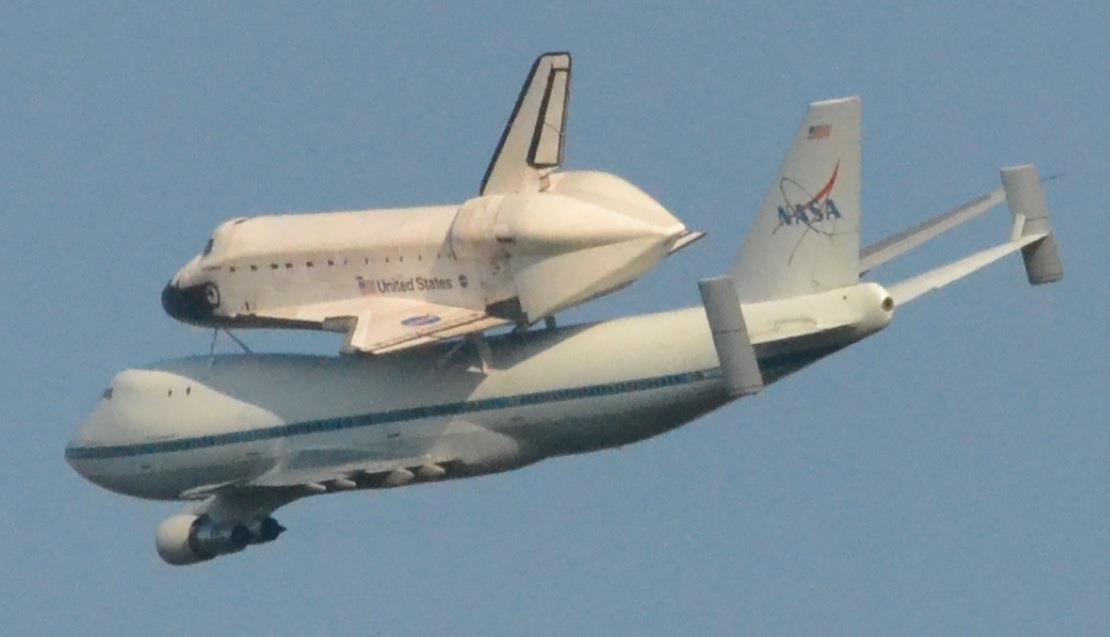
The SCA, Endeavour (OV-105), and chase plane shortly after departing Edwards AFB

I must admit to being a little mystified that NASA hasn’t chosen to fly over and salute Rocketdyne today. Every main engine that powered every Shuttle flight into orbit was designed, manufactured, and assembled primarily at the Canoga Avenue campus. I know they couldn’t fly over every place where components were made in the country, but they’re flying over the freaking Hollywood sign and Universal Studios! Rocketdyne’s campus is just a few miles to the Northwest of those locations. How hard would it have been?

I have often lamented the fact that Rocketdyne never saw fit to advertise itself much. Whenever there was a launch of an Atlas or Delta vehicle, the vehicle manufacturers and integrators always had their names and logos prominently displayed. I am willing to bet very few people in this country even recognize the name Rocketdyne. Do they know every American Astronaut (other than those who’ve flown on Russian missions) was lifted into space by a Rocketdyne engine? I doubt it.

Mercury, Gemini, Apollo. All those flights were powered by Rocketdyne engines. The Lunar Excursion Module (LEM) was powered off the Moon’s surface by a Rocketdyne engine. The Space Shuttle Orbiters would never have made it to LEO were it not for the Space Shuttle Main Engines. The SRBs (Solid Rocket Boosters – or Motors, SRMs) only burned for 126 seconds before separation from the vehicle stack. The Main Engines continued burning for approximately six more minutes, depending on the mission. The SSME was – and still is, as far as I’m aware – the only reusable and fully throttleable rocket engine ever designed and flown.

Anyway, today marks what for me is a very sad day. It should be sad for all of us, IMO. This is the final flight (albeit strapped to the back of the SCA, a specially modified 747) of the last of the Orbiter Vehicles that served us for well over two decades and, unfortunately, we currently have nothing to replace it. The ISS is still on orbit, but we now have to hitchhike there aboard Russian rockets. There’s really no way to tell how long it will be before we return to space.

It also reminds me that I was put out to pasture, though nobody’s suggested ensconcing me in a museum 🙂 I didn’t realize how much retirement would affect me. I’ve enjoyed having time to be with my children, who are eight and eleven. I’ve also enjoyed working at building a modest service business supplying social media marketing for small businesses. However, in this economy that has turned out to not be a very useful business model and, once again, I find I must reinvent myself. Today I’ve decided to wallow a bit in my grief. Grief for the symbolic end of the Shuttle program, on which I labored for over two decades and grief for the symbolic end of my usefulness as a human being, which is what retirement sometimes feels like.

Rocketdyne Logo

The Original Rocketdyne Logo

One more thing. In my opinion Rocketdyne deserves better. I know people whose entire lives were dedicated to the space program. They worked tirelessly; lived and breathed the concept of space travel and exploration. And those engines played a major role in putting Endeavour (OV-105) on orbit. Just sayin’.


Good Bye Endeavour

Endeavour (OV-105)

Endeavour flying over Stennis Space Center on her way to Los Angeles

Space Shuttle Endeavor (OV-105) is on the way to her new job at the California Science Center. She is scheduled to arrive at LAX on Friday after completing a flyover of several landmarks, including The Griffith Park Observatory and Disneyland (Disneyland?). I’m conflicted over whether I should drive to Griffith Park or, perhaps, to Malibu – where she is also scheduled to fly over. Parking could be a real pain.

As a young man I used to go to LAX, park in the lot of the Proud Bird Restaurant, and walk down Aviation Blvd. to the East end of the runway. I could stand there and watch the planes come in for a landing, at times only a hundred feet or so over my head. It was exhilarating. Maybe I’ll do that.

I spent nearly half of my adult life working on the Space Shuttle Main Engine (SSME) program at Rocketdyne in Canoga Park, California. I grew up in the San Fernando Valley and have vivid memories of the many rocket engine tests that took place in the Santa Susana Mountains to the West of where I lived. I would go outside and could hear the roar and see the sky lit up. Those engines helped take us to the Moon. It was magical.

I came to Rocketdyne quite by accident and, even after I started as a temp (what they called a “Job Shopper”) working on the return to flight efforts after the Challenger disaster, it took a while for me to realize I could work there. Not being an Engineer, it somehow never crossed my mind that I could find a place in the organization. I ended up spending 21 years there – in a 23 year period (taking two years off in an ill-fated attempt to return to a family business) – working primarily on the SSME program. Endeavour was the replacement vehicle for Challenger, so I am somewhat emotionally tied to her. Half my working life!

In 2010, I accepted an offer of early retirement, which was made to those of us who were sixty years of age or over because the Shuttle Program was coming to an end. It wasn’t quite over, and I had always joked that I would be the one to turn the lights out at the end. I expected to work until I dropped dead, maybe around 80. It didn’t work out that way. I still miss being a part of the space program and seeing Endeavour on her last flight is dredging up a flood of emotion I’m not sure I’m prepared to handle.

Thankfully, she’ll be very close by and I can take my two girls to see her. Fare thee well, Endeavour. I am eternally thankful I was able to play a small role in your voyages. I wish you well on this, your final mission.

Photo Courtesy of Mike Malinzak


Our Grief Was NOT a Cry for WAR

Our Grief

We Weren’t Looking for Retribution; Merely Justice

I can’t let today pass without saying a word or two about the tragic events of eleven years ago today. Unlike most Americans, at least as far as I can tell, these events were tragic to me for many reasons. I am somewhat ashamed to note the many people who mourn the loss of those nearly 3000 who died as a direct result of the attacks of 9/11, yet seem to show little or no feeling toward the loss of lives that came about as a result of the actions the United States and other nations took in seeking vengeance for these attacks.

I don’t wish in any way to denigrate the innocent victims of these heinous acts, and I am especially mindful of the hundreds of first-responders who lost their lives performing the duties they were sworn to in order that others might live. I respect and honor their devotion and the sacrifices they made – and continue to make – on our behalf.

Nevertheless, in the wake of this tragedy we engaged in two wars – at least one of which was entirely unnecessary – and was, indeed, a war of aggression based on lies and deception.

While it’s impossible to get an accurate figure, an average assessment of the number of Iraqi civilian deaths — based on numerous estimates — indicates there have been at least several hundred thousand civilian deaths alone (cite). There have been over 4400 U.S. deaths and 32,000 wounded in Iraq (cite). The death toll in Afghanistan is so muddled it’s difficult to determine how many civilians have been killed as the result of our activities and how many might have been killed by the Taliban regardless. There have been over 3,000 coalition deaths (over 2,000 U.S.) and approximately 24,000 wounded. In addition, over 14,000 Afghan security forces personnel have been killed (cite).

Our nation’s cry is “Never Forget”, and we won’t. We shouldn’t. However, we must always be mindful that great injustice was done in the name of those who perished on this day. We should also continue asking questions not only about why we did what we did, but what actually happened on 9/11. I doubt the truth has yet to be told. Keep your eyes and ears open.