I came across this poem a couple of years ago and shared it on Facebook. It just came back as one of my “memories” and I was a bit stunned to realize I had completely forgotten about it. I’ve thought about (and written about on occasion) death, though it was always kind of philosophical; musings on mortality if you will.
However, given the health issues I’ve experienced in the past nearly nine months, I’ve begun thinking seriously about the inevitable. The other day I made my oldest daughter my legacy contact for everything Apple and I have a lot more to get done in the next few months. I also told my wife I thought this poem would be nice to read if there’s any kind of memorial service conducted after my death. I’m also including the introductory comments from the person who originally shared it.
Since it is an optional reading in the Reform Jewish liturgy recited before the Mourner’s Kaddish, and I was raised as a Conservative Jew, I’d never encountered it. I find it breathtaking. Hope it resonates.
”Every once in a while, a poem or song is so well constructed, so clearly conveys the authors meaning and is so precisely expressive that it becomes something of an anthem. The poem below, Epitaph, was written by Merrit Malloy and as one of those poems, has become a staple of funeral and memorial services…for good reason.”
Epitaph – By Merrit Malloy
When I die Give what’s left of me away To children And old men that wait to die.
And if you need to cry, Cry for your brother Walking the street beside you. And when you need me, Put your arms Around anyone And give them What you need to give to me.
I want to leave you something, Something better Than words Or sounds.
Look for me In the people I’ve known Or loved, And if you cannot give me away, At least let me live on in your eyes And not your mind.
You can love me most By letting Hands touch hands, By letting bodies touch bodies, And by letting go Of children That need to be free.
Love doesn’t die, People do. So, when all that’s left of me Is love, Give me away. I’ll see you at home In the earth.
NB –Before reading the following post, please be advised it was written with the assistance of Chat-GPT, after a couple of iterations of my asking for a blog post on the subject, and clarifying what it was I looked for. It’s not quite my style, but it gets across the subject I was having a bit of difficulty honing in on. I would likely have been more wordy, so I’m content to leave this up in order to get the gist of my thinking out in the world.
As a former Jew who is now an atheist, I have always been interested in social justice issues and have been an advocate for antiracism for many years. However, it was only in the last few years that I learned about Juneteenth, an American holiday that celebrates the emancipation of African American slaves. As I learned more about Juneteenth, I couldn’t help but compare it to Passover, a Jewish holiday that commemorates the liberation of the Israelites from slavery in ancient Egypt.
At first glance, it may seem like Passover and Juneteenth have little in common. Passover is a religious holiday that is celebrated by Jews all over the world, while Juneteenth is a secular holiday that is primarily celebrated in the United States. Passover has a long history that dates back thousands of years, while Juneteenth is a relatively new holiday that has only been officially recognized by the federal government since 2021. However, as I delved deeper into the meanings behind these holidays, I found that they share a common theme of liberation and freedom.
For Jews, the story of the Exodus is a powerful reminder of the importance of freedom and the need to fight against oppression. The story tells of how Moses led the Israelites out of slavery in Egypt and into freedom, and it is a story that has been retold for thousands of years. During the holiday of Passover, Jews gather with family and friends to retell the story of the Exodus, eat traditional foods such as matzah and bitter herbs, and participate in symbolic rituals such as the Seder. The holiday is a time to reflect on the past and to look towards a brighter future.
Juneteenth, on the other hand, celebrates the emancipation of African American slaves. The holiday commemorates June 19, 1865, which is the day that Union General Gordon Granger arrived in Galveston, Texas, and announced that all slaves in Texas were free. This announcement came two and a half years after the Emancipation Proclamation was signed, and it marked the end of slavery in the United States. Juneteenth is a time to celebrate the end of slavery and the beginning of a new era of freedom and equality.
Despite the differences between Passover and Juneteenth, they share a common theme of liberation and freedom. Both holidays celebrate the idea of breaking free from oppression and moving towards a brighter future. They also emphasize the importance of family and community. For Jews, the Seder is a time to retell the story of the Exodus and to pass down traditions and values to the next generation. For African Americans, Juneteenth is a time to celebrate their heritage and to remember the struggles and sacrifices of their ancestors.
As an antiracist, I find it important to acknowledge the intersectionality of these two holidays. While Passover and Juneteenth have different histories and meanings, they both symbolize the fight for freedom and justice. As a former Jew, I feel that it is important to recognize the role that the Jewish community played in the civil rights movement. Many Jews were active participants in the struggle for civil rights and worked alongside African Americans to fight against racism and discrimination. As an atheist, I believe that it is important to recognize and celebrate the diversity of cultures and traditions in our society.
In conclusion, Passover and Juneteenth are two holidays that may appear to be very different on the surface, but they share a common theme of liberation and freedom. As someone who is no longer practicing Judaism but is committed to antiracism, I find it important to acknowledge the intersectionality of these two holidays and to celebrate the diversity of cultures and traditions in our society. Passover and Juneteenth are reminders that the struggle for justice and equality is ongoing and that we must continue to fight against oppression in all its forms.
I need to tell you something. Although I’m a Boomer, I have a great deal of love and respect for your generation. One reason for this is because my wife and I became first-time, adoptive parents late in life and both our daughters are in your generation. They’re currently 19 and 21. But also because you embody the ideals and aspirations I had as a young man back in the sixties and seventies, when I was an anti-war and social justice activist.
In 1966, shortly after I graduated High School and when the war in Vietnam was heating up, with US troops heading toward an eventual commitment of half a million troops, I joined the US Navy, following in the footsteps of my father and thinking it was the right thing to do. I was medically discharged after only a month and 23 days, but that’s another story that has nothing to do with the point I’m making herein.
When the police rioted in Century City in the summer of 1967, and I was running a small snack shop in downtown L.A., I remember thinking that the police were probably right and dealt with the demonstrators appropriately. I was soon to discover just how mistaken I was. So began my transformation into an anti-war activist.
Without going into too much detail, I’ll just note that I spent about five years organizing, demonstrating/marching, and doing security for others who were protesting the war in Vietnam and racism and sexism in our society. It was pretty much full-time and I only worked to make enough money to allow me to survive while being an activist. My work culminated in a two-month trip in the Spring of 1973 to Cuba, as a guest of the Cuban Government, with the Venceremos Brigade. Shortly after my return I began law school. I was burned out and wanted to get on with my life, which I had neglected in favor of my activism.
I remained politically active to some degree, but not like I had been, especially since U.S. involvement in Vietnam had effectively ended in January of 1973. It was with great dismay that I realized my generation was not merely withdrawing from the activism the war had ignited, but was actively moving to political and economic conservatism. In 1976, the year I graduated with my J.D., Jackson Browne released his album “The Pretender”. The title song contained the following lyrics, which resonated deeply with me. The still do.
I want to know what became of the changes We waited for love to bring Were they only the fitful dreams Of some greater awakening?
The Pretender – Jackson Browne
Just recently, as I was refreshing my memory about the lyrics and what he was saying, I came across a video where he explains a bit about the genesis and meaning of the song. In describing who the pretender is, he says, ” … it’s anybody that’s sort of lost sight of some of their dreams…and is going through the motions and trying to make a stab at a certain way of life that he sees other people succeeding at. So maybe it’s a lot of people of a certain generation who sort of embraced a very material lifestyle in place of dreams that they had that sort of disintegrated at some point.”
I don’t mean to imply, by the title I’ve chosen for this post, that it’s your generation’s responsibility to achieve what my generation so spectacularly (at least apparently) failed at, but rather my hope as I approach the end of my life to see a truly better society, a better world, and a rise in decency and mutual respect among the people of this planet. I’m hoping you will prove to be the generation that achieves that “greater awakening”.
I included this video in a blog post I wrote over ten years ago. In the process of compiling some of those posts, along with other material, into a memoir I encountered it again. It still moves me to tears.
I am an atheist, but I do feel a certain sense of spirituality in the universe. Not the supernatural kind, but one borne of the reality we are all (as Joni sang) stardust. We are all made of the same stuff and on a quantum level we are deeply connected. I believe this to be true though most of us are blissfully and completely unaware of it.
I was fortunate to be a member of the Space Shuttle Main Engine program for nearly a quarter century, beginning a year after Challenger was destroyed and ending a year before the Shuttle program was forever cancelled.
I have long considered it our “sacred” duty to get off this planet and establish not merely a scientific presence, but also a cultural presence in case we suffer an extinction level event. In that way we might assure ourselves the human race will continue, rebuild, and flourish. It’s a big reason I was able to stay so long on that program despite the insufferable bureaucracy of the three corporations who owned Rocketdyne during my tenure: Rockwell Int’l.; The Boeing Co.; and Pratt & Whitney/United Technologies.
Came across this wonderful, reasonably short article about death and dying, a subject I have long been interested in; especially as I’m winding down my 75th year here.
Preparing for death by making peace with it.
Excerpt:
First, you withdraw.
Life shrinks down to the size of your home, then to your bedroom, then to your bed—sometimes over months, but more often over weeks.
Old joys stop having the same pull.
You eat less, drink less. Have less interest in speaking.
As your body’s systems start shutting down, you have less and less energy.
You sleep more and more throughout the day.
You start to slip in and out of consciousness and unconsciousness for longer periods of time.
Staying alive starts to feel like staying awake when you are very immensely tired.
At some point, you can’t hold on any longer.
And then you die.
A calm fall into a cosmic sleep.
But that’s not even the half of it.
Read more (much more) by clicking on the link below:
Alan Watts suggested that belief is stagnant and unyielding to change, whereas faith is open and accepting of what is. I often say I have faith the universe is unfolding just fine no matter what any of us believe. We are such insignificant little tubes of matter, constantly ingesting, inhaling, and absorbing stuff that isn’t us, then exhaling, excreting, and sloughing off that which once was us but is now something else. We exist for a moment, comparatively so brief as to be virtually non-existent to anything but our pitiful little selves. Calm down and enjoy the ride. As Jim Morrison said, “No one gets out of here alive.”
Recently, I came across an article on Axios.com with the title “America is losing its religion.” In the article, the author (Bryan Walsh) opens by saying, “New surveys show Americans’ membership in communities of worship has declined sharply in recent years, with less than 50% of the country belonging to a church, synagogue or mosque.” He goes on to list the Gallup poll results he rests his premise on and concludes with the following thought: “But conventional religion’s power is on the wane, and it might take a miracle for that to change.”
I can’t say I’m bothered in the slightest about this trend. Being an atheist, I have a somewhat dim view of organized religion, especially when it’s used to deny rights to others based on some cockamamie interpretation of words that were uttered thousands of years ago, when life, economics, and society in general were much different than they are now.
On the other hand, I understand, and empathize with, the desire for community that religious observance brings to those who practice, but belief in a supreme intelligence/being that literally created us and watches over us is, IMO, patently absurd. I find acknowledging and appreciating how physics, chemistry, and cosmology (in other words, science) explain where we came from far more compelling and beautiful than anything to be found in any religious text I’ve read. And to be clear, my general attitude toward religion is, “what you believe is none of my business … until you start telling me or others we are required to believe as you do or we’re damned.”
So … here’s the deal. If attending services at a “house of worship” is your cup of tea, and you attend with others who share your beliefs or your faith (however you define those) I say “zei gezunt,” which is Yiddish for “be well” or, as I tend to think of it, and somewhat more ironically “more power to you.” Just keep it to yourself. Don’t bring it to the commons. Enjoy it for you and those who you consider part of your fellowship, but don’t for one minute suppose you can tell others this is the ONLY way. Do that and you will richly deserve to be shunned by others who don’t feel as you do.
PS – You can read the article, which contains a bit more detail than I’m including, here.
I came across this graphic on Facebook today. It struck me, as the concept has struck me for decades, that this should be part of any truly progressive agenda. I have been an “ordained minister” since the late sixties. I have performed approximately 50 weddings, which was the main reason I became “ordained.” It wasn’t to lead a congregation or even to claim tax breaks, and I claim no special relationship with the universe. In fact, I am an atheist.
One thing I learned early on, though, is the State considers a church a business, an organization, with the lone exception (that I can think of) of taxation. By not taxing religious organizations the State is giving them an unfair advantage over any other type of business and is, in my less-than-humble opinion, violating the 1st Amendment to the Constitution by—in fact—making a law respecting an establishment of religion.
Even more egregious is the situation depicted here. Mega churches are nothing more than income sources for their “leaders.” I believe this is Joel Osteen’s “flock,” as well as his home. Why does a follower of Jesus, a poor itinerant, and one who purports to be a spiritual leader, need a house that could probably accommodate the entire village of ancient Bethlehem? If nothing else, these huge and “Osteen”tacious abominations should pay their fair share of taxes on the revenue they get from their “flock.”
There are two books that have had an inordinately large effect on my life. One of them I can remember large parts of and can offer reasonably intelligent analyses of what the author was trying to say. The other one I can hardly recall one thing about, save for the overall message the author was trying to convey. The reason these two come to mind—and have affected me so greatly—is that they’re closely related conceptually and their messages resonate and overlap, at least as I see them and I’m pretty sure that’s about all that counts.
The first of these two books is “The Wisdom of Insecurity,” by Alan Watts. The second of these books is “Passages,” by Gail Sheehy. Without going into any detail, I’ll merely note that each of them speaks to the inexorable rhythms of life and the inevitability of change. They also offer a philosophical approach to dealing with those rhythms and changes that offers one a chance to navigate them with as little friction and pain as possible. I read the book by Watts in my early twenties. At the time I was head-over-heels in love with a young woman, but the relationship wasn’t to be and she broke up with me. I was young, impetuous, and prone to bouts of manic happiness and deep, dark depression.
I somehow found the book; how is lost in the mists of my slowly calcifying synapses. Perhaps it found me. It wasn’t the first book by Watts I had read. That was “The Book: On the Taboo Against Knowing Who You Are,” which I found quite helpful in navigating the changes I was going through shortly after high school, a short stint in the U.S. Navy, a slightly longer stint as a businessman, a somewhat shorter flirtation with Haight-Ashbury in the Summer of ’67, and a steadily growing antipathy toward the nation’s conduct of the war in Vietnam.
Another thing I thought interesting, and somewhat serendipitous, was the juxtaposition of the release of two Beatles records that coincided with my reading of these two books by Watts. When I read “The Book: …” the Beatles had just released “Everybody’s Got Something to Hide Except Me and My Monkey.” The book was kind of my introduction to Zen Buddhist philosophy and the concept of the dialectic as represented by the Yin-Yang symbol. I was beginning to understand the duality of nature and the essence of all forms of evolution. Some of the lyrics in the song point out that same kind of duality, e.g. “Your inside is out when your outside is in. Your outside is in when your inside is out,” and the title of the song seemed to resonate with Watts’s message that we needed to get in touch with our actual selves (our “inner monkey”) if we were to understand our place in the world and not color it with the expectations of others.
The second song, which coincided with my reading of “The Wisdom of Insecurity,” was “Let It Be” which, as I understood it was the message Watts was conveying about the reality there is no such thing as security, that all things are in a constant state of flux, and the only way to (paradoxically, a very Zen concept) achieve any semblance of security—no matter how ephemeral and transient it may be—was to stop seeking it.
Sheehy’s book, as I recall it (and I only read it once, whereas I’ve read The Wisdom of Insecurity three times) had a similar message, but it was less on a spiritual and philosophical level and more on a practical, everyday “here’s what to expect” kind of approach. She wrote of what she referred to as the “passages” we all go through as we age and gain experience, while everything around us is changing and moving forward.
The reason I’m bringing this up is because I have reached a point (a passage, if you will) in my life where I find far too many reasons to prepare myself for the end. I’ll be 74 years old three months from today. Next month I will be fourteen years older than my father was when he died. I realize I’ve reached an age where I could, conceivably, live another decade or more, but I could also drop dead tomorrow. There sure are a lot of people doing it who are younger than me.
Throw in the reality that I still have two daughters at home, one of whom is a Junior in High School, the other a Freshman in College, and it’s producing a bit of a tension arc that I’m struggling to put behind me.
I’m not trying to be morose, or overly glum. I am, however, attempting to approach what is definitely the autumn (more likely winter) of my life with as much spring in my step and lightness in my heart as I can muster. I need to understand what this passage I’m experiencing is all about (Sheehy did not write about septuagenarians) and position myself to take advantage of all it might offer. If there’s one thing I have learned over the years, it’s that there’s always benefit to be found in nearly every situation, at least until there isn’t (if that makes sense.) I am an optimist, so even when I get deeply (perhaps depressingly) introspective, I usually snap out of it within a few hours or now more than a day or two.
I’m looking forward to what the next stage of my life is going to offer. Both of my girls will be on their own in a few years, God (or whoever’s in charge of these things) willing and the creek don’t rise, and Linda and I will be on our own again. The difference for us, is we won’t be in our early to late fifties, like most people who have their families when they’re no older than their thirties. As long as I know my girls are doing well and taking care of themselves (which is an entirely different story) I’ll be OK with whatever happens. I will say this. Not having to help with high school homework will be deeply enjoyable!
As some of you know, I am working on a couple of memoirs, as well as my autobiography. In doing so, I’ve been slowly going through all my photos and files, culling out items that I can use in these documents. While I am hopeful I can make a little money from these efforts, I’m hardly depending on it and I am mostly working to preserve my memories (which are beginning to fade) for myself and my family, especially my two daughters.
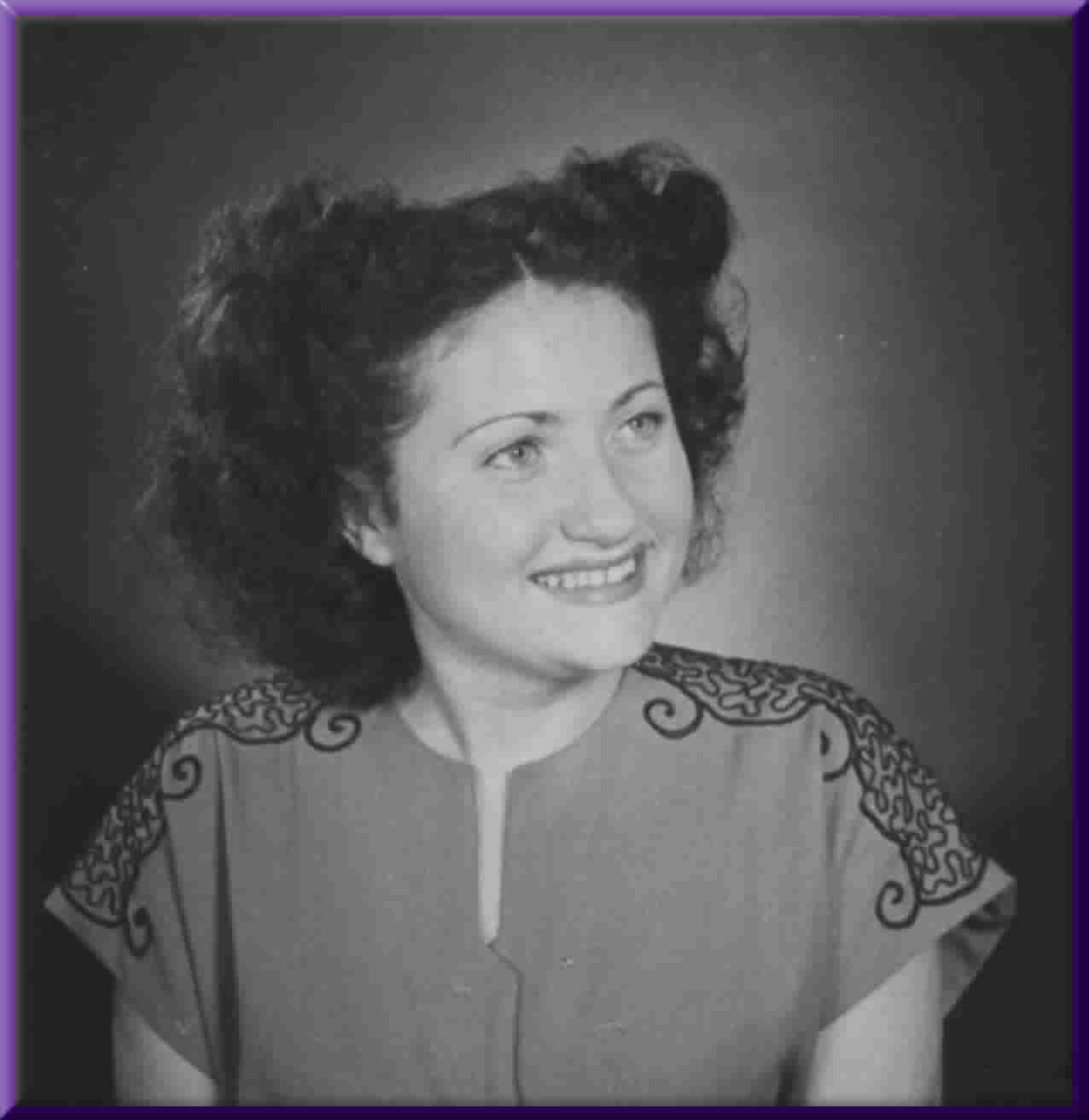
My mother at about 18 years old. This is one of the pics I used for her funeral program
What follows is the funeral service I wrote and gave for my mother, who passed away over 15 years ago. I had not seen this since I recited it that day. It was a little difficult to read. Although I did not give it attribution at the time (I may have mentioned it, though I didn’t write it in the “script”) the first paragraph is the section “On Death,” from The Prophet, by Khalil Gibran.
I am not a religious man, though I believe I am spiritual and have a deep and awesome relationship with the universe as I understand it. I did attend four years of Hebrew school and am bar mitzvah. I am also an ordained minister in the First Church of God The Father. I claim no special connection to, or knowledge of, the infinite and received this ordination in order that I might perform weddings. I have performed around 50 of them. I’ve also done a couple of funerals, but they were all in the family. Here’s the text from one of those funerals:
You would know the secret of death. But how shall you find it unless you seek it in the heart of life? If you would indeed behold the spirit of death, open your heart wide unto the body of life. For what is it to die but to stand naked in the wind and to melt into the sun? And what is it to cease breathing, but to free the breath form its restless tides, that it may rise and expand and seek God unencumbered? Only when you drink from the river of silence shall you indeed sing. And when you have reached the mountain top, then you shall begin to climb. And when the earth shall claim your limbs, then shall you truly dance.
On behalf of Steve and Angela, their daughters Blaire and Erika, Brooke and Paul, Myself and Linda, and our daughter, Aimee, thank you for being here today to honor the memory of our Mother and Grandmother. I must tell you I agonized for a while over using the word “welcome” in the little pamphlet we prepared for this day. I thought “Is it appropriate to welcome someone to what is a sad and solemn occasion?”
However, the more I thought about it, the more it became apparent to me this is a very intimate moment for our family and, in reality, you are more than welcome to be here to share it with us. We are profoundly grateful for the love and respect you show to our mother’s memory by being here today. What I really want to do, what I’m going to try to do, is speak not so much of my mother, though I will certainly be speaking from my experience of her, but more of our mother. I want to try and express just a little of what she meant to all of us.
How does one sum up a life of over 80 years in just a few sentences, especially when ours is so intimately intertwined with hers?
First of all, let me say this will not be a traditional Jewish funeral service, though there are two prayers that will be recited in honor of our mother. For our family, you might say Judaism was like the sun; you didn’t have to believe in it for it to shine its warmth on you. Our early life was filled with a great deal of Jewish observance and celebration. We belonged to the Sun Valley Jewish Community Center, later to be renamed Valley Beth Israel. Mom was, for a time, quite active in the Temple’s Sisterhood and counted many of her friends among the congregation.
She was not, however, (at least in her later years) an observant Jew. Despite this, she held on to her Judaism in certain, small ways which had meaning for her and which gave her comfort. For instance, she always had a mezuzah on her door, and she couldn’t help but utter a Kenahorah (Kayn Aynhoreh – no evil eye), whenever she remarked on something good that happened.
When my maternal grandmother died, my mother took it very hard. I had never seen her so upset and the memory of her distress stayed with me – at times haunted me – for years. As I grew older and began to contemplate the mysteries of life, I felt a need to know that she would grow old gracefully and that she would, when the moment came, be able to peacefully accept and embrace her death.
When the opportunity would arise, I would find a way to discuss death with her, so I could figure out how she saw things. We also talked at times about religion. When I asked her if she believed in God or an afterlife, she always responded with one of two expressions. Either she would just shrug her shoulders and give me a look, as if to say “I don’t know. Who does”, or she would wave her hand dismissively, as if to say “Why bother thinking about those things?”
Most people elicit, at one time or another, virtually every emotion we are capable of, and our mom was no exception. She could be endearing, warm, and comforting, and she could also be tough, uncompromising, and infuriating.
All of us have weaknesses and frailties. If I had to point to one of my mother’s, it would have to have been her bluntness; her habit of telling you exactly what was on her mind. Sometimes, it was hard to remember she was also a kind and thoughtful person, who was capable of giving a great deal of her self for others.
In many ways, her habit of speaking her mind was not necessarily a bad thing. When Stephen’s Sister-in-law, Erika, called the other night to express her condolences, she told me of a conversation she had with her father, Wence, shortly after he had learned of Mom’s death. She said he told her something she had not thought of before. That the one thing you always knew for certain with Annette was where she stood. That she was incapable of artifice or, in many ways, subtlety. What you saw was, indeed, what you got. I believe this honesty of hers caused her a great deal of heartache over the years, but it is, I also believe, a good quality; not a bad quality.
As I think back on my mother’s life, I can point to what I consider to be three wonderful achievements she is responsible for. They are, of course, my brother, my sister, and (I like to think) myself.
To be sure, none of us have become famous or wealthy. But I think each of us has become what she had hoped for us; responsible adults, striving to fulfill our dreams and accomplishing many of the goals we’ve set for ourselves. We couldn’t have reached the point we are at today without the values she instilled in us. We couldn’t have become the people we are today without the lessons we learned through her guidance.
She brought us into this world, and it is now our solemn duty to help her leave it. Her passing marks the end of a large chapter in our family’s life. I, personally, do not believe in an afterlife; at least not in any way that I have learned from the many religions I have studied. Nevertheless, I do believe in some sort of continuation of her life, if only in the hearts and memories of those who she loved, and who loved her. I came across a wonderful quote, which I think concisely states my feelings about this.
Death does not extinguish the light; it merely puts out the lamp because dawn has arrived.
The Lord is my Shepherd; I shall not want. He maketh me to lie down in green pastures: He leadeth me beside the still waters. He restoreth my soul: He leadeth me in the paths of righteousness for His name’ sake. Yea, though I walk through the valley of the shadow of death, I will fear no evil: For thou art with me; Thy rod and thy staff, they comfort me. Thou preparest a table before me in the presence of mine enemies; Thou annointest my head with oil; My cup runneth over. Surely goodness and mercy shall follow me all the days of my life, and I will dwell in the House of the Lord forever.
Mitzvot (plural of mitzvah) – Shoveling dirt on the casket. This mitzvah is known as hesed shel emet, true loving kindness. Traditionally each person at the graveside, beginning with those closest to the deceased, puts three shovels of dirt into the grave – replacing the shovel in the earth for the next mourner, rather than handing the shovel directly, to avoid “passing on death.” This mitzvah demonstrates our continuing concern for the deceased as we make sure their final journey is completed – some say we should use the back of the shovel to signify this is different than any other use we make of the shovel.






 Systems Savvy