Category Archives: Business

Entrepreneurs Have Lost a Good Friend

I just received the stunning and very sad news that John Dilts, Founder and President of the Maverick Angels, has passed away. I knew he had been sick for a while, but I don’t think even he knew he was this sick. The cause of his tragic death has not yet been announced. I had known John for about four years, since he first brought a Maverick Angels’ Arena Meeting to Pratt & Whitney Rocketdyne’s Leadership & Learning Center. There, amidst the rocket engine hardware of some 50 years of America’s space program, I got my first taste of what Angel Investing and, really, entrepreneurship was all about. My relationship with John continued, albeit on a very low-key basis, until a few months ago, when I accepted an early severance package from PWR.

John was one of the first people I contacted and he was eager to find a way I could fit into what the Maverick Angels were doing. Whether or not we were destined to become colleagues or partners, I will now never know. However, John was both an inspiration and a guiding light and I will miss his presence. My condolences go out to his family, his colleagues, and his numerous friends. Here is a link to a memorial page his organization has stood up in his memory. Rest in Peace, John.


How Much of a Relationship Do Your Customers Actually Want? (via I’m Not Actually a Geek)

Hutch makes some really good points here about how to gauge the nature of the relationship your customers want with you. He brings in Clayton Christiansen’s advice regarding the necessity to understand the correct mix of social, functional, and emotional dimensions of every customers requirements (whether wanted or needed).

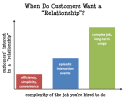
I found a statement by Hutch about SAP rather interesting, because he uses them as an example of the complexity requiring a deep, attached relationship (the green bar of the graph associated with this cross-post), and goes on to say “Customers want a relationship with SAP. Frankly, they need it.” I found the last sentence rather interesting because it does sound a bit like a marriage of convenience gone bad; morphing into more of a marriage of necessity; impossible to extricate from regardless of how uncomfortable, expensive, and counter-productive it might be.

I understand my opinion here may be somewhat colored by my experience at my last company, where an acquisition by an organization that was tied to SAP resulted in a forced switch that was very uncomfortable (maybe even painful) for quite a lot of people and which didn’t necessarily solve any problems other than those perceived by corporate IT and procurement folks.

If you’re interested in CRM or SCRM, and what some thoughts are with respect to whether or not customers actually want a relationship with you or your organization, this is a good read.

How Much of a Relationship Do Your Customers Actually Want? On the Harvard Business Review, Matt Dixon and Lara Ponomareff wrote a piece that caught my eye, Why Your Customers Don't Want to Talk to You. Consumers increasingly prefer self-service, and the authors speculate: Maybe customers are shifting toward self service because they don't want a relationship with companies. While this secular trend could be explained away as just a change in consumers' channel preferences, skeptics might argue that custo … Read More

via I'm Not Actually a Geek


Going Viral in the Enterprise (via Controlled Falling)

I’m not yet all that familiar with cross-posting, but I want to share a post by my friend, Mark Eggleston. This is a great post and it reminded me of my own experience, which I noted in a comment to this post. BTW – I really like the graphic, as I frequently refer to my work in adopting enterprise collaboration tools at my last job as evocative of Sisyphus’s labors. Enjoy!

Going Viral in the Enterprise How can you tell if you are succeeding in your campaign for adoption of new enterprise collaboration tools?  How can you define that magic moment when you can breathe a sigh of relief and say "That's the tipping point."  Metrics maybe?  Sure, they are important, but for me it's when some idea goes viral on your network.  Viral, like the Old Spice guy or the BPGlobalPR twitter feed, but inside your organization.          More about that in a minut … Read More

via Controlled Falling


Everything There is to Know about the Enterprise 2.0 Conference – Boston 2010

Yeah, I know. Pretty pretentious title there, eh? But, seriously, I’m not referring to what I know about the conference. I’m just going to provide you with one link I think contains just about everything you can access (after the fact) that was recorded or written about it. This includes an extensive tweetlog and recordings of quite a few of the keynotes.

Caveat Emptor – the link is to a wiki I’m pretty sure anyone can read. If you wish to add something to it, however, I believe you will have to sign up with PBWorks (it’s free). The wiki is courtesy of @jimworth, but it has been co-created by numerous people who were at the conference or were following the live tweeting and blogging that was going on at the time.

My hat’s off to Jim and everyone who took the time to share their thoughts about, or any work they created from, the Enterprise 2.0 Conference held this past June, 2010. I had an amazing time and contributed my cent and a half as well. Next up, I’m going to share my thoughts about some things I think are missing, or not discussed enough, in the conversation about E2.0, including more on its relationship with KM and what it has and doesn’t have in common with Web 2.0.

So . . . before I forget, here’s the link. Hope you enjoy.


The Zen of PowerPoint, Facebook and Twitter

Click here to view original post

Stolen from Guy Kawasaki (to illustrate his post I'm pointing to)

Well . . . this is a bit upsetting, not the least because it serves to point out my level of ignorance when it comes to using Posterous :). I emailed this link to Posterous from Osfoora (a Twitter app) on my iPad, hoping it would post as a picture along with the link. That didn’t happen so I’m editing this post to include what I can to make it a bit better. Live and learn, eh?

< —- Click on the pic to read the article I forwarded from Guy Kawasaki.

Sent via Osfoora

Rick Ladd

Chief Emergineer
Rick Ladd & Associates
Sent from my iPad (then edited in WordPress; is this what I want?)

Enterprise 2.0 Conference Still Percolating in my Head

Almost three weeks ago I had the good fortune to attend my first Enterprise 2.0 Conference, in Boston, MA. My attendance, though highly sought after (by me) for over a year (as a representative of the company I just “retired” from), was still somewhat serendipitous, and relied heavily on the generosity of Susan Scrupski, the Executive Director (or, as she is wont to describe herself, the Concierge) of the 2.0 Adoption Council.

This was a new experience for me and I had no knowledge of what, exactly, had taken place in previous conferences – other than what generally takes place at most conferences. There was one major difference this event was going to mean for me. For well over a year I had been accumulating “friends” through my use of social media, especially Twitter. I had never met any of these people face-to-face, yet many of them I felt I knew reasonably well and, in fact, quite a few of them I believed I could trust – at least as much as I would trust any colleague I had ever worked with. Now I was going to have the opportunity to spend some face-time with them, rubbing (and bending . . . over numerous beers) elbows for over three days.

A little over a month ago I posted about the possibilities of building relationships virtually and argued that face-to-face meetings, though valuable, were not necessarily the sine qua non of meaningful, trusting, and useful relationships. I was primarily addressing business relationships and, especially, the necessary interplay of colleagues – peripherally touching on sales and arms-length transactions as well.

I haven’t changed my thoughts on the value of virtual contact and the ability to have meaningful relationships without meeting face-to-face . . . but I surely had to think deeply about it after Boston. Here’s why. My first full day there I made it to the all-day Black-Belt practitioner’s session a couple hours late, due to several snafus I experienced with Boston’s public transportation. I entered a room with no less than 60 or 70 people seated at round tables facing the front of the room as a presentation was being given. I managed to find an empty space, sat down, and immediately started searching the room for “familiar” faces. I soon spotted two people I had become “friends” with via their blogs and, especially, through numerous conversations we’d had on Twitter – Luis Suarez and Mary Abraham (@elsau and @VMaryAbraham, respectively).

I was able to recognize both of them despite the fact I had never seen them in person and only knew what they looked like based on their avatars. This in and of itself should be a good indication of authenticity, now that I think about it. At any rate, as soon as there was a break I moved over to their table and was greeted with the warmth and enthusiasm reserved for old friends. I’m not sure I can adequately express the feelings I had right then and, frankly, it’s taken me this long to sort out my feelings and what I think I learned from the entire experience. I’m not quite certain I’ve processed it all yet, but I’m finally able to complete enough of my thoughts to get a blog out.

Later that evening, after the day’s conference activities were completed, Luis, Mary, and I sat in M. J. O’Connor’s (in the hotel where the conference was taking place) drinking Blue Moons, getting to know each other a bit better, and sorting through the day’s experience. I know that Luis has been to many of these conferences and, as one of the most vocal and prolific proponents I know of in favor of social media, he’s no doubt met many people over the years he had previously only know through virtual media. I don’t think it was the same for Mary and I know it wasn’t the same for me. This was the first time I had come face-to-face with people I had grown to know through Twitter, blogging, Facebook, etc. It was truly a wondrous experience.

Seriously, I’m still not entirely over the whole thing. Consider this. It was the first time in my life I attended a conference for my own benefit. Previously, I attended numerous conferences, but always as an employee of Rocketdyne (in all its incarnations during my career there). Before that, I was in small businesses and I don’t recall ever attending any conferences, so no experience on that level. Now let me bring this back to what I think I learned from this particular level of the experience.

It is possible to conduct business and to build a solid, trusting relationship with people you have never met. It is, however, far preferable to have some kind of face-to-face meeting at some point in time in order to solidify the relationship. Of course, now that I’ve written these words I realize I haven’t communicated with either Luis or Mary since returning to Southern California from Boston. Then again, it’s only been three weeks (almost) since the conference began and, given the intensity of the experience, I don’t suppose that’s so out of the ordinary. I took a week out of my life to attend and had a lot of catching up to do once I returned. Couple that with the death of my last (and favorite) uncle a week ago, I suppose it makes sense.

Oops! I’ve managed to digress, so let me return to my last thought. I believe people who wish to work together virtually can enhance the quality of their relationships by having at least occasional in-person meetings with their colleagues. However, I don’t think it’s a matter of the ability to experience body language, eye contact, etc. so many people assert as the most important aspects of human connection, as much as it’s just the informal, off-hand, and emergent conversations and interactions that can only happen during the course of an afternoon or evening spent together. This should include, if possible, sharing a meal or sitting in a pub and bending elbows over a pint or three of some good beer, ale, etc.

As I said, I haven’t entirely processed how I feel about this or what I think I’ve learned, but I’ve waited long enough to write something down about the experience. I plan on posting at least twice more on what I got out of the conference. My next post will be more of a compilation of the many posts others far more knowledgeable than me have written since the conference was over. Following that, I intend on discussing an issue of Enterprise 2.0 I think is missing from the equation; namely some of the design principles of Web 2.0 I think E2.0 should be emulating and that I don’t see at present. Stay tuned.


Enterprise 2.0 Through The Eyes of a Friend

I have been a KM practitioner for over a decade, and one of the principal reasons we have given for using KM principles is the need to keep from reinventing the wheel. So, in that spirit, rather than write my impressions of the Enterprise 2.0 Black Belt Workshop here at the Enterprise 2.0 Conference in Boston, I’m merely going to point to the blog of my friend @VMaryAbraham, since she has taken copious notes and already put them online.

This will make up for the fact that I accidentally set my alarm for 6:51 pm (most of my timepieces are set to 24 hr time) and got about an hour later than I had planned, coupled with a public transport nightmare, that had me over two hours late to today’s inaugural session.

So without further ado, here’s the link to Mary’s (award-winning, I might add) blog – Above and Beyond KM – http://aboveandbeyondkm.com/2010/06/learn-from-the-e2-0-vanguard-part-3.html

P.S. – unfortunately, WordPress does not fully support the iPad yet, and publishing a blog is a bit problematic. One problem; I can’t make the URL to Mary’s blog an actual hyperlink. I’ll have to fix that as soon as I have access to a regular computer. In the meantime, if you want to read Mary’s notes you’ll have to copy and paste the URL into your browser. Sorry about that.


Look Out Boston, Here I Come

Along with a couple hundred (?) of my best virtual friends, I’ll be in Boston next week for the Enterprise 2.0 Conference. Last Friday I treated myself – for my 63rd birthday – to a new Apple 64Gb, 3G iPad and I’m taking it with instead of my laptop.

At the very least, I expect it will provide me with enough entertainment to keep me occupied on the plane both ways, as well as give me something to do with my time if (God forbid) I should at any time get bored.

As someone who has been constrained to use the technology that was given to me by the company I worked for, and generally only had the same kind of technology at home (inasmuch as my personal life has always been so intertwined with my professional life), this has been a real treat. Additionally, I’ve not had an iPhone so I’m not used to having so many apps available and, this is really fun, I haven’t had a touch screen . . . ever.

I’m going to do what I can to both tweet and blog from the conference, but I expect to spend a lot of time with the carbon-based representations of the many people I have only gotten to know virtually over the past few years. I’m truly excited; no mean feat for a guy like me.


Do I Really Have to Look at Your Ugly Mug?

My Babies

No Rights Reserved. So There!!

I had a great lunch with two former colleagues (and continuing friends) at a superb Korean restaurant today; one I never would have gone to on my own merely because it was in a location I just wouldn’t have thought of stopping to eat in. Then again, for many years I haven’t been the type of person who goes out much for lunch. I used to bring my lunch and eat at my desk and continue screwing arou . . . er . . . working. So, during the conversation we got to talking about one of my favorite subject, which is how important is face-to-face contact . . . really?

Lots of people I know insist face-to-face meetings are, hands down, the best way to conduct meetings. They believe the numerous signals that can’t be communicated virtually are so important to understanding and communication that without them too much is lost. To them, conducting meetings virtually is not useful enough to justify engaging in often. To some, it is of no value at all unless it includes a voice connection (at the least) as well. I’m not sure I agree with them. Actually, I don’t agree with them at all. I am in the opposite camp.

Now, don’t get me wrong. I’m all in favor of face-to-face meetings. After all, you can’t go out drinking together if you aren’t actually together. Nevertheless, in today’s environment and, perhaps, regardless of how much the economic situation improves, travel is expensive in all kinds of ways. There’s the money spent on the travel and lodging itself. There’s the lost productivity while stuck in airports or overcoming jet lag. There’s the societal costs associated with the resources used to fly jets, drive cars, etc, etc. There’s being away from one’s family and the pressure that brings. There’s the cost of bringing souvenirs home for your kids that will often as not end up under the couch within a couple of days, not to be seen for a while (and surely not missed).

I just don’t buy the argument that being able to read facial expressions and body language are all that important. Perhaps when negotiating a complex contract, where there’s a bit of gamesmanship going on, it’s absolutely necessary. However, in the kinds of arms-length transactions that make up the bulk of the activity people travel to conduct, we can usually presume a desire to achieve the same, or similar, results – can’t we? I have a lot of relationships these days with people I have never met in person. I’ve seen still pictures (mostly avatars), but nothing else of them. Frankly, I don’t even know for sure it’s what they look like. Yet, there are ways in which trust is attained; built up in thin, seemingly tenuous layers of  engagement; in the sharing of innocuous details of one’s activities and interests, etc. Some of my “virtual” friends I feel closer to than I do to many of my “analog” friends.

This I attribute to the richness of communication that generally emerges with the proper use of a good social system. For instance, Twitter allows me to engage with people on several different continents. Over time, I know (and I can reasonably confirm it to be true) where they work, what they do, what they like, and – especially – what they think about things I like to think about. Over time I can determine whether or not they keep their word; that is, how trustworthy they are. In communication and collaboration, nothing is more valuable in my opinion than trust.

I want to repeat my position here. I am not suggesting meeting people in person is not valuable or that we can do away with it. I do believe, however, if we found ourselves in a situation where we needed to work with someone we just wouldn’t have the opportunity to sit in the same room with . . . it wouldn’t be all that terrible. I’m going to Boston next month to attend the Enterprise 2.0 Conference. Frankly, my main reason for going is to meet – in person – at least a dozen people I have been interacting with for various periods of time who I have grown to trust and respect. I wasn’t going to go, despite my desire to meet up with these new friends. Fortunately, one of them (@ITSinsider, aka Susan Scrupski) made me an offer I just couldn’t refuse. Had I not been able to attend in person I still would have continued my relationships with these friends, and I believe they would have grown and improved.

So. I kind of hope I’ve gored someone’s ox. Otherwise, why do I reveal myself this way? Who’s going to join the fray? Virtually speaking.


Older People Aren’t as Dumb as you Think, Kid

Whenever most people talk about technology and people my age, it amazes me how many assume we can’t set the time on a VCR (remember those?) or that our view of IM is that it’s a tool primarily useful for young teenagers to plot their escape from under their parents’ watchful eyes. Perhaps, as a generalization this is somewhat true, but it’s not really a correct depiction of how we more “mature” folks use and view technology. The reality is far more complex.

As someone who struggled for well over two decades to bring the latest technology into a large, ponderous, and eminently cautious aerospace company, I have encountered all types of people, from foot draggers (lots of them) to early (and enthusiastic) adopters. Obviously, my favorite is the latter but the challenge really presents itself in the former. One thing I found is that things aren’t always as they seem either.

For instance, I was working with a person who was the Director of a newly formed organization. He was nearing the end of his career, which had been very successful. He was a wonderful person; friendly, helpful, and full of joy and excitement for his job and the work of others. He was very supportive of using newer technology yet, despite continuous efforts to engage him in instant message conversations (our offices were quite a ways apart), he never responded to me. Frustrating!

One day I happened to be in his office to talk with him for a while. As I was sitting there he was composing an email. It was then I realized why he wouldn’t answer my IM communication attempts. He used what an old friend of mine used the call the “search and destroy” method of typing; what most call “hunt and peck”. Carrying on an IM conversation for him would be like talking with a very bad stutter and it just didn’t leave him with a warm fuzzy, so he did the best thing for him. He opted out.

So be careful how you categorize or pigeonhole people. This very successful individual had spent a long career doing just fine without IM. As much as I believe it was a superior tool for communication and that it served to enhance our ability to share (I sometimes now think of it as a stunted form of micro-blogging) information and knowledge, virtually all of his career had proceeded rather nicely without it. I knew I had to accept this and make adjustments.

He retired within a year and I, for one, was very sorry to see him go. Keep in mind there are many more wonderful people in your organizations like him – to one degree or another. Don’t shortchange them or your company by selling them short just because they don’t see the use of technology exactly like you do.