Category Archives: Professional

Posting in Another Location

I just posted to Content Management Connection, where I have become a member. I tried to set it up so this blog, Systems Savvy, was connected to CMC, but I wasn’t sure if I had done it correctly. Based on my Google Reader, I actually was successful. However, it’s a one-way street, so I though I would put a link here to the post.

It’s entitled “Knowledge Management Ain’t Actually Going Anywhere“.


It’s Getting Chilly, or How I’m Planning on Doing Some Cold-Calling

Well, I’ve finally decided to go out in earnest and get some clients. I don’t think I’ve mentioned much (if anything) about what I had hoped to do with my life after leaving Rocketdyne and, frankly, it was a bit amorphous in my mind for some time as well. I keep looking for ways in which the knowledge I’ve gained over the years can be put to good use for others. I’m beginning to see some fairly clear outlines of just how I might be able to do that. It isn’t all about “clients” either.

Today I met with the Principal of my youngest daughter’s school, Sycamore Elementary in Simi Valley; on Friday I am meeting with the Principal of my other daughter’s school, Vista Elementary also in Simi. I decided a while back I wanted to see if I could bring something to the table that might improve the educational system . . . some small but significant contribution I might offer that would take advantage of my Knowledge Management, Social Networking/Computing experience, as well as my overall skill set acquired from well over four decades of business experience.

Today’s meeting was a bit of serendipity, actually. I take my children to school every morning, dropping the older one off first, then dropping my youngest off on the way back home. Today I also walked the youngest in and watched her play a bit before class started. I then went into the office to talk to the Principal. My intent was to have essentially the same conversation I had with the Principal at Vista. After all, it resulted in an appointment to delve further into the issues. All that I could have asked for. I discovered today was the one day out of only a few in which she has set aside some time to have coffee and a chat with whichever parents happened to show up. Lucky for me!

Double lucky . . . the President of the PTA was there as well. She was very interested in what I suggested which, btw, was that I learn how they do “business” with an eye toward discovering ways they can take advantage of new tools, services, and techniques that might relieve them of any pain they’re experiencing. I know they’re experiencing it. You can’t be paying attention and think the schools and their ancillary organizations aren’t suffering from any number of headaches and problems which would improve the educational experience for students, teachers, parents, and administrators alike if they could be even partially solved.

So that’s what I offered to give to both schools. I have suggested I can afford to put in at least four hours a month per school and I am both willing and eager to do so. I plan on taking the same attitude to commercial and industrial establishments as well. I believe there are lots of ways in which social computing can be put to good use for small, medium, and large businesses. I also believe there are a lot of people out there who are holding themselves out as Social Media “Experts”. I am not doing that. I’m merely saying I think I can help – first and foremost – understand what kinds of problems any particular organization has that they want to address. Only then can they even think about what tool, service, process, or technique might serve to do so.

In order to drum up business that will actually make me income, I have developed my first piece of “Collateral” to leave behind after visiting the organizations I offer my services to. Anyone who is following me on Twitter, is my friend in Facebook, is connected with me through LinkedIn, reads this blog, or connects with me in any one of numerous other ways probably knows I’ve shared a few presentations I’ve given in the past – when I was still an employee of Rocketdyne. They can be found on Slideshare, here. I want to share what I’ve done in creating a brochure to leave behind after an initial conversation with a prospect. My intent is not for this brochure to introduce me, but rather to serve as a reminder of the conversation I expect to have with whoever it is I’m discussing these things with.

I know, from my years of pursuing knowledge in this field, through literally hundreds of conversations on the subject, and from following and reading the work of dozens of people whose intelligence I have nothing but the deepest respect for, that almost anyone; every process; every business; yes, even every institution – up to, and including, those of government at any level – could be improved through the intelligent application of social computing. Of course, every situation is different. The City Council here in Simi surely would neither benefit from, nor require, the same thing that might benefit the U.S. Senate, and a small restaurant surely doesn’t require the same capabilities that a large manufacturing or distribution enterprise would find helpful.

So . . . that’s my story, and I’m sticking to it. Below are the two pages of a three-fold brochure I’m going to get printed shortly and start bringing with me as I literally knock on doors. It’s not the only method I intend on using, but it gets me out of the house, and that’s a good thing. I’d be interested in any feedback those of you who might read this post have to offer. I’m a work in process. Aren’t we all?

Click on Image for Larger (Legible) Version

Click on Image for Larger (Legible) Version

P.S. – Special thanks are due to my friend Luis Suarez, who was kind enough to look over what I had done and make some very useful observations and suggestions. Thank you so much, Luis. You are one of those people whose presence I value dearly.


But, I Thought you Meant . . .

Why do some people seem to think that language can be treated like art . . . always? Language, of course, frequently finds its expression in art; witness poetry, musical lyrics, etc., but it is not – by itself – a pure art form. Language exists, surely in the context of business and economics, philosophy and religion, as an endeavor of some precision in communication and, dare I use the word, collaboration. People can’t share what they know, or work together on a project for which the outcome they seek is collectively desirous, without having the ability to communicate absent misunderstanding or, at the very least, with a minimum of misunderstanding.

Mathematics is a form of language. Imagine if someone argued that an expression might be used sort of willy-nilly, depending on how one was feeling at the moment. Imagine someone saying, when confronted with the misuse of a mathematical expression, “well, you know what I meant.” Yet, people do this with language all the time. As for my real peeve here, it seems I am often accused of being too “lawyer-like” when I insist on the accurate use of words. I just don’t understand this. Why do people think dictionaries or thesauri exist? For entertainment purposes?

I am not here talking about the incorrect use of “to”, “too”, and “two” or “your” and “you’re”, maddening as those may be. I am more interested in the misuse of synonyms, especially when there are crucial differences – subtle as they may be – between one word and another. There’s a reason those words exists and it is directly related to those differences. For instance, let’s look at the differences between the words “lucky”, “privileged”, and “promising” – all three synonymous according to Merriam-Webster online. “Lucky” means “having good luck”. It could easily refer to one instance, however small the result, or an entire lifetime. “Privileged” means having or enjoying a special capability or position based either on happenstance (which would be lucky) or through hard work and successful endeavors. “Promising” means one might become privileged at some point, or successful, but there is no guarantee and it looks to the future, not some result of the past. Both “privileged” and “promising” may contain elements of luck, but they aren’t proper substitutes for the word “lucky”. They are somewhat imprecise synonyms for it.

Now, lest I be accused of a level of curmudgeonliness far exceeding that I am actually guilty of, I am merely attempting to point out how cavalier some can be with language and, when they’re called on it, how adamant I have found some to be in defending what is, in my opinion, an indefensible position. Call me a member of the language police if you will, but I like as much precision in my discussions as possible.

PS – This post was “incited” by a conversation with my wife; a conversation that recurs every now and again 🙂 Do you think I’m too sensitive? Do you think I used the word “incited” improperly; that I should have used “instigated” or “stimulated” or maybe even “inspired”? Just wondering.


Companies Should Pay Attention to Former Employees

Today, my friend (I consider anyone I can have a decent, useful conversation with on Twitter a friend) Kelly Kraft (@KRCraft) posted a blog asking the question “How much and what kind of a relationship do you have with former employees?” Her experience is much different than mine, though I think her conclusions make perfect sense for any organization contemplating doing as her former org did. The question is not – in my mind and, I think, in Kelly’s – whether or not to have ongoing relationships. Rather, it is what kind of relationships, and how extensive (or intimate), will they be?

KM Through Social Media

Over eight years ago, in response to a perceived need for understanding (and locating) the depth and breadth of expertise at Rocketdyne Propulsion and Power (then a division of Boeing’s Space & Communications business unit – whew!), I did some research and found a company that provided a tool that was a predecessor of many of the social media offerings of today. In my opinion they were way ahead of their time. The tool was called AskMe Enterprise and it offered profiles, Q&A threads (including forwarding, commenting by others, feedback as to quality and efficacy), file and link uploading and sharing, etc. We later had a customization added that provided for posting Lessons Learned and, about four years ago, they added a blogging capability.

Unfortunately, the larger percentage of our workforce (especially leadership and management) adamantly refused to participate. This wasn’t unexpected, however disappointing it may have been, and we continued to use the tool and work on building acceptance by example and through its ever-growing usefulness. Many years ago, I suggested we consider finding a way to stay connected with the constant flood of experienced Engineers, and others, who were retiring or moving on to other pastures. Inasmuch as we had a history of bringing some of those people back as contractors, I thought we might be able to find an inexpensive method of remaining in contact with the majority who didn’t return.

The proposal I thought made the  most sense was to provide retirees with a secure connection to our network and, as compensation for being available for questioning within AskMe, perhaps covering the cost of their Internet connection. I don’t believe anyone took this idea seriously and it essentially died on the vine.

Intellectual Property & Communication

Now here comes Kelly, pointing out how valuable her former organization, Exact Software, has found maintaining continuous relationships with former employees can be. She also addresses the issue of what kinds of relationships make sense for different types of employees. Specifically, she notes the difference between outward-facing, highly engaged employees as opposed to somewhat sequestered, internally focused employees like many of the Engineers I worked with. She is, however, right on the mark suggesting each of them can be successfully engaged.

For instance, she points to her own experience as an Implementation Consultant for Exact and the work she did in the years since, noting there probably isn’t a great deal the enterprise needs to do to engage her. She is also, I believe, referring in part to her use of Twitter to stay in touch. My Engineer friends are not terribly likely to engage using Twitter (or blogging, or anything else that public for that matter). There are considerations of IP protection they can’t afford to ignore, as well as governmental restrictions like ITAR that, contravened, will surely bite them in the ol’ behind. This can be, and has been, quite expensive and can be done somewhat inadvertently.

Nevertheless, as Kelly points out, there are numerous ways in which an enterprise can stay in touch, and engaged, with its former employees. In Rocketdyne’s case – especially – with those employees who have retired and are not working for another company. She is also pointing out, in my opinion, that CRM (or SCRM) isn’t just for sales and marketing to dun customers with either. Social Media have many applications. Many of them are useful for engaging with an enterprise’s customers, but many are also valuable for engaging one’s own employees (current and former). The lunches and parties sound pretty cool, too.

PS – The article she credits me with was a few paragraphs of my opinion of what Hutch Carpenter (VP of Product at Spigit@bhc3) had to say at his blog, “I’m Not Actually a Geek” (which he really is, but you didn’t hear that from me).


Entrepreneurs Have Lost a Good Friend

I just received the stunning and very sad news that John Dilts, Founder and President of the Maverick Angels, has passed away. I knew he had been sick for a while, but I don’t think even he knew he was this sick. The cause of his tragic death has not yet been announced. I had known John for about four years, since he first brought a Maverick Angels’ Arena Meeting to Pratt & Whitney Rocketdyne’s Leadership & Learning Center. There, amidst the rocket engine hardware of some 50 years of America’s space program, I got my first taste of what Angel Investing and, really, entrepreneurship was all about. My relationship with John continued, albeit on a very low-key basis, until a few months ago, when I accepted an early severance package from PWR.

John was one of the first people I contacted and he was eager to find a way I could fit into what the Maverick Angels were doing. Whether or not we were destined to become colleagues or partners, I will now never know. However, John was both an inspiration and a guiding light and I will miss his presence. My condolences go out to his family, his colleagues, and his numerous friends. Here is a link to a memorial page his organization has stood up in his memory. Rest in Peace, John.


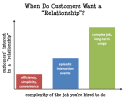
How Much of a Relationship Do Your Customers Actually Want? (via I’m Not Actually a Geek)

Hutch makes some really good points here about how to gauge the nature of the relationship your customers want with you. He brings in Clayton Christiansen’s advice regarding the necessity to understand the correct mix of social, functional, and emotional dimensions of every customers requirements (whether wanted or needed).

I found a statement by Hutch about SAP rather interesting, because he uses them as an example of the complexity requiring a deep, attached relationship (the green bar of the graph associated with this cross-post), and goes on to say “Customers want a relationship with SAP. Frankly, they need it.” I found the last sentence rather interesting because it does sound a bit like a marriage of convenience gone bad; morphing into more of a marriage of necessity; impossible to extricate from regardless of how uncomfortable, expensive, and counter-productive it might be.

I understand my opinion here may be somewhat colored by my experience at my last company, where an acquisition by an organization that was tied to SAP resulted in a forced switch that was very uncomfortable (maybe even painful) for quite a lot of people and which didn’t necessarily solve any problems other than those perceived by corporate IT and procurement folks.

If you’re interested in CRM or SCRM, and what some thoughts are with respect to whether or not customers actually want a relationship with you or your organization, this is a good read.

How Much of a Relationship Do Your Customers Actually Want? On the Harvard Business Review, Matt Dixon and Lara Ponomareff wrote a piece that caught my eye, Why Your Customers Don't Want to Talk to You. Consumers increasingly prefer self-service, and the authors speculate: Maybe customers are shifting toward self service because they don't want a relationship with companies. While this secular trend could be explained away as just a change in consumers' channel preferences, skeptics might argue that custo … Read More

via I'm Not Actually a Geek


Going Viral in the Enterprise (via Controlled Falling)

I’m not yet all that familiar with cross-posting, but I want to share a post by my friend, Mark Eggleston. This is a great post and it reminded me of my own experience, which I noted in a comment to this post. BTW – I really like the graphic, as I frequently refer to my work in adopting enterprise collaboration tools at my last job as evocative of Sisyphus’s labors. Enjoy!

Going Viral in the Enterprise How can you tell if you are succeeding in your campaign for adoption of new enterprise collaboration tools?  How can you define that magic moment when you can breathe a sigh of relief and say "That's the tipping point."  Metrics maybe?  Sure, they are important, but for me it's when some idea goes viral on your network.  Viral, like the Old Spice guy or the BPGlobalPR twitter feed, but inside your organization.          More about that in a minut … Read More

via Controlled Falling


Everything There is to Know about the Enterprise 2.0 Conference – Boston 2010

Yeah, I know. Pretty pretentious title there, eh? But, seriously, I’m not referring to what I know about the conference. I’m just going to provide you with one link I think contains just about everything you can access (after the fact) that was recorded or written about it. This includes an extensive tweetlog and recordings of quite a few of the keynotes.

Caveat Emptor – the link is to a wiki I’m pretty sure anyone can read. If you wish to add something to it, however, I believe you will have to sign up with PBWorks (it’s free). The wiki is courtesy of @jimworth, but it has been co-created by numerous people who were at the conference or were following the live tweeting and blogging that was going on at the time.

My hat’s off to Jim and everyone who took the time to share their thoughts about, or any work they created from, the Enterprise 2.0 Conference held this past June, 2010. I had an amazing time and contributed my cent and a half as well. Next up, I’m going to share my thoughts about some things I think are missing, or not discussed enough, in the conversation about E2.0, including more on its relationship with KM and what it has and doesn’t have in common with Web 2.0.

So . . . before I forget, here’s the link. Hope you enjoy.


Double Rainbows Herald Crazy Synchronicity

Wow!!

My Serendipitous Rainbows

Right after (and I do mean “right” after) I had shown some friends the “Crazy Double Rainbow Guy” YouTube video, it started to rain a bit. This, in and of itself, was quite unusual here in Southern California. July is not known for a month in which you can expect any kind of precipitation. As I was grilling some hot dogs and hamburgers for the kids and our adult guests (it was my oldest daughter’s 9th birthday party), I looked up and saw a somewhat faint, yet quite distinct, double rainbow.

It was neither as full, nor as bright, as the one that had inspired such ecstasy in the crazy guy, but there it was . . . as was my Flip videocam. I had put on an apron (something I seldom do) and stashed the camera in one of the pockets. I managed to record a bit of my crazy-ass double rainbow and a few comments from my perspective as well. I offer them here not as any especially entertaining video, but rather as a way to memorialize the event, which I considered quite serendipitous and synchronicitous (if I may be so bold as to make up my own words :)) Here’s the link. Hope anyone who sees it (undoubtedly not many will) finds it at least a bit entertaining.


The Zen of PowerPoint, Facebook and Twitter

Click here to view original post

Stolen from Guy Kawasaki (to illustrate his post I'm pointing to)

Well . . . this is a bit upsetting, not the least because it serves to point out my level of ignorance when it comes to using Posterous :). I emailed this link to Posterous from Osfoora (a Twitter app) on my iPad, hoping it would post as a picture along with the link. That didn’t happen so I’m editing this post to include what I can to make it a bit better. Live and learn, eh?

< —- Click on the pic to read the article I forwarded from Guy Kawasaki.

Sent via Osfoora

Rick Ladd

Chief Emergineer
Rick Ladd & Associates
Sent from my iPad (then edited in WordPress; is this what I want?)