Companies Should Pay Attention to Former Employees

Today, my friend (I consider anyone I can have a decent, useful conversation with on Twitter a friend) Kelly Kraft (@KRCraft) posted a blog asking the question “How much and what kind of a relationship do you have with former employees?” Her experience is much different than mine, though I think her conclusions make perfect sense for any organization contemplating doing as her former org did. The question is not – in my mind and, I think, in Kelly’s – whether or not to have ongoing relationships. Rather, it is what kind of relationships, and how extensive (or intimate), will they be?

KM Through Social Media

Over eight years ago, in response to a perceived need for understanding (and locating) the depth and breadth of expertise at Rocketdyne Propulsion and Power (then a division of Boeing’s Space & Communications business unit – whew!), I did some research and found a company that provided a tool that was a predecessor of many of the social media offerings of today. In my opinion they were way ahead of their time. The tool was called AskMe Enterprise and it offered profiles, Q&A threads (including forwarding, commenting by others, feedback as to quality and efficacy), file and link uploading and sharing, etc. We later had a customization added that provided for posting Lessons Learned and, about four years ago, they added a blogging capability.

Unfortunately, the larger percentage of our workforce (especially leadership and management) adamantly refused to participate. This wasn’t unexpected, however disappointing it may have been, and we continued to use the tool and work on building acceptance by example and through its ever-growing usefulness. Many years ago, I suggested we consider finding a way to stay connected with the constant flood of experienced Engineers, and others, who were retiring or moving on to other pastures. Inasmuch as we had a history of bringing some of those people back as contractors, I thought we might be able to find an inexpensive method of remaining in contact with the majority who didn’t return.

The proposal I thought made theĀ  most sense was to provide retirees with a secure connection to our network and, as compensation for being available for questioning within AskMe, perhaps covering the cost of their Internet connection. I don’t believe anyone took this idea seriously and it essentially died on the vine.

Intellectual Property & Communication

Now here comes Kelly, pointing out how valuable her former organization, Exact Software, has found maintaining continuous relationships with former employees can be. She also addresses the issue of what kinds of relationships make sense for different types of employees. Specifically, she notes the difference between outward-facing, highly engaged employees as opposed to somewhat sequestered, internally focused employees like many of the Engineers I worked with. She is, however, right on the mark suggesting each of them can be successfully engaged.

For instance, she points to her own experience as an Implementation Consultant for Exact and the work she did in the years since, noting there probably isn’t a great deal the enterprise needs to do to engage her. She is also, I believe, referring in part to her use of Twitter to stay in touch. My Engineer friends are not terribly likely to engage using Twitter (or blogging, or anything else that public for that matter). There are considerations of IP protection they can’t afford to ignore, as well as governmental restrictions like ITAR that, contravened, will surely bite them in the ol’ behind. This can be, and has been, quite expensive and can be done somewhat inadvertently.

Nevertheless, as Kelly points out, there are numerous ways in which an enterprise can stay in touch, and engaged, with its former employees. In Rocketdyne’s case – especially – with those employees who have retired and are not working for another company. She is also pointing out, in my opinion, that CRM (or SCRM) isn’t just for sales and marketing to dun customers with either. Social Media have many applications. Many of them are useful for engaging with an enterprise’s customers, but many are also valuable for engaging one’s own employees (current and former). The lunches and parties sound pretty cool, too.

PS – The article she credits me with was a few paragraphs of my opinion of what Hutch Carpenter (VP of Product at Spigit@bhc3) had to say at his blog, “I’m Not Actually a Geek” (which he really is, but you didn’t hear that from me).


Entrepreneurs Have Lost a Good Friend

I just received the stunning and very sad news that John Dilts, Founder and President of the Maverick Angels, has passed away. I knew he had been sick for a while, but I don’t think even he knew he was this sick. The cause of his tragic death has not yet been announced. I had known John for about four years, since he first brought a Maverick Angels’ Arena Meeting to Pratt & Whitney Rocketdyne’s Leadership & Learning Center. There, amidst the rocket engine hardware of some 50 years of America’s space program, I got my first taste of what Angel Investing and, really, entrepreneurship was all about. My relationship with John continued, albeit on a very low-key basis, until a few months ago, when I accepted an early severance package from PWR.

John was one of the first people I contacted and he was eager to find a way I could fit into what the Maverick Angels were doing. Whether or not we were destined to become colleagues or partners, I will now never know. However, John was both an inspiration and a guiding light and I will miss his presence. My condolences go out to his family, his colleagues, and his numerous friends. Here is a link to a memorial page his organization has stood up in his memory. Rest in Peace, John.


How Much of a Relationship Do Your Customers Actually Want? (via I’m Not Actually a Geek)

Hutch makes some really good points here about how to gauge the nature of the relationship your customers want with you. He brings in Clayton Christiansen’s advice regarding the necessity to understand the correct mix of social, functional, and emotional dimensions of every customers requirements (whether wanted or needed).

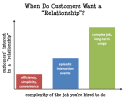
I found a statement by Hutch about SAP rather interesting, because he uses them as an example of the complexity requiring a deep, attached relationship (the green bar of the graph associated with this cross-post), and goes on to say “Customers want a relationship with SAP. Frankly, they need it.” I found the last sentence rather interesting because it does sound a bit like a marriage of convenience gone bad; morphing into more of a marriage of necessity; impossible to extricate from regardless of how uncomfortable, expensive, and counter-productive it might be.

I understand my opinion here may be somewhat colored by my experience at my last company, where an acquisition by an organization that was tied to SAP resulted in a forced switch that was very uncomfortable (maybe even painful) for quite a lot of people and which didn’t necessarily solve any problems other than those perceived by corporate IT and procurement folks.

If you’re interested in CRM or SCRM, and what some thoughts are with respect to whether or not customers actually want a relationship with you or your organization, this is a good read.

How Much of a Relationship Do Your Customers Actually Want? On the Harvard Business Review, Matt Dixon and Lara Ponomareff wrote a piece that caught my eye, Why Your Customers Don't Want to Talk to You. Consumers increasingly prefer self-service, and the authors speculate: Maybe customers are shifting toward self service because they don't want a relationship with companies. While this secular trend could be explained away as just a change in consumers' channel preferences, skeptics might argue that custo … Read More

via I'm Not Actually a Geek


Going Viral in the Enterprise (via Controlled Falling)

I’m not yet all that familiar with cross-posting, but I want to share a post by my friend, Mark Eggleston. This is a great post and it reminded me of my own experience, which I noted in a comment to this post. BTW – I really like the graphic, as I frequently refer to my work in adopting enterprise collaboration tools at my last job as evocative of Sisyphus’s labors. Enjoy!

Going Viral in the Enterprise How can you tell if you are succeeding in your campaign forĀ adoptionĀ of new enterpriseĀ collaboration tools?Ā  How can you defineĀ that magic moment whenĀ you can breatheĀ a sigh of relief andĀ sayĀ "That's the tipping point."Ā  Metrics maybe?Ā  Sure, they are important,Ā but for meĀ it's when some idea goes viral on your network.Ā  Viral, like the Old Spice guyĀ or the BPGlobalPR twitter feed, but inside your organization.Ā Ā Ā Ā Ā Ā Ā Ā Ā  More about that in a minut … Read More

via Controlled Falling


Everything There is to Know about the Enterprise 2.0 Conference – Boston 2010

Yeah, I know. Pretty pretentious title there, eh? But, seriously, I’m not referring to what I know about the conference. I’m just going to provide you with one link I think contains just about everything you can access (after the fact) that was recorded or written about it. This includes an extensive tweetlog and recordings of quite a few of the keynotes.

Caveat Emptor – the link is to a wiki I’m pretty sure anyone can read. If you wish to add something to it, however, I believe you will have to sign up with PBWorks (it’s free). The wiki is courtesy of @jimworth, but it has been co-created by numerous people who were at the conference or were following the live tweeting and blogging that was going on at the time.

My hat’s off to Jim and everyone who took the time to share their thoughts about, or any work they created from, the Enterprise 2.0 Conference held this past June, 2010. I had an amazing time and contributed my cent and a half as well. Next up, I’m going to share my thoughts about some things I think are missing, or not discussed enough, in the conversation about E2.0, including more on its relationship with KM and what it has and doesn’t have in common with Web 2.0.

So . . . before I forget, here’s the link. Hope you enjoy.


Double Rainbows Herald Crazy Synchronicity

Wow!!

My Serendipitous Rainbows

Right after (and I do mean “right” after) I had shown some friends the “Crazy Double Rainbow Guy” YouTube video, it started to rain a bit. This, in and of itself, was quite unusual here in Southern California. July is not known for a month in which you can expect any kind of precipitation. As I was grilling some hot dogs and hamburgers for the kids and our adult guests (it was my oldest daughter’s 9th birthday party), I looked up and saw a somewhat faint, yet quite distinct, double rainbow.

It was neither as full, nor as bright, as the one that had inspired such ecstasy in the crazy guy, but there it was . . . as was my Flip videocam. I had put on an apron (something I seldom do) and stashed the camera in one of the pockets. I managed to record a bit of my crazy-ass double rainbow and a few comments from my perspective as well. I offer them here not as any especially entertaining video, but rather as a way to memorialize the event, which I considered quite serendipitous and synchronicitous (if I may be so bold as to make up my own words :)) Here’s the link. Hope anyone who sees it (undoubtedly not many will) finds it at least a bit entertaining.


The Zen of PowerPoint, Facebook and Twitter

Click here to view original post

Stolen from Guy Kawasaki (to illustrate his post I'm pointing to)

Well . . . this is a bit upsetting, not the least because it serves to point out my level of ignorance when it comes to using Posterous :). I emailed this link to Posterous from Osfoora (a Twitter app) on my iPad, hoping it would post as a picture along with the link. That didn’t happen so I’m editing this post to include what I can to make it a bit better. Live and learn, eh?

< —- Click on the pic to read the article I forwarded from Guy Kawasaki.

Sent via Osfoora

Rick Ladd

Chief Emergineer
Rick Ladd & Associates
Sent from my iPad (then edited in WordPress; is this what I want?)

Enterprise 2.0 Conference Still Percolating in my Head

Almost three weeks ago I had the good fortune to attend my first Enterprise 2.0 Conference, in Boston, MA. My attendance, though highly sought after (by me) for over a year (as a representative of the company I just “retired” from), was still somewhat serendipitous, and relied heavily on the generosity of Susan Scrupski, the Executive Director (or, as she is wont to describe herself, the Concierge) of the 2.0 Adoption Council.

This was a new experience for me and I had no knowledge of what, exactly, had taken place in previous conferences – other than what generally takes place at most conferences. There was one major difference this event was going to mean for me. For well over a year I had been accumulating “friends” through my use of social media, especially Twitter. I had never met any of these people face-to-face, yet many of them I felt I knew reasonably well and, in fact, quite a few of them I believed I could trust – at least as much as I would trust any colleague I had ever worked with. Now I was going to have the opportunity to spend some face-time with them, rubbing (and bending . . . over numerous beers) elbows for over three days.

A little over a month ago I posted about the possibilities of building relationships virtually and argued that face-to-face meetings, though valuable, were not necessarily the sine qua non of meaningful, trusting, and useful relationships. I was primarily addressing business relationships and, especially, the necessary interplay of colleagues – peripherally touching on sales and arms-length transactions as well.

I haven’t changed my thoughts on the value of virtual contact and the ability to have meaningful relationships without meeting face-to-face . . . but I surely had to think deeply about it after Boston. Here’s why. My first full day there I made it to the all-day Black-Belt practitioner’s session a couple hours late, due to several snafus I experienced with Boston’s public transportation. I entered a room with no less than 60 or 70 people seated at round tables facing the front of the room as a presentation was being given. I managed to find an empty space, sat down, and immediately started searching the room for “familiar” faces. I soon spotted two people I had become “friends” with via their blogs and, especially, through numerous conversations we’d had on Twitter – Luis Suarez and Mary Abraham (@elsau and @VMaryAbraham, respectively).

I was able to recognize both of them despite the fact I had never seen them in person and only knew what they looked like based on their avatars. This in and of itself should be a good indication of authenticity, now that I think about it. At any rate, as soon as there was a break I moved over to their table and was greeted with the warmth and enthusiasm reserved for old friends. I’m not sure I can adequately express the feelings I had right then and, frankly, it’s taken me this long to sort out my feelings and what I think I learned from the entire experience. I’m not quite certain I’ve processed it all yet, but I’m finally able to complete enough of my thoughts to get a blog out.

Later that evening, after the day’s conference activities were completed, Luis, Mary, and I sat in M. J. O’Connor’s (in the hotel where the conference was taking place) drinking Blue Moons, getting to know each other a bit better, and sorting through the day’s experience. I know that Luis has been to many of these conferences and, as one of the most vocal and prolific proponents I know of in favor of social media, he’s no doubt met many people over the years he had previously only know through virtual media. I don’t think it was the same for Mary and I know it wasn’t the same for me. This was the first time I had come face-to-face with people I had grown to know through Twitter, blogging, Facebook, etc. It was truly a wondrous experience.

Seriously, I’m still not entirely over the whole thing. Consider this. It was the first time in my life I attended a conference for my own benefit. Previously, I attended numerous conferences, but always as an employee of Rocketdyne (in all its incarnations during my career there). Before that, I was in small businesses and I don’t recall ever attending any conferences, so no experience on that level. Now let me bring this back to what I think I learned from this particular level of the experience.

It is possible to conduct business and to build a solid, trusting relationship with people you have never met. It is, however, far preferable to have some kind of face-to-face meeting at some point in time in order to solidify the relationship. Of course, now that I’ve written these words I realize I haven’t communicated with either Luis or Mary since returning to Southern California from Boston. Then again, it’s only been three weeks (almost) since the conference began and, given the intensity of the experience, I don’t suppose that’s so out of the ordinary. I took a week out of my life to attend and had a lot of catching up to do once I returned. Couple that with the death of my last (and favorite) uncle a week ago, I suppose it makes sense.

Oops! I’ve managed to digress, so let me return to my last thought. I believe people who wish to work together virtually can enhance the quality of their relationships by having at least occasional in-person meetings with their colleagues. However, I don’t think it’s a matter of the ability to experience body language, eye contact, etc. so many people assert as the most important aspects of human connection, as much as it’s just the informal, off-hand, and emergent conversations and interactions that can only happen during the course of an afternoon or evening spent together. This should include, if possible, sharing a meal or sitting in a pub and bending elbows over a pint or three of some good beer, ale, etc.

As I said, I haven’t entirely processed how I feel about this or what I think I’ve learned, but I’ve waited long enough to write something down about the experience. I plan on posting at least twice more on what I got out of the conference. My next post will be more of a compilation of the many posts others far more knowledgeable than me have written since the conference was over. Following that, I intend on discussing an issue of Enterprise 2.0 I think is missing from the equation; namely some of the design principles of Web 2.0 I think E2.0 should be emulating and that I don’t see at present. Stay tuned.


Love (I mean LOVE) my iPad, but . . .

My new BFFIn the over two decades I worked at Rocketdyne I never had anything near “state-of-the-art” technology available to me. This isn’t surprising. After all, most – if not all – large companies have security issues they must deal with, and by the time they’ve fully tested any hardware or software they’re going to roll out to the enterprise and then support, quite a bit of time necessarily has passed. In a world that changes as rapidly as tech, that pretty much ensures nobody will be using the latest thing.

So, thanks to one of those occasional confluences of events we sometimes refer to as serendipity, after leaving Rocketdyne and as I was getting ready to travel to the Enterprise 2.0 Conference in Boston, MA, I decided to give myself a 63rd birthday present and purchase an iPad. I resolved to take it with me to the conference instead of a laptop, convinced the experience would be worth whatever inconvenience it created. More about that in a moment.

Although I went to the Apple store with the intention of purchasing the 16 gig, wi-fi model, I discovered they didn’t have any. While I was talking to the guy from whom I had purchased our two iMacs, he went to the back of the store to check on availability and discovered someone had canceled their purchase of the 64 gig, 3G model. Well . . . it was my birthday after all and, with very little hesitation, I decided to pull the trigger and spend the extra few hundred dollars. I’m glad I did, especially for the 3G model. I also just got in under the wire for AT&T’s $29.99 per month unlimited plan. Unless they’ve changed (and I’ve not seen it either way) that plan is no longer available for new users.

My plan for the conference was to take my iPad and my Bluetooth keyboard with me. I had already tested and confirmed it worked fine (though I didn’t have a stand for the iPad yet). I was hoping to be able to both live tweet from the sessions, and to blog here as I took some time to reflect. Unfortunately, halfway to the airport I realized I had left the keyboard at home. Now I was constrained to use the built-in, virtual, touchscreen keyboard. The challenges were increasing dramatically. So . . . here’s what I learned so far.

From my perspective, although manageable, the keyboard kind of sucks. It is very sensitive which, for many purposes, is just fine. However, for typing it is what I can only describe as unforgiving. If I don’t hold my hands somewhat rigidly over the keyboard, I am very likely to barely touch a key that isn’t the one I want to touch. For a touch typist this is very annoying. After all, it’s the ability to touch a keyboard that makes it possible to type without looking. Interestingly (and not a little ironically), the graphical representation of the keyboard shows the little nipples on the F and J keys! What’s that all about? They serve no purpose I can discern. Not only can’t you feel them, you can’t touch those keys without invoking them . . . so what’s the point?

The keyboard is also (if I’ve measured and calculated correctly – no guarantee here) approximately 20% smaller than my iMac’s keyboard, measuring from left to right on one set of keys. I’m not even bothering to measure other portions of the several keyboards available, depending on what you’re doing, as the scale is fairly consistent throughout. Let me just say the keyboards need some work, in my opinion. For instance, to get to the hashtag (all important when tweeting from something like a conference and, yes, I know many apps provide the ability to insert hashtags, but you still have to initiate their use) requires two keystrokes just for it to appear, then another to actually use it. This is but one of the combinations I find somewhat cumbersome. I find this unacceptable and I’m hopeful Apple will be able to provide a more useful set of keyboards once they realize how this works. Then again, maybe my experience is not mainstream enough and they just won’t care.

OK, enough of the difficulties. Overall, I had a great experience with my iPad. I used it everywhere; that’s where the 3G capability proved invaluable, even if it is AT&T. (For the record, my wireless experience – which spans well over ten years – is entirely with Verizon, dating back to when it was AirTouch here in California. Although my experience with AT&T is less than a month old, I can read!)

Two examples: On the first day of the conference I was pretty unclear on the best way to get there from my hotel, which was about six miles away in Chelsea. I was able to take the hotel shuttle to the airport, but from there I had to take the Silver Line bus to within walking distance of the Westin Boston Waterfront, my final destination. I got off at the wrong station and was unsure of the best way to get to the hotel. I invoked the maps and charted a pedestrian course to the hotel, holding the iPad flat in front of me and just following the directions it gave me. Worked like a charm.

The TV of my childhood

Small, tall, and Black & White

The second example is more fun and, since the hotel wi-fi wasn’t available, the 3G capability was invaluable. I needed to participate in a telecon and GoToMeeting with two colleagues in Philadelphia and a potential client in Austin.Ā  I went in to M. J. O’Connor’s (an Irish pub in Boston – imagine that!) where the hostesses were kind enough to allow me to sit in a closed area that was reasonably quiet. I called into the telecon and, because I have a Bluetooth earpiece, I was able to lay my BlackBerry down and use it to provide a bit of an angle for the iPad, on which I had logged into the meeting space. As I was sitting there, for a moment I thought back to my childhood of dial telephones, party lines, and tiny black and white television screens in gigantic consoles. I was living the future I once visited in my imagination! I could have done virtually the same with a laptop, but the angle of the iPad made me feel as though I was peering through a kind of wormhole into this amazingly clear and colorful, collaborative space. It was magical.

That’s some of my experience over the last few days. Next up, some of my thoughts about Enterprise 2.0 and the conference, as well as some personal experiences and impressions.


Enterprise 2.0 Through The Eyes of a Friend

I have been a KM practitioner for over a decade, and one of the principal reasons we have given for using KM principles is the need to keep from reinventing the wheel. So, in that spirit, rather than write my impressions of the Enterprise 2.0 Black Belt Workshop here at the Enterprise 2.0 Conference in Boston, I’m merely going to point to the blog of my friend @VMaryAbraham, since she has taken copious notes and already put them online.

This will make up for the fact that I accidentally set my alarm for 6:51 pm (most of my timepieces are set to 24 hr time) and got about an hour later than I had planned, coupled with a public transport nightmare, that had me over two hours late to today’s inaugural session.

So without further ado, here’s the link to Mary’s (award-winning, I might add) blog – Above and Beyond KM – http://aboveandbeyondkm.com/2010/06/learn-from-the-e2-0-vanguard-part-3.html

P.S. – unfortunately, WordPress does not fully support the iPad yet, and publishing a blog is a bit problematic. One problem; I can’t make the URL to Mary’s blog an actual hyperlink. I’ll have to fix that as soon as I have access to a regular computer. In the meantime, if you want to read Mary’s notes you’ll have to copy and paste the URL into your browser. Sorry about that.