
I might blog more with my phone if this keyboard wasn’t so difficult to type with. Guess I’ll keep plugging away in the hope I can get at least as fast as my two thumb/two finger BlackBerry method allowed. Anybody else out there struggling with this issue?
Author Archives: Rick Ladd
About Rick Ladd

Heaven Is Where You Find It?

Where Would You Rather Be?
I just got an email from an organization asking me two questions designed to get my interest in their activities on behalf of preventing any cuts to Social Security. The questions are:
- Do you want to work until you die?
- Do you want to eat cat food in your old age?
I pretty much have a strong opinion on the latter question, though the prescription diet one of our cats requires does smell somewhat inviting at times. I’m afraid, though, the lack of variety would disappoint me.
As far as the first question goes, I don’t have quite as clear cut an answer. I’ve always assumed I would work until I dropped. After all, that’s what all the men in my family did; at least all the real men. I managed to disabuse myself of the notion that was a good thing a long time ago. However, I also retained (and continue to retain) a vestige of whatever work ethic I was raised with.
Here’s the thing. I don’t want to “work” work, that is be forced to report to a job I dislike, working with people I don’t care for, and working for people I don’t respect. That would indeed be Hell-on-Earth. At the same time, I want to be engaged, challenged, and – above all else – relevant until my last breath. I can’t imagine doing otherwise. But that involves doing, which is – strictly speaking – working.
So I guess my answer to the first question is “Yes. I do want to work until I die”. I also want my Social Security to be there for me, so maybe he should have asked the question differently. Then again, maybe there aren’t a lot of people out there who see work the same way I do. How about it?
ADDENDUM (as of 27 February 2012)
It’s been over 15 months since I wrote this, and 21 months since my retirement from PWR. I’ve been looking for work and also looking for interesting things to get involved in. I have yet to be terribly successful at the former, but I can’t honestly say I’ve tried as hard as I could. That’s in part due to my desire to spend as much time as I can being a good father to my two young children. I don’t think there are too many people my age who have young children to raise. All of my friends have been grandparents for at least a decade or so.
To hear some people tell it, you would think organizations should be beating down my door to get someone of my age, with my experience, to help them deal with social business transitions and the imminent retirement of the generation (Baby Boomers) I’m in the vanguard of, age-wise. I’m not convinced. I think our cultural affection for youth is still pretty strong and I have my doubts that HR departments or Management in general are all that anxious to hire someone who will soon be 65 years old.
I do believe I have a great deal to offer the right organizations and intend on getting a lot more aggressive about seeking out consulting or contract gigs, and I’m in it for the long haul. After all, my kids are only 10 and 8. Nevertheless, I think it’s going to take a while to break through the prejudice against us old folk. In the meantime, I’m pleased with the progression my writing is taking and I’m grateful for those of you who take the time to read what I have to say.
I assume mine is a bit different than many blogs. According to sysomos, as of June 2010 bloggers over the age of 51 make up only 7.1% of the blogging population. Less than half are male and slightly less than one-third originate in the United States. Without putting too fine a point on it, I figure that means there are likely about 5 other bloggers in my demographic group . . . if that. Since my readership is continuously growing, and no one has yet called me a damn fool, I guess I’ll continue in the direction I’ve been heading; which means an eclectic blend of personal and professional musings. I may have a few surprises in store as well. Just to see if anyone’s really paying attention.
Why Connecting Matters – andrewpwilson’s posterous
This seems like a human analog of the Network Effect. It also seems somewhat analogous to gravity. The more massive a body, the more likely it is to accrete matter from its surrounding space. Connections work that way as well.
Whether it’s physics or economics that best explain what the author is talking about, there’s no doubt having lots of “useful” connections increases the number and quality of transactions you can or are likely to be involved in.
See this Amp at http://amplify.com/u/f0y7
Alternative News Media Websites
Tired of all the old news sources? You know, the ones that don’t really tell you much of what’s going on and dwell on the sensational to the detriment of real reporting and analysis. Well, here’s a nifty list of alternative media you just may find useful. You’re welcome.
See this Amp at http://amplify.com/u/enrm
Obvious to Him . . . Perhaps?

Euan Semple is a friend of mine; at least in the sense we are “friends” on Facebook and we are “connected” and have engaged in an email conversation on LinkedIn. I also follow him on Twitter and read his blog (somewhat infrequently, I must confess). I know he’s read my blog at least once because he commented on a post of mine. We have not yet met face-to-face, nor have we had an actual conversation where we could hear each other’s voices (each others’ voice?), say . . . over the phone or with Skype.
This morning I came across an item on my Facebook wall from him. It was a link to a video of his Do Lecture, shared through his blog, “The Obvious?”. I don’t see too many things from Euan in Facebook, so it caught my attention. I clicked on it to open a tab with the link so I could view it later. Many times I don’t end up viewing the item I’ve set aside, but this time I did. I’m very glad too. You can listen yourself here.
Euan is probably best known for his introduction of forums, blogs, and wikis to the BBC and now spends his time advising organizations on how to integrate these and other “social” applications into their businesses. You can learn more about Euan from his blog or from his website.
As I’m writing this I see one of his friends has commented on the original Facebook post. She says she finds his talk bitter sweet, because he says what she’s been saying too . . . to no avail. I have to admit to feeling the same way, though I did manage to get some traction in changing the organization I spent nearly a quarter century with.
Euan clearly knows what makes an enterprise tick. He also is keenly aware of the numerous ways in which traditional organizations and management waste time and energy and, actually, hinder progress in most every enterprise that’s built on the traditional, hierarchical business model we’re all so familiar with.
I strongly suggest you listen to his lecture yourself. It’s only about a half-hour and it’s quite enlightening and entertaining. He’s a wonderful storyteller. I actually took some notes while I was listening – which is not like me at all – and here are some thoughts that stood out. I’d sure be interested in hearing any of yours.
Euan points out that fear of messiness is troubling. I forget his exact word, but I wrote down the thought it triggered for me, and that was fear of messiness stifles creativity and, therefore, innovation. In addressing the fear that using social media would get out of control, he reasonably points out we still need middlemen to make sense of all the data and information out there. I have heard the people I believe he’s talking about referred to as curators or gardeners. He goes on to point out what we don’t need are gate-keeping middlemen who add no value at all.
He makes quite a few points about culture and how best to deal with the inevitable resistance and fear one encounters when even talking about social media. One of them is a reference to the concept of Trojan mice, i.e. unobtrusive, small things that generate change through their adoption and use. Another comes from one of the few slides he used with words – “Easier to build a tool for the community than a community for the tool” – though he expresses a bit of distaste for the way many view communities. Here he points to the difference between conscripts and volunteers and, for me, invokes the value of emergence, that communities spring up from recognized, shared needs and desires, not from the dictate of management.
I think my favorite thing he talks about is the dreaded ROI argument; one I was beaten about the head and shoulders with for many years, both in terms of knowledge management and later regarding the use of social media (which I have argued elsewhere is what KM is really about; surely the kind of KM I’m most interested in!) to connect people. In a sense, it’s what the entire lecture is about, but he offers up what he calls a Scotsman’s tip about ROI – “Keep the I really small and no one will give you shit about the R”. I got a kick out of that.
So, please take a half hour of your time (plus however long it took you to read this far) and check his lecture out. It’s quite good. It helped me get to know Euan a little better, as well as reinforced my thoughts about so many things I don’t know where to begin. It is, indeed, bitter sweet for me as well.
The Evolution of Lean: A Timeline
It is exceedingly frustrating to realize what a putz you are . . . at least it is for me. I struggle with how and what to blog, and yet miss some of the more obvious things I can post about. For instance, Dan Keldsen posts a link in Facebook to an article conveying a timeline of the history of Lean Manufacturing. This line, however, is entirely textual and Dan writes – parenthetically – “(need a graphic of this… hmm)”. Reading this I was reminded of a graphic I put together several years ago at the request of one of the Manufacturing Engineers at Pratt & Whitney Rocketdyne, William “Bill” Garrison. I was able to find it in short order (kudos to my PKM, IMO) and sent it to Dan. I then posted it in FB and, within a very short time received a comment from another friend, Robert Lavigne. I had also had an email conversation with Dan and he mentioned a product that produced graphical timelines, BEEDOCS.

The Evolution of Lean: A Timeline
Click on Graphic for Larger Version
At any rate I’ve now spent a fair amount of time thinking about the history of lean and the purpose and efficacy of graphical timelines; something I actually have contemplated quite a bit over time. I’ve also checked out the software’s website and, after another comment or two between Rob and I, he suggests the subjects are “still worthy of a blog entry and a link to your insights about the new product”. I find myself thinking he’s right so here we go. I hope this is what he had in mind. I’ll consider it an “aha” moment if I’m right.
So, here’s the real post. The article Dan linked to (see my link to it, above) is a bit more detailed and the earliest event evidencing lean in the timeline is fully 440 years ago, which causes Dan to lament over the seeming inability of many to just continue using the stuff that’s worked for centuries, eh wot? I can only nod in stupefied agreement. What appears above, in the form of a graphic representation, is an overview of the history of lean manufacturing. It’s heavy on the Toyota Production System (TPS), but there’s actually a lot of non-Toyota information in it as well. We didn’t want it to be too busy.
Now, as far as the software goes, I am surely in no hurry to purchase it at this point, but it does look like it provides some useful and interesting functionality. They point out the concept grew from Attorneys asking for timelines for use in trials and now is used by “Film makers, museum curators, professors, novelists, grad students and business leaders”. The timelines look beautiful and varied and the concept of using 3D (I don’t think real 3D, but film & television-like) makes the timelines visually appealing. It’s only $65 for Mac OS X Leopard and, for many, seems a small price to pay if you’re in the market for really good timelines.
That’s my story and, well, you know the rest. Thanks to Rob for prodding me. Thanks to you, whoever you are, for reading this far 🙂
UPDATE: I neglected to point out there’s a bit more to this timeline than mere events. It also points to the correlation between time, reduction in cost, and reduction of Cycle Time. Probably pretty obvious, but felt compelled to point it out just so you don’t think I’m stupid. It’s bad enough I think it.
Craft Work is Knowledge Work
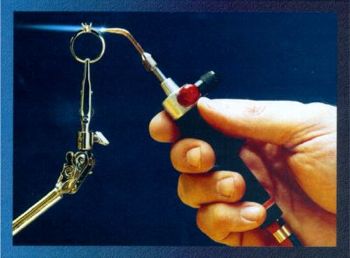
Soldering Jewelry
I’ve been following the action at #TUG2010 (Traction Users Group), reading and retweeting lots of good stuff from @rotkapchen, @vmaryabraham, @jackvinson, and @lehawes. Jack Vinson tweeted “Craft work can become knowledge work. Making it visible. narrating it. He added the hashtag for observable work, #owork, as well – indicating that was the concept he was associating it with.
My initial reaction to what Jack wrote, however, was to the implication that craft work isn’t normally knowledge work, which I don’t think is an accurate statement. Let me also say I’m not sure if Jack actually authored those words or if he was merely reporting them from the presenter at the user’s group preso he was attending and tweeting from. So I’m not taking issue with Jack. Actually, I’m not even interested in who said it; I just want to address the concept of craft work as knowledge work.
I believe all work is knowledge work. Sure, there are different levels at which the knowledge exists or asserts itself, but there’s always some component that involves knowledge; at least if it’s done by a human being. So it is with craft work, assuming I’m using the term in the same sense as Jack or whoever is using it, that is work manifested in tangible items, such as wallets or hydroelectric dams. I think of it as things like welding, carving, painting, growing, etc.
All of these things require a fair amount of tacit (in the head, as we sometimes refer to it) knowledge. As far as the concept of making this kind of knowledge visible goes, I think a lot of it gets transferred that way . . . usually in a mentor or apprenticeship kind of relationship. Making some of it more “visible” can make it more accessible, but there are necessarily limitations.
An instance of this from my life comes from many years ago when I was a jewelry bench worker. The place I was at made very high-end gold and silver shadow-box cuff links and they require some interesting soldering. I melted an awful lot of precious metal before I learned to recognize the colors, smells, and sounds that hinted I was almost at the right temperature and had to back the flame off. I believe what I gained from that experience was knowledge; hence, I was engaged in knowledge work, albeit at a lower level than, say, when I worked on the Space Shuttle Main Engine team.
Maybe the exigencies of saying something in less than 140 characters played a role in it coming out the way it did, but I felt the need to at least record my thoughts. I believe what Jack (or whoever actually made the statement) meant was that making craft work visible increases its accessibility and, therefore, its likelihood of being more easily transferred or learned. It doesn’t thereby become knowledge work, however. It already is and always has been knowledge work. Anybody disagree? Did I misunderstand Jack or the message he was conveying from the presenter?
New Book (Posthumously Published) by Russ Ackoff
Russ was such a good storyteller, this book has got to be a great read.`
Amplify’d from www.triarchypress.com
a triarchy press publication
Memories
by Russell L. Ackoff
Foreword by Peter Senge
Publication Date: 21 October 2010
No of pages: 120
Book type: Paperback
Print ISBN: 978-0-9565379-7-3
List Price: £16 (approx. $20)
“Russ was an incisive, lifelong critic of the modern organizational form. He saw its limitations and argued for radical redesign. He was an advocate for major re-visioning and processes of change that started with helping people see what they truly valued and where they truly wanted to get – and then working backwards to see what it would take to get there.”
Peter Senge, from his Foreword to Memories
When he died late in 2009, Russ Ackoff left two unpublished manuscripts. Memories is the first of these – a collection of stories drawn from his life experience, selected by Russ because they stood out in his memory as instances where he learned something. As he says in his Preface, “Life is a series of relationships formed and dissolved”. For Russ, the important principles and qualities around which his work was centred – clear-sightedness, looking at the bigger picture, working backwards towards solutions, radicalism – crossed over into most, if not all, other aspects of his extraordinary life. The stories in Memories focus on the human side of life and, in so doing, they demonstrate how many of the skills and attributes that are fundamental to professional success are found in personal experience.
In this book, Russ draws from his experiences of serving in the US army during World War II; of bringing up a young family; of encountering different cultures whilst working abroad. From analyzing birth rates in India, to a fireside chat with the Queen of Iran, to introducing theme parks to the US, the stories collected in Memories lay bare the workings of a number of well-known businesses and other organizations – and the people who run them. They describe common attitudes, behaviours and assumptions, which, if left unchallenged, can destabilize or even destroy an organization.
The book shows how thinking systemically leads to real organizational improvements in a variety of academic and workplace settings and – just as important – how failure to do so can be both personally embarrassing and damaging to the organization. Each story is used to illustrate a belief, principle or conclusion central to Russ’s theories of Systems Thinking and Design Thinking. And each of them is told with his customary generosity, wit and wisdom.
Memories is available in paperback or in a hardcover Collector’s Edition.
See this Amp at http://amplify.com/u/cddj

 Systems Savvy