Category Archives: Knowledge Management

The Ubiquitous Conference Room: Where Collaboration Goes to Die
Before you get your panties in a bunch, I’m not really advocating the complete abolition of meetings. I always loved getting together with 20 or 30 of my closest associates and spending the first ten minutes – of what always managed to completely fill the exact amount of time allotted to it – with banter about our kids, our pets, our plants, and our plans for retirement. Regardless, it always seemed to me there were just a few too many of them, and many were just . . . well . . . kind of unnecessary. So I’m just saying maybe we should consider there are meetings that are a complete – or near complete – waste of everyone’s time. Allow me to provide an example and, hopefully, I won’t piss off my former employer too much by sharing this.
Quite a few years ago I was a member of the High Pressure Fuel Turbopump team for the Space Shuttle Main Engine program at a famous, but not very well-known organization. [Pop Quiz! Who designed the engines that powered the Saturn vehicles to the moon?] At the time, another company was in the process of certifying their design for the same pump, as (Warning! the following statement may be hotly disputed by the parties, and they are only a partial recollection from a limited perspective) NASA had determined their (the other company’s) design was more reliable and, therefore, more safe. Unfortunately, this other organization was having trouble with some of their design and they weren’t meeting their certification and delivery goals. For this reason, we were given a contract to produce ten more high pressure fuel pumps.
For a length of time I can no longer recall (this was in the late 1990s, I believe, and the experience was somewhat painful), but let’s say it was around or over a year, we had a stand-up meeting every day to discuss what had happened the day before and what we wanted to happen that day. There were always between 15 and 20 people in attendance. However, on most days only a few of these folks actually had to be there. Unfortunately, it was impossible at the time for anyone to know whether or not they were needed without attending the meeting to see and hear what was talked about.
At the time, Macromedia had a product they called Generator which, as the team’s webmaster and web content volunteer learner guy, I had discovered. Generator worked with Flash to create animated displays. Among the things you could do with it was to create a ticker tape that would run a stream of updates at the bottom of an employee’s display. I knew nothing of “social” back then, but it sure seemed to me that having people update their activity through the use of this ticker tape would obviate the necessity for at least half (probably more like 80%, thank you Mr. Pareto) of the meetings we were having. This seemed a significant savings to me. Unfortunately, I might as well have been standing in the corner talking to it.
Now that this occurrence has faded in my rearview mirror, I can look at it a little more rationally. At the time, it was just one of numerous ways in which I saw us spending far more money and effort than necessary to get things done (don’t get me started on how click-to-talk phones could have sped up the flow of components through the shop). It wasn’t to be.
Although I’m no longer in that world (corporate, that is), I have good reason to believe things haven’t changed much in all this time. I know they hadn’t by the time I left (May of 2010). Are you still having meetings that accomplish little other than to fill up the hours? Here’s a suggestion. Read the book by Patrick Lencioni – “Death by Meeting: A Leadership Fable“. It’s a great business book masked as an entertaining fable, in the mold of Eli Goldratt’s “The Goal“. See if you can’t turn your meetings into what they should be, a vital and invigorating component of running an organization rather than a time-wasting drag on everyone’s energy and enthusiasm.
2 Comments | tags: Adobe, Apollo, associates, banter, Death by Meeting, exploration, F-1 engine, Flash, Generator, Goldratt, intranet, Lencioni, Macromedia, meetings, Moon, NASA, panties, Pareto, postaweek2011, pump, reliable, safe, Saturn vehicle, space, Space Shuttle, SSME, The Goal, turbopump, webmaster | posted in Business, Collaboration, Knowledge Management, Professional, Systems Thinking

Watch out for that fly
I worked for over two decades at a very large (and exceedingly ponderous) corporation. Actually, I worked at three of them without every leaving the location I originally hired in at. Although I worked at a company called Rocketdyne, it was a division of Rockwell International when I hired in. It was later sold to The Boeing Company and, in 2005 was purchased by United Technologies and became a part of its Pratt & Whitney family.
Each one of these organizations were not only capable of, but repeatedly dabbled in a level of bureaucratic numbskullery that I still find hard to fathom. I have yet to have it explained to me – at least in a way I can understand – why large for-profit organizations engage in activities that are guaranteed to hinder their ability to perform well or that cost far more than is reasonable. Frankly, I’m not sure anyone who’s directly involved in them can explain why it’s so, because I’ve never known anyone who said it was their job to slow down or squash anything . . . yet that’s exactly what happens in many instances.
The other day I watched a video shared with me and others by Euan Semple. I would link to the video, but it’s been removed by the user. I guess it was meant to just make the point for Euan mostly. Anyway, shortly after looking at it I came across a three-year-old email I had sent to a colleague. The video Euan shared was made by a student. It’s quite simple and shows how many of the social sites this college student wished to go to during the course of a day were blocked by the school’s policies. Maybe you’re thinking that isn’t such a bad thing, but I’m of the belief that people should be trusted first, as most are trustworthy. Should they betray that trust, then there might be consequences based on their situation. Spending 15 minutes on Facebook catching up with friends and family is not the same as spending an hour or two trading stocks online or visiting pornography sites. Wholesale domain blocking does not exhibit any level of trust at all and tends to alienate the majority of people who want access when they need it, but will not normally abuse the privilege.
Now to the rediscovered email. I’ll let it speak for itself. The episode which sparked it is not terribly important in my opinion, though it was important enough for me to memorialize and share it with a colleague whose mission was (and is) to steer the organization from simple-minded, one-size-fits-all policies and procedures. This is, I think, what it evidences. I hope you don’t think it too petty of me to point it out. I think this approach still dominates the thinking of the corporate world, as well as academia, as evidenced by the video Euan shared. What follows is my email.
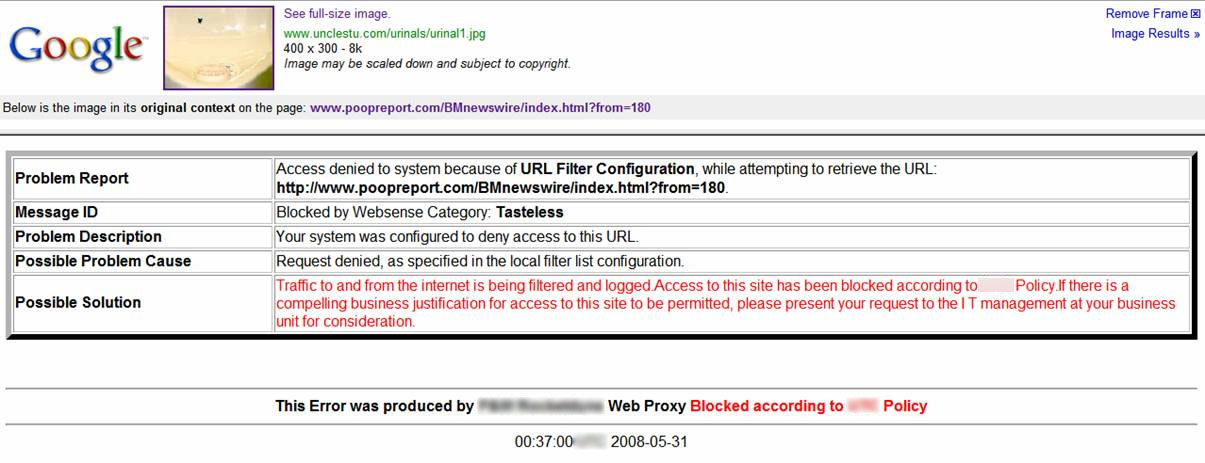
I don’t know what to make of this. Well . . . actually, I kinda do. It’s kind of funny, yet somehow a bit infuriating. Allow me to explain. As you may or may not recall, the men’s room near my cubicle was recently finished and re-opened. One of the features they installed is those waterless urinals. I’ve only seen them once before, and each time I go in I make note of the name of the company – thinking to find them on the Internet so I can read something about the science behind them. Also, each of the urinals has a bee painted on them and I wanted to see if I could find something quickly about why (though I suspected I already knew). At any rate, I finally remembered to investigate both (after several weeks of forgetting as soon as I got back to my computer) and found what I wanted and decided to just click on Google images as well. The first picture was of a urinal with a fly – not a bee – painted in the sweet spot.
I decided to take a close look and clicked on the picture. Although I was able to see the picture, even open the full-size image, the website it was on (which appears in a lower frame in Google images) was blocked by Websense. What I find remarkable, ironic, asinine, stupid, foolish, and probably a dozen more useful adjectives is the category they chose to block it under – “Tasteless”. Tasteless!!!! Is there some sort of absolute scale on which that quality can be measured? It was probably the name, but what if the website was about caring for infants or puppies or god knows what? This I find not a little insulting. What children they think we are! Let’s not forget the further irony that I could, for all their blocking, see the image. Perhaps I should sue for negligent infliction of emotional distress. Here they made an attempt to insulate me from something as tasteless as this, and I was nevertheless forced to look at a painted fly in a vitreous porcelain urinal due to the incompetence of Information Technology and UTC Policy. I hope I recover. I hope I can sleep tonight.
There! I got it off my chest. Please realize this email was sent approximately 3 years ago, so some things (like Google’s positioning of images and their associated sites) have changed. If Euan’s friend’s example is any indication, however, other things haven’t changed at all. I don’t think this bodes well for any organization seeking to do its best work. My experience says it hinders creativity and innovation, as it blocks people from following leads and decreases whatever chances might exist for serendipity and loose ties to open up new avenues and approaches to solving problems.
4 Comments | tags: blocked, blocking, Blogging, blogs, Boeing, bureaucracy, bureaucrat, college, Euan Semple, policies, postaweek2011, Pratt & Whitney, procedures, Rocketdyne, Rockwell International, Social Media, The Obvious, United Technologies, university, Video, waste, websense | posted in Business, E2.0, Enterprise 2.0, Knowledge Management, Systems Thinking

Euan Semple is a friend of mine; at least in the sense we are “friends” on Facebook and we are “connected” and have engaged in an email conversation on LinkedIn. I also follow him on Twitter and read his blog (somewhat infrequently, I must confess). I know he’s read my blog at least once because he commented on a post of mine. We have not yet met face-to-face, nor have we had an actual conversation where we could hear each other’s voices (each others’ voice?), say . . . over the phone or with Skype.
This morning I came across an item on my Facebook wall from him. It was a link to a video of his Do Lecture, shared through his blog, “The Obvious?”. I don’t see too many things from Euan in Facebook, so it caught my attention. I clicked on it to open a tab with the link so I could view it later. Many times I don’t end up viewing the item I’ve set aside, but this time I did. I’m very glad too. You can listen yourself here.
Euan is probably best known for his introduction of forums, blogs, and wikis to the BBC and now spends his time advising organizations on how to integrate these and other “social” applications into their businesses. You can learn more about Euan from his blog or from his website.
As I’m writing this I see one of his friends has commented on the original Facebook post. She says she finds his talk bitter sweet, because he says what she’s been saying too . . . to no avail. I have to admit to feeling the same way, though I did manage to get some traction in changing the organization I spent nearly a quarter century with.
Euan clearly knows what makes an enterprise tick. He also is keenly aware of the numerous ways in which traditional organizations and management waste time and energy and, actually, hinder progress in most every enterprise that’s built on the traditional, hierarchical business model we’re all so familiar with.
I strongly suggest you listen to his lecture yourself. It’s only about a half-hour and it’s quite enlightening and entertaining. He’s a wonderful storyteller. I actually took some notes while I was listening – which is not like me at all – and here are some thoughts that stood out. I’d sure be interested in hearing any of yours.
Euan points out that fear of messiness is troubling. I forget his exact word, but I wrote down the thought it triggered for me, and that was fear of messiness stifles creativity and, therefore, innovation. In addressing the fear that using social media would get out of control, he reasonably points out we still need middlemen to make sense of all the data and information out there. I have heard the people I believe he’s talking about referred to as curators or gardeners. He goes on to point out what we don’t need are gate-keeping middlemen who add no value at all.
He makes quite a few points about culture and how best to deal with the inevitable resistance and fear one encounters when even talking about social media. One of them is a reference to the concept of Trojan mice, i.e. unobtrusive, small things that generate change through their adoption and use. Another comes from one of the few slides he used with words – “Easier to build a tool for the community than a community for the tool” – though he expresses a bit of distaste for the way many view communities. Here he points to the difference between conscripts and volunteers and, for me, invokes the value of emergence, that communities spring up from recognized, shared needs and desires, not from the dictate of management.
I think my favorite thing he talks about is the dreaded ROI argument; one I was beaten about the head and shoulders with for many years, both in terms of knowledge management and later regarding the use of social media (which I have argued elsewhere is what KM is really about; surely the kind of KM I’m most interested in!) to connect people. In a sense, it’s what the entire lecture is about, but he offers up what he calls a Scotsman’s tip about ROI – “Keep the I really small and no one will give you shit about the R”. I got a kick out of that.
So, please take a half hour of your time (plus however long it took you to read this far) and check his lecture out. It’s quite good. It helped me get to know Euan a little better, as well as reinforced my thoughts about so many things I don’t know where to begin. It is, indeed, bitter sweet for me as well.
4 Comments | tags: blogs, Collaboration, communication, Control, Creativity, Enterprise, Enterprise 2.0, Euan Semple, Facebook, Fear, Forums, Friends, innovation, IT, Knowledge Management, Lecture, LinkedIn, Messiness, ROI, twitter, Wiki | posted in Business, Collaboration, E2.0, Knowledge Management
It is exceedingly frustrating to realize what a putz you are . . . at least it is for me. I struggle with how and what to blog, and yet miss some of the more obvious things I can post about. For instance, Dan Keldsen posts a link in Facebook to an article conveying a timeline of the history of Lean Manufacturing. This line, however, is entirely textual and Dan writes – parenthetically – “(need a graphic of this… hmm)”. Reading this I was reminded of a graphic I put together several years ago at the request of one of the Manufacturing Engineers at Pratt & Whitney Rocketdyne, William “Bill” Garrison. I was able to find it in short order (kudos to my PKM, IMO) and sent it to Dan. I then posted it in FB and, within a very short time received a comment from another friend, Robert Lavigne. I had also had an email conversation with Dan and he mentioned a product that produced graphical timelines, BEEDOCS.

The Evolution of Lean: A Timeline
Click on Graphic for Larger Version
At any rate I’ve now spent a fair amount of time thinking about the history of lean and the purpose and efficacy of graphical timelines; something I actually have contemplated quite a bit over time. I’ve also checked out the software’s website and, after another comment or two between Rob and I, he suggests the subjects are “still worthy of a blog entry and a link to your insights about the new product”. I find myself thinking he’s right so here we go. I hope this is what he had in mind. I’ll consider it an “aha” moment if I’m right.
So, here’s the real post. The article Dan linked to (see my link to it, above) is a bit more detailed and the earliest event evidencing lean in the timeline is fully 440 years ago, which causes Dan to lament over the seeming inability of many to just continue using the stuff that’s worked for centuries, eh wot? I can only nod in stupefied agreement. What appears above, in the form of a graphic representation, is an overview of the history of lean manufacturing. It’s heavy on the Toyota Production System (TPS), but there’s actually a lot of non-Toyota information in it as well. We didn’t want it to be too busy.
Now, as far as the software goes, I am surely in no hurry to purchase it at this point, but it does look like it provides some useful and interesting functionality. They point out the concept grew from Attorneys asking for timelines for use in trials and now is used by “Film makers, museum curators, professors, novelists, grad students and business leaders”. The timelines look beautiful and varied and the concept of using 3D (I don’t think real 3D, but film & television-like) makes the timelines visually appealing. It’s only $65 for Mac OS X Leopard and, for many, seems a small price to pay if you’re in the market for really good timelines.
That’s my story and, well, you know the rest. Thanks to Rob for prodding me. Thanks to you, whoever you are, for reading this far 🙂
UPDATE: I neglected to point out there’s a bit more to this timeline than mere events. It also points to the correlation between time, reduction in cost, and reduction of Cycle Time. Probably pretty obvious, but felt compelled to point it out just so you don’t think I’m stupid. It’s bad enough I think it.
7 Comments | tags: Cadillac, Deming, Evolution, Ford, GM, Goldratt, Isikawa, JIT, Lean, Manufacturing, Shewhart, Shingo, Taguchi, TOC, Toyota, TPS | posted in Business, Knowledge Management, Science, Systems Thinking

Soldering Jewelry
I’ve been following the action at #TUG2010 (Traction Users Group), reading and retweeting lots of good stuff from @rotkapchen, @vmaryabraham, @jackvinson, and @lehawes. Jack Vinson tweeted “Craft work can become knowledge work. Making it visible. narrating it. He added the hashtag for observable work, #owork, as well – indicating that was the concept he was associating it with.
My initial reaction to what Jack wrote, however, was to the implication that craft work isn’t normally knowledge work, which I don’t think is an accurate statement. Let me also say I’m not sure if Jack actually authored those words or if he was merely reporting them from the presenter at the user’s group preso he was attending and tweeting from. So I’m not taking issue with Jack. Actually, I’m not even interested in who said it; I just want to address the concept of craft work as knowledge work.
I believe all work is knowledge work. Sure, there are different levels at which the knowledge exists or asserts itself, but there’s always some component that involves knowledge; at least if it’s done by a human being. So it is with craft work, assuming I’m using the term in the same sense as Jack or whoever is using it, that is work manifested in tangible items, such as wallets or hydroelectric dams. I think of it as things like welding, carving, painting, growing, etc.
All of these things require a fair amount of tacit (in the head, as we sometimes refer to it) knowledge. As far as the concept of making this kind of knowledge visible goes, I think a lot of it gets transferred that way . . . usually in a mentor or apprenticeship kind of relationship. Making some of it more “visible” can make it more accessible, but there are necessarily limitations.
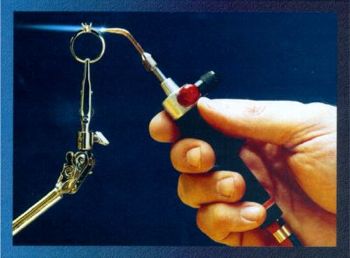
An instance of this from my life comes from many years ago when I was a jewelry bench worker. The place I was at made very high-end gold and silver shadow-box cuff links and they require some interesting soldering. I melted an awful lot of precious metal before I learned to recognize the colors, smells, and sounds that hinted I was almost at the right temperature and had to back the flame off. I believe what I gained from that experience was knowledge; hence, I was engaged in knowledge work, albeit at a lower level than, say, when I worked on the Space Shuttle Main Engine team.
Maybe the exigencies of saying something in less than 140 characters played a role in it coming out the way it did, but I felt the need to at least record my thoughts. I believe what Jack (or whoever actually made the statement) meant was that making craft work visible increases its accessibility and, therefore, its likelihood of being more easily transferred or learned. It doesn’t thereby become knowledge work, however. It already is and always has been knowledge work. Anybody disagree? Did I misunderstand Jack or the message he was conveying from the presenter?
12 Comments | tags: Documenting, Jewelry, Knowledge Management, Learning, Narrating, Observable Work, Senses, sharing, Soldering, Tacit Knowledge, Transferring, TUG2010, Visible | posted in Knowledge Management
Well, I’ve finally decided to go out in earnest and get some clients. I don’t think I’ve mentioned much (if anything) about what I had hoped to do with my life after leaving Rocketdyne and, frankly, it was a bit amorphous in my mind for some time as well. I keep looking for ways in which the knowledge I’ve gained over the years can be put to good use for others. I’m beginning to see some fairly clear outlines of just how I might be able to do that. It isn’t all about “clients” either.
Today I met with the Principal of my youngest daughter’s school, Sycamore Elementary in Simi Valley; on Friday I am meeting with the Principal of my other daughter’s school, Vista Elementary also in Simi. I decided a while back I wanted to see if I could bring something to the table that might improve the educational system . . . some small but significant contribution I might offer that would take advantage of my Knowledge Management, Social Networking/Computing experience, as well as my overall skill set acquired from well over four decades of business experience.
Today’s meeting was a bit of serendipity, actually. I take my children to school every morning, dropping the older one off first, then dropping my youngest off on the way back home. Today I also walked the youngest in and watched her play a bit before class started. I then went into the office to talk to the Principal. My intent was to have essentially the same conversation I had with the Principal at Vista. After all, it resulted in an appointment to delve further into the issues. All that I could have asked for. I discovered today was the one day out of only a few in which she has set aside some time to have coffee and a chat with whichever parents happened to show up. Lucky for me!
Double lucky . . . the President of the PTA was there as well. She was very interested in what I suggested which, btw, was that I learn how they do “business” with an eye toward discovering ways they can take advantage of new tools, services, and techniques that might relieve them of any pain they’re experiencing. I know they’re experiencing it. You can’t be paying attention and think the schools and their ancillary organizations aren’t suffering from any number of headaches and problems which would improve the educational experience for students, teachers, parents, and administrators alike if they could be even partially solved.
So that’s what I offered to give to both schools. I have suggested I can afford to put in at least four hours a month per school and I am both willing and eager to do so. I plan on taking the same attitude to commercial and industrial establishments as well. I believe there are lots of ways in which social computing can be put to good use for small, medium, and large businesses. I also believe there are a lot of people out there who are holding themselves out as Social Media “Experts”. I am not doing that. I’m merely saying I think I can help – first and foremost – understand what kinds of problems any particular organization has that they want to address. Only then can they even think about what tool, service, process, or technique might serve to do so.
In order to drum up business that will actually make me income, I have developed my first piece of “Collateral” to leave behind after visiting the organizations I offer my services to. Anyone who is following me on Twitter, is my friend in Facebook, is connected with me through LinkedIn, reads this blog, or connects with me in any one of numerous other ways probably knows I’ve shared a few presentations I’ve given in the past – when I was still an employee of Rocketdyne. They can be found on Slideshare, here. I want to share what I’ve done in creating a brochure to leave behind after an initial conversation with a prospect. My intent is not for this brochure to introduce me, but rather to serve as a reminder of the conversation I expect to have with whoever it is I’m discussing these things with.
I know, from my years of pursuing knowledge in this field, through literally hundreds of conversations on the subject, and from following and reading the work of dozens of people whose intelligence I have nothing but the deepest respect for, that almost anyone; every process; every business; yes, even every institution – up to, and including, those of government at any level – could be improved through the intelligent application of social computing. Of course, every situation is different. The City Council here in Simi surely would neither benefit from, nor require, the same thing that might benefit the U.S. Senate, and a small restaurant surely doesn’t require the same capabilities that a large manufacturing or distribution enterprise would find helpful.
So . . . that’s my story, and I’m sticking to it. Below are the two pages of a three-fold brochure I’m going to get printed shortly and start bringing with me as I literally knock on doors. It’s not the only method I intend on using, but it gets me out of the house, and that’s a good thing. I’d be interested in any feedback those of you who might read this post have to offer. I’m a work in process. Aren’t we all?

- Click on Image for Larger (Legible) Version

Click on Image for Larger (Legible) Version
P.S. – Special thanks are due to my friend Luis Suarez, who was kind enough to look over what I had done and make some very useful observations and suggestions. Thank you so much, Luis. You are one of those people whose presence I value dearly.
6 Comments | tags: Blogging, Collaboration, communication, Computing, Design, E2.0, Education, Enterprise 2.0, Facebook, innovation, Knowledge Management, Learning, LinkedIn, Organizational Dynamics, sharing, social computing, Teaching, Technology, twitter | posted in E2.0, Knowledge Management
Today, my friend (I consider anyone I can have a decent, useful conversation with on Twitter a friend) Kelly Kraft (@KRCraft) posted a blog asking the question “How much and what kind of a relationship do you have with former employees?” Her experience is much different than mine, though I think her conclusions make perfect sense for any organization contemplating doing as her former org did. The question is not – in my mind and, I think, in Kelly’s – whether or not to have ongoing relationships. Rather, it is what kind of relationships, and how extensive (or intimate), will they be?
KM Through Social Media
Over eight years ago, in response to a perceived need for understanding (and locating) the depth and breadth of expertise at Rocketdyne Propulsion and Power (then a division of Boeing’s Space & Communications business unit – whew!), I did some research and found a company that provided a tool that was a predecessor of many of the social media offerings of today. In my opinion they were way ahead of their time. The tool was called AskMe Enterprise and it offered profiles, Q&A threads (including forwarding, commenting by others, feedback as to quality and efficacy), file and link uploading and sharing, etc. We later had a customization added that provided for posting Lessons Learned and, about four years ago, they added a blogging capability.
Unfortunately, the larger percentage of our workforce (especially leadership and management) adamantly refused to participate. This wasn’t unexpected, however disappointing it may have been, and we continued to use the tool and work on building acceptance by example and through its ever-growing usefulness. Many years ago, I suggested we consider finding a way to stay connected with the constant flood of experienced Engineers, and others, who were retiring or moving on to other pastures. Inasmuch as we had a history of bringing some of those people back as contractors, I thought we might be able to find an inexpensive method of remaining in contact with the majority who didn’t return.
The proposal I thought made the most sense was to provide retirees with a secure connection to our network and, as compensation for being available for questioning within AskMe, perhaps covering the cost of their Internet connection. I don’t believe anyone took this idea seriously and it essentially died on the vine.
Intellectual Property & Communication
Now here comes Kelly, pointing out how valuable her former organization, Exact Software, has found maintaining continuous relationships with former employees can be. She also addresses the issue of what kinds of relationships make sense for different types of employees. Specifically, she notes the difference between outward-facing, highly engaged employees as opposed to somewhat sequestered, internally focused employees like many of the Engineers I worked with. She is, however, right on the mark suggesting each of them can be successfully engaged.
For instance, she points to her own experience as an Implementation Consultant for Exact and the work she did in the years since, noting there probably isn’t a great deal the enterprise needs to do to engage her. She is also, I believe, referring in part to her use of Twitter to stay in touch. My Engineer friends are not terribly likely to engage using Twitter (or blogging, or anything else that public for that matter). There are considerations of IP protection they can’t afford to ignore, as well as governmental restrictions like ITAR that, contravened, will surely bite them in the ol’ behind. This can be, and has been, quite expensive and can be done somewhat inadvertently.
Nevertheless, as Kelly points out, there are numerous ways in which an enterprise can stay in touch, and engaged, with its former employees. In Rocketdyne’s case – especially – with those employees who have retired and are not working for another company. She is also pointing out, in my opinion, that CRM (or SCRM) isn’t just for sales and marketing to dun customers with either. Social Media have many applications. Many of them are useful for engaging with an enterprise’s customers, but many are also valuable for engaging one’s own employees (current and former). The lunches and parties sound pretty cool, too.
PS – The article she credits me with was a few paragraphs of my opinion of what Hutch Carpenter (VP of Product at Spigit – @bhc3) had to say at his blog, “I’m Not Actually a Geek” (which he really is, but you didn’t hear that from me).
4 Comments | tags: communication, Contact, E2.0, Enterprise 2.0, Facebook, family, Former Employees, Knowledge, Knowledge Management, Learning, Organizational Dynamics, Relationships, sharing, social computing, Systems Thinking | posted in Business, Collaboration, E2.0, Enterprise 2.0, Family, Knowledge Management, Systems Thinking
I have been a KM practitioner for over a decade, and one of the principal reasons we have given for using KM principles is the need to keep from reinventing the wheel. So, in that spirit, rather than write my impressions of the Enterprise 2.0 Black Belt Workshop here at the Enterprise 2.0 Conference in Boston, I’m merely going to point to the blog of my friend @VMaryAbraham, since she has taken copious notes and already put them online.
This will make up for the fact that I accidentally set my alarm for 6:51 pm (most of my timepieces are set to 24 hr time) and got about an hour later than I had planned, coupled with a public transport nightmare, that had me over two hours late to today’s inaugural session.
So without further ado, here’s the link to Mary’s (award-winning, I might add) blog – Above and Beyond KM – http://aboveandbeyondkm.com/2010/06/learn-from-the-e2-0-vanguard-part-3.html
P.S. – unfortunately, WordPress does not fully support the iPad yet, and publishing a blog is a bit problematic. One problem; I can’t make the URL to Mary’s blog an actual hyperlink. I’ll have to fix that as soon as I have access to a regular computer. In the meantime, if you want to read Mary’s notes you’ll have to copy and paste the URL into your browser. Sorry about that.
Leave a comment | tags: communication, Community, E2.0, Enterprise 2.0, Knowledge Management, Learning, Organizational Dynamics, Philosophy, sharing, social computing, Technology | posted in Business, Collaboration, E2.0, Economics, Enterprise 2.0, Knowledge Management

No Rights Reserved. So There!!
I had a great lunch with two former colleagues (and continuing friends) at a superb Korean restaurant today; one I never would have gone to on my own merely because it was in a location I just wouldn’t have thought of stopping to eat in. Then again, for many years I haven’t been the type of person who goes out much for lunch. I used to bring my lunch and eat at my desk and continue screwing arou . . . er . . . working. So, during the conversation we got to talking about one of my favorite subject, which is how important is face-to-face contact . . . really?
Lots of people I know insist face-to-face meetings are, hands down, the best way to conduct meetings. They believe the numerous signals that can’t be communicated virtually are so important to understanding and communication that without them too much is lost. To them, conducting meetings virtually is not useful enough to justify engaging in often. To some, it is of no value at all unless it includes a voice connection (at the least) as well. I’m not sure I agree with them. Actually, I don’t agree with them at all. I am in the opposite camp.
Now, don’t get me wrong. I’m all in favor of face-to-face meetings. After all, you can’t go out drinking together if you aren’t actually together. Nevertheless, in today’s environment and, perhaps, regardless of how much the economic situation improves, travel is expensive in all kinds of ways. There’s the money spent on the travel and lodging itself. There’s the lost productivity while stuck in airports or overcoming jet lag. There’s the societal costs associated with the resources used to fly jets, drive cars, etc, etc. There’s being away from one’s family and the pressure that brings. There’s the cost of bringing souvenirs home for your kids that will often as not end up under the couch within a couple of days, not to be seen for a while (and surely not missed).
I just don’t buy the argument that being able to read facial expressions and body language are all that important. Perhaps when negotiating a complex contract, where there’s a bit of gamesmanship going on, it’s absolutely necessary. However, in the kinds of arms-length transactions that make up the bulk of the activity people travel to conduct, we can usually presume a desire to achieve the same, or similar, results – can’t we? I have a lot of relationships these days with people I have never met in person. I’ve seen still pictures (mostly avatars), but nothing else of them. Frankly, I don’t even know for sure it’s what they look like. Yet, there are ways in which trust is attained; built up in thin, seemingly tenuous layers of engagement; in the sharing of innocuous details of one’s activities and interests, etc. Some of my “virtual” friends I feel closer to than I do to many of my “analog” friends.
This I attribute to the richness of communication that generally emerges with the proper use of a good social system. For instance, Twitter allows me to engage with people on several different continents. Over time, I know (and I can reasonably confirm it to be true) where they work, what they do, what they like, and – especially – what they think about things I like to think about. Over time I can determine whether or not they keep their word; that is, how trustworthy they are. In communication and collaboration, nothing is more valuable in my opinion than trust.
I want to repeat my position here. I am not suggesting meeting people in person is not valuable or that we can do away with it. I do believe, however, if we found ourselves in a situation where we needed to work with someone we just wouldn’t have the opportunity to sit in the same room with . . . it wouldn’t be all that terrible. I’m going to Boston next month to attend the Enterprise 2.0 Conference. Frankly, my main reason for going is to meet – in person – at least a dozen people I have been interacting with for various periods of time who I have grown to trust and respect. I wasn’t going to go, despite my desire to meet up with these new friends. Fortunately, one of them (@ITSinsider, aka Susan Scrupski) made me an offer I just couldn’t refuse. Had I not been able to attend in person I still would have continued my relationships with these friends, and I believe they would have grown and improved.
So. I kind of hope I’ve gored someone’s ox. Otherwise, why do I reveal myself this way? Who’s going to join the fray? Virtually speaking.
8 Comments | tags: body language, clarity, communication, connecting, E2.0, facial clues, family, gestures, Knowledge, Learning, meetings, sharing, social computing, twitter | posted in Business, Collaboration, E2.0, Knowledge Management, Random Thoughts
Whenever most people talk about technology and people my age, it amazes me how many assume we can’t set the time on a VCR (remember those?) or that our view of IM is that it’s a tool primarily useful for young teenagers to plot their escape from under their parents’ watchful eyes. Perhaps, as a generalization this is somewhat true, but it’s not really a correct depiction of how we more “mature” folks use and view technology. The reality is far more complex.
As someone who struggled for well over two decades to bring the latest technology into a large, ponderous, and eminently cautious aerospace company, I have encountered all types of people, from foot draggers (lots of them) to early (and enthusiastic) adopters. Obviously, my favorite is the latter but the challenge really presents itself in the former. One thing I found is that things aren’t always as they seem either.
For instance, I was working with a person who was the Director of a newly formed organization. He was nearing the end of his career, which had been very successful. He was a wonderful person; friendly, helpful, and full of joy and excitement for his job and the work of others. He was very supportive of using newer technology yet, despite continuous efforts to engage him in instant message conversations (our offices were quite a ways apart), he never responded to me. Frustrating!
One day I happened to be in his office to talk with him for a while. As I was sitting there he was composing an email. It was then I realized why he wouldn’t answer my IM communication attempts. He used what an old friend of mine used the call the “search and destroy” method of typing; what most call “hunt and peck”. Carrying on an IM conversation for him would be like talking with a very bad stutter and it just didn’t leave him with a warm fuzzy, so he did the best thing for him. He opted out.
So be careful how you categorize or pigeonhole people. This very successful individual had spent a long career doing just fine without IM. As much as I believe it was a superior tool for communication and that it served to enhance our ability to share (I sometimes now think of it as a stunted form of micro-blogging) information and knowledge, virtually all of his career had proceeded rather nicely without it. I knew I had to accept this and make adjustments.
He retired within a year and I, for one, was very sorry to see him go. Keep in mind there are many more wonderful people in your organizations like him – to one degree or another. Don’t shortchange them or your company by selling them short just because they don’t see the use of technology exactly like you do.
4 Comments | tags: Adaptation, communication, Design, IM, Instant Messaging, Judgment, Knowledge, Knowledge Management, Learning, mistakes, sharing, social computing, Typing | posted in Business, Collaboration, Knowledge Management







 Systems Savvy