Category Archives: Professional

Why Can’t You Learn, Old Dog?

I am both amazed and highly disappointed at the number of people who believe the ability of colleagues to talk to each other via a tool that is either fairly ephemeral and basic (e.g. MS Communicator) or more persistent and inclusive (e.g. MS Yammer or Cisco Jabber) is a waste of their time. One of my least favorite things to hear is “I’m too busy to learn how to do that” or “I don’t have the time to waste on these things.”

Tin Can Phone

How can I help you?


“These things” are designed to improve our ability to share what we know and to find out what others know; not as a lark or just because, but in support of the work we do every day. How often have you remembered there’s some information that’s available to help you out, but you can’t quite recall where you last saw it or who told you about it? Imagine being able to essentially broadcast a question and have it reach dozens or more people, any one of whom might be able to answer the question for you. How is that a waste and in what way is spending 10 or 15 minutes to learn how to use a tool wasteful given how much time it can save in the long run? Even if you only saved 5 minutes per month, you’d be in the black after only a third of a year.

The business world is changing; grudgingly – at least in many places – but nevertheless changing. A long time ago one of my colleagues who had been a student of Deming’s and who was deeply involved in the understanding of systems, offered his belief that the main reason we survived as a company wasn’t so much because of how good we were at what we do. Rather, it was in large part due to the reality that everyone else was much worse. He wasn’t talking about our organization’s technical skills, but rather about our systems and procedures, most all of which exude bureaucracy from every corner.

I believed him then, and I’ve seen nothing to dissuade me from believing it still – even after a nearly five year hiatus and having been back for over six months now. I’m not sure how much longer any organization can continue doing business the way they’ve always done. I can’t possibly predict when it will be too late to change; when another business will match our technical skills and outperform our organizational skills, leaving us – eventually – in the dust.

It will undoubtedly take longer in aerospace than it would in, say consumer electronics, but even with long-term contracts and government funding there has to come a time when failure to learn and modify how things get done, especially those things that rely on people talking to and working with one another, will mark the end of an organization’s viability. I don’t dwell on it, but I do find myself occasionally listening for that other shoe to drop. You?


Shake, Rattle, and Rolling Along

 I’m beginning to see the effects of aging on my proficiency in much of my work; not just the slow and inexorable deterioration of mental acuity, but the slight discomfort I sometimes experience when either writing or typing. Due to my essential tremors, and the loss of flexibility and dexterity that can’t be avoided with aging, I frequently find there are times when I can barely do either. I have experienced instances when the shaking has been so bad I had to stop, stand up, and walk away until the shaking subsides.

For many years I’ve believed as long as I had the ability to type and use a computer, I would be able to communicate and, more importantly, work and earn at least a bit of income to supplement what retirement income I have. Now I’m faced with the possibility a time will come – perhaps not for another decade – when I will not easily be able to do so. I’ve experimented over the years with apps like Dragon Dictate, but I’m so much more comfortable actually having my fingers on a keyboard. If I am forced to do it, I suppose I’ll adapt. The prospect isn’t terribly exciting though.


Where are all the aliens?

There are so many excellent thoughts, revelations, ideas in this post I have no idea where to start. So, instead of quoting anything, I will merely urge you to read this in its entirety.

I take it back. Here’s what may be my favorite part:

“An even more advanced civilization might view the entire physical world as a horribly primitive place, having long ago conquered their own biology and uploaded their brains to a virtual reality, eternal-life paradise. Living in the physical world of biology, mortality, wants, and needs might seem to them the way we view primitive ocean species living in the frigid, dark sea. FYI, thinking about another life form having bested mortality makes me incredibly jealous and upset.”


Our Work Lives & the Relevance Imperative

This post is from a former manager and colleague of mine; currently a fellow Rotarian and someone I like to think of as a friend. Don was one of the more thoughtful and kind people I ever had the pleasure to work for and with (and he always made sure it was far more “with” than “for”). These are some of his thoughts on relevance; a concept the organization we both retired from – and we both have returned to in one capacity or another – seems to be struggling with nowadays.

donmcalister's avatarDon McAlister's Blogsite

Relevance1I’ve spent a lot of time recently, thinking about our psychological need for relevance, and the huge impact it has on the way we live our lives. I’m speaking here about personal relevance, which I will define as the degree to which we feel connected to others in a meaningful and valued way.

The pursuit of relevance is a fundamental, albeit sub-conscious, driver in what we think and do in our personal and work lives. All of us have this relevance imperative wired in to our brains. It is a characteristic of human life, and perhaps all life. I claim no expertise in psychology or neurobiology, but it makes sense to me to think that our brains relevance imperative probably started as desire to belong to a group or tribe as a strategy for safety and survival. Over time, it has evolved, adapting to the demands of increasingly more complex…

View original post 394 more words


Why I’ve Seldom Written On Paper

I work in an engineering company and engineers like to write things down, as well as illustrate their points when describing why they did something or how a component/tool/machine works. To that end, just about every one of them carries around a hardcover journal. I, on the other hand, have seldom written things down. In my entire school career, which includes two postgraduate degrees (but no undergrad school), I may have taken a few pages of notes, but that would be it.

White boards are also the domain of engineers and scientists, and every conference room generally has numerous illustrations and equations written on the boards on their walls. As a southpaw who writes backhanded, I’ve never been comfortable writing on a chalkboard or whiteboard. I just end up smearing everything. In fact, even on paper I’ve been known to fill out a form from the bottom up, just so I wouldn’t smear the ink before it had time to dry.

Folio

It’s so elegant, it almost feels like a crime to write anything in it. Weird, huh?

Still, just recently I decided to carry around one of the ubiquitous journals the company provides for everyone to use. Not only that, I purchased a really nice Moleskine Folio Professional Notebook, a leather pencil/pen case, and am seriously thinking about some high-quality pens. I did this in an effort to force myself to write more frequently. Unfortunately, I still have a problem getting anything down.

It’s really been bothering me as, at 68 years of age, I’m not sure how much time I have left, either in my life or in my ability to write coherently . . . and to remember what it is I’m doing. I have managed to write a few things down and, especially at work, I’ve found it helpful to keep notes about what I need to do in a journal, rather than on separate sheets of paper, which is what I’ve been doing for a while.

The problem for me is multi-faceted. As a leftie, I’ve never had terribly legible handwriting. Since I had no intention of becoming a physician, a profession where legible handwriting doesn’t seem to be a prerequisite, I gave up years ago and only print, in CAPS. When I actually write something down, that is. I learned to type in the seventh grade and during my second year of law school I got a job as a legal secretary, where my typing speed steadily improved until I was at about 85 wpm. Not blazing, but much faster than I can write/print. The attorney I worked for got an IBM memory typewriter, for which I spent a full day in class at one of their offices. I was enamored of word processing and, shortly afterward, he got a somewhat more sophisticated computer called an Artec Display 2000. It used 8″ floppies and I assembled wills, trusts, pleadings, and interrogatories with it. Keep in mind, this was in 1974 or 75 — forty years ago.

Since that time I have worked with quite a few word processing tools: Wordstar, with which I wrote many a module in dBase II; WordPerfect, which I learned on-the-fly when I answered the call for a temp job at a law office and again at an insurance agency; Lotus Word Pro and a homegrown (Rockwell International) competitor, with which I wrote reports at Rocketdyne, my alma mater and current place of employment (though it’s now Aerojet Rocketdyne – after being Boeing and UTC’s Pratt & Whitney Rocketdyne); and, Scrivener, with which I hope to write my memoirs soon, providing I can remember anything clearly.

The thing is, when you write something down on paper it’s very difficult to do much editing whereas with a computer (or even a phone or tablet) editing is essentially a piece of cake. Hence, the problem I have with physically writing anything down is my belief that if it’s anything useful, I’m going to want to save it electronically so I can both edit and post it (if it’s worthy and, frankly, maybe even if it isn’t). That will require a duplication of effort my experience in knowledge management makes it very difficult for me to contemplate. Yet, I will try and find those circumstances where writing something on paper makes sense. So far I’ve put about a hundred words in to my Moleskine.

How about you? Do you take notes? Do you ever write anything down except the occasional phone number when you’re hurriedly listening to your voicemail?


Social Media, White Privilege & Why Black Folks aren’t Too Sensitive

I want to share this post, along with the comment I left for the author. My comment comes first:

“Thank you, Vanessa, for your voice, your love, and your strength. As a white (although left-handed, atheist, commie) man I agree with you completely. I was fortunate to be involved in the Peace & Justice movement back in the late 60s and early 70s and, prior to spending two months in Cuba with the Venceremos Brigade, was heavily schooled in racism and cultural chauvinism. Our instructors were from the Black Panther Party, the Committee to Free Angela Davis, and the Brown Berets. I also read many of that time’s dominant black voices: Eldridge Cleaver; Julius Lester; George Jackson; Malcolm X, etc.

“I have tried to share what I learned, and what I have continued to learn, with my friends, family, and a long line of people I came across over the years who were desperately in need of getting a clue. Of course, it has branded me as somewhat of an outlier, which is fine with me and, occasionally, I too am accused of being too sensitive.

“I am now 68 years old and I use Facebook (plus a little Twitter, some LinkedIn, and a tiny bit of Instagram) to continue educating my friends and family. Most of them don’t respond to my posts; some of them are enthusiastically supportive. I will never stop spreading the word and keeping my eye on the prize. I wish you nothing but the best.”

sweetvanessaleigh's avatarBLK GRRRL BOOK FAIR

By Vanessa Leigh Lewis

Graham Case Fuck Racism graffiti October 2006 Graham Case
Fuck Racism graffiti
October 2006

We live in a country where white is the default; beauty is measured in standards defined by whiteness. Racial controversies can appear small, but are common place.  Remember the racist backlash from white fans (largely millennials), when Amandla Stenberg, a young mixed race actress who plays Rue in Hunger Games discussed race in her Tumblr video, “Don’t Cash Crop my Corn Rows”?

Social media racial backlash often gets brutally ugly —very quickly.

When these issues come up on my Facebook feed the “discussions” quickly turn into a battleground. Those discussions turn personal quickly and the argument becomes “I’m not racist,” or “This isn’t about racism.” People throw out that there is another reason, another way, another issue, but those reasons or issues are never racism.

White people don’t like to discuss racism unless they are assured that they are…

View original post 1,194 more words


Let’s Bite Off Our Noses To Spite Our Faces

It seems to me that anyone who really cares about their country, who is a genuine patriot, has to care for everyone. Life is NOT a zero-sum game, where the gains enjoyed by others are a loss to you and yours. No, life and human society are highly complex, interdependent systems where every part has a role to play, and when we don’t provide optimal conditions for the health and well-being of some of the parts, the whole body suffers. Would you want your car’s engine to go without one of its spark plugs? While it would still get you to where you were going, it wouldn’t do it as efficiently, nor as effectively. In the end, it would almost certainly cost more to deal with the results of an imbalance in the engine than it would to ensure all its components were kept in good working order.

Yet many approach life as though they are living on an island. It’s difficult to fathom the level of insensitivity, blindness to reality, and the callous lack of empathy it takes to turn one’s back on people who may not directly affect your life in a way you can feel immediately, but who nevertheless impact the organizations and institutions you deal with all the time.

For instance, by not ensuring all children receive healthcare, adequate nutrition, and early education, we ensure our up and coming workforce will be less prepared than they otherwise could be for the kinds of jobs that will be available in the near future. The net result is we not only handicap those children, we also handicap their families, their friends, and the entire nation. By guaranteeing they need more help for far longer than might otherwise be the case, we add to both their burden and ours.

We hobble ourselves with mistaken, outdated, unsupportable notions that give far more importance to diversity as a bad thing; as something that takes away from our sense of worth, of self. Instead of understanding, celebrating, and taking advantage of all the ways in which we complement and enhance each other, too many of us turn those virtues into imaginary vices and use them to divide and separate us. What a pity.


Halleluiah! The Seeing Is Truly Spectacular.

It’s been exactly one week since I had my cataract surgery and I thought I would share the experience. I wasn’t terribly worried about it, but the combination of it being surgery and the thought of having a knife cut into my eyeball wasn’t the most relaxing set of circumstances I could imagine. The reality was that I really needed the surgery, as my eyesight was becoming more and more problematic. I’m happy to say everything went off incredibly smoothly and I was actually able to go outside two days afterward and see the Moon, Venus, and Jupiter clearly for the first time in years. I nearly cried with joy.

Moon Venus Jupiter

This is similar to what I was able to see after the surgery. Previously, there would have been one fuzzy Moon and two ghostly ones accompanying it. Venus had become a dark circle with multi-colored, spectral rays emanating outward.

I was due at the Woodland Hills campus of Kaiser Permanente, in California, at 2:00 pm. The hospital isn’t too far from where I live and my wife was able to pick up several of our oldest daughter’s friends and ferry them to Girl Scout camp, then make it to Woodland Hills in plenty of time. We also had our youngest, who is not very good at a thing called patience, and I knew there was no way she would sit in a waiting room for at least a couple of hours without driving my wife (and everyone else, no doubt) crazy. I had her drop me off so they could go elsewhere and do something other than sit.

I got out and walked the short distance to the entrance that leads to the Ophthalmology Department and took the elevator up the one flight to the Surgi-Center, right down the hall from where I had been examined previously. I checked in and sat down to wait. There was no cell service so I opened up my Kindle app and continued reading one of the many books I have loaded on my phone. About ten minutes later my name was called and I went into the Center.

I was led to one of the many hospital beds that sat on each side of the room, each with its own monitoring equipment and privacy curtain. The nurse who was getting me prepped introduced herself and started me on the routine she has likely gone through dozens, if not hundreds, of times. I only needed to take my shirt off and put on one of those wonderful gowns every hospital has. I also had to take off the gold chain I have worn for nearly twenty years. At her suggestion, I put it in my pocket.

She had be get in the bed, sort of high up so my head was resting on a special pillow. I didn’t even have to remove my shoes! I lay back and, as she began to ask me some questions, another nurse came and started an IV on my right arm. A blood pressure cuff was placed on my left arm. The first nurse asked me my name and date of birth. She had me look at the info, which included the consent form I had signed, and asked me if it was correct. She asked me which eye was to have the procedure. She put an indelible, purple mark just above my eyebrow on the side it was supposed to be.

She also explained she was going to put drops in my eye to anesthetize it a bit in order to make me comfortable with the small sponge containing a chemical designed to dilate my eye. She was very concerned that I not experience any discomfort and repeated her offer to make me comfortable should my eye bother me. She then left me alone.

Shortly afterward, a young man came in and introduced himself as the anesthesiologist. He asked me the same questions I had been asked a few minutes previously and, being a big believer in the old adage, “measure twice; cut once”, I was more than happy to give him my answers. He checked my chart, apparently was convinced I was unlikely to die in the OR, thanked me, and disappeared.

Finally, about a half hour after I climbed into bed, my doctor appeared. She put a few more drops in my eye and carefully removed the sponge. It was the first time I realized there was a sponge in my eye. The nurse who put it in hadn’t mentioned what it was, just that she wanted to be sure it didn’t make me uncomfortable. My doctor then took a large syringe — kinda like a turkey baster — and filled my eye with a warm, gooey substance. She told me that I would be close to sleep, but they needed me to be awake at least enough to follow some instructions during the procedure. They then began moving my bed.

I remember nothing after that, save for a moment when I heard someone telling me to “look directly at the light.” Others have pointed out it was good they weren’t saying “go to the light.” I followed the instructions, especially since they had told me that’s what would be happening and I had been anticipating it . . . sort of. The next thing I knew, I was back where I had been prepped and my wife and daughter were coming in to see how I was doing.

I had a clear plastic, protective “patch” taped over my eye. I was able to get up, put my shirt on, and prepare to be driven home. I was also give a pair of sunglasses, a roll of tape, and printed instructions on what to do next. Although I was still a bit groggy, I was able to walk with my family out to the front of the building, where I sat down while my wife went to get the car. I noticed immediately, despite my eye being considerably dilated, that my sight was clearer. I was done with the hard part and everything seemed fine, which it was.

I had been using two different ophthalmic drops (one anti-inflammatory and one antibiotic) for four days and now had to start a third, another anti-inflammatory). The drops had caused a bit of discomfort, as they burned after I instilled them. However, the first couple of times I put them in after the procedure it felt like someone stabbed me in the eyeball. It was the most painful part of the whole ordeal.

I had to return the next day, Thursday, so I didn’t go into work that day, but I was able to comfortably return to work on Friday. I had my final post-op exam today and everything is going swimmingly. I’ve been putting drops in my eyes nine times a day for the last week, but now only have to put two of them in three times a day for the next week, then a week at two times and another at once a day. Then I’m done.

I’m told there’s a possibility my eye could, in time, develop a membrane that will act like another cataract, but it can be removed with a simple laser procedure. I am extremely grateful for the existence of this procedure I just had and the manner in which it was performed. I am nearly ecstatic to have my eyesight back. It’s better than it’s been in many years. If you’re having a problem with cataracts, which nearly everyone develops if they live long enough, I highly recommend you have the surgery performed. I now have a serialized, registered implant in my eye (my card says so), but I can’t feel it and the difference in my world is like . . . well . . . night and day.


Slice – Destroy – Remove – Replace That Lens!

Kaiser Hallways

I understand sterility is important in a hospital or medical facility, but this is a bit ridiculous.

The other day I accomplished another step in getting my impaired sight back to a reasonable semblance of normal. As I have written before, seeing has become a bit problematic though, when it first started, it was somewhat entertaining and humorous. I wrote about it again when I noticed it was affecting just about everything. What I find amazing is to realize I wrote these two posts over three years ago. Amazing what you’ll put up with, or what I’ll put up with.

At any rate, my ophthalmological exam revealed I am a candidate for cataract removal and the replacement of my natural lens with an artificial one. I have chosen to have my vision corrected for distance so, even though I will almost certainly have much improved distance vision, I will still need reading glasses. I have been wearing glasses for a large portion of my adult life and I don’t mind wearing them the rest of it. I’m just looking forward to seeing clearly again. I have not been able really enjoy the night sky for years and it is one of the things I’m most looking forward to.

I would, however, have put up with this longer no doubt were it not for the fact I’ve returned to work and one of my duties involves working in a conference room with team members on various program schedules I build or maintain with Microsoft Project. It’s reached the point where sitting in the back of any of the most frequently used conference rooms, where the keyboards and mice reside, makes it difficult and annoying to read what’s on the screen, especially numbers (dates, durations, lag times, etc.).

The surgery is scheduled for this coming Wednesday, June 17, time to be determined when I call the surgery dept. on Tuesday. This morning I began a regimen of antibiotic eye drops, which I must instill in my right eye four times per day. I will continue using them post-op, and will add a third type of drop, which is a corticosteroid designed to reduce the chance of swelling. Not sure how long I will need to continue this regimen, but I’m figuring at least a week or two, depending on how the eye responds to the insult.

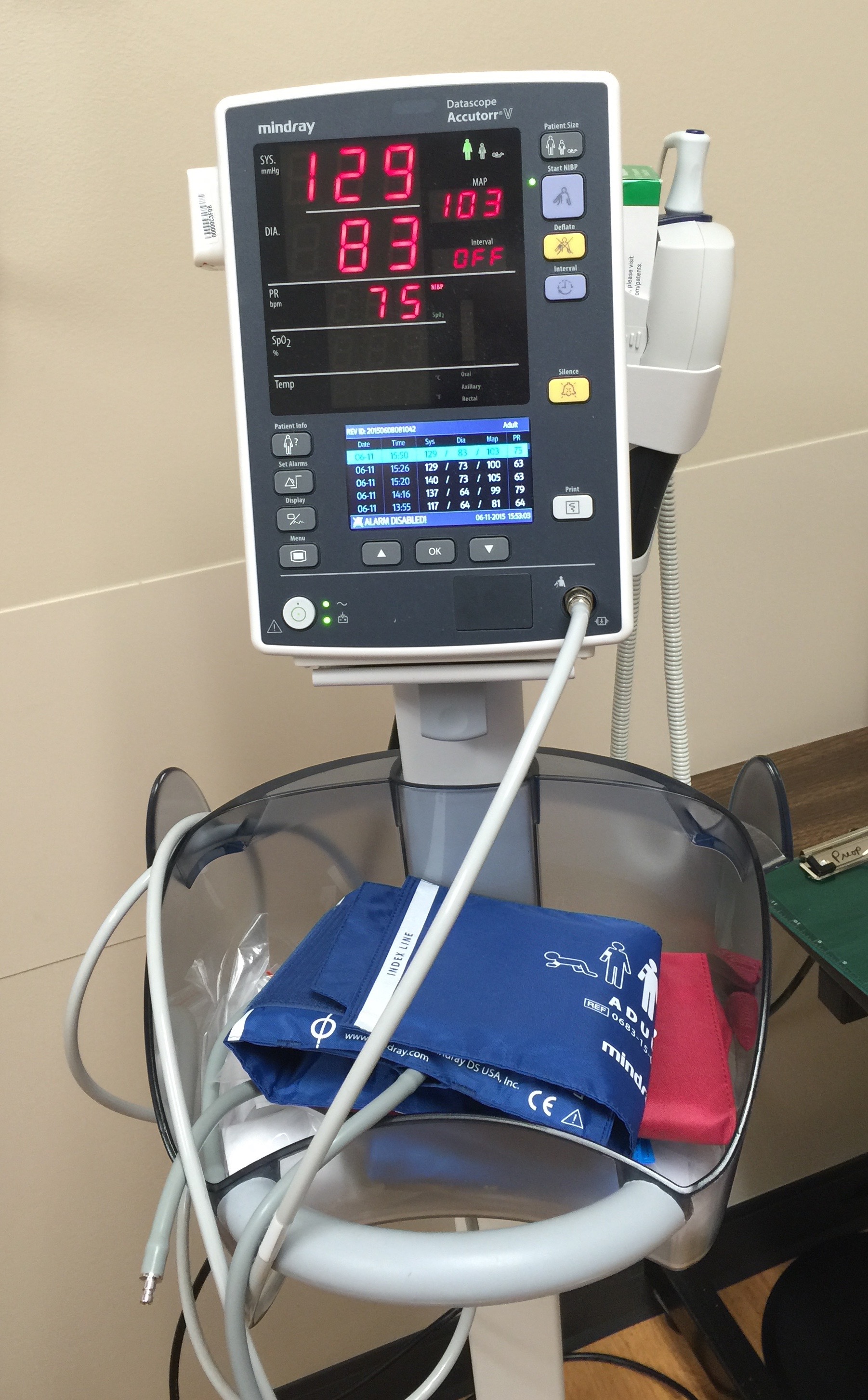
Blood Pressure Results

Nailed it!

I had my pre-op exam last Thursday and am happy to say I passed. I was pleasantly surprised to find my blood pressure was really good (I have been dealing with essential hypertension for a couple of decades, for which I take medication) and will present no problem with respect to the surgery.

I think I’m really ready for this. As I get older, I have (as most of us do) more issues to deal with, some of which are more serious than others. While this is surgery, it’s outpatient and it is the most frequently performed procedure in the world. I expect no difficulties. I can’t wait to see Venus, Mars, Jupiter, and Saturn without their accompanying satellites I know aren’t really there, and I’m especially looking forward to again see the craters of only one (not three) Moon. That will be sweet. IMO.


New Eyeball Coming Soon to a Head Near Me

Blurry fingers

Totally groovy. Peace to you – twice . . . at least.

I got a call from the Ophthalmological surgery department yesterday to ask me if I wanted to have my cataract removed and replaced next Wednesday instead of next month. I said “yes”, so I’m having my pre-op exam this afternoon and, if all goes well, by this time next week I should have my new lens and be well on my way to healing. I’ll still need glasses for really sharp vision, but the constant blurring of my right eye will be gone (Dog willing and the creek don’t rise!).