Category Archives: Professional

Paine’s Nightmare

We’re about to find out just how many “summer soldiers and sunshine patriots” have managed to ascend to positions of power and influence in our country.

I fear such knowledge is going to be deeply disappointing and demoralizing. I will be surprised if even half of elected Democrats rise to the occasion. I hope I’m wrong.


Why Are People Giving In?

In his book, โ€œOn Tyranny: Twenty Lessons From The Twentieth Centuryโ€, the very first lesson Timothy Snyder presents us with is โ€œDo not obey in advanceโ€.


Yet this is precisely what the mainstream media (including MSNBC and even Comedy Central) are doing wrt the โ€œcandidacyโ€ of Rapey McEarGotNicked. Theyโ€™re cravenly removing shows that might โ€œoffendโ€ Trumplethinskin, ostensibly in the forlorn hope that if he wins theyโ€™ll obtain or retain access to him during his admin, er reign as King of the World.

Another admonition from Snyder; โ€œBe calm when the unthinkable arrives.โ€ Unfortunately, if my admittedly unscientific analysis is correct, this is what far too many of us are doing on the daily. I say this because of a couple of things.


One – Facebook provides a range of reactions for posts and comments. These are โ€œLikeโ€, โ€œLoveโ€, โ€œCareโ€, โ€œHa Haโ€, โ€œWowโ€, โ€œSadโ€, and โ€œAngerโ€. I see lots of people reacting to news of Mango Mussoliniโ€™s outlandish โ€œpositionsโ€ (especially Project 2025) with โ€œSadโ€ rather than โ€œAngerโ€. Being sad is debilitating. Being angry is energizing. It can, and should, lead to dogged determination to resist, whereas being sad leads to fear, anxiety, and panicked paralysis.

Two – On Threads which, despite being a META product like FB & IG, doesnโ€™t provide for a range of reactions, I consistently read comments by people who are afraid or uncomfortable. Hardly any are angry at whatโ€™s going on with the Treason Weaselโ€™s โ€œcampaignโ€.


What we face with the prospect of another Trump Presidency is objectively horrendous, yet many seem to be paralyzed and incapable of doing anything other than complaining and expressing their fear for the future.


Maybe Iโ€™m off base here, but I believe they are doing what Professor Snyder is admonishing us against, i.e. obeying in advance or, to put it more succinctly, giving up.


WE NEED TO DO BETTER. Only 112 days remain for us to educate and fire up the electorate, especially the large chunk of people who donโ€™t ordinarily vote.


PS – Iโ€™m a 77-year-old, straight, cis gendered, white male who lives in SoCal, is retired, and has enough retirement income (thank you Social Security & Medicare) to squeak by almost no matter what happens. Nevertheless, I care about my fellow meat sacks and, especially, my two adopted girls. For this reason I will not obey, either in advance or afterward. Thereโ€™s just too much at stake.

Hasta la victoria siempre. ยกVenceremos!


Deming and Rocketdyne

Sometime in late January of 1987, almost one year to the day after the Space Shuttle Orbiter Challenger was destroyed as it ascended to orbit, I was assigned by the temp agency I was using at the time to begin work on the Space Shuttle Main Engine team at Rockwell International’s Rocketdyne Division in Woodland Hills, CA.

Prior to that fateful date I had, with one exception, never worked at a company with more than a dozen employees. My family’s wholesale food business, at its peak, was only my father, brother, me, and one employee and most of the numerous jobs I had held over the previous 20 years or so were similarly small.

Rocketdyne employed several thousand people, most of whom labored at our campuses in Woodland Hills and Canoga Park, CA. It was a division of Rockwell International, which employed over 100,000 people world-wide. It was a jarring transition to go from small (really small) businesses to a multi-national aerospace conglomerate. However, having been somewhat of a space-cadet, i.e. enthusiast most of my life, I was thrilled with the opportunity.

A year later on 1 February 1988, I was hired to work in Engineering Computing on the Flight Ops team – a position I would not have dared to dream of filling. Nevertheless, there I was helping our nation’s space program get back on track. It was truly a dream come true.

At the same time, I was becoming aware of the unique way in which large organizations conduct themselves. Some of it wasn’t pretty. I first encountered the business philosophy of W. Edwards Deming soon after I was officially hired as I was lucky enough to have a colleague who was a student of his. Deming had written a book (he wrote many) in which he laid out a fourteen-point explication of his concept of TQM (Total Quality Management).

I was enamored of his positions, as they coincided with my growing understanding how things worked in virtually any organization. I had long been someone who looked for and found ways in which to improve the processes and procedures of any organization I was involved with, and Deming’s philosophy made a great deal of sense to me.

At the same time, I was becoming increasingly aware of the reality that many companies, including Rocketdyne, were honoring those principles in their breach, not their adherence to them. As I was studying Deming’s 14 points I began to realize just how thoroughly many of the managers I encountered were oblivious to the virtues Deming laid out.

Somewhere around 1990 I decided to see if I could capture the differences between what Deming offered and how Rocketdyne was actually doing things. I captured Deming’s 14 points and then created Rocketdyne’s 14 counterpoints. I’ve kept them over the years and am here sharing my understanding with two screenshots of those differing points of view. Please keep in mind not all managers were as controlling as the worst of them. I was lucky to work under the supervision of several truly wonderful managers in my nearly quarter century of employment there. Regardless, I think my analysis was reasonable, even after over 34 years. You?


A Chatbot Experiment

Is Marxism Still Relevant in the 21st Century?

Karl Marx, the bearded revolutionary with a penchant for manifestos, left an indelible mark on history. His economic theories and philosophy of dialectical materialism ignited revolutions, shaped political landscapes, and inspired countless thinkers. But in the 21st century, with globalization, technological advancements, and shifting social dynamics, one can’t help but wonder: is Marxism still relevant?

The Spectre of Capitalism Haunts the World

Marx’s core critique of capitalism remains eerily relevant. He argued that capitalism inherently generates inequality, with the wealthy owning the means of production (factories, machines) and exploiting the labor of the working class for profit. Today, we see this play out in stark income gaps, wealth concentrated in the hands of a few, and precarious job markets that leave many struggling to make ends meet.

Globalization has further intensified these issues. Corporations can now exploit cheap labor in developing countries, further widening the gap between rich and poor. The 2008 financial crisis, triggered by reckless financial speculation, exposed the inherent instability of a system driven by the pursuit of profit at all costs.

Technology: Friend or Foe of the Proletariat?

Technological advancements, a cornerstone of the 21st century, present both challenges and opportunities for Marxist analysis. On the one hand, automation threatens to displace large swathes of the workforce, potentially exacerbating unemployment and inequality. On the other hand, technology can also be a tool for empowering workers. Communication platforms and social media enable workers to connect and organize across borders, potentially building solidarity and challenging corporate power.

However, the benefits of technology are not evenly distributed. Access to education and training is crucial for workers to adapt to changing technological landscapes, but these opportunities are often limited by socioeconomic factors. The digital divide can further marginalize vulnerable groups and exacerbate existing inequalities.

The Metamorphosis of Class

The nature of social class has also undergone significant transformations since Marx’s time. The traditional working class of factory laborers has shrunk, replaced by a more diverse and service-oriented workforce. This makes it harder to identify clear class divisions and build class solidarity.

Furthermore, identity politics have risen in prominence, with groups emphasizing shared experiences based on race, gender, or sexual orientation. While these movements are crucial for addressing specific forms of oppression, they can also complicate the traditional Marxist focus on class as the primary driver of social conflict.

Beyond the Manifesto: Rethinking Marxism for the 21st Century

So, is Marxism still relevant? The answer is not a simple yes or no. While some of Marx’s specific predictions haven’t materialized (like the inevitable proletarian revolution), his core critique of capitalism’s inherent inequalities remains as sharp as ever. However, to remain relevant in the 21st century, Marxism needs to adapt to the changing realities of globalization, technology, and the evolving nature of social class.

This could involve developing new strategies for worker organizing that leverage technology and social media. It could mean acknowledging the importance of identity politics while still recognizing the role of class in shaping broader social structures. Ultimately, a 21st-century Marxism should be flexible, adaptable, and open to incorporating new ideas and perspectives.

Marxism may not offer all the answers, but it provides a valuable framework for analyzing the power dynamics and inequalities inherent in our current economic system. By critically engaging with its core ideas and adapting them to the realities of the 21st century, we can build a more just and equitable future for all.

Remember, the conversation on Marxism’s relevance is far from over. This blog post is just a starting point. What are your thoughts? Do you think Marxism still has something to offer us today? Share your views in the comments below!



Hardly Frightening!

Bruce McCandless – Feb. 7, 1984

This photo is often shared and referred to as a “frightening picture”. From the first time I saw this (which happened 40 years ago this Feb. 7) I found it both thrilling and a testament to what human ingenuity can accomplish. To me it also represents how, despite his apparent loneliness in the vastness of space, it took his crew, the NASA team below, and thousands upon thousands of people to make that one act happen.

It should be noted that another astronaut, Bob Stewart, completed a similar mission while both of them were aboard Challenger, flying mission STS-41B. There does not seem to be a photo of Stewart’s space walk.

He may look lonely out there, but the reality is he’s a member of a huge team of fellow humans who make such a feat possible. I suspect that’s true for just about all of us if we’re to be successful.


More Than 2 Dozen Jobs!

In my 76 years on this planet, I’ve worked no less than 2 doz jobs, ranging from short order cook, busboy, waiter, restaurant manager, truck driver, forklift driver, butcher, jewelry bench worker, and wiener clerk, to legal secretary, project manager, knowledge manager, and business manager.

I retired from Pratt & Whitney Rocketdyne, where I worked on the Space Shuttle Main Engine program for nearly a quarter century and I am neither an engineer nor a scientist. Now … in a desire to get out of the house and make a little money, I am beginning a job working as a clerk in a liquor/convenience store. It’s low pay, low stress, and part time (26 hours/week).

My experience runs the gamut from highly physical work to entirely knowledge/mental work. If I’ve learned nothing else, it’s that there’s no such thing as a menial job. There is dignity and sanity in working at virtually any job. I know this one won’t tax my intellect, but I’m looking forward to it.


I Was Just Passing The Time

When I first ended up at Rocketdyne (it was serendipity, not a conscious move) I was gobsmacked knowing I was working on the Space Shuttle Main Engine program, with bonafide rocket scientists and engineers. It was 1987, almost exactly one year since Challenger exploded and I was working on the FMEA/CIL (Failure Modes and Effects Analysis/Critical Items List) in anticipation of the shuttle’s return to flight. There were frequent dead times while I waited for an engineer/scientist to bring me their work so I could input it into the format we were using to present the information.

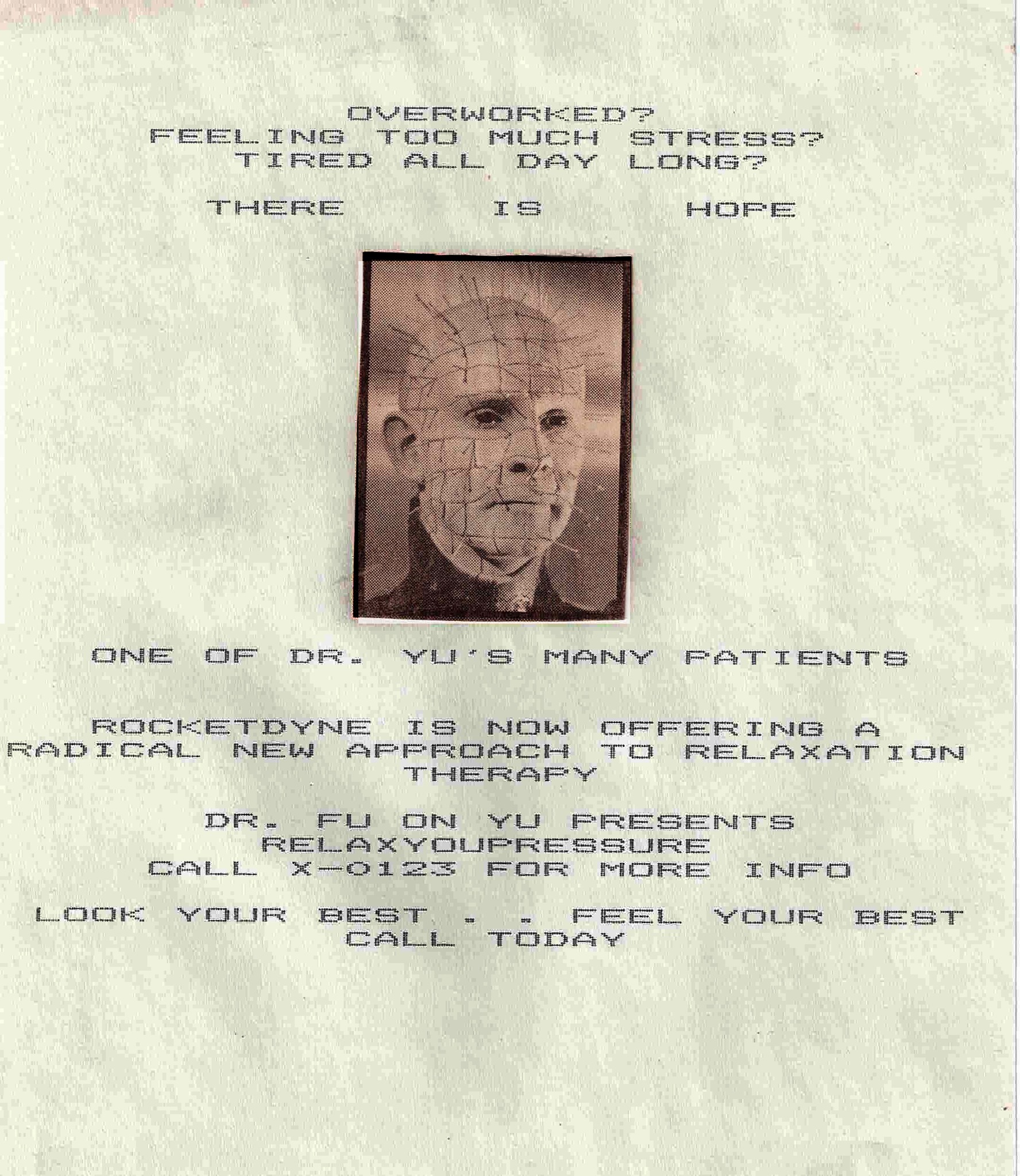
I was just going through a folder I found stashed away that’s chock full of some of the things I created back then while I was bored. Keep in mind we only had dot matrix printers and early IBM PCs. I’m pretty sure we were using IBM XTs running Intel 8088 processors. Anyway, here’s one of the things I put together to assuage my boredom back then.


A Different Kind of Foodie

Like many a young American, my very first job, that is the first one I got paid for, was at a McDonaldโ€™s in Arleta, CA. I was sixteen years old and had just earned my driverโ€™s license. This was in the Summer of 1963 and my father had bought me a used ’57 Chevy – my dream car. On my first day I did nothing but make milkshakes. On the second day I bagged french fries. Then the manager discovered I knew how to work the cash register and to make change, a skill I learned in Junior High when I worked in the student store. From then on I worked the window, taking and fulfilling orders. I had nightmares involving endless lines of people who ate every meal there (at least lunch and dinner; McDonaldโ€™s didnโ€™t serve breakfast in 1963) every day. These dreams were based, in part, on the fact there were several customers who did eat there every day. It was a frightening thought.

My second job was as a bus boy at Pancake Heaven, which no longer exists but was just around the corner from the McDonaldโ€™s I cut my working teeth on. I eventually became a fry cook there for a while and learned how to make breakfasts, for the most part. At least, thatโ€™s all I can barely remember. Actually, one specific skill I recall learning was how to hide mistakes with garnish; a slice of orange or a sprig of parsley. I also worked at Mikeโ€™s Pizza on Van Nuys Blvd. for a while. The only thing I remember about that job was sneaking out a bottle of Chianti in a trash can filled with the sawdust I was responsible for changing out every few days so the floors were reasonably clean.

The Summer before I graduated High School, which was actually the Summer after I should have graduated High School, I worked as a โ€œbus boyโ€ at Pacific Ocean Park (POP). My job was to walk around the pier on which the park was built and scoop trash into one of those self-opening dust pans and empty it into one of the larger trash bins that were placed all over the โ€œparkโ€. It actually had nothing to do with food or food service, other than that most of the trash was created by people who had purchased something to eat and were too damned lazy to deposit the trash in a receptacle themselves.

I didnโ€™t work in or around food service again until 1973, when I tended bar at the Ash Grove in Los Angeles, where I was raising money for my upcoming trip to Cuba with the 6th contingent of the Venceremos Brigade. I had studied Hapkido with Ed Pearl, the owner of the club. It was a favorite target for anti-Castro Cubans and was burned down for the third and final time shortly after I worked there. I donโ€™t think we had a liquor license; only a beer and wine license, so tending bar wasnโ€™t quite as intellectually challenging as it would have been had I been required to remember dozens of mixed drinks, but it was a busy venue and I enjoyed my time there.

Shortly after returning from Cuba, in my first year of law school, I secured a position as a โ€œwiener clerkโ€ at The Wiener Factory in Sherman Oaks, CA, where I served up the finest hot dogs, knackwurst, and polish sausage to ever cross a taste bud. Even though they closed on December 31, 2007 (>15 years ago) itโ€™s still talked about as the top example of how a hot dog should be presented to the discriminating public. I loved it there. PS โ€“ Click on the link and you might find my posthumous review of the place, which I posted almost 13 years ago.

I didnโ€™t work in food service again until sometime in the mid-nineties. I had left my job at Rocketdyne to rejoin my brother in a family wholesale food/restaurant supply business our father had started when I was 13. After less than two years it wasnโ€™t going well and I decided to leave and fend for myself. One of my customers was Les Sisters Southern Kitchen in Chatsworth, CA. The owner at the time, Kevin Huling, was working his butt off and wanted to be able to take a day off during the week. I offered to run the place for him on Wednesdays and, until I returned to Rocketdyne, I managed the restaurant once a week. My favorite day was when I had to wait on tables. I made quite a bit more money than I did from just managing the place (hint: tips!).

In addition to all these jobs, my father was working at the Grand Central Market in downtown Los Angeles when I was born. He worked at Faberโ€™s Ham Shop, which was a stand in the market that sold lunch meats and fresh chickens. He liked to refer to himself as a butcher, but my birth certificate lists his occupation as โ€œFood Clerkโ€. I remember my mother taking me shopping there when I was about five years old. We took Pacific Electricโ€™s Red Car on the Red Line that stretched from San Fernando, running right through Panorama City, where we lived, to downtown L.A. My father put me in a far-too-large, white butcherโ€™s coat, and put a Farmer John paper campaign hat on my head, stood me on a milk crate and had me selling lunch meat for an hour or so. I learned my first three words of Spanish behind that counter, which were โ€œยฟQue va llevar?โ€ literally โ€œwhat are you going to carry?โ€, but was more loosely translated as โ€œwhatโ€™ll you have?โ€ or โ€œwhat can I get for you?โ€

Later on, specifically right after I handed over every check I received for a Bar Mitzvah gift to my father so he could buy a truck, he went out on his own. He became the broken wienie king of Los Angeles, buying (essentially) mistakes from packing houses and selling them to his old boss, as well as to other small markets scattered throughout the greater Los Angeles area. Until his death in 1984, I spent virtually every school holiday being his โ€œswamperโ€ on his route orโ€”later onโ€”delivering and selling on my own as part of the business. Somewhere around 1994 I left my job at Rocketdyne to rejoin my brother in the family business, once again selling almost exclusively to restaurants.

My point is, I have no formal training in the culinary arts, but during a rather large portion of my life until I was around 50, I spent quite a bit of time working in jobs and being in businesses that involved food; at times merely delivering it and at other times preparing and serving it. I know my way around a kitchen and I know quite well how to operate a successful food business. Itโ€™s not easy. People can be real assholes when theyโ€™re hungry, and people who cook can be real prima donnas, so learning to satisfy your customers can be a painful experience. It is, however, quite rewarding when it works out. I think you have to genuinely like people in order to do it well.


Bass Ackward EVM

Has anyone else noticed how the majority of illustrations depicting Earned Value Management methodology show projects over budget and behind schedule? Why the pessimism? I know itโ€™s frequently how things work out, but why do we put up with what amounts to continuous failure improvement? Why donโ€™t we โ€“ since weโ€™re only depicting how measurements and calculations are made โ€“ show the positive side, e.g. under-spent and ahead of schedule?

It seems like it would make a difference if, rather than presenting failure in the abstract, we presented success in the abstract. Isnโ€™t it better to be going in with a success-oriented mindset, tempered with a good dose of reality? Of course, this presupposes situations where weโ€™re not driven by the dynamics to be overly optimistic and unrealistic at the front end of a project in order to win a bid or compete with others, especially in large programs/projects. A tall order methinks.

Earned Value Management chart example.
Behind Schedule & Over Budget!