Category Archives: Professional

Are You, or Should You be, Shopping Local?

Shop Simi Valley First Logo

My City's Logo for Encouraging Local Shopping

There are several commercial “movements” gaining steam nowadays expressing the desire of smaller communities to get residents spending more of their money at local, usually small, businesses. Small Business Saturday’s Facebook page has almost 3 Million “Likes”. My city of Simi Valley has spent a fair amount of money promoting the concept. Locally it’s called “Shop Simi Valley First“. Unfortunately, the money that was used to create the website and other marketing efforts to support it has now dried up, possibly never to return. On the bright side, some of our citizens created a Facebook page for them and it’s approaching 1K “Likes”. It might increase now that the “official” effort is unfunded. I think this is a good thing and here’s why.

For the last year or so I have been gently pushing the city, and local small businesses, to recognize the power available to them in the use of social media to market themselves, as well as to create connections that just haven’t been possible in the past. I think, when it comes to marketing – especially in terms of encouraging local residents to patronize small businesses in our city – the connectivity and mutual support provided by services like Facebook, Twitter, and Yelp may prove a decisive factor in reasonable, if not substantial, growth.

As I see it, local small businesses can use these services not merely to promote themselves individually but, as long as there’s no conflict of interest, they can also promote each other. Here’s what I imagine happening.

Let’s say you have a restaurant that serves a reasonably upscale clientele. You know there is a certain demographic that’s not terribly likely to frequent your business. Maybe they’ll patronize your place on special occasions, but not regularly. Would it be a bad thing to give props to other eating establishments more desirable or affordable to those people? Would it threaten your business or might it not actually result in your being recognized as more friendly and approachable? I’m betting the latter is more likely.

Perhaps you own a clothing store, a dry cleaners, or you’re a Dentist or other professional or service provider. I see no reason why you can’t agree with other businesses to post on each others’ Facebook pages once in a while, sharing what you have to offer or special deals you’re running at the time. Frankly, I haven’t worked out all the details in my head yet. I’ve tried to work with local businesses and the City to encourage this type of practice using social media but, much like my experience at Pratt & Whitney Rocketdyne, I’ve met a lot of inertia and resistance to change, even in the face of impending closure or bankruptcy. Part of it is a lack of understanding and part of it is a lack of resources, but the result is the same. Nothing much is happening.

What I envision happening is essentially two-fold. The first thing is that participating businesses benefit from the following of the other businesses on whose Facebook pages they promote themselves. This increases the likelihood of their being noticed by a larger group of residents. Secondly, it also increases the chances people in outlying areas will become aware of local businesses, thereby increasing the possibility people from neighboring cities may drive on over and patronize our local businesses a bit more frequently.

Does this make sense to you? What do you think about promoting local small business and how well do you think the use of social media platforms like Facebook, Twitter, and Yelp can increase awareness of certain types of businesses? I’d sure like to see a more coordinated, concerted effort at making it happen.


Occupy Communities

The title for this post comes from a session my friend, Trisha Liu, has proposed for this June’s Enterprise 2.0 Conference in Boston, MA. I came across it the other day quite serendipitously while checking a few Twitter streams on my iPad as I waited for my car to be washed. The title caught me eye immediately as anyone who knows me will understand, especially when read in its entirety, viz “Occupy Communities: Social Media Training for the 99%”. If you have a moment please visit the page and, if you agree it’s a great idea, leave a comment saying so.

Despite the call to my base political instincts, upon reading Trisha’s idea there were several reasons her proposal resonated with me. Foremost, Trisha is addressing the fear of adoption of social tools for business (i.e. inside the organization, behind the firewall, and dedicated to facilitating the business processes that carry the enterprise forward in its mission). I spent many years at a staid old aerospace company beating my head against a wall of resistance fueled by this fear. She refers to it as “SoMe-itis” and breaks it down into the following components:

  • Shock: “Help!! My company wants me to ‘be social’!”
  • Split personality: “Do I have to be a nerd/extrovert/Millennial to ‘be social’?”
  • Dry mouth: “How do I choose what to ‘say’ in social media?”
  • Anxiety: “What if I say something dumb?”
  • Low self esteem: “Will people care about what I have to say?”
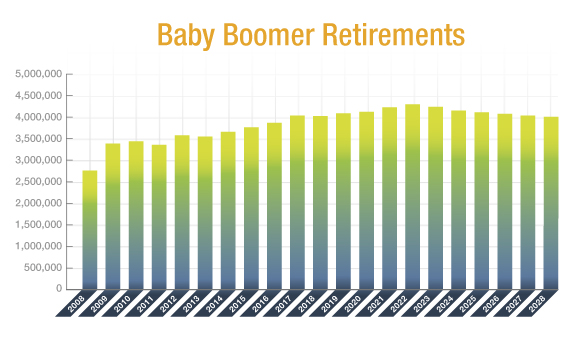
Baby Boomers Eligible for Retirement

This "Crisis" is NOT Going Away

Additionally, although I am interested in, and have dealt with, all of these issues people face in the course of introducing a social tool into the workplace, there is one of them I’m currently more interested in than others; that’s the second one she lists. Even more specifically, one of my main interests centers on the question “Do I have to be a Millennial to ‘be social’?” I even tweeted Trisha and asked her if I could use her proposal as a basis for a portion of my business model:

https://twitter.com/#!/rickladd/status/164839087180742656

A friend told me recently he’s been hearing more and more concern from large organizations about the upcoming wave of retirements from my generation – Baby Boomers. He is not alone. A decade ago, when I first started doing Knowledge Management work for Rocketdyne, one of the most important issues we wanted to address was the looming wave of Boomers who would be reaching retirement age and the threat that posed for the collective knowledge of our organization. As a company that designed, manufactured, tested, and flew the world’s most sophisticated rocket engines (including the Atlas, Delta, and Space Shuttle Main Engines), each of which had long histories and service lives (as systems, not as individual units), continuity of our knowledge was of paramount importance. Those of us who were actively pursuing KM were very concerned we would fall below a critical level of skill and jeopardize the safety of the Astronauts who flew the Space Shuttle.

Unfortunately, although lots of lip service was paid to the “looming” problem – as well as a lot of time and money likely heading off (in retrospect) in the wrong direction, turning that massive ship around was virtually impossible. Now that the program is over and there was nothing already in the pipeline to replace it, my alma mater is bleeding talent on a regular basis. I suspect there are lots of organizations facing this “crisis” as well. I’d love to be able to help them out . . . and here’s my business model (at least a portion of it; I’ve other things in the works as well).

With the growing number of Baby Boomers set to retire – or even partially retire (like I have) – and not reaching a crescendo for another decade, the issue we once dealt with as a Knowledge Management problem I now believe is one of acceptance of social media inside the firewall, i.e. the development and use of communities, facilitated by tools and leaders trained in their use as a knowledge transfer process. We spent many years finding and categorizing hard-copy and digital media. We’ve spent countless hours and dollars on exit interviews and video recording of retiring employees. All the time we kept saying tacit knowledge (the knowledge people carry around in their heads) was something like 80% of the actionable and useful knowledge possessed by an organization.

I have argued for some time that social media IS the new knowledge management. Although it’s now a bit old, I have a presentation on SlideShare I originally prepared for my cohort at CSUN‘s Tseng College, shortly after I finished a Masters program in KM. Sadly, though not surprisingly, the program no longer exists. I believe this is partly because they failed to recognize the power of social media to do what KM really needed to do. As practiced, in my experience KM was far more like Library Science. What is happening now is a sea change, a phase shift that employs technology capable of connecting people in real-time, while also providing a level of archival, indexing, and search capability that allows for historical knowledge discovery as well.

However, I’ve also experienced a high level of resistance to accepting what I consider to be inevitable. I can only speak for the aerospace industry, but I struggled to implement social business capabilities for nearly a decade and, as far as I can tell, my former organization is still fairly resistant to the possibilities it provides. This is the issue I believe others are encountering as well, and it is what Trisha’s presentation is all about. A more specific interest of mine is in gaining acceptance from the group of people who will be retiring within the next decade or so. I believe it’s important to engage older, soon-to-be retiring employees in the use of social business tools, not to “pick” their brains, but to provide a forum for interaction with their younger employees, within the tool (embedded within the processes they are currently employing, if possible), so their knowledge can be slowly transferred to those who will follow in their footsteps.

As a Baby Boomer who is entirely comfortable with the use of these kinds of tools and the behaviors that must exist in order for them to be effective, I believe I have a unique perspective to offer organizations who wish to engage their “more mature” employees. Many of them think they are incapable of understanding them or that you have to be young to employ them. Worse still, many have been influenced by the media’s depiction of tools like Twitter, Facebook, and YouTube such that they are currently incapable of seeing the value in micro-blogging, status posting, and video sharing to an organization’s ability to improve how they get things done. I – and, I’m sure, many others like me – can reach these employees far more easily than their younger colleagues, if only because we have the same generational backgrounds and have (or have dealt with) similar fears and anxiety.

This is why I believe Trisha’s presentation is important. It may not address the more sophisticated aspects many in the Enterprise 2.0 (or Social Business, whatever we wish to call it) world are concerned with as they mature and evolve their theory and practice, but it does directly address what I believe is a core issue with the effective use of these tools in our various organizations. Without acceptance, I am convinced the tools and practices that facilitate the sharing and use of “The Corporate Memory” will remain on the periphery of the enterprise and likely chew up more time and money than they’re worth and, in doing so, become more of an anchor than a sail. My goal here is not to delve too deeply into the many nuances of this issue – e.g. Tacit vs. Explicit knowledge, cultural change, the role of Executive leadership, etc. I will save that for further posts. However, I do think acceptance is a huge millstone hanging from the neck of many an organization. Am I too pessimistic? What do you think?

Graph Courtesy of InContext


To The Moon, Alice!

Moon Colony

Some Day This Should be all Ours

The other day a friend of mine posted an interesting item on his blog, Global Neighbourhoods (love that other side of the pond spelling) and asked on Twitter if anyone had read it. I saw the tweet because it was ported over to my Facebook news feed. I answered I hadn’t, but would shortly . . . which I did. Shel makes an interesting point that, regardless of how one may feel about Newt Gingrich – and we both agree we wouldn’t vote for him even if Hell froze over – his idea about establishing a colony on the Moon isn’t such a bad one. Consider that President Kennedy’s call to put a man on the Moon preceded an unprecedented growth in innovation through the technologies that needed to be developed in order to accomplish the feat required by the Apollo program.

Shel goes on to ask that we think about what such an endeavor might mean for us, regardless of the situation we are in right now. As he says:

“It seems to me, that what makes us unique from other animals is that our entire history is based on going beyond what we have done. Before we consider the benefits or catastrophes, we simply have to see if we can do it.

“Why should man walk on the moon? Because some day, we can build a colony on it? What will we do then? Look around and see what else we can do, where else we can go, we can learn more about the moon, and thus about the earth and our universe and how life got to here and anywhere else that it might exist.

“And yes the cost is huge at a time when people are losing their homes. But to me, the cost is an investment, one that will create a great many new jobs that may be more appealing than the manufacturing our current president seems to be focused upon.

“What we learn along the way will give the world new technology that is likely to pervade into computing, science, medicine, earth sciences, the classroom and places that we cannot yet imagine.”

I responded the next day in a comment. As of the date of this posting, it still says it’s waiting moderation but, hopefully, by the time most read this it will have been posted. Suffice it to say I agree with Shel’s assessment of the technologies it will create and that it is an investment. I also have another, long-standing reason I believe we should go back to the Moon and establish a permanent presence there, which I have set forth in my comment. I have also written about it several times in various posts on this blog. I encourage you to read Shel’s post. Tell him I sent you.

Photo Courtesy of Dallas1200am


A Quick Quora Quest

The Coastline of Atlantis

How Long Was The Coast of Atlantis?

I had to test posting this here directly from Quora . . . because it’s there (here) and I could . . . and it worked!

OK, so I’m not a Software Engineer. Heck, I’m not even an Engineer, but I did sleep in a Holiday Inn a few times; plus, I worked with Rocket Scientist, Engineers, and Mechanics for over two decades, so I know a little bit about the animal. I also worked in Project Management, including some software development and IT architecture efforts.

This is a really good – and entertaining – analogy of the problem posed in the question. Make sure you read the comments as well, because there are some add-ons that extend the analogy to include other issues not raised directly by the author of the answer. There are 80 answers to the question, but read the top one; the one that got well over 3500 votes. Read the others as well if you want to. Far be it from me to tell you what to do. While you’re at it, if you haven’t been to or heard of Quora before, you might want to check it out.

Engineering Management: Why are software development task estimations regularly off by a factor of 2-3? 80 answers on Quora

Why are software development task estimations regularly off by a factor of 2-3?

Photo shamelessly stolen from Professor Tomasz Zastawniak


Health News – Neuroscientists Find That Status within Groups Can Affect IQ

NOTE: This is the first time, to my recollection, I’ve posted directly from Posterous. I’m not sure how I want to deal with this, but thinking I’d rather share a link to the article than the whole damn thing. Nonetheless, this is a fascinating look at how social status can affect intellectual performance, which points out yet again the impossibility of understanding anything well in isolation from the system – or environment – within which it exists and operates. My comments from Posterous are at the end.

PASADENA, Calif.—Our cognitive abilities and decision-making skills can be dramatically hindered in social settings where we feel that we are being ranked or assigned a status level, such as classrooms and work environments, according to new findings from a team of researchers from the California Institute of Technology (Caltech) and four other institutions.

The finding flies in the face of long-held ideas about intelligence and cognition that regard IQ as a stable, predictive measure of mental horsepower.

“This study tells us the idea that IQ is something we can reliably measure in isolation without considering how it interacts with social context is essentially flawed,” says Steven Quartz, professor of philosophy at Caltech and one of the authors of the new study, which appears in the current issue of Philosophical Transactions of The Royal Society B. “Furthermore, this suggests that the idea of a division between social and cognitive processing in the brain is really pretty artificial. The two deeply interact with each other.”

“You may joke about how committee meetings make you feel brain-dead, but our findings suggest that they may make you act brain-dead as well,” says Read Montague, director of the Human Neuroimaging Laboratory and Computational Psychiatry Unit at the Virginia Tech Carilion Research Institute and corresponding author on the paper.

To investigate the impact of social context on IQ, the researchers divided a pool of 70 subjects into groups of five and gave each individual a computer-based IQ test. After each question, an on-screen ranking showed the subjects how well they were performing relative to others in their group and how well one other person in the group was faring. All of the subjects had previously taken a paper-and-pencil IQ test, and were matched with the rest of the group so that they would each be expected to perform similarly on an IQ test.

At the outset, all of the subjects did worse than expected on this “ranked group IQ task.” But some of the subjects, dubbed High Performers, were able to improve over the course of the test while others, called Low Performers, continued to perform below their expected level. By the end of the computer-based test, the scores of the Low Performers dropped an average of 17.4 points compared to their performance on the paper-and-pencil test.

“What we found was that sensitivity to the social feedback of the rankings profoundly altered some people’s ability to express their cognitive capacity,” Quartz says. “So we get this really quite dramatic downward spiraling of one group purely because of their sensitivity to this social feedback.” Since so much of our learning—from the classroom to the work team—is socially situated, this study suggests that individual differences in social sensitivity may play an important role in shaping human intelligence over time.

During the computer-based test, about a third of the subjects underwent brain scans, using functional Magnetic Resonance Imaging (fMRI). This type of imaging allows scientists to track increases in oxygenated blood flow, indicating heightened activity, in the brain. At the start of the test, researchers observed increased activity in all the participants in a brain region called the amygdala, which is associated with fear and emotional arousal. Among High Performers, that activation decreased over time, while it remained steady in Low Performers.

“What is causing the Low Performers to be hindered by the social context is something for follow-up studies, but certainly the suspicion is that it’s a dimension of personality that is driving the difference,” Quartz says. That dimension could be neuroticism, the tendency to worry or to ruminate about social information. “The pattern of activity that we see originally in both groups, but especially in the low-performing group, is quite similar to the pattern of activity you see in studies looking at the neuroscience of neuroticism.”

The researchers also tracked activity in the nucleus accumbens, a part of the brain involved in the processing of rewards. They observed elevated activity in the nucleus accumbens when a subject’s rank within the group increased. “That shows that the task was motivationally important to people,” Quartz says. “When they saw their rank go up, that was a reward.”

The idea for the new study came, in part, from a study published in 1999 in which researchers from Emory University examined social rank—a strong and extremely motivating signal among primates. It has long been known that even monkeys that have never met before can quickly sort themselves based on social standing within the group. The Emory researchers isolated low-ranking rhesus monkeys and taught them a learning task. They found that in the presence of high-ranking group members, the monkeys who had learned the task acted as though they were not familiar with it.

“Social rank isn’t as well understood in humans,” Quartz says. “So we wanted to see what would happen when social rank becomes salient in a group of humans, as it does in most real-world learning environments. We wanted to see if this has an effect on the expression of IQ.”

Throughout the 20th century, IQ was used in different arenas as a way of sorting or classifying people into niches. Because people believed it to be a more abstract notion of cognitive ability, it was thought to have strong predictive validity of mental capabilities even from age six. But IQ was always measured in social isolation. “That reflects a long tradition of intellectual history, of considering rationality and cognition to be this isolated process,” Quartz says. “But one of the things that we’re learning more and more in social neuroscience is the role of our social contexts and the social adaptation of the brain.” Understanding the role social context plays and its differential impact on the brain may ultimately help educators and others to design more effective learning environments.

The present study found some unexpected trends, including the tendency for female subjects to be more affected than males by the implicit signaling of social status during the test. Although all of the subjects scored similarly on the paper-and-pencil IQ test, 11 of the 14 Low Performers on the ranked group IQ task were female, while 10 of the 13 High Performers were male. Due to sample size limitations, additional studies are needed to validate the finding and to investigate possible causes.

In addition to Quartz and Montague, additional authors on the paper, “Implicit signals in small group settings and their impact on the expression of cognitive capacity and associated brain responses,” are Kenneth Kishida of Virginia Tech Carilion Research Institute, Dongni Yang of the Baylor College of Medicine, and Karen Hunter Quartz of the University of California, Los Angeles. Montague is also affiliated with the Wellcome Trust Centre for Neuroimaging in London. The work was funded by the Wellcome Trust Principal Research Fellowship, the Kane Family Foundation, and the National Institutes of Health.

# # #

Written by Kimm Fesenmaier

Deborah Williams-Hedges
626-395-3227

The part of this I find fascinating, even though I’m tempted to point out I’ve always found meetings a bit mind-numbing, is the apparent systemic nature of IQ and overall cognitive ability, and it’s (again apparent; more research is in order) cultural sensitivity. The apparent gender bias, for instance, tracks well with much previously observed behavior. I suspect there would be other, similar results in the future related to less generic (genderic?) aspects of culture as well. Vewy intewesting!


Giving this a test drive on my iPad

iBooks Author

iBooks and iBooks Author

Giving this a test drive on my iPad. Apple just released the updated version of iBooks today. They seem to be adding textbooks as I look. I’m downloading a free version of “Life on Earth: An Introduction” to see what it’s like. Text books are $14.99 or less!

NB – I posted this using HootSuite. Wasn’t sure how it would come out and I’m not enitrely happy with the result, but I’m editing it so I can keep it here.

UPDATE:

After installing the free textbook “Life on Earth: An Introduction”, I opened the book to see what it looked like. It started with a video that only played the audio and, when done, I found myself stuck in the app with nothing more than a grey, linen-like background and no discernible way to exit the app. I’m not sure how I eventually got out of it, but I did. I invoked the book again and this time the video played nicely. When it was done a table of contents appeared and started to skim the book. There is lots of interactive content available. However, after tapping on one of the numerous videos I was completely dropped out of the app (a problem that happens all-too-frequently with my iPad, I’m afraid) and, when I returned I was brought back to the very beginning, having to listen to the introduction again. I resumed my exploration and once again had problems with a video not playing properly, leaving me with that dismal grey screen again. This time I shut down the device and started it again. I assume that’s the equivalent of a cold boot.

After exiting the app entirely, I just started it up again. Unfortunately, although it brought me to the page I had left from, no sooner did it load then it dropped me back to the grey screen of death. At least I’ve been disabused of the notion that Apple’s just might be far superior to PCs. Sometimes I find myself sorry I didn’t spend my money on something else. I’m not pleased at this point. What I’ve seen of the textbook I have is exciting and makes me wish I was a few decades younger, as I think learning in school would have been far more interesting had I access to this type of book. Now I just need to figure out why the damn thing keeps dropping me out so thoroughly.


I Can Be This Boring. Really!

How many incredibly boring presentations have you sat through? How many times have you either missed just about everything that was presented because it was impossible to concentrate or you desperately wanted to get up and leave, only to remain because you didn’t want people to think you were uninterested in the subject or disrespectful of the presenter? As a former employee (now retired) of a large aerospace organization, I can tell you I have struggled mightily to stay awake through many a presentation consisting of literally dozens of bulleted PowerPoint charts being read, word-for-word, by the presenter, usually an Engineer . . . as a class not well-known for being the most exciting of speakers.

There is nothing quite so boring as a presentation where the person standing in front is reading the words you are quite capable of reading yourself, much faster than they can be spoken. As pointed out by both Edward Tufte and Richard Feynman, this kind of presentation is not only boring, but can be quite dangerous when used to convey (or obfuscate) critical information needed to make a life-and-death decision, such as those made with respect to both the Challenger and the Columbia disasters.

Admittedly, most presentations don’t convey life-and-death information, and I’m surely not implying they be given the same weight and import. However, there’s usually a reason, frequently a very good one, a presentation is being given and people are spending a portion of their precious time attending it. In that spirit and, thanks to Gil Yehuda and a Facebook share, I give you:


How Networked Science is Stretching Our Vision

Making Sense of it All

Making Sense of it All

My original intent for this blog was something far different than it’s become. I don’t think it’s a problem, as I seem to be morphing my approach into something that can easily accommodate that original intent. In case you aren’t aware of what I wanted to do when I began this little journey, I have described it somewhat here. I intend on updating that page periodically to keep up with the developments and changes as they occur (or, hopefully, shortly thereafter). This continues to be a work-in-process and I think that’s how I want it.

I have had a deep love and respect for the concept of Systems Thinking a good part of my adult life. As a young man I didn’t even know it was something people studied or wrote about; just that it seemed to be a useful way to look at the world and try to make sense of it. Recognizing the systemic nature of things and seeing the interrelationship (no matter how distant or tenuous) between them can, in my opinion, make them far more intelligible while increasing the odds of understanding consequences and why certain things happen.

Today I came across a wonderful article on Facebook from The Atlantic, through a post by John Hagel of the Deloitte Center for the Edge. I’m not “friends” with John, though I have sent him a request. In the meantime (and I assume he will likely ignore me) I do “subscribe” to his public updates. He shares some truly fascinating and interesting information.

The article is entitled “To Know, but Not Understand: David Weinberger on Science and Big Data” and he discusses and explains how the prolific growth of data, information, storage capabilities, and computing power is facilitating the understanding of large-scale or highly complex systems, despite their being beyond our ken as mere human beings. He points out that, despite our limitations as individuals to understand why some things work as they do, the growth of networked science is providing us with a capacity for making use of this data, information, and knowledge. I found it truly fascinating and want to share it here. If you have 10 – 15 minutes, I highly recommend you take the time to read it. Here’s the link.


Another Visit to Spamalot

Screenshot of comment spam

A Sampling of How Akismet Flags Comment Spam

A while back I wrote about some of the spam comments I have gotten on this site. According to the plug-in, Akismet, which WordPress provides me, I have had 18,202 spam comments intercepted by them. By the way, I use WordPress “dot com”, not “dot org”, though I have been considering moving over. I have been very happy with WordPress’s offering and it’s really tough to beat the price.

After I wrote that particular post, the number of spam comments I received seemed to level off at a tolerable rate; sometimes going for days with no flagged activity. However, during this holiday season it picked up dramatically and, in the past month I have probably been protected from a couple hundred spam comments. I think the biggest violator of my space has been Ugg boots (which hasn’t gone unnoticed by others), followed at a distance by Louis Vuitton. I have permanently deleted, collectively, a long essay’s worth of Cyrillic, some Chinese, a smattering of Hebrew, and quite a few short stories that made absolutely no sense at all. Invariably, the writing is atrocious. The most entertaining are the ones that seek to praise my writing style or the organization of the “site”, etc., presumably to flatter me so I won’t want to delete the comment. Fat chance!

At any rate, I took a partial screenshot of some of the latest (they’re coming in at a furious pace lately) before I deleted them. I’m including it so you can see what I see. I imagine each one of these represents a person who has been suckered into paying money for these attempted backlinks, though my knowledge of SEO (especially “Black Hat SEO“) is insufficient to be sure I fully understand why so many would continue doing this sort of thing.

I guess I’m naive. Fortunately, I’m not terribly gullible.

PS – To all my readers, thank you so much for taking the time to come here. I wish you a very Happy and Prosperous New Year. May 2012 bring you greater joy and contentment than you have enjoyed previously, and less damn fools to darken your doorstep 😦


One Way To Impress Your Colleagues

Kimchi Ingredients

Basic Kimchi Ingredients

I have been a lover of Asian food for most of my adult life. Among my favorites are Korean pickled vegetables, called Kimchi. Most people are only familiar with the one you’ll find in the supermarket, which is made of (generally) Napa cabbage and contains red chili pepper flakes. However, there are hundreds of varieties. There was until recently a pretty good Korean BBQ restaurant nearby that served a variety consisting of potatoes and sesame oil that I could make a meal out of. This, of course, is not a traditional variety of Kimchi but, being raised as a meat and potatoes kind of a guy, I found it immensely enjoyable.

Our Personal Stash

A good friend of ours has been making us one-gallon jars of Kimchi for many years. Usually it consists of quartered cabbage heads, vinegar, salt, dill, garlic, and yellow peppers, plus a few other spices. My wife, who is Sansei (3rd generation American-born Japanese), calls it Koko (similar to Tsukemono) and we enjoy it shredded with many a meal. Every once in a while our friend tries something else. For instance, just the other day she gave me a jar of pickled sweet onion. We have yet to taste them so the jury’s out on whether we’ll be happy with the result.

A while ago – like maybe ten years (my, how time flies!) – she made a batch of Kimchi out of Daikon radish, dill, and garlic. Now another of the kinds of pickles I’m really fond of, and consider comfort food, is kosher pickles; the more garlic, the better. She had cut up the Daikon into spears about the size of a quarter of a pickling cucumber and they were magnificent. To my taste buds, these pieces of pickled radish tasted like the best kosher pickles I had ever had and I couldn’t get enough of them.

At the time I took my lunch to work every day at ate at my desk. I brought some of these pickles with me one day and was sharing them with a colleague and friend who sat on the other side of our 1/2 height cubicle wall. We were marveling at the fullness of the flavor when I noticed people standing up at their desks and looking around. The term used back then for what I witnessed was “prairie dogging” and I soon heard someone say “what’s that smell?” I looked at my friend and, frankly, we didn’t smell anything. We were too busy enjoying the incredible, garlicky flavor of this wonderful condiment. In retrospect, I think we were insulated from the truth because we were so enamored of the flavor, and we chose to ignore what others were agitated about lest we had to stop eating.

Not Again?

The following day, I brought a container of pickled Daikon again and was sharing them over the wall as I had the day before. Sure enough, as the aroma spread out I noted a “wave” of people standing up to try and figure out what was going on. This time I called my wife at her place of work. “You know that Daikon Kimchi Chea Yon made for us?”, I asked. She replied in the affirmative. “Have you ever brought it to work?” Her reply, “Hell No! That stuff stinks!!”

I later discovered someone had actually called Environmental to suggest something had died in the ducting and request an inspection. I know I ultimately explained what the cause of the stink was, but I don’t think it was until much later. Chea Yon has never again made that particular kind of Kimchi for us, but I would kill to relive the experience.

Photo Courtesy of Korea.net