Category Archives: Social Media

Getting to Observable Work

Observable Work

We Can Work Smarter & More Effectively When We Can See What Our Colleagues Are Doing.

One of the concepts I think best conveys what many are trying to do with social media inside organizations, mostly large ones, is that of “working out loud” or “observable work”. The idea is that one’s efforts and day-to-day activities are conducted in such a way as anyone who wants to can find and see visible artifacts of that work.

There are numerous benefits to doing this. One way in which it is highly beneficial is it obviates the need for regular activity reporting. Where I used to work, a great deal of time was spent at the end of each month as employees gathered information and wrote up their reports on the activity they could recall or that they had been organized enough to make notes about.

Once they had done so, these reports went from the workers to first-level managers, who read, edited, consolidated, and passed the information up. This continued through the organizational hierarchy until it finally reached the President, where it had been re-written, re-organized, and (sometimes) thoroughly filtered to ensure bad news wasn’t included or was glossed over or minimized. Not the best way to do business, IMO. It was very stressful and quite time consuming.

A good friend and long-time blogger in the field of knowledge management and social media – Luis Suarez of IBM – recently summarized the most important issues he got from last month’s Enterprise 2.0 Conference in Boston. Especially useful to enabling observable work, I think, is Alan Lepofsky‘s concept of social task management, which Luis discusses in an excellent post on CMS Wire. There’s lots of good info Luis offers there as well as some links to other stuff, including one to an excellent Slideshare presentation on Social Fatigue. Check it out yourself:

http://www.cmswire.com/cms/social-business/social-task-management-when-social-business-got-down-to-work-016309.php


Ooh! Ooh! Look At Me!

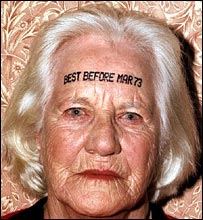
Too Old to Work?

Too Old to be Useful?

I’m fully aware my experience is entirely anecdotal. After all, it has happened – as far as I can tell – only to me. Furthermore, I really have no way of knowing why things occurred the way they did because I haven’t been made privy to the processes and decisions that went into the “invisible” side of my experience. Therefore, you may write these words off as the irascible grousing of a bitter old man, if you like.

Nevertheless, inasmuch as I have applied for a shitload full of jobs in the recent past, all of them online and most of them through LinkedIn, let me offer a little of my experience in doing so. When it comes to hiring, regardless of whatever else they may or may not do right, and regardless of the good intentions of no doubt good hearted people, HR departments suck at treating applicants as human beings.

Of all the positions I applied for, I would say no more than 20 – 25% of them acknowledged my existence in any way after I had completed my application. Of those, the majority were simple web pages that I was fed after completing their application. In total, I received no more than four email acknowledgements of my effort.

Unfortunately, my application was the last of our “engagement” and this was even true of organizations whose primary business was “Social” business. Even people I knew personally managed to avoid interviews or much, if any, communication. I don’t think it was because I have body odor, either.

One company, to which I applied for a community management position, sent me a four-page document containing around a dozen scenarios and problems they wanted me to respond to with my analysis of the situation and how I would handle it. I took the opportunity (and at least four hours) to respond to the challenge and provide what I hoped were good answers.

Despite my relatively rapid response, it wasn’t until I publicly wondered (on Twitter) why I was being ignored that I received an email (or was it a tweet?) informing me the job had been filled. Another company was kind enough just yesterday to let me know of another position that has been filled . . . months after I offered my application. I wonder why they never thought to interview me?

Here’s what I think may be happening. Despite all the rah rah talk about respect for the knowledge and experience of older workers, nobody really wants to hire someone my age. It’s pretty easy to figure out approximately how old I am simply by looking at my LinkedIn profile. If nothing else, you’ll be able to figure out I’m a Baby Boomer and, actually, with very little search proficiency, I believe one could ascertain my exact age with reasonable certainty. I have no intention of hiding it either.

I must point out, as well, I’m fully aware I have made a large portion of my life an open book by my participation in social media and through my blogging efforts. However, I also have a long track record of loyal and valuable leadership and service to an organization that played a significant role in the United States’ space program. I have also, for many years,  shared a great deal of the knowledge and experience I have gained from those efforts. There is a digital trail of my work as well.

I guess my best bet is to continue seeking clients who can use my assistance for short periods of time or for limited responsibilities. Let me say this to hiring managers, though. You really ought to figure out processes for treating your applicants with a bit more respect. I know they’re supplicants as well as applicants, but do you have to treat them like shit by essentially ignoring them throughout what is not a comfortable process to begin with? Just a thought. After all, the word “Human” is part of your process and job description, no?


Ooh! Ooh! Look At Me!

Too Old to Work? Too Old to be Useful?

I’m fully aware my experience is entirely anecdotal. After all, it has happened – as far as I can tell – only to me. Furthermore, I really have no way of knowing why things occurred the way they did because I haven’t been made privy to the processes and decisions that went into the “invisible” side of my experience. Therefore, you may write these words off as the irascible grousing of a bitter old man, if you like.

Nevertheless, inasmuch as I have applied for a shitload of jobs in the recent past, all of them online and most of them through LinkedIn, let me offer a little of my experience in doing so. When it comes to hiring, regardless of whatever else they may or may not do right, and regardless of the good intentions of no doubt good hearted people, HR departments suck at treating applicants as human beings.

Of all the positions I applied for, I would say no more than 20 – 25% of them acknowledged my existence in any way after I had completed my application. Of those, the majority were simple web pages that I was fed after completing their application. In total, I received no more than four email acknowledgements of my effort.

Unfortunately, my application was the last of our “engagement” and this was even true of organizations whose primary business was “Social” business. Even people I knew personally managed to avoid interviews or much, if any, communication. I don’t think it was because I have body odor, either.

One company, to which I applied for a community management position, sent me a four-page document containing around a dozen scenarios and problems they wanted me to respond to with my analysis of the situation and how I would handle it. I took the opportunity (and at least four hours) to respond to the challenge and provide what I hoped were good answers.

Despite my relatively rapid response, it wasn’t until I publicly wondered (on Twitter) why I was being ignored that I received an email (or was it a tweet?) informing me the job had been filled. Another company was kind enough just yesterday to let me know of another position that has been filled . . . months after I offered my application. I wonder why they never thought to interview me?

Here’s what I think may be happening. Despite all the rah rah talk about respect for the knowledge and experience of older workers, nobody really wants to hire someone my age. It’s pretty easy to figure out approximately how old I am simply by looking at my LinkedIn profile. If nothing else, you’ll be able to figure out I’m a Baby Boomer and, actually, with very little search proficiency, I believe one could ascertain my exact age with reasonable certainty. I have no intention of hiding it either.

I must point out, as well, I’m fully aware I have made a large portion of my life an open book by my participation in social media and through my blogging efforts. However, I also have a long track record of loyal and valuable leadership and service to an organization that played a significant role in the United States’ space program. I have also, for many years,  shared a great deal of the knowledge and experience I have gained from those efforts. There is a digital trail of my work as well.

I guess my best bet is to continue seeking clients who can use my assistance for short periods of time or for limited responsibilities. Let me say this to hiring managers, though. You really ought to figure out processes for treating your applicants with a bit more respect. I know they’re supplicants as well as applicants, but do you have to treat them like shit by essentially ignoring them throughout what is not a comfortable process to begin with? Just a thought. After all, the word “Human” is part of your process and job description, no?


More of That Lifelong Learning!

The Queen Mary from my hotel window

The Queen Mary Outside My Hotel

I just finished my presentation, the last in a group of three on the subject of social media for the American Oil Chemists’ Society’s meeting in Long Beach, CA. This was a huge event, with about 1500 people and lots of organizations in attendance.

The room was set up for nearly 300 people, but no more than 30 – 40 were in attendance at any one time. I have since learned (and am not in any way surprised to find) that the scientists in the organization are somewhat reticent to adopt social media. Actually, I’m very familiar with the problem and even discussed it in my presentation.

One thing I think I’ve gotten out of this, as a result of going through the process of creating my schpiel and also from my conversations with my co-presenters, who both have businesses they’ve been running for about as long as I was at Rocketdyne, is a clearer understanding of what I may have to offer and can build a viable business around.

Both of them told me nobody’s providing much in the way of education and services designed for the use of social media inside an organization. Both of their presentations were about the value of social media, but they were focused almost entirely on how to use it to either market your organization or to connect with like-minded people in order to build your connections or your personal brand.

After I finished, we sat down for a panel discussion. Frankly, I wasn’t feeling all that good about my efforts, but I do seem to be my own worst critic. However, one of the members of the Society, who has been attending meetings since 1976, got up and said he thought ours was the best session he had ever attended. That felt pretty darn good to hear!

One more bright spot. I was asked to write an article on my subject for their industry publication and expect to hear more about it in the next several days. We’ll see how that goes. I’m glad I put this presentation together and now I’m going to refine it and see if I can find other places who would like me to give it. I’m told there’s a market out there. Now I have to find it.


Are You Comfortable With Being Social?

A Child's Trust

Trust. Catch Some!

Funny thing about blogging. Unless someone takes the time to comment, or they subscribe, there’s no way to know who is reading and what interests them. There are lots of tools to figure out where traffic comes from, including a list of the search terms that brought people to my site, but it really doesn’t help me understand as thoroughly as I’d like which of my posts strikes a chord

On the other hand, I’ve been testing the waters with a couple of different styles and I’m working on changing voice as well. So, I’m mostly writing to say what I have to say and it’s kind of like “damn the torpedoes, full steam ahead” . . . “let the chips fall where they may”. That isn’t to say I don’t care. I do. What it does say, though, is I’m not sure who will be interested in what I’m sharing today.

My history with, and interest in, Enterprise 2.0 (now mostly referred to as “Social Business“) has brought me a lot of “friends” I would not otherwise have encountered. When I say “friends” I am referring to people, some of whom I have never met in person, and some of whom I’ve only actually seen once in my life. The person who gave the presentation that appears below is one of the latter, though we’ve communicated in various ways in the past nearly two years.

I first met him at the Enterprise 2.0 Conference in Boston in June of 2010. I didn’t realize it at the time, but later discovered he coined what had become one of my favorite words – folksonomy. I had been arguing for some time that we (Pratt & Whitney Rocketdyne, where I was working) should concentrate less on a formal taxonomy for our explicit knowledge artifacts (meaning paper reports and electronic files) and go with tagging, which would create a useful folksonomy. Actually, I was arguing at the time for developing a hybrid, i.e. providing a “recommended” set of tags, allowing leeway in using them and creating new ones, and occasionally “culling” the list to get rid of the less useful tags while retaining the most useful ones for later use.

At any rate, Thomas has become a valuable source of understanding. I appreciate his insights and only wish I was in a position to attend more conferences and the kinds of presentations from which I can learn other viewpoints about the use of social media, especially for business. While I have some reasonably well-developed concepts and a fairly good understanding, there are so many areas where others have far more experience than I, especially when it comes to the information technology (including IA, Information Architecture) aspects of how it affects people and their relationships.

Below I’ve embedded the presentation Thomas gave at a recent conference on IA, which he just uploaded to Slideshare. Since he uses the same philosophy of presenting that I and many others do, i.e. avoid bullet points wherever humanly possible, use lots of interesting graphics, and talk your butt off, I can’t be quite certain I understand the point(s) behind every slide, but I think I get his drift. In fact, I love the concept of “Social Comfort” as I spent many years working to alleviate the discomfort so many of my colleagues seemed to feel back in the day. I also like his idea of avoiding use of the word “Trust” and – instead – substitute related words that evoke a feeling of trust, e.g. dependable, believable, treasured, consistent, honest, etc.

Going back to my use of the word “friends” for people I don’t really know or, at least, have never met in person. I consider them friends precisely because over time they have shown themselves to be dependable, consistent, honest, etc. That is, I’ve come to trust them based on numerous instances of conversation or reading something they’ve chosen to share not only with me, but with the entire online community. People who are unworthy of our trust don’t stick their necks out very often . . . if at all. The people I consider friends do so repeatedly, which is something I cherish.

I hope you can glean something useful from Thomas’s presentation. I believe I have. Feel free to comment here or to go to Slideshare and comment directly to Thomas if there’s something you don’t get or would like to discuss with him further.

Trust photo by mikebaird


Are You, or Should You be, Shopping Local?

Shop Simi Valley First Logo

My City's Logo for Encouraging Local Shopping

There are several commercial “movements” gaining steam nowadays expressing the desire of smaller communities to get residents spending more of their money at local, usually small, businesses. Small Business Saturday’s Facebook page has almost 3 Million “Likes”. My city of Simi Valley has spent a fair amount of money promoting the concept. Locally it’s called “Shop Simi Valley First“. Unfortunately, the money that was used to create the website and other marketing efforts to support it has now dried up, possibly never to return. On the bright side, some of our citizens created a Facebook page for them and it’s approaching 1K “Likes”. It might increase now that the “official” effort is unfunded. I think this is a good thing and here’s why.

For the last year or so I have been gently pushing the city, and local small businesses, to recognize the power available to them in the use of social media to market themselves, as well as to create connections that just haven’t been possible in the past. I think, when it comes to marketing – especially in terms of encouraging local residents to patronize small businesses in our city – the connectivity and mutual support provided by services like Facebook, Twitter, and Yelp may prove a decisive factor in reasonable, if not substantial, growth.

As I see it, local small businesses can use these services not merely to promote themselves individually but, as long as there’s no conflict of interest, they can also promote each other. Here’s what I imagine happening.

Let’s say you have a restaurant that serves a reasonably upscale clientele. You know there is a certain demographic that’s not terribly likely to frequent your business. Maybe they’ll patronize your place on special occasions, but not regularly. Would it be a bad thing to give props to other eating establishments more desirable or affordable to those people? Would it threaten your business or might it not actually result in your being recognized as more friendly and approachable? I’m betting the latter is more likely.

Perhaps you own a clothing store, a dry cleaners, or you’re a Dentist or other professional or service provider. I see no reason why you can’t agree with other businesses to post on each others’ Facebook pages once in a while, sharing what you have to offer or special deals you’re running at the time. Frankly, I haven’t worked out all the details in my head yet. I’ve tried to work with local businesses and the City to encourage this type of practice using social media but, much like my experience at Pratt & Whitney Rocketdyne, I’ve met a lot of inertia and resistance to change, even in the face of impending closure or bankruptcy. Part of it is a lack of understanding and part of it is a lack of resources, but the result is the same. Nothing much is happening.

What I envision happening is essentially two-fold. The first thing is that participating businesses benefit from the following of the other businesses on whose Facebook pages they promote themselves. This increases the likelihood of their being noticed by a larger group of residents. Secondly, it also increases the chances people in outlying areas will become aware of local businesses, thereby increasing the possibility people from neighboring cities may drive on over and patronize our local businesses a bit more frequently.

Does this make sense to you? What do you think about promoting local small business and how well do you think the use of social media platforms like Facebook, Twitter, and Yelp can increase awareness of certain types of businesses? I’d sure like to see a more coordinated, concerted effort at making it happen.


Occupy Communities

The title for this post comes from a session my friend, Trisha Liu, has proposed for this June’s Enterprise 2.0 Conference in Boston, MA. I came across it the other day quite serendipitously while checking a few Twitter streams on my iPad as I waited for my car to be washed. The title caught me eye immediately as anyone who knows me will understand, especially when read in its entirety, viz “Occupy Communities: Social Media Training for the 99%”. If you have a moment please visit the page and, if you agree it’s a great idea, leave a comment saying so.

Despite the call to my base political instincts, upon reading Trisha’s idea there were several reasons her proposal resonated with me. Foremost, Trisha is addressing the fear of adoption of social tools for business (i.e. inside the organization, behind the firewall, and dedicated to facilitating the business processes that carry the enterprise forward in its mission). I spent many years at a staid old aerospace company beating my head against a wall of resistance fueled by this fear. She refers to it as “SoMe-itis” and breaks it down into the following components:

  • Shock: “Help!! My company wants me to ‘be social’!”
  • Split personality: “Do I have to be a nerd/extrovert/Millennial to ‘be social’?”
  • Dry mouth: “How do I choose what to ‘say’ in social media?”
  • Anxiety: “What if I say something dumb?”
  • Low self esteem: “Will people care about what I have to say?”
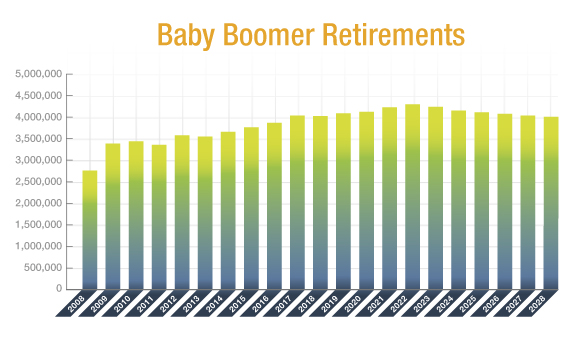
Baby Boomers Eligible for Retirement

This "Crisis" is NOT Going Away

Additionally, although I am interested in, and have dealt with, all of these issues people face in the course of introducing a social tool into the workplace, there is one of them I’m currently more interested in than others; that’s the second one she lists. Even more specifically, one of my main interests centers on the question “Do I have to be a Millennial to ‘be social’?” I even tweeted Trisha and asked her if I could use her proposal as a basis for a portion of my business model:

https://twitter.com/#!/rickladd/status/164839087180742656

A friend told me recently he’s been hearing more and more concern from large organizations about the upcoming wave of retirements from my generation – Baby Boomers. He is not alone. A decade ago, when I first started doing Knowledge Management work for Rocketdyne, one of the most important issues we wanted to address was the looming wave of Boomers who would be reaching retirement age and the threat that posed for the collective knowledge of our organization. As a company that designed, manufactured, tested, and flew the world’s most sophisticated rocket engines (including the Atlas, Delta, and Space Shuttle Main Engines), each of which had long histories and service lives (as systems, not as individual units), continuity of our knowledge was of paramount importance. Those of us who were actively pursuing KM were very concerned we would fall below a critical level of skill and jeopardize the safety of the Astronauts who flew the Space Shuttle.

Unfortunately, although lots of lip service was paid to the “looming” problem – as well as a lot of time and money likely heading off (in retrospect) in the wrong direction, turning that massive ship around was virtually impossible. Now that the program is over and there was nothing already in the pipeline to replace it, my alma mater is bleeding talent on a regular basis. I suspect there are lots of organizations facing this “crisis” as well. I’d love to be able to help them out . . . and here’s my business model (at least a portion of it; I’ve other things in the works as well).

With the growing number of Baby Boomers set to retire – or even partially retire (like I have) – and not reaching a crescendo for another decade, the issue we once dealt with as a Knowledge Management problem I now believe is one of acceptance of social media inside the firewall, i.e. the development and use of communities, facilitated by tools and leaders trained in their use as a knowledge transfer process. We spent many years finding and categorizing hard-copy and digital media. We’ve spent countless hours and dollars on exit interviews and video recording of retiring employees. All the time we kept saying tacit knowledge (the knowledge people carry around in their heads) was something like 80% of the actionable and useful knowledge possessed by an organization.

I have argued for some time that social media IS the new knowledge management. Although it’s now a bit old, I have a presentation on SlideShare I originally prepared for my cohort at CSUN‘s Tseng College, shortly after I finished a Masters program in KM. Sadly, though not surprisingly, the program no longer exists. I believe this is partly because they failed to recognize the power of social media to do what KM really needed to do. As practiced, in my experience KM was far more like Library Science. What is happening now is a sea change, a phase shift that employs technology capable of connecting people in real-time, while also providing a level of archival, indexing, and search capability that allows for historical knowledge discovery as well.

However, I’ve also experienced a high level of resistance to accepting what I consider to be inevitable. I can only speak for the aerospace industry, but I struggled to implement social business capabilities for nearly a decade and, as far as I can tell, my former organization is still fairly resistant to the possibilities it provides. This is the issue I believe others are encountering as well, and it is what Trisha’s presentation is all about. A more specific interest of mine is in gaining acceptance from the group of people who will be retiring within the next decade or so. I believe it’s important to engage older, soon-to-be retiring employees in the use of social business tools, not to “pick” their brains, but to provide a forum for interaction with their younger employees, within the tool (embedded within the processes they are currently employing, if possible), so their knowledge can be slowly transferred to those who will follow in their footsteps.

As a Baby Boomer who is entirely comfortable with the use of these kinds of tools and the behaviors that must exist in order for them to be effective, I believe I have a unique perspective to offer organizations who wish to engage their “more mature” employees. Many of them think they are incapable of understanding them or that you have to be young to employ them. Worse still, many have been influenced by the media’s depiction of tools like Twitter, Facebook, and YouTube such that they are currently incapable of seeing the value in micro-blogging, status posting, and video sharing to an organization’s ability to improve how they get things done. I – and, I’m sure, many others like me – can reach these employees far more easily than their younger colleagues, if only because we have the same generational backgrounds and have (or have dealt with) similar fears and anxiety.

This is why I believe Trisha’s presentation is important. It may not address the more sophisticated aspects many in the Enterprise 2.0 (or Social Business, whatever we wish to call it) world are concerned with as they mature and evolve their theory and practice, but it does directly address what I believe is a core issue with the effective use of these tools in our various organizations. Without acceptance, I am convinced the tools and practices that facilitate the sharing and use of “The Corporate Memory” will remain on the periphery of the enterprise and likely chew up more time and money than they’re worth and, in doing so, become more of an anchor than a sail. My goal here is not to delve too deeply into the many nuances of this issue – e.g. Tacit vs. Explicit knowledge, cultural change, the role of Executive leadership, etc. I will save that for further posts. However, I do think acceptance is a huge millstone hanging from the neck of many an organization. Am I too pessimistic? What do you think?

Graph Courtesy of InContext


The Many Uses of Facebook

Speak Up?

Thinking Back

A while back I wrote about the dilemma I faced when I first realized my Facebook “friends” consisted of numerous constituencies, and my concern that speaking frankly to one may unwittingly offend or alienate some from another. I also mentioned that, despite this initial fear, I quickly resolved it in favor of just being myself and not worrying too much about it.

Lately I’ve noticed another phenomena that’s been slowly creeping into my activity on Facebook. While it’s related to my interest in economics and politics, it does seem to be driven considerably by the Occupy movement (I use only Occupy advisedly, as there exist not merely an Occupy Wall Street group – which started this whole thing – but also other groups, most evident on Facebook as Occupy Together, Occupy Marines, etc.)

As part of my decision to just “let it all hang loose” and be myself, I have increasingly shared articles, pictures, etc. from some of the political sites I either frequent or that like-minded friends have shared with me. As it happens, I generally characterize my political leaning as so far to the left I’m almost a Libertarian (mind you, emphatically not one). I have also responded to some posts from people with whom I don’t exactly agree, telling them politely of my problems with their positions. Most of these conversations have been quite pleasant; spirited debates over policy and principle. Several times someone has actually commented on how they were pleased with the civility of the thread and its participants.

Is Useful Political Discourse Possible?

So, what I’m beginning to wonder is if this is, indeed, a new phenomena that may turn out to be useful and healthy for political discourse. If you have a fair amount of friends there’s a substantial chance they will represent numerous viewpoints and positions on the important issues facing us. Might not we be able to understand each other better and, consequently, move away from the precipice of irreconcilable differences we seem to be teetering on lately?

I have to admit there is a bit of a dark side to this as well. Two things have happened to me that I find a bit chilling. The first was a friendly “suggestion” I received that I might want to tone it down a bit when discussing the Occupy movement and the politics and economics behind it. The impact this might have on my standing in the business community was the implication, and its seriousness did not go unnoticed by me. The second is related, but needs a bit of background.

UC Davis Pepper Spray Incident

Not Exactly a Meeting of Minds

Maybe We Can’t All “Just Get Along”

I live in a relatively insular city – Simi Valley, CA – home of the Ronald Reagan Presidential Library and Museum. The City leaders are, for the most part, far more conservative than I am (who isn’t?) and I have become Facebook friends with a lot of them, including the Mayor, members of the local Chamber of Commerce, and at least one City Council member. Being a strong proponent of the right of free speech, I have spoken my mind rather openly; at least on Facebook. I don’t get into too many political discussions when doing business and I am a big supporter of local small business and wish to actively contribute to making our local economy strong and vibrant.

Last night I realized the City Council member had “unfriended” me, presumably due to a conversation I had with a couple of his friends. As I recall, it was one that received a post of praise for its tenor and the level of intellect involved. I do recall, though, I was very adamant in pointing out what I saw as fallacious arguments based on incomplete or incorrect knowledge. Frankly, I’d like to hear of anyone having a really fruitful discussion about the merits of Dialectical Materialism with a rabid anti-Communist. In my experience, the philosophy behind Marxism is little known here in these enlightened United States, and it’s very hard to receive any respect from someone who is certain of the correctness of their knowledge and the evilness of yours.

A Profound Dilemma

So I’m also wondering . . . despite my essentially being out of the job market and, therefore, not having to worry about alienating a potential employer, do I now have to censor myself politically lest I “upset” a city leader and risk throwing a roadblock in my meager, but important, efforts at making Simi Valley a better place to live? I don’t ask that people agree with me; merely that they respect my position and – especially – my desire to do what’s right for the community as I see it . . . just as I respect their beliefs and integrity. I really don’t care for revisiting this whole dilemma around what’s appropriate when it involves the core issues of our lives and livelihoods.

As well, I’m very disappointed this person decided to unfriend me. I believe we have more in common than we differ on. I also wanted to keep up with what he was doing as a Councilperson, as he uses Facebook to post from various events he is involved with. It seems I’ve been cut off from a useful, viable channel to the goings on of one of my city’s leaders and I’m still not sure how I feel about it. How do you feel about this?

Mouth/Flag Image from reading. writing. revolution


Hey! Long Time, No See.

Putting The Pieces Together

These Trying Times

So . . . I haven’t written much lately. I had been writing about things I believe will be helpful to the people and organizations I’m beginning to work with to build their businesses in these trying times. This has been, however, a period of transition for me and sometimes I feel the need to concentrate on what I’m doing, as well as on my current clients and others who have expressed an interest in using my services. One of those services is not yet writing a blog; at least not this one.

The last few weeks have been quite interesting for me. I’ve been working in earnest with two larger clients, both of whom require a lot of attention and even more learning on my part. They are helping me continue my journey from the corporate world to the world of small business. The differences are stark and, sometimes, very challenging to deal with competently. Frightening is a word that comes to mind some times as well.

I live in a comparatively small town. Simi Valley has a population – according to the last census – of nearly 125,000 people. Not tiny by a long shot, but pretty small compared to its neighbor, Los Angeles. Everybody doesn’t know everybody, but it can seem that way at times. It took a while, but I finally settled on a business model I though made sense and, slowly but surely, it seems to be working out. The model is simple. Provide social media marketing coaching for small businesses.

The model may be simple, but I’m discovering the execution of that model is fraught with difficulty. I think there are two things that make selling my services so hard. The first has to do with the lack of understanding – and misunderstanding – of the role social media plays in marketing one’s products or services; the second is tied to the economics of very small businesses and the current state of the economy. I am addressing the former in several different ways, but the latter is something I have little control over.

What’s both interesting and frustrating is that various surveys are showing greater and greater acceptance of social media within large organizations, but it doesn’t seem to be translating into the same interest and use by small businesses. For instance, I am working with a small development company/landlord that has approximately 30 retail tenants. All of these businesses could benefit from the use of social media to market themselves.

They are a combination of restaurants, retail shops, service organizations, and professionals – each with slightly different but closely related needs when it comes to marketing. The landlord is very supportive of the tenants, always looking for ways to increase traffic and visibility of their businesses. They’ve even offered to underwrite some of my services, and I’ve endeavored to offer a package that would be both useful and quite affordable.

Regardless, it feels like pulling teeth to get most of these businesses to take advantage of either the services available to them or the coaching and analysis I can offer in their proper use. This is an ongoing battle I’m not willing to forsake at this time, as I am committed to seeing my little town weather this economic storm and, if at all possible, even thrive. I’m working on different methods to help and am hopeful that some combination of offers will allow me to be both useful and modestly profitable. In addition, I hope to share more and more of what I’m discovering as I travel this new road. Stay tuned.

Photo Credit:

Winston-Salem-SEO.com


Are Marie Callender’s & Applebee’s Providing Us Object Lessons?

Recently, our local (here in Simi Valley, CA) Marie Callender’s restaurant – a staple of the community for at least a couple of decades – was shut down as part of the recently merged (with Memphis based Perkins) company’s bankruptcy. I belong to a business network that has met there for most of the time they’ve been in business, though I’ve only been a member for less than a year. Still, having to eat breakfast there once a week was a bit of a trying experience, as the food was a couple taste buds short of mediocre.

The business network has a system of points one can earn for providing “tips”, which can run the gamut from a couple thousand dollar repair to your vehicle or home or eating a meal at a member’s (which Marie Callenders was) establishment. It’s a system that just invites gaming (in the worst sense of the word), inasmuch as each tip carries the same weight or value. Needless to say, many of the members found themselves eating there a couple of times a week. I never could bring myself to do so.

As part of my membership, I offered to provide a couple of free hours of social media marketing coaching and to see to it that each member had access to those services that promised to help their business out. Very few of them took me up on it; probably because most of these guys are almost as old as I am :). Marie Callenders was one of those businesses I struggled valiantly to see the efficacy of at least paying attention to what was being said about them online, especially the reviews that were being written on Yelp. They wouldn’t pay attention. My research had shown they were getting some pretty uniformly horrible reviews and, clearly, no one was paying much attention to them. I’m not surprised they’re no longer in business.

Though I can no longer check the reviews of our local Applebee’s – you see, they’ve closed down as well, actually before MCs did. Yelp doesn’t retain reviews after a business closes its doors. I now wish they would, if only so I could make sure my understanding of what happened is close to the truth.

I’m bringing this up in large part because a friend of mine posted an interesting piece entitled “Applebee’s Review Explains Why Companies Should Care About Online Reviews” (link). I think Mark hits the head right on the nail (sic) and find myself wondering if the experiences we’re seeing with Marie Callenders and Applebee’s aren’t indicative of just how useful these growing online review services are to those of us who like to eat out.

For quite some time in the enterprise world, the questions those of us advocating for greater use of social media had to answer consistently was, “What’s the ROI (Return on Investment) of using these tools? Why should we spend the money unless you can show us there’s added value in it?” Frankly, for a long time I struggled with the answer. It seemed clear to me they provided the basis for greater collaboration, easier communication, faster innovation, etc., but these things were hard to quantify in a classical sense. The answer that has stuck in my mind, though, (and I can’t recall where I heard it) is “The ROI of using social media is you’ll still be in business in five years.” I know that was somewhat glib, but I’m wondering now if Marie Callenders and Applebee’s aren’t providing us object lessons on just how prescient that statement was.