I came across this poem a couple of years ago and shared it on Facebook. It just came back as one of my “memories” and I was a bit stunned to realize I had completely forgotten about it. I’ve thought about (and written about on occasion) death, though it was always kind of philosophical; musings on mortality if you will.
However, given the health issues I’ve experienced in the past nearly nine months, I’ve begun thinking seriously about the inevitable. The other day I made my oldest daughter my legacy contact for everything Apple and I have a lot more to get done in the next few months. I also told my wife I thought this poem would be nice to read if there’s any kind of memorial service conducted after my death. I’m also including the introductory comments from the person who originally shared it.
Since it is an optional reading in the Reform Jewish liturgy recited before the Mourner’s Kaddish, and I was raised as a Conservative Jew, I’d never encountered it. I find it breathtaking. Hope it resonates.
”Every once in a while, a poem or song is so well constructed, so clearly conveys the authors meaning and is so precisely expressive that it becomes something of an anthem. The poem below, Epitaph, was written by Merrit Malloy and as one of those poems, has become a staple of funeral and memorial services…for good reason.”
Epitaph – By Merrit Malloy
When I die Give what’s left of me away To children And old men that wait to die.
And if you need to cry, Cry for your brother Walking the street beside you. And when you need me, Put your arms Around anyone And give them What you need to give to me.
I want to leave you something, Something better Than words Or sounds.
Look for me In the people I’ve known Or loved, And if you cannot give me away, At least let me live on in your eyes And not your mind.
You can love me most By letting Hands touch hands, By letting bodies touch bodies, And by letting go Of children That need to be free.
Love doesn’t die, People do. So, when all that’s left of me Is love, Give me away. I’ll see you at home In the earth.
Today would have been my mother’s 99th birthday. It’s been 18 years since she died and, truth to tell, I don’t think of her all that often. Time, as they say, softens the blow of a loved one’s loss. It’s surely the case with my feelings toward my mother. I do, however, keep her birthday as an event on my calendar so I’m reminded at least once a year of her presence in my life.
My father died 21 years before her and my brother and I made sure she was taken care of until her final moments. I must admit there are moments—even to this day—when I question whether we did all we could for her, but I don’t find doing so all that useful as I am pretty sure we did out best. We weren’t wealthy or powerful; just a couple of working class guys doing our best.
I even lived with her for a while to help her stay in the house she had been living in for some time. I don’t quite remember the details of why that changed; it was probably due to my needing to get on with my life. Shortly after that we moved her into a modest one-room apartment not too far from the house where she had been living.
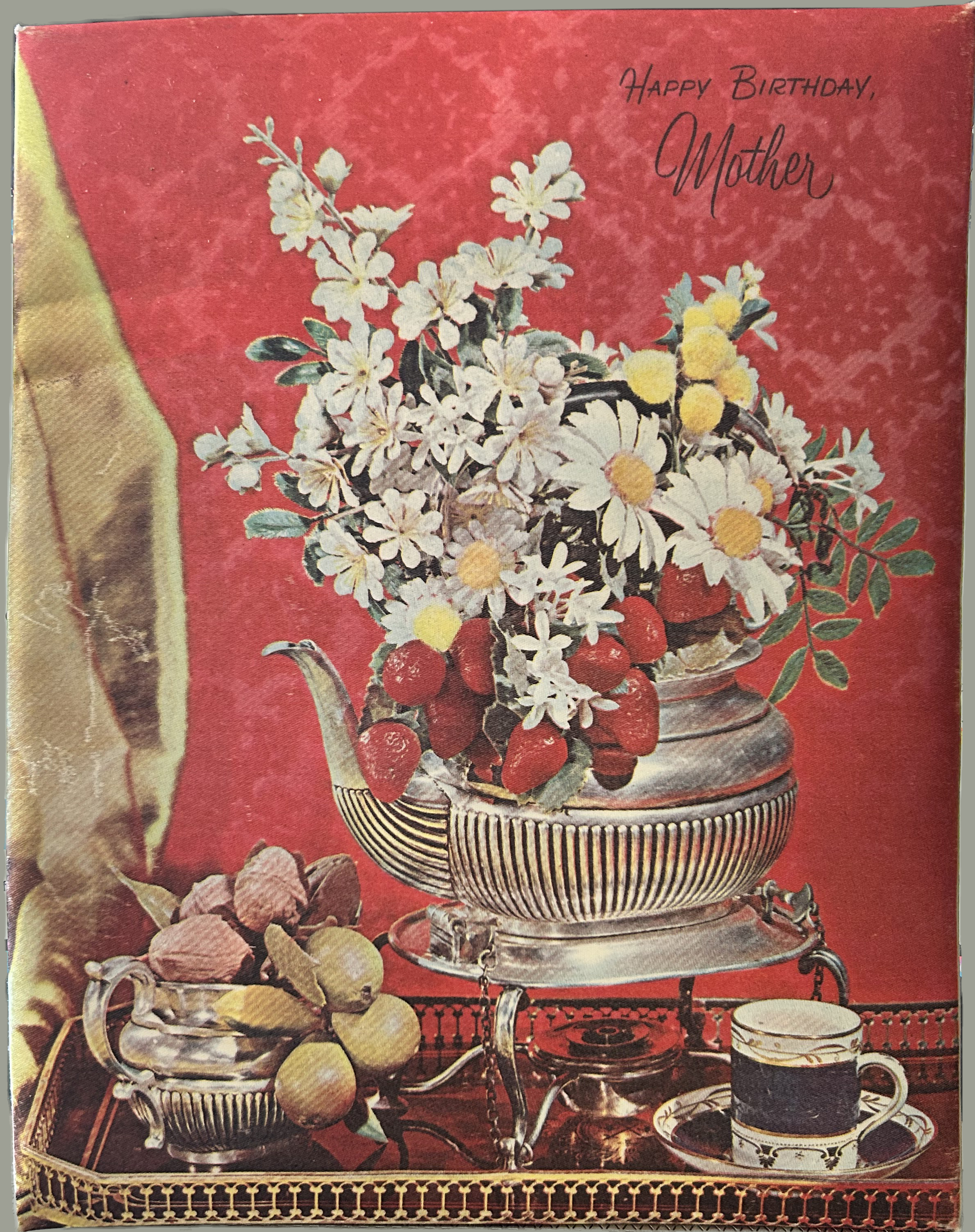
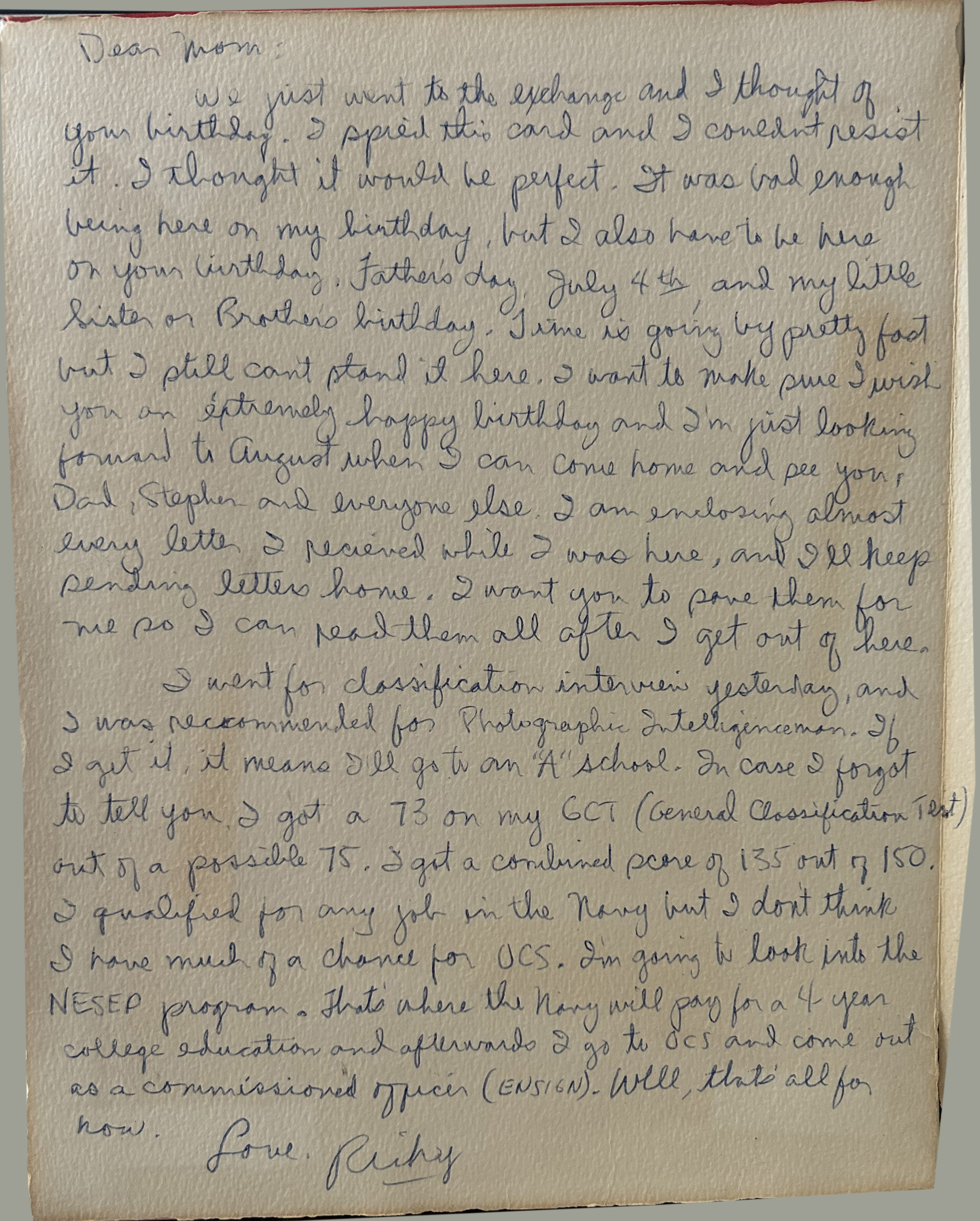
After she died, my brother and I (don’t remember if our sister was able to help) went to her apartment and cleaned it out. As I was going through her stuff and deciding what to do with things, I came across a birthday card I had sent her from US Navy boot camp, in June of 1966. That she had kept it all those years moved me to tears. After all, my feelings over her loss were still pretty raw.
I’m sharing these pictures of the card and what I wrote mostly as a way of preserving a bit of my history and as a testament to my mother. She was very good to me and, although I have gotten over her death (hell! I’m now contemplating mine) I am grateful for what she did for me and how much she loved and took care of me.
Came across this wonderful, reasonably short article about death and dying, a subject I have long been interested in; especially as I’m winding down my 75th year here.
Preparing for death by making peace with it.
Excerpt:
First, you withdraw.
Life shrinks down to the size of your home, then to your bedroom, then to your bed—sometimes over months, but more often over weeks.
Old joys stop having the same pull.
You eat less, drink less. Have less interest in speaking.
As your body’s systems start shutting down, you have less and less energy.
You sleep more and more throughout the day.
You start to slip in and out of consciousness and unconsciousness for longer periods of time.
Staying alive starts to feel like staying awake when you are very immensely tired.
At some point, you can’t hold on any longer.
And then you die.
A calm fall into a cosmic sleep.
But that’s not even the half of it.
Read more (much more) by clicking on the link below:
I just realized … of all the ways in which this pandemic has changed me, the biggest difference between now and a little over a year ago is … it’s turned me into an introvert. Linda used to complain that we were always the last to leave a party, which was true as I loved engaging not only my friends and relatives, but anybody who was interesting and willing to discuss a huge range of subjects.
I’m one of those people who readily starts up conversations with strangers; at least I used to be that kind of person. I’m not so sure anymore. I’ve gotten so accustomed to staying home and reaching out through Facebook, Twitter, and my blog that I no longer feel much of a need to get out of the house and do something.
OTOH, there is a part of me that’s kind of chomping at the bit; anxious to get back to the way things were, at least in terms of being able to go grocery shopping or eating out, etc. I’m fully vaccinated and, as most of my friends know, was infected with—and recovered from—Covid this past January. I’m about as safe as I’m going to be. I will continue to wear a mask when grocery shopping, but will also be looking for opportunities to go maskless.
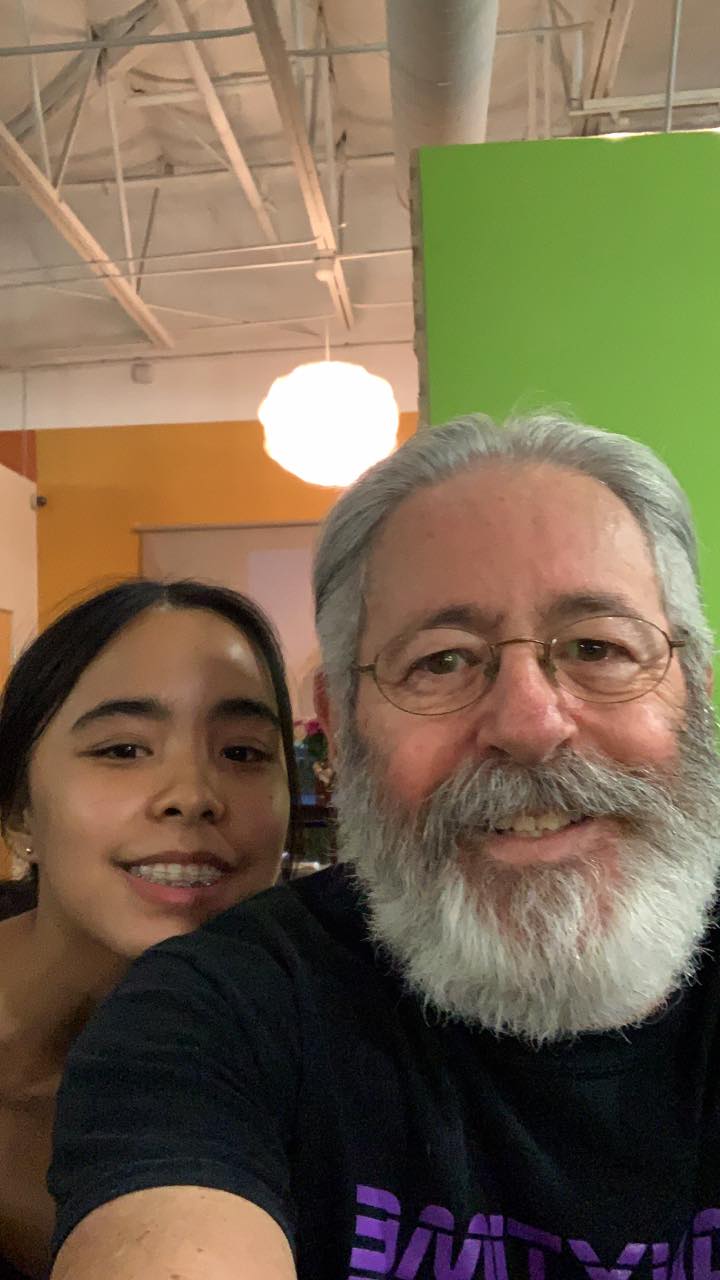
Me and Alyssa at the gym
I have returned to the gym, along with my buddy, Steve, and my daughter, Alyssa. I don’t wear a mask when I’m there and neither does anyone else. I don’t participate in classes and work out on my own. I stay away from others and the gym has several overhead fans which move the air downward. Right now I’m trying to get back to lifting the weights I was working out with before everything shut down, as well as doing the amount of different exercises I had the stamina for last year. I expect it will take a bit longer at my age than it would have, say, thirty years ago, but I believe it will add to the time I have left on this planet.
Inasmuch as I’m seriously working on a memoir of my experiences becoming a first-time father five years after AARP got me in their sights, I expect to continue spending a lot of my time where I’m sitting right now. I’ve begun communicating with friends we traveled and spent time with in order to get their perspective and to help jar my memory of things in which we all participated.
Now I find myself wondering if I’ll retain some of these introvert tendencies. I learned a long time ago how to be alone without being lonely, and I’m quite comfortable with who I am and the path I’m on, but I am looking forward to how things will change once both of my girls are more fully on their own. Time (the thing I don’t have a great deal of at this point) will tell. I’ve often said I needed to live long enough to get the girls to adulthood, but I’d really like to live long enough to enjoy them as adults for a while. I’m shooting for at least 90, giving me 16 more years. Who knows, maybe I can make it to 100, which nobody in my family has ever reached. Maybe I’ll start surfing again at 80.
There are two books that have had an inordinately large effect on my life. One of them I can remember large parts of and can offer reasonably intelligent analyses of what the author was trying to say. The other one I can hardly recall one thing about, save for the overall message the author was trying to convey. The reason these two come to mind—and have affected me so greatly—is that they’re closely related conceptually and their messages resonate and overlap, at least as I see them and I’m pretty sure that’s about all that counts.
The first of these two books is “The Wisdom of Insecurity,” by Alan Watts. The second of these books is “Passages,” by Gail Sheehy. Without going into any detail, I’ll merely note that each of them speaks to the inexorable rhythms of life and the inevitability of change. They also offer a philosophical approach to dealing with those rhythms and changes that offers one a chance to navigate them with as little friction and pain as possible. I read the book by Watts in my early twenties. At the time I was head-over-heels in love with a young woman, but the relationship wasn’t to be and she broke up with me. I was young, impetuous, and prone to bouts of manic happiness and deep, dark depression.
I somehow found the book; how is lost in the mists of my slowly calcifying synapses. Perhaps it found me. It wasn’t the first book by Watts I had read. That was “The Book: On the Taboo Against Knowing Who You Are,” which I found quite helpful in navigating the changes I was going through shortly after high school, a short stint in the U.S. Navy, a slightly longer stint as a businessman, a somewhat shorter flirtation with Haight-Ashbury in the Summer of ’67, and a steadily growing antipathy toward the nation’s conduct of the war in Vietnam.
Another thing I thought interesting, and somewhat serendipitous, was the juxtaposition of the release of two Beatles records that coincided with my reading of these two books by Watts. When I read “The Book: …” the Beatles had just released “Everybody’s Got Something to Hide Except Me and My Monkey.” The book was kind of my introduction to Zen Buddhist philosophy and the concept of the dialectic as represented by the Yin-Yang symbol. I was beginning to understand the duality of nature and the essence of all forms of evolution. Some of the lyrics in the song point out that same kind of duality, e.g. “Your inside is out when your outside is in. Your outside is in when your inside is out,” and the title of the song seemed to resonate with Watts’s message that we needed to get in touch with our actual selves (our “inner monkey”) if we were to understand our place in the world and not color it with the expectations of others.
The second song, which coincided with my reading of “The Wisdom of Insecurity,” was “Let It Be” which, as I understood it was the message Watts was conveying about the reality there is no such thing as security, that all things are in a constant state of flux, and the only way to (paradoxically, a very Zen concept) achieve any semblance of security—no matter how ephemeral and transient it may be—was to stop seeking it.
Sheehy’s book, as I recall it (and I only read it once, whereas I’ve read The Wisdom of Insecurity three times) had a similar message, but it was less on a spiritual and philosophical level and more on a practical, everyday “here’s what to expect” kind of approach. She wrote of what she referred to as the “passages” we all go through as we age and gain experience, while everything around us is changing and moving forward.
The reason I’m bringing this up is because I have reached a point (a passage, if you will) in my life where I find far too many reasons to prepare myself for the end. I’ll be 74 years old three months from today. Next month I will be fourteen years older than my father was when he died. I realize I’ve reached an age where I could, conceivably, live another decade or more, but I could also drop dead tomorrow. There sure are a lot of people doing it who are younger than me.
Throw in the reality that I still have two daughters at home, one of whom is a Junior in High School, the other a Freshman in College, and it’s producing a bit of a tension arc that I’m struggling to put behind me.
I’m not trying to be morose, or overly glum. I am, however, attempting to approach what is definitely the autumn (more likely winter) of my life with as much spring in my step and lightness in my heart as I can muster. I need to understand what this passage I’m experiencing is all about (Sheehy did not write about septuagenarians) and position myself to take advantage of all it might offer. If there’s one thing I have learned over the years, it’s that there’s always benefit to be found in nearly every situation, at least until there isn’t (if that makes sense.) I am an optimist, so even when I get deeply (perhaps depressingly) introspective, I usually snap out of it within a few hours or now more than a day or two.
I’m looking forward to what the next stage of my life is going to offer. Both of my girls will be on their own in a few years, God (or whoever’s in charge of these things) willing and the creek don’t rise, and Linda and I will be on our own again. The difference for us, is we won’t be in our early to late fifties, like most people who have their families when they’re no older than their thirties. As long as I know my girls are doing well and taking care of themselves (which is an entirely different story) I’ll be OK with whatever happens. I will say this. Not having to help with high school homework will be deeply enjoyable!
One of the ways I’ve been working on upping my writing game is by paying attention to what people are reading here on my blog so I might get an idea of what moves my readers. I have now posted well over six hundred times and about 90% of these posts are essentially essays regarding my thoughts about various things, e.g. politics, religion, life, the universe, and everything. The other 10% are tests and sharing things I’ve come across but have little to say about. I also occasionally have reason to look back myself, even if no one has recently read a particular post of mine I find interesting.
To Open Up And Believe
Because there have been many highly emotional news stories lately, and emotions are high to begin with, I’ve been giving a lot of thought to the role of emotions and, especially, how they relate to empathy. Turns out I had written about empathy over eight years ago, long before Donald Trump’s presidency. Since the reality has hit us that he is entirely without empathy, I would like to share a concatenation of the two posts I wrote in late September of 2012. It’s my hope these two are as pertinent today as they were when I wrote them; perhaps more so because I was only writing then about my feelings and now what I wrote seems so pertinent to what we’re all experiencing in the waning days of this disastrous presidency.
The willing suspension of disbelief. What a powerful, magical, and exceedingly frightening thing it can be – at least for me. Not always, though. It’s been quite a while since my last venture into the genre but, a long time ago – in a galaxy far, far away – I read a lot of Science Fiction. Reading it can’t possibly be enjoyable if you aren’t able to suspend your ability to think critically. Nevertheless, I enjoyed the hell out of what many an author hated being called Sci-Fi.
I’m normally somewhat cynical and am a fairly skeptical person, so I’m continuously surprised at how easily I can get sucked into a compelling story, especially if the characters are even moderately complex. I think it actually frightens me to realize how deeply I have disappeared into many a television drama.
This tendency has no doubt been exacerbated by my becoming a father at the ripe old age of 55, when my wife and I culminated a decision we had made a couple of years earlier and traveled to the People’s Republic of China to adopt our first child. We repeated the process four years later and, at the tender age of 59, I once again became a new father.
I now find myself immersed in shows where children are involved (it happens far more often than one might think) and I can’t help but identify with the parents, which sometimes brings me to tears – occasionally racking sobs of grief.
It has always been this way. I’ve been told the men in my family – many of them – were blubberers. Though I couldn’t have been older than five or six at the time, I recall the first time I saw my father cry. He had just received news that my Bubbie Jennie, his mother, had died. He hadn’t seen much of her since moving to Southern California. She had remained in Chicago, where both my parents were born. It was eerie, and not a little unsettling to see my father, a young boy’s tower of strength and resolve, break down like that.
It was made more difficult because I had only met her once, when she came to visit for a week, and she was unfamiliar to me. On the other hand, my maternal grandparents lived with us and I felt a strong emotional tie to them I could not summon up for her. She was by Bubbie, though. My mother’s mother was just Grandma.
I frequently ask myself, however, why I am so deeply and painfully drawn into these stories. I’m not entirely certain I have the answer, but I’m pretty sure it’s not so much the story itself as it is the relationship those stories bear to my own life.
Dictionary.com defines empathy as follows: the intellectual identification with or vicarious experiencing of the feelings, thoughts, or attitudes of another. That seems pretty straight-forward, yes? I am a fairly empathetic person and I tend toward the second part of that definition, i.e. I feel the pain of others vicariously. However, I don’t think this captures the essence of what is happening when I am fully immersed in a story.
Perhaps it’s too fine a point and the distinction isn’t all that great, but it seems to me what’s really happening is I’m overlaying the experience in the story onto my own life. I’m not so much experiencing the feelings of another as I’m experiencing the feelings I would have were I to be in that situation. I don’t think they’re the same. Then again, maybe that’s the mechanism that actually facilitates empathy.
This is a minor conundrum that comes to me most every time it happens and, usually, I forget about it within a minute or two. Lately I decided to try and get a descriptive handle on it and this is my first attempt.
Empathy is a valuable and deeply human trait. It is one of the five traits listed as characteristic of emotional intelligence which, in turn, is seen by many as a valuable business and leadership skill. It’s important to understand and to cultivate in order that we may better understand the people in our lives, whether at work, play, or home.
I want to understand what is moving me when this happens. On some levels it seems patently ridiculous to get so emotionally involved in a fiction story. On the other hand, perhaps it is really what makes us human. I’m wondering if someone with a more classical education than I have knows more of the thinking humans have brought to the subject. I’m sure some in the Arts (especially the Theater Arts) have tackled it. I’ll have to do more research. In the meantime, I’m glad there’s plenty of tissue in the house.
As it turns out, thanks to a friend I discovered an interesting answer through a wonderful TED talk by VS Ramachandran, a Neuroscientist who has studied the functions of mirror neurons. It would seem there is overwhelming evidence we humans are more closely connected than I was hinting at.
In his talk he says, “There is no real independent self, aloof from other human beings, inspecting the world, inspecting other people. You are, in fact, connected not just via Facebook and Internet, you’re actually quite literally connected by your neurons.” I find this resonates in many ways with my understanding of Systems Dynamics, Quantum Theory, and Zen and goes a long way toward answering my question. Frankly I find it a meaningful addition to my understanding, but still find myself wondering why it manifests itself so powerfully in some . . . and not at all in others. After all, the world is filled with people who are anti-social in varying degrees of severity from mild conduct disorders to outright sociopathy or APSD.
Regardless, there is much value in this talk. He speaks of the wonders of the human brain and, with respect to the issues I raised yesterday, uses words like imitation and emulation, ultimately winding his way to empathy. Rather than repeat any of his talk, I urge you to listen to it. There’s at least one very cool surprise a little more than halfway through. At less than eight minutes, it’s really engaging. Here’s the video. I’d love to hear what others think of this:
There’s a “tripwire” somewhere Out there, downstream Where . . . I’m not sure
Some discover its presence early For some the revelation is a surprise Everyone’s waiting for it Our entire lives Some wait with dread and trepidation Some with simple resignation Many in anticipation Of what lies on the other side
Are there any who give it no thought? Like our animal brethren Who live their lives on a daily basis, Not as an ongoing saga
Many of us prepare In numerous ways Some useful Some not I know I’ve been waiting For as long as I can remember Now, however, I’m beginning to Sense its presence more acutely I feel its approach Though it’s still amorphous and indistinct
And each time someone younger than me passes I swear I can feel its hot breath on the back of my neck
Looking back on the news, it appears Governor Newsom ordered a statewide shelter-in-place on the 19th of this month (03/19/20.) However, when I look at my calendar, I see we started doing it the previous day. So, despite what I said in an earlier post, today seems to be the 10th day of our hermitage.
I’ve been spending a fair amount of time tracking the course of this pandemic, especially here in the U.S. and my home state of California. In doing so, I created a meme showing how things are changing . . . actually, accelerating with time, just as we were told would happen. Here’s that meme, which I just updated as of a few minutes ago.
I’ve also been keeping track of the growing death rate and graphing it for myself. All the data I’m using is coming from a site called worldometer and there are numerous tables and charts available there for a breakdown of all the states, as well as a list of every country’s numbers for this virus. The link I’ve provided is to the page with U.S. info on the Corona virus. If you go to their home page, you’ll find links to all kinds of statistics. Check it out.
It’s worthy to note that the percentage of deaths to total cases is 0.0154, which is considerably higher than the rate for the flu. It’s really far too early to tell if that’s what the actual death rate is, as there are just too many unresolved cases. Based on the data available now, the percentage of deaths to total resolved cases is 0.385, which is astoundingly high. What we should glean from this, IMO, is that it’s just far too early in the trajectory of this disease to gather much useful information on lethality or recovery.
I don’t know if or when I’ll update this again. It’s fascinating, but also quite depressing. Perhaps I should just watch television. 😦
I’ve written fairly frequently about death and dying. The concept of non-existence for eternity fascinates me. I suppose that might be a taste weird, but I have a feeling I’m not alone in my wondering. One of my first posts on the subject is about my attitude toward my own death. You can read it here, if you’re so inclined.
I’ve also written about one of my closest friends who was killed in Vietnam, long ago. That post is located here. Another came much later, and is about another friend I had known since before I can remember. I hadn’t spoken with him in a long time and heard about his death from one of his brothers. It can be found here.
I also touched on the subject of grief, somewhat generally, in a post where I ended by lamenting the loss of people I never knew but somehow felt I should have upon hearing from those who were close to them. That post is located here.
All this is merely an intro to a thought I encountered recently on Facebook, and I wanted to share. I think it more than adequately expresses what grief truly is, and how it affects us. What follows is that sentiment. I want to remember it well.
Grief, I’ve learned, is really just love. It’s all the love you want to give, but cannot. All of that unspent love gathers in the corners of your eyes, the lump in your throat, and in the hollow part of your chest. Grief is just love with no place to go.
Thirty-eight years ago tonight I came within a hair’s breadth of being murdered in my own home. It’s an interesting story, I suppose, but recalling it still causes a little adrenaline to spill into my bloodstream. Some of the facts are in this decision, but the main reason I’ve bookmarked the site for myself is to help me remember when it happened. It was on my 32nd half-birthday and, although I remember more detail than I wish, I can’t seem to keep the year in my head.
At one point I was laying on the floor and the perp, Leonard Brown, was sitting on my futon. He pointed my Ruger Blackhawk at my head and said, “I’m going to blow your fucking brains out.” I asked, simply, “Why?” He responded, “Cause you’re a honky.” I said, “Is that all?” He had no response to that.
He started telling me a story about being in Vietnam but, having spent many years working with lots of veterans from that war, I could tell he hadn’t really been there. He was, I believe, trying to work himself into enough of a frenzy – as well as getting me to respond fearfully, which I declined to do – so he could shoot me.
Eventually, he went to get something to tie my hands behind my back, which I was not going to allow to happen, regardless of the consequences, as I was sure that would be the end for me. He had to leave the bedroom momentarily and I had been slowly working my foot behind the door. As he left, I was able to slam the door, practically levitate myself off the floor one-handed (lots of adrenaline at that point), and grab my shotgun from a spot where I had hidden it in my closet.
I pumped a round into the chamber and said, “Get out of my house or I’ll kill you.” I heard him flee. Since I could not see where he was, and my girlfriend at the time (later to become my first wife) was going to be home at any minute, I could not fire through the door. I ended up going through the apartment, room by room, as I wasn’t sure if he had actually made it out. It was harrowing, to say the least.
There’s a lot more to the story, including three murders, several rapes, and somewhat of a comedy of errors (not funny at the time) getting the police to come and take a report. It took me five phone calls to three different jurisdictions – I was living in Venice, next to Marina del Rey – before the LAPD, who I called first and knew had jurisdictions as I saw them patrolling all the time, showed up. The officer who arrived was alone, had his hat in hand, and the safety strap to his sidearm in place, which unnerved him when he found out he was working an armed burglary and hadn’t been told so by the dispatcher.
Mr. Brown was eventually arrested, mainly due to his continuing crime spree. I ended up testifying against him twice – once at his original trial and again, years later, at a retrial on one of his murder counts.
The Court got one of the facts wrong in this decision. He only stole one weapon from me, and that was the Blackhawk, which he used to kill three men over the course of about a week and a half. I never got that handgun back, nor did I get back the beautiful pocket watch I had been given years prior by my maternal grandfather. I still miss the watch sometimes.






 Systems Savvy