Tag Archives: Diversity

Juneteenth and Passover

NB – Before reading the following post, please be advised it was written with the assistance of Chat-GPT, after a couple of iterations of my asking for a blog post on the subject, and clarifying what it was I looked for. It’s not quite my style, but it gets across the subject I was having a bit of difficulty honing in on. I would likely have been more wordy, so I’m content to leave this up in order to get the gist of my thinking out in the world.

As a former Jew who is now an atheist, I have always been interested in social justice issues and have been an advocate for antiracism for many years. However, it was only in the last few years that I learned about Juneteenth, an American holiday that celebrates the emancipation of African American slaves. As I learned more about Juneteenth, I couldn’t help but compare it to Passover, a Jewish holiday that commemorates the liberation of the Israelites from slavery in ancient Egypt.

At first glance, it may seem like Passover and Juneteenth have little in common. Passover is a religious holiday that is celebrated by Jews all over the world, while Juneteenth is a secular holiday that is primarily celebrated in the United States. Passover has a long history that dates back thousands of years, while Juneteenth is a relatively new holiday that has only been officially recognized by the federal government since 2021. However, as I delved deeper into the meanings behind these holidays, I found that they share a common theme of liberation and freedom.

For Jews, the story of the Exodus is a powerful reminder of the importance of freedom and the need to fight against oppression. The story tells of how Moses led the Israelites out of slavery in Egypt and into freedom, and it is a story that has been retold for thousands of years. During the holiday of Passover, Jews gather with family and friends to retell the story of the Exodus, eat traditional foods such as matzah and bitter herbs, and participate in symbolic rituals such as the Seder. The holiday is a time to reflect on the past and to look towards a brighter future.

Juneteenth, on the other hand, celebrates the emancipation of African American slaves. The holiday commemorates June 19, 1865, which is the day that Union General Gordon Granger arrived in Galveston, Texas, and announced that all slaves in Texas were free. This announcement came two and a half years after the Emancipation Proclamation was signed, and it marked the end of slavery in the United States. Juneteenth is a time to celebrate the end of slavery and the beginning of a new era of freedom and equality.

Despite the differences between Passover and Juneteenth, they share a common theme of liberation and freedom. Both holidays celebrate the idea of breaking free from oppression and moving towards a brighter future. They also emphasize the importance of family and community. For Jews, the Seder is a time to retell the story of the Exodus and to pass down traditions and values to the next generation. For African Americans, Juneteenth is a time to celebrate their heritage and to remember the struggles and sacrifices of their ancestors.

As an antiracist, I find it important to acknowledge the intersectionality of these two holidays. While Passover and Juneteenth have different histories and meanings, they both symbolize the fight for freedom and justice. As a former Jew, I feel that it is important to recognize the role that the Jewish community played in the civil rights movement. Many Jews were active participants in the struggle for civil rights and worked alongside African Americans to fight against racism and discrimination. As an atheist, I believe that it is important to recognize and celebrate the diversity of cultures and traditions in our society.

In conclusion, Passover and Juneteenth are two holidays that may appear to be very different on the surface, but they share a common theme of liberation and freedom. As someone who is no longer practicing Judaism but is committed to antiracism, I find it important to acknowledge the intersectionality of these two holidays and to celebrate the diversity of cultures and traditions in our society. Passover and Juneteenth are reminders that the struggle for justice and equality is ongoing and that we must continue to fight against oppression in all its forms.

How To Be A Patriot

Photo by Pixabay on Pexels.com

It seems to me that anyone who really cares about their country, who is a genuine patriot, has to care for everyone. Life is NOT a zero-sum game, where the gains enjoyed by others are a loss to you and yours. No, life and human society are highly complex, interdependent systems where every part has a role to play, and when we don’t provide optimal conditions for the health and well-being of some of the parts, the whole body suffers. Would you want your car’s engine to go without one of its spark plugs? While it would still get you to where you were going, it wouldn’t do it as efficiently, nor as effectively. In the end, it would almost certainly cost more to deal with the results of an imbalance in the engine than it would to ensure all its components were kept in good working order.

Yet many approach life as though they are living on an island. It’s difficult to fathom the level of insensitivity, blindness to reality, and the callous lack of empathy it takes to turn one’s back on people who may not directly affect your life in a way you can feel immediately, but who nevertheless impact the organizations and institutions you deal with all the time.

For instance, by not ensuring all children receive healthcare, adequate nutrition, and early education, we ensure our up and coming workforce will be less prepared than they otherwise could be for the kinds of jobs that will be available in the near future. The net result is we not only handicap those children, we also handicap their families, their friends, and the entire nation. By guaranteeing they need more help for far longer than might otherwise be the case, we add to both their burden and ours.

We hobble ourselves with mistaken, outdated, unsupportable notions that give far more importance to diversity as a bad thing; as something that takes away from our sense of worth, of self. Instead of understanding, celebrating, and taking advantage of all the ways in which we complement and enhance each other, too many of us turn those virtues into imaginary vices and use them to divide and separate us. What a pity.


Do We Fully Understand Diversity?

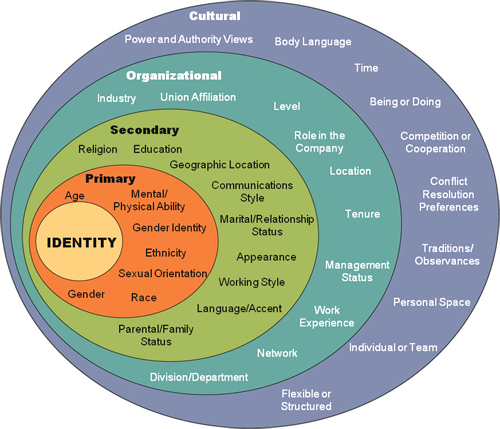
Dimensions of Diversity

This graphic does a decent job of showing the different dimensions in which we find diversity

What do we mean when we talk about diversity? Merriam-Webster online’s first definition is “the quality or state of having many different forms, types, ideas, etc.” Not bad. Not bad at all. How about the second definition? It’s presented as “the state of having people who are different races or who have different cultures in a group or organization.”

I find this second definition somewhat troublesome and simplistic, in large part because I think a large percentage, if not an overwhelming majority, of people think of diversity in a very limited form. In my experience, within organizations — i.e. enterprise-size businesses — race, ethnicity, physical ability, and gender are about the only classifications in which “diversity” is interpreted to matter. This in spite of definitions that suggest far more inclusiveness, like this one from the University of Oregon’s website:

The concept of diversity encompasses acceptance and respect. It means understanding that each individual is unique, and recognizing our individual differences. These can be along the dimensions of race, ethnicity, gender, sexual orientation, socio-economic status, age, physical abilities, religious beliefs, political beliefs, or other ideologies. It is the exploration of these differences in a safe, positive, and nurturing environment. It is about understanding each other and moving beyond simple tolerance to embracing and celebrating the rich dimensions of diversity contained within each individual.

Getting back to M-W’s first definition. Although it only mentions different forms, types, and ideas, it does manage to throw in an “etc.”, thereby inviting us to expand on the inclusiveness of its meaning. Here’s where I’d like to see a little more creative (and empathetic) thinking about diversity.

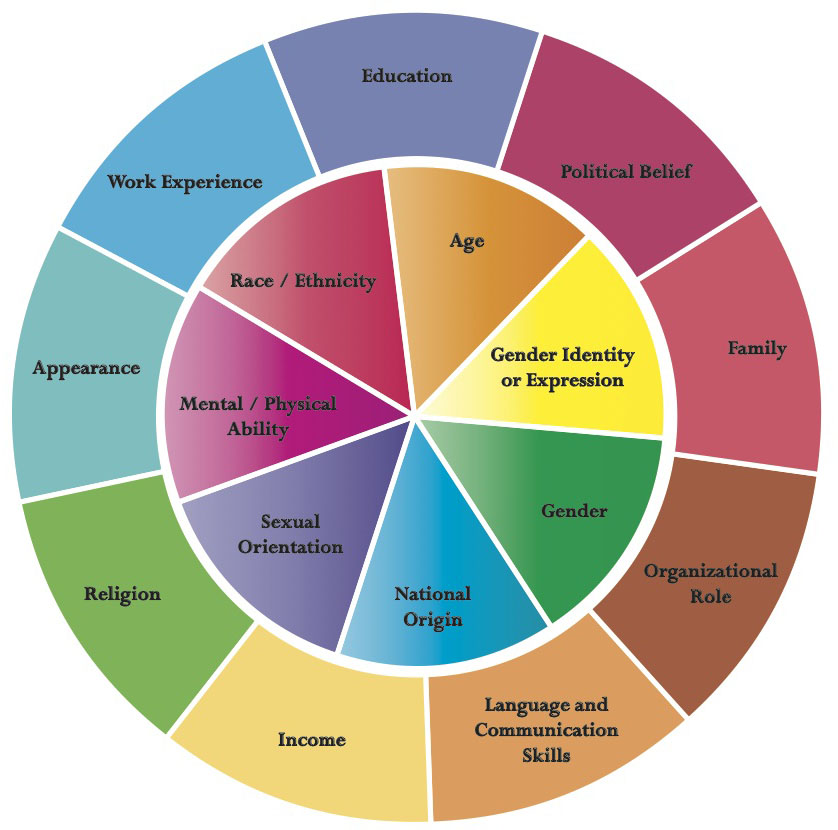
Diversity Wheel

This graphic shows similar information regarding diversity, but only breaks it out into two dimensions

For instance, a few simple areas in which we find diversity that aren’t usually thought of as important are: handedness, learning style, personal style, interests and hobbies, hair length and type, gregariousness, public speaking ability, etc. Without belaboring the subject, I’m sure I could come up with dozens of other ways in which we find “diversity”. As the University of Oregon’s definition states, “. . . each individual is unique . . .”.

Isn’t it time we started treating people in terms of the larger context of their lives and experiences, rather than categorizing them — somewhat restrictively — in just a few, largely useless boxes? I’m not suggesting the categories we’ve been using are completely useless, merely that they’re terribly restrictive and overly broad. What’s your opinion? There should be quite a few out there. 😉