Tag Archives: Social Media

Are Marie Callender’s & Applebee’s Providing Us Object Lessons?

Recently, our local (here in Simi Valley, CA) Marie Callender’s restaurant – a staple of the community for at least a couple of decades – was shut down as part of the recently merged (with Memphis based Perkins) company’s bankruptcy. I belong to a business network that has met there for most of the time they’ve been in business, though I’ve only been a member for less than a year. Still, having to eat breakfast there once a week was a bit of a trying experience, as the food was a couple taste buds short of mediocre.

The business network has a system of points one can earn for providing “tips”, which can run the gamut from a couple thousand dollar repair to your vehicle or home or eating a meal at a member’s (which Marie Callenders was) establishment. It’s a system that just invites gaming (in the worst sense of the word), inasmuch as each tip carries the same weight or value. Needless to say, many of the members found themselves eating there a couple of times a week. I never could bring myself to do so.

As part of my membership, I offered to provide a couple of free hours of social media marketing coaching and to see to it that each member had access to those services that promised to help their business out. Very few of them took me up on it; probably because most of these guys are almost as old as I am :). Marie Callenders was one of those businesses I struggled valiantly to see the efficacy of at least paying attention to what was being said about them online, especially the reviews that were being written on Yelp. They wouldn’t pay attention. My research had shown they were getting some pretty uniformly horrible reviews and, clearly, no one was paying much attention to them. I’m not surprised they’re no longer in business.

Though I can no longer check the reviews of our local Applebee’s – you see, they’ve closed down as well, actually before MCs did. Yelp doesn’t retain reviews after a business closes its doors. I now wish they would, if only so I could make sure my understanding of what happened is close to the truth.

I’m bringing this up in large part because a friend of mine posted an interesting piece entitled “Applebee’s Review Explains Why Companies Should Care About Online Reviews” (link). I think Mark hits the head right on the nail (sic) and find myself wondering if the experiences we’re seeing with Marie Callenders and Applebee’s aren’t indicative of just how useful these growing online review services are to those of us who like to eat out.

For quite some time in the enterprise world, the questions those of us advocating for greater use of social media had to answer consistently was, “What’s the ROI (Return on Investment) of using these tools? Why should we spend the money unless you can show us there’s added value in it?” Frankly, for a long time I struggled with the answer. It seemed clear to me they provided the basis for greater collaboration, easier communication, faster innovation, etc., but these things were hard to quantify in a classical sense. The answer that has stuck in my mind, though, (and I can’t recall where I heard it) is “The ROI of using social media is you’ll still be in business in five years.” I know that was somewhat glib, but I’m wondering now if Marie Callenders and Applebee’s aren’t providing us object lessons on just how prescient that statement was.


Would You Pass Up Free Advertising?

Foursquare Logo

Attract New and Reward Loyal Customers

I’ve been concentrating on a couple of new clients and have neglected to post for a couple of weeks. During this time I’ve been thinking about some of the subjects I’d like to cover. One of those is the use of Foursquare for small, retail businesses. Actually, it can be used for virtually any type of business, but the usage model it presents is most applicable to businesses with lots of traffic and churn. I see them as being in somewhat of a pyramid. For instance, those businesses that will get the most value from Foursquare are restaurants, bars, and clubs. Next in line are retail outlets and, finally, service businesses with a brick and mortar location.

Other types of businesses can use the service to get some free advertising, but if your business isn’t amenable to friends sharing the location (primarily because they want to enjoy each others’ company), it’s not going to have the same kind of value for you. As an example, there are Dentist’s offices who use it to present teeth cleaning and whitening specials. I am pretty sure people don’t check in to their Dentist’s office because they’re having a bang-up time and want to share it with their friends. However, everyone who uses Foursquare on their phone is going to get an impression of the special the office has created. You never know and, after all, it’s currently free!

Thanks to a heads-up from one of my friends, @mor_trisha, I read an article at ClickZ (authored by )  making essentially the same points I wanted to make. I’d like give you my version of why I think Foursquare is an important channel for small business to use, with a bit of local flavor for examples. I’d also like to expand a bit on how to use the service if you are a business owner considering using it.

First, let me say a few things about Foursquare in case you aren’t aware of what it is and how it’s used. Foursquare is a location-based, check-in application that consumers with smart phones can download and use to find nearby locations their friends frequent, as well as check-in when they are there. In addition, those merchants who have taken the time to “claim” their venue using the website provided for their use can create specials to entice new customers and to reward the loyalty of their ongoing customers. More about that in a bit.

As a user, Foursquare provides you with the ability to “check in” at a restaurant, pub, retail outlet, or service provider’s location whenever you are there. Using your phone’s GPS system you are provided, through the app, with a list of those venues that are close by. You can also see if any of your friends (or anyone else for that matter) is at a particular location so you can join them if you wish. In a rural environment or in a small town with few users, this capability is probably not all that useful. In my hometown, which is relatively small, the usage is now growing to the point where enough people are checking in for it to be useful. I imagine in large, urban areas it’s very useful – and likely lots of fun for some. There is also a couple of gaming aspects (points, earned badges) to using the service, but I’ll save that for another post.

Foursquare Globe

Think Global, Check-in Local

For business owners, Foursquare provides some interesting capabilities that are available for free. You cannot access them, however, until you take a little time to “claim” your venue. This is a relatively painless process that involves creating an account if you don’t already have one, finding your location on their website,  and clicking on the link that appears on the right hand side of your screen. It says “Do you manage this venue? Claim here.” Once you click on the link you will have to answer a few more questions, then agree to receive a phone call where you will be given a four-digit code to enter on another screen. After that, you will have access to some useful tools, which I’ll get to in a moment.

Now, I said relatively painless for a reason. I have had several instances where a business that’s been around for a long time was unable to use their phone number because Foursquare said they couldn’t verify it belonged to them. Since they had the number for quite some time, I’m unclear why this happens. Nevertheless, it isn’t the end of the road. Foursquare will give you the opportunity to have them contact you by snail mail, in which case you’ll receive the code you need as well as a cling to put in your window to advertise your presence on the site.

Once you have claimed your venue you will have access to their “Manager Tools”. These include venue statistics, which will show you number of check-ins, social reach (whether or not the info was sent to Twitter or Facebook), time, gender, and age breakdowns (as available), and the profiles of your visitors. This information can be presented in numerous time slices, e.g. today, last week, last 30, 60, & 90 days, or all. All of this information is useful for understanding the penetration and coverage you’re getting with people who use Foursquare.

However, in my opinion the most useful tool of all (and the one that will really make the stats worthwhile) is the ability to create campaigns and specials. To start a campaign you simply add a special, of which there are five designed to attract new customers and two designed to reward the loyalty of existing customers. These specials (with my suggested ways they might be used) are as follows:

  • Attract new customers
    • Swarm Special (If 10 people check in at the same time you all get 20% off your meal, etc.)
    • Friends Special (Check in with 3 friends and dessert is free for the group)
    • Flash Special (The first 10 check-ins after 8pm get a free beverage)
    • Newbie Special (Get a free appetizer on your first check-in)
    • Check-in Special (Get a half-price beverage every time you check in)
  • Reward existing customers
    • Loyalty Special (Get a free appetizer every fourth time you check in)
    • Mayor Special (The Mayor gets 25% off their entire bill)

Foursquare also provides some nice, printable flyers to hand out to your customers and your employees, so everyone knows how it works and what an “opened” special looks like. Hint – if it’s in black and white, it hasn’t been unlocked. There’s also a lock icon that appears as unlocked when it is.

Ms. Jenning pointed out four good examples of how to (and not to) use Foursquare specials to get the results you’re looking for. I’d like to do the same for four locations in my neighborhood.

Aeropostale

They offer a standard check-in special. Each check-in gets you $10 off a purchase of $50 or more. With a purchase of exactly $50 that works out to a 20% discount; large enough to entice new customers. Frankly, I would have used a straight 20% discount, perhaps with a min (maybe even a max), rather than a minimum purchase. As it stands, if you spend $100 (and who spends only $50 on clothing nowadays?) you’re only getting a 10% discount. Maybe not enough to bring in new business.

Cherry on Top

They also offer a check-in special of 10% off with every check-in. This isn’t a bad deal. Most people are going to go for ice cream or frozen yogurt after a meal, or as a summer-time treat, when they feel like it and, all things being equal, I would go to the place that offers a discount. Most don’t, so I suspect this is at least marginally helping them compete with the other venues in town.

Limon Latin Grill

This one is somewhat similar to the example given by Ms. Jennings of Bangkok Joe’s. It’s a bit puzzling to me why they think this would entice anyone. They actually offer three check-in specials presented as one. Your first check-in is worth $2.00 on a drink, the second is $5.00 off any entree after five check-ins, the third is a free drink after 10 check-ins. This is not an inexpensive restaurant and I believe a normal meal, especially if it includes a drink, will cost at least $20. This makes the second of the specials worth about 5%; not exactly something to write home about. The same goes for the other ones. None of them seem very enticing. I’d be curious to know if they’re getting much action at all. I actually used the first one, but only because I went there to see a friend’s band playing. The waitress was unfamiliar with the entire concept, which leads me to believe they aren’t getting much traction out of the campaign. I’m not surprised.

California Pizza Kitchen

This venue is using a Friends Special, stated so: “Show you phone to a manager and get 20% off when you and 3 friends check-in to the same CPK! Excludes alcohol, tax & gratuity, gift cards. Not valid w/other offers. Valid at participating locations.” What I get from this is the place is probably micromanaged, as I find it a bit mystifying they don’t trust their wait staff to validate the check-ins. It’s also a bit comical to me they feel the need to qualify the offer so carefully. Lighten up! Nevertheless, 20% off isn’t a bad deal for a mid-priced meal with 3 of your BFFs.

There are numerous other examples of specials being offered, many by venues you probably wouldn’t expect to find using them. I want to think about them a little more and maybe drop in to a couple to find out how they’re doing with them. The lesson here – if you’re running a restaurant, bar, nightclub, or a retail store with the potential for lots of foot traffic, your venue has probably already been entered into Foursquare’s database. Now you need to get out there, claim it, and start providing some specials to take advantage of what it has to offer. Remember, IT’S FREE, but that probably won’t last forever. Why not take advantage of it while you can? You’re welcome.


For Restaurants Engagement Has Always Been on the Menu

Engage!

Make it so!

Everyone and her aunt – at least those in the social media world – is talking about engagement nowadays. For instance, just a few weeks ago Brian Solis posted “The Rules of Social Media Engagement” on his blog. Ten days ago, Laurel Papworth wrote “7 Levels of Social Media Engagement” at socialmediatoday. Way back in January of 2010 Jason Falls wrote a rather scathing review of the concept in social media explorer entitled “What is Engagement And How Do We Measure it?”

Now, I’m far from an expert in this field. I have no training in marketing, PR, or advertising, though I have pretty extensive experience in sales, having spent many years in the wholesale food business doing just that (lots of cold calling on people who were already buying from someone else, actually). However, since embarking on my new career as a social media marketing strategist and bottle-washer, I do have some thoughts about what “engagement” means to me.

I’m of the opinion the use of “engagement”, in today’s rapidly changing social media fueled world, means a shift away from broadcasting one’s message out through print media, email blasts, websites, etc. toward a model that invites dialogue and conversation. I believe the difference is fairly well expressed in the concepts of “outbound” and “inbound” marketing. As I said, though, I’m a bit of a novice at this, so maybe I’m just full of hot air myself.

Nevertheless, I do have a fair amount of experience with the restaurant business, having eaten at lots of them, as well as managed a couple, and sold lots of product to many. I learned all about service from the restaurant business. I learned how to make people not only comfortable, but happy they did business with me.

So . . . what do I mean by the title of this piece? I am doing some low-level reputation management and I have some Google alerts set up to let me know when some of the businesses I’m working with, or am interested in, are being discussed. Today I got one that led me to read a couple of reviews of a particular sports bar I would like to have as a client. One of the reviews mentioned how the owner walked around and talked to each of the tables where people were eating, drinking, and watching a game. The author of the review also suggested this was no longer the norm, which was why it stood out. Also mentioned was the author’s belief this wasn’t just a cursory walk-around, but a genuine conversation; an “engagement” with the people that pay his rent and his employee’s salaries.

It made me realize the best, most successful restaurants have always done something like this. They make their customers feel as though they are eating with friends, that they matter, and their comfort and satisfaction matter. It’s not something that goes on a checklist of things to do. It’s natural (at least with the best of owners and managers) and – which it always was for me – fun and fulfilling. It’s also a way to get immediate feedback and to address problems before they get out-of-hand.

Engagement is important, and social media provides ways for most anyone in business to participate as never before possible. However, as many also point out, it’s important to be genuine and it helps if you really care. Successful restauranteurs understand this in their bones. Their success proves its value as well. Have you figured out how to genuinely engage with your customers?


My Apologies

Anyone coming here from a link in a tweet – or just stopping by because you had nothing better to do – and expecting to see something new should be disappointed . . . and for that I must apologize. I was testing the capability of posting directly from a Slideshare presentation and it didn’t voik. I had to remove the post. I believe I also removed the tweet WordPress automatically generated for me, but I have no control over other avenues. Sorry.

BTW – The presentation I was attempting to post is located here. It’s by Hubspot and is entitled “It’s Time to Transform Your Marketing.”


Why Do We Bother?

I am constantly blown away by the quality and quantity of good information that’s available on the web. I have been studying the use of social media for some time; initially for use within the firewall of a large organization and, more recently, for small business marketing. One channel I think many businesses, especially those that experience high foot traffic, e.g. restaurants, bars, retail stores, is Facebook. I will never refer to myself as an expert, but I have been gaining some expertise in both the strategy and the mechanics of taking advantage of their fan pages.

Unfortunately, I can’t keep track of all the good information that keeps being thrust my way! I want to share just one of them. I like what Jordan Julien has to say, though I find myself wondering why he’s not including mobile now in his assessments. Perhaps he is and I need to dig a little deeper but, for now I just want to share one post he’s written that I think is quite useful. It’s entitled “How Should I Use Social Media” and you can find it at http://bit.ly/ge2vwl. Check it out and see if it doesn’t clarify some things for you. Study the graphics carefully. There’s a lot of info packed into them.

So, by my title I mean . . . I sometimes wonder why I blog at all, since there’s so much information out there; much of it far more knowledgeable than what I have to offer. I know there’s got to be a good reason, else why do I bother?

The link referred to above is no longer available at Posterous!


Why Are Some Large Enterprises So Darn Stupid?


Can you believe they blocked this?

Watch out for that fly

I worked for over two decades at a very large (and exceedingly ponderous) corporation. Actually, I worked at three of them without every leaving the location I originally hired in at. Although I worked at a company called Rocketdyne, it was a division of Rockwell International when I hired in. It was later sold to The Boeing Company and, in 2005 was purchased by United Technologies and became a part of its Pratt & Whitney family.

Each one of these organizations were not only capable of, but repeatedly dabbled in a level of bureaucratic numbskullery that I still find hard to fathom. I have yet to have it explained to me – at least in a way I can understand – why large for-profit organizations engage in activities that are guaranteed to hinder their ability to perform well or that cost far more than is reasonable. Frankly, I’m not sure anyone who’s directly involved in them can explain why it’s so, because I’ve never known anyone who said it was their job to slow down or squash anything . . . yet that’s exactly what happens in many instances.

The other day I watched a video shared with me and others by Euan Semple. I would link to the video, but it’s been removed by the user. I guess it was meant to just make the point for Euan mostly. Anyway, shortly after looking at it I came across a three-year-old email I had sent to a colleague. The video Euan shared was made by a student. It’s quite simple and shows how many of the social sites this college student wished to go to during the course of a day were blocked by the school’s policies. Maybe you’re thinking that isn’t such a bad thing, but I’m of the belief that people should be trusted first, as most are trustworthy. Should they betray that trust, then there might be consequences based on their situation. Spending 15 minutes on Facebook catching up with friends and family is not the same as spending an hour or two trading stocks online or visiting pornography sites. Wholesale domain blocking does not exhibit any level of trust at all and tends to alienate the majority of people who want access when they need it, but will not normally abuse the privilege.

Now to the rediscovered email. I’ll let it speak for itself. The episode which sparked it is not terribly important in my opinion, though it was important enough for me to memorialize and share it with a colleague whose mission was (and is) to steer the organization from simple-minded, one-size-fits-all policies and procedures. This is, I think, what it evidences. I hope you don’t think it too petty of me to point it out. I think this approach still dominates the thinking of the corporate world, as well as academia, as evidenced by the video Euan shared. What follows is my email.

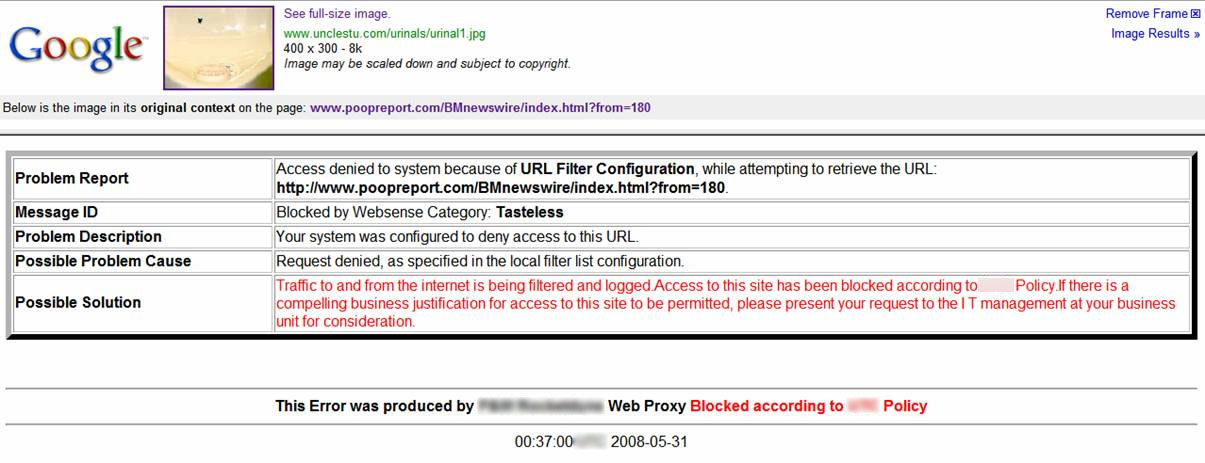
I don’t know what to make of this. Well . . . actually, I kinda do. It’s kind of funny, yet somehow a bit infuriating. Allow me to explain. As you may or may not recall, the men’s room near my cubicle was recently finished and re-opened. One of the features they installed is those waterless urinals. I’ve only seen them once before, and each time I go in I make note of the name of the company – thinking to find them on the Internet so I can read something about the science behind them. Also, each of the urinals has a bee painted on them and I wanted to see if I could find something quickly about why (though I suspected I already knew). At any rate, I finally remembered to investigate both (after several weeks of forgetting as soon as I got back to my computer) and found what I wanted and decided to just click on Google images as well. The first picture was of a urinal with a fly – not a bee – painted in the sweet spot.

I decided to take a close look and clicked on the picture. Although I was able to see the picture, even open the full-size image, the website it was on (which appears in a lower frame in Google images) was blocked by Websense. What I find remarkable, ironic, asinine, stupid, foolish, and probably a dozen more useful adjectives is the category they chose to block it under – “Tasteless”. Tasteless!!!! Is there some sort of absolute scale on which that quality can be measured? It was probably the name, but what if the website was about caring for infants or puppies or god knows what? This I find not a little insulting. What children they think we are! Let’s not forget the further irony that I could, for all their blocking, see the image. Perhaps I should sue for negligent infliction of emotional distress. Here they made an attempt to insulate me from something as tasteless as this, and I was nevertheless forced to look at a painted fly in a vitreous porcelain urinal due to the incompetence of Information Technology and UTC Policy. I hope I recover. I hope I can sleep tonight.

There! I got it off my chest. Please realize this email was sent approximately 3 years ago, so some things (like Google’s positioning of images and their associated sites) have changed. If Euan’s friend’s example is any indication, however, other things haven’t changed at all. I don’t think this bodes well for any organization seeking to do its best work. My experience says it hinders creativity and innovation, as it blocks people from following leads and decreases whatever chances might exist for serendipity and loose ties to open up new avenues and approaches to solving problems.


The Wisdom of Engagement

Foursquare and Yelp Logos

Two "Big Hitters" for Retail

I just came across a couple of quotes that rather succinctly state the issue anyone using Social Media for marketing needs to keep in mind with respect to engagement with their customers. I think it comes from some of the activity surrounding a virtual Enterprise 2.0 Conference event. I picked them up in my tweet stream. I wasn’t able to attend, but found them because I have a continuing search on the hashtag #e2conf, which keeps me in the loop.

These two quotes appear to be traceable to Sameer Patel, a man I admire for his business savvy and knowledge of social media engagement. I have been using the tag line “People are talking. Are you listening?” His quotes are a bit longer than my tag line, but I think they state the issue rather well:

Part of the problem is trying to “control the message”. The conversation will happen with or without you.

This is one of the things that I’m trying to get across to some of the small businesses (I’m beginning with restaurants) I’ve been working with. The other line is even more important:

Your brand perception is now in the hands of strangers. Isn’t it time you got to know them?

This is so important for small retail establishments to understand. With the advent of services like Foursquare and Yelp, the conversations about their businesses are already taking place. They need to, at the very least, claim their venues in each of these and get involved in the conversation. If a customer has a bad experience, don’t you want to know about it? Don’t you want to have the opportunity to make it right . . . publicly?

It’s true and it’s only going to get “worse”. People ARE talking. Shouldn’t you at least be listening? Better yet, why not engage with them. I’m convinced the process will strengthen your relationships with your customers and do wonders to make you more accessible and easy to do business with.


Small Business and Social Media Marketing

Where I came from

I Was a Cubesicle Denizen

Yesterday (February 14th) marked the nine-month anniversary of my leaving Pratt & Whitney Rocketdyne. In this time I have slowly transformed from an employee of a large, multi-national corporation to a self-employed entrepreneur. In so doing I have changed my mindset from that of a community member and manager, responsible for greasing the skids of social interaction amongst workers with similar goals, to that of a marketer, responsible for understanding how social creates a different kind of community amongst people with a symbiotic, but not so insular connection.

I can’t remember where I read it, but I try to always keep in mind what someone said about marketing, which I can directly apply to my work – You can learn marketing, but you can’t be taught what is learned in over forty years of experience. So I’m busily studying marketing and, especially, how to utilize social media to provide a new level of engagement never before possible between a business and its customers.

In making this change I have joined the local Chamber of Commerce and a business network. I have also, since I am old and experienced enough, volunteered my services to my local SCORE chapter. My knowledge of social media was in great demand and I ended up helping a few people out even before I was officially a member.

As a result of my Chamber membership, I decided to do a little study of the restaurants in the Chamber and their use of four avenues often used for marketing and public relations, e.g. Foursquare, Yelp, Facebook, and Twitter. I looked at each channel a bit differently. For instance, for both Yelp and Foursquare I was most interested not in whether or not the business was listed or had either tips or reviews of it, but whether or not the businesses in question had claimed their venue so they would have some level of engagement available to them. What I discovered was surprising.

Despite the fact these services are all free to use (I’m not factoring in the expense in time necessary to wring the most out of using them), usage of all is abysmally low. The numbers are as follows:

  • Foursquare – 11% have claimed their venue (most all have been entered into the db)
  • Yelp – 26% have claimed their venue (most all exist in the db)
  • Facebook – 26% have business pages (many venues had close to 100 check-ins via Places)
  • Twitter – 26% have Twitter accounts (very few know how to use it, IMO)

I haven’t looked at all the other restaurants in the area. Nor have I considered bars, pubs, retail establishments that could benefit from the use of these four services (as well as other methods of marketing considered social, e.g. blogs), or professional services that could do the same. This does indicate to me a huge market for my services, although my experience tells me it will be a bit tough to crack, as these kinds of business owners are notoriously frugal and suspicious.

Nevertheless, I think the clear direction is for greater and greater use of social media to market small business and, especially, to engage with customers in a transformation of  how business relates to, and learns from, them. I think there’s a place for me and others like me to provide them with a bit of knowledge, some organizational help, and strategic direction.

One thing’s for certain. I am really enjoying connecting with my business roots, as I was in small business for over two decades before joining Rocketdyne prior to my 40th birthday – much of it actually in the food business. As I gain experience and knowledge in my new field, I hope to share it here on my blog. Stay tuned!


I’m OK, You’re a Pathological Techno-Geek

You won’t go wrong reading the entire review, but in the interest of brevity I am herewith sharing the author’s final paragraph. It’s a couple days old. Sorry :)

Amplify’d from www.boston.com
Boston.com

Antisocial media

An MIT professor and psychologist argues our modern wired lifestyle is damaging us and our relationships, but she may be a bit premature


January 16, 2011

But, suppose human nature is more malleable than her psychological model allows. Suppose the Internet is devising a self that is social in new ways that include intimacy, but that also find real human value in thinly spread connections. Turkle’s observations raise disturbing issues, but her theoretical framework so colors her conclusions that, although her book will spark useful debate, it settles less than she seems to think. The changes our technology is bringing are challenging our conceptual frameworks for understanding those changes, including the psychological standpoint Turkle takes as secure.

David Weinberger is a senior researcher at Harvard’s Berkman Center for Internet & Society. He can be reached at self@evident.com.
© Copyright 2011 Globe Newspaper Company.

Read more at www.boston.com


Please Help!

Please help

Hello. My name is Rick and . . . well . . . I’m a bit of a Social Media addict. I’ve been able to resist Farmville, but I still check in frequently to see what’s up on Facebook. I follow amazingly fascinating and informing people on Twitter and have connected with them on Facebook as well. Many of them are in far away locations on the planet, so there’s almost always a conversation going on; at any time of day or night. Today it became clear to me just how much of a problem this is for me.

I have an iMac, an iPad, and (I know this probably seems heretical, but what can I say?) an HTC Hero running Google Android. I use or have used Twitter’s web app, Nambu, Osfoora, Hootsuite, Tweetdeck, Twitter for iPad, and maybe some services I can’t even remember using. I ran my iPad’s battery down by about 3:00 pm PST today and had to switch over to my phone exclusively while it’s recharging. The process has me twitching a little bit. The alternative is to sit in my home office, tethered to my Mac, but the weather is gorgeous and at least I can be somewhat ambulatory with either of my other devices.

It’s not that I’m on Twitter all the time; it’s just that I feel compelled to at least pay attention. I also find myself checking in using Foursquare or Facebook Places, and writing reviews on Yelp. I’m fascinated with the quality of information available via Twitter or, lately, Quora.

I can’t seem to disengage, and I don’t even work in Tech or a large enterprise (at least not anymore). What can I do? My children are begging me to help them be less bored. I should get them their own smart phones I suppose, but they’re only 7 and 9. Still . . . the temptation is strong.

My name is Rick. I’m 63 years old, semi-retired, and wondering what to do with this addiction. Please help!