Tag Archives: SSME

It’s OK, Beth. We’ll Carry On From Here

Beth Thompson

Farewell, Beth. You touched a lot of lives and will be sorely missed

I posted the following on Facebook two days ago and I want to share it here as a tribute to my friend and former colleague:

I am beside myself with grief. A couple hours ago I received a message from a friend who wanted to confirm what he had heard – that our former colleague and good friend, Beth Thompson, had passed away. I started frantically contacting as many people as I could think of, all the while hoping it was just some stupid Internet screwup. It was not to be. Apparently, while preparing to leave for work this morning, Beth suffered a heart attack and passed.

Beth was one of my first friends when I joined the Program Office on the Space Shuttle Main Engine program at Rocketdyne. Her good humor and iconoclastic attitude helped me ease into the corporate world, a world I didn’t join until I was 40 years old, and was ill-suited for. Along with many others I’m proud and happy to still call good friends, Beth was family. I still have the card she picked out for me and had everyone sign when I left for what turned out to be a short stint back in my family’s business. That was about 17 or 18 years ago.

She moved up to the Seattle area with her husband, Paul, and their three children, where she continued to work for Boeing, one of several major players that passed Rocketdyne around like a financial hot potato. This is tough to digest. My kids have seen me cry for the first time in their memory. People who are younger than you aren’t supposed to die before you do. It’s just not right.

We hardly saw each other in the past few years, but we liked and commented on each other’s FB posts now and again. At least I knew she was there and I got to see a little bit of her life and happiness. That is now gone and my world is poorer for it. Goodbye, Beth. I love you and will always remember how you brightened my world and the world of so many others.


Serendipity Runs Circles Around Causality

Funny how some things seem — given enough time — to come full circle. Although I have always seen patterns and complexity, as well as the intricacies of their interplay, I wasn’t introduced to the concept of Systems Thinking until I worked on the Space Shuttle Main Engine program at (what was then) Rockwell International’s Rocketdyne division. That introduction included being exposed to the thinking of Dr. Russell Ackoff, a recognized authority in the field. I was fortunate enough to spend some time with him, twice in Philadelphia, prior to his death in October of 2009.

Shortly after retiring from Rocketdyne in 2010, I was introduced to Dr. Lorien Pratt of Quantellia, LLC, who showed me a tool her organization had developed called World Modeler. I was excited at what I saw and hopeful I could somehow become involved with Dr. Pratt and her team. However, that was not to be at the time. I was provided the opportunity to more thoroughly investigate the tool, but I had made a conscious choice to refamiliarize myself with Apple products (after over two decades of living in the PC, DOS, and Windows environment) and World Modeler was not written to be run on a Mac. Furthermore, the PC laptop I had wasn’t powerful enough to do the math and drive the graphics required for running models in real time. I was hosed.

Decision Intelligence Technologies

Decision Intelligence Technologies

Finally, about six months ago I was contacted by Dr. Pratt, who asked me if I wanted to assist in writing a paper that described an effort in which they were involved with the Carter Center. I enthusiastically said “Yes!” I’ve done a couple of other things with Quantellia since then but, beginning a few weeks ago, I took on an entirely new and (for me) exciting role as a referral partner.

Right now I’m spending a fair amount of time learning Decision Science in general, and the process and tools Quantellia uses to help organizations understand complex interrelationships and make better decisions based on that understanding. As I’m doing this I watch videos, read blogs and articles, look for original research, and work on presentations that will help me educate others in this important approach to business and organizational operations.

So . . . here’s the full circle part. As I’m looking for definitions, or explanations, of Decision Science and its origins, I Google the term. The first two hits I get are to The Decision Sciences Institute and to Carnegie Mellon University’s Department of Social and Decision Sciences. The third link is to a Wikipedia article on that same Department. In that article, there’s a link to Decision Science, specifically. However, it redirects to an article on Operations Research, which is where Systems Thinking originated. At the bottom of the page is a list of researchers under the heading “See Also”. One of the researchers, unsurprisingly, is Russell L. Ackoff. To me, that’s a combination of serendipity and years of working on better understanding how an understanding of systems can work to the benefit of any organization; actually, anyone.

I’ll be writing a lot more about Decision Science, including my understanding of some of its constituent parts, Decision Intelligence, Decision Engineering, Decision Modeling, and the power and value of our tools, World Modeler and DEEPM (Decision Engineering for Enterprise Project Management). I hope I will be able to clearly explain what it is we have to offer and, more importantly, what everyone has to gain by understanding it. The value exists independently of me or even Quantellia. We’ve just been at it for a while and can apply and employ the discipline both efficiently and effectively. Stay tuned.


Thanks For The Boost Rocketdyne!

Atlantis Ascends

Atlantis Ascends on Three SSMEs

Before I go any further, I want to explain why I use only the name Rocketdyne in the title of this post. During the time I worked there, it was owned by Rockwell International, The Boeing Company, and Pratt & Whitney – a Division of United Technologies. The video was produced by Pratt & Whitney Rocketdyne (PWR), but the flights and the engines depicted are from those three organizations, as well as others that preceded them. In reality, they are from the people of Rocketdyne; those folks who worked tirelessly to help boost humans and human artifacts into space and out into the cosmos. Without them, none of this would have been possible.

It’s important to note that Rocketdyne engines have powered virtually every American astronaut, with the exception of those who have ascended on Russian vehicles, into Low Earth Orbit and beyond. A large portion of the robotic exploration of the Solar System and its planets have depended on Rocketdyne’s engines to get to their destinations. The Hubble telescope owes its usefulness to the Space Shuttle, and the Apollo Moon explorers were returned from the surface of the Moon thanks in large part to Rocketdyne engines. Simply put, our Space Program would not exist were it not for Rocketdyne propulsion.

Now PWR has just released a new video and I would like very much to share it. I don’t know if others will get from it what I do. After all, I worked there, on the Space Shuttle Main Engine program, for over two decades. I could not watch the Shuttle ascend off the launch pad without having to choke back a tear or two every time. As a matter of fact, watching old launches still excites the hell out of me. I am proud. So sue me.

Even if you don’t resonate with the “hurling humans into space” part, the sheer taming of all that power should give you a little bit of a chill. Or you’re dead. Who knows?

Here is PWR’s latest release entitled “Proud”:


Good Bye Endeavour

Endeavour (OV-105)

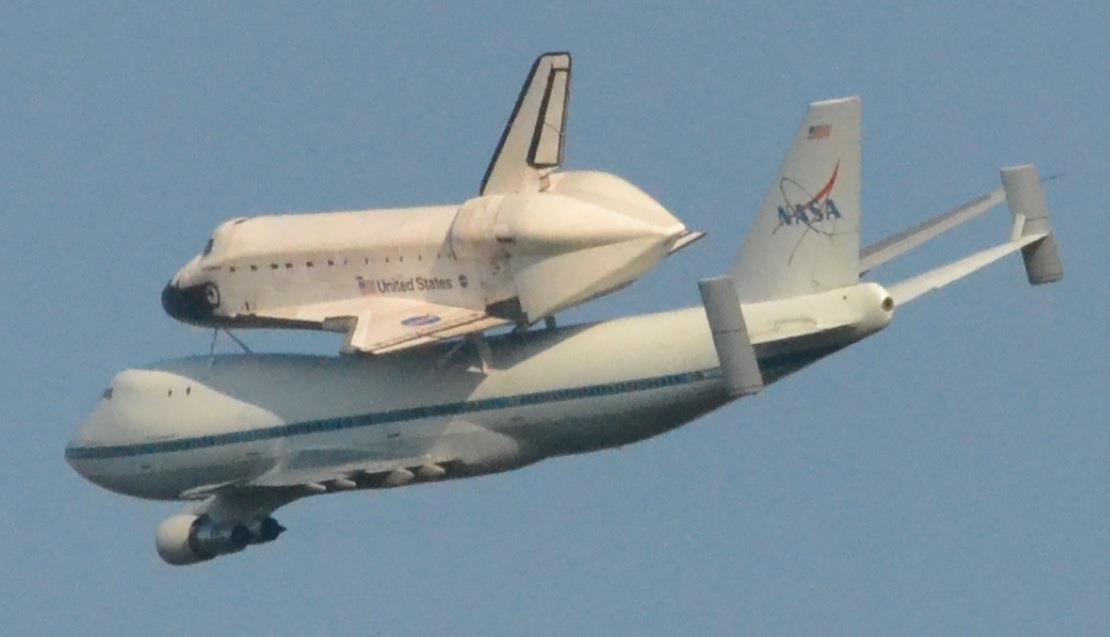
Endeavour flying over Stennis Space Center on her way to Los Angeles

Space Shuttle Endeavor (OV-105) is on the way to her new job at the California Science Center. She is scheduled to arrive at LAX on Friday after completing a flyover of several landmarks, including The Griffith Park Observatory and Disneyland (Disneyland?). I’m conflicted over whether I should drive to Griffith Park or, perhaps, to Malibu – where she is also scheduled to fly over. Parking could be a real pain.

As a young man I used to go to LAX, park in the lot of the Proud Bird Restaurant, and walk down Aviation Blvd. to the East end of the runway. I could stand there and watch the planes come in for a landing, at times only a hundred feet or so over my head. It was exhilarating. Maybe I’ll do that.

I spent nearly half of my adult life working on the Space Shuttle Main Engine (SSME) program at Rocketdyne in Canoga Park, California. I grew up in the San Fernando Valley and have vivid memories of the many rocket engine tests that took place in the Santa Susana Mountains to the West of where I lived. I would go outside and could hear the roar and see the sky lit up. Those engines helped take us to the Moon. It was magical.

I came to Rocketdyne quite by accident and, even after I started as a temp (what they called a “Job Shopper”) working on the return to flight efforts after the Challenger disaster, it took a while for me to realize I could work there. Not being an Engineer, it somehow never crossed my mind that I could find a place in the organization. I ended up spending 21 years there – in a 23 year period (taking two years off in an ill-fated attempt to return to a family business) – working primarily on the SSME program. Endeavour was the replacement vehicle for Challenger, so I am somewhat emotionally tied to her. Half my working life!

In 2010, I accepted an offer of early retirement, which was made to those of us who were sixty years of age or over because the Shuttle Program was coming to an end. It wasn’t quite over, and I had always joked that I would be the one to turn the lights out at the end. I expected to work until I dropped dead, maybe around 80. It didn’t work out that way. I still miss being a part of the space program and seeing Endeavour on her last flight is dredging up a flood of emotion I’m not sure I’m prepared to handle.

Thankfully, she’ll be very close by and I can take my two girls to see her. Fare thee well, Endeavour. I am eternally thankful I was able to play a small role in your voyages. I wish you well on this, your final mission.

Photo Courtesy of Mike Malinzak


My First Encounter with NASA

How Meetings End Up

From Space to Sleep

Yesterday, a friend of mine, Luis Suarez, posted some information on Google+ about sleep, which elicited a fair amount of commentary (including from me) and, in the process, reminded me of a story that comes from my first days as a member of the Flight Operations team on the Space Shuttle Main Engine (SSME) program.

I’ve written before about my feelings regarding meetings and their efficacy, which I tend to frequently question. However, this was a meeting where I might have been able to learn more about the job I was embarking upon. Unfortunately, it didn’t quite work out like I hoped it would.

SSME, MCC, HPFTP, HPOTP, LPFTP, LPOTP, MECO

The aerospace industry, like many others, is replete with acronyms. In addition, I was working at an organization that was primarily an Engineering company and I’m not an Engineer. After over two decades there I have often noted I am now covered with a reasonably thick patina of Engineer, but this was at the very beginning of my tenure and everything was new to me.

This particular meeting was a telecon with our NASA counterparts at a time when the U.S. Space program was recovering from the destruction of Challenger. The year was 1988 and we were approximately 8 months away from returning to flight; human flight, that is. Although the SSME was in no way implicated in the disaster, we had been using the stand-down to prepare a Failure Mode and Effect Analysis, as well as a Critical Items List (referred to as a FMEA-CIL). It consisted of breaking down the operation of our engines into discrete activities beginning with “tanking” (the loading of fuel into the External Tank) and ending with MECO (Main Engine Cut-Off).

To make a long story short, I entered a packed conference room designed to accommodate approximately 35 – 40 people. It was full, with every available seat taken, and there was a conference phone, on the other side of which was an equally packed room at Marshall Space Flight Center in Huntsville, AL. I don’t recall the specific technical issues that were discussed at that meeting, partly because I really didn’t have the faintest idea what they were talking about – especially because of the prolific use of the aforementioned acronyms and technical jargon, as well as the use of numerous bullet charts and a dizzying array of graphics which, presumably, represented performance data of various sorts.

The Hypoglycemia Zone

I sat in the back, against the wall, and tried to follow along, anxious to learn what I could about my new job and what my organization was responsible for. It wasn’t long before I felt my head bang against the wall. With horror, and not a little consternation, I realized I had dozed off. To make things worse, I was quite certain I had begun to snore, as I have been shunned by many because of my snoring. I also noticed I received a couple of sidelong glances from my new colleagues.

Needless to say, I got up and left the room, delaying my education . . . and hoping I hadn’t been noticed by too many influential people. I never forgot that day and, throughout my over two decades career there, I was always conscious of the possibility of falling asleep during meetings, especially terminally long ones where incredibly arcane technical discussions were accompanied by the kinds of charts I grew used to, and which Edward Tufte so vociferously decried. In that more than twenty years I also witnessed an awful lot of people dozing during meetings, especially if they took place after lunch – in the Hypoglycemia zone.

I really think meetings are over-rated and we tend to have far too many that are unproductive and unnecessary. Is this the case where you work?

Photo Courtesy of Rational Supervision


We Don’t Need No Stinking Meetings!

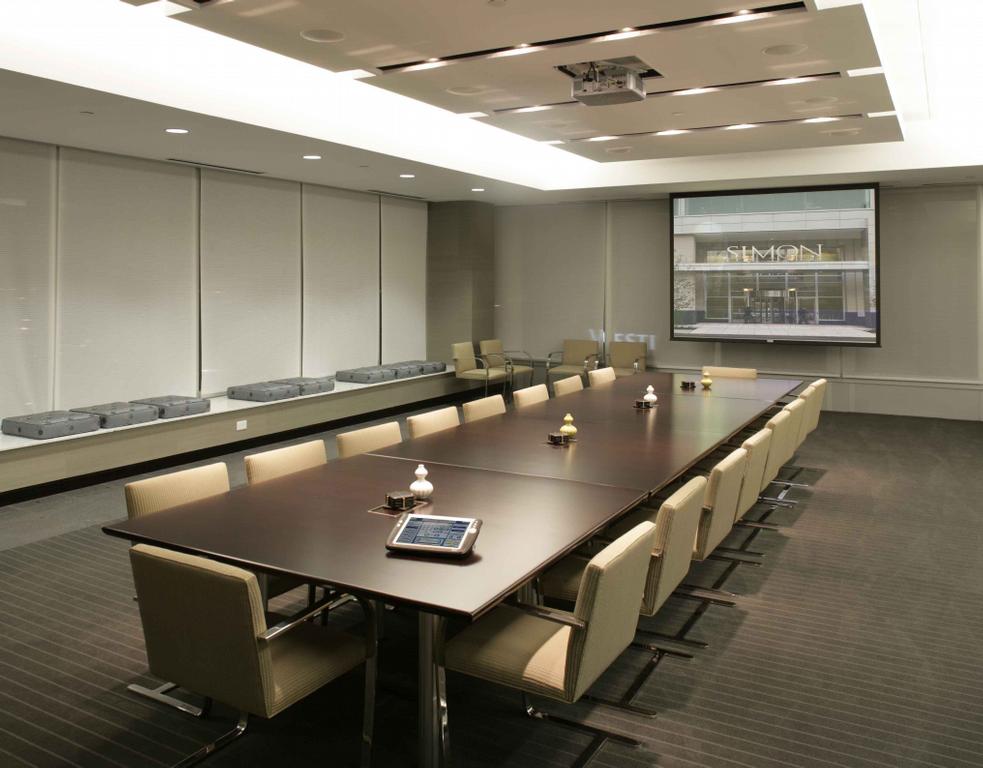
The Ubiquitous Conference Room: Where Collaboration Goes to Die

Before you get your panties in a bunch, I’m not really advocating the complete abolition of meetings. I always loved getting together with 20 or 30 of my closest associates and spending the first ten minutes – of what always managed to completely fill the exact amount of time allotted to it – with banter about our kids, our pets, our plants, and our plans for retirement. Regardless, it always seemed to me there were just a few too many of them, and many were just . . . well . . . kind of unnecessary. So I’m just saying maybe we should consider there are meetings that are a complete – or near complete – waste of everyone’s time. Allow me to provide an example and, hopefully, I won’t piss off my former employer too much by sharing this.

Quite a few years ago I was a member of the High Pressure Fuel Turbopump team for the Space Shuttle Main Engine program at a famous, but not very well-known organization. [Pop Quiz! Who designed the engines that powered the Saturn vehicles to the moon?] At the time, another company was in the process of certifying their design for the same pump, as (Warning! the following statement may be hotly disputed by the parties, and they are only a partial recollection from a limited perspective) NASA had determined their (the other company’s) design was more reliable and, therefore, more safe. Unfortunately, this other organization was having trouble with some of their design and they weren’t meeting their certification and delivery goals. For this reason, we were given a contract to produce ten more high pressure fuel pumps.
For a length of time I can no longer recall (this was in the late 1990s, I believe, and the experience was somewhat painful), but let’s say it was around or over a year, we had a stand-up meeting every day to discuss what had happened the day before and what we wanted to happen that day. There were always between 15 and 20 people in attendance. However, on most days only a few of these folks actually had to be there. Unfortunately, it was impossible at the time for anyone to know whether or not they were needed without attending the meeting to see and hear what was talked about.
At the time, Macromedia had a product they called Generator which, as the team’s webmaster and web content volunteer learner guy, I had discovered. Generator worked with Flash to create animated displays. Among the things you could do with it was to create a ticker tape that would run a stream of updates at the bottom of an employee’s display. I knew nothing of “social” back then, but it sure seemed to me that having people update their activity through the use of this ticker tape would obviate the necessity for at least half (probably more like 80%, thank you Mr. Pareto) of the meetings we were having. This seemed a significant savings to me. Unfortunately, I might as well have been standing in the corner talking to it.

Now that this occurrence has faded in my rearview mirror, I can look at it a little more rationally. At the time, it was just one of numerous ways in which I saw us spending far more money and effort than necessary to get things done (don’t get me started on how click-to-talk phones could have sped up the flow of components through the shop). It wasn’t to be.

Although I’m no longer in that world (corporate, that is), I have good reason to believe things haven’t changed much in all this time. I know they hadn’t by the time I left (May of 2010). Are you still having meetings that accomplish little other than to fill up the hours? Here’s a suggestion. Read the book by Patrick Lencioni – “Death by Meeting: A Leadership Fable“. It’s a great business book masked as an entertaining fable, in the mold of Eli Goldratt’s “The Goal“. See if you can’t turn your meetings into what they should be, a vital and invigorating component of running an organization rather than a time-wasting drag on everyone’s energy and enthusiasm.


Why Would We Wish to Waste So Much Talent & Investment?

Atlantis ascending - STS-27

Atlantis Powers to Orbit

As long as I worked at what is now called Pratt & Whitney Rocketdyne we referred to NASA and the Air Force as our “customers”. For nearly twenty years I worked on the Space Shuttle Main Engine program and we always called NASA our “customer”. In the last few years of my employment there, when my awareness of – and interest in – social media brought me to learn as much as I could about what was available and how it might be of benefit to my company, I began arguing for a different approach. I believed, still do, that the real customers of companies involved in space exploration are the American people, those who pay the taxes that were used to pay our salaries. I still believe this is the case, and I still await the evidence of an enlightened approach to engaging them.

In the meantime, I just received an email request to take action and I want to pass it on in the hope some of you who read this will consider taking action; very simple, virtual action. I believe it is imperative for the human race to establish not merely a technological presence in space, but a strong cultural presence as well. I don’t believe it has to be dominated by the United States. In fact, I would prefer it be an international, world-wide effort to ensure the long-term survival of our species. Nevertheless, what is currently happening here is the gradual wasting away of our talent and our industrial base to continue leading the effort. I will no doubt write more about this as it is near and dear to my heart.

What follows is the text of the email, which comes from the website I’m asking you to visit and consider using to send a letter of support to the President, your U.S. Senators, and your Congressional Representative. I’m also including the link below the text so you might take action if you’re so inclined.

I’m concerned about the future of the United States’ role in space. Investments in our nation’s space programs will have a direct impact on our future economic strength and ability to remain a space-faring nation on the cutting edge of technology. I urge you to make a strong commitment to maintaining the U.S. as the unsurpassed leader in space.

For decades, U.S. leadership in space has been recognized across the globe. However, that position is perishable, and continued national leadership will be vital for our future. Therefore:

  • It is important to establish a long-term national space strategy that factors in civil, national security and commercial interests in space. Our national strategy must also cut across all agencies that have a stake in space. Without a national strategy, America risks a future where the workforce and industrial capacity needed to maintain U.S. leadership and competitiveness in space is seriously – and in some cases irreversibly – degraded.
  • It is important for our future global competitiveness, leadership and innovation in space that budgets and funding remain stable and robust. Appropriate funding must accompany strategic goals to meet established objectives and sustain a strong and progressive space industry.
  • It is important to support policies that maintain a healthy and vibrant space industrial base that employs technically-skilled American workers. Modernizing our nation’s export control policies – so that U.S. industry can compete on a level playing field – is one step in the right direction.
  • It is important to recognize that the space industrial base drives technological development important to our economy and national security. Our national strategy must identify and seek to preserve the space capabilities critical to meeting our national goals.

The United States stands at a critical juncture between past accomplishments and future ambitions in space. The rest of the world is not waiting. Yet there is uncertainty about the future of U.S. leadership in space; our workforce is facing upheaval and layoffs and the U.S. space industrial base is at the brink of losing our competitive and innovative edge.It is absolutely critical that our nation’s decision-makers work together to show the leadership needed to keep our space efforts robust. I urge you to make addressing these issues a national priority.

Here is the link to send this letter. Thanks for considering it – http://www.spaceleadership.org/


A Personal Reflection on the Loss of STS-51-L (Challenger)

I was rooting around in the garage the other day; not really looking for anything in particular;  just looking to remind myself of things I keep around. I have lots of “keepsakes” from my life. Not collectibles . . . hardly, but little things that remind me of events I’ve experienced in one way or another. It could be a ticket to a Lakers’s playoff game (against the Celtics, no less), a “Nixon, Humphrey, Wallace – Three Strikes and You’re Out” button, or a bar mitzvah boy decoration that once sat atop my birthday cake over 50 years ago.

All three of these items have powerful memories associated with them, though each was quite different in the degree to which those things I remember actually affected my life. All three have also faded with time so , interestingly, the one that seems to have the strongest memories is the Lakers ticket. I suppose it makes sense. Even though it’s been over 25 years since it happened, it was the first time the Lakers ever beat the Celtics for the championship. On the other hand, though politics and religion have always played a major role in my life, my everyday existence has not been impinged upon too much by governmental activity and I’ve been an atheist since I was 16. Basketball, however, comes back around every season to refresh the wounds and triumphs and, even though I don’t watch many games any more, the finals are always exciting.

I didn’t actually come across any of these items the other day, but I did come across an item which has more meaning for me – in many ways – than all three of the others combined. As I opened up a piece of old decorative pottery someone once gave me, I found the medallion I’ve pictured below. I suspect most everyone who might read this post is familiar with the Challenger disaster but, just in case some aren’t, the Challenger Space Shuttle Orbiter, one of five orbiters to once exist in the NASA fleet, was lost in an explosion during launch on January 28, 1986. Clicking on the picture will take you to NASA’s official site for this launch. This month marks the 25th anniversary of what was both a national, nay, human tragedy and the beginning of a new life for me.
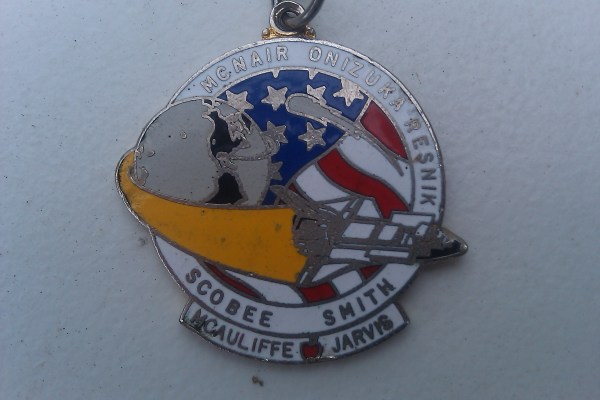
 

Challenger STS-51L Mission Patch

Challenger STS-51L Mission Patch


Finding this medallion at this time seems somewhat serendipitous to me, as it neatly intersects with so much of my life these past 25 years. Let me explain and I will try not to bore you.

When Challenger exploded I was working in Century City, Los Angeles, California at a litigation support firm. Our business was to organize the information available from mountains of questions (called interrogatories in the legal profession) and their answers, as well as transcripts of real-time examinations of witnesses and parties (called depositions). The two main cases we were involved with were family battles over empires worth hundreds of millions of dollars, so there was a lot at stake (silly and humorous as it was to me).

There was a grill and pub inside the building I worked in, which I frequented for lunch and a couple of adult beverages in the evening whilst waiting for the Northbound insanity on the 405 to subside. This generally took a few hours, but it was a congenial place and I enjoyed the company of numerous denizens. Sometimes I would eat dinner there as well. It wasn’t like the sports bars we have today, but they had a television in there and, now that I think about it, I believe it was the only one. There were no flatscreens, no HD, etc. After all, it was 1986. A long time ago . . . in terms of consumer technology, at least.

When I heard the news, though I now wonder  how it traveled so fast without Twitter to carry it, I immediately left my desk and went down to the pub. I can’t recall if the TV was on when I entered, but it was certainly on shortly after I got there. I watched in horror as the news showed the explosion of Challenger over and over and over and over and . . . well, you know . . . over. To this day, I can’t stand to watch it again. Without even closing my eyes, right now I can see the two solid rocket motors splitting off, yet continuing to ascend under power after the orbiter disintegrated. It was a horrendous site and it cost the lives of seven intrepid souls, including the woman who would have been the first teacher in space, Christa McAuliffe.

These seven people gave their lives that we and our children might more fully live ours. They deserve to be honored and I wish to acknowledge them here:

Michael J. Smith
Dick Scobee
Ronald McNair
Ellison Onizuka
Christa McAuliffe
Gregory Jarvis
Judith Resnik

I have long been a space cadet (in more than one sense 🙂 ) and I am a staunch supporter of our space program, as well as one who strongly believes we must establish a cultural – not merely technological – presence in space and on other worlds. When I was a boy living in the middle of the San Fernando Valley, I vividly recall hearing the sound of the Saturn vehicle’s second and third stage engines (the J-2) being tested at Rocketdyne’s Santa Susanna Field Laboratory and seeing the sky above turn red over the hills to the West. I also recall laying on the grass in front of our home and watching Sputnik go by overhead when I was 10 years old. I dreamed of going into space; still do, though I have no real expectation of doing so other than in my imagination.

A year after Challenger was destroyed, thanks to a bit of serendipity (and Apple One), I found myself showing up as a temp worker on the Space Shuttle Main Engine (SSME) program’s efforts to return to flight after the disaster. Although the SSME was not a factor in the tragedy, the team was using the resultant stand-down to re-assess the likelihood of one of the three engines which are responsible for lifting the shuttle into low earth orbit (LEO) failing at any time in a mission.

A year later, despite not being an Engineer, I found myself working as a full-time employee of Rockwell International‘ on the Flight Operations Team of the SSME. Last year (in May), I took an early retirement package offered to those of us 60 years and older. It’s been about eight months now since my separation from the place I worked at for most of a 23 year period and the 28th of this month will mark the 25th year since these seven brave astronauts perished on a cold, wintry Florida day. I find it ironic (and painfully humbling) to realize their deaths intersect with the birth of my first real career (I had been in many small businesses until that point, some as an employee, others as a partner) and now this anniversary comes so close on the heels of my leaving. Although I grieve for having left the place I thought I would work at until I dropped dead, I still find an even larger hole in my heart for having lost the crew of Challenger, as well as the vehicle that killed them.

If you have a special memory of these people or this tragedy, I hope you’ll share it somewhere during this anniversary.