Category Archives: Professional

The Elements of Dialectical Materialism

Yin Yang Symbol

My Favorite Representation of The Concept of The Dialectic

I am not an academic. Neither am I a philosopher or a journalist. Nevertheless, I do write on occasion and make an effort to share my thoughts in a somewhat coherent manner. I have to admit it’s gotten a little bit more difficult over the last few years, what with Twitter, Facebook, and other social media apps, platforms, and sites, slowly turning me into a scattershot reader of content.

My goal for the foreseeable future is to reverse that trend somewhat and spend more time writing and sharing my thoughts, perhaps some of my dreams, and a few (or more) of my memories. I’ll be 70 years old next June and, in mid-April of next year, will have outlived my father by a decade. Although relatively healthy, I do have my share of ailments that seem to come to everyone eventually: Mild Hypertension; Type II Diabetes (though, thanks to Fitbit and a little willpower made easy by the data retrieved from my Aria scale and Charge HR (link is to their latest version), I’ve lost a little over 30 pounds in a little over a year — and it’s had its salutary effect on my blood sugar); surgery for a Melanoma; Dupuytren’s Contracture; trigger finger; and a bunch of weird-ass nerve issues that are making many reaching movements with my hands problematic. In other words, I’m doing pretty good for an old guy.

I’m hoping to live long enough to share a little of the adult life of my children, who are currently 15 and 13, but there’s no way to know if that will happen. A lot of folks around my age have been dying off lately, and I can feel the inexorable decline of my physical strength, stamina, and overall health accelerating as I age. It’s a strange trip, I must say. Sometimes I worry a bit that I’m paying too much attention to the end, but I have always been one who has enjoyed the ride and I’m not really too concerned with its conclusion. I just happen to be fascinated by the concept of nothingness, which I contend is nigh onto impossible for we humans to comprehend. I also believe it is a big part of what has long attracted people to religion; they need to believe there’s some sort of consciousness after they die. I don’t believe that’s possible.

As someone who has embraced (if not always lived up to the practices inherent in doing so) Systems Thinking, I long ago came to the conclusion that the philosophy of Karl Marx and Friedrich Engels, Dialectical Materialism, is the framework from which systems thinkers can best view the development of the natural world which, of course, includes human beings and our social constructs.

In that regard, I thought I would share this compilation of the elements of the philosophy, as culled from the works of Vladimir Ilyich Lenin, one of the world’s clearest explicators of the work of Marx. Here are the 16 elements I’ve been able to find. I once had a slightly shorter version, which I had printed out and displayed at my desk. Several years before I retired, someone had the audacity to take it down from the wall, rip it in half, and leave it on my seat. I’ve never quite understood the cowardice it takes to do something like that but, no matter, the words — and the concepts they represent — can’t be erased quite that easily. Here’s the list:

Summary of Dialectics

Vladimir Ilyich Lenin

  1. The objectivity of consideration (not examples, not divergences, but the Thing-in-itself).
  2. The entire totality of the manifold relations of this thing to others.
  3. The development of this thing, (phenomenon, respectively), its own movement, its own life.
  4. The internally contradictory tendencies (and sides) in this thing.
  5. The thing (phenomenon, etc.) as the sum  and unity of opposites.
  6. The struggle, respectively unfolding, of these opposites, contradictory strivings, etc.
  7. The union of analysis and synthesis — the breakdown of the separate parts and the totality, the summation of these parts.
  8. The relations of each thing (phenomenon, etc.) are not only manifold, but general, universal. Each thing (phenomenon, process, etc.) is connected with every other.
  9. Not only the unity of opposites, but the transitions of every determination, quality, feature, side, property into every other [into its opposite?].
  10. The endless process of the discovery of new sides, relations, etc.
  11. The endless process of the deepening of man’s knowledge of the thing, of phenomena, processes, etc., from appearance to essence and from less profound to more profound essence.
  12. From coexistence to causality and from one form of connection and reciprocal dependence to another, deeper, more general form.
  13. The repetition at a higher stage of certain features, properties, etc., of the lower and
  14. The apparent return to the old (negation of the negation).
  15. The struggle of content with form and conversely. The throwing off of the form, the transformation of the content.
  16. The transition of quantity into quality and vice versa.

As I said, I am hardly a philosopher; merely a person who has found Materialism, whether it be Dialectical or Historical, to be the best method available to understand history and the development of society without — and this is important — the intervention of the supernatural. I try to apply this type of thinking to everything I ponder, but I do fall short at times. I, like most of us, am a work-in-progress. More to come.



Dealing With Narcissistic Personality Disorder

I came across a post on Facebook last night which I thought very clearly laid out the personality traits of someone with narcissistic personality disorder, specifically one Donald J. Trump. It had been copied from elsewhere, and the friend who posted it passed on the suggestion that the text be copied and pasted, rather than “shared.” I’m not entirely certain why, though I suspect it is shared a little more pervasively with one’s friends if it’s seen as an original post. Someone please correct me if I’m wrong. Several of my friends commented on how useful it was and suggested publishing it, which I think is a good idea.

Trump admires himself

“Who Loves Me, Baby?”

At any rate, there are some very astute observations and insights in the text and we would do well to understand how things are likely going to work. Here’s the money quote for me:

“Focus on what you can change and how you can resist, where you are. We are all called to be leaders now, in the absence of leadership.”

Here’s the post in its entirety:

I want to talk a little about narcissistic personality disorder. I’ve unfortunately had a great deal of experience with it, and I’m feeling badly for those of you who are trying to grapple with it for the first time because of our president-elect, who almost certainly suffers from it or a similar disorder. If I am correct, it has some very particular implications for the office. Here are a few things to keep in mind:

  1. It’s not curable and it’s barely treatable. He is who he is. There is no getting better, or learning, or adapting. He’s not going to “rise to the occasion” for more than maybe a couple hours. So just put that out of your mind.
  2. He will say whatever feels most comfortable or good to him at any given time. He will lie a lot, and say totally different things to different people. Stop being surprised by this. While it’s important to pretend “good faith” and remind him of promises, as Bernie Sanders and others are doing, that’s for his supporters, so *they* can see the inconsistency as it comes. He won’t care. So if you’re trying to reconcile or analyze his words, don’t. It’s 100% not worth your time. Only pay attention to and address his actions.
  3. You can influence him by making him feel good. There are already people like Bannon who appear ready to use him for their own ends. The GOP is excited to try. Watch them, not him. President Obama, in his wisdom, may be treating him well in hopes of influencing him and averting the worst. If he gets enough accolades for better behavior, he might continue to try it. But don’t count on it.
  4. Entitlement is a key aspect of the disorder. As we are already seeing, he will likely not observe traditional boundaries of the office. He has already stated that rules don’t apply to him. This particular attribute has huge implications for the presidency and it will be important for everyone who can to hold him to the same standards as previous presidents.
  5. We should expect that he only cares about himself and those he views as extensions of himself, like his children. (People with NPD often can’t understand others as fully human or distinct.) He desires accumulation of wealth and power because it fills a hole. (Melania is probably an acquired item, not an extension.) He will have no qualms *at all* about stealing everything he can from the country, and he’ll be happy to help others do so, if they make him feel good. He won’t view it as stealing but rather as something he’s entitled to do. This is likely the only thing he will intentionally accomplish.
  6. It’s very, very confusing for non-disordered people to experience a disordered person with NPD. While often intelligent, charismatic and charming, they do not reliably observe social conventions or demonstrate basic human empathy. It’s very common for non-disordered people to lower their own expectations and try to normalize the behavior. DO NOT DO THIS AND DO NOT ALLOW OTHERS, ESPECIALLY THE MEDIA, TO DO THIS. If you start to feel foggy or unclear about this, step away until you recalibrate.
  7. People with NPD often recruit helpers, referred to in the literature as “enablers” when they allow or cover for bad behavior and “flying monkeys” when they perpetrate bad behavior on behalf of the narcissist. Although it’s easiest to prey on malicious people, good and vulnerable people can be unwittingly recruited. It will be important to support good people around him if and when they attempt to stay clear or break away.
  8. People with NPD often foster competition for sport in people they control. Expect lots of chaos, firings and recriminations. He will probably behave worst toward those closest to him, but that doesn’t mean (obviously) that his actions won’t have consequences for the rest of us. He will punish enemies. He may start out, as he has with the NYT, with a confusing combination of punishing/rewarding, which is a classic abuse tactic for control. If you see your media cooperating or facilitating this behavior for rewards, call them on it.
  9. Gaslighting — where someone tries to convince you that the reality you’ve experienced isn’t true — is real and tortuous. He will gaslight, his followers will gaslight. Many of our politicians and media figures already gaslight, so it will be hard to distinguish his amplified version from what has already been normalized. Learn the signs and find ways to stay focused on what you know to be true. Note: it is typically not helpful to argue with people who are attempting to gaslight. You will only confuse yourself. Just walk away.
  10. Whenever possible, do not focus on the narcissist or give him attention. Unfortunately we can’t and shouldn’t ignore the president, but don’t circulate his tweets or laugh at him — you are enabling him and getting his word out. (I’ve done this, of course, we all have… just try to be aware.) Pay attention to your own emotions: do you sort of enjoy his clowning? do you enjoy the outrage? is this kind of fun and dramatic, in a sick way? You are adding to his energy.

Focus on what you can change and how you can resist, where you are. We are all called to be leaders now, in the absence of leadership.


From Anne Lamotte

I’m posting this as much as a reminder to me.

Writing: shitty first drafts. Butt in chair. Just do it. You own everything that happened to you. You are going to feel like hell if you never write the stuff that is tugging on the sleeves in your heart–your stories, visions, memories, songs: your truth, your version of things, in your voice. That is really all you have to offer us, and it’s why you were born.


The Moron’s Case For Hillary Clinton…because some of you really are that stupid.

Hillary vs Trump Monsters

From Larry Wilmore and The Nightly Show (RIP)

Had to share this. Also want to see how it shows up, since I’m reblogging from my phone. I just added the graphic above. Larry said it gave him nightmares – and I can understand why – but I found it oddly satisfying.

The Great Contrarian's avatarThe Contrarian Blog

An old colleague and I were having breakfast this morning when he looked up at the news (I can’t remember which network …MSNBC, I think) and noticed a split screen of Donald Trump and Hillary Clinton. He lamented long about how terrible both candidates are in this election and I guess we just have to choose the lesser of the two evils or, as he put it, “…put on a blindfold and just pick. It doesn’t really make any difference.”

And that’s when I went off.

I am really sick and tired of people saying both candidates are equally horrible choices, how much America thoroughly hates both of them to the core, that there’s not a single positive trait in either one of them and wow, if only we had voted for that guy behind the deli counter or the neighbor’s cat, America would be WAY better off.

Fuck you. Fuck the…

View original post 1,419 more words


Gawker, the open web, Thiel and Zuck

Since I don’t have anywhere near as much time to write as I used to (now that I’m back working) I thought I would start sharing some of my favorite writers and posts. Here’s one from Dave Winer that he posted on the 25th anniversary of the Web. Dave knows of what he speaks, having been one of the earliest bloggers and developers. Here’s a piece from yesterday, August 23, 2016.  

~ Rick

nuttyBars

Perhaps not many people will see the connection between today being the first day Gawker is gone, it being the 25th Anniversary of the Web, and the message all Facebook users were greeted with this morning.

  1. Gawker is gone because Peter Thiel financed its murder-by-lawyer. It’s legal to do this in the US, but until now as far as I know, no one has crossed this line. Now that the line has been crossed, it’s fair to assume it will become standard practice for billionaires like Thiel to finance lawsuits until the publication loses and has to sell itself to pay the judgment.
  2. It’s the 25th Anniversary of the Web because 25 years ago a generous visionary named Tim Berners-Lee invented something that would benefit humanity more than it would benefit him. And many other visionaries saw it, and because it was open, were able to build anything they could imagine using it as a basis. And they did, making something like Facebook possible.
  3. Facebook is a silo for web writing. And while it would be easy for them to create paths for ideas to flow in and out of Facebook, at very low cost, and they have the features already developed, and use them internally, they refuse to share them with users. I suppose we could just explain this as they’re a very large tech company and that’s what tech companies do, but they also have the chutzpah to pretend to support the open web. They have been happy to accept its bounty and have done nothing to return what they’ve taken from the commons to the commons.
  4. And finally, remember Peter Thiel, the guy who thinks his wealth entitles him to shut down publications he doesn’t like, not only did he make billions from Facebook stock, he’s still on the board of Facebook. Zuckerberg has had plenty of time to ask him to leave, or to fire him, and he hasn’t done it. Again, you could just shrug it off and say Zuck is like Thiel, but he’s extra special in that he wants you to believe he appreciates the gift of the open web, as he strangles it.

Source: Gawker, the open web, Thiel and Zuck


NOVA’s Opening Makes Me Feel Optimistic

I love the PBS documentary series, NOVA. The fact that it’s entertaining and informative, oddly enough, is not what makes it stand out for me, though. It’s the introduction. The music is beautiful and uplifting. It inspires, even if only momentarily . . . and it never fails to do so. Here’s the best video I could find of it. Don’t let the title fool you. It’s only the latest version we’re interested in, so here’s the very end of what is a somewhat longer video.


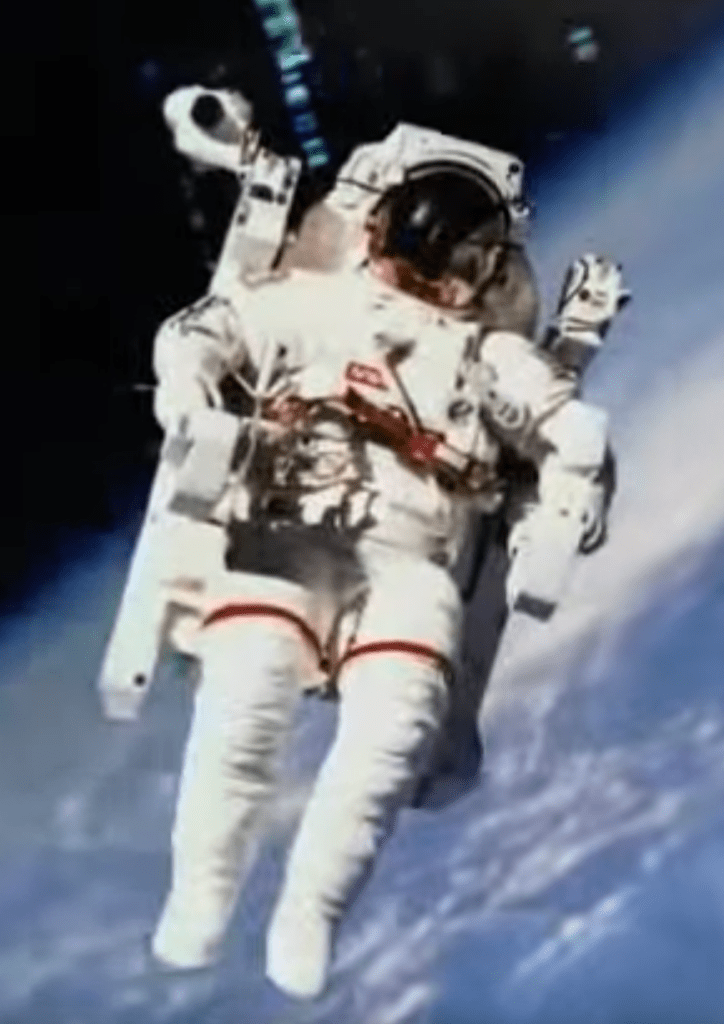
There’s another bit of the intro that speaks to me as well. It happens at 1:11 and, unfortunately, it passes way too fast. I don’t expect others will relate to it quite like I do. After all, I spent over two decades working on the Space Shuttle Main Engine and am a lifelong space cadet — in more ways than one. When I see that astronaut floating in space, it almost chokes me up. It’s kind of bittersweet, though, as living down here the majesty of what we’re capable of achieving is somewhat offset by the mayhem we’re creating all too frequently. Nevertheless, at least for a few seconds, this picture — combined with the music — is wonderfully moving. Here’s the pic. I watched the video full screen and grabbed this piece.

Screenshot 2016-07-05 17.22.56

Float like a butterfly, sting like the Borg.


Our Spring Break Denouement

All Aboard

All Aboard

We’re on our way to San Diego, aboard Train 768, from the Simi Valley Amtrak station a few minutes from our house. After a half hour layover at Union Station in Downtown LA, Fullerton is our next stop. I chose this method of travel thinking it would be a bit of a different experience for the girls. Also, the commute in a car is not one of my favorites. Frankly, driving is not one of my passions, even though I’ve done a lot of it. 

It’s the end of Spring break for the girls and I’ve been squirreling away money so we could do something before it’s too late. Our oldest will be 15 in less than three months and she already inhabits a different universe than Linda and I do, and this may be the last time we’ll be able to enjoy a couple of days together for many years.

After we get to San Diego we’re going to head to the hotel and see if we can check in early. If we can’t, we’ll check our bags in, head to lunch, and then to the USS Midway Maritime Museum. 

Tomorrow is reserved for the zoo. Our younger daughter really, really, really wanted to go to the zoo, so she’s very excited. I already purchased our tickets online, though I printed them out, as I wasn’t convinced they would accept the .pdf they sent and I saved to Evernote. The Midway has an app and our tickets are available in it. Amtrak scans everything (as does just about everyone, I suppose) and I just confirmed with the Conductor the .pdf they sent would be just fine off of my phone. I’ll do that on our return. 

The trip is a bit longer than if we had driven but, unless you’re Agoraphobic, it’s far less stressful. I am, after all, writing this as we now head toward Irvine. We’re headed almost due south and will soon be skirting the Pacific Ocean. So far, the urban scenery has been pretty grim. I’m looking forward to seeing some open, less sullied space. I need to give a shoutout to Google Maps, and GPS technology in general, as I no longer have to guess where we are. For someone with a slight bent toward orienteering, it’s a bonus. 

There’s a bunch of guys who, apparently, are on their way to a bachelor party, a fact I just learned after this rather loquacious woman got on and immediately started a boisterous conversation with them. I can barely hear them, but I’m sure most of the car can hear her, and her male companion who chimes in now and again. Unfortunately, Aimee (our oldest) has her ear buds nestled tightly in her music saturated skull and is missing the show. This was one of the reasons I thought the train would be interesting for the girls. Dang!

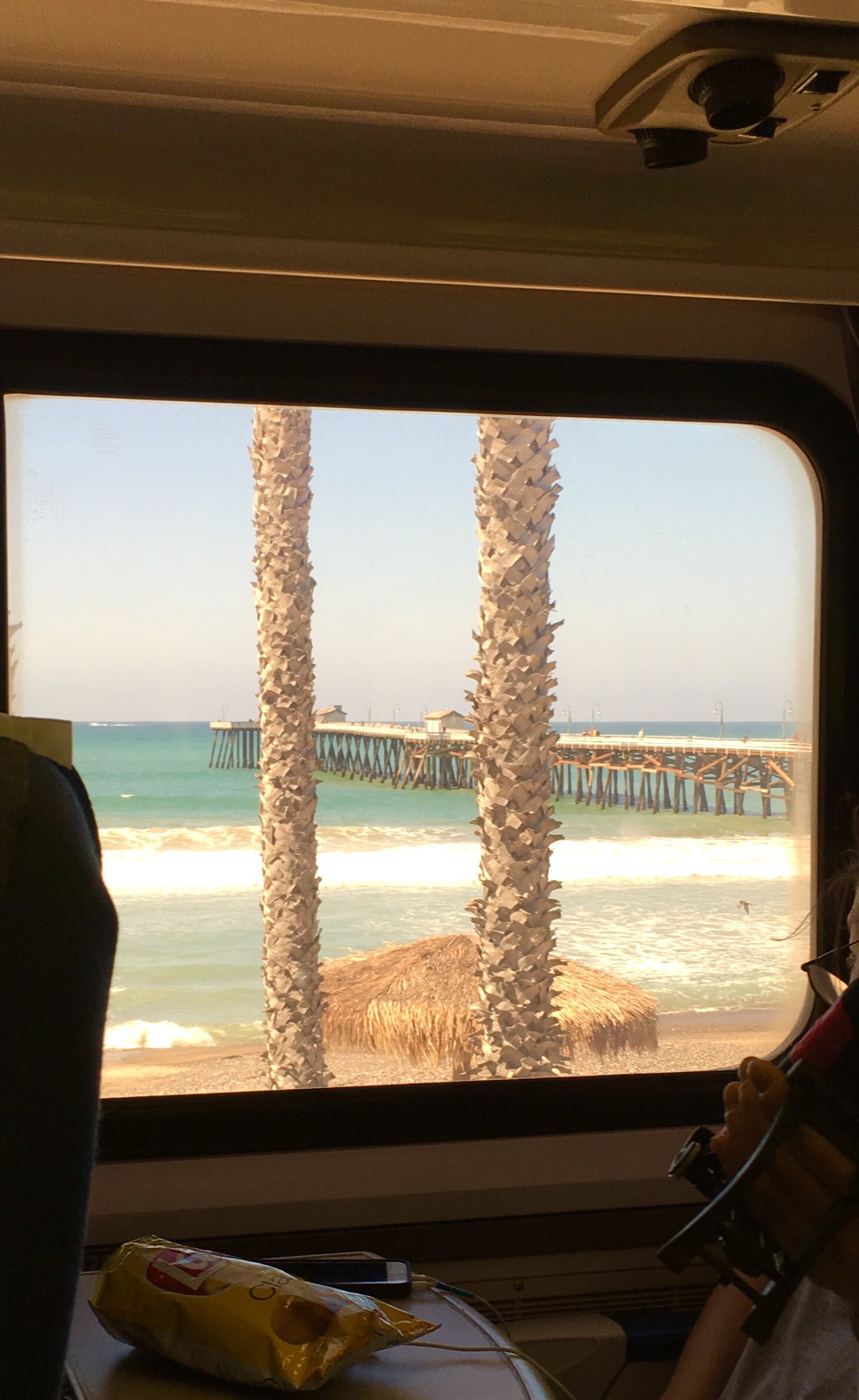
Just pulled into San Juan Capistrano; not a swallow in sight but, the Pacific is nigh. Surf’s only a couple feet and it’s a bit choppy, but there are some stalwarts out apaddlin’.


San Clemente Pier

San Clemente Pier


Cliffs

The edge of the continent, slowly eroding


San Onofre

San Onofre which, thankfully, has yet to melt down

We’ll be there soon and I have a family to attend to. So far, so good. There’s a bit of a party atmosphere aboard this train. Looking forward to exploring the Midway. Now I have to decide whether or not to punk the girls for April Fools. 😀 


A Day With Edward Tufte

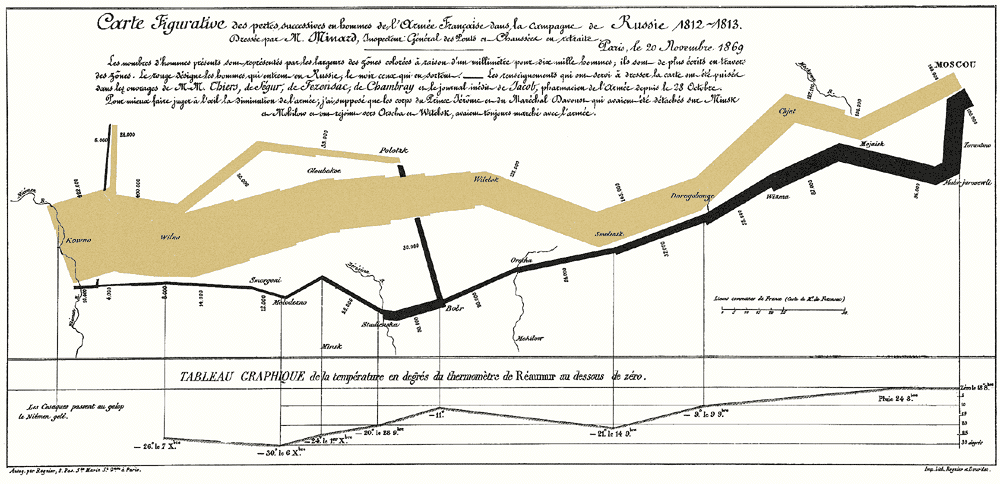
Graphic of Napolean's March

One of the more iconic images Professor Tufte uses in his presentations. I have a mounted, autographed poster of this one.

If you create reports, presentations, info graphics, or are in any way involved with presenting data of any sort, I hope you’ve heard of Edward Tufte. Even better if you’ve heard of his work, especially what I believe is his seminal book, “The Visual Display of Quantitative Information.”

As part of my job at Rocketdyne, I was privileged to attend an all-day seminar of his in Los Angeles in the Spring of 2007 or ’08. Upon my return, I wrote down some notes and impressions for my colleague who paid for the day. There’s some really good stuff in here. As a knowledge management professional, I’m a bit chagrined it’s taken me this long to share it. I truly hope someone finds Tufte’s words useful.

Bill:

Here’s a quick recap of Edward Tufte’s presentation last Thursday. What I did, for the most part, was enter points he made as numbered bullets. Therefore, I’ll do the same here with the addition of some extra comments if I feel they are necessary.

1. Professor Tufte refers to the nature of the work he does as “escaping flatland”. He believes dimensionality is extremely important when using visualization to represent quantitative data.

2. Another aspect of visually presenting data which he emphasizes is data density, i.e. resolution. He repeatedly stressed the need to drive for greater and greater resolution when presenting data.

3. With respect to items such as run charts, histograms, etc., he believes it is far better to label the data directly, avoiding the use of keys, which he feels are distracting.

4. He presented a copy of Euclid’s Elements, which included many “pop-up” graphics used to illustrate his points. The copy of the book he had an assistant bring around (wearing white gloves) for us to view is 432 years old. It was awesome just to see it. He refers to these pop-ups as the “brute force” method of escaping flatland.

5. A key point he stressed is to enforce visual comparisons. The terms he used (should sound familiar) were, “it depends” and “compared to what?”.

6. The visual representation of data should show mechanism, process, or dynamics, i.e. they should present causality as an aide to understanding and clarity.

7. He also stressed the importance of showing more than 1 or 2 variables when preparing a chart.

8. Presentations must be content driven, i.e. they must embody the three elements of quality, relevance, and integrity. Integrity was a big theme of his and one I don’t believe most of us would find fault with.

9. Design can’t rescue failed content, which he referred to as “chart junk”. This is another point which relates to integrity, and one which he continually stressed throughout his presentation.

10. Whether it’s drawing or words, it’s all information. Don’t be afraid to use words to make your point.

11. I’m not entirely certain of what he meant by this point, but what I wrote down was the following: “Better to show info adjacent in space as opposed to stacked in time.”

12. He stressed that you should use small multiples, i.e. strive for high resolution of the data.

13. Another point which he used to continue driving home the importance of integrity was to show the whole data set. At the same time he stressed that one need not show the zero point, i.e. context is what’s important in making a useful, accurate presentation.

14. Detail does not mean clutter. If you can’t present your data in sufficient enough detail without making it difficult to understand, rethink your design; it’s probably faulty.

15. When presenting data always normalize, adjust, and compensate to provide greater clarity and integrity. The example he gave for this involved a situation where it was impossible to know the real changes in costs of consumer items without taking into consideration the rate of inflation over a period of time. Absent this adjustment, the changes appeared to be far greater than they actually were.

16. Perhaps this next point was specific to financial charts, but it seems appropriate for many others. Don’t trust displays which have no explanatory footnotes. Generally speaking, Tufte believes one should annotate everything. His philosophy appears to be to always err on the side of accuracy and completeness (see integrity).

17. He made a point of explaining the human mind’s tendency to remember only the most recent (recency bias) data it perceives. I don’t remember the exact context in which this statement was made, but I think it is related to Ed Maher’s assertion that we tend to focus on the out-of-family (I can’t remember the exact phrase he used) experiences rather than the steady state.

18. He used a word I thought was interesting to describe people who create fancy charts which don’t actually say much – “chartoonist”.

After going into some detail regarding how the Challenger disaster occurred or, more accurately, how it was allowed to happen, he suggested there were three moral lessons to be learned from the experience. He posed these lessons in the form of three questions one must ask oneself when producing information of this nature.

1. Where is the causality?

2. Is all relevant data included?

3. What do I really need to see if I’m going to decide this?

He guaranteed if these three questions were adequately addressed, the chance of getting the decision right were greatly increased.

He then went on to lay out a list of rules for presentations, as follows:

1. Get their attention (he gave an example of what he called the “stumblebum” technique, where a presenter purposely made a mistake – which the audience was more than happy to point out – in order to insure everyone was paying attention (presumably to see if they could catch him again; which they never did.) He made a point of suggesting this probably wasn’t the best technique, unless you’re really good.

2. Never apologize – don’t tell the audience how you didn’t sleep well the night before, etc.

3. PGP – Start with the particular, move to the general, return to the particular.

4. Give everyone at least one piece of paper; something tangible they can leave the room with.

5. Respect your audience’s intelligence.

6. Don’t just read from your charts.

7. Forget K.I.S.S. – Be thorough and accurate, not simple and vague.

8. He stressed the importance of humor, something he was excellent at. He did caution appropriate use (duh?).

9. If you believe what you’re presenting, make sure the audience knows it.

10. Finish early

His final points to improving one’s presentations were directed to the presenter and the presentation, respectively. The first point was to practice or rehearse so the presentation goes smoothly and you are able to get through it without stumbling or going over your allotted time. The second was to have better, stronger content.

Professor Tufte’s presentation was extremely engaging, from my point of view. He knew his stuff and made it interesting, fun, and funny. I confirmed that most of what he discussed is contained in one or more of the three books I took from the seminar, and I’m looking forward to reading again what I think I learned from him. Much of what he had to say was common sense, which I have encountered previously from the years I’ve spent putting together presentations. Nevertheless, I believe he had a great deal to offer which will ultimately improve my ability to present information, whether in a briefing or on a web site. I really enjoyed seeing and listening to him. Thanks for the opportunity.

Rick


Program Management By Ouija Board

image

Going back to work after nearly five years of “retirement” has been both interesting and instructive. When I was asked if I would be willing to do scheduling, which is something I had done many years ago, I happily said “yes”. I would have probably agreed to almost anything they wanted me to do, as I was anxious to supplement my meager retirement income. Actually, I first learned scheduling software using a mainframe tool called Artemis. Shortly afterward, we were introduced to a PC version of Artemis which, if memory serves, was called Schedule Publisher and, within another very short period, it was spun off into a product from Advanced Management Solutions, called AMS REALTIME Projects.

This was somewhere around 1994 and, at the time, Microsoft Project was comparatively bare bones and nowhere near as useful (in my opinion at the time) as REALTIME Projects. Having long been very much a visual person, I find the visualization provided by Gantt charts to be particularly useful when looking to see how the logic in a schedule affects downstream activities as time, and the work contemplated in the schedule, moves forward. Until Project introduced the Timeline view, which allows quick zooming and panning, I was not terribly happy with it compared to the AMS product, which offered a useful timeline capability.

So . . . since I had done scheduling for a few years during the 90s, I readily accepted the challenge and, upon my return on January 19, 2015, I was amused to see the company was still using Project 2002 which, although newer than the version I had struggled with, was still well over a decade old. The main reason for this, I was told, was because a set of macros had been developed over the years that allowed schedules to be matched up with the organization’s earned value management system, which is Deltek MPM.

Unfortunately, using such an old piece of software presented some interesting problems. One of the most egregious, from my point of view, was its inability to run in any of the conference rooms in my building. This was — and still is — due to an IT rule put in place that won’t run software in conference rooms if it’s more than two versions older than the most current one available. In the case of MS Project, the latest version available when I returned was 2013. Also, MS had released a 2007 and a 2010 version, which put the one in widespread use more than two versions behind and, as a result, clicking on the tool (which was installed in all the conference rooms) invoked Project but, instead of seeing the tabular data alongside a Gantt chart, all one got was an empty box with a small red “x” in the upper lefthand corner.

In my experience, scheduling is an activity that absolutely must be done collaboratively. A good, useful schedule requires (at the very least) a great deal of understanding of not only the work to be done, but the ways in which the logic of its progression needs to be modeled in order to accurately reflect how downstream activities are impacted by small changes as work progresses . . . and changes are absolutely unavoidable, especially in large, complex projects such as rocket engine design, manufacture, and test.

Since it was impossible to use the tool in a conference room, where I could sit with the Program Manager, one or more Control Account Managers, and various Engineers (Design, Quality, Manufacturing, etc.) developing schedules became somewhat difficult and inordinately iterative, requiring dozens of communications back and forth between me and the Program Manager, as well as others who we needed input from. As work progressed, I was able to get IT to agree to allow me to log into my computer remotely from any one of the conference rooms, which made working on the schedule much easier. However, the resolution in the conference rooms was far less than that available to me on my Dell all-in-one. Its screen is 23″ diagonally, plus I have an extension display that gives me another 19″ off to the side. What I see on screen in conference rooms is not as inclusive as what I normally work with and it takes a bit of adjusting, which cuts into the speed with which I can get things done.

As I both refamiliarize myself with the scheduling process and learn how the tools have advanced, I’m learning a lot about how best to do it. Perhaps more importantly, I’m also learning how little most people know of the power of a good piece of scheduling software. There are people here who still use Excel spreadsheets and date functions to create schedules. Maybe I’m missing something, but MS Project and other similar tools provide not only calendaring functionality, but also the kind of logic necessary to accurately model the interplay between design, quality, procurement, operations, testing, and numerous other ancillary and important processes that make up the entirety of a program.

Inasmuch as Project also provides for highly detailed resource loading (quite literally down to the gnat’s ass, if one is so inclined), I’m unclear as to why we don’t use it for at least first cut proposal activity. Were we to do so, I’m convinced it would not only speed up the initial process of pricing a decent proposal but, when completed, there would be no need to then create a schedule from scratch, which is generally the way it’s done now. I suspect there are some people out there who actually do what I’m suggesting but, for all I know at this point, my perception could be wildly innacurate.

So . . . I’m kind of hedging my bets and, while I’m agitating for people to consider using MS Project more widely and for deeper resource planning, I’m mostly looking to understand the tool a little more each day. It, like many tools available to organizations of all kinds and sizes, is far more powerful than most individuals understand or are interested in learning. I’m constantly finding myself believing we are crippling ourselves by not using it far more extensively but, as many have pointed out, changing direction in a reasonably large organization, especially one which depends largely on government contracts and oversight, is like turning an aircraft carrier with a canoe paddle. On the bright side, it could keep me working for another decade, the prospect of which does not bother me in the slightest.


Donald J. Drumpf – Your Drunk Neighbor

Based on recordings of things Teh Donald™ has actually allowed to plummet out of his fabulously wealthy piehole, this video pretty much sums up many (not all, but many) of my feelings about the man and his followers. I understand the fear some white people feel, though I think it’s ridiculous of them to do so. I’m pretty sure what really scares them is the realization of how terrible people of color have been treated and, since they’re so good at projection, they’re assuming white people are now going to get as good as they gave.

As a straight, white male I really do understand what many of them feel. However, as one who works hard to understand others, and who believes empathy is an important tool for anyone who wishes to live in a reasonably civilized, respectful, and well-adjusted society, I am of the opinion they’re making things worse for everyone, including themselves.

So . . . here it is folks. I can hardly think of a better way to characterize the blatherings of our first reality show presidential candidate. This is YUGE!!