Category Archives: Professional

Good Bye Endeavour

Endeavour (OV-105)

Endeavour flying over Stennis Space Center on her way to Los Angeles

Space Shuttle Endeavor (OV-105) is on the way to her new job at the California Science Center. She is scheduled to arrive at LAX on Friday after completing a flyover of several landmarks, including The Griffith Park Observatory and Disneyland (Disneyland?). I’m conflicted over whether I should drive to Griffith Park or, perhaps, to Malibu – where she is also scheduled to fly over. Parking could be a real pain.

As a young man I used to go to LAX, park in the lot of the Proud Bird Restaurant, and walk down Aviation Blvd. to the East end of the runway. I could stand there and watch the planes come in for a landing, at times only a hundred feet or so over my head. It was exhilarating. Maybe I’ll do that.

I spent nearly half of my adult life working on the Space Shuttle Main Engine (SSME) program at Rocketdyne in Canoga Park, California. I grew up in the San Fernando Valley and have vivid memories of the many rocket engine tests that took place in the Santa Susana Mountains to the West of where I lived. I would go outside and could hear the roar and see the sky lit up. Those engines helped take us to the Moon. It was magical.

I came to Rocketdyne quite by accident and, even after I started as a temp (what they called a “Job Shopper”) working on the return to flight efforts after the Challenger disaster, it took a while for me to realize I could work there. Not being an Engineer, it somehow never crossed my mind that I could find a place in the organization. I ended up spending 21 years there – in a 23 year period (taking two years off in an ill-fated attempt to return to a family business) – working primarily on the SSME program. Endeavour was the replacement vehicle for Challenger, so I am somewhat emotionally tied to her. Half my working life!

In 2010, I accepted an offer of early retirement, which was made to those of us who were sixty years of age or over because the Shuttle Program was coming to an end. It wasn’t quite over, and I had always joked that I would be the one to turn the lights out at the end. I expected to work until I dropped dead, maybe around 80. It didn’t work out that way. I still miss being a part of the space program and seeing Endeavour on her last flight is dredging up a flood of emotion I’m not sure I’m prepared to handle.

Thankfully, she’ll be very close by and I can take my two girls to see her. Fare thee well, Endeavour. I am eternally thankful I was able to play a small role in your voyages. I wish you well on this, your final mission.

Photo Courtesy of Mike Malinzak


What Is Romney’s Campaign Thinking?

Romney Button "Made in China"

Don’t these people vet anything?

I am now fully aware this picture is not real. Please see my apology and explanation here.

I wasn’t quite sure I wanted to blog about politics, but it seems I just can’t keep my mind off the election. It’s easy to say, as I probably have many times before, this is the most important election of my life. I’m not sure it’s true. There is nothing, in my opinion, Romney and Ryan can do that will stop the inevitable. The arc of history has always bent toward the increasing prevalence of peace, justice, and freedom – even if it doesn’t seem that way in various parts of the world.

Much like the existence of cooler temperatures in one small area of the planet does not prove global warming isn’t occurring, you can’t generalize from regional strife and even setbacks like our current economic conditions that our society is devolving. I have said more than once I almost thought it would be good for Michelle Bachmann to become our President because it would surely bring about the next – quite likely necessary – American revolution. I say “almost” because I really would prefer we evolve peacefully. Violence doesn’t generally do much for the species, although it may temporarily benefit one group over another.

Now . . . having said that, let me offer that this probably is the most important election of my life :). We have just barely come through the worst economic collapse in several generations and we’re not out of the woods yet. In my opinion the Policies espoused by the Romney-Ryan ticket are destined to turn the United States of America into what Arianna Huffington has referred to as Third World America. As Bill Clinton said the other night, in his speech to the Democratic National Convention, the Republican position is “we left him a total mess, he hasn’t cleaned it up fast enough, so fire him and put us back in.” I’m pretty sure that’s not a good idea. I will have more to say about this in the next couple of months. There’s plenty of material out there. I just need to move it from Facebook to here.

At any rate, this graphic is both sad and hilarious. I keep saying that the Republican Party leadership projects all of their worst traits onto others. To me, this is a perfect example of it. One can reasonably assume, if it actually crossed their mind it was important, they would have been willing to spend a little more money getting their buttons made here in the USA. That they don’t care seems pretty evident. Where the projecting comes in is I’m reasonably certain they think we don’t care either and won’t be paying any attention? Am I crazy? What’s your interpretation of why this would happen?

PS – If it’s unclear in the picture I snatched from my Facebook news feed, the arrow is pointing to the words, “Made in China” . . . but you knew that, right?


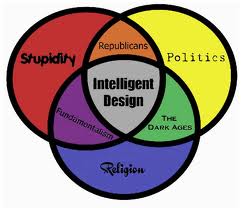
Intelligent Design is Really Stupid

Unintelligent Design

The Intersection of Stupidity, Religion, & Politics

I had an experience this morning that reminded me of something Neil deGrasse Tyson said, which I’ve read in many places. I’ve also had the experience many times in my life and consider myself somewhat lucky so far having managed not to suffer the final indignity the experience portends.

I’m speaking about nearly choking to death because I fell victim to the inherent – as Neil points out – stupid design of my body that has me breathing, eating, and talking through the same hole.

I was at my weekly QBN (Quality Business Network) breakfast meeting. We meet each week on Tuesday, at 7:00 – 8:30 am at The Junkyard Cafe here in Simi Valley, CA. Most of what is on a breakfast menu I can’t conscientiously eat if I want to keep my blood sugar under control. Pancakes, waffles, french toast, regular toast, potatoes, syrup, jam . . . they’re all verboten. I can have a plate of bacon, eggs, and cheese . . . and sometimes do.

However, today I asked for a salad, with ranch dressing and balsamic vinegar. I don’t have a cholesterol problem, so I don’t worry about the dressing too much. I’ve long liked ranch and Italian, which the vinegar substitutes for nicely.

No sooner did I start shoveling food in my mouth than a stream of vinegar squirted off the salad on my fork into my throat. I inhaled it slightly and immediately started coughing; nearly choking. It was so bad others started to get alarmed for my safety and I had to leave the room to keep from interrupting the presentation that one of our members was giving.

Obviously, I made it. It wasn’t the first time this has happened. I once inhaled some hot sake at a sushi bar in Venice Beach. The owner was horrified. He thought I was going to die right there in the restaurant and indicated how much he would like me to die outside on the sidewalk. I ignored him.

Anyway, back to Mr. deGrasse Tyson. I thought I would share this lovely video of his explaining – by pointing out how stupidly we, and the universe, are designed for life – how there is no such thing as intelligent design. Keep in mind, please, I’m not attacking religion, faith, or spirituality. I don’t care what you believe in. However, if it’s intelligent design, I (and Neil) maintain there is absolutely no evidence for it and only someone who refuses to face reality would entertain such a belief. Here’s the video:


The Prime Discriminator is Within

Edward Ladd & Sons

Company Jacket created by Cat’s Pyjamas

As an opening aside, I find it an interesting statement about the immediacy of the Internet that I would hesitate to share an article or blog post I encountered because it’s more than a week since it was published. Nevertheless, I did hesitate when I came across this particular article in Fast Company. I ended up sharing it on my Facebook Fan page and I’m going to share it here, with a little bit of personal annotation.

Many years ago, when I was in my family’s wholesale food business, I realized what I found to be a very sobering fact. As long as we weren’t manufacturing or producing anything, the only way to stand out from the crowd was to provide service over and above everyone else. Anyone can buy and sell items that are readily available and this was surely true of food. We could break the ice with price, but that was ultimately a losing proposition as the customers we sold to would inevitably leave us for someone offering a lower price.

However, not everyone could provide exceptional service. As a result, we were constantly thinking of ways in which we could provide value that others didn’t even think of. One way to do this is to just be available. When a restaurant runs out of product for whatever reason – whether it be unexpectedly busy days or flat-out stupidity in anticipating certain inevitably busy days – always being there and coming through was one way to stand out.

But that wasn’t enough. I think the real discriminator was the mind-set that our relationship with our customers was more than just seller-buyer; it was that of partners. Such a mindset had us thinking as though we were in their shoes and, frequently, it made enough of a difference in how we anticipated their needs and even helped them understand their needs in ways they weren’t always capable of. I think it worked pretty well while I was there.

So when I read this article today I was both intrigued and somewhat satisfied. I never thought of what we were doing as anything other than providing good service. I didn’t realize it was providing a special customer experience. Back then, as the article points out, customer experience wasn’t what it is today, but in our little corner of the world – in the kind of business we were engaged in at the time – it was what we were providing.

Now, it seems, it’s what everybody needs to do . . . and I agree. Here’s a quote from the article I’m referencing:

You don’t have to take my word for this. Over the last five years we’ve been running a study in which we ask consumers to rate the customer experience at companies they do business with. What we can now prove is that customer experience correlates to loyalty. Specifically, it correlates highly to willingness to consider for another purchase, willingness to recommend, and reluctance to switch to a different provider. In other words, if you want that next sale, if you want good word of mouth, and if you want to keep your customers, it’s unlikely that anything else you do matters more than delivering a superior experience.

Indeed!

Here’s the link. You can read the whole thing at Fast Company. It’s well worth it, even if it is almost two weeks old.

http://www.fastcompany.com/3000350/why-customer-experience-only-thing-matters

Enjoy


A Slight Change of Course

Since my presentation to the American Oil Chemists’ Society at the end of April, I’ve been seeking out other engagements to talk about using social media for managing communities within an enterprise. All of my experience heretofore has been inside the firewall of a large (very large) aerospace corporation, and it was the essence of my presentation to the AOCS.

I haven’t been actually hustling engagements; rather I’ve just been suggesting I’m available and that I might have something worthwhile to say. Today, nearly four months later, I finally had the opportunity to present to an organization that could use social media to improve their ability to achieve their goals, which are manifold – but not commercial.

The organization I spoke with today is a local Rotary Club that has two major fund-raisers each year. Originally, I had spoken with my friend and former Manager who, since retiring, has joined this Club and had suggested I might present, about the one I gave to the AOCS. However, after having dinner with the President of the Club it became clear he wanted to at least partially address the difficulty he’d been having with getting the membership to “like” their Fan pages and join and engage with their group page.

So . . . I put this together somewhat hastily and concentrated primarily on the benefits social media provide for communicating and sharing knowledge, as well as addressing the issue of reluctance to participate. I finished with a little info on how its use is disruptive and pointed out how they could use Clayton Christensen‘s concept of Jobs-to-be-done (disruptive innovation is one of his as well) to address the direction they might take their new efforts in.

I also prepared the presentation exclusively using Google Docs; the first time I have ever done that. The only exception is that I imported a couple of slides from my AOCS preso, which I originally prepared using PowerPoint. I also heavily annotated the slides, which I do not normally do, and printed out a copy of them and the notes. However, I did not use them during the presentation. Once I got going I just winged it, which seems to fit my style perfectly. Having the notes kept me from being nervous, but turned out to be mostly superfluous. I only experienced one moment when I couldn’t think of the right word I wanted to make a point, but it came to me reasonably quickly.

So . . . here ’tis. I don’t know how intelligible it is without the notes. Especially considering I made these slides last close to 25 minutes, I believe. I guess having a long history and lots of stories comes in handy when you tend toward loquaciousness. 🙂

One more thing. I uploaded the .pdf to Slideshare in the early evening and shortly afterward received an email from them that my presentation was the most talked about one on Facebook (where I had shared it) and so they were featuring it on their home page. Frankly, I didn’t see any evidence of the discussion, but the preso had been viewed close to 180 times last I looked, so maybe I’m getting some traction there. Hope you enjoy it.


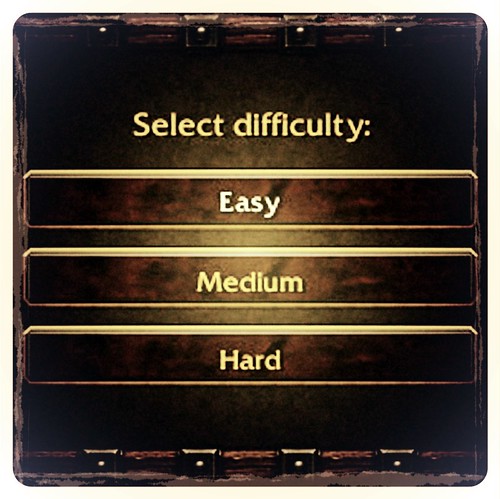
You’re Privileged to be Playing the Game

Levels of Difficult

You Can’t Choose This Difficulty Level!

I think I received my first comeuppance regarding white privilege around 1973. I was not quite 26 years old and had been a very active member in the anti-Vietnam War movement in Los Angeles. I had attended, organized, publicized, and provided security for a number of demonstrations and events.

Now I was preparing to spend a couple of months in Cuba as a guest of the Cuban government. I was a member of the Sixth Contingent (Sexto Contingente) of La Brigada Venceremos. I was excited. However, nobody was allowed to travel without first undergoing some rigorous training in how to not be an ugly American.

We Americans (even the term American is somewhat arrogant, as the U.S. is only one country in an entire hemisphere referred to as America), especially us straight males, have got it way better than we like to think. Unfortunately, due to the concept of American Exceptionalism, we really do like to think our shit doesn’t stink and we are in a class by ourselves.

Well, actually, we are in a class by ourselves – but it’s really not something to be all that proud of, in my less than humble opinion. But I digress.

Part of my ongoing training (which lasted several months) was learning about white privilege, i.e. the numerous and subtle ways in which being white gives those who sport the color (or lack thereof) a leg up on everyone else. The training was excellent. I was not made to feel guilty; merely shown how it works, the evidence of which was impossible for me to deny.

As a Knowledge Management professional, one of the things that’s important to me is the avoidance of re-inventing the wheel. That means, among other things, using the work of others to build on, where appropriate. I think this is an appropriate place to do that with a blog written by John Scalzi who, frankly, I don’t know much about. Nevertheless, this blog he wrote is absolutely brilliant and draws an analogy I think useful in understanding the concept I’m talking about. I want to share it with my small group of readers.

Here’s the link to his post – http://whatever.scalzi.com/2012/05/15/straight-white-male-the-lowest-difficulty-setting-there-is/

I also want to share a video that’s a nice supplement to it. Enjoy!


Can You Sense Me Now?

Below is a Slideshare presentation posted by a friend who is in the process of authoring a new book entitled “The Age of Context”. He’s presenting it today at the Big 3 Conference in San Francisco, where he is one of the keynote speakers. It’s quite high level and somewhat simplistic at this point, but you should be able to get an idea of the direction the book will be taking.

I have long believed we humans are on the road to becoming a race of cyborgs. Nothing that’s happened in the last quarter century has served to dissuade me from this belief, either. At the rate we’re developing and making use of prostheses, and with continuing advancements in Fetal surgery and in utero cardiac procedures, it’s only a matter of time (100 years? 1000 years?) before most humans will have some sort of inorganic component attached or implanted.

I haven’t thought much about this lately, being content to watch as we meandered down this path. However, recently I was made aware that a couple of social media “friends” of mine were writing a book discussing another aspect of this inevitable evolutionary route we’re on. Their current working title is The Age of Context and I am really glad they’re writing it.

What they’re talking about is the newest developments in the fields of mobile technologies, wearable computers, sensing and mapping capabilities, big data residing in “the cloud”, and the apps and services that bring them together. I believe they’re truly on to something.

The book likely won’t be available until sometime next year. However, one of the authors (they are Shel Israel and Robert Scoble) has put together a simple Slideshare presentation that gives some hints of the direction they’re heading in. Since the presentation is available, I thought I would share it to give you a taste of what they’re seeing and thinking. I am hopeful I’ll have a lot more to say about the subject as time goes on. Suffice it to say I’m very excited about their thoughts, including how they mesh with and supplement those I’ve had for several decades now.

Disclosure: At the request for assistance by the authors, I offered to proofread the manuscript for them and they agreed. Here is how Shel tweeted about it a couple of weeks ago.


People ARE Talking. Are YOU Listening?

Infoweek Cover

Yes. They Are. You Need to be Paying Attention.

The title of this post used to be the tag line I put on my business card. It’s still on the vehicle sign that covers the rear window of my Honda Pilot, and it’s still in my Facebook Fan Page’s “about” section. The first paragraph of that section continues, “Your company – your brand – is being discussed publicly. Don’t you think you should join the conversation?”

Information Week made it the cover story of their June 25, 2012 edition and I pointed out the similarity in a graphic I created and posted on my Facebook Fan Page. In some respects, we weren’t quite talking about the same thing, though, but they’re closely related. Their article focuses on sentiment analysis and my thoughts were more directed toward overall engagement, which includes sentiment analysis. They are also far more attuned to the needs of larger brands, whereas my concern is for small businesses and the value they can get from what I see as the proper use of social media.

Today I was pointed to an article by Brian Solis of the Altimeter Group, entitled “Why Digital Influence is So Important“. Brian discusses the value of shared experiences, the building of trust, and the spread of influential content, pointing out the value of online recommendations from people we know and trust. He concludes with the following questions: “Do you know what’s being said about your business? And who’s saying it? How are you getting closer to your customer by examining your digital influence?”

Now the reason I bring this up is there are a number of people here in Simi Valley who have created Facebook groups designed to help us communicate or promote local businesses or both. One of the activities that’s taking place is what some call “Cash Mobs“. We are trying to pick out small, independently owned businesses that we might be able to help out (at least with their cash flow) by patronizing them.

As a result of this, one of the members suggested a location that might be able to use a small infusion of business and, consequently, cash. Since I have been trying to get locals to realize the value of using mostly free platforms, services, and apps to market and publicize their businesses, I’m always wondering how well certain ones are doing this. So I decided to check out this particular business with respect to a few things I think it could (or should) be doing.

I didn’t do extensive research, but I did find out some things I think are interesting in light of what Brian has to say about digital influence, as well as what I know about it from my research and experience. What I found was the following:

  • They have a Facebook fan page but do very little with it. The page has 45 likes and 10 people have gone to the trouble of checking in there.
  • They haven’t bothered to claim their venue on Foursquare (a very simple process) and, even though 30 people have checked in a total of 106 times (that’s an average of 3 times per person; an indication of some loyalty), they cannot create specials to reward that loyalty and, perhaps, entice more people to try them out.
  • They also have two listings in Yelp but have yet to claim either of them. Were they to do so, they would be able to correct one of the listings, as well as provide accurate information on what it is they do. What they do have is four (two for each listing) high quality, five-star reviews for their establishment. I say high-quality because all of the reviewers have numerous friends and have posted multiple reviews in Yelp.
  • I also checked Yahoo Local (basic minimum listing), Bing Local (basic listing w/two of the Yelp reviews), and they don’t show up at all in Google+ Local.

So what’s wrong with this picture? Here’s another quote from Brian:

“In the end, people are at the center of your business. And connections are the ties that bind in social media. Your next step is to see what people are saying or what they’re not saying about your business to learn how you can become part of the conversation and ultimately part of the decision making process.”

My contention is that by not taking the small amount of time required to at least claim venues and ensure they are completely populated with information about your business, you are showing you don’t really care what people are saying about you. Your absence from Yelp means you lose the ability to both thank people who take the time to say something nice about you, and to respond to those who take the time to report a problem they may have had. Without Foursquare you lose the ability to create specials designed to reward loyalty from current customers who are using the service and to entice new customers to try you out.

Even if you’re reading the reviews on Yelp and the tips on Foursquare (and it’s highly likely you aren’t) you have no possibility of “becoming part of the conversation and ultimately part of the decision making process.”

There’s another factor as well, which Brian discusses in his article. When people check in to your business on Facebook or Foursquare or Yelp, which they can do with their smart phones, tablets, and laptops there is always the chance some of their friends will see where they are or where they’ve been. Since the most trusted method of referral is that received from a friend, either online or in person, every business that doesn’t take advantage of these tools is shortchanging themselves. There are other issues having to do with gamification, peer response, and virality but we’ll leave them alone for now. They are important to fully understanding how to use each of these applications, but they don’t matter one bit if your business isn’t using them at even their most basic level.

In this economy I’m of the opinion not taking advantage of free marketing seems almost criminal and, while the tools may change as time goes by, the concepts aren’t going anywhere. What are you doing about it?



Why I Love Facebook’s Timeline

A Pic From My FB Timeline

How My Friends Can Share With Me

Change is Good

Every time Facebook changes something on their (not sure whether to call it a platform, app, or service) offering, people seem to get all freaked out and complain because they have to learn something new or change the way they were doing things. I understand and appreciate change can be a bit disconcerting, but I’m one of those people who not only accepts change; I actually seek it out. So when Facebook adds or rearranges things I immediately start looking for how I can take advantage of it.

Just so I’m clear, I am not referring to the issues of privacy and information security that arise now and again. That’s an entirely different story and, while I am clearly not as protective as many, I am always concerned about the security of my truly private information and that of my family. Changes in functionality are an entirely different animal and that’s what I’m concerned with here.

Embracing Timeline

When Facebook first introduced Timeline and made it available as a developer version, I was all over it. I was anxious to try it out, primarily because I was building a business that was based in large part on my understand of and familiarity with Facebook. I was anxious to see what they were doing, even though at the time it was not available to fan pages, which is the part of FB my business is involved with. I went through the necessary steps and got myself going. Much like my introduction to Twitter well over four years ago, I really wasn’t sure how I was going to use or benefit from it, but I was sure I wanted to figure it out.

Now that it’s a part of fan pages and I’ve grown increasingly familiar with it, I’ve finally figured out how to use it for myself. Not my fan page, but my personal Timeline. I came into this world about the time personal photography was starting to take off. As a firstborn son, my parents took lots of pictures of me. They also took lots of pictures of family and, over the years, many of them have come into my possession. It wasn’t until Facebook made it possible for posts to be scheduled, i.e. given a Timeline date in the future and held in a queue until that time, when they would then appear, that I made the connection to the past.

Yes, It’s About Me

Up until very recently I have shared some old pictures, but I have dated them on my Timeline on the date I posted them. I have since come to realize I can create somewhat of an autobiography by posting items (pictures, scanned documents, etc.) and dating them appropriately. I can even add in locations and people I was with, provided they are current Facebook friends. This is no small thing for me, as I have two fairly young (11 and 8) children to whom I want to leave a record of my life. Using Timeline to do so seems so much easier than writing a book. It also is far more graphic and, because many of my friends (including those who were present when some of the pictures were taken) can post comments to them, they become even richer and more engaging. Furthermore, as evidenced by the picture above, my friends can share pictures they have, which become part of my Timeline as well.

Interestingly, this picture was posted last November and I only just tried to change the date to the year and approximate month in which it was taken. I wasn’t able to do it, but I requested my friend who posted it to make the change and he did. Actually, he told me he didn’t know how to do it (people my age seldom do), but he had someone take care of it. I also realized there was a friend in the pic who has since become a Facebook friend as well and I was able to tag him. He chimed in within less than a day.

I could never recreate my past in this way by myself. First of all, I don’t know any other tool that provides the combination of functionality that Facebook does. Surely there’s nothing that would allow me to slowly record a retrospective with input from many people who were there at the time or who experienced similar episodes and milestones. I believe I have a lot more to learn about doing this, but I’m enjoying discovering new ways in which to create the virtual experience I want to leave for my kids. Maybe it won’t work the way I am envisioning. Maybe my kids won’t care when it comes down to it. I don’t much care at this point. It’s a great learning experience and – so far – it’s a lot of fun because I almost always get feedback from others when I do post something. After all, it may be dated long ago on my Timeline, but it’s something new and it shows up in my friends’ news feed when I post it.

Anybody out there have stories about their use of timeline, or have you discovered a bit of functionality you really like that you think others might want to know about . . . or that I might want to know about? Please be so kind as to share. Thanks.


Intertwingled in Plain Sight

Intertwingled

All Things Are Ultimately Intertwingled

I’m going to continue on a theme from my 4th of July entry, where I kind of resurrected an old post of mine from Content Management Connection. This time, however, it’s not a post of mine but that of a friend, Greg Lloyd – President and co-founder of Traction Software, Inc.

There are two terms I remember from when I first read Greg’s post – originally published on July 5, 2010 – which have helped me understand what I expect from the application of knowledge management and social business (formerly Enterprise 2.0 © ) design concepts and tools. These two terms also help me describe several of the most important attributes and indications of a well functioning, successful organization or group. They are “intertwingled” and “observable work”.

As a knowledge management professional (hemidemisemiretired) my long-standing and overarching goal has been to help people (and their organizations) improve on their ability to make sense of the huge amount of data that flows from their work. Doing so requires consideration of both macro-environmental factors and micro-environmental factors. For me, intertwingle describes the macro environment and observable work is what helps the micro environment to thrive. Let me very briefly explain why I believe this. Then I’ll send you off to Greg’s wonderful post where he explains it far better than I am capable of doing.

I frequently use the term “systems thinking” to describe what I see as an ongoing process of understanding that recognizes the interconnection, as well as the interdependency, of . . . well . . . everything. Useful systems thinking also requires the ability to see boundary conditions in pursuit of knowledge, but keeps the systemic nature of all things in mind when considering how they work. The word ‘intertwingle” seems to succinctly embody what I just spent a paragraph attempting to explain; probably not very well. 😦

“Observable work”, on the other hand, evokes a vision of people communicating with each other and the data and information essential to the smooth functioning of the work they do. It promises not necessarily the disappearance of silos, but does suggest making those silos – and the varying and very real relationships they have with each other – more transparent and discernible.

There’s much, much more that flows from these two concepts but, since I have no intention of rewriting that which has already been published, I urge you to read Greg’s post. If you have the time and the inclination, you may want to follow some of the numerous links he provides that serve to further define and illustrate these two concepts. Think of it as a quest to find the social business/knowledge management version of the Higgs Boson particle or, at least, the Gluon.  Here’s the link.