Tag Archives: postaweek2011
I am constantly blown away by the quality and quantity of good information that’s available on the web. I have been studying the use of social media for some time; initially for use within the firewall of a large organization and, more recently, for small business marketing. One channel I think many businesses, especially those that experience high foot traffic, e.g. restaurants, bars, retail stores, is Facebook. I will never refer to myself as an expert, but I have been gaining some expertise in both the strategy and the mechanics of taking advantage of their fan pages.
Unfortunately, I can’t keep track of all the good information that keeps being thrust my way! I want to share just one of them. I like what Jordan Julien has to say, though I find myself wondering why he’s not including mobile now in his assessments. Perhaps he is and I need to dig a little deeper but, for now I just want to share one post he’s written that I think is quite useful. It’s entitled “How Should I Use Social Media” and you can find it at http://bit.ly/ge2vwl. Check it out and see if it doesn’t clarify some things for you. Study the graphics carefully. There’s a lot of info packed into them.
So, by my title I mean . . . I sometimes wonder why I blog at all, since there’s so much information out there; much of it far more knowledgeable than what I have to offer. I know there’s got to be a good reason, else why do I bother?
The link referred to above is no longer available at Posterous!
4 Comments | tags: bar, foot traffic, infographics, Information, Knowledge, Marketing, postaweek2011, restaurant, retail, share, Small Business, Social Media | posted in Business

Atlantis Powers to Orbit
As long as I worked at what is now called Pratt & Whitney Rocketdyne we referred to NASA and the Air Force as our “customers”. For nearly twenty years I worked on the Space Shuttle Main Engine program and we always called NASA our “customer”. In the last few years of my employment there, when my awareness of – and interest in – social media brought me to learn as much as I could about what was available and how it might be of benefit to my company, I began arguing for a different approach. I believed, still do, that the real customers of companies involved in space exploration are the American people, those who pay the taxes that were used to pay our salaries. I still believe this is the case, and I still await the evidence of an enlightened approach to engaging them.
In the meantime, I just received an email request to take action and I want to pass it on in the hope some of you who read this will consider taking action; very simple, virtual action. I believe it is imperative for the human race to establish not merely a technological presence in space, but a strong cultural presence as well. I don’t believe it has to be dominated by the United States. In fact, I would prefer it be an international, world-wide effort to ensure the long-term survival of our species. Nevertheless, what is currently happening here is the gradual wasting away of our talent and our industrial base to continue leading the effort. I will no doubt write more about this as it is near and dear to my heart.
What follows is the text of the email, which comes from the website I’m asking you to visit and consider using to send a letter of support to the President, your U.S. Senators, and your Congressional Representative. I’m also including the link below the text so you might take action if you’re so inclined.
I’m concerned about the future of the United States’ role in space. Investments in our nation’s space programs will have a direct impact on our future economic strength and ability to remain a space-faring nation on the cutting edge of technology. I urge you to make a strong commitment to maintaining the U.S. as the unsurpassed leader in space.
For decades, U.S. leadership in space has been recognized across the globe. However, that position is perishable, and continued national leadership will be vital for our future. Therefore:
- It is important to establish a long-term national space strategy that factors in civil, national security and commercial interests in space. Our national strategy must also cut across all agencies that have a stake in space. Without a national strategy, America risks a future where the workforce and industrial capacity needed to maintain U.S. leadership and competitiveness in space is seriously – and in some cases irreversibly – degraded.
- It is important for our future global competitiveness, leadership and innovation in space that budgets and funding remain stable and robust. Appropriate funding must accompany strategic goals to meet established objectives and sustain a strong and progressive space industry.
- It is important to support policies that maintain a healthy and vibrant space industrial base that employs technically-skilled American workers. Modernizing our nation’s export control policies – so that U.S. industry can compete on a level playing field – is one step in the right direction.
- It is important to recognize that the space industrial base drives technological development important to our economy and national security. Our national strategy must identify and seek to preserve the space capabilities critical to meeting our national goals.
The United States stands at a critical juncture between past accomplishments and future ambitions in space. The rest of the world is not waiting. Yet there is uncertainty about the future of U.S. leadership in space; our workforce is facing upheaval and layoffs and the U.S. space industrial base is at the brink of losing our competitive and innovative edge.It is absolutely critical that our nation’s decision-makers work together to show the leadership needed to keep our space efforts robust. I urge you to make addressing these issues a national priority.
Here is the link to send this letter. Thanks for considering it – http://www.spaceleadership.org/
2 Comments | tags: Air Force, cultural, economy, exploration, funding, international, Leadership, NASA, national, postaweek2011, Pratt & Whitney, presence, Rocketdyne, science, scientific, space, Space Shuttle, spending, SSME, strategy, taxes, taxpayers, technological, Technology | posted in Business, Economics, Marketing/Branding, Science, Systems Thinking

Watch out for that fly
I worked for over two decades at a very large (and exceedingly ponderous) corporation. Actually, I worked at three of them without every leaving the location I originally hired in at. Although I worked at a company called Rocketdyne, it was a division of Rockwell International when I hired in. It was later sold to The Boeing Company and, in 2005 was purchased by United Technologies and became a part of its Pratt & Whitney family.
Each one of these organizations were not only capable of, but repeatedly dabbled in a level of bureaucratic numbskullery that I still find hard to fathom. I have yet to have it explained to me – at least in a way I can understand – why large for-profit organizations engage in activities that are guaranteed to hinder their ability to perform well or that cost far more than is reasonable. Frankly, I’m not sure anyone who’s directly involved in them can explain why it’s so, because I’ve never known anyone who said it was their job to slow down or squash anything . . . yet that’s exactly what happens in many instances.
The other day I watched a video shared with me and others by Euan Semple. I would link to the video, but it’s been removed by the user. I guess it was meant to just make the point for Euan mostly. Anyway, shortly after looking at it I came across a three-year-old email I had sent to a colleague. The video Euan shared was made by a student. It’s quite simple and shows how many of the social sites this college student wished to go to during the course of a day were blocked by the school’s policies. Maybe you’re thinking that isn’t such a bad thing, but I’m of the belief that people should be trusted first, as most are trustworthy. Should they betray that trust, then there might be consequences based on their situation. Spending 15 minutes on Facebook catching up with friends and family is not the same as spending an hour or two trading stocks online or visiting pornography sites. Wholesale domain blocking does not exhibit any level of trust at all and tends to alienate the majority of people who want access when they need it, but will not normally abuse the privilege.
Now to the rediscovered email. I’ll let it speak for itself. The episode which sparked it is not terribly important in my opinion, though it was important enough for me to memorialize and share it with a colleague whose mission was (and is) to steer the organization from simple-minded, one-size-fits-all policies and procedures. This is, I think, what it evidences. I hope you don’t think it too petty of me to point it out. I think this approach still dominates the thinking of the corporate world, as well as academia, as evidenced by the video Euan shared. What follows is my email.
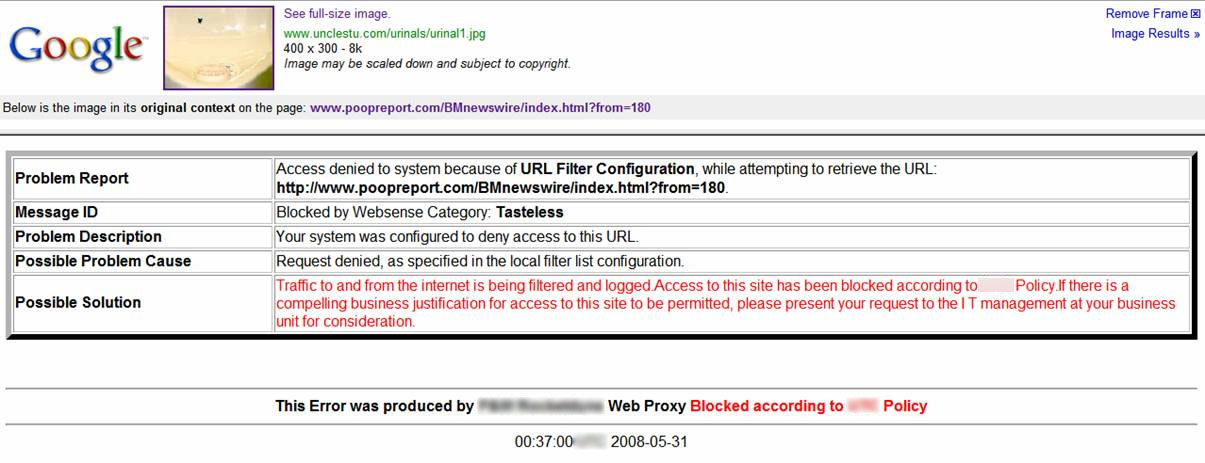
I don’t know what to make of this. Well . . . actually, I kinda do. It’s kind of funny, yet somehow a bit infuriating. Allow me to explain. As you may or may not recall, the men’s room near my cubicle was recently finished and re-opened. One of the features they installed is those waterless urinals. I’ve only seen them once before, and each time I go in I make note of the name of the company – thinking to find them on the Internet so I can read something about the science behind them. Also, each of the urinals has a bee painted on them and I wanted to see if I could find something quickly about why (though I suspected I already knew). At any rate, I finally remembered to investigate both (after several weeks of forgetting as soon as I got back to my computer) and found what I wanted and decided to just click on Google images as well. The first picture was of a urinal with a fly – not a bee – painted in the sweet spot.
I decided to take a close look and clicked on the picture. Although I was able to see the picture, even open the full-size image, the website it was on (which appears in a lower frame in Google images) was blocked by Websense. What I find remarkable, ironic, asinine, stupid, foolish, and probably a dozen more useful adjectives is the category they chose to block it under – “Tasteless”. Tasteless!!!! Is there some sort of absolute scale on which that quality can be measured? It was probably the name, but what if the website was about caring for infants or puppies or god knows what? This I find not a little insulting. What children they think we are! Let’s not forget the further irony that I could, for all their blocking, see the image. Perhaps I should sue for negligent infliction of emotional distress. Here they made an attempt to insulate me from something as tasteless as this, and I was nevertheless forced to look at a painted fly in a vitreous porcelain urinal due to the incompetence of Information Technology and UTC Policy. I hope I recover. I hope I can sleep tonight.
There! I got it off my chest. Please realize this email was sent approximately 3 years ago, so some things (like Google’s positioning of images and their associated sites) have changed. If Euan’s friend’s example is any indication, however, other things haven’t changed at all. I don’t think this bodes well for any organization seeking to do its best work. My experience says it hinders creativity and innovation, as it blocks people from following leads and decreases whatever chances might exist for serendipity and loose ties to open up new avenues and approaches to solving problems.
4 Comments | tags: blocked, blocking, Blogging, blogs, Boeing, bureaucracy, bureaucrat, college, Euan Semple, policies, postaweek2011, Pratt & Whitney, procedures, Rocketdyne, Rockwell International, Social Media, The Obvious, United Technologies, university, Video, waste, websense | posted in Business, E2.0, Enterprise 2.0, Knowledge Management, Systems Thinking
|
The value of being ‘liked’
|
How much are you willing to pay to be liked? It was a fitting question for JP Davidson and Elah Feder, the creators of “I Like You,” a podcast about modern love, from friends-with-benefits to the ins and outs of queer Jewish speed-dating.
|
“We were looking for new ways to expand our listenership,” says Mr. Davidson. “Like everybody else, we saw the ads in the Facebook sidebar constantly, and looked into how much it would cost to run a campaign.”
|
Leave a comment | tags: advertising, cheap, Cost-per-click, Cost-per-impression, CPC, CPM, Demographics, display, effective, Facebook, inexpensive, Interest, Like, Liked, Liking, Marketing, postaweek2011, PR, public relations, Usefulness, value | posted in Business

My youngest at my brother's 60th
There are lots of things I love about being a father of young children. One of them just happened in our living room while I was cleaning the kitchen. Our oldest is away with Mom at a Girl Scout activity and the youngest daughter of one of the other families is here playing with our youngest.
I just listened to her (the friends’ daughter) start to sing Frosty the Snowman which, mid-way, transformed into Rudolph the Red-Nosed Reindeer, and somehow ended in an amalgamated medley of the two. Listening to this incredible editing job, which I’m sure was invented on-the-fly, was priceless. I will miss this age as I miss others that have passed. Thankfully my memory isn’t what it used to be, so the loss isn’t melancholy for long. Still . . .
1 Comment | tags: aging, children, editing, father, Frosty, Girl Scouts, invention, medley, melancholy, Memory, mother, postaweek2011, priceless, Reindeer, Rudolph, singing, Snowman, song | posted in Business

Two "Big Hitters" for Retail
I just came across a couple of quotes that rather succinctly state the issue anyone using Social Media for marketing needs to keep in mind with respect to engagement with their customers. I think it comes from some of the activity surrounding a virtual Enterprise 2.0 Conference event. I picked them up in my tweet stream. I wasn’t able to attend, but found them because I have a continuing search on the hashtag #e2conf, which keeps me in the loop.
These two quotes appear to be traceable to Sameer Patel, a man I admire for his business savvy and knowledge of social media engagement. I have been using the tag line “People are talking. Are you listening?” His quotes are a bit longer than my tag line, but I think they state the issue rather well:
Part of the problem is trying to “control the message”. The conversation will happen with or without you.
This is one of the things that I’m trying to get across to some of the small businesses (I’m beginning with restaurants) I’ve been working with. The other line is even more important:
Your brand perception is now in the hands of strangers. Isn’t it time you got to know them?
This is so important for small retail establishments to understand. With the advent of services like Foursquare and Yelp, the conversations about their businesses are already taking place. They need to, at the very least, claim their venues in each of these and get involved in the conversation. If a customer has a bad experience, don’t you want to know about it? Don’t you want to have the opportunity to make it right . . . publicly?
It’s true and it’s only going to get “worse”. People ARE talking. Shouldn’t you at least be listening? Better yet, why not engage with them. I’m convinced the process will strengthen your relationships with your customers and do wonders to make you more accessible and easy to do business with.
5 Comments | tags: brand perception, Conference, Control, Conversation, Engagement, Enterprise 2.0, Foursquare, listening, Marketing, message, postaweek2011, pretzel logic, Relationships, restaurants, retail, savvy, Small Business, Social Media, Talking, tweet, twitter, Yelp | posted in Business, E2.0, Marketing/Branding

I Was a Cubesicle Denizen
Yesterday (February 14th) marked the nine-month anniversary of my leaving Pratt & Whitney Rocketdyne. In this time I have slowly transformed from an employee of a large, multi-national corporation to a self-employed entrepreneur. In so doing I have changed my mindset from that of a community member and manager, responsible for greasing the skids of social interaction amongst workers with similar goals, to that of a marketer, responsible for understanding how social creates a different kind of community amongst people with a symbiotic, but not so insular connection.
I can’t remember where I read it, but I try to always keep in mind what someone said about marketing, which I can directly apply to my work – You can learn marketing, but you can’t be taught what is learned in over forty years of experience. So I’m busily studying marketing and, especially, how to utilize social media to provide a new level of engagement never before possible between a business and its customers.
In making this change I have joined the local Chamber of Commerce and a business network. I have also, since I am old and experienced enough, volunteered my services to my local SCORE chapter. My knowledge of social media was in great demand and I ended up helping a few people out even before I was officially a member.
As a result of my Chamber membership, I decided to do a little study of the restaurants in the Chamber and their use of four avenues often used for marketing and public relations, e.g. Foursquare, Yelp, Facebook, and Twitter. I looked at each channel a bit differently. For instance, for both Yelp and Foursquare I was most interested not in whether or not the business was listed or had either tips or reviews of it, but whether or not the businesses in question had claimed their venue so they would have some level of engagement available to them. What I discovered was surprising.
Despite the fact these services are all free to use (I’m not factoring in the expense in time necessary to wring the most out of using them), usage of all is abysmally low. The numbers are as follows:
- Foursquare – 11% have claimed their venue (most all have been entered into the db)
- Yelp – 26% have claimed their venue (most all exist in the db)
- Facebook – 26% have business pages (many venues had close to 100 check-ins via Places)
- Twitter – 26% have Twitter accounts (very few know how to use it, IMO)
I haven’t looked at all the other restaurants in the area. Nor have I considered bars, pubs, retail establishments that could benefit from the use of these four services (as well as other methods of marketing considered social, e.g. blogs), or professional services that could do the same. This does indicate to me a huge market for my services, although my experience tells me it will be a bit tough to crack, as these kinds of business owners are notoriously frugal and suspicious.
Nevertheless, I think the clear direction is for greater and greater use of social media to market small business and, especially, to engage with customers in a transformation of how business relates to, and learns from, them. I think there’s a place for me and others like me to provide them with a bit of knowledge, some organizational help, and strategic direction.
One thing’s for certain. I am really enjoying connecting with my business roots, as I was in small business for over two decades before joining Rocketdyne prior to my 40th birthday – much of it actually in the food business. As I gain experience and knowledge in my new field, I hope to share it here on my blog. Stay tuned!
9 Comments | tags: bars, Blogging, blogs, chamber of commerce, Community, corporations, cubicle, entrepreneur, Facebook, Foursquare, manager, Marketing, merchandising, postaweek2011, professionals, public relations, pubs, restaurant, retail, self-employed, Small Business, Social Media, symbiosis, twitter, venue, worker, Yelp | posted in Business, Marketing/Branding
Leave a comment | tags: advertising, Amplify, Blogging, commercial, football, graphic, infographic, postaweek2011, relationship, timing, Writing | posted in Business
I am a VIP guest taking part in a unique opportunity to engage in an interactive discussion about the growing influence of social technology in business.
On February 8-11, 2011 I will be joining IBM to host their Social Business Jam where we will cooperatively explore the value of social technology in business, the mitigation of its risks, and the management system required to drive the social transformation required for its use. This web-based event will provide an unrivalled opportunity for thousands of leaders from around the world to pool their knowledge and experiences, and to examine this next generation of business. I urge you to participate. Learn more here: www.ibm.com/social/businessjam
There will be 5 discussion forums occurring simultaneously, where participants can join any time during the event. The subjects of these forums are:
- Building the Social Business of the Future
- Building Participatory Organizations Through Social Adoption
- Using Social to Understand and Engage with Customers
- What does Social mean for IT?
- Identifying Risks and Establishing Governance
Participation does not require your full-time involvement during the 72 hours of the event. You can log-in to the Jam whenever you are available, and spend as much time as you want to comment, read or engage in topic areas you find most interesting. We’re looking forward to your participation!
Please join me in this exciting conversation about the new era of business:
1. Register for the Jam: Please register for the Jam via this link: http://ibm.co/joinsbjam
2. Spread the word about the Jam: Please help us generate buzz about this upcoming event via Twitter (#sbjam) and other channels of communication you have access to.
Thanks.
1 Comment | tags: Awareness, Blogging, blogs, Business, Buzz, communication, Customer, Engagement, Facebook, IBM, postaweek2011, Social Jam, twitter | posted in Business
|
An MIT professor and psychologist argues our modern wired lifestyle is damaging us and our relationships, but she may be a bit premature
|
But, suppose human nature is more malleable than her psychological model allows. Suppose the Internet is devising a self that is social in new ways that include intimacy, but that also find real human value in thinly spread connections. Turkle’s observations raise disturbing issues, but her theoretical framework so colors her conclusions that, although her book will spark useful debate, it settles less than she seems to think. The changes our technology is bringing are challenging our conceptual frameworks for understanding those changes, including the psychological standpoint Turkle takes as secure.
|
David Weinberger is a senior researcher at Harvard’s Berkman Center for Internet & Society. He can be reached at self@evident.com.
|
Leave a comment | tags: antisocial, Collaboration, david weinberger, Internet, media, pathology, postaweek2011, sharing, Social Media, text messaging | posted in Business



 Systems Savvy