Bill Barr has proven himself to be nothing more than another of Trump’s uncritical sycophants. Instead of being Attorney General for the United States of America, he’s acted as Donald Trump’s personal attorney. Couple that with his overwhelming partisanship and dishonesty, and you have a perfect case for another impeachment and a criminal indictment. Make it so!
Author Archives: Rick Ladd
Thread by @djrothkopf: “Just got this via text: “You are a retarded kike. You dont want to win 2020. You enjoy complaining about Trump.” It was accompanied by this […]”
I want . . . no, I need to share this thread. Although I have been an atheist for most of my adult life, I was born a Jew and am bar mitzvah. I feel it is incumbent upon me to stand not only with my fellow Jews, but also with all those who suffer oppression, prejudice, and hatred. I am not a public figure, so I have not been attacked like David, but if this keeps up (and, especially, if Trump is re-elected) we can expect things to get worse, perhaps a lot worse. Don’t think it can’t happen because this is America. As David points out, America is responsible for the slaughter of our native peoples and the enslavement of Africans for centuries. Our hands are hardly clean. We need to be prepared for the worse, all while working to bring about a better world for all.
Thread by @djrothkopf: “Just got this via text: “You are a retarded kike. You dont want to win 2020. You enjoy complaining about Trump.” It w by this and other anti-semitic art. This is Trumpism. The instances of this & worse happening in my life […]”
Bribery or Extortion?

A lot of airtime has been spent over whether or not Donald Trump offered a quid pro quo to the President of Ukraine, Volodymyr Zelensky. Many astute commentators, however, have pointed out that a quid pro quo is not necessary in this case and, in any event, the real criminal activity here is either bribery or extortion. I would argue that it’s actually both. Let’s look at the elements of bribery.
- The individual being bribed is a “public official,” which includes rank-and-file federal employees on up to elected officials; [President Zelensky is most definitely a public official, as is Donald Trump.]
- A “thing of value” has been offered, whether it’s tangible (such as cash) or intangible (such as the promise of influence or official support); [Lots of cash was offered to Zelinsky. This is the “Quid.”]
- There’s an “official act” that may be influenced by a bribe (such as pending legislation that may have a direct impact on the party offering the bribe); [The Ukrainian government was to make an official announcement it was conducting a corruption investigation into the Bidens and the DNC server. This is the “Quo.”]
- The public official has the authority or power to commit the official act (for instance, the official is a senator who is voting on a particular piece of legislation); [Two Presidents . . . duh!]
- There must be the establishment of intent on the part of the bribing party to get a desired result (the intent to sway the vote by handing over an envelope full of cash); [The “transcript” of Trump’s call and plenty of testimony], and
- The prosecution must establish a causal connection between the payment and the act meaning there must be more than just a suspicious coincidence. [Again . . . lots of testimony from highly credible witnesses to the ongoing attempt at extortion].
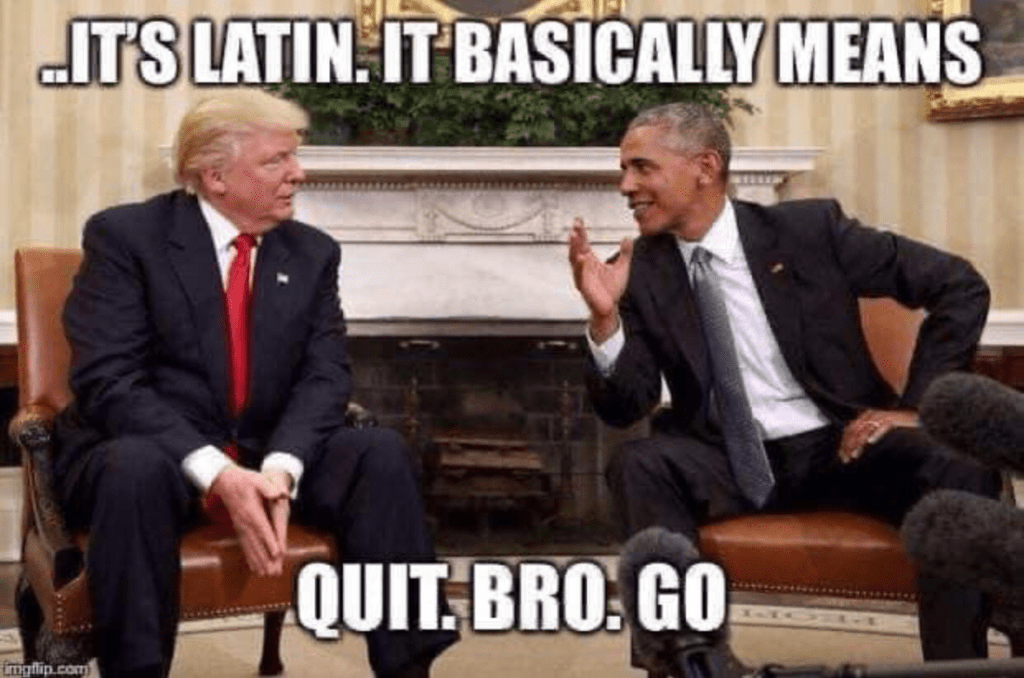
It’s become quite clear the American public is a bit uncomfortable with the Latin phrase, quid pro quo and, in fact, as previously stated a definitive “this for that” offer isn’t necessary. Given the totality of the evidence so far, it’s quite clear to anyone who is really paying attention—and understands how the law works—Trump was using the threat of Russian violence to extort an announcement of (at the minimum; actual investigation as they real object) an investigation into Burisma and Hunter Biden.
It can also be argued, at the very least, that Trump was also soliciting a bribe from Zelensky before he would release the money Congress had already authorized for military aid to the Ukrainians. Also offered, in exchange for such a bribe, was a meeting at the White House for President Zelensky.
What’s important to realize is there is no reason to dwell on whether or not there was a specific quid from quo (an offer of something in exchange for something else) to find Trump was engaging in extortion and (as previously noted) at the very least solicitation of a bribe.
That Trump is a common criminal and con man, who has managed to grift his way into the highest office in the land, should be quite obvious to all but those who are now deeply enmeshed in his cult of personality. What this says about that swath of the populace supporting him is quite uncomfortable to fathom. Regardless, I’m looking forward to his impeachment and, if we’re fortunate, removal from office of this deeply deranged and hateful man masquerading as an actual President of the United States of America.
A Forgotten Limerick

Looking through some of my old writings, many of which have never been published (some because they’ve never been finished,) I came across this limerick. It’s dated December 3, 2013.
Fox newscasts, so chock full of hate
Render truth an impervious gate
They so often dissemble
We can’t help but tremble
With hope they will soon meet their fate
13 Reasons Why People Don’t Share Their Knowledge – and what to do about it

This is another paper I found on my computer. Truth to tell, I have no idea who wrote it. It could have been me, but I don’t remember. I searched the phrase from the title in Google, but could not find anything. Inasmuch as I retired from Rocketdyne (and the pursuit of enterprise-wide KM) nearly 10 years ago, it could be from something I encountered more than a decade ago. Nevertheless, I’m sharing it with the caveat that I’m not claiming to have written it; I’m only asserting it’s an important document for anyone who’s struggling with getting their organization’s people to share their knowledge for the benefit of their company. My experience, as well as my discussion with those who are still involved in the corporate world, is that knowledge sharing is still nowhere near as widespread as I think it should be. So, without further ado, here’s that Baker’s dozen of reasons people aren’t sharing:
- They don’t know why they should do it. Leadership has not made a strong case for knowledge sharing. Solution: Have the leader of the organization communicate regularly on knowledge sharing expectations, goals, and rewards.
- They don’t know how to do it. They have not received training and communications on how to share knowledge. Solution: Regularly communicate and conduct training, webinars, and knowledge fairs. Web-based training and webinar recordings should be available for all tools.
- They don’t know what they are supposed to do. Leadership has not established and communicated clear goals for knowledge sharing. Solution: Establish and communicate clear knowledge-sharing goals.
- They think the recommended way will not work. They have received training and communications but don’t believe what they are being asked to do will work. Solution: The KM leaders, knowledge brokers, and other members of the KM team have to convince people in small groups or one-on-one by showing them that it does work.
- They think their way is better. They are used to working on their own or collaborating only with a small group of trusted comrades and believe this is the best way. Solution: Regularly share stories of how others are benefiting from sharing knowledge using the recommended ways. This should help sway those stuck in their current ways to consider using better ways.
- They think something else is more important. They believe that there are higher-priority tasks than knowledge sharing. Solution: Get all first-level managers to model knowledge-sharing behavior for their employees, and to inspect compliance to knowledge-sharing goals with the same fervor as they inspect other goals.
- There is no positive consequence to them for doing it. They receive no rewards, recognition, promotions, or other benefits for sharing knowledge. Solution: Implement rewards and recognition programs for those who share their knowledge. For example, award points to those who share knowledge, and then give desirable rewards to those with the top point totals.
- They think they are doing it. They are sharing knowledge differently than the recommended ways (e.g., sending email to trusted colleagues or distribution lists). Solution: Assign people to work with each community and organization to show them how to use the recommended ways and how they work better than other ways. Providing a new tool or process which is viewed as a “killer app” – it quickly and widely catches on – is the best way for the old ways to be replaced with new ways.
- They are rewarded for not doing it. They hoard their knowledge and thus get people to beg for their help, or they receive rewards, recognition, or promotions based on doing other tasks. Solution: Work with all managers in the organization to encourage them to reinforce the desired behaviors and stop rewarding the wrong behaviors.
- They are punished for doing it. As a result of spending time on knowledge sharing, they don’t achieve other goals which are more important to the organization. Solution: Align knowledge-sharing processes and goals with other critical processes and performance goals.
- They anticipate a negative consequence for doing it. They are afraid that if they share knowledge, they will lose their status as a guru (no one will have to come begging to them at the time of need), that people they don’t trust will misuse it or use it without attribution, or that they will not achieve other more important goals. They are afraid of asking a question in public because it may expose their ignorance or make them appear incompetent. Solution: Position knowledge sharing as being a critical success factor for the organization. Facilitate ways for people to establish trusting relationships through enterprise social networks and face-to-face meetings. Recognize those who ask in public, and provide ways to ask questions on behalf of others.
- There is no negative consequence to them for not doing it. Knowledge sharing is not one of their performance goals, or it is a goal which is not enforced. Solution: Work with all first-level managers to get them to implement, inspect, and enforce knowledge-sharing goals. This needs to come from the top – if the leader of the organization insists on it and checks up on compliance, it will happen.
- There are obstacles beyond their control. They are not allowed to spend time sharing knowledge, they don’t have access to systems for knowledge sharing, or they don’t have strong English language skills for sharing with those outside of their country. Solution: Embed knowledge sharing into normal business processes. Provide ways to collaborate when not connected (e.g., using email for discussion forums). Encourage those with weak English skills to share within their countries in their native languages.
For My Eyes Also (Part 7)

Managing Culture Change
Corporate culture consists of three levels: Artifacts; espoused values; and shared tacit assumptions.[1] Each of these levels is important in understanding not only what corporate culture is, but how it works, and how it can be both changed and used to the benefit of the organization as a whole.
Artifacts
Artifacts consist of real, tangible things which can be associated with the organization. For example, McDonald’s has its golden arches, KFC has its colonel, and Nike has its swoosh. These are the most obvious, though not necessarily the most powerful, artifacts which can be associated with a company or organization. The more important artifacts are, for our purpose, things like architecture, décor, and the way people act while at work.
Some of the deepest feelings attributable to an organization’s culture are engendered by artifacts. For example, outside the main entrance to Rocketdyne sits an F-1 Rocket Engine. The engine stands approximately 20 feet high and, at its base, is around 12 – 15 feet in diameter. In front of it is a simple, bronze plaque, which informs you that this is the engine, along with four others, which lifted the Apollo Lunar Modules off the earth on their trip to the moon.
For anyone who works there, and knows anything about the company where they work, this engine evokes powerful feelings of accomplishment and success. I know from firsthand experience and observation that this frequently translates into a willingness (at the very least, resignation) to work that extra hour, to take a little more time in assuring your work is the best it can be.
Espoused Values
These may be characterized by, among other things, an organization’s beliefs, level of communication, and methods of accomplishing it mission. These values may be seen in such things as a company’s rules, policies, and procedures. It may be found on the walls as slogans and posters. In talking to members of the organization you may be told that the company believes in things like teamwork, “best practices”, continuous improvement, and lean manufacturing.
At Rocketdyne, the corporate mantra involves team-based component production, commitment to safety, scientific analysis at all levels of the corporate structure, and lessons learned, in addition to other policies and procedures too numerous to mention. It is the background against which our daily activities take place and translates into copious collections of data, numerous briefings to higher and higher levels of management, and close inspection and analysis of every piece of hardware which goes out the door.
However, while many of these concepts may be spoken of, and may even appear as items of value on the corporate web pages and on slogans and posters put up around the plant and offices, it does not necessarily follow that they are actually carried out in our day-to-day lives. Frequently, managers and others who will say they believe in stated policies, are nevertheless placed in positions where they are required by more specific policies to do exactly the opposite of what the company says it believes in.
At Rocketdyne, this can be seen in the use of individual awards and yearly performance reviews, in spite of the outer appearance given by a team-based organization. This is a case where the management, due to executive requirements, fails to “walk the talk”, and falls back on “the way we’ve always done it”.
This inconsistency leads to what is arguably the most important aspect of culture, the real, deep assumptions by an organization and its members of how to accomplish the daily tasks, the sum total of which are the company’s true vision and mission.
Shared Tacit Assumptions
This is perhaps the most pervasive and, with respect to efforts at change, the most insidious of the three aspects of corporate culture. They are the things which “go without saying”, which we accept as the ways of the world, or the ways in which things get done. People cannot readily tell you what their culture is, any more than fish, if they could talk, could tell you what water is.[2]
In the same way, a company’s shared tacit assumptions are taken for granted. Many, if not most, people are incapable of seeing any other way to perform a task or get a particular result. It is all they know, and to think otherwise is, in a word, unthinkable.
At Rocketdyne there are numerous ways in which this happens. They are frequently discovered only when something goes wrong, or when a series of small things go wrong which, by themselves might go unnoticed, but which lead to a major problem. We have studied the Valuejet disaster in 1995 at some length, yet as soon as we return to our jobs we occasionally find it easy to forget that it can, and sometimes does, happen to us.
We have instituted numerous methods of improving quality and performance, such as quality circles, continuous process improvement, and total quality management. We are in the process of instituting “lean manufacturing” and some of the aspects of the theory of constraints. Nevertheless, we continue to assume individual action and heroics are the real way things get done. We look for the engineer or mechanic who will come up with the answer to difficult problems, and neglect to look to the whole company for answers.
Recently, some managers have been looking for people who can “think out of the box”, who are capable of changing their frame of reference and understanding our problems in unique ways, or approaching them from a different perspective. Still, the focus is more on the individual and not on the team.
If one sets about to change a company’s culture, its view of the world, it is of the utmost importance to understand not only these three aspects of culture, but also the depth with which they pervade the organization. Failing to do so will certainly result in a misapprehension of the difficulty involved in change.
The most important things to realize are: 1. Culture is deep – it is tacit and gives meaning and predictability to our daily lives; 2. Culture is broad – it involves every aspect of our work and sometimes even invades the way we conduct our personal lives, and; 3. Culture is stable – people are generally not fond of change, and are far happier when everything goes along smoothly, just like it did yesterday and the day before. Any attempt to enforce change is likely to produce resistance and anxiety.[3]
As formidable as the technical and procedural issues of Knowledge Management are, the need to change an organization’s culture far exceeds them. Most all have heard the term “knowledge is power”. This is generally perceived to be so and frequently translates into a desire to hoard information. Many organizations have experienced the “building of empires” which stands in the way of its freely sharing collective knowledge. Without a major change in our attitude toward ownership of information, we will not be able to take advantage of the tools available to us.
Peter Senge, in his book “The Fifth Discipline”, writes of the steps and the “core disciplines” involved in creating a learning organization[4] He points out that, among those disciplines, is that of having a shared vision, and why it is important. Here is what Senge has to say about shared vision.
“In a corporation, a shared vision changes people’s relationship with the company. It is no longer ‘their company;’ it becomes ‘our company.’ A shared vision is the first step in allowing people who mistrusted each other to begin to work together. It creates a common identity. In fact, an organization’s shared sense of purpose, vision, and operating values establish the most basic level of commonality. . . .
“Shared visions compel courage so naturally that people don’t even realize the extent of their courage. Courage is simply doing whatever is needed in pursuit of the vision.”[5]
I can think of no better way to conclude my paper. Moving from our current relationship with collective knowledge, our intellectual capital, may well require a massive rethinking of our entire corporate culture. There are organizations, mostly younger and already possessed of a shared vision which includes becoming a learning organization, who are already pursuing this path.
However, there are numerous, often older organizations which will be hard-pressed to find the courage and character it will take to let go of the control they feel they now have and embrace a new kind of control; that which comes from an entire organization pursuing the same goals and vision. Until we experience the transformation from being data and information driven, to being truly knowledge driven, we will frequently be at war with ourselves.
Knowledge
Management provides some of the understanding of the problem, and the vision
and direction we must strive toward. However, without fundamental changes in
our attitudes the path will be long and fraught with difficulty. It is, however,
truly a worthy struggle and is almost certainly inevitable. Changes in
technology are coming at us with greater rapidity. We have no choice but to
develop new ways of thinking to better take advantage of the new tools placed
at our disposal. We owe it to ourselves.
[1] Edgar H. Schein, The Corporate Culture Survival Guide, (San Francisco, CA, Jossey-Bass, Inc., 1999), pp. 15-20
[2] Schein, Op. Cit., p. 21
[3] Schein, Op. Cit., pp. 25 – 26
[4] Peter M. Senge, The Fifth Discipline, “The Art & Practice of The Learning Organization” (New York: Bantam Doubleday Dell, 1990; A Currency Paperback, 1994)
[5] Senge, Op, Cit,. p. 208
For My Eyes Also (Part 5)

Tacit Knowledge
There is one further dimension of knowledge which needs to be discussed, and that is the concept of tacit knowledge. Tacit knowledge is knowledge which cannot be put into words. Despite the numerous definitions, and the apparent disagreement of what exactly Knowledge Management is, there appears to be a great deal of agreement on the type of knowledge which presents the greatest amount of potential benefit to a business.
IBM states the issue thus, “. . .lots of valuable knowledge ‘falls through the cracks’ within business organizations, never finding its way into databases, process diagrams, or corporate libraries. As a consequence, much of what the firm ‘knows’ remains unknown or inaccessible to those who need it. Such knowledge is present within the organization, but it remains hidden, unspoken, tacit. In business organizations, this hidden or tacit knowledge takes one of two forms: 1) knowledge embodied in people and social networks, 2) knowledge embedded in the processes and products that people create.”[1]
Tacit knowledge, therefore, represents at once both the most important type of knowledge and the least accessible form of knowledge. It is invaluable in efficiently carrying on the activities of an organization, yet is exceedingly difficult to harness in any meaningful fashion. Even when an organization is able to somehow chronicle the experience of its employees, it does not follow that it will be capable of passing that knowledge on in a manner that is both easily accessible and effortlessly assimilable. Two examples which come to mind from the organization of which I am a part are welding and scheduling.
Welding of exotic metals, especially for components which will be used in manned space flight and are, therefore, subject to the most stringent specifications, is composed of both explicit elements and tacit elements. While the former (the explicit elements) may be capable of precise, scientific expression, the latter of these are similar to art. It is not uncommon to find that a welder has retired and, suddenly, the company is without a person who can reliably perform a critical weld. Immediately, the company finds itself in a position where it must either allot a far greater amount of time to accomplishing the weld, or attempt to lure the retired welder back to perform the weld or to teach a younger welder how to do so.
The second example involves the scheduling of complex, time-phased activities which include the procurement, manufacture, inspection, and testing of literally thousands of items used in the manufacture of rocket engines. This task was performed for years by groups of individuals using hand-drawn Gantt charts. It is now being performed by individuals using a combination of mainframe software (e.g. MRPII, OPT21) and PC-based, standalone software (e.g. Microsoft Project98, Advanced Management Solutions’ RealTime Projects). Experience is showing that the earlier, more labor-intensive methods were, against all logic, accomplished with greater accuracy and reliability.
These two problems point to the necessity of Rocketdyne’s utilizing one of the basic elements of Knowledge Management, that of acquiring, retaining, and disseminating the tacit knowledge, gained through years of experience, of its workforce. This is not the same as simply cataloguing items such as tools used, temperatures achieved, lead time per component, and supplier on-time reliability, nor even placing all this information within easy reach through the company intranet.
Inherent
in the definition of tacit knowledge is its ephemeral nature, the difficulty of
conveying things which are understood, at times, only subconsciously or of
which people are only vaguely aware. This, then, is probably one of the most difficult
tasks faced by any organization, given our current state of development in the
field of Knowledge Management.
[1] Working With Tacit Knowledge. Horvath, Joseph A., Ph.D. IBM
<http://www-4.ibm.com/software/data/knowledge/reference.html> (undated; accessed October 28, 2000)