Author Archives: Rick Ladd

About Rick Ladd

Unknown's avatar
I retired over14 years ago, though I've continued to work on and off since then. Mostly I'm just cruising, making the most of what time I have remaining. Although my time is nearly up, I still care deeply about the kind of world I'll be leaving to those who follow me and, to that end, I am devoted to seeing the forces of repression and authoritarianism are at least held at bay, if not crushed out of existence. I write about things that interest me and, as an eclectic soul, my interests run the gamut from science to spirituality, governance to economics, art and engineering. I'm hopeful one day my children will read what I've left behind.

For My Eyes Also (Part 2)

https://www.sonhslks.com/knowledge-management.html

A (very) Brief History of Knowledge Management

Although the current move toward gathering, cataloguing, storing, and disseminating information and data for widespread organizational use is a fairly recent development, the basic concepts of Knowledge Management have been with us for as long as humans have gathered in communities. Humans have always struggled with the need to pass on information gathered through hard experience and disastrous failure.

In his new book, to be published this fall, Steven Denning sets forth a brief synopsis of the human activities which have preceded our current drive toward Knowledge Management. In it he states, “The pursuit of any significant human activity typically leads to the acquisition by those involved of know-how and expertise as to how the activity may be successfully conducted. Insofar as what is learned in the process can be captured, and communicated and shared with others, it can enable subsequent practitioners – or even generations – to build on earlier experience and obviate the need of costly rework or of learning by making the same repetitive mistakes.

In the village, from time immemorial, the elder, the traditional healer and the midwife have been the living repositories of distilled experience in the life of the community.

“…

Interactive knowledge-sharing mechanisms have always been used – from palavers under the baobab, village square debates, and town meetings, to conclaves, professional consultations, meetings, workshops, and conferences – all functioning to enable individuals to share what they know with others in the relevant area of knowledge. “[1] (emphasis the author’s)

In 1988, as the pace of change was accelerating with the rapid development and deployment of large-scale information systems, Peter F. Drucker observed, “Information responsibility to others is increasingly understood, especially in middle-sized companies. But information responsibility to oneself is still largely neglected. That is, everyone in an organization should constantly be thinking through what information he or she needs to do the job and to make a contribution”.[2]

Drucker understood then the pivotal dilemma with respect to data and information now being faced by many organizations, that of understanding its power and devising the methodologies whereby it can be harnessed and used to the benefit of the people who need it to perform their jobs properly.

In referring to information specialists as toolmakers, Drucker said, “They can tell us what tool to use to hammer upholstery nails into a chair. We need to decide whether we should be upholstering a chair at all.

“Executives and professional specialists need to think through what information is for them, what data they need: first, to know what they are doing; then, to be able to decide what they should be doing; and finally, to appraise how well they are doing. Until this happens MIS departments are likely to remain cost centers rather than become the result center they could be.”[3]

Today, MIS departments are still struggling with the notion of becoming “result centers”. Too frequently, they concern themselves with the infrastructure of the organization’s data processing capabilities, and completely ignore the role Knowledge Management (in its broadest sense) can play. Instead of leading the way through the morass of competing needs, whether perceived or real, they find themselves being led around by various departments seeking to have their agenda legitimized, often to the detriment of the MIS department’s ability to serve the company as a whole.

At Rocketdyne, which employs a large percentage of well-educated, highly computer literate individuals, there exists a great deal of enmity between the users and the Information Systems (IS) department. There are many who feel the department should fulfill the role only of providing the infrastructure, i.e. the telecommunications backbone and the hardware, and maintaining its reliability. These people believe IS has abdicated its responsibility of providing guidance for software development and acquisition, through an historic ineptness in performing this function.

Whether this view is accurate or not, it demonstrates a division which has long been developing and will not soon go away, especially without visionary leadership schooled in the concept of Knowledge Management. Many knowledgeable workers at Rocketdyne believe they must have the freedom to purchase software which will support their needs, or to develop that software without interference and second-guessing by the IS department.

The question which looms now for most organizations, and certainly for Rocketdyne, is how can the data which is both created and collected be harnessed for the purpose of continuing a company’s pursuit of its goals.

What we are experiencing, I believe, is a time of challenge and opportunity. Historically, humans have always valued the hard-earned wisdom of our forebears. We rightly believe in the inappropriateness of “reinventing the wheel”, and we have continuously improved on our methodologies for categorizing and memorializing the lessons we have been taught or have learned through experience.

Knowledge Management is merely the application of this historical pursuit of know-how and expertise to the comparatively new tools we have developed. The concept itself is nothing new, The question then becomes one of how do we go about harnessing these tools to our advantage; how do we make that quantum leap into an entirely new way of viewing an old problem.

In the next section we will look at a little bit of the background of the present day approaches to Knowledge Management, and see how companies are beginning to recognize the necessity of understanding and utilizing this approach to conducting business and running an organization successfully.


[1] Stephen Denning, “The history of knowledge management-The idea of sharing knowledge is not new“, in “The Springboard“; available at http://www.stevedenning.com/history_knowledge_management.html (accessed October 27, 2000)

[2] Peter F. Drucker, “The Coming of the New Organization”, Harvard Business Review on Knowledge Management (Boston: Harvard Business School, 1998) p. 11

[3] Drucker, Op, Cit, . pp. 11 – 12

For My Eyes Also

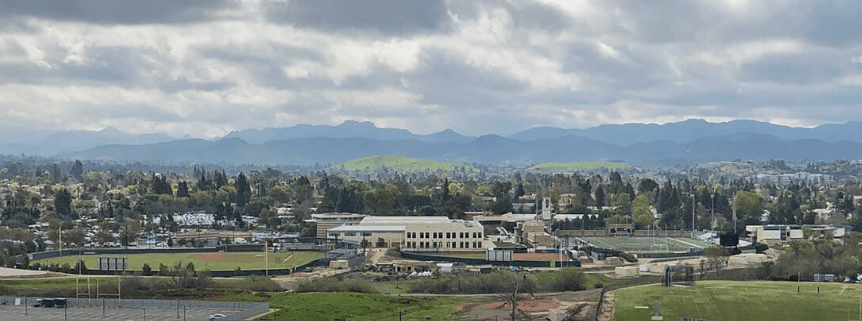
California Lutheran University Campus

I’ve begun work on something I have wanted to do for a long time but, for numerous reasons (some of which actually make sense in retrospect) have not been able to accomplish. I’m speaking of writing a book. Actually, I’ve had three books in mind for a few years: One sharing my blog posts; one about the years I spent in the Peace & Justice movement, with special emphasis on the movement against the war in Vietnam; and, my memoirs. I can say with reasonable objectivity, I have had a rather unconventional and interesting life.

Since the beginning of March of 2018, I have been working part-time as the business manager for a small AI software development firm. In doing so, I transitioned from my Mac to a PC laptop in order to comply with the company standards. Today I moved my Mac out into a place in our living room where I can sit quietly and write. Since this is the first time I’ve actually spent a while at the Mac, I have been going through my files and am somewhat pleased to discover there are a lot things I’ve written over the years that should prove helpful in writing (at least) my memoirs. Some of the things I’ve written are only a couple of sentences or a paragraph or two, but they convey the essence of a thought I can expand upon. On the other hand, some of them are completely unintelligible.

What I’m going to do here, however, is use this blog to publish a term paper I submitted 19 years ago, when I was attending classes at California Lutheran University, in their Center for Lifelong Learning offering, ADEP (Adult Degree Evening Program.) It’s 22 pages long, so I’m going to post it in sections, as I wrote it. Today I’m sharing the intro. As I’ve re-read parts of it, I’m reasonably certain some will end up in at least my memoirs, as they are part of my unusual education.

Introduction

Although this paper is being written as part of the requirements for a grade in Organizational Management, its impetus and content are driven by a real life situation at the company I work for, Rocketdyne Propulsion and Power, a business unit of the Space and Communications Division of the Boeing Company. As suggested in the course syllabus, I selected a subject which I felt had some relevance to my company’s activities and my position within it.

As with many organizations throughout the world, mine is struggling with understanding and implementing the concepts of Knowledge Management. These concepts, and the issues surrounding them, are numerous and complex. As an example, one question which must be asked is how does an organization determine the importance of the information it uses and how does it weight that importance? How does it determine who needs it, who wants it, who might benefit from knowing of its existence, or whether or not it should be available to everyone who might wish to make those determinations for themselves?

Furthermore, there are numerous software developers who are touting their particular method of capturing data and making it available to a company’s workforce. Each of these developers will attempt to convince you their method is best for your application. Of course, this situation is hardly different from that faced by anyone who has to determine what method they will use, or what software they will purchase, for any task. Nevertheless, at this early stage of the game it doesn’t make the task any easier.

I propose, in the following pages, to set forth some of the history of Knowledge Management, from tribal times to today, and the perceived need for Knowledge Management, both in general, and with particular emphasis for my company, Rocketdyne. I will look at what knowledge management means, and briefly mention some of the tools which are being used to develop its use. The definition of tacit knowledge, and the importance of understanding it when implementing Knowledge Management will be discussed, along with a brief look at how we acquire and share knowledge. I will close with a glance at what is probably the most daunting task facing a company which desires to utilize Knowledge Management to its advantage, the need for dramatic cultural change.

Before beginning, however, I would like to quickly explain the nature of this paper’s subtitle, “Breaking the Information Bottleneck”. Here, the word bottleneck has the same meaning we use when speaking of a traffic jam. Most of us have experienced being caught on the freeway when suddenly we come to a crawl or dead stop. Usually there is an explanation for the delay. Sometimes, however, there is no apparent reason.

In the same way that freeways experience bottlenecks, so too does any system which requires the smooth flow of some activity or commodity. On the shop floor, it is generally components, though it can also be tooling, raw material, or usage hardware. In the office it is generally data or information, and when its flow is restricted the organization suffers.

I believe, with the advent of computers, and their widespread use through Local Area Networks and intranets, and with our increasing dependence on technology to solve our problems, we have forgotten how sharing knowledge actually works and, in the process, created huge information bottlenecks which will not go away until we learn once again how to manage knowledge.

Unfortunately, the scope of this paper is woefully inadequate to fully treat all the issues involved in this major change now occurring. It is my hope that I will be able to expand upon and use it to help melt the glacier of resistance which surrounds my organization at present and makes change painful and tedious.


Never Give Up!

Make no mistake. Trump, Barr, Pompeo, Graham, and numerous others are not merely corrupt. They are enemies of the United States of America. Despite cries of “America First” and assertions they are working for us, they are financial internationalists. They don’t give a rip about anything other than their next grift and they will sell us down the river if there’s anything to be gained for them. We will continue to decline as long as they hold the reins of our—repeat, our—government.

I’m happy impeachment hearings are finally under way, but we need to pay close attention to everything that’s going on, and we need to be ready to take matters into our own hands. I’m taking about organizing, demonstrating, marching, striking, boycotting, and whatever it takes to fight back. Our health, our wealth, our freedoms, and everything we hold dear are being slowly eroded by people who have neither the right, nor the desire, to be public servants.

Eyes on the prize, my friends. And make sure you elect progressives to every local office you can: Park Board; Board of Education; City Council; Mayors, etc.


Helping Out

In addition to the newsletters I’ve published over the years, I’ve also done some promotional work for various businesses and reasons. This was a flyer I put together for a fundraiser at Simi Hills Golf Course, where I learned to play at 46-years-old. This means I’ve been playing golf for 26 years, which I have a hard time believing. Of course, when I became a first-time, adoptive father at 55, it definitely put a cramp in my style and I’m only now reaching a point where I think I might have time to play and practice a bit more frequently. Not sure I’ll be able to afford it, though.


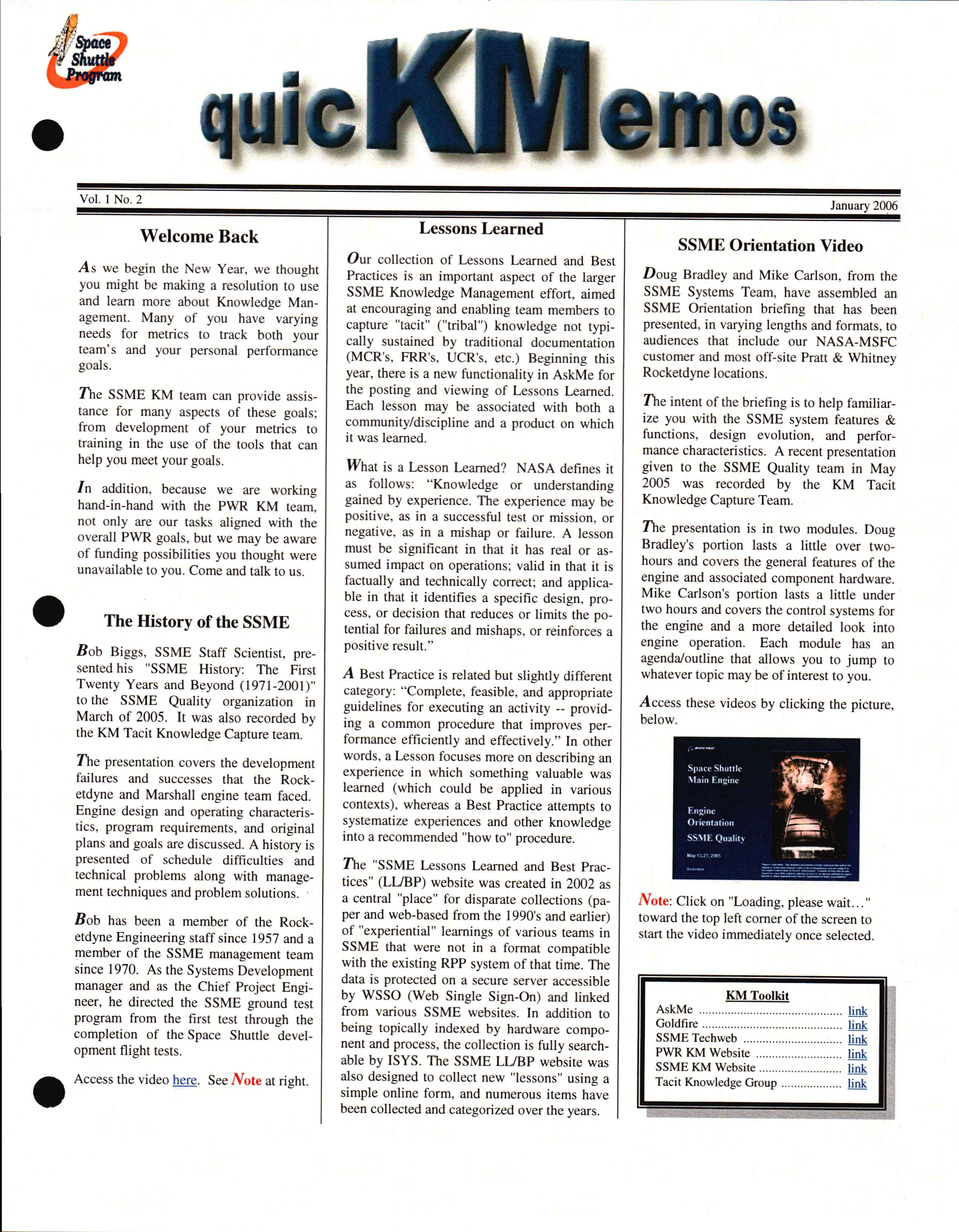
quicKMemos Vol. 1 No. 2

Here’s the second issue of the KM newsletter I wrote and published for the SSME KM team. This one was for January of 2006. The middle column has a couple of decent descriptions of “Lessons Learned” and “Best Practices.” What it doesn’t address, which is something many of us came to understand later, is that we don’t actually want “Best” Practices; which implies there won’t be any room for improvement, as “best” is a superlative adjective, which means it just doesn’t get any better than best. We, therefore, preferred to talk about “Better” Practices, which also fits rather nicely into the philosophy of continuous improvement. My apologies if this is boring.


Another Newsletter

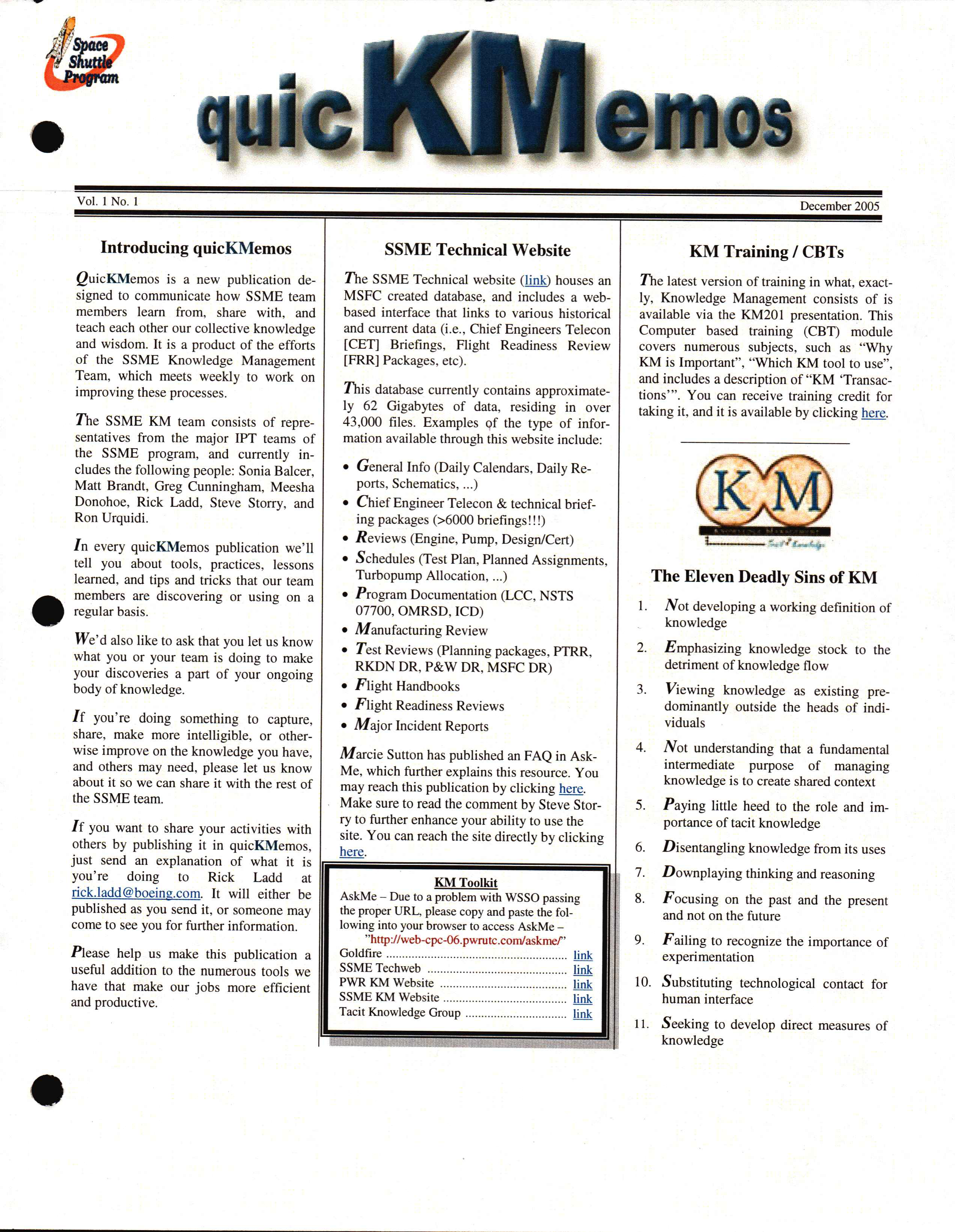
At the end of 2005, I was still five years away from accepting an early severance package from Pratt & Whitney Rocketdyne and then retiring a couple years early. I don’t think the Shuttle program had yet been cancelled, so everything appeared to be full steam ahead. I had been deeply involved in developing the concept of Knowledge Management (KM), primarily to the Space Shuttle Main Engine (SSME) team—for which I was the lead—as well as for the entire organization, from its ownership by Boeing to a subsequent purchase and merger with United Technologies’ Pratt & Whitney Division.

So, there were two teams I was involved with: the corporate, enterprise-wide team, and the SSME team. I had convinced my management to start the SSME team before I knew there was a corporate team, and it was my primary focus of attention at the time. Starting in December of 2005, I published a newsletter for the team; a KM newsletter, ostensibly by the SSME KM team for the entire SSME program team.

When I returned to work for a couple of years at Rocketdyne in 2015, I was able to find pdf files of every issue of that newsletter, which we called “quicKMemos.” I’m am converting these pdf files into png files so I can upload them here. I’ll post them somewhat sporadically, no doubt, as I have several duties and obligations that are always tugging at my sleeve and demanding my attention. So . . . here’s the first one; Vol. 1 No. 1, December 2005.

NB – Check out the Eleven Deadly Sins of KM. They still seem relevant to me, though it’s hard for me to tell as it’s been nearly 10 years since I’ve been in a large enterprise environment.


WTF Happened?

I just introduced #WTFWednesday, as in WTF happened, on Facebook. Here is the photograph I presented to my friends that I just discovered in my seemingly never-ending caches of paperwork, photos, etc., that keep popping up. I believe this is my 1st grade class at Chase St. Elementary School, in Panorama City, California. After WWII, Panorama City advertised itself as the “Heart of the Valley,” the San Fernando Valley, that is . . . like totally.

I only know what happened to one of the kids in this photo; the one in the Hopalong Cassidy shirt, third from the right, third row up. The kid with the large, goofy ears. Last I heard, he was still trying to figure out what he wants to be when he grows up.


Socialism is NOT a bad word!

The economic system of capitalism means that money (specifically investment, not wages) is society’s primary consideration. Socialism means people (workers, humans) are society’s primary consideration. I know what I prefer. How about you?

Sure . . . there are thorny issues of ownership and incentivization, what deserves to be nationalized and what can remain in the private sector, but they will be addressed with people, not capital, foremost in mind. And don’t come at me with that tired old trope that socialism has been tried and it’s failed. That’s not even close to the truth. Most examples given are usually of a country that attempted to go straight from feudalism to socialism, without experiencing capitalism at all.

If Karl Marx was correct, and I believe he was, economies need to develop and evolve through various stages, and attempting to circumvent one of those developmental stages isn’t a good idea. This is why I believe the U.S. economy is ripe for becoming socialist; it already is to some extent. Our economy is, if not the most advanced, one of the more advanced capitalist economies in the world. Yet, many of its sectors are—or have been—treated as worthy of receiving benefits in the form of subsidies, grants, and tax breaks that are tantamount to them being socialized.

Most importantly, many larger sectors of the economy are highly developed, with a few being in nearly monopolistic control of their market. This is what Marx called late-stage, monopoly capitalism. It suggests that larger industries, which have become monolithic, are ripe for worker ownership and a more equitable distribution of their profits to the people who actually make those profits happen.

Let’s stop treating the concept, let alone the word, of socialism as if it’s still some sort of disease or bogeyman. The forces of reaction and fascism have long told us to be afraid . . . be very afraid . . . of socialism, but they’re crying wolf and their arguments are dishonest and disingenuous. That is to say, they’re fucking liars and can’t be trusted. They don’t care about you and me. Don’t expect them to be helpful, unless they’re helping themselves.


Are We Alone?

“Is it all just for us, or do we get to share it with anyone?”

~ Paul Sutter (Astrophysicist on “How The Universe Works”)


Our galaxy, the Milky Way, is around 100,000 light years in diameter. That’s roughly 587,900,000,000,000,000 miles or 946,100,000,000,000,000 kilometers across. Those are in the quadrillions, which translates loosely into a “shitload.” The fastest man-made object—according to my research on the Intertubes—was a bit of a toss-up between NASA’s Helios 2 and their Juno spacecraft; that is until the Parker Solar Probe was launched. When it reaches its closest to the sun (in a few years) it will be traveling at approximately 430,000 MPH! That’s screaming. However, even at that speed it would take nearly 1,560 years to cross the entire galaxy.

Current estimates suggest there may be as many as 200,000,000,000 galaxies in the universe. Astronomers, astrophysicists, and cosmologists suggest our galaxy alone contains up to 200,000,000,000 stars. That’s an awful lot of stuff, eh?

The Milky Way
The Milky Way

Yet, in all of this, we have not been able to answer the most fundamental question we have about the universe . . . Are we alone? Is there life out there we just haven’t discovered? I like how astrophysicist Paul Sutter looks at it (see the quote from him, above, that I started this post off with.) I find it difficult to believe, now that we understand much of the physics and chemistry of the Universe, that life hasn’t (or won’t) evolve in places other than this one nondescript star system we call home.

Another quote I love is one I’m going to paraphrase, as the original quote, from Edward Robert Harrison, doesn’t quite provide the essence of what I’m trying to get across. His quote is: “Hydrogen is a light, odorless gas, which, given enough time, turns into people.” It almost says it all, but I think “Hydrogen is a light, odorless gas which, given enough time, begins to wonder where it came from . . . and where it’s going,” is a bit more on point.

If you are unfamiliar with, or new to, the field of cosmology you might not know what this means. Essentially, it’s refining what is the generally accepted understanding of how the Universe has evolved from nothing but sub-atomic particles to Hydrogen and, through the process of star formation (and spectacular stellar deaths via supernovae) the heavier elements have been formed . . . many of which are the building blocks of life, and us. We’re the descendants of the primal Hydrogen that made up the early universe and its first generation of stars.

To me, the concept of evolution—both of the universe itself and of life on Earth (perhaps elsewhere)—is far more incredible and truly beautiful than any origin story of any religion I’ve encountered . . . and I’ve encountered a fair number of them. Imagining the evolutionary process, which has played out over billions and billions (h/t Carl Sagan) of years is—for me—a challenging flight of fancy and an enlightening exercise in the dialectic, or zen, or yin-yang of life in this universe.

I hope one day we’ll find out we’re not alone. Perhaps that will give us the humility we need to get along with one another on this little blue dot we call home.


The Farmdale Boyz

This pic was taken in about 1972 or 1973. I lived for about two or three years with these guys in two three-bedroom homes, side-by-side in North Hollywood, CA. Two sets of brothers and two close friends. In the background, at one time or another, those two tanks held a couple of snakes. One of them was named “Ellis A. Piary” (because that’s where he/she was rudely captured by one of our number) and the other, naturally, was named “Lefty.” Two of the people in this photo are not on Facebook, but everyone’s still alive!! — with Rick London, Loren Goetz, Stephen Ladd, Tom Shannon and Mark London.

Sometime after this picture was taken, I traveled to Cuba with the sixth contingent of the Venceremos Brigade and, shortly after my return in the Summer of ’73, I began attending law school. There have been some changes over the years, and a couple of us don’t talk much with each other, but for the most part we’ve all remained friends.