I retired over14 years ago, though I've continued to work on and off since then. Mostly I'm just cruising, making the most of what time I have remaining.
Although my time is nearly up, I still care deeply about the kind of world I'll be leaving to those who follow me and, to that end, I am devoted to seeing the forces of repression and authoritarianism are at least held at bay, if not crushed out of existence.
I write about things that interest me and, as an eclectic soul, my interests run the gamut from science to spirituality, governance to economics, art and engineering. I'm hopeful one day my children will read what I've left behind.
I’ve received plenty of advice or, more precisely, offers to subscribe to newsletters, attend webinars, or purchase books on how to get more traffic to one’s blog. I’ve never been all that interested in them though, truth to tell, I sometimes read a few paragraphs or so. One of the great “formulas” for blog writing is “The List” which, for some odd reason, amuses the hell out of me.
Lists are ubiquitous and endless. Virtually anything you can think of has been – or can be – reduced to a list and chances are someone has created one. In that spirit, today I did a little poking around to confirm my suspicions. For your dining pleasure I bring you 12 lists of 12 things you should know about something or another.
I got these from searching Google for the phrase “12 things you should know about”, which returned a little less than 50 pages of reasonably relevant material. Some of the results were for different size lists. Five, ten, and seven are pretty popular size lists as well, each one returning around 40 pages, though the time-honored dozen provided the largest return.
I don’t know what this means or what it says about us (writers and readers). I’m not really big on formulaic writing, though I’ve recently done quite a few case studies, which must follow a basic format in order for them to make sense. Still, there’s something about the ubiquity of lists that grates on me a bit. Maybe my next post should be “13 Reasons I Can’t Stand Lists.”
I am pleased, proud, and excited to announce I have joined the team at Quantellia, LLC. Located in Denver, Colorado. My official title is Consulting Analyst and my main duties consist of (oddly enough) analysis . . . and some writing. OK, lots of writing.
Making Sense of Complexity
Quantellia is the leader in the emerging discipline of Decision Intelligence and, among other offerings, provides a software platform, World Modeler™, designed to rapidly create interactive simulations for envisioning and understanding highly complex systems interactions and the results of decisions affecting them.
For my friends in the Knowledge Management field, as well as anyone who is involved with complex business, governmental, or other organizational decision making, I invite you to learn more about Quantellia. My professional opinion is (though somewhat slanted) you won’t regret it.
Jordan Spieth Hugs His Caddy After Winning The John Deere Classic
I used to love baseball. Truth to tell, I still do though I seldom watch any longer. I haven’t since the World Series was cancelled in 1994 because of a labor dispute. I considered that act a stinging slap in the face of the very people whose money the players and owners were fighting over. It was also a blow to all the small vendors whose livelihood depended on the games played in the ballparks in which they labored. It was incredibly selfish in my judgement and I have yet to truly forgive the sport.
This post, however, isn’t about labor vs. management. Nor is it a discussion of the value of sports and entertainment. It’s about something a bit less dramatic but, perhaps, of more general and long-lasting significance. I’ll let you be the judge. I just want to share my thoughts, which come about after this week’s MLB All-Star game (the only baseball I’ve watched all season) and were additive to some I had at the end of the John Deere Classic golf tournament last weekend.
It’s actually a very simple observation, though it may have (I hope it has) tremendous significance historically and culturally. When I was a young man, it was unheard of for men to hug each other (with, perhaps, the exception of the swarm at the mound after a World Series victory). For the most part, men shook hands or slapped each other on the back. Later on, there was the high five, the chest bump, fist bump, etc. All of these were “manly”.
Lately, however, I’ve seen men hug after a victory or, in the case of baseball, even after a particularly important play. The hugs aren’t exactly what I would characterize as warm—as there’s still usually a little backslapping that goes along with them that, in my mind, signify assurance one is not being intimate—but they’re more frequent and less self-conscious. I’m of the opinion this is a good thing.
I think this is important, as well as reflective of a growing acceptance of homosexuality in our culture. I say this because I believe the reason men haven’t been able to hug comes from a deep-seating, acculturated fear of physical intimacy among men; fear that enjoying the sensual pleasure of a good hug somehow puts their masculinity into question. I find this fear a bit ridiculous, but I also believe it’s pervasive. I say ridiculous because, just as being gay is not something one chooses, neither is being straight. Therefore, enjoying a good hug with someone you like and whose company you enjoy and, especially, after an accomplishment you admire, does not mean you are suddenly changing your sexual orientation.
So it’s good to see men becoming more comfortable with hugging each other. I think it signifies a maturity that will, ultimately, result in unthinking and unconscious acceptance of our gay brothers and sisters and is another step on the road to accepting all our fellow human beings, even us atheists.
The 18th Hole at Simi Hills Golf Course – Simi Valley, California
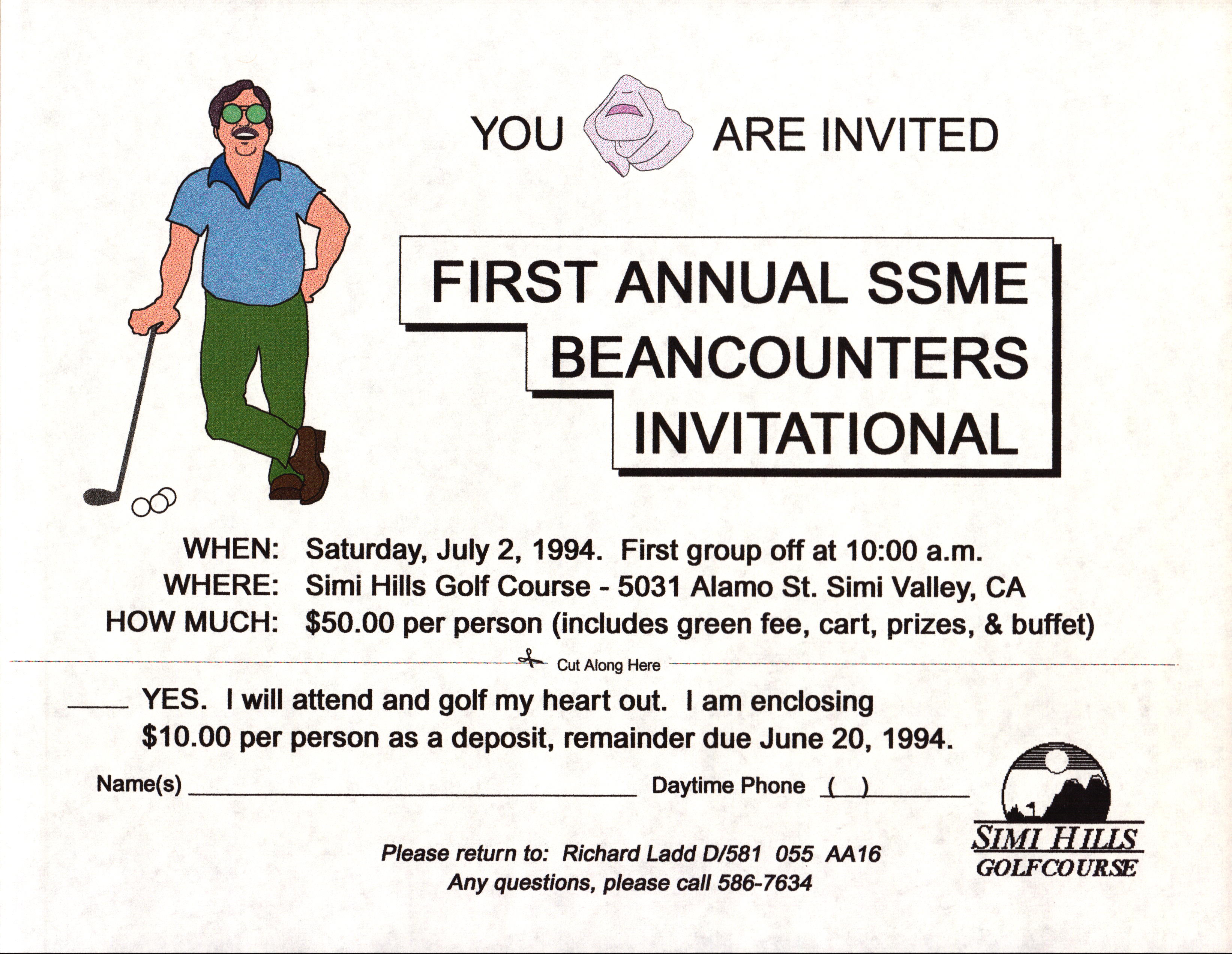
I took up golf at the tender age of 46. My department at Rocketdyne was having a tournament and they needed bodies to fill up open slots. After a significant amount of badgering, I agreed to participate. To be fair, I had been introduced to golf when I was fifteen. My father had taken it up and he wanted me to enjoy it as he did. Unfortunately, he also wanted me to be right-handed. I’m not. He insisted I would be better off golfing right-handed and I tried, but it wasn’t to be. I felt incredibly awkward and didn’t want to put up with what I perceived to be an inordinately difficult effort to make the switch.
Couple that with the belief (this was back in 1962) that golf was primarily for old farts, and a strong desire to spend time surfing, and I didn’t last long at all. I guess, then, it’s not entirely correct to say I took it up at 46, despite the intervening 31 years before I handled a golf club again. Regardless, I played in the company tournament and spent a little time on the driving range and practice green in preparation. I was hooked—big time!
Addendum: I thought this might be the flyer I put together for that first tournament but, based on the date, I don’t believe it is, because in July of 1994 I was 47 years old, not 46.
My uncle offered to have a friend make me a set of custom clubs for a very reasonable price, which I did. I quickly discovered, however, golf can be a very expensive sport, especially when you spend all your spare time hitting balls or playing. I could not afford to keep up the pace I was going at. In order to continue, I wrote and published a newsletter for the course I spent all my time at, Simi Hills. None of the articles were based on anything but my own fertile imagination and conjecture, but the General Manager of the course loved it and asked me to do it on a monthly basis, with real information this time.
In exchange for my efforts, he began allowing me to hit as many balls as I wished on the range and I took full advantage of it, frequently hitting hundreds of balls as I perfected my game. Soon I was invited to play with the head pro and the GM and, of course, it was as good as getting hours and hours of free lessons. I got my handicap down to 12 within a fairly short while, no mean feat for a man who was then pushing 50.
As I increased both my physical capabilities and my understanding of the game, I was soon approaching a single-digit handicap. It was then my wife and I decided to adopt. I wasn’t actually too keen on the idea at first, as I had visions of retirement, travel, and lots of golf. However, the desire to be a parent overcame my (very strong) desire to continue playing golf and, once the process began rolling along, it became harder and harder to play or practice. By the time we returned home with our oldest, in 2002, I was 55 and it became very difficult to fulfill my duties as a husband and father and still have time to play golf.
So, why am I telling you all of this? I still watch golf quite a bit and, lately, I’ve been playing a very realistic virtual game (World Golf Tour) online. Also, I have given a lot of thought to the role golf plays and how it jibes with my world view. I am aware there are numerous arguments for golf being a wasteful, indulgent sport of the rich. I am aware golf courses take up a lot of property for the use of, perhaps, not very many people. My best, somewhat informed, guesstimate is that the average full-size course is used by around 350 golfers a day. That’s not very many compared to the numbers using a municipal park or a National or State park. It surely explains why golf is so expensive, as it is a heavily tended and manicured environment.
Many courses, some suggest as many as 40% in the 1990s, were built as a part of a real estate development, and I’m not even going to get into the place Country Clubs play in terms of the exclusivity and expensiveness of golf. A large percentage of golfers are very well off. I suppose, comparatively, I am one of them. Certainly, when I was still employed in an excellent, well-paying job, I had the money to play a couple of times a month and practice several days a week when I wished.
There are, however, significant attempts to bring golf to the less-than-affluent, Tiger Woods’s “The First Tee” likely being the most prominent. Frankly, I don’t believe golf need be an “exclusive” sport. Furthermore, I think it has values to teach, as The First Tee does, that are difficult to find in today’s hyper-competitive environment found in many other sports. Inasmuch as I started so late in life, golf hasn’t taught me so much as it has reinforced in me many values I find important and useful, e.g. integrity, self-assurance, patience, calm deliberation, respect for others, etc. I also found on the golf course a place where everything else in my life melted away for a few hours. I was able to put my job and my responsibilities out of my head for a while; no mean feat for one such as I.
Tiger Thanks a Marine For His Service
There’s one other thought I had – and this whole post (which is somewhat off the top of my head, though I’ve thought about it a lot) was begun with this thought in mind – that bothers/concerns me. The military has long had a close association with golf (see this USGA history) and I have no problem with this. It does, however, lend even more credence to the belief that golf is exclusive because, historically, it has been primarily the Officers who had the time and money to play. That may be changing, but my goal isn’t to analyze the development of golf inside the military. What I am interested in understanding is what it means that every golf tournament now seems to have members of the military ceremoniously tending at least one flag on the course – generally the 18th.
I find myself wondering if this doesn’t, in some small way, signify our becoming more and more a military culture and also, given our penchant for honoring our armed forces for serving, yet never questioning how and why we ask them to serve, if this isn’t a bit backwards. What does it say about us as a society that we don’t seem to question how our military is used, yet now (post-Vietnam) bend over backward to thank them for their service? How do we justify asking them to do what many believe is not in our best interests, yet feel a heartfelt “thank you for your service” is somehow enough to justify our cavalier attitude toward the forces behind their service and sacrifice?
This leads me to other questions, such as are we becoming a sort of Sparta by proxy? Are we a nation that uses its wealth to prosecute wars that are unnecessary and only serve the interests of the truly wealthy and powerful, simultaneously insulating the average citizen from the sacrifices and costs involved? Are we asking the members of our armed forces to kill, fight, and die for no other reason than to preserve our position as the world’s largest consumers of natural resources, then showering them with just enough pomp and circumstance to obfuscate the ugly and horrific reality?
This is where I find cognitive dissonance. As I watched the end of the Greenbrier Classic yesterday, there were two service members tending the pin on the 18th. I am pretty sure I’ve seen this at just about every tournament I’ve watched this year and it seems as though it’s been only recently this has happened regularly. I really love golf as a sport, though I do wonder where it fits in the overall cultural milieu I live in. I hate to see it used as a propaganda tool but, truth to tell, I’m not sure that is what’s happening. What do you think about this? Am I crazy; being too ideological; reading too much into a genuine expression of gratitude? The dissonance is killing me.
When was it? A week or so ago? Remember that Cheerios video with the beautiful little girl and her interracial mom and dad? Unfortunately, cute and entertaining as it was, it brought out a vocal contingent of hateful bigots, prompting General Mills to suspend commenting on the YouTube video.
It even made it into the International Business Times, and is (as of this date) still being discussed extensively.
Well . . . a gentleman by the name of Kenji America has produced a video in response to those hateful people who, IMO, represent a dying breed spasming as they approach the demise of their narrow-minded, backward, disgusting ways. Check it out!
Only about 6,000,000 people have viewed this so far (at least on YouTube) and it’s got to be one of the best car commercials I’ve ever seen. Thought I would share in case any of my readers have yet to encounter it.
Our Real Common Bond is our Life on Earth . . . in This Cosmos.
In October of last year, I posted about a dilemma I was having with the possibility I would, at some time, be asked to give the pre-meeting invocation at one of my Rotary Club’s weekly meetings. I haven’t been asked yet and, even though there are no comments to the post, I have received a couple of emails from others who have dealt with the problem before.
As I said, I haven’t been asked and I’m not in the lineup for at least another month or so. Neither have I bothered to write anything. I will likely wait until it’s absolutely necessary prior to doing so. I need the actual pressure of a deadline sometimes to get things done. I do, however, think about what to say quite frequently, especially when I come across a story that touches on the issues.
Today, a friend shared a link to an Arizona publication that posted a story about a State Legislator – Juan Mendez, of Tempe – who gave a prayer-less “invocation” before a session of the Arizona House of Representatives. The story pointed out, as well, that he quoted Carl Sagan in closing. Here’s a link and, just in case you don’t bother to go there but would like to know a bit more, here’s an excerpt:
“Most prayers in this room begin with a request to bow your heads,” Mendez said. “I would like to ask that you not bow your heads. I would like to ask that you take a moment to look around the room at all of the men and women here, in this moment, sharing together this extraordinary experience of being alive and of dedicating ourselves to working toward improving the lives of the people in our state.”
He went on to say:
“This is a room in which there are many challenging debates, many moments of tension, of ideological division, of frustration. But this is also a room where, as my secular humanist tradition stresses, by the very fact of being human, we have much more in common than we have differences. We share the same spectrum of potential for care, for compassion, for fear, for joy, for love.”
And closed with:
“Carl Sagan once wrote, ‘For small creatures such as we, the vastness is bearable only through love.'”
He said one more thing I think is especially pertinent to what happened yesterday (May 21, 2013) in Arizona. It also reflects how I feel about the importance of “coming out” for those of us who profess no belief in a supreme deity, and it’s something I’ve struggled with for years. It hasn’t shaken the strength of my convictions, but it has been a royal pain in the ass at times.
When I worked on the SSME program at Rocketdyne, I felt it necessary to be very careful about expressing my beliefs for at least a decade. When I first started working there (late 80s) it was practically a shrine to Ronald Reagan, and overtly identifying myself as an atheist I’m pretty sure would have been counter-productive, if not self-destructive :).
As an ordained Minister (in the eyes of the State, a “Church” is a corporation) I have performed somewhere around fifty weddings over the years. All of them have been non-religious, non-sexist ceremonies, using a combination of portions of The Prophet, by Khalil Gibran, descriptions of folklore and customs I had learned about, and the occasional poem written especially for the couple. I was pretty close to a lot of the people I performed the ritual for, including my brother and sister-in-law and my sister and brother-in-law. Crafting something especially for them was pretty easy. I usually worried, however, that someone’s parents would be offended though, of course, no one ever was. Come to think of it, Gibran uses the word “God” a couple of times in one of the pieces I used repeatedly.
Here’s the final quote I think is so important, in light of my experiences and those of so many others:
“I hope today marks the beginning of a new era in which Arizona’s non believers can feel as welcome and valued here as believers.”
The part of me that’s remains Jewish wants to say “from his lips to G-d’s ears”, but that would be just silly, right?
An open letter to my fellow motorists. You know, you folks driving cars all around me . . . and each other. Apparently, a lot of you are unaware of some points I think it would be valuable for you to keep in mind. I’ll try to address them in a reasonably coherent order, so you won’t have any trouble understanding what I’m getting at.
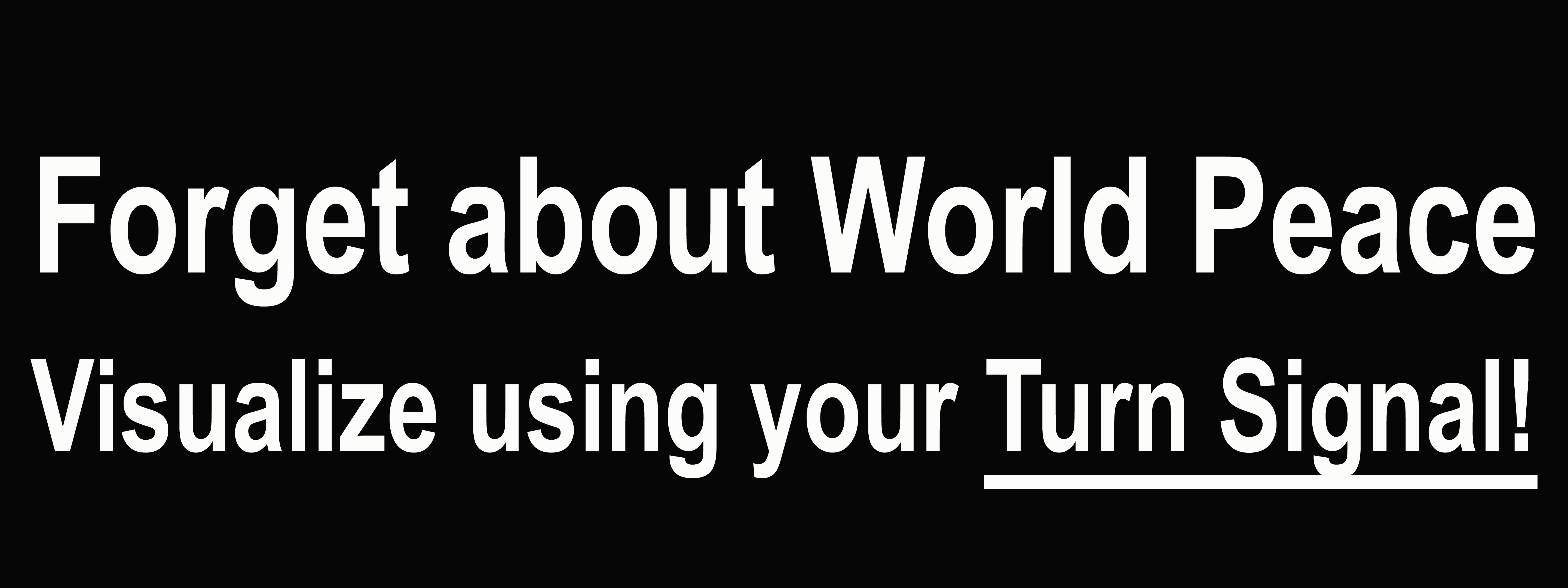
See that little handle-like thingy behind the left side of your steering wheel? The manufacturer of your vehicle put it there so you can use the handy lights generally found toward the outboard side of your fenders – front and back – to signal your intention to turn either left or right.
Signaling your intention can be quite useful for other drivers using the same roads you happen to be using. By other drivers, I mean those people in other vehicles whose presence seldom seems to make it into your actual consciousness.
I have a sneaking suspicion you didn’t receive a discount on those turn signals you apparently don’t know how to use, so why not take advantage of a bit of functionality you’ve already paid for?
Contrary to what you may believe (and your tax accountant, if you have one, will probably back me up on this), your vehicle’s depreciation will not decrease as a result of never using those turn signals you didn’t get that discount on.
So here’s what I’m trying to get at – especially for you dunderheads and borderline sociopaths who seem not to be aware you share the road with others and a little common courtesy is both useful and welcome when you’re navigating these roads our vehicles were designed to drive on.
Driving continues to be somewhat dangerous and people tend to be reasonably cautious when turning onto a street where there’s already moving traffic. They also depend on signals from others to inform them regarding the safety (or not) of the choices they make. Without those signals, traffic moves more slowly and, in some cases, accidents are probably more likely to occur. Why not be respectful of others? It doesn’t make you a Socialist, for crying out loud.
Yeah! Who Cares About Whirled Peas Anyway?
PS – An octagonal, red sign with the letters S-T-O-P means your vehicle should achieve a speed of zero miles per hour (MPH) prior to engaging the accelerator once again. Some of you clearly don’t understand this simple, yet useful rule.
About two weeks ago our youngest daughter was sitting on the couch in the family room and asked a simple question, “Why are there bubbles in the ceiling, Daddy?” Much to our chagrin, once we looked up it was difficult not to notice areas that were clearly filling up with water. We had a leak (another one, as it turns out, since we’d had one almost two years ago). We immediately fetched a couple of buckets and pierced the paint holding the water in to relieve the pressure. I also immediately called the Plumber, who fortunately was able to come out and fix the leak.
Stage one was complete. We’d stemmed the tide. Unfortunately, the ceiling was now ruined and – as Shane the Plumber pointed out to us, there was still a fair amount of water up there. Next stage – contact the insurance company and get someone out who can fix the ceiling and bring us back to status quo ante. Would that it were so easy.
More Bubbles and Damage
Because of the age of our house, everyone now suspected there might be asbestos involved and we needed to have someone come out and test for both it . . . and lead, which might have been in older paint. Sure enough, asbestos was discovered but no lead <whew!>. So now we need to have specialists come in, completely seal off the room to avoid contaminating other parts of the house, and remove all the offending material.
One problem. The room has to be completely emptied and nobody says they expect me to do it on my little lonesome. Hint – there are items of furniture in that room most 35 year old men can’t move by themselves, let alone a 65 year old man. So the guys show up but the room is as it was. They get all confused and, ultimately, leave without saying a word. Thus begins a bit of a Keystone Kops routine of non-communication, mis-communication, and confusion.
Family Room Empty – Living Room Stuffed
As of today, I’m pretty certain things have been worked out. The company I was referred to by Shane the Plumber came out and packed up everything and moved almost all of it into the living room. Tomorrow the remediation company is scheduled to show up, seal off the room, dry the attic, and remove any asbestos they find. Unfortunately, they will have no choice but to seal off the back of the house, rendering it unlivable. I’m waiting for the adjuster to get back to me and authorize our staying at a local residence inn for Wednesday and Thursday nights; they say we’ll be able to return on Friday.
In the meantime, the kids have school and life goes on. We get a two-day “vacation” I really don’t want yet have no choice other than to take. So . . . we’re off on a mini-adventure as of, well, as of now since we’re going to have to pack up and gtf outta here early tomorrow.
Thanks to a respected Facebook friend, I encountered a wonderfully perceptive, entertaining, and enlightening post by Steve Denning on Forbes.com today. Because of my long-time involvement in the knowledge management world, both as a practitioner and somewhat as a thought leader, I also count Steve as one of my Facebook friends. However, I didn’t find the piece through him. Regardless, I’m glad I encountered it and, as a bonus, it really came at a propitious time for me. I’ll link to it at the end of this post. It’s somewhat long, but so full of good information and insight I believe it’s worth every moment it takes to read it.
As I’ve written about numerous times, I took an early retirement from the organization I had pretty happily labored for for over two decades. Actually, five days from now it will be precisely three years since my last day there. It was a bittersweet day for me, as I was both glad to be rid of the constraining shackles of the parent organization and depressed over saying goodbye to so many people I’d come to regard as family.
Adding insult to injury was the seeming invisibility that seems to accompany most everyone who’s put out to pasture. I wrote about that as well here. I have found myself occasionally lamenting my decision, though I always seem to be able to recall there truly was a good reason for it; I couldn’t stand the corporate culture of United Technologies and Pratt & Whitney. I was ready for a change.
Now comes Steve’s wonderful article. To sum it up as briefly as I can – so you can spend your precious time reading what he wrote, which is far better than anything I’m capable of – he breaks down the realities of the three different economies we can see all around us: Traditional, Financial Capitalism, and Creative. I have long been most interested in dealing primarily with the Creative Economy, but spent a large portion of my working life in the Traditional Economy. My experience with Financial Capitalism is much the same as just about everyone else. I’ve lost substantial equity because of their criminal activities and greed.
I’m now more convinced than ever I will spend the rest of my life making a place in the Creative Economy. I want as little a part of the Traditional Economy as possible, though part of what I’ve been working on may require providing creative services to traditional organizations. I will no doubt see how that progresses and am prepared to turn on a dime if necessary. I have no desire at all – never have – to be a part of Finance, save for some of the more creative and worthwhile aspects such as crowdfunding and efforts like Kiva, etc.
Now, to get you to Steve’s article without further ado. The title is “Leadership In The Three-Speed Economy“. If you have the time, I’d love to read what you get out of the piece. Hope you get a lot, regardless.