

Testing to see what this looks like when I send from HootSuite directly to my WordPress blog. Please ignore the man behind the curtain. This was merely a test, though I’m not removing it and I’m not apologizing for it. :0P

Testing to see what this looks like when I send from HootSuite directly to my WordPress blog. Please ignore the man behind the curtain. This was merely a test, though I’m not removing it and I’m not apologizing for it. :0P

The Ubiquitous Conference Room: Where Collaboration Goes to Die
Before you get your panties in a bunch, I’m not really advocating the complete abolition of meetings. I always loved getting together with 20 or 30 of my closest associates and spending the first ten minutes – of what always managed to completely fill the exact amount of time allotted to it – with banter about our kids, our pets, our plants, and our plans for retirement. Regardless, it always seemed to me there were just a few too many of them, and many were just . . . well . . . kind of unnecessary. So I’m just saying maybe we should consider there are meetings that are a complete – or near complete – waste of everyone’s time. Allow me to provide an example and, hopefully, I won’t piss off my former employer too much by sharing this.
Now that this occurrence has faded in my rearview mirror, I can look at it a little more rationally. At the time, it was just one of numerous ways in which I saw us spending far more money and effort than necessary to get things done (don’t get me started on how click-to-talk phones could have sped up the flow of components through the shop). It wasn’t to be.
Although I’m no longer in that world (corporate, that is), I have good reason to believe things haven’t changed much in all this time. I know they hadn’t by the time I left (May of 2010). Are you still having meetings that accomplish little other than to fill up the hours? Here’s a suggestion. Read the book by Patrick Lencioni – “Death by Meeting: A Leadership Fable“. It’s a great business book masked as an entertaining fable, in the mold of Eli Goldratt’s “The Goal“. See if you can’t turn your meetings into what they should be, a vital and invigorating component of running an organization rather than a time-wasting drag on everyone’s energy and enthusiasm.

It used to be there were essentially three things a restaurant could do to attract, satisfy, and keep customers; three things they had virtually total control over, not counting advertising and marketing, which has almost always been about pricing (coupons, two-for-ones, etc.):
These three things can be broken down into lots of sub-areas, e.g. type of food, number of choices, speed of preparation, cleanliness (or decor) of the bathrooms, etc., but just about everything restaurant owners and their staff have control over comes down to these three choices. Much like the mantra heard in large, project focussed organizations says, “Quality – Price – Speed. You May Choose Two“, people might overlook one of these if the other two met or exceeded their expectations, but provide them with only one and it better be extraordinary if you want to survive for very long.
If your patrons are dissatisfied with any of these, they might decide sacrificing one for the other two is worthwhile. They might even think it’s a good bargain. On the other hand, they might not be happy about it and not only refuse to return, but also tell their friends if the subject happens to come up. If they had a particularly bad experience – say, a surly or inattentive waiter or a dish that wasn’t prepared properly – they could tell you and, if you cared at all, you could comp their meal or offer them a refund, etc. Unfortunately for many, a lot of people will not say a word; they just won’t come back.
Well, things have changed; dramatically, in my opinion. Thanks to the ever-growing popularity of location-based applications for smart phones, as well as the addition to those applications of review-writing and gaming aspects, this is no longer the case. People who are dissatisfied – I mean truly dissatisfied for good reason – have a bully pulpit from which to share their grief, and it’s no longer confined to just their friends and acquaintances.
The two services I am most familiar with inhabit two similar, yet distinct niches in this expanding field. They are Foursquare and Yelp. If you own a restaurant, or a retail shop, or even a service-based business and you don’t participate in these two applications, you are really missing out on a great bargain and, perhaps, even hurting your ability to compete. Here’s what you need to do.
Doing these reasonably simple things will give you access to the basic tools you need to start taking advantage of these powerful location-based services. Remember, if your marketing and advertising are only reaching people who read papers and their junk mail, or who only use the Internet, you’re addressing a shrinking part of the population. Young people are all carrying smart phones, and they’re talking to each other or, in the case of those who use Foursquare and Yelp, they’re actually playing games with one another as they use them. Why not have them spend their time at your place?
I will be writing more about some of the specific ways in which you can take advantage of these two services and truly engage with your customers/clients/patients, as well as explaining the value of other, similar services like Urban Spoon, Groupon, and local listing services you can take advantage of.
There is such as thing as bad publicity. Maybe not for someone who can thrive on notoriety, but most small business owners would soon be looking for a job if they were unfortunate enough to receive it. However, you can’t have enough good publicity, even if it’s only getting your name out in as many places as possible. Caveat here: You don’t want to spread yourself too thin, as each of these services may be free, but they require some time and energy to use properly.

Death strips or Yummy Lozenges?
This blog is hosted by WordPress.com. I love it. It’s easy to maintain an organized, continuous presence on the web (assuming I post fairly frequently) and I have found it to be a continuously improving Content Management System as well, i.e. more than just a blog for me. This year the folks at WordPress launched a sort of challenge to those who use their services. It was to blog every day, if possible, or at least every week. I chose to accept the latter challenge, though I have declined to use the subjects they suggest every day.
However, today they suggested writing something about bacon and I just couldn’t resist. Having been raised in the world of smoked and luncheon meats (bologna, ham, hot dogs, head cheese!, liverwurst, and bacon – to name a few) I have a long-standing love/hate relationship with them. I am intimately familiar with almost all of them (head cheese was never a favorite of mine, but I’ve sold and delivered a fair amount), and I am pretty familiar with the health consequences of eating them, though there are lots of conflicting viewpoints; some with merit.
That said, I spent the summer between my first and second years of Law School (1974) working at a butcher shop in Gardena, California. We had a large, automated bacon-slicing machine and kept several hundred slabs of bacon around, which we sliced fresh each day. On Saturday, I would keep my eye on the case the sliced stuff was in and, when I noticed we had revealed a particularly lean part of the tray we laid out, I would snag a pound to take home for next day’s breakfast. My girlfriend at the time was from Vermont and we always had blueberry pancakes made on a Vermont Soapstone, drizzled with the best Vermont Fancy Maple Syrup. The bacon was thick-cut and the rind (skin) was left on, making each piece crunchy. These were incredible breakfasts, the memory of which has stuck with me all these years.
Now what does the title I’ve used have to do with anything remotely involved with bacon? There is a dessert found in many Mexican as well as Central and South American cuisines. It’s called Flan and, if you have not experienced it, think custard and Crème caramel for somewhat of an analogy. There are similarities. Like many dishes, there are numerous variants and the skill of the person baking it can change a delightful experience into a ho hum downing of a reasonably tasty sponge. Texture is quite important with this dish, IMO.
The type of Flan that stands out in my mind, however, is the Cuban version. It’s called Tocino del Cielo and it is – I guess – at least twice as rich as the kind I favor the most. For my tastes, it’s a little bit too rich. Nevertheless, it is clearly savored by quite a few people. Now to the title. I have always translated the name of this Cuban Flan in two different but related ways. The first is Sky Bacon or, literally, Bacon of the sky. My favorite translation, though, is Heavenly Bacon. Given that bacon is probably the richest meat you can purchase and cook without any preparation, I think attaching the word to an incredibly rich dessert makes some sense and, even though I find it a bit overbearing, adding heavenly kind of makes sense as well.

Six Degrees Probably Won't Cook This Dude

Stalls at the Grand Central Market in L.A.
Perhaps this may seem strange, especially to those who’ve not experienced it, but I just love being out in places where there’s a lot of foot traffic and commerce is humming along. Although I fairly recently left a large corporation, where I worked in a windowless environment for a mostly faceless organization, I spent my formative years in very small businesses. My father was – after he took the money I got for my Bar Mitzvah to purchase a truck – a food peddler, selling mostly meat and cheese to places like the Grand Central Market in downtown Los Angeles.
I used to love going to that market and walking through it to get to a hand truck or a small four-wheeled cart I could bring back to our truck to schlep boxes of product to some of the stalls we sold to or, better yet, to one of the walk-ins where the vendors kept their produce, etc. they would then put in their cases to sell to the public. There was one place that sold a lot of chiles and spices. I think the dominant smell in that cooler was Cumin, or Cominos. I loved going into their walk-in and would usually loiter there after I had unloaded the cart with the boxes of product they had purchased from us. I was also introduced to things like lamb French Dip sandwiches and Orange Julius at the Grand Central. I can still hear my father pushing a cart loaded with meat and cheese, yelling “Wash (sic) your feet!” to warn shoppers of our presence.

The Angel's Flight Funicular
Across the street was one of the iconic places in the City of the Angels, a funicular called Angel’s Flight. It was an amazing ride to nowhere for me. Up the hill (Bunker Hill) and back down. No place to go, but I was in heaven on that little trolley.
I’ve been back a few times since my father’s death just over twenty-five years ago and it never fails to give me the chills and warm my heart at the same time. Now when I go out to talk with prospects for my business, I find I’m getting the same old feeling. There’s a connection I can’t fully explain, though I’m trying to here. I hope it never goes away. It’s part of what makes everything I do worthwhile.
Angel’s Flight Pic Courtesy of NIEHS

Atlantis Powers to Orbit
As long as I worked at what is now called Pratt & Whitney Rocketdyne we referred to NASA and the Air Force as our “customers”. For nearly twenty years I worked on the Space Shuttle Main Engine program and we always called NASA our “customer”. In the last few years of my employment there, when my awareness of – and interest in – social media brought me to learn as much as I could about what was available and how it might be of benefit to my company, I began arguing for a different approach. I believed, still do, that the real customers of companies involved in space exploration are the American people, those who pay the taxes that were used to pay our salaries. I still believe this is the case, and I still await the evidence of an enlightened approach to engaging them.
In the meantime, I just received an email request to take action and I want to pass it on in the hope some of you who read this will consider taking action; very simple, virtual action. I believe it is imperative for the human race to establish not merely a technological presence in space, but a strong cultural presence as well. I don’t believe it has to be dominated by the United States. In fact, I would prefer it be an international, world-wide effort to ensure the long-term survival of our species. Nevertheless, what is currently happening here is the gradual wasting away of our talent and our industrial base to continue leading the effort. I will no doubt write more about this as it is near and dear to my heart.
What follows is the text of the email, which comes from the website I’m asking you to visit and consider using to send a letter of support to the President, your U.S. Senators, and your Congressional Representative. I’m also including the link below the text so you might take action if you’re so inclined.
I’m concerned about the future of the United States’ role in space. Investments in our nation’s space programs will have a direct impact on our future economic strength and ability to remain a space-faring nation on the cutting edge of technology. I urge you to make a strong commitment to maintaining the U.S. as the unsurpassed leader in space.
For decades, U.S. leadership in space has been recognized across the globe. However, that position is perishable, and continued national leadership will be vital for our future. Therefore:
- It is important to establish a long-term national space strategy that factors in civil, national security and commercial interests in space. Our national strategy must also cut across all agencies that have a stake in space. Without a national strategy, America risks a future where the workforce and industrial capacity needed to maintain U.S. leadership and competitiveness in space is seriously – and in some cases irreversibly – degraded.
- It is important for our future global competitiveness, leadership and innovation in space that budgets and funding remain stable and robust. Appropriate funding must accompany strategic goals to meet established objectives and sustain a strong and progressive space industry.
- It is important to support policies that maintain a healthy and vibrant space industrial base that employs technically-skilled American workers. Modernizing our nation’s export control policies – so that U.S. industry can compete on a level playing field – is one step in the right direction.
- It is important to recognize that the space industrial base drives technological development important to our economy and national security. Our national strategy must identify and seek to preserve the space capabilities critical to meeting our national goals.
The United States stands at a critical juncture between past accomplishments and future ambitions in space. The rest of the world is not waiting. Yet there is uncertainty about the future of U.S. leadership in space; our workforce is facing upheaval and layoffs and the U.S. space industrial base is at the brink of losing our competitive and innovative edge.It is absolutely critical that our nation’s decision-makers work together to show the leadership needed to keep our space efforts robust. I urge you to make addressing these issues a national priority.
Here is the link to send this letter. Thanks for considering it – http://www.spaceleadership.org/
Watch out for that fly
I worked for over two decades at a very large (and exceedingly ponderous) corporation. Actually, I worked at three of them without every leaving the location I originally hired in at. Although I worked at a company called Rocketdyne, it was a division of Rockwell International when I hired in. It was later sold to The Boeing Company and, in 2005 was purchased by United Technologies and became a part of its Pratt & Whitney family.
Each one of these organizations were not only capable of, but repeatedly dabbled in a level of bureaucratic numbskullery that I still find hard to fathom. I have yet to have it explained to me – at least in a way I can understand – why large for-profit organizations engage in activities that are guaranteed to hinder their ability to perform well or that cost far more than is reasonable. Frankly, I’m not sure anyone who’s directly involved in them can explain why it’s so, because I’ve never known anyone who said it was their job to slow down or squash anything . . . yet that’s exactly what happens in many instances.
The other day I watched a video shared with me and others by Euan Semple. I would link to the video, but it’s been removed by the user. I guess it was meant to just make the point for Euan mostly. Anyway, shortly after looking at it I came across a three-year-old email I had sent to a colleague. The video Euan shared was made by a student. It’s quite simple and shows how many of the social sites this college student wished to go to during the course of a day were blocked by the school’s policies. Maybe you’re thinking that isn’t such a bad thing, but I’m of the belief that people should be trusted first, as most are trustworthy. Should they betray that trust, then there might be consequences based on their situation. Spending 15 minutes on Facebook catching up with friends and family is not the same as spending an hour or two trading stocks online or visiting pornography sites. Wholesale domain blocking does not exhibit any level of trust at all and tends to alienate the majority of people who want access when they need it, but will not normally abuse the privilege.
Now to the rediscovered email. I’ll let it speak for itself. The episode which sparked it is not terribly important in my opinion, though it was important enough for me to memorialize and share it with a colleague whose mission was (and is) to steer the organization from simple-minded, one-size-fits-all policies and procedures. This is, I think, what it evidences. I hope you don’t think it too petty of me to point it out. I think this approach still dominates the thinking of the corporate world, as well as academia, as evidenced by the video Euan shared. What follows is my email.
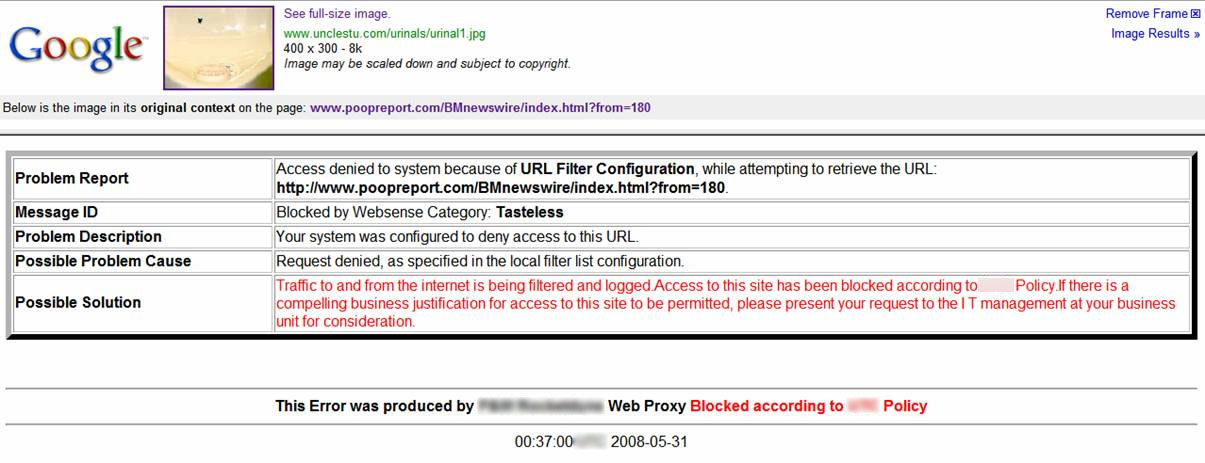
I don’t know what to make of this. Well . . . actually, I kinda do. It’s kind of funny, yet somehow a bit infuriating. Allow me to explain. As you may or may not recall, the men’s room near my cubicle was recently finished and re-opened. One of the features they installed is those waterless urinals. I’ve only seen them once before, and each time I go in I make note of the name of the company – thinking to find them on the Internet so I can read something about the science behind them. Also, each of the urinals has a bee painted on them and I wanted to see if I could find something quickly about why (though I suspected I already knew). At any rate, I finally remembered to investigate both (after several weeks of forgetting as soon as I got back to my computer) and found what I wanted and decided to just click on Google images as well. The first picture was of a urinal with a fly – not a bee – painted in the sweet spot.
I decided to take a close look and clicked on the picture. Although I was able to see the picture, even open the full-size image, the website it was on (which appears in a lower frame in Google images) was blocked by Websense. What I find remarkable, ironic, asinine, stupid, foolish, and probably a dozen more useful adjectives is the category they chose to block it under – “Tasteless”. Tasteless!!!! Is there some sort of absolute scale on which that quality can be measured? It was probably the name, but what if the website was about caring for infants or puppies or god knows what? This I find not a little insulting. What children they think we are! Let’s not forget the further irony that I could, for all their blocking, see the image. Perhaps I should sue for negligent infliction of emotional distress. Here they made an attempt to insulate me from something as tasteless as this, and I was nevertheless forced to look at a painted fly in a vitreous porcelain urinal due to the incompetence of Information Technology and UTC Policy. I hope I recover. I hope I can sleep tonight.
There! I got it off my chest. Please realize this email was sent approximately 3 years ago, so some things (like Google’s positioning of images and their associated sites) have changed. If Euan’s friend’s example is any indication, however, other things haven’t changed at all. I don’t think this bodes well for any organization seeking to do its best work. My experience says it hinders creativity and innovation, as it blocks people from following leads and decreases whatever chances might exist for serendipity and loose ties to open up new avenues and approaches to solving problems.


Do You “Like” Me?
One of the easiest ways to use Facebook is to “like” the things you actually take the time to read, unless of course either you don’t like what you read or you take even longer to post a comment and engage in conversation. Most of the time you’re probably skimming through stuff your friends or the Fan Pages you’ve “liked” are posting.
You might want to consider clicking the like button for those posts. It’s simple, quick, and goes a long way to let people know you’re actually paying attention. This is especially true of Fan Pages because the admins of those pages have access to Facebook Insights, a set of analytics that tells them if they’re reaching their audience or not. Feedback is one of the things that social is all about, most frequently in the form of some kind of engagement, e.g. comments to blogs, re-tweets, etc.
Clicking on the “like” tag is surely one of the best ways to engage with your friends and the brands and stores you care about. Give it a try. You’ll like it!
If you care to share:
Leave a comment | tags: attention, blog, Brands, button, comment, Engagement, Facebook, fan page, feedback, Friends, Like, Marketing, respect, sharing, stores, twitter, Writing | posted in Business, Social Media