Category Archives: Family

Juneteenth and Passover

NB – Before reading the following post, please be advised it was written with the assistance of Chat-GPT, after a couple of iterations of my asking for a blog post on the subject, and clarifying what it was I looked for. It’s not quite my style, but it gets across the subject I was having a bit of difficulty honing in on. I would likely have been more wordy, so I’m content to leave this up in order to get the gist of my thinking out in the world.

As a former Jew who is now an atheist, I have always been interested in social justice issues and have been an advocate for antiracism for many years. However, it was only in the last few years that I learned about Juneteenth, an American holiday that celebrates the emancipation of African American slaves. As I learned more about Juneteenth, I couldn’t help but compare it to Passover, a Jewish holiday that commemorates the liberation of the Israelites from slavery in ancient Egypt.

At first glance, it may seem like Passover and Juneteenth have little in common. Passover is a religious holiday that is celebrated by Jews all over the world, while Juneteenth is a secular holiday that is primarily celebrated in the United States. Passover has a long history that dates back thousands of years, while Juneteenth is a relatively new holiday that has only been officially recognized by the federal government since 2021. However, as I delved deeper into the meanings behind these holidays, I found that they share a common theme of liberation and freedom.

For Jews, the story of the Exodus is a powerful reminder of the importance of freedom and the need to fight against oppression. The story tells of how Moses led the Israelites out of slavery in Egypt and into freedom, and it is a story that has been retold for thousands of years. During the holiday of Passover, Jews gather with family and friends to retell the story of the Exodus, eat traditional foods such as matzah and bitter herbs, and participate in symbolic rituals such as the Seder. The holiday is a time to reflect on the past and to look towards a brighter future.

Juneteenth, on the other hand, celebrates the emancipation of African American slaves. The holiday commemorates June 19, 1865, which is the day that Union General Gordon Granger arrived in Galveston, Texas, and announced that all slaves in Texas were free. This announcement came two and a half years after the Emancipation Proclamation was signed, and it marked the end of slavery in the United States. Juneteenth is a time to celebrate the end of slavery and the beginning of a new era of freedom and equality.

Despite the differences between Passover and Juneteenth, they share a common theme of liberation and freedom. Both holidays celebrate the idea of breaking free from oppression and moving towards a brighter future. They also emphasize the importance of family and community. For Jews, the Seder is a time to retell the story of the Exodus and to pass down traditions and values to the next generation. For African Americans, Juneteenth is a time to celebrate their heritage and to remember the struggles and sacrifices of their ancestors.

As an antiracist, I find it important to acknowledge the intersectionality of these two holidays. While Passover and Juneteenth have different histories and meanings, they both symbolize the fight for freedom and justice. As a former Jew, I feel that it is important to recognize the role that the Jewish community played in the civil rights movement. Many Jews were active participants in the struggle for civil rights and worked alongside African Americans to fight against racism and discrimination. As an atheist, I believe that it is important to recognize and celebrate the diversity of cultures and traditions in our society.

In conclusion, Passover and Juneteenth are two holidays that may appear to be very different on the surface, but they share a common theme of liberation and freedom. As someone who is no longer practicing Judaism but is committed to antiracism, I find it important to acknowledge the intersectionality of these two holidays and to celebrate the diversity of cultures and traditions in our society. Passover and Juneteenth are reminders that the struggle for justice and equality is ongoing and that we must continue to fight against oppression in all its forms.

A Different Kind of Foodie

Like many a young American, my very first job, that is the first one I got paid for, was at a McDonald’s in Arleta, CA. I was sixteen years old and had just earned my driver’s license. This was in the Summer of 1963 and my father had bought me a used ’57 Chevy – my dream car. On my first day I did nothing but make milkshakes. On the second day I bagged french fries. Then the manager discovered I knew how to work the cash register and to make change, a skill I learned in Junior High when I worked in the student store. From then on I worked the window, taking and fulfilling orders. I had nightmares involving endless lines of people who ate every meal there (at least lunch and dinner; McDonald’s didn’t serve breakfast in 1963) every day. These dreams were based, in part, on the fact there were several customers who did eat there every day. It was a frightening thought.

My second job was as a bus boy at Pancake Heaven, which no longer exists but was just around the corner from the McDonald’s I cut my working teeth on. I eventually became a fry cook there for a while and learned how to make breakfasts, for the most part. At least, that’s all I can barely remember. Actually, one specific skill I recall learning was how to hide mistakes with garnish; a slice of orange or a sprig of parsley. I also worked at Mike’s Pizza on Van Nuys Blvd. for a while. The only thing I remember about that job was sneaking out a bottle of Chianti in a trash can filled with the sawdust I was responsible for changing out every few days so the floors were reasonably clean.

The Summer before I graduated High School, which was actually the Summer after I should have graduated High School, I worked as a “bus boy” at Pacific Ocean Park (POP). My job was to walk around the pier on which the park was built and scoop trash into one of those self-opening dust pans and empty it into one of the larger trash bins that were placed all over the “park”. It actually had nothing to do with food or food service, other than that most of the trash was created by people who had purchased something to eat and were too damned lazy to deposit the trash in a receptacle themselves.

I didn’t work in or around food service again until 1973, when I tended bar at the Ash Grove in Los Angeles, where I was raising money for my upcoming trip to Cuba with the 6th contingent of the Venceremos Brigade. I had studied Hapkido with Ed Pearl, the owner of the club. It was a favorite target for anti-Castro Cubans and was burned down for the third and final time shortly after I worked there. I don’t think we had a liquor license; only a beer and wine license, so tending bar wasn’t quite as intellectually challenging as it would have been had I been required to remember dozens of mixed drinks, but it was a busy venue and I enjoyed my time there.

Shortly after returning from Cuba, in my first year of law school, I secured a position as a “wiener clerk” at The Wiener Factory in Sherman Oaks, CA, where I served up the finest hot dogs, knackwurst, and polish sausage to ever cross a taste bud. Even though they closed on December 31, 2007 (>15 years ago) it’s still talked about as the top example of how a hot dog should be presented to the discriminating public. I loved it there. PS – Click on the link and you might find my posthumous review of the place, which I posted almost 13 years ago.

I didn’t work in food service again until sometime in the mid-nineties. I had left my job at Rocketdyne to rejoin my brother in a family wholesale food/restaurant supply business our father had started when I was 13. After less than two years it wasn’t going well and I decided to leave and fend for myself. One of my customers was Les Sisters Southern Kitchen in Chatsworth, CA. The owner at the time, Kevin Huling, was working his butt off and wanted to be able to take a day off during the week. I offered to run the place for him on Wednesdays and, until I returned to Rocketdyne, I managed the restaurant once a week. My favorite day was when I had to wait on tables. I made quite a bit more money than I did from just managing the place (hint: tips!).

In addition to all these jobs, my father was working at the Grand Central Market in downtown Los Angeles when I was born. He worked at Faber’s Ham Shop, which was a stand in the market that sold lunch meats and fresh chickens. He liked to refer to himself as a butcher, but my birth certificate lists his occupation as “Food Clerk”. I remember my mother taking me shopping there when I was about five years old. We took Pacific Electric’s Red Car on the Red Line that stretched from San Fernando, running right through Panorama City, where we lived, to downtown L.A. My father put me in a far-too-large, white butcher’s coat, and put a Farmer John paper campaign hat on my head, stood me on a milk crate and had me selling lunch meat for an hour or so. I learned my first three words of Spanish behind that counter, which were “¿Que va llevar?” literally “what are you going to carry?”, but was more loosely translated as “what’ll you have?” or “what can I get for you?”

Later on, specifically right after I handed over every check I received for a Bar Mitzvah gift to my father so he could buy a truck, he went out on his own. He became the broken wienie king of Los Angeles, buying (essentially) mistakes from packing houses and selling them to his old boss, as well as to other small markets scattered throughout the greater Los Angeles area. Until his death in 1984, I spent virtually every school holiday being his “swamper” on his route or—later on—delivering and selling on my own as part of the business. Somewhere around 1994 I left my job at Rocketdyne to rejoin my brother in the family business, once again selling almost exclusively to restaurants.

My point is, I have no formal training in the culinary arts, but during a rather large portion of my life until I was around 50, I spent quite a bit of time working in jobs and being in businesses that involved food; at times merely delivering it and at other times preparing and serving it. I know my way around a kitchen and I know quite well how to operate a successful food business. It’s not easy. People can be real assholes when they’re hungry, and people who cook can be real prima donnas, so learning to satisfy your customers can be a painful experience. It is, however, quite rewarding when it works out. I think you have to genuinely like people in order to do it well.


Remembering My Mother

Today would have been my mother’s 99th birthday. It’s been 18 years since she died and, truth to tell, I don’t think of her all that often. Time, as they say, softens the blow of a loved one’s loss. It’s surely the case with my feelings toward my mother. I do, however, keep her birthday as an event on my calendar so I’m reminded at least once a year of her presence in my life.

My father died 21 years before her and my brother and I made sure she was taken care of until her final moments. I must admit there are moments—even to this day—when I question whether we did all we could for her, but I don’t find doing so all that useful as I am pretty sure we did out best. We weren’t wealthy or powerful; just a couple of working class guys doing our best.

I even lived with her for a while to help her stay in the house she had been living in for some time. I don’t quite remember the details of why that changed; it was probably due to my needing to get on with my life. Shortly after that we moved her into a modest one-room apartment not too far from the house where she had been living.

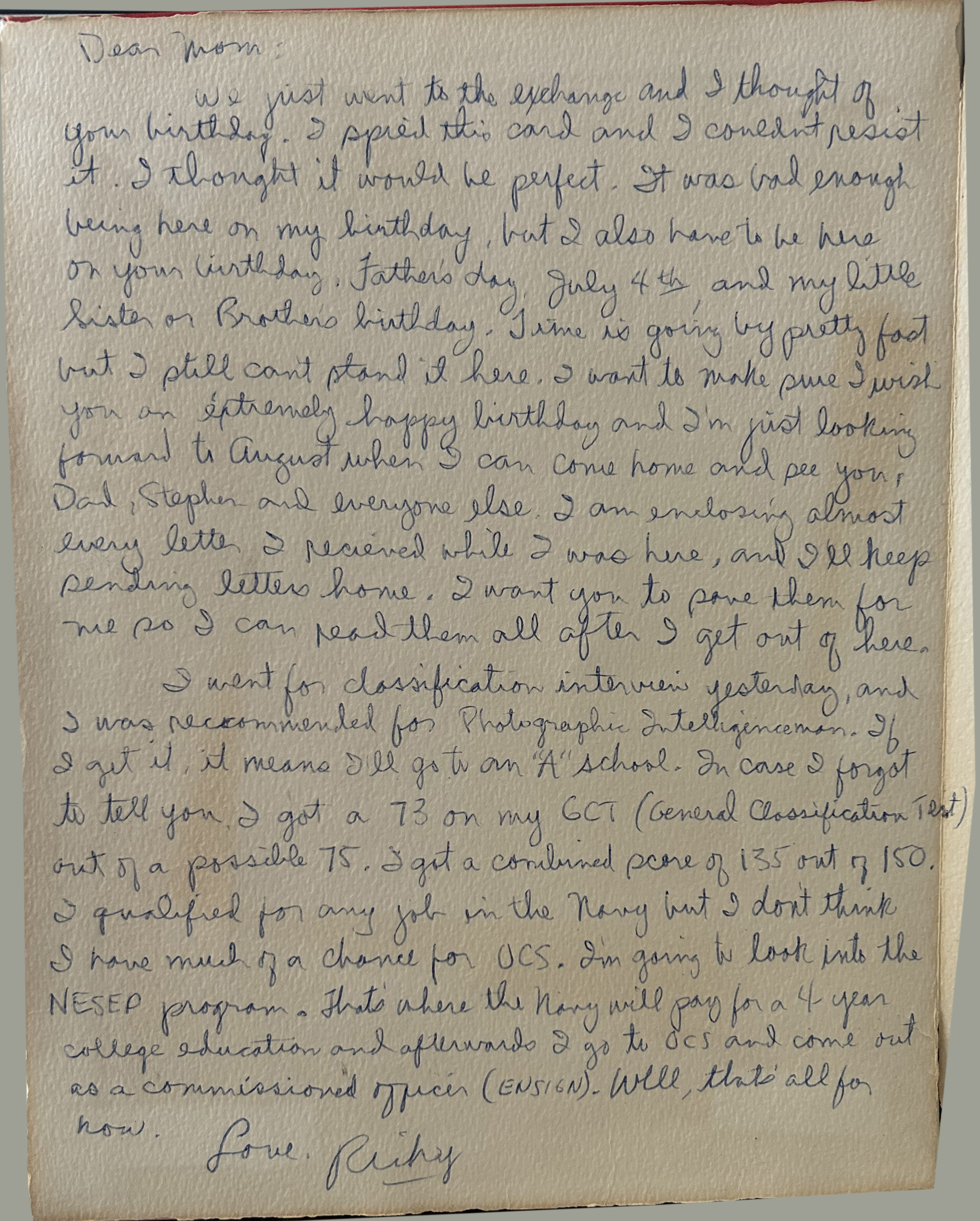
After she died, my brother and I (don’t remember if our sister was able to help) went to her apartment and cleaned it out. As I was going through her stuff and deciding what to do with things, I came across a birthday card I had sent her from US Navy boot camp, in June of 1966. That she had kept it all those years moved me to tears. After all, my feelings over her loss were still pretty raw.

I’m sharing these pictures of the card and what I wrote mostly as a way of preserving a bit of my history and as a testament to my mother. She was very good to me and, although I have gotten over her death (hell! I’m now contemplating mine) I am grateful for what she did for me and how much she loved and took care of me.


My Sandwich Chef

My almost 22-year-old daughter has been inventing in the kitchen, based on whatever’s available in the house, interestingly diverse meals. “Whatever’s available” is almost always a variety of foods drawn from the tastes of her parents (my wife and me) who are descendants of Eastern European Jews and Japanese.

What Do You Think?

I think this sandwich is an interesting example. It consists of a sliced chunk of Trader Joe’s organic baguette drizzled with extra virgin olive oil, a few slices of dried Italian salami, a slice of LASCCO Nova lox, smashed avocado, sliced tomato, laced with Sriracha and Japanese Kewpie mayonnaise.

Sound good to you? It’s not quite my cup o’ tea, but it looked interesting enough I wanted a picture. Note as well, she’s always considering presentation, in addition to flavor.


Keeping Up The Pace!

After I checked in the other day on Facebook, while at the KP Pacemaker Clinic for an update on my device’s performance, I noticed a lot of my friends aren’t exactly familiar with what all this means. Please allow me to explain what is happening and how my device works.

I have known for decades I had an electrical problem with my heart. My doctor told me a long time ago I had a right bundle branch block, which I could live with indefinitely or which could kill me in short order. I never let it bother me and figured I would live my life as best I could and not worry about dropping dead.

At the beginning of this year I started noticing I was having problems with heartbeat irregularities and I contacted my doctor. To make a long story short, it became apparent I was experiencing bradycardia (slow heartbeat). One of the diagnostic tools used was what is called a Holter Monitor (it’s a heart monitor, which I wore pasted to my chest for seven days). One night my pulse rate dropped to 26 BPM; not dead, but awfully slow.

After a telephone consultation with a cardiologist—now MY cardiologist—to go over the results of the Holter Monitor and blood tests, we decided a pacemaker might be indicated. That was February 27. Between then and March 3 I had trouble walking from the bedroom to the kitchen, or from the family room to my car, without requiring a moment or three to recover from a feeling of utter exhaustion. I couldn’t fathom living like that for long, so I called my cardiologist to discuss what was going on. I wasn’t scheduled for a consultation on my test results until late March, but that wasn’t acceptable to me. He indicated he had a surgical opening the following Wednesday, March 8, and I agreed to the procedure.

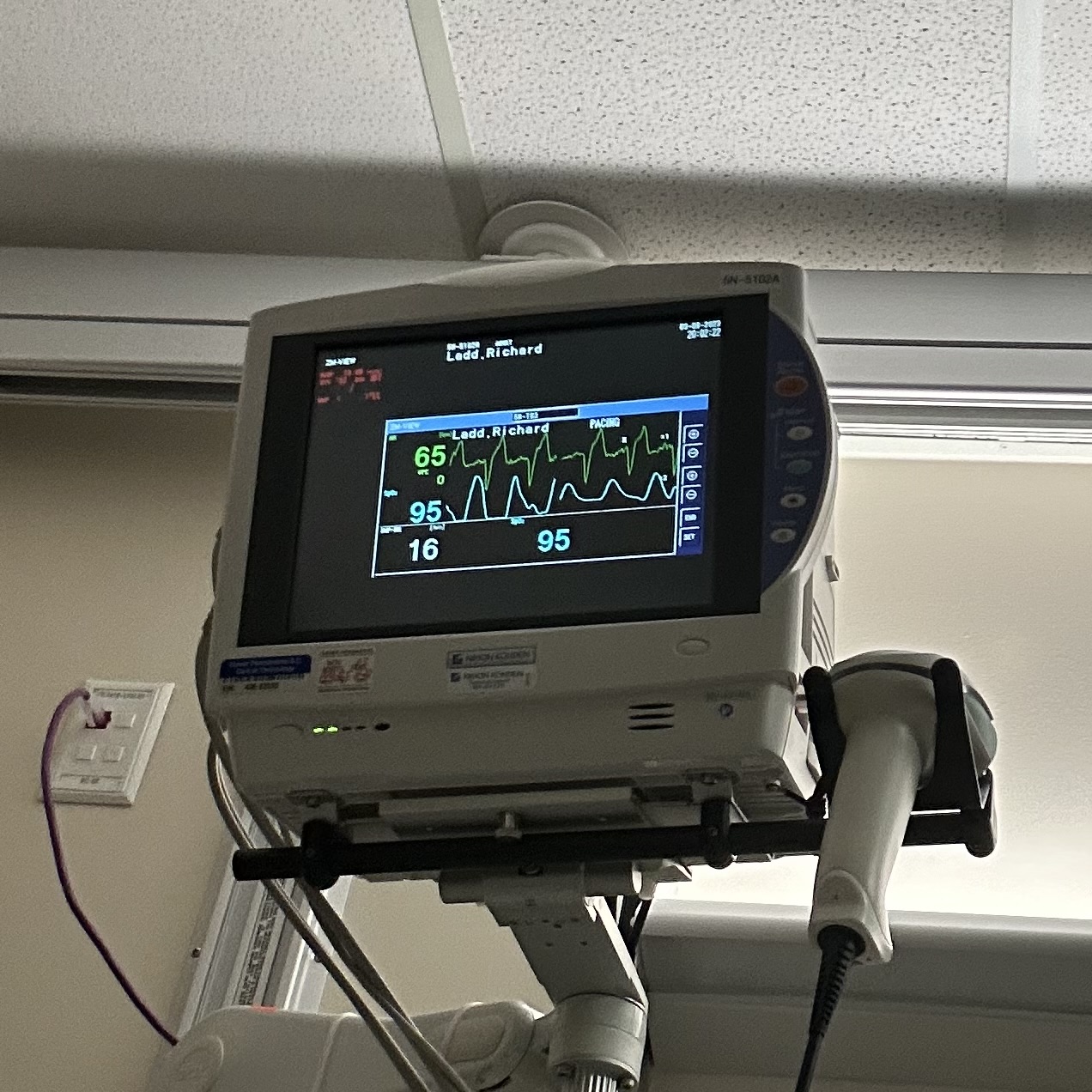
On the morning of March 8, I checked in to the Kaiser Permanente hospital in Woodland Hills, CA and the procedure was performed later that afternoon. I had a Boston Scientific Accolade MRI pacemaker implanted in my chest, just below my left collarbone. The device is about 25% bigger in diameter than a silver dollar, and three times as thick. It’s a nice size chunk of metal I’m still getting used to. It consists of a dual-core processor with 512KB of RAM, a large battery, and two leads – one to my right Atrium and one to my right Ventricle. It is programmed to send an electrical signal to “pace” my heart when it drops below 60 beats per minute. I also have a communication device that sits next to my bed that receives data from the pacemaker and transmits it through a dedicated cell connection to the pacemaker clinic at Kaiser. The pacemaker is also programmed to recognize when my heart rate rises above 130 bpm, at which point the device by my bed (it’s called a “latitude” and is also from Boston Scientific) will notify the clinic.

Two weeks after the surgery, I want for my first device checkup at the clinic. The Nurse Practitioner who manages the clinic advised me that my latitude was communicating properly and she had received data from it. She also told me that my right ventricle was being paced 100% of the time, but my right atrium was being paced far less. She reprogrammed the algorithm in my pacemaker right there (I didn’t feel a thing) and increased the timing between atrial contraction and ventricular contraction. Before I left she informed me my heart was beating on its own.

In The Waiting Room

She also told me the battery indicated it would last for 12 years, but since she had changed the algorithm that would likely change and we would know more the next time I came in. That was last Wednesday, May 24. At that visit I was informed my heart is being “paced” about 40% of the time and that the battery now appears it will last for 15 years.

As of now I will only need to go in to the clinic once a year. I’m feeling good, at least as good as one can expect after almost 76 years of heavy use. So if I use up the remaining battery life—assuming it lasts as long as it predicts—I should make it to 91. Of course, that’s assuming nothing else gets me first, and there are quite a few other things that I have to be careful about. Regardless, I’m thankful I’m reasonably energetic and my brain seems to function as well as it ever has, despite the wear and tear of my party animal past. Life is good, and every moment is precious to me – more now than ever.


Angel Does Pelé

Here’s a video of Angel playing soccer (or a reasonable facsimile thereof) with herself. Between this and her scattering toys all over the house—even outside in the backyard—we’re getting worried about her. We think she may have ADOG. Hopefully, the Vet has meds available to help her out.

Scoooooooooooore!

Rick 2.0

In retrospect, I should have seen it coming. However, like the proverbial frog in the pot I didn’t realize the water was boiling until it required a drastic intervention. In the past nearly seven weeks, I’ve had the time to reflect on what was happening to me and realize the peak of the problem came up somewhat suddenly, but the signs and symptoms were there for quite some time. The farthest I can consciously go back as of now is to July of 2022.

I believe some of my symptoms were masked by the fact I’d been lifting weights for several years and I was working at a job that was physically demanding, which kept my heart rate up and lulled me into thinking what was happening was normal for someone my age. Every morning when I got ready for work I would pull on my zip-up boots. They were snug and it was a bit of a struggle to slip into them. I usually had to pause for a couple seconds to catch my breath before finishing my preparations for work. I also had to walk between two warehouses at times and was always a bit winded and tired when I got to my destination, which was only about 1,000 yards. Same with climbing one flight of stairs. Some of my problem I also attributed to the fact I was born with club feet, which required major surgery to correct and made walking more difficult than it ought to be.

I lived with these issues for about six months before I experienced what felt like a sudden, drastic change. I was sitting in the lounge of our local Planet Fitness, waiting for my youngest daughter to finish working out. I hadn’t worked out myself and was just biding my time while she was getting in her exercise. When she finished, she came in to let me know and I stood up to leave. I was hit with an overwhelming wave of exhaustion and my knees nearly gave out on me. I didn’t realize it at the time, but I was likely experiencing syncope (fainting). I was able to make it to the car, but it wasn’t a walk in the park.

We made it home (I have lots of experience driving under, shall we say, impaired conditions, during my well-spent youth) and, checking my heart rate with my Fitbit Charge 5, I noticed it was wildly erratic. The next day I contacted my doctor at Kaiser here in Simi and, although he was not available, I was able to get an appointment with another physician. As a result of that exam, I began a series of tests, including wearing a Holter monitor for seven days. I was also scheduled for a cardio stress test a couple of weeks later.

When I finally (it took longer than I thought it should, but that’s another story) got the results from the monitor I’d worn, they were published for me to read on the Kaiser website and their mobile app, which I have on my phone. Reading the results was sobering and alarming. My heart rate had, at one point, dropped down to 27 beats per minute and I had experienced numerous instances of tachycardia. I also had experienced numerous incidents of AV (atrial ventricular) Block. There was enough jargon in the results that I was able to look up and get enough of an understanding to be quite concerned about my heart. This was exacerbated by the overwhelming exhaustion I was beginning to experience when walking from the bedroom to the kitchen or from the house to my vehicle.

The results were published on February 8, but I wasn’t scheduled to consult with a cardiologist until the end of the third week of March. As I read more about my results and experienced longer and more difficult periods of exhaustion, I became increasingly concerned that I might not make it to the consult. I started agitating for things to speed up. After an phone conversation with a cardiologist, I decided to purchase a KardiaMobile personal EKG device. It turned out to be difficult to get good readings because I have essential tremors in my hands and the shaking is accompanied by electrical activity in the muscles of my forearm, which confused the EKG device. When I could get a good reading, it wavered from normal sinus rhythm to bradycardia to possible atrial fibrillation. This somewhat paralleled my experience, as there were times when I felt quite normal and did not tire easily from a short walk.

I sent some of the results to who was now my cardiologist and, after several phone conversations, we determined there was a good chance I needed a pacemaker. My condition continued to deteriorate and we finally decided an implant procedure was indicated. On Friday, March 3 my cardiologist informed me he had a time slot open the following Wednesday, March 8 in which to perform the procedure. I agreed immediately.

On the 8th my wife drove me to the Kaiser hospital in Woodland Hills, CA and I was admitted for surgery that afternoon. All went well, I stayed overnight for observation, and was discharged in the afternoon of the 9th. My wife and youngest daughter picked me up and we stopped for some Chinese food on the way home. I felt great and continue to heal and recover. I was told not to raise my left arm above shoulder height for six weeks and did not do so. My next goal comes on June 8, when I will be able to swing a golf club again. A week and a half after the surgery I attended an air show at Pt. Mugu NAS and walked over two miles without experiencing any shortness of breath. A week later, I want to Arizona to attend to spring training games and walked over two miles on each of the two days I was there, again with no discomfort or deleterious effects.

It’s difficult to say how long I’ll live with this device and, of course, my aging heart. I’ve already outlived my father—who I was told I was “exactly like”—by 16 years. I have numerous comorbidities as well. The battery in my pacemaker, according to the Nurse Practitioner who runs the pacemaker clinic at Kaiser, has over 12 years of life remaining and it can be replaced if necessary. A review of the available information on the remaining lifespan for men like me range from 5 to 15 years or more, depending on numerous factors, including lifestyle. I have to balance my desire to enjoy the life I have left in a fashion that suits me, or live longer by changing my habits and desires. I’m working on that now. My outlook and philosophy are undergoing a transition and I’m not quite sure where I’ll end up, but I’m still here for now and I intend on living each day to the fullest.


Testing The Waters

I have been working (read “struggling”) on my memoirs/autobiography for longer than I care to think about. I’ve managed to write close to 90,000 words and am sure I need to write another 90,000 (at least) in order to feel I’ve accomplished what I set out to do. Some of what I’m including comes from blog posts I’ve authored over the past decade and a half. Now I’ve decided to take a slightly different tack and publish some of my work here in my blog, in the hope I can get some feedback—at least from my friends who sometimes read what I write here. What follows is the first draft of my Preface to what I’m tentatively entitling “A Stunning Display of Intelligence”, the meaning of which is contained therein. If you read this, and have a mind to, I would greatly appreciate your thoughts, suggestions, etc. Thank you.


I’ve not been one to toot my own horn, preferring to let my actions speak for themselves. This is, in part, because I suffer from impostor syndrome, or something similar to it. My particular iteration of this syndrome isn’t a cause of great anxiety. It’s more like I’ve always felt everyone knew everything I did and what I knew or was capable of wasn’t all that special. It’s only in the last decade I’ve come to understand how this affected me and began to throw off whatever constraints it placed on my progress and enjoyment of life.

It was the blog of an online friend, someone I have never met in person but, because of our mutual interest in the advent of what was called Web 2.0, as well as social media and its application to the enterprise, that brought me my first glimmer of a deeper understanding. He named his blog “The Obvious” and, when I asked him why that was so he told me it was because his impostor syndrome led him to believe the things he wrote about were “obvious” to others; hence the name.

This work of mine is my way of not necessarily showing off, or displaying my accomplishments, but of sharing my experiences, many of which for numerous reasons I have been reluctant to talk about at all with nearly anyone save for those who were with me when they happened and who helped me plan or plot to accomplish. Some of the things I’ve done, especially when I was young and impetuous, not to mention bullet-proof and invincible, were illegal. My virtue is never having been caught, not necessarily being a good citizen. Although, in my defense I will argue much of those activities might have been illegal, but they were hardly wrong. Enjoying the pleasures of Cannabis is one of them. I will discuss this in greater detail a bit later.

My life, while reasonably normal, has not been all that conventional. By that I mean I’ve done most of the things normal people do, I just haven’t done them in the same order others normally have. I have long suggested I’ve lived a great deal of my life in reverse and I believe I am accurately depicting how I’ve done it. For instance, although I did not attend undergraduate school, I was admitted to law school eight years after I graduated high school, graduating with a Juris Doctorate three years later. Many years after that experience (33 to be exact) I earned a Master’s Degree in Knowledge Management. It was shorty after my 62nd birthday. I have considered getting a Bachelor’s Degree just to complete the backward educational hat trick, but at this stage of my life it’s unlikely. I did some undergrad work at the University of Phoenix and Cal Lutheran when I was working on the Space Shuttle Maine Engine (SSME) program at Rocketdyne. I think I finished a semester at the University of Phoenix and a year or more of work in an adult evening degree program at Cal Lu, but it was difficult to reconcile taking classes designed primarily for 18 – 22 year olds still wet behind the ears. The knowledge I could have taught some of those classes was a bit aggravating too. I will discuss these efforts a little later.

I didn’t become a father until I was 55 years old, when my wife and I, after trying to get pregnant, traveled to the People’s Republic of China to adopt our oldest child. It was a two-year, difficult, and amazing adventure. A few years later, in what I’ve often thought of sarcastically as a stunning display of intelligence, we adopted another child from China. Hence the title of this memoir. Later on I will introduce you to my girls, Fooshie and Typhoon Girl.

A word of caution. As I am writing down my recollections I am also researching dates and locations to ensure my memories are as accurate as one can expect from a seventy-five year old man. I have never been one to exaggerate my experiences, but I know that time can play tricks on one’s memory. I am making every attempt to be accurate, but I realize a few of these memories may be slightly distorted. For instance, I know I was five years old when I had surgery to correct my clubbed left foot, but I’m pretty certain (based on my research of when he played for the Los Angeles Angels) I was five years old when I picked up a foul ball during batting practice and, at his request, returned it to Chuck Connors. I’m not sure I can reconcile being mobile enough to get that ball with having some fairly major surgery done to my foot and ankle. Nevertheless, I have managed to slog through what remains of my mind and am presenting what I remember as best I can.

It is also nigh on to impossible to refer to many of the organizations I worked for or the places I visited and which meant something to me and my development or experience back then, because some of these memories are from a long time ago. As an example, one of the companies I worked for and which played a bit of a role in making my visit to Cuba somewhat strange was purchased long ago and, in fact, was re-branded sometime after that purchase-and that was a long time ago.

A substantial portion of this memoir was written over the past 10 – 15 years and posted on one of the two blogs I’ve maintained since early 2006, when I published my first post at The Cranky Curmudgeon (http://crankycur.blogspot.com/). I posted there for a few years until 2014. I did not publish very often the last few years because I had started another blog with WordPress, which I call Systems Savvy (https://rickladd.com/). My first publication there was at the beginning of 2008. I have since published there sporadically and continue to do so; currently a bit over 700 times, not including saved drafts. Some of those posts were simple, short, and sweet while others were somewhat lengthy and more complex and nuanced. Several of them recount experiences of mine, while other reflect on lessons I believe I’ve learned from work or life.

Long ago I came to the conclusion the only thing that mattered for me, in terms of what I accomplish in my life, was that I gained wisdom. When I first began to feel that way I was only in my thirties and I knew that you can’t just hang out a shingle and declare oneself a wise person. I also knew that wisdom comes with time and experience; some would say after a great deal of false starts and failures too. Whether or not I’ve reached that particular plateau will be for others to decide and I am hopeful you will find a nugget or two buried in my remembrances, especially those that are from the more seminal experiences of my now fairly long life.
I’ve struggled to find my voice for, well, pretty much forever and I’m not sure I’ve managed to do a good job with this memoir.

However, I don’t think it’s hyperbole to believe I can at times sense the hot breath of the grim reaper on my neck and I feel a strong need to get this done before it’s too late. As well, I want to leave some coherent (ha!) record of who—and why—I am for my daughters. They lost two fathers before they were old enough to understand what was happening to them and I want them to have something to hang on to after I’m gone. I am, for the most part, the only father they can remember.

For years I considered writing memoirs about certain parts of my life and experience; mostly my political and counter-culture activities and my becoming a first-time adoptive father so late in life. However, various circumstances militated against my doing so, not the least of which was my inability to just sit down and write, as well as organize my thoughts and memories. In this work I have decided to go through my life and get as much of it down as possible. As I began outlining and organizing my thoughts I found it increasingly easier to link various parts, the sum of which can be confusing when taken all at once.

I have therefore attempted to organize my thoughts in such a way the reader can get a sense of what I have learned from a particular part of my life without having to understand the entirety of it, the gestalt if you will. I think you will find it easy to skip over portions that aren’t terribly interesting to you and still get something of value. At least I hope that is the case. I know my life has been unconventional. Not all of it, but substantial chunks of time and experience. I’ve tried to convey what I’ve learned from those periods, as well as the more normal everyday experiences we all seem to go through. I hope you’ll find it of interest, if not enlightening.


In Memory of Laverne & Shirley

How many of my friends know what a schlemiel or a schlimazel is? These two words came up quite frequently in my youth. The simple explanation I received to help me understand the difference between the two is as follows (btw, mazel mean “luck” in Yiddish):

A schlemiel is a person who, while walking through a large, mostly empty dining room with a bowl of hot soup, nevertheless manages to spill the soup. A schlemazel is the person on whom the soup lands, perhaps the only one in the entire room.


Back to School (Not Really)

I’m in the library at Moorpark College after accompanying Alyssa while she drove to her Jazz Dance class, where I then took the car to a public parking lot and walked to the library. I’m now sitting and waiting for her class to be over at 10:50. We’ve been planning this for a while, but I wasn’t sure I’d be able to make it given my health concerns.

However, I did get a heart monitor yesterday and it’s important I conduct myself as normally as possible so we get plenty of data in order to more accurately assess what’s going on. The short walk here with about a 10-pound backpack (I brought my laptop so I could get some stuff done with a full-size keyboard) got my heart rate up to about 106, which seems kind of high. After finding a desk to set up at, it’s now down to 66 which, given that I’ve not been terribly active lately, seems a bit low. Part of me is wondering if my Fitbit tracker is on the fritz, as it’s given me some fairly strange readings lately.

At any rate, I’m going to keep on keepin’ on for the next six days, then remove the monitor and send it to the vendor who supplies it, then wait a few days to hear from my doctor. I’m also waiting to hear from Kaiser regarding an echo cardiogram, which has also been ordered. Overall, I’m feeling reasonably good. Time will tell.