Category Archives: Business

At The End Of The Day

I prompted Poe’s chatbot, “Assistant”, with the following. Its response seems almost like it enjoyed doing this.

“Write a corporate pep talk of at least 300 words that sounds reasonable, but is nothing more than corporate gibberish.”


Team:

As we embark on the next fiscal quarter, it’s imperative that we synergize our verticals and double down on our core competencies to truly unlock cross-functional scalability. The paradigm shifts in our industry demand an agile mindset, and we are uniquely positioned to leverage our robust infrastructure to capitalize on emerging opportunities. Now is the time for us to think outside the box, lean into our KPIs, and disrupt the status quo with unprecedented velocity.

 Our mission is clear: we must amplify our operational bandwidth while maintaining a laser-sharp focus on customer-centric deliverables. This is not just about meeting expectations—it’s about exceeding them at every touchpoint. By fostering an ecosystem of innovation and embedding a culture of excellence into our DNA, we can achieve a seamless alignment between our strategic objectives and ground-level execution.

 Remember, success in today’s dynamic landscape is not a linear journey. It’s about embracing iterative growth, harnessing actionable insights, and pivoting proactively when faced with volatility. Let’s not forget the power of collaboration—our ability to break down silos, ideate collectively, and drive end-to-end solutions will define our trajectory as market leaders.

 I urge each of you to take ownership of your deliverables and approach challenges with a growth mindset. Let’s circle back to our organizational north star and ensure that every touchpoint in our value chain is optimized for maximum impact. The low-hanging fruit is ours to harvest, but we must also keep an eye on the blue-sky opportunities that will future-proof our success.

 In closing, I want to reiterate that our greatest asset is you—the people who make this organization thrive. Together, let’s move the needle, operationalize our vision, and deliver unparalleled value to our stakeholders. The sky is not the limit—it’s just the beginning. Let’s make it happen!


Deming and Rocketdyne

Sometime in late January of 1987, almost one year to the day after the Space Shuttle Orbiter Challenger was destroyed as it ascended to orbit, I was assigned by the temp agency I was using at the time to begin work on the Space Shuttle Main Engine team at Rockwell International’s Rocketdyne Division in Woodland Hills, CA.

Prior to that fateful date I had, with one exception, never worked at a company with more than a dozen employees. My family’s wholesale food business, at its peak, was only my father, brother, me, and one employee and most of the numerous jobs I had held over the previous 20 years or so were similarly small.

Rocketdyne employed several thousand people, most of whom labored at our campuses in Woodland Hills and Canoga Park, CA. It was a division of Rockwell International, which employed over 100,000 people world-wide. It was a jarring transition to go from small (really small) businesses to a multi-national aerospace conglomerate. However, having been somewhat of a space-cadet, i.e. enthusiast most of my life, I was thrilled with the opportunity.

A year later on 1 February 1988, I was hired to work in Engineering Computing on the Flight Ops team – a position I would not have dared to dream of filling. Nevertheless, there I was helping our nation’s space program get back on track. It was truly a dream come true.

At the same time, I was becoming aware of the unique way in which large organizations conduct themselves. Some of it wasn’t pretty. I first encountered the business philosophy of W. Edwards Deming soon after I was officially hired as I was lucky enough to have a colleague who was a student of his. Deming had written a book (he wrote many) in which he laid out a fourteen-point explication of his concept of TQM (Total Quality Management).

I was enamored of his positions, as they coincided with my growing understanding how things worked in virtually any organization. I had long been someone who looked for and found ways in which to improve the processes and procedures of any organization I was involved with, and Deming’s philosophy made a great deal of sense to me.

At the same time, I was becoming increasingly aware of the reality that many companies, including Rocketdyne, were honoring those principles in their breach, not their adherence to them. As I was studying Deming’s 14 points I began to realize just how thoroughly many of the managers I encountered were oblivious to the virtues Deming laid out.

Somewhere around 1990 I decided to see if I could capture the differences between what Deming offered and how Rocketdyne was actually doing things. I captured Deming’s 14 points and then created Rocketdyne’s 14 counterpoints. I’ve kept them over the years and am here sharing my understanding with two screenshots of those differing points of view. Please keep in mind not all managers were as controlling as the worst of them. I was lucky to work under the supervision of several truly wonderful managers in my nearly quarter century of employment there. Regardless, I think my analysis was reasonable, even after over 34 years. You?


More Than 2 Dozen Jobs!

In my 76 years on this planet, I’ve worked no less than 2 doz jobs, ranging from short order cook, busboy, waiter, restaurant manager, truck driver, forklift driver, butcher, jewelry bench worker, and wiener clerk, to legal secretary, project manager, knowledge manager, and business manager.

I retired from Pratt & Whitney Rocketdyne, where I worked on the Space Shuttle Main Engine program for nearly a quarter century and I am neither an engineer nor a scientist. Now … in a desire to get out of the house and make a little money, I am beginning a job working as a clerk in a liquor/convenience store. It’s low pay, low stress, and part time (26 hours/week).

My experience runs the gamut from highly physical work to entirely knowledge/mental work. If I’ve learned nothing else, it’s that there’s no such thing as a menial job. There is dignity and sanity in working at virtually any job. I know this one won’t tax my intellect, but I’m looking forward to it.


A Different Kind of Foodie

Like many a young American, my very first job, that is the first one I got paid for, was at a McDonald’s in Arleta, CA. I was sixteen years old and had just earned my driver’s license. This was in the Summer of 1963 and my father had bought me a used ’57 Chevy – my dream car. On my first day I did nothing but make milkshakes. On the second day I bagged french fries. Then the manager discovered I knew how to work the cash register and to make change, a skill I learned in Junior High when I worked in the student store. From then on I worked the window, taking and fulfilling orders. I had nightmares involving endless lines of people who ate every meal there (at least lunch and dinner; McDonald’s didn’t serve breakfast in 1963) every day. These dreams were based, in part, on the fact there were several customers who did eat there every day. It was a frightening thought.

My second job was as a bus boy at Pancake Heaven, which no longer exists but was just around the corner from the McDonald’s I cut my working teeth on. I eventually became a fry cook there for a while and learned how to make breakfasts, for the most part. At least, that’s all I can barely remember. Actually, one specific skill I recall learning was how to hide mistakes with garnish; a slice of orange or a sprig of parsley. I also worked at Mike’s Pizza on Van Nuys Blvd. for a while. The only thing I remember about that job was sneaking out a bottle of Chianti in a trash can filled with the sawdust I was responsible for changing out every few days so the floors were reasonably clean.

The Summer before I graduated High School, which was actually the Summer after I should have graduated High School, I worked as a “bus boy” at Pacific Ocean Park (POP). My job was to walk around the pier on which the park was built and scoop trash into one of those self-opening dust pans and empty it into one of the larger trash bins that were placed all over the “park”. It actually had nothing to do with food or food service, other than that most of the trash was created by people who had purchased something to eat and were too damned lazy to deposit the trash in a receptacle themselves.

I didn’t work in or around food service again until 1973, when I tended bar at the Ash Grove in Los Angeles, where I was raising money for my upcoming trip to Cuba with the 6th contingent of the Venceremos Brigade. I had studied Hapkido with Ed Pearl, the owner of the club. It was a favorite target for anti-Castro Cubans and was burned down for the third and final time shortly after I worked there. I don’t think we had a liquor license; only a beer and wine license, so tending bar wasn’t quite as intellectually challenging as it would have been had I been required to remember dozens of mixed drinks, but it was a busy venue and I enjoyed my time there.

Shortly after returning from Cuba, in my first year of law school, I secured a position as a “wiener clerk” at The Wiener Factory in Sherman Oaks, CA, where I served up the finest hot dogs, knackwurst, and polish sausage to ever cross a taste bud. Even though they closed on December 31, 2007 (>15 years ago) it’s still talked about as the top example of how a hot dog should be presented to the discriminating public. I loved it there. PS – Click on the link and you might find my posthumous review of the place, which I posted almost 13 years ago.

I didn’t work in food service again until sometime in the mid-nineties. I had left my job at Rocketdyne to rejoin my brother in a family wholesale food/restaurant supply business our father had started when I was 13. After less than two years it wasn’t going well and I decided to leave and fend for myself. One of my customers was Les Sisters Southern Kitchen in Chatsworth, CA. The owner at the time, Kevin Huling, was working his butt off and wanted to be able to take a day off during the week. I offered to run the place for him on Wednesdays and, until I returned to Rocketdyne, I managed the restaurant once a week. My favorite day was when I had to wait on tables. I made quite a bit more money than I did from just managing the place (hint: tips!).

In addition to all these jobs, my father was working at the Grand Central Market in downtown Los Angeles when I was born. He worked at Faber’s Ham Shop, which was a stand in the market that sold lunch meats and fresh chickens. He liked to refer to himself as a butcher, but my birth certificate lists his occupation as “Food Clerk”. I remember my mother taking me shopping there when I was about five years old. We took Pacific Electric’s Red Car on the Red Line that stretched from San Fernando, running right through Panorama City, where we lived, to downtown L.A. My father put me in a far-too-large, white butcher’s coat, and put a Farmer John paper campaign hat on my head, stood me on a milk crate and had me selling lunch meat for an hour or so. I learned my first three words of Spanish behind that counter, which were “¿Que va llevar?” literally “what are you going to carry?”, but was more loosely translated as “what’ll you have?” or “what can I get for you?”

Later on, specifically right after I handed over every check I received for a Bar Mitzvah gift to my father so he could buy a truck, he went out on his own. He became the broken wienie king of Los Angeles, buying (essentially) mistakes from packing houses and selling them to his old boss, as well as to other small markets scattered throughout the greater Los Angeles area. Until his death in 1984, I spent virtually every school holiday being his “swamper” on his route or—later on—delivering and selling on my own as part of the business. Somewhere around 1994 I left my job at Rocketdyne to rejoin my brother in the family business, once again selling almost exclusively to restaurants.

My point is, I have no formal training in the culinary arts, but during a rather large portion of my life until I was around 50, I spent quite a bit of time working in jobs and being in businesses that involved food; at times merely delivering it and at other times preparing and serving it. I know my way around a kitchen and I know quite well how to operate a successful food business. It’s not easy. People can be real assholes when they’re hungry, and people who cook can be real prima donnas, so learning to satisfy your customers can be a painful experience. It is, however, quite rewarding when it works out. I think you have to genuinely like people in order to do it well.


Bass Ackward EVM

Has anyone else noticed how the majority of illustrations depicting Earned Value Management methodology show projects over budget and behind schedule? Why the pessimism? I know it’s frequently how things work out, but why do we put up with what amounts to continuous failure improvement? Why don’t we – since we’re only depicting how measurements and calculations are made – show the positive side, e.g. under-spent and ahead of schedule?

It seems like it would make a difference if, rather than presenting failure in the abstract, we presented success in the abstract. Isn’t it better to be going in with a success-oriented mindset, tempered with a good dose of reality? Of course, this presupposes situations where we’re not driven by the dynamics to be overly optimistic and unrealistic at the front end of a project in order to win a bid or compete with others, especially in large programs/projects. A tall order methinks.

Earned Value Management chart example.
Behind Schedule & Over Budget!

Gratitude

I had my job interview the other day. Now that it’s completed and I wait for them to conduct a couple more interviews, I’m thankful for several things:

1. I still remember how to tie a four-in-hand knot, though I haven’t worn a tie in years;

2. Despite wearing zoris and sneakers for some time, my feet still fit comfortably in my dress shoes;

3. My brain remains agile and capable of fielding questions with ease;

4. I retain the knowledge, if not all of the skills, of every one of the dozens of jobs I had during the more than two decades in which I worked before joining Rocketdyne at 39;

5. I’ve kept my ability to use Excel all these years. I actually started with VisiCalc in the early 80s;

6. If I don’t get this job it won’t in any way diminish my self esteem.

I am, if nothing else, persistent.


Don’t Call Me a Guru, Dammit!

NB: I published this article sometime in 2010, around the time I accepted an early severance package from Pratt & Whitney Rocketdyne and retired. It was published using WordPress’s old classic editor and didn’t render well any longer, so I’ve upgraded it to their current block editor format. This should explain why the date associated with it is May 16, 2023.


This article is a few years old, but there’s so much good stuff in here I’m thinking I should post it every other week for the rest of my life. Seriously, with all the talk lately about how you need to be careful of people who hold themselves out as Social Media Experts, Russ’s words are even more impactful.

This October Russ will have been gone for a year. I’m willing to bet I speak for a lot of people when I say he is sorely missed. He is surely not forgotten. Read the whole article; then get the book f-Laws.

Update (Thanksgiving, 2013) This post was originally published from www.telegraph.co.uk using Amplify, a curation service that no longer exists. Below is the excerpt as Amplify prepared it.

Anti-guru of joined-up management

Published: 12:01AM GMT 08 Feb 2007

My Last Visit With Russ
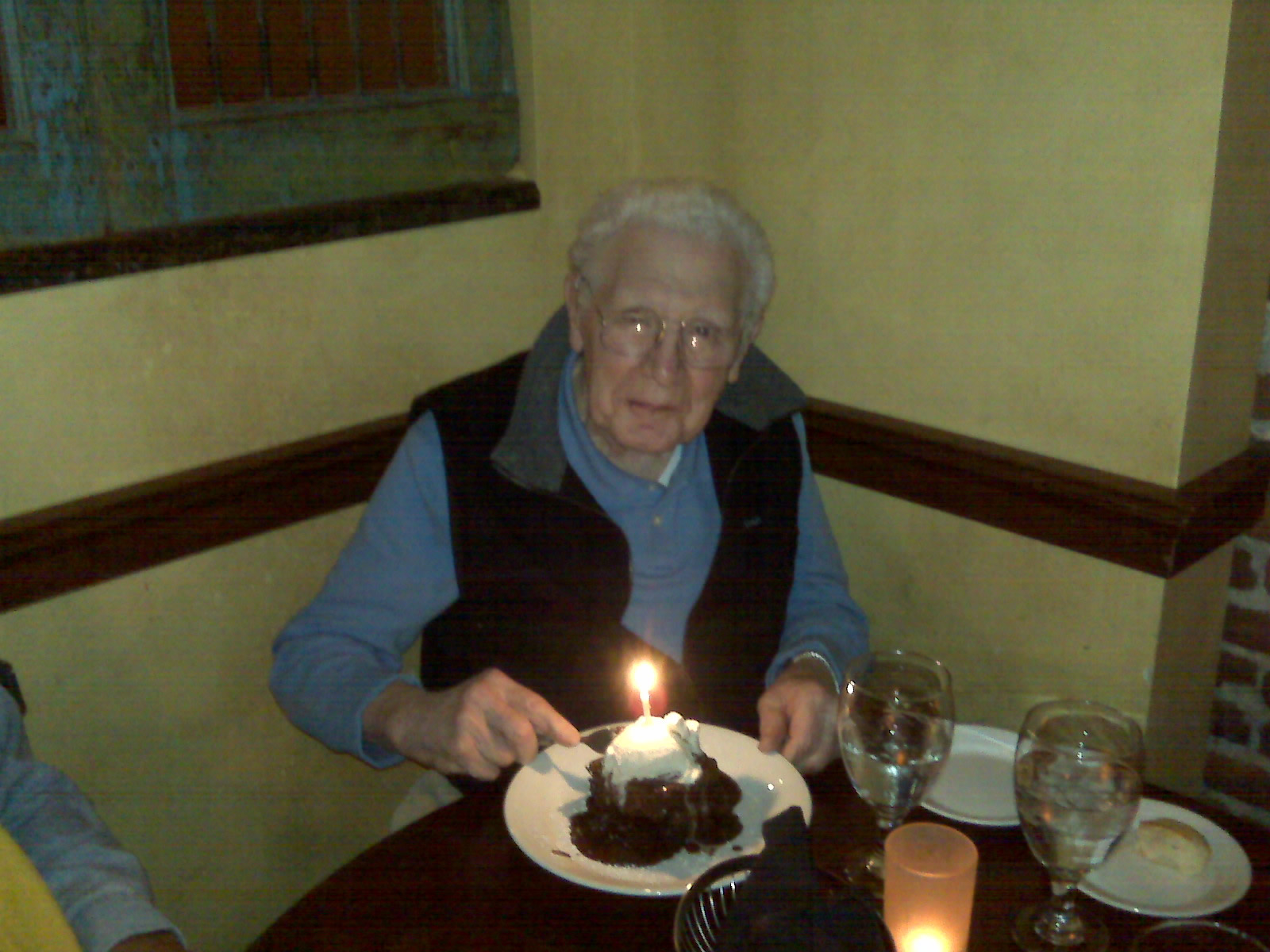
I was fortunate to spend Russell’s 90th birthday with him in Philly, I took this photo when Bill Bellows and I had dinner with Russell and his wife, Helen

If you were asked to picture what a management guru should look and sound like, you might come up with a description of someone very like Russ Ackoff. Grey-haired, distinguished, softly spoken, Ackoff fits the bill. And also, since he turns 88 on Monday, he can claim the benefit of wisdom earned over the course of six decades studying and working with businesses and organisations.

Except, of course, that “guru” is not a label that Ackoff is keen to accept.

“A guru produces disciples, and a discipline, and a doctrine,” he says. “If you are a follower of a guru, you don’t go beyond his thoughts, you accept his thoughts. He gives you the questions and the answers – it’s an end to thought. An educator is exactly the opposite,” he says. “You take off where he sets you up for the next set of questions. One is open-ended, the other is closed. Most consultants are gurus. They are ‘experts’, not educators.”

So please don’t refer to Ackoff’s body of work as gurudom and please don’t describe his work with clients as management consulting.

“We don’t call it consulting,” he states firmly. “We make a distinction between consulting and being an educator. A consultant goes in with a solution. He tries to impose it on a situation. An educator tries to train the people responsible for the work to work it out for themselves. We don’t pretend to know the way to get the answer.”

In his distaste for gurudom, Ackoff is of a mind with his old friend and colleague, the late Peter Drucker. Drucker famously once observed that the only reason people called him a guru was that they did not know how to spell the word “charlatan”.

“Peter Drucker made a great distinction between doing things right and doing the right thing,” Ackoff says. “All of our social problems arise out of doing the wrong thing righter. The more efficient you are at doing the wrong thing, the wronger you become. It is much better to do the right thing wronger than the wrong thing righter! If you do the right thing wrong and correct it, you get better.”

Read more at www.telegraph.co.uk (I don’t believe you can see the entire article without accepting a “free” monthly subscription, which you will have to cancel if you don’t want to be charged.)


Stepping Off The Deep End

I’ve got a job interview tomorrow, less than three weeks before my 76th birthday. I’m not old; I’m experienced, I’m seasoned, I’m tested. I know I’m at an age where, even if I don’t look as old as I am, I still look old and, in my experience, ageism is a very real thing. This position is in aerospace, which I’ve found to be more accepting, but the proof is in the pudding, as us old farts like to say. 😉


Memories

This month will be 13 years since I retired from Rocketdyne. At the time it was owned by United Technologies’ Pratt & Whitney division. When I first joined the organization in 1987 the mother ship was Rockwell International. Later it was sold to The Boeing Co. It is currently owned by Aerojet, but negotiations are continuing to complete its sale to L3Harris.

Throughout all these changes, which I have either experienced or watched somewhat closely from not too far, one thing has remained relatively constant. The quality of the people who work there. I believe I was privileged to work with some of the smartest, most competent people on the planet. After all, it WAS rocket science. To be more precise, Rocket Engine science.

Now, I’m neither an engineer, nor a scientist. I am not a machinist, technician, or mechanic. I had nothing to do with the actual design, manufacture, assembly, test, or flight of the rocket engines we manufactured and provided to NASA. Not directly, that is. An organization such as Rocketdyne cannot operate without ancillary functions to ensure lines of communication are robust and effective between and amongst each of the dozens of functions such an org needs and I am happy I was able to provide some of the skills and knowledge necessary to facilitate those connections.

When I left the company in May of 2010, I took home with me numerous mementos of my time there. These include printed editions of studies I played a major role in conducting, training materials for a tool I was the project manager for, internal awards I received, and other items that had some meaning for me. Today I once again came across this simple ticket. I’ve kept it all these years because it reminds me of one of my favorite people ever. Myrna Beth Thompson or, as we knew her, Beth.

She was one of the first people I met and became friends with when I joined the Program Office of the Space Shuttle Main Engine team. In an organization composed of very conservative people, she was another progressive I could relate to and she wasn’t shy about her beliefs. She was also kind, caring, empathetic, and always available to help anyone who needed it. Tragically, she died of a massive heart attack nine years ago this month.

The ticket is a prop from a class Beth championed and taught as part of our efforts to instill the concept of Systems Thinking into the heart of the organization for which we labored. It was based on Barry Oshry’s book, Seeing Systems: Unlocking the Mysteries of Organizational Life. If I recall correctly, one of the concepts taught was that of the Abilene Paradox or, as many people refer to it, The Road to Abilene. You can read about it here. It’s understanding, however, is ancillary to my reason for posting this.

Beth has been gone nearly a decade. I don’t think of her often, much as I don’t think of my father, mother, and others who have passed on. But I’ve kept this simple little ticket all these years because it reminds me of her and our friendship. I can’t bring myself to part with it. I’m pretty sure it will be one of those things my children will unceremoniously dump when I am gone. It has absolutely no intrinsic value any longer. Its value is entirely dependent on my memories and my life. I consider that extremely valuable.

PS – In case you’re wondering, SSME stands for Space Shuttle Main Engine (the program we both worked on for many years) and O.E. stands for Organizational Excellence, one of the numerous efforts we indulged in over the years to improve how we did business. They were often spectacularly unsuccessful, but that’s another story.


Bye Bye Twitter?

I first joined Twitter in March of 2006. At the time part of my job at Rocketdyne Propulsion and Power, a division of The Boeing Company, was to examine platforms described as examples of what was then referred to as Web 2.0, as well as new applications being referred to as “social media.” I was doing this as a member of the Knowledge Management team for the division, and as the Knowledge Management lead for the Space Shuttle Main Engine team.

In 2002, I had been leading the team that introduced one of the earliest “social media” applications to the SSME team and the organization as a whole. We didn’t think of it as social media at the time, however. Our main goal was to provide a tool (we called it an “enabler”) that made it easier to locate subject matter experts (SMEs) and facilitate not only communication between those seeking knowledge and those possessing it, but to capture that knowledge and make it easily accessible for others who might need it at a later date.

The name of the tool we purchased 1000 seats for was AskMe Enterprise. It was, if memory serves, based on a former website of the same name, but was now a proprietary tool meant to stay within the firewall of an organization. Rocketdyne needed something that would be useful internally and had no reason to use something that was open outside the organization’s firewall. In fact, given the nature of its products being open to the outside was anathema and a matter of national security.

At the same time, we were looking for a communications tool that provided one-to-many capabilities and short-form text sharing and publishing. There were several tools that were coming online around that time, including Jive and Yammer, but Twitter seemed to be the most interesting. Nevertheless, it took me something like six months before I could identify a use case for it. At the time it seemed merely a tool for non-productive jabber and gossip.

What changed it for me was when I found out the team preparing the Space Shuttle Orbiter for the next launch was using it to communicate their activities and progress. There were something like two dozen people who were working on various tasks that were independent in numerous different ways. If you’ve ever done project management, especially if you’ve used a tool like Microsoft Project, you know there are several types of dependencies between activities, e.g. finish-to-start (the most common). The Orbiter team, much like many of the teams that organizations (not just Rocketdyne) have to accomplish their work, would meet every morning to present progress and discuss how to proceed with remaining activities.

Twitter changed the dynamic significantly. Now, instead of waiting until the team gathered each morning, team members who were out in the field accomplishing tasks could communicate in real-time with their colleagues (all of them) when they had finished a task which was a predecessor to another team member’s task. All they had to do was Tweet. They didn’t have to compose an email, direct an IM to two dozen people, or make a phone call. They just had to follow each of their teammates.

This may seem a trivial thing, but if a predecessor task was completed at, say, two in the afternoon and that fact could be communicated to the entire team, anyone who needed that information to know where they stood in the flow of activities didn’t have to wait until the following morning stand-up to find out what their status was. Work on complicated engineering projects can be expensive and even apparently small savings of time could add up to saving tens, if not hundreds, of thousands of dollars.

So, that was my introduction to Twitter. I never could get my colleagues at Rocketdyne to use it. I had a hard enough time getting them to use AskMe and soon after I accepted an early severance package in May of 2010 (as the Shuttle program was coming to an end) it became obvious without my constant agitating for its use it wasn’t going to survive. It didn’t.

However, I kept a kind of love/hate relationship with Twitter over the years. There were times I didn’t pay much attention to it, and periods where I was quite active. Unfortunately, a couple of years ago, after nearly a decade and a half, I was permanently suspended after I suggested a certain former guy might benefit from a coronary episode (I was only looking out for his best interests!). I created another account, which I am still using. Actually, I created two more accounts, one of which was also suspended, but reinstated upon appeal, though I no longer use it. Now, instead of @rickladd I’m @retreado.

I really wish I still had my real name, but it looks as though Twitter may not survive the petty indulgences of the world’s richest 10-year-old. Toward the end, I found Twitter to be an invaluable source of news, not so much as a primary but as a pointer to in-depth analyses, opinion, and good, solid journalism. It was a great way to keep track of trends and what movers and shakers were thinking, as well as hints as to which direction developing issues might go in. If Twitter does go away, I will miss it, but it won’t be the end of the world. I’ve already created an account at Mastodon and am considering other apps. Time will tell. Frankly, I wouldn’t mind taking a break from the immediacy and constant movement of Twitter. I’m getting old and I appreciate moments of silence more than ever.