Category Archives: Business

Oh Snap! Tough Love For Uber

I don’t know about you, but I’ve been following the ongoing saga of Uber as they shove a full-sized sedan up their collective ass. Between the misogyny and now the threat by a VP to use their data to harass journalists they think are being unfair to them, not to mention the calls by lots of people for a few heads to roll, it’s been quite a couple of weeks of revealing info. I don’t usually write about current events, but this one is just so bloated with lessons to be learned and practices to avoid if you want to run a successful business . . . and keep it that way, I thought I would share this latest spike strip thrown on the road, access to which Uber seems so desperate to control. Enjoy!

Franken Letter to Uber - Page 1

Click to Enlarge


Franken Letter to Uber - Page 2

Click to Enlarge


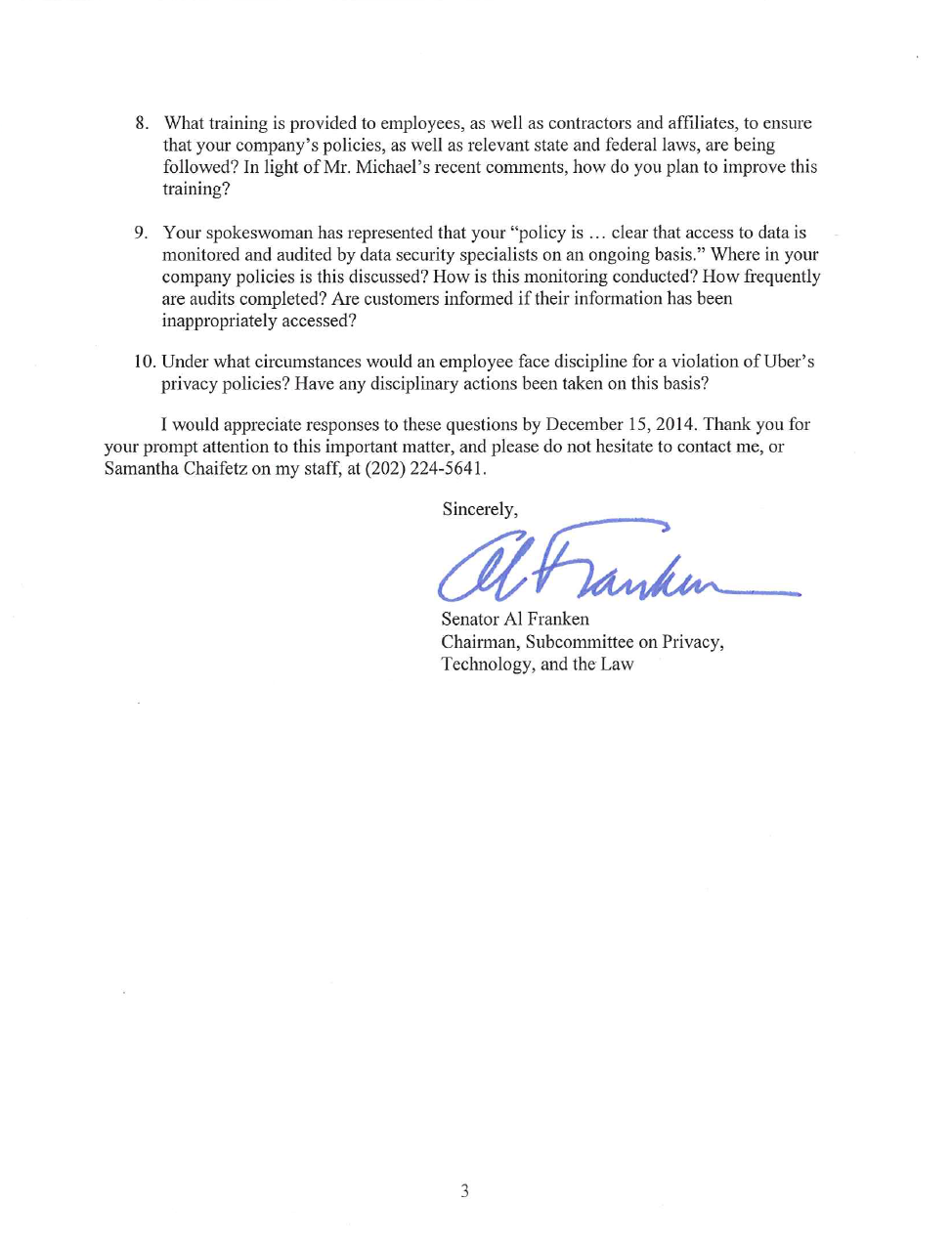
Franken Letter to Uber - Page 3

Click to Enlarge


Six Ways To Avoid Using Lists

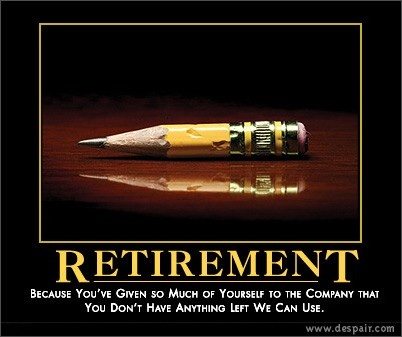
Does Retirement Mean "Used Up"?

Does Retirement Mean “Used Up”?

OK — I’m lying about the six ways and the lists. I couldn’t help myself. I had just been perusing the Pulse articles available on LinkedIn and was amused by how many of them contain lists, e.g. “7 Ways Leaders Fail”, “The 8 Simple Rules Of Expert Negotiation”, “3 Traits Shared By Companies And Hoarders”, “The four types of clients you should fire immediately”, “12 Email Marketing Credibility Boosters”, etc., etc., etc. I could go on for some time, but I won’t bore you as much as I was. I know I’ve read somewhere that lists are a great way to create posts and get people to read them. Nevertheless, I tend to shy away from using that strategy because it seems so formulaic to me, and I’m not interested in taking that route.

I know I should have written this earlier today but, as I’ve noted numerous times before, I’m not a journalist and I don’t do this as a business, so I have never been all that interested in an editorial calendar or lining up my posts perfectly with anything in particular. Nevertheless, today is a bit of a milestone and I thought I should mark it with a bit of possibly rational blather.

It’s been exactly — datewise — four and one-half years since I retired from Rocketdyne, where I labored for approximately 23 years. My last day (though, to tell the truth, I had been working at home and nobody expected much from me for the final two weeks I was officially “there”) was May 14, 2010. I can still vividly recall my final moments; being walked to the guard at the front reception area, handing in my badge, saying goodbye and shaking hands with my Manager, and walking out the door knowing I could not walk back in beyond the reception area without an escort.

I felt both elation and sadness. I threw my arms up in the air, but had tears in my eyes. Both emotions were warranted, as the last four and a half years have made quite clear. It’s not an easy thing walking away from a large group of people who you’ve come to think of as almost family and, make no mistake about it, once the main thing you have in common with them is gone, most people essentially disappear from your life forever.

Blogging on the beach

Blogging on the beach, something I’ve never actually done

For me, this has been the hardest part of retirement. While I’ve stayed in touch with a few of my former colleagues, some of whom remained and others who became casualties of our nation’s decision to essentially forget about space exploration (at least manned space exploration) for what still seems like forever, the majority of people I saw on a regular basis I have not heard from again. There’s also a sort of mid-range group who I’ve connected with via Facebook and LinkedIn, but I’ve had little contact with most of them.

I think this is a big problem with our entire concept of retirement. In our culture it seems once you retire, you might as well be dead. The place you worked at has no use for you and, since we are also a culture that celebrates youth and fears old age and death, nobody really wants to know what you’re doing. A possible exception is made for those people who worked at one company all, or almost all, of their life and, consequently, retire with enough money to not have to do anything to supplement their income. Remaining employees do seem to enjoy receiving the occasional postcard from an exotic location, or another reminder of what they, someday, may be able to do as well.

I’m sure there are those who thoroughly enjoy hanging out and doing whatever they want, or nothing at all. I’m not one of them. Bottom line, I guess, is this. I have managed to survive relatively well, though I have yet to find a way to supplement my income such that we’ll be reasonably comfortable for the foreseeable future. I do worry about what might happen in a few years when our income suffers from inflation or some disease or unfortunate turn of events depletes what little savings and investments remain.

I also worry about my physical and mental ability to generate income. At 67 years old, it’s difficult to not notice I’m gaining speed on that inevitable slide down life’s rollercoaster. Nevertheless, I’m not one for fretting too much about choices I’ve made. I’ve been characterized by others as a survivor; one who will find a way to make things happen. Especially when push comes to shove and I’m backed into a corner. I don’t actually want to reach that point, so I’m working on quite a few prospects and avenues.

In another six months it will have been half a decade since I left the place I had been at longer than anywhere save this planet. I’m looking forward to celebrating that occasion a little more energetically. If I’m lucky, I’ll be able to afford throwing a little party for some of those former colleagues who remain friends. That would be a hoot.


Possibly Another Stellar Career Move?

USC Marshall Logo

Yesterday was a very good day. I didn’t make a penny and I don’t care. Jimmy could have cracked an entire bushel of corn and I still wouldn’t care. I had a good morning, posting a few items to my FB page, as well as a special item to my Rotary Club’s group and page. I spent a little time studying a request to get involved in the effort to bring open source, transparent voting technology to bear in California, and I enjoyed some interesting conversations with friends here on FB. I received a copy of a soon-to-be-released, transformational book that I had the privilege to help one of the authors with . . . and it was signed with a nice personal note. I also noticed I received a mention in the acknowledgements. All good stuff.

However, the pinnacle, the apex, the absolutely awesome apogee of my day was an interview at USC’s Marshall School of Business, where I had applied for a position as an Adjunct Professor. At this point I don’t even know who referred me to them. I thought it was a friend who teaches there, for whom I have been a guest lecturer a couple of times, but the woman who interviewed me thought it was a cousin who is a Professor in the Education department. I need to sort that out.

My appointment was for 2:30 pm and, since I live over forty miles from the campus and would have to traverse downtown Los Angeles to get there, I planned on leaving an hour and a half early. It turned out to be perfect, as I ran into the expected traffic, arriving at the entrance a half hour before the scheduled time. It took a couple of minutes to secure a parking permit (they had reserved a slot for me) and the gentleman who did so also gave me a map and instructions.

I parked on the fourth floor of a large structure and, noticing there were no elevators, I walked down the stairs to the street level. I guess I haven’t been in a building that tall in quite some time — at least one without an elevator — and, between the distortion of my bifocals, my being out-of-shape, and what I can only assume is an age related tendency to experience a little vertigo, I felt like a doddering old man, carefully stepping down each flight while holding on to the hand rail. I can remember a time when I could virtually skip down such stairs, but I guess those days are long gone.

As I walked the nearly quarter mile to the building I was headed to, I looked around at all the students walking and riding bicycles and skateboards, as well as the plethora of vehicles that included a large number and variety of electric carts and vans. Coming from the suburbs, I was struck by how closely packed everything seemed to be and I found myself thinking we are preparing the students for life as sardines.

USC Mascot

Tommy Trojan and Traveler – Fight On!

I had little trouble finding the Accounting building, where I was to report and, once inside, I sat down for a moment to get my bearings and to check in with my location on Facebook. I had posted about the interview and was pleased to find so many friends wishing me luck and I wanted to let them know I was there. I once read of a man who, asked to what he attributed his success, answered that he always arrived ten minutes early. As I had long believed a lack of punctuality was disrespectful, I adopted his tactic and, in this case, I was actually 15 minutes early. I don’t know if all this will translate into success, but I’m committed to the effort.

Based on a quick reconnoiter of the office numbers, I figured the one I was headed to was on the fourth floor, so I climbed up the first flight of stairs. At the top I found a sign indicating the stairs provided access to floors one through three, and that there was also access to the roof. I was pretty sure the office I was looking for wasn’t on the roof, but I couldn’t find any sign that pointed out where access to the fourth floor was located. I stopped a couple of students and asked them. They didn’t know, but one offered that she was going upstairs and she would walk with me. When we got to the third floor, it appeared there was another flight, but when we went around the corner it led to a locked door. We clearly weren’t going to the roof.

The student who had accompanied me offered to seek out advice and we ended up finding one of the Deans, who led me down a corridor to a door that opened up to stairs. Not in any way obvious, but . . . voila! I was near the end of my search and still 10 minutes early. I climbed the stairs and found the office I was seeking, announced my presence and the recognition I was early, and took a seat outside. Within minutes, the woman who was to conduct the interview popped her head out the door, introduced herself, and asked me to come on in.

I followed her inside, through the reception area, and into her office where she offered me a seat, closed the door, and sat down at her desk opposite me. We had an interesting opening chat which thoroughly confused me as to how my name had found its way to her, and I intend on researching that a little more, but it wasn’t really all that important. It did serve to show I had more connections to the University than I had realized, which was gratifying.

To make what is now a long story a little bit shorter, she told me I had a very impressive resume and she thought I would be perfect teaching both business communications and writing. She also told me they’re already set with their Spring schedule and that I would likely be offered a position after that, which would probably be teaching either Sophomores or Juniors, students she suggested would be very interested in my eclectic experience and knowledge. She also said I might be able to teach virtually, especially since they’re heading more in that direction and I had fairly recently completed my Masters degree in Knowledge Management entirely online. I would also be assigned a mentor, this being my first experience teaching at this level.

As it stands right now, in the interim I have the opportunity to be a guest lecturer, somewhat at my leisure and with subjects of my choosing. This, of course, would be uncompensated but I consider it valuable experience and a way of showing what I can do. I will soon send her a couple of synopses of what I propose to offer. Otherwise, I wait. Based on her enthusiasm and interest, unless she’s being disingenuous (and I have no reason to believe that to be the case), I expect I will begin what may be a new, interesting, and challenging chapter in my life’s journey within the next year.

One thing I find both interesting and ironic about all this is that I grew up believing I would attend UCLA, if I went to a local University. As it turns out, I never did go to undergraduate school, but UCLA likely would have been my first choice. That I may end up teaching at USC, their bitter crosstown rival, is kind of like growing up wanting to play baseball for the Los Angeles Dodgers, only to end up being drafted by the San Francisco Giants. There are far worse things I can think of.


Making Sense of All That Data

Deep Data

Transforming Big Data Information into Deep Data Insights

Yesterday I posted a question to several of the groups I belong to on LinkedIn. It was related to several of the things I’m interested and involved in: Systems Thinking, Knowledge Management, and Decision Modeling. It was somewhat informed, as well, by an article appearing in the Huffington Post, where Otto Scharmer, a Senior Lecturer at MIT and founder of the Presencing Institute, talks about the need to make sense of the huge and growing amounts of data we have available to us. He argues the importance of turning from “Big” data, where we mainly look outward in our attempt to understand what it is telling us about markets and our external influence, to “Deep” data, where we begin looking inward to understand what it’s telling us about ourselves and our organizations and how we get things done.

The question I asked was designed to seek out capabilities and functionality that people would like to have, but that is currently unavailable. My interests include working with others to understand and provide for those needs, if possible. I thought I would present the question here as well, where it will remain a part of my online presence and, hopefully, might elicit some useful responses. Here it is:

With the growing proliferation and importance of data — a development at least one author and MIT Lecturer has suggested is moving us from the information technology era to the data technology era — what tools would you like to see become available for handling, understanding, and sharing the new types of information and knowledge this development will bring?

In other words, what would you need that you don’t have today? What types of technology do you think would offer you, your colleagues, and your organizations a greater ability to make use of data to bring about a transformation from primarily siloed, outward looking data to collaborative, inward looking data as well?

I would love to hear of any ideas you might have regarding the kinds of tools or apps you could use to better deal with data by turning it into useful information and knowledge . . . perhaps even a smidgen of understanding and wisdom.


All Hail The Beneficent, Ubiquitous Keyboard

There’s a little sort of game going on in Facebook lately. Someone is challenged to list three things they’re thankful for for seven days, at the same time tagging a friend each day (or something like that) to do the same. I haven’t been asked to do it, and I have no plans of doing it either, as it just seems too spread out and broad to do justice to the recognition of those things we might be thankful for. Nevertheless, it does give me pause and I have been thinking about what I would say should I choose one or two specific things for which I’m thankful. There is one seemingly mundane thing that keeps popping into my head. My ability to type.

I can’t imagine how different my world would be if I had to use what an old girlfriend of mine called the “search and destroy” method of typing. Most people use the more pastoral term “hunt and peck”, but she spent several tours with the USO in Vietnam and her life was colored by her exposure to that war, the military, and her involvement in the movement to end it. If I were hampered by that inability, my social presence and my ability to communicate would be virtually non-existent.

I was fortunate. In Junior High School I took a typing class; instead of what I haven’t the faintest, but I recall it seeming to be the most useful option at the time. As a result, I learned to touch type. Later on, when I was in Law School, I secured a position as a legal secretary for a sole practitioner who did a lot of contract and property damage work for several of the largest car rental agencies in the country. We were very busy and my workload was challenging enough that my speed increased. I’ve never been as prolific as the best, but I was up to a little over 80 wpm, with few if any errors. That’s not quite as fast as the average person can speak, but it’s a respectable clip.

IBM Memory Typewriter

The IBM Memory Typewriter

The job turned out to be a major turning point in my life, as I was introduced to the early stages of office computing and word processing. We ended up getting an IBM Memory Typewriter, the one built on the correcting Selectric, but with a dial providing memory for 50 separate pages. We moved up shortly to an Artec Display 2000, which used two 8″ floppies and had a scrolling display of approximately 30 characters. I don’t remember if it was LED or LCD, but the characters were red. We used it for pleadings, and wills and trusts.

Back to typing speed and how critical it is to communication in today’s world. I don’t really have to imagine what it would be like, because I had an experience with a colleague that pointed it out rather clearly, though it took months for me to recognize what was happening. I was working with the Director of our newly formed Program Management Office at what was then the Rocketdyne Power & Propulsion business unit of The Boeing Company. We were at almost opposite ends of the main office building in Canoga Park and I was upstairs in what was called The Annex. The distance between his office and my cubesickle was around 400 yards; not a huge distance, but it took time to walk back and forth. Plus it meant passing through the Executive Office area and there were always distractions.

I can’t recall the exact dates, but it was very early in our use of Instant Messenger; so early that I had to point out its value, as most of the older staff (which meant all of the Executives) perceived it as only a toy their kids used to communicate with each other. I kept sending IMs to this Director, but he never answered them, nor did he respond in anything resembling a timely manner to emails, so I was forced to walk to his office repeatedly during the day.

It wasn’t until a couple of months had passed that I happened to be sitting with him in his office and he was answering an email. Watching him type . . . ever so slowly and painfully . . . made it clear why he never responded to me. He had to hunt anew for each letter and, with his two index fingers, peck them out in a long, excruciatingly difficult session. He clearly hated it. I know I was cringing as I watched. I never sent him an IM after that day.

I’m thinking the ability to type is one of those essential tools we seldom think about — perhaps take for granted — without which our world would be far less rich and fulfilling. I can type this post, tweet, post to Facebook, engage in lengthy, spirited debates with dozens of widely dispersed people, and participate in a plethora of other forms of communication or collaboration relatively easily, all because of my ability to type quickly and accurately. I imagine this is true for almost all, if not all, of my friends and acquaintances.

For this I am deeply thankful.


Tweaking Facebook

Facebook Like Icon

Use the Like, Luke.

I am — at least, I was — a Knowledge Management professional. It’s what I did for over a decade at Rocketdyne, starting when it was a business unit of The Boeing Company, up through my retirement from Pratt & Whitney Rocketdyne, a division of United Technologies. Pratt & Whitney paid for me to earn a Masters Degree in KM online from CSUN’s Tseng College. It’s such an exclusive degree they don’t offer it anymore. 🙂

I mention this because it affects how I share information, especially here on my blog. One of the tenets we tried to drill into people’s heads, and follow ourselves, was to avoid reinventing the wheel. That is, make it a habit to reuse information and knowledge that’s already been won at some cost to one or more individuals and the organization in which it was produced. This means, among other things, I am not interested in rewriting what others have written, while adding my own twist to it. This doesn’t apply when how I perceive an issue is substantially different than others, but it does when I’m sharing things I mostly agree with.

Yesterday and today brought me two great, and related, examples of things that need sharing and for which there’s little for me to do than announce them. The first I will actually place second, below, as it’s the subject of the second, which is a post by Dennis Howlett, which he published today in diginomica. What Dennis discusses is a Google Hangout Robert Scoble conducted, wherein he described what he has learned in thousands of hours of tweaking Facebook’s algorithms — primarily through his educated use of lists, likes, shares, etc.

Both Dennis and Robert are still far more embedded in the business world than I am and, rather than attempt an explanation through my eyes, I want to leave it to both of them to help you out. If you are using Facebook for your business or profession, or even if you just want to have a much better experience when using Facebook personally, I suggest reading the post and watching the video, which I am also including here. As Dennis points out, Robert is very generous with sharing his knowledge, something this KM pro really admires. You really should take advantage of it.

http://www.youtube.com/watch?v=Wq4IzbVZr3o


Chasing Earned Value

Recently, I was given the task of writing a short (4 – 5 page) paper on the basics of Earned Value Management (EVM), and why it’s useful for medium to large organizations in managing their projects. The idea was to deal with the “why”, not the “how”. I worked in a large aerospace organization for over two decades and we used EVM extensively. It is, after all, a requirement for all government contractors.

Earned Value Terminology

A Plethora of Acronyms Revealed

Having retired from that industry a little over four years ago, I was a bit rusty. However, you can’t have that stuff drummed into your head without it engraving itself fairly deeply on your consciousness. It didn’t take me long to come back up-to-speed. In fact, the biggest problem I had was knowing where to stop. EVM is full of acronyms and formulae (BCWS, BCWP, ACWP, SPI, CPI, etc., etc., etc.), all of which I’m fairly certain are useful . . . when used intelligently. As with most things, how valuable they are depends a great deal on what you’re trying to accomplish, how prepared and disciplined you are, and how well you execute over time.

Now this brings me to a somewhat vexing problem and the reason I’m sharing this. I could swear there’s a good argument somewhere as to why EV is not a very good method for managing a project. However, when I searched for problems or reasons not to use EV, all I could find were lists of where organizations go wrong because they don’t plan properly, they don’t pay attention to detail, or they don’t use tools as they’re designed to be used.

So I have a question, which I am now going to throw out into the aether. Assuming some who read this actually know about, and have experience with, Earned Value Management and maybe one or more of the systems used to facilitate its proper application, are you aware of any reasons NOT to use EVM and, if so, could you point me to a resource or school me on the subject? Thanks.


The Crowd, The Cloud, & Working Out Loud

A couple of years ago, in response to a request from the Simi Valley Chamber of Commerce, I conducted (as I recall) twice-monthly seminars on the use of social media for small businesses. They were called “Facebook Fridays” and you’ll never guess what day of the week we held them on. They started out as presentations on various aspects of the technology and the philosophy behind their use. However, after a short while it became clear that people had lots of specific questions they wanted answered. In response, I changed the nature of what I did and started each session off by opening it up to questions.

It worked quite well for nearly a year but, toward the end, attendance dwindled and I grew somewhat weary of doing the necessary preparation and having to show up twice a month. The Chamber found someone else willing to continue the work and I moved on. By that time I was becoming disenchanted with the direction I had chosen to attempt building a useful business and was looking to other areas of endeavor as well.

Recently, I had lunch with the CEO of the Chamber and we decided it would be useful for me to bring back what I had done before, the difference being the subject matter would be a little less focused on marketing and a lot more focused on business model, business process, technology, and cultural transformation. Today was the first of what I hope will be many such events.

I used a vehicle I have not used before to conduct this 50 minute webinar – Google Hangouts on Air. I’m not sure it’s the best way to conduct something like this, but viewership is unlimited and the session is both recorded and automatically placed on my YouTube Channel. I’m embedding the session below. This really was somewhat of an experiment and the subject was quite broad. I’d love to get some feedback. Don’t be shy now.


Simplicity is the Ultimate Sophistication


In an effort to improve my “working out loud” chops, I’m learning from a friend who has begun sharing the text of (not links to) his blog posts on Facebook and LinkedIn, as well as on the blog he’s had for a very long time. <Light Bulb!> This one’s a kind of reverse emulation, as this is something I shared on Facebook first.

Simplicity - Da VinciI have found an interesting difference of opinion on the subject of simplicity versus complexity, but it seems to hang on what dimension of endeavor we’re looking from. From an engineering design perspective – especially wrt products for the consumer market – there’s evidence complexity (think shiny objects) is actually a better seller than simplicity.

It seems to me, however, that da Vinci was looking a little deeper than marketing prospects and was more interested in the aesthetics of design . . . all kinds of design.

So . . . I’m thinking of it in terms of this software tool I am now representing, called World Modeler, which is used to model the elements required to make important and quite likely expensive organizational decisions to better . What we (Quantellia, LLC and I) can do is transform highly complex decision models (involving numerous decision levers, external factors, intermediate effects, interconnections, and even qualitative assumptions) to graphically (and quite simply) show how they will play out over time given certain values. The goal is to render the complex simple, not to simplify that which is complex.


What Is Decision Intelligence?

World Modeler Logo

World Modeler adds a Systems approach to Project Management

In my last post I took a stab at defining, and explaining, the concept of Decision Intelligence. I’m willing to bet you’re going to be hearing a lot about it in the not-too-distant future. So you don’t have to click back and forth, I’ll copy over what I wrote about it in that post:

This is the term Quantellia now uses to describe what it is we do. NB – The term is not “Decision Analytics”; there’s a reason for this. Perhaps it is best understood when one looks at a part of how decision modeling is accomplished. Part of the raw material available today for making decisions is what we call “big data”. There’s an awful lot of attention being paid to the field of predictive analytics, which uses big data as its raw material. We at Quantellia prefer the term predictive intelligence. This is because predictive analytics uses past performance (data) to project trends into the future. We like to think we take the concept a bit further.

While we believe analytics are useful and important, they lack the dimensions of human knowledge and understanding that can more completely predict how the past will play out in the future. A subtle distinction? Perhaps, but I find it a valuable one. Unless we’re talking about the future activity of a machine designed to perform a very limited set of instructions or actions, our activities involve human understanding, emotion, and interpretation. There are times when these attributes can dramatically change the course of an organizational effort, rendering previous decisions moot or, at best, only partially useful or correct.

By providing a method whereby human understanding, intuition, and wisdom can be incorporated into the decision model itself, we believe we can more intelligently predict the future. We are well aware there is no such thing as infallibility. However, we also know the more useful and actionable information and knowledge we have available to understand what has happened − and is likely to happen − the better our decisions will be.

Now, having had some time to think about it – it’s been over a month since that post -and having discussed it a bit with Quentellia’s Chief Scientist, Dr. Lorien Pratt (@LorienPratt), I’d like to add a little something to both the definition and the description of what World Modeler has to offer. Keep in mind, as with many things, perhaps even more so with something truly emergent and reasonably new to my experience, both my understanding and my ability to explain are evolving; developing structure and nuance as I learn more theory and encounter more examples of real-world situations.

I consider systems thinking, or the ability to see systems — and systems of systems — as the most effective way to understand what is happening within any one or more of those systems, as well as have a chance at affecting the outcomes of the ones designed to produce value and realize valuable results or consequences of their workings. The more elements of a system that can be modeled, the more likely you will be able to understand downstream effects of your decisions, and the more likely you are to see the unintended consequences of actions before you take them.

Here’s where Quantellia’s World Modeler™ excels as a decision modeling — and making — tool and enabler. Consider Predictive Analytics, the practice of extracting information from existing data sets in order to determine patterns and predict future outcomes and trends. PA usually returns fairly simple, pairwise relationships, e.g. these customers in this demographic, with this amount of revenue, etc. are likely/not likely to churn or devoting a certain amount of energy to customer retention is likely to affect/not affect customer churn.

World Modeler, on the other hand, allows you to create a highly complex systems model. This means you can look at numerous elements and their interrelationships to see how they work together, e.g. customer characteristics, customer retention efforts, likelihood to churn, total customers, revenues, and even business rules that might have to be taken into consideration if certain levels of activity are reached. Furthermore, when you don’t have data for one or more of these elements, you can use human expertise, the tacit knowledge of your employees or the group to fill in the gaps. When you have real data, if you later are able to gather it, you can then plug it into the model and continue going.

One more thing. World Model is a highly flexible, iterative navigation mechanism. It allows you to predict without complete or perfect knowledge, then pivot and change the model as new and/or different knowledge, information, and data are gathered or encountered. You can do this repeatedly over the course of months or years, whatever’s necessary to help you make the best decisions for achieving your desired outcomes. So success doesn’t depend on long-term predictions. Rather, it depends on navigation and alignment between the organizations systems, processes, and the humans that employ them.

Now . . . having learned all that, aren’t you interested in seeing how this tool works? You can get a free evaluation copy and all you’re giving up is a little contact information. There’s no obligation. Click on this the link to download a fully-functional two-week evaluation copy of World Modeler. Give her a Whirl(d)!