Category Archives: Writing/Editing

For My Eyes Also (Part 3)

https://www.linkedin.com/pulse/30-knowledge-management-insights-stan-garfield

The Impetus Toward Knowledge Management

Whether it is called Knowledge Management, knowledge sharing, intellectual capital management, best practice management, the learning organization, or innovation management, there are powerful reasons to learn about knowledge and the process of communicating complex change and ideas in order to achieve rapid action in their integration into the organization.

There are also many reasons proposed for adopting a method of managing the growing volume of information gathered and accessed by various organizations. While these reasons are numerous and varied, they generally share some of the same characteristics. This is true with respect to both governmental and commercial organizations. Two disparate examples are the Directors of Information Management of the United States Army on whose website appears a lengthy presentation regarding Knowledge Management, and the Rochester, New York SGML/XML (Structured General Markup Language/Extendable Markup Language) User’s Group.

The Army’s presentation speaks to two of the basic issues addressed by KM, viz. how an organization can remain effective in the face of a diminished workforce, and how that organization can provide some form of logical continuity to its operations despite the possibility of frequent retirement and turnover.[1]

The SGML/XML User’s Group addresses the same general problem the Army faces, speaking in terms of “Leverag[ing] Work Already Done” and “Stop[ping] Knowledge ‘Walking out of the door’ “.[2] These are two of the most critical issues faced by all organizations today, and have been a continuing problem, the solution of which may now be possible through the use of new technology and new thinking. Much of the new technology has become available recently due to the continuing growth and development of the Worldwide Web and other forms of rapid communication and widespread dissemination of information.

Examples of tools which are commonly in use today, and which did not exist 5 – 10 years ago, are search engines, data mining software, the development of portable data format (pdf) and distillers, Internet and intranet portal sites, desktop dashboards, and knowledge organizing agents.

There are also two basic tracks, or methodologies, with which to approach the concept of Knowledge Management. The first treats knowledge as an object which can be identified and handled using information systems. These systems include artificial intelligence, reengineering, and groupware, among others. The second track looks at people and their management. To the people involved in this track, knowledge is seen as processes to be changed and improved [3]

The former is developing rapidly, as new technology comes on line, whether it be faster processors, wireless communications, new forms of data storage and retrieval, or new software for organizing and comprehending information and data. The latter, however, is where the real developmental difficulty lies. There are several problems inherent in teaching people new methods for acquiring and, especially, for sharing knowledge.

Nevertheless, companies like IBM and Lotus are investing a great deal of time and money in supporting the move toward Knowledge Management. In a recently published paper, these two organizations assert that “Knowledge Management will soon pervade business practices in the same way that eBusiness pervades commerce. Similar to eBusiness, this trend started out on the fringe of computing and gained incremental credibility from the successes of early adopters.

“…

“Similar to eBusiness, Knowledge Management will play a critical role in corporate longevity and ultimately distinguish the winners from those companies that merely survive. It will enable companies to apply their intangible assets, and in the spirit of eBusiness, revolutionize the way they do business. In fact, elements of Knowledge Management are already manifest in many successful eBusiness practices such as electronic procurement where knowledge accelerates and bolsters the entire procurement process.”[4]

The number of organizations, including Universities around the world, which are discussing, teaching, or extolling the virtues of Knowledge Management are too numerous to chronicle in so short a paper. To emphasize the point, as of this writing a search at http://www.altavista.com, typed in as “why do we need knowledge management” (without the quote marks surrounding the phrase) produces 1,274,124 pages or “hits”.

Of those, only the first 200 are available, and my experience is that the last of the pages will generally not be on point, that is their relationship to the original search phrase will only be ancillary. In this case, the 198th page is, although not responsive to the question “why do we need” it, nevertheless directly on point regarding Knowledge Management. Furthermore, it isn’t the website of some college kid who has a passing interest in the subject, it is a page from the Cap Gemini Ernst & Young Center for Business Innovation.[5]

Other organizations whose sites appear in the first six pages of hits are Rutgers University, Oklahoma State University, the Xerox Corporation, Compaq, and the Anderson School of Business at UCLA. I believe it can be safely said that Knowledge Management has come in from the fringe of computing, and is gaining steam with every day.


[1]Using Knowledge Management for Mission Success“, [on-line presentation] 1999 U. S. Army DOIM (Directors of Information Management) Conference; available at http://doim.army.mil/dc99/presentations.htm; accessed 30 October 2000

[2] Jerry Ulbricht, “Turning Information into Knowledge” [on-line presentation]Rochester, New York SGML/XML Users Group; available at <http://www.rnysxug.com/> (1999)

[3] Sveiby Knowledge Management – http://www.sveiby.com.au/KnowledgeManagement.html (accessed October 27, 2000)

[4]Lotus and IBM Knowledge Management Strategy“, [on-line white paper], (Lotus Development Corporation, 2000); available as “Knowledge Management Strategy” at http://www-4.ibm.com/software/data/knowledge/reference.html

[5] Cap Gemini Ernst & Young Center for Business Innovation, [on-line business site] (last updated August 21, 2000); available at http://www.businessinnovation.ey.com/


For My Eyes Also (Part 2)

https://www.sonhslks.com/knowledge-management.html

A (very) Brief History of Knowledge Management

Although the current move toward gathering, cataloguing, storing, and disseminating information and data for widespread organizational use is a fairly recent development, the basic concepts of Knowledge Management have been with us for as long as humans have gathered in communities. Humans have always struggled with the need to pass on information gathered through hard experience and disastrous failure.

In his new book, to be published this fall, Steven Denning sets forth a brief synopsis of the human activities which have preceded our current drive toward Knowledge Management. In it he states, “The pursuit of any significant human activity typically leads to the acquisition by those involved of know-how and expertise as to how the activity may be successfully conducted. Insofar as what is learned in the process can be captured, and communicated and shared with others, it can enable subsequent practitioners – or even generations – to build on earlier experience and obviate the need of costly rework or of learning by making the same repetitive mistakes.

In the village, from time immemorial, the elder, the traditional healer and the midwife have been the living repositories of distilled experience in the life of the community.

“…

Interactive knowledge-sharing mechanisms have always been used – from palavers under the baobab, village square debates, and town meetings, to conclaves, professional consultations, meetings, workshops, and conferences – all functioning to enable individuals to share what they know with others in the relevant area of knowledge. “[1] (emphasis the author’s)

In 1988, as the pace of change was accelerating with the rapid development and deployment of large-scale information systems, Peter F. Drucker observed, “Information responsibility to others is increasingly understood, especially in middle-sized companies. But information responsibility to oneself is still largely neglected. That is, everyone in an organization should constantly be thinking through what information he or she needs to do the job and to make a contribution”.[2]

Drucker understood then the pivotal dilemma with respect to data and information now being faced by many organizations, that of understanding its power and devising the methodologies whereby it can be harnessed and used to the benefit of the people who need it to perform their jobs properly.

In referring to information specialists as toolmakers, Drucker said, “They can tell us what tool to use to hammer upholstery nails into a chair. We need to decide whether we should be upholstering a chair at all.

“Executives and professional specialists need to think through what information is for them, what data they need: first, to know what they are doing; then, to be able to decide what they should be doing; and finally, to appraise how well they are doing. Until this happens MIS departments are likely to remain cost centers rather than become the result center they could be.”[3]

Today, MIS departments are still struggling with the notion of becoming “result centers”. Too frequently, they concern themselves with the infrastructure of the organization’s data processing capabilities, and completely ignore the role Knowledge Management (in its broadest sense) can play. Instead of leading the way through the morass of competing needs, whether perceived or real, they find themselves being led around by various departments seeking to have their agenda legitimized, often to the detriment of the MIS department’s ability to serve the company as a whole.

At Rocketdyne, which employs a large percentage of well-educated, highly computer literate individuals, there exists a great deal of enmity between the users and the Information Systems (IS) department. There are many who feel the department should fulfill the role only of providing the infrastructure, i.e. the telecommunications backbone and the hardware, and maintaining its reliability. These people believe IS has abdicated its responsibility of providing guidance for software development and acquisition, through an historic ineptness in performing this function.

Whether this view is accurate or not, it demonstrates a division which has long been developing and will not soon go away, especially without visionary leadership schooled in the concept of Knowledge Management. Many knowledgeable workers at Rocketdyne believe they must have the freedom to purchase software which will support their needs, or to develop that software without interference and second-guessing by the IS department.

The question which looms now for most organizations, and certainly for Rocketdyne, is how can the data which is both created and collected be harnessed for the purpose of continuing a company’s pursuit of its goals.

What we are experiencing, I believe, is a time of challenge and opportunity. Historically, humans have always valued the hard-earned wisdom of our forebears. We rightly believe in the inappropriateness of “reinventing the wheel”, and we have continuously improved on our methodologies for categorizing and memorializing the lessons we have been taught or have learned through experience.

Knowledge Management is merely the application of this historical pursuit of know-how and expertise to the comparatively new tools we have developed. The concept itself is nothing new, The question then becomes one of how do we go about harnessing these tools to our advantage; how do we make that quantum leap into an entirely new way of viewing an old problem.

In the next section we will look at a little bit of the background of the present day approaches to Knowledge Management, and see how companies are beginning to recognize the necessity of understanding and utilizing this approach to conducting business and running an organization successfully.


[1] Stephen Denning, “The history of knowledge management-The idea of sharing knowledge is not new“, in “The Springboard“; available at http://www.stevedenning.com/history_knowledge_management.html (accessed October 27, 2000)

[2] Peter F. Drucker, “The Coming of the New Organization”, Harvard Business Review on Knowledge Management (Boston: Harvard Business School, 1998) p. 11

[3] Drucker, Op, Cit, . pp. 11 – 12


For My Eyes Also

California Lutheran University Campus

I’ve begun work on something I have wanted to do for a long time but, for numerous reasons (some of which actually make sense in retrospect) have not been able to accomplish. I’m speaking of writing a book. Actually, I’ve had three books in mind for a few years: One sharing my blog posts; one about the years I spent in the Peace & Justice movement, with special emphasis on the movement against the war in Vietnam; and, my memoirs. I can say with reasonable objectivity, I have had a rather unconventional and interesting life.

Since the beginning of March of 2018, I have been working part-time as the business manager for a small AI software development firm. In doing so, I transitioned from my Mac to a PC laptop in order to comply with the company standards. Today I moved my Mac out into a place in our living room where I can sit quietly and write. Since this is the first time I’ve actually spent a while at the Mac, I have been going through my files and am somewhat pleased to discover there are a lot things I’ve written over the years that should prove helpful in writing (at least) my memoirs. Some of the things I’ve written are only a couple of sentences or a paragraph or two, but they convey the essence of a thought I can expand upon. On the other hand, some of them are completely unintelligible.

What I’m going to do here, however, is use this blog to publish a term paper I submitted 19 years ago, when I was attending classes at California Lutheran University, in their Center for Lifelong Learning offering, ADEP (Adult Degree Evening Program.) It’s 22 pages long, so I’m going to post it in sections, as I wrote it. Today I’m sharing the intro. As I’ve re-read parts of it, I’m reasonably certain some will end up in at least my memoirs, as they are part of my unusual education.

Introduction

Although this paper is being written as part of the requirements for a grade in Organizational Management, its impetus and content are driven by a real life situation at the company I work for, Rocketdyne Propulsion and Power, a business unit of the Space and Communications Division of the Boeing Company. As suggested in the course syllabus, I selected a subject which I felt had some relevance to my company’s activities and my position within it.

As with many organizations throughout the world, mine is struggling with understanding and implementing the concepts of Knowledge Management. These concepts, and the issues surrounding them, are numerous and complex. As an example, one question which must be asked is how does an organization determine the importance of the information it uses and how does it weight that importance? How does it determine who needs it, who wants it, who might benefit from knowing of its existence, or whether or not it should be available to everyone who might wish to make those determinations for themselves?

Furthermore, there are numerous software developers who are touting their particular method of capturing data and making it available to a company’s workforce. Each of these developers will attempt to convince you their method is best for your application. Of course, this situation is hardly different from that faced by anyone who has to determine what method they will use, or what software they will purchase, for any task. Nevertheless, at this early stage of the game it doesn’t make the task any easier.

I propose, in the following pages, to set forth some of the history of Knowledge Management, from tribal times to today, and the perceived need for Knowledge Management, both in general, and with particular emphasis for my company, Rocketdyne. I will look at what knowledge management means, and briefly mention some of the tools which are being used to develop its use. The definition of tacit knowledge, and the importance of understanding it when implementing Knowledge Management will be discussed, along with a brief look at how we acquire and share knowledge. I will close with a glance at what is probably the most daunting task facing a company which desires to utilize Knowledge Management to its advantage, the need for dramatic cultural change.

Before beginning, however, I would like to quickly explain the nature of this paper’s subtitle, “Breaking the Information Bottleneck”. Here, the word bottleneck has the same meaning we use when speaking of a traffic jam. Most of us have experienced being caught on the freeway when suddenly we come to a crawl or dead stop. Usually there is an explanation for the delay. Sometimes, however, there is no apparent reason.

In the same way that freeways experience bottlenecks, so too does any system which requires the smooth flow of some activity or commodity. On the shop floor, it is generally components, though it can also be tooling, raw material, or usage hardware. In the office it is generally data or information, and when its flow is restricted the organization suffers.

I believe, with the advent of computers, and their widespread use through Local Area Networks and intranets, and with our increasing dependence on technology to solve our problems, we have forgotten how sharing knowledge actually works and, in the process, created huge information bottlenecks which will not go away until we learn once again how to manage knowledge.

Unfortunately, the scope of this paper is woefully inadequate to fully treat all the issues involved in this major change now occurring. It is my hope that I will be able to expand upon and use it to help melt the glacier of resistance which surrounds my organization at present and makes change painful and tedious.


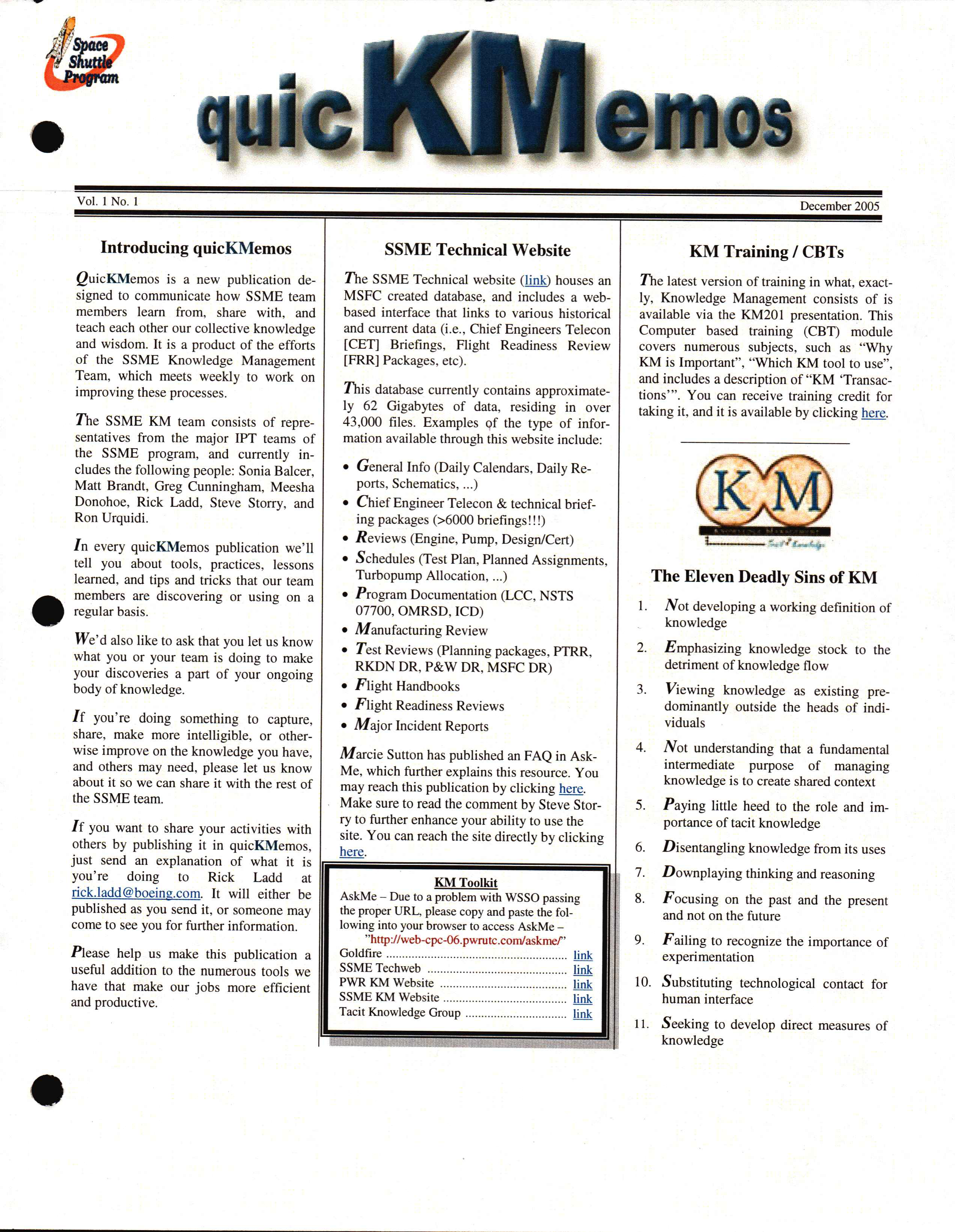
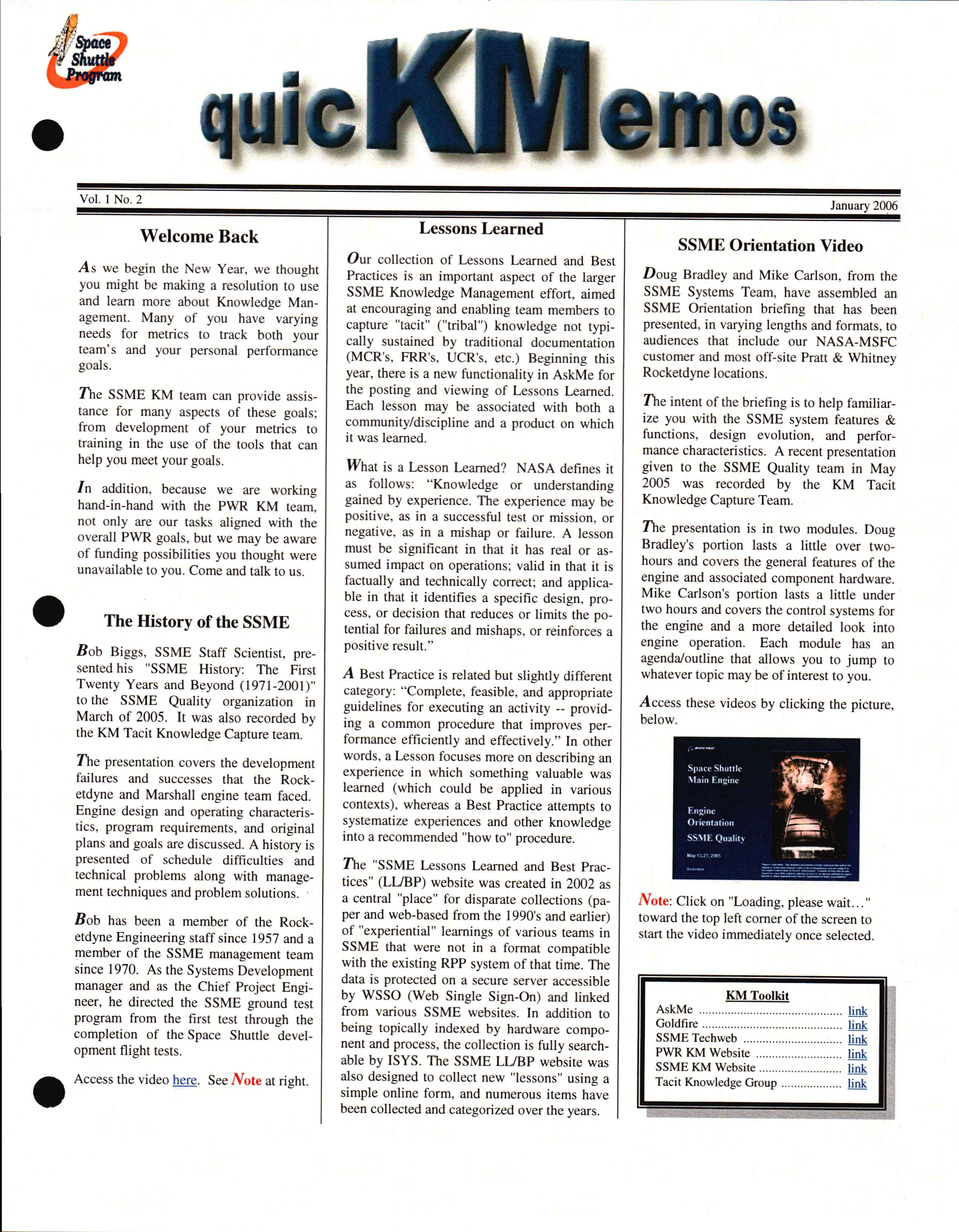
quicKMemos Vol. 1 No. 2

Here’s the second issue of the KM newsletter I wrote and published for the SSME KM team. This one was for January of 2006. The middle column has a couple of decent descriptions of “Lessons Learned” and “Best Practices.” What it doesn’t address, which is something many of us came to understand later, is that we don’t actually want “Best” Practices; which implies there won’t be any room for improvement, as “best” is a superlative adjective, which means it just doesn’t get any better than best. We, therefore, preferred to talk about “Better” Practices, which also fits rather nicely into the philosophy of continuous improvement. My apologies if this is boring.


Another Newsletter

At the end of 2005, I was still five years away from accepting an early severance package from Pratt & Whitney Rocketdyne and then retiring a couple years early. I don’t think the Shuttle program had yet been cancelled, so everything appeared to be full steam ahead. I had been deeply involved in developing the concept of Knowledge Management (KM), primarily to the Space Shuttle Main Engine (SSME) team—for which I was the lead—as well as for the entire organization, from its ownership by Boeing to a subsequent purchase and merger with United Technologies’ Pratt & Whitney Division.

So, there were two teams I was involved with: the corporate, enterprise-wide team, and the SSME team. I had convinced my management to start the SSME team before I knew there was a corporate team, and it was my primary focus of attention at the time. Starting in December of 2005, I published a newsletter for the team; a KM newsletter, ostensibly by the SSME KM team for the entire SSME program team.

When I returned to work for a couple of years at Rocketdyne in 2015, I was able to find pdf files of every issue of that newsletter, which we called “quicKMemos.” I’m am converting these pdf files into png files so I can upload them here. I’ll post them somewhat sporadically, no doubt, as I have several duties and obligations that are always tugging at my sleeve and demanding my attention. So . . . here’s the first one; Vol. 1 No. 1, December 2005.

NB – Check out the Eleven Deadly Sins of KM. They still seem relevant to me, though it’s hard for me to tell as it’s been nearly 10 years since I’ve been in a large enterprise environment.


Who Is This Guy?

I believe I wrote this poem in the early nineties. It was, at least obliquely, addressed to a woman I had fallen desperately in love with (this would be the last time in my life I fell that stupidly, at least until we adopted and I became a father.) The love of one’s child—especially the first—is far more powerful and nuanced than any other type of love I’ve ever experienced.

This poem, however, speaks to my desire to see this woman* open up and face some of what I thought were self-destructive fears that were keeping her from enjoying her life. It was complicated, as was she . . . and it just wasn’t to be. I have little doubt the somewhat crazy depth of my desire was just too overwhelming for her. Hey! I was just a kid . . . in my late forties.


There exists in all things
A strength and beauty
Unappreciated by those of us
Who have suffered the constraints of narrow education
Yet . . . it exists
In repose
Silently waiting for the moment of discovery
In many of us it is doomed
To remain unannounced
unapprehended and, yet
Undeniably
It is there
And there are those of us
Who by some mad twist of fate
Crush the beauty in ourselves
Divert the strength
And smother the fragile wonder of our lives
Beneath pain and isolation
Which we call self-protection


* I will not use her name in deference to my wife and children. She is a part of my history, but only relevant today to explain the motivation behind this particular bit of communication.


Was This Me?

I recently shared an old poem I’d written. A short little ditty that rhymed and everything, though it was – as I said – short. Here’s another I wrote about twenty-five years ago, when I was a mere pup in my late forties. I had fallen desperately in love with a woman who, as it turned out, had a few too many problems. It didn’t last, but it didn’t end ugly either. None of my relationships has ever ended ugly. I’ve been able to fall “out” of love, but I’ve never been able to stop loving someone I once loved.

!Warning!

I think my writing style here was heavily influenced by Kahlil Gibran. I’m not sure I did a very good job but, in the interests of preserving my old writings, I’m willing to risk being embarrassed.


What wonders have I known since first I met you
I have tasted of your lips
Yet it is the thoughts they have expressed
Which ring in my ears
I have suckled at your breasts
Not early as a babe
Yet it is the aroma of your flesh which haunts me in my reverie
And the sound of your sweet sighs which fills my memories

To taste of the flesh is a simple thing
Too easily exalted
Too frequently abused
To taste of the soul is a wondrous thing
Too seldom found
Too seldom used

It is not just your eyes I see
But the depth which lies behind them
It is not merely your lips I crave
But the ideas which they convey
These remain with me during the days
And calm my evenings
That I may lie
With images of you to lull me
Softly as I drift to sleep

Your smile floats before me even now
Your laugh softly fills my mind
And I crave your presence
Even as its memory fills me with joy

I have found in you a person worth cherishing
A woman whose value I deem boundless
And who soul I have already partaken of
I ask for little more
Than to entrust me desires
My hopes and dreams
With one
As sharing
As giving
As you


Preserving My Past

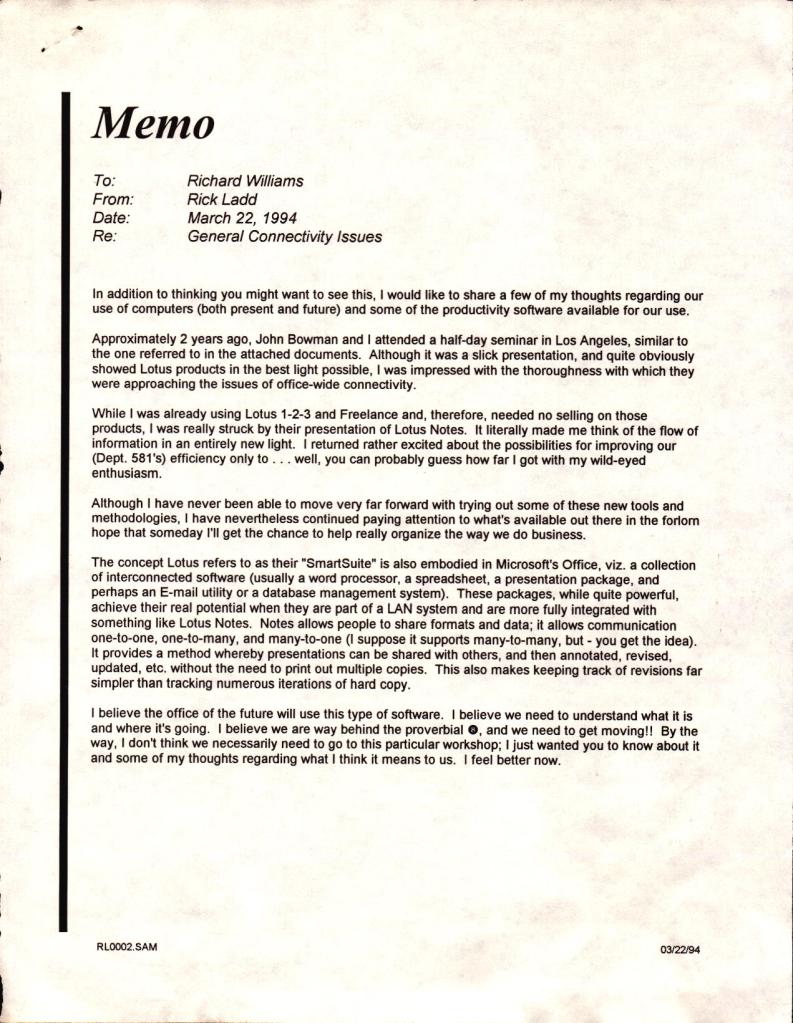
The time has come for me to simplify . . . to apply some feng shui to my collection of old (ancient?) paperwork, some of which is more than several decades old. Paper is the one thing I seem to be a bit of a hoarder with; that and old clothing, I guess.

I am coming across papers, letters, and notes I’ve written over the years, many of them from my over two decades of service at Rocketdyne, where I was privileged to work on the Space Shuttle Main Engine program. In that time I worked for (without changing desks) Rockwell International, The Boeing Company, and the Pratt & Whitney Division of United Technologies. After I accepted an early retirement package in 2010, I returned as a contractor to work for Aerojet Rocketdyne in 2015, where I worked for a bit over two years.

Recently, I purchased a small, portable Brother scanner and I am slowly scanning old papers I’m finding. Inasmuch as I’m now publishing far more frequently to this blog, I’ve decided to save some of these things so I can throw the paper away and still have a record. It’s been over nine years since I retired and I find I’m forgetting what working in a large organization was like. Reading some of the documents I created helps me to remember what I did, as well as to feel reasonably confident I wasn’t just spinning my wheels.

What follows should be somewhat self-evident. It’s a letter I wrote to my manager in 1994, now over 25 years ago. I think I sound pretty reasonable, and I’m gratified to know I was pushing—pretty hard, I think—for positive change back then. I’m not an IT person; never went to undergrad and, besides, the earliest PCs didn’t come into existence until I was nearing my thirties. However, I did recognize the value such tools brought to managing and operating a business and I have always been a big promoter of technology in the office. At any rate, this is more for me than my readers, but some may find it “amusing.”

PS – I scanned the original “memo” in .jpg format and the accompanying Lotus presentation materials in .pdf, which you’ll have to click on if you’re interested in what Lotus was doing 25 years ago, before its acquisition by IBM.


Just A Little Reminder To Me

Sometimes I forget the work I’ve done. I mean . . . it’s over, lessons learned have been internalized and generalized . . . time to move on to something else, right? So I move on. My entire career has consisted of learning, sharing, and moving on. I’ve known people who held onto their knowledge like a life vest, scared silly for anyone to even know precisely what they do or how they do it. In my corporate experience there’s a phrase that perfectly embodies that kind of attitude: “Knowledge is Power.”

I’ve never agree with that concept. In fact, when I was doing Knowledge Management work for Rocketdyne, I used to say “If knowledge is power, then knowledge shared is power squared.” Unfortunately, becoming a sharing and learning organization requires a major cultural change and — especially in aerospace and other conservative industries — change is difficult to effect; certainly not within a short window of time.

At any rate, I was looking at the blog and web sites I am an admin for and realized I had written a couple of blog posts for a local business that was a client of mine for a very short while. I thought I would share it, only because I want to preserve as much of my work as possible. I want this in large part because almost everything I did at Rocketdyne is the intellectual property of the organizations that were the mother ship for Rocketdyne in the over two decades I was there.

I have a few presentations I did that are on SlideShare, but they don’t come close to the amount of content I produced over that time, and that includes a couple of years worth of monthly newsletters that were researched, written, and published almost entirely on my own. I even did the graphics for them. As I said, I don’t own them and, frankly, they were written for my colleagues and much of it wouldn’t make a great deal of sense to anyone outside the organization. Nevertheless, it’s a bit sobering to know you did a lot of work you cannot now take credit for . . . at least not easily. What follows is the blog post I wrote for Choice 1 Cleaners.


Your Tortured Garments

Red Wine Stain on White Blouse

Oops!

Many things in this world are a lot more complex than first meets the eye. Dry cleaning happens to be one of them. Actually, when it comes to today’s garments, any kind of cleaning is far more complex than one might imagine. This isn’t true of all garments, but it is true of garments in general.

Take, for instance, the variability in both materials and the things that stain them. There are basic differences, e.g. fabrics are made out of plant-based (cotton, linen), animal-based (silk, wool, leather), or synthetic (polyester, acrylic, nylon) materials. Stains come in different varieties as well; they’re either plant, animal, or synthetic. Proper cleaning requires an appreciation of the science involved when trying to remove those stains without harming the fabric.

In addition to the variations in material and the things that stain them, consideration needs to be given to the method of construction and the existence of adornments or embellishments, such as pearls, beads, chains, etc. Each of these creates different challenges that need to be addressed before the garments they’re attached to can be safely cleaned. Some require gauze to be hand-stitched over them in case they come loose. Some designer clothing can contain materials that need four to six different treatments to be thoroughly cleaned.

In order to get your garments truly clean – as clean as you expect them to be – we need to test spots as well, many of which you aren’t aware exist. For instance, sweat, alcohol, and perfume stains may not show up for a while. Your skin’s oils may leave stains you don’t notice either. However, when we clean your clothes we will discover them.

Rest assured, no matter how difficult the challenge, our mission is to clean your garments so they look and feel brand new. We can’t do much about the effects of time, but we can do an awfully good job removing the things that get on your clothing and render it stained and dirty. We pride ourselves on being the best and we think you’ll agree we are!


The Elements of Dialectical Materialism

Yin Yang Symbol

My Favorite Representation of The Concept of The Dialectic

I am not an academic. Neither am I a philosopher or a journalist. Nevertheless, I do write on occasion and make an effort to share my thoughts in a somewhat coherent manner. I have to admit it’s gotten a little bit more difficult over the last few years, what with Twitter, Facebook, and other social media apps, platforms, and sites, slowly turning me into a scattershot reader of content.

My goal for the foreseeable future is to reverse that trend somewhat and spend more time writing and sharing my thoughts, perhaps some of my dreams, and a few (or more) of my memories. I’ll be 70 years old next June and, in mid-April of next year, will have outlived my father by a decade. Although relatively healthy, I do have my share of ailments that seem to come to everyone eventually: Mild Hypertension; Type II Diabetes (though, thanks to Fitbit and a little willpower made easy by the data retrieved from my Aria scale and Charge HR (link is to their latest version), I’ve lost a little over 30 pounds in a little over a year — and it’s had its salutary effect on my blood sugar); surgery for a Melanoma; Dupuytren’s Contracture; trigger finger; and a bunch of weird-ass nerve issues that are making many reaching movements with my hands problematic. In other words, I’m doing pretty good for an old guy.

I’m hoping to live long enough to share a little of the adult life of my children, who are currently 15 and 13, but there’s no way to know if that will happen. A lot of folks around my age have been dying off lately, and I can feel the inexorable decline of my physical strength, stamina, and overall health accelerating as I age. It’s a strange trip, I must say. Sometimes I worry a bit that I’m paying too much attention to the end, but I have always been one who has enjoyed the ride and I’m not really too concerned with its conclusion. I just happen to be fascinated by the concept of nothingness, which I contend is nigh onto impossible for we humans to comprehend. I also believe it is a big part of what has long attracted people to religion; they need to believe there’s some sort of consciousness after they die. I don’t believe that’s possible.

As someone who has embraced (if not always lived up to the practices inherent in doing so) Systems Thinking, I long ago came to the conclusion that the philosophy of Karl Marx and Friedrich Engels, Dialectical Materialism, is the framework from which systems thinkers can best view the development of the natural world which, of course, includes human beings and our social constructs.

In that regard, I thought I would share this compilation of the elements of the philosophy, as culled from the works of Vladimir Ilyich Lenin, one of the world’s clearest explicators of the work of Marx. Here are the 16 elements I’ve been able to find. I once had a slightly shorter version, which I had printed out and displayed at my desk. Several years before I retired, someone had the audacity to take it down from the wall, rip it in half, and leave it on my seat. I’ve never quite understood the cowardice it takes to do something like that but, no matter, the words — and the concepts they represent — can’t be erased quite that easily. Here’s the list:

Summary of Dialectics

Vladimir Ilyich Lenin

  1. The objectivity of consideration (not examples, not divergences, but the Thing-in-itself).
  2. The entire totality of the manifold relations of this thing to others.
  3. The development of this thing, (phenomenon, respectively), its own movement, its own life.
  4. The internally contradictory tendencies (and sides) in this thing.
  5. The thing (phenomenon, etc.) as the sum  and unity of opposites.
  6. The struggle, respectively unfolding, of these opposites, contradictory strivings, etc.
  7. The union of analysis and synthesis — the breakdown of the separate parts and the totality, the summation of these parts.
  8. The relations of each thing (phenomenon, etc.) are not only manifold, but general, universal. Each thing (phenomenon, process, etc.) is connected with every other.
  9. Not only the unity of opposites, but the transitions of every determination, quality, feature, side, property into every other [into its opposite?].
  10. The endless process of the discovery of new sides, relations, etc.
  11. The endless process of the deepening of man’s knowledge of the thing, of phenomena, processes, etc., from appearance to essence and from less profound to more profound essence.
  12. From coexistence to causality and from one form of connection and reciprocal dependence to another, deeper, more general form.
  13. The repetition at a higher stage of certain features, properties, etc., of the lower and
  14. The apparent return to the old (negation of the negation).
  15. The struggle of content with form and conversely. The throwing off of the form, the transformation of the content.
  16. The transition of quantity into quality and vice versa.

As I said, I am hardly a philosopher; merely a person who has found Materialism, whether it be Dialectical or Historical, to be the best method available to understand history and the development of society without — and this is important — the intervention of the supernatural. I try to apply this type of thinking to everything I ponder, but I do fall short at times. I, like most of us, am a work-in-progress. More to come.