Author Archives: Rick Ladd

About Rick Ladd

Unknown's avatar
I retired over14 years ago, though I've continued to work on and off since then. Mostly I'm just cruising, making the most of what time I have remaining. Although my time is nearly up, I still care deeply about the kind of world I'll be leaving to those who follow me and, to that end, I am devoted to seeing the forces of repression and authoritarianism are at least held at bay, if not crushed out of existence. I write about things that interest me and, as an eclectic soul, my interests run the gamut from science to spirituality, governance to economics, art and engineering. I'm hopeful one day my children will read what I've left behind.

Easing Up

While I know it means more lost jobs, ever since we started staying at home, I’ve enjoyed seeing TV pundits and their guests having discussions from their homes. The lost jobs I refer to are primarily the people that see to the hosts’ and guests’ hair and makeup prior to going on camera. That’s not feasible now and it’s sometimes quite obvious that people are putting on their own makeup (if any) and letting their beards grow (that would be the men, that is.)

Trevor Noah and His Books

It’s interesting to see the different levels of technology available to the hosts and guests as well. Some will be using wired earbuds, some will have airbuds, and some are using their computer or phone’s speakers and mic. The hosts, I’m assuming here, have access to more sophisticated equipment, though that wasn’t the case at first. It’s also been interesting to see the evolution of some of these shows, as I’m sure some of the tech they normally use in production has been moved to the homes of the hosts.

I’m speaking here of many of the afternoon and evening shows on MSNBC, the Late Show with Stephen Colbert, The Daily Show with Trevor Noah, and Late Night with Seth Meyers. All of these shows have a plethora of guests, and each one is communicating from somewhere in their home.

Another aspect of this new reality I find fascinating is where these people choose to set up their “studio.” On MSNBC, many of the guests (especially now, when so much of the news centers on this pandemic and many of the guests are medical and epidemiology professionals, as well as public health and service professionals, there are lots of bookshelves in the background.

Some of the guests are situated so it’s possible to get a glimpse of the titles of a few of their books and it’s possible to gain a sliver of insight into who these people are or, at least, what they’re interested in. My entire adult life, whenever I am at the house of someone I know, if I have the opportunity I will always check out their bookshelves. It’s not different when I have the opportunity to do so via the Tube.

Just one example. If I remember correctly, at least until recently, Trevor Noah had two books laying down on a shelf over his right shoulder. I don’t recall if I could make out the titles, but the authors’ names were quite visible and, frankly, that’s enough to get a sense of what he’s giving credence to or what he’s enjoying learning about. The two authors in this case were. Ta-Nehisi Coates and Eddie Glaude, two men I admire.

There are two other shows I normally watch, and each of them has chosen a wildly different approach for how to go about having a show with no guests and no crew (at least not at their homes.) They are Last Week Tonight with John Oliver and Real Time with Bill Maher. John Oliver, whose show generally consists of him sitting behind a desk, with an audience, now sits in front of a white wall; that’s it. Bill Maher, on the other hand, has chosen to record his show in his backyard and he uses laugh tracks from old (and I do mean old – black and white) TV shows.

I can’t imagine how they’re thinking of doing original dramas, rom-coms, and the like, but I hope they never go back to doing reality shows. The last nearly three and a half years should have cured the majority of the nation from the need to ever see a reality show again.

Regardless, it’s interesting to watch the development of “workarounds” as their crews get more and more creative in dealing with working remotely. I’m hopeful it will result in a lasting change to how we view things like the need for men to wear a suit and tie almost any time a camera is on them. Or the need for women to have perfectly coiffed hair and painstakingly applied makeup. I’d like to see the world lighten up and relax a bit. We could use it.
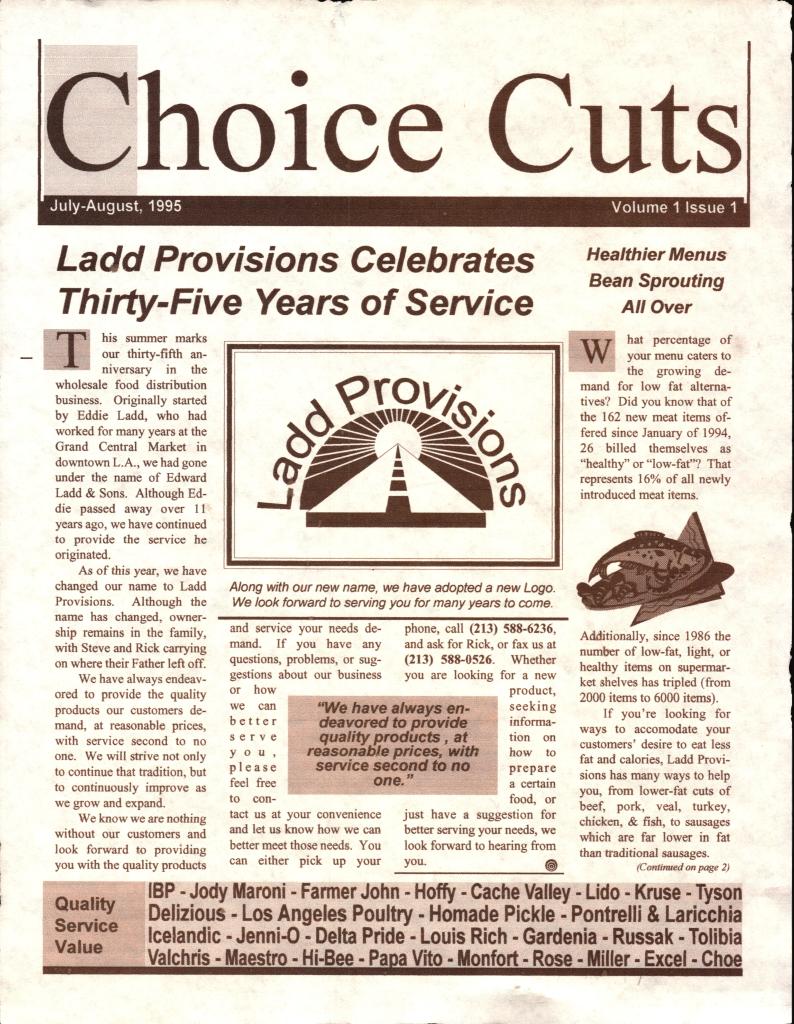

Ladd Provisions Memorabilia

I think I’ve mentioned before that I’ve done quite a few newsletters over the years. I think I started doing them in part because it was what my father had done aboard ship during World War II, when he served as a Radioman in the U.S. Navy. I used to have a collection of his newsletters, which would be about five years older than me now. They might still be in a box somewhere in our garage. Maybe I’ll find out one of these days.

At any rate, here is a newsletter I found recently. I’m just posting it here because I scanned it and want to preserve it. Now I can throw away (recycle) the paper copy which, as you can see, is discolored from age. A quarter century is a fairly long time for it to have lasted. I probably shouldn’t have kept it, but I’m a paper pack rat.


Feng Shui or Marie Kondo?

Funny how being mostly confined to your house gives you a lot of time on your hands. After over a month of familial isolation, I think I’m finally getting used to what will likely be my existence for up to another year; maybe more. The reason I expect it to take that long for me to feel comfortable going to the gym or eating out at restaurants has to do with my vulnerability to this virus. I will be 73 in a little over a month. I have type II diabetes, essential hypertension, stage 2 kidney disease, and mild COPD. All of these health issues are normally well-controlled but, with COVID-19 that quite likely won’t matter. Ergo, great caution is warranted, IMO.

So . . . what am I doing with that time? Well, it generally doesn’t feel like much, though I do spend a lot more time planning our grocery shopping. I would prefer to have our groceries delivered, but nobody was doing a very good job of it for the first few weeks of this social isolation effort. At first, I went online and spent anywhere from a half hour to forty-five minutes carefully choosing what I wanted to have delivered, only to discover when attempting to check out that there were no times available. Frustrating! That’s beginning to change and I’ve been able to successfully get a couple of deliveries. This necessarily includes several disconnects (for instance, I had coffee from Trader Joe’s delivered but forgot to ask the woman who did the shopping to grind it for us.) Also, nobody picks fruit and some other things the way I do, and we normally shop from a half-dozen different stores depending on what it is we’re purchasing. That’s no longer possible for now.

I also find I’m spending a fair amount of time helping my 16-year-old with her homework, some of which requires a significant investment of time. Today I learned (or re-learned) a lot of stuff about the difference between Napoleonic warfare and WWI warfare, so I could help her answer questions about them. I don’t think I’m capable of helping her with her algebra homework. Although I was in one of the first classes in the Los Angeles Unified School District allowed to take Algebra in the second semester of eighth grade (in 1961) I don’t remember a damned thing about it and I don’t recognize anything when I look at the equations she has to work with. Frankly, I’m not relishing revisiting high school; it was a disaster when I was a student from 1962 to 1966 (one extra semester as a result of cutting far too many classes.)

Now, the point of this post isn’t to regale you on all the ways in which I’m coping—or not—with this pandemic lock-down. I just want to share something I found while straightening out some of the clutter in my office. This “Birthday” card, homemade by my brother’s daughters almost 28 years ago, was in a bag with old photos, etc. I decided to scan it and I’ve share it on Facebook. I want to share it here as well. It warms my heart. My nieces were four and seven at the time.

It WAS a happy birthday; my 45th

A Novel Form of an Old Virus

As I’ve noted before, I’m continuously improving my Photoshop skills, learning how tools I’ve not used before can improve my efforts, as well as improving on techniques I’ve learned as I’ve attempted to create the visions I imagine. Here’s one I did regarding the protests in Michigan and a tweet that made light of the protestors.

Some White Boys Cosplaying as Patriots (which they’re decidedly NOT!)

Dialectical Zenosity

The Interpenetration of Opposites

My philosophy of life has been informed by two people, both of whom I was first introduced to (not personally, but via their writings) in my early twenties. They helped me understand the meaning of the dialectic of life; the yin yang of our corporeal (and intellectual) existence.

The former brought me an understanding of spirituality that did not require the existence of a supreme “being,” while the latter helped me to see how our thinking is shaped by the material world we live in, and how our thinking can then help us act to change that world for the better.

The former brought me “The Wisdom of Insecurity” and taught me to accept the tenuousness of existence and the need to slow down and enjoy life absent regret for the past or anxiety for the future (not that I am proficient at it always,) while the latter gave me a much clearer understanding of both biological evolution and the evolution of human society.

These two people are: Alan Watts, who many considered the western world’s foremost authority on Zen, a philosophy I believe reflects our place in the universe; and Karl Marx who, along with Friedrich Engels, developed and promulgated the philosophy of dialectical materialism, which I believe accurately reflects how the physical world informs our existence and how our ability to understand that physical world gives us the ability to significantly alter it.

It’s been over fifty years since I first encountered these two aspects of what I consider to be a somewhat “unified” theory of existence. Nothing in the interim has dissuaded me from following their teachings. I find the physical universe to be infinitely more beautiful and mystical than any of the Gods humans have worshiped over millennia.


Yikes!

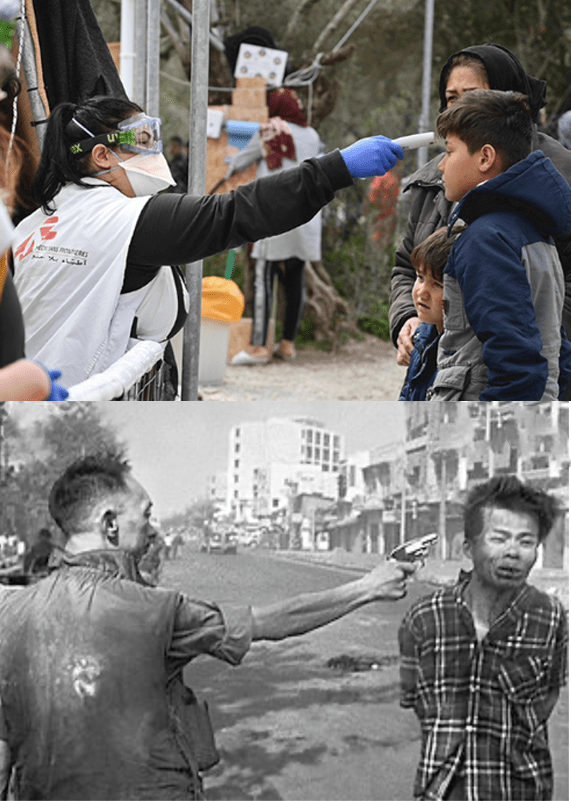
The photo on the bottom has haunted me for 50 years. Not that I think about it every day . . . or even every year, but over a half century it’s come to mind far more times than I would have liked. So, when I saw the top picture on my phone, it instantly evoked the extra-judicial execution of Nguyễn Văn Lém. I needed to do this to stop thinking about it. Too much thinking about death lately. 😕


Contemporary American History

I just came across one of the better summarizations of two disparate responses to infectious diseases by our two latest Presidents here in the United States. I am not the author of what follows, but I would like to post it here, as I believe it will ultimately get more exposure than it will on Facebook (where I encountered it.)


For those of you complaining about Trump being blamed for the COVID-19 pandemic, here’s a little history lesson for everyone on both sides of the political divide. It’s important that we understand the truth, especially come November when it’s time to vote. Forgive the length, but hey, we all have time on our hands to read, correct?

In December 2013, an 18-month-old boy in Guinea was bitten by a bat and died a brutal death a day later. After that, there were five more fatal cases. When Ebola spread out of the Guinea borders into neighboring Liberia and Sierra Leone in July 2014, President Obama activated the Emergency Operations Center at the Centers for Disease Control in Atlanta. The CDC immediately deployed CDC personnel to West Africa to coordinate a response that included vector tracing, testing, education, logistics, and communication.

Altogether, the CDC, under President Obama, trained 24,655 medical workers in West Africa, educating them on how to prevent and control the disease before a single case left Africa or reached the U.S. Working with the U.N. and the World Health Organization President Obama ordered the re-routing of travelers heading to the U.S. through certain specific airports equipped to handle mass testing. Back home in America, more than 6,500 people were trained through mock outbreaks and practice scenarios. That was done before a single case hit America.

Three months after President Obama activated this unprecedented response, on September 30, 2014, we detected our first case in the U.S.A. A man had traveled from West Africa to Dallas and somehow slipped through the testing protocol. He was immediately detected and isolated. He died a week later. Two nurses who tended to him contracted Ebola but later recovered. All the protocols had worked. It was contained. The Ebola epidemic could have easily become a pandemic, but thanks to the actions of our government under President Obama, it never did. Those THREE EBOLA CONFIRMED CASES were the ONLY cases of Ebola in the U.S.A. because Obama did what needed to be done THREE MONTHS PRIOR TO THE FIRST CASE.

Ebola is even more contagious than COVID-19. Had Obama not acted swiftly, millions of Americans would have died horrible, painful, deaths like something out of a horror movie (if you’ve never seen how Ebola kills, it’s horrific). It is ironic because since President Obama acted decisively we forget about his actions since the disease never reached our shores.

Now the story of COVID-19 and Trump’s response that we know about thus far:
Before anyone even knew about the disease (even in China) Trump disbanded the pandemic response team that Obama had put in place. He cut funding to the CDC, and he cut our contribution to the World Health Organization (WHO). Trump fired Rear Admiral Timothy Ziemer, the person on the National Security Council in charge of stopping the spread of infectious diseases before they reach our country – a position created by the Obama administration.

When the outbreak started in China, Trump assumed it was China’s problem and sent no research, supplies or help of any kind. We were in a trade war, why should he help them? In January he received a briefing from our intelligence organizations that the outbreak was much worse than China was admitting and that it would definitely hit our country if something wasn’t done to prevent it. He ignored the report, not trusting our own intelligence.

When the disease spread to Europe, the World Health Organization offered a plethora of tests to the United States. Trump turned them down, saying private companies here would make the tests “better” if we needed them. However, he never ordered U.S. companies to make tests and they had no profit motive to do so on their own.According to scientists at Yale and several public university medical schools, when they asked for permission to start working on our own testing protocol and potential treatments or vaccines, they were denied by Trump’s FDA.

When Trump knew about the first case in the United States he did nothing. It was just one case and the patient was isolated. When doctors and scientists started screaming in the media that this was a mistake, Trump claimed it was a “liberal hoax” conjured up to try to make him “look bad after impeachment failed.”

The next time Trump spoke of COVID-19, we had SIXTY-FOUR CONFIRMED CASES but Trump went before microphones and told the American public that we only had FIFTEEN cases “and pretty soon that number will be close to zero.” All while the disease was spreading, he took no action to get more tests. What Trump did was to stop flights from China from coming here. This was too late and accomplished nothing according to scientists and doctors. By then the disease was worldwide and was already spreading exponentially in the U.S. by Americans, not Chinese people as Trump would like you to believe.

As of the moment I am posting this, the morning of April 20, 2020, we have 770,076 COVID-19 CONFIRMED CASES and 40,316 COVID-19 DEATHS in the U.S.A. The actual number is undoubtedly more than triple that amount.

As if you needed one more reason to vote, here it is.


Oh … He’s Not Progressive Enough For You?

I posted this response a few days ago to someone on Facebook who said they would never vote for Biden, and that Trump winning a second term as POTUS would “teach people” a lesson. I believe that’s an amazingly idiotic and insensitive response to your candidate not winning the Democratic nomination. What follows is my response:


Which people? The kids still in concentration camps?

The women who will lose all control over reproductive rights once Trump replaces RBG with another conservative ideologue?

I’m a Marxist. Bernie’s policies are more conservative than those I’ve been advocating for for 50 years.

This is my 14th general election and I’ve never had a candidate who really represented me.

But, as a Marxist my philosophy—dialectical materialism—is pragmatic, based on the reality we face, not how I would like things to be.

Apparently, you have nothing to lose if this country goes full-blown fascist, and you couldn’t care less about the millions who will needlessly suffer when that happens.

Biden is hardly an ideal candidate. Neither was Obama, Bill Clinton, Jimmy Carter, or Hubert fucking Humphrey, but any one of them were head and shoulders above Trump.

I’ll vote for Biden.

I don’t expect to see this country become a socialist economy in my lifetime (which, at almost 73, is coming to a close sooner than later) but I don’t measure progress by how correct I am.

I measure it by how things change for the better, for those who need it most.

I understand your disappointment, but I have no patience for anyone’s privileged petulance.

Feel free to unfriend me.


Happy Holidays!!

Although I am an atheist, I was raised in a predominantly Christian country, in a Conservative Jewish family (I’m bar mitzvah) and am well aware of the importance of both Easter and Passover. They no longer (or never did) carry any religious significance for me, but they do (in the broadest sense) carry a great deal of spiritual significance . . . in terms of the import of each holiday’s lessons on the human condition.

So . . . without going into great detail to assert my bona fides when it comes to all things religious, I just want to wish my Yiddishe meshpuchah, chag Pesach kasher vesame’ach, and my Christian friends and family (yes, there be Catholics in mine) a blessed and joyful Easter.

In this trying time we’re experiencing, we can use the dual messages of liberation from slavery and oppression, and the dialectic of life and death that both these holidays bring us. May we come out of this pandemic with a new appreciation for life, and for each other and the value each of us intrinsically brings to human society. Peace, love, and Harvey Krishberg.

Hang in there . . . I love you all.


Casual Everyday?

I wonder if this pandemic, and our response to it, will change how seriously we take ourselves. If you’ve been watching television—and I’m going to go out on a limb here and assume most everyone is—you may have noticed some changes in much of live news and late night programming.
Since nearly everyone who’s reporting is at home, by themselves, it’s obvious that the women anchors, reporters, and pundits are having to do their own hair and makeup. Regardless of how well they might do it, it’s not the same and it’s noticeable. I haven’t noticed how much, if any, makeup the men are wearing, but I have noticed a whole bunch of them has decided it’s not worth shaving right now (I’m one of them.)


So . . . what I’m wondering is, after we are able to return to some semblance of a normal life, where we can gather again so that newscasters and performers can return to the studio, when knowledge workers can return to their cube farms . . . will we? Better yet, should we? I spent the last few years of my career at Rocketdyne working from home. I’d like to think I was at least as productive, if not more so, than I was when I was going in to the office each day.


When I first started working there, I wore a suit and tie each and every day. By the time I left, the only time I wore a tie was if the “customer” (usually NASA) was visiting and we had to blow smoke up their asses. Knit polo shirts and chinos became acceptable and, on Fridays, everyone wore denim. I’d like to think one of the lessons we’ll glean from this (and there will be dozens, no doubt) is that we can be a lot more casual and still perform at a high level. And there are numerous ways to communicate, connect, and collaborate, especially if we’re not hamstrung by unnecessary and awkward notions of propriety.


What do you think?