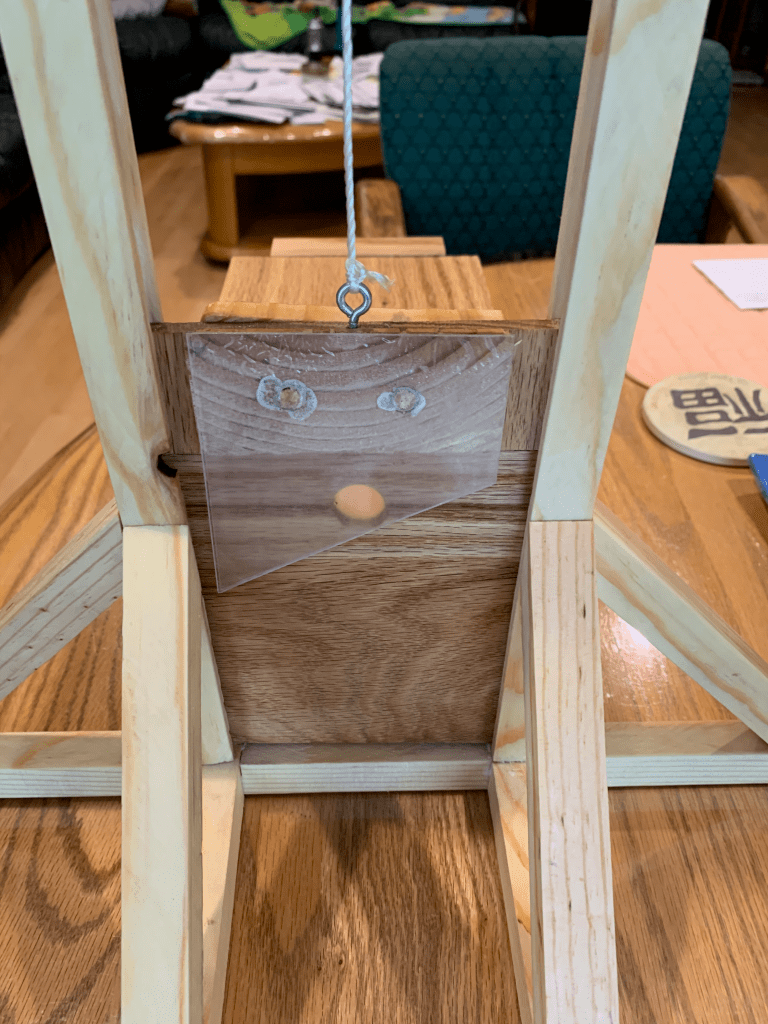
My youngest daughter (I have two) is in the 10th grade in high school. Her history class is studying the French Revolution right now and, during the Thanksgiving break she decided she wanted to build a scale model guillotine for extra credit. She, of course, enlisted my help. It never even occurred to me that I could probably find something online that would suffice and, in fact, I just looked and found a couple of places I could have purchased a kit. Here’s a really simple one. Here’s another.
As it turned out, I think I jumped at the opportunity to re-arrange our ridiculously stuffed garage, so I could get to my woodworking bench and use all the tools I’ve purchased or was given over the years and haven’t used for nearly a decade. Amazingly enough, they all worked despite some rust and corrosion.
I took some pictures as I was going along, and finished it yesterday so she could bring it to school today. This afternoon, I came across the original note her teacher gave her with the “rules”, e.g. it must work, it can’t have a sharp blade, and it isn’t due until Friday . . . grrrrr. Frankly, I became a wee tad obsessed with pulling this off and I’m glad it’s done and gone. I was having a hard time doing anything else, even though there were periods of time in between gluing and when I needed to build up my confidence that I could pull something off. Sometimes it mostly involved my remembering how to do something.
I made the whole thing out of a plank of 3/4″ thick Pine and a hobby piece of 1/4″ Oak. Since most of the table called for 3/4″ square pieces, I had to use an old table saw designed for onsite carpentry. It belonged to a friend of mine and, even though it’s been in my garage for at least 17 or 18 years, it still belongs to him. I just get to use it. Some of the cuts I had to make concerned by fingertips greatly, but they all managed to survive.
At any rate, here are some photos.
Here, the guillotine is mostly finished and assembled. You can see I was making a set of stairs, which I hadn’t planned on doing, but my daughter insisted was necessary.I made the blade out of plastic, so it’s incapable of cutting, the spacer out of some Oak I had to purchase to get the 1/4″ thickness I needed for a few pieces, and I made the counterweight out of a piece of 2×4 that’s probably been sitting in our garage for the last two decades.If you compare the stairs to what I started with and have depicted in the first photo, above, you’ll note I ultimately ended with four steps. I think it was because I realized I’d made them too tall to begin with and had to scale them down. The steps and the table/platform are made of Oak and here the whole thing has been treated with Watco Danish oil.Getting the blade to actually drop was a bit of a challenge because cutting the channels on the two uprights so the blade assembly would be able to slide smoothly up and drop fairly quickly down was challenging, and they weren’t quite as smooth as I would have liked them to be. Nevertheless, I got it done after a bit of trial and error.
We have a little squeeze toy I picked up at a conference a long time ago from Hitachi. It’s a Sumo wrestler and, unfortunately, his head has managed to depart his body, though we keep him around (why, I don’t know). My wife thought he fit rather nicely with the device, so here ’tis. Next photo is from the other side.
Bill Barr has proven himself to be nothing more than another of Trump’s uncritical sycophants. Instead of being Attorney General for the United States of America, he’s acted as Donald Trump’s personal attorney. Couple that with his overwhelming partisanship and dishonesty, and you have a perfect case for another impeachment and a criminal indictment. Make it so!
Bill Barr lied to Congress. He falsely accused the FBI of spying that did not occur. That's a felony. He needs to be impeached, removed from office and prosecuted.https://t.co/jxatU1tmZp
I want . . . no, I need to share this thread. Although I have been an atheist for most of my adult life, I was born a Jew and am bar mitzvah. I feel it is incumbent upon me to stand not only with my fellow Jews, but also with all those who suffer oppression, prejudice, and hatred. I am not a public figure, so I have not been attacked like David, but if this keeps up (and, especially, if Trump is re-elected) we can expect things to get worse, perhaps a lot worse. Don’t think it can’t happen because this is America. As David points out, America is responsible for the slaughter of our native peoples and the enslavement of Africans for centuries. Our hands are hardly clean. We need to be prepared for the worse, all while working to bring about a better world for all.
Thread by @djrothkopf: “Just got this via text: “You are a retarded kike. You dont want to win 2020. You enjoy complaining about Trump.” It w by this and other anti-semitic art. This is Trumpism. The instances of this & worse happening in my life [โฆ]”
Uh oh! Ricky’s been a baaaaad boy. This is what happens when you suggest a man surrounded by secret service protection and the best medical care in the world experience something everyone’s speculating he’s experienced already. The man responsible for hundreds, if not thousands of needless deaths and who knows how much misery. The man who vilifies those he represents and spews a constant stream of vile, hateful lies and deceptions. The person who violates Twitters rules on a daily basis and suffers nothing for his transgressions. And, of course, there’s precious little I can do about it. I will appeal and suggest context matters, but I can’t even be sure what I was responding to. I think I know what it was, though, so I’ll go that route.
Golly gee whiz! I sure hope I didn’t hurt his feefees or anything.
I’ve written fairly frequently about death and dying. The concept of non-existence for eternity fascinates me. I suppose that might be a taste weird, but I have a feeling I’m not alone in my wondering. One of my first posts on the subject is about my attitude toward my own death. You can read it here, if you’re so inclined.
I’ve also written about one of my closest friends who was killed in Vietnam, long ago. That post is located here. Another came much later, and is about another friend I had known since before I can remember. I hadn’t spoken with him in a long time and heard about his death from one of his brothers. It can be found here.
I also touched on the subject of grief, somewhat generally, in a post where I ended by lamenting the loss of people I never knew but somehow felt I should have upon hearing from those who were close to them. That post is located here.
All this is merely an intro to a thought I encountered recently on Facebook, and I wanted to share. I think it more than adequately expresses what grief truly is, and how it affects us. What follows is that sentiment. I want to remember it well.
Grief, Iโve learned, is really just love. Itโs all the love you want to give, but cannot. All of that unspent love gathers in the corners of your eyes, the lump in your throat, and in the hollow part of your chest. Grief is just love with no place to go.
A lot of airtime has been spent over whether or not Donald Trump offered a quid pro quo to the President of Ukraine, Volodymyr Zelensky. Many astute commentators, however, have pointed out that a quid pro quo is not necessary in this case and, in any event, the real criminal activity here is either bribery or extortion. I would argue that it’s actually both. Let’s look at the elements of bribery.
The individual being bribed is a “public official,” which includes rank-and-file federal employees on up to elected officials; [President Zelensky is most definitely a public official, as is Donald Trump.]
A “thing of value” has been offered, whether it’s tangible (such as cash) or intangible (such as the promise of influence or official support); [Lots of cash was offered to Zelinsky. This is the “Quid.”]
There’s an “official act” that may be influenced by a bribe (such as pending legislation that may have a direct impact on the party offering the bribe); [The Ukrainian government was to make an official announcement it was conducting a corruption investigation into the Bidens and the DNC server. This is the “Quo.”]
The public official has the authority or power to commit the official act (for instance, the official is a senator who is voting on a particular piece of legislation); [Two Presidents . . . duh!]
There must be the establishment of intent on the part of the bribing party to get a desired result (the intent to sway the vote by handing over an envelope full of cash); [The “transcript” of Trump’s call and plenty of testimony], and
The prosecution must establish a causal connection between the payment and the act meaning there must be more than just a suspicious coincidence. [Again . . . lots of testimony from highly credible witnesses to the ongoing attempt at extortion].
It’s become quite clear the American public is a bit uncomfortable with the Latin phrase, quid pro quo and, in fact, as previously stated a definitive “this for that” offer isn’t necessary. Given the totality of the evidence so far, it’s quite clear to anyone who is really paying attentionโand understands how the law worksโTrump was using the threat of Russian violence to extort an announcement of (at the minimum; actual investigation as they real object) an investigation into Burisma and Hunter Biden.
It can also be argued, at the very least, that Trump was also soliciting a bribe from Zelensky before he would release the money Congress had already authorized for military aid to the Ukrainians. Also offered, in exchange for such a bribe, was a meeting at the White House for President Zelensky.
What’s important to realize is there is no reason to dwell on whether or not there was a specific quid from quo (an offer of something in exchange for something else) to find Trump was engaging in extortion and (as previously noted) at the very least solicitation of a bribe.
That Trump is a common criminal and con man, who has managed to grift his way into the highest office in the land, should be quite obvious to all but those who are now deeply enmeshed in his cult of personality. What this says about that swath of the populace supporting him is quite uncomfortable to fathom. Regardless, I’m looking forward to his impeachment and, if we’re fortunate, removal from office of this deeply deranged and hateful man masquerading as an actual President of the United States of America.
Looking through some of my old writings, many of which have never been published (some because they’ve never been finished,) I came across this limerick. It’s dated December 3, 2013.
Fox newscasts, so chock full of hate Render truth an impervious gate They so often dissemble We canโt help but tremble With hope they will soon meet their fate
This is another paper I found on my computer. Truth to tell, I have no idea who wrote it. It could have been me, but I don’t remember. I searched the phrase from the title in Google, but could not find anything. Inasmuch as I retired from Rocketdyne (and the pursuit of enterprise-wide KM) nearly 10 years ago, it could be from something I encountered more than a decade ago. Nevertheless, I’m sharing it with the caveat that I’m not claiming to have written it; I’m only asserting it’s an important document for anyone who’s struggling with getting their organization’s people to share their knowledge for the benefit of their company. My experience, as well as my discussion with those who are still involved in the corporate world, is that knowledge sharing is still nowhere near as widespread as I think it should be. So, without further ado, here’s that Baker’s dozen of reasons people aren’t sharing:
They
don’t know why they should do it. Leadership has not made a strong case for
knowledge sharing. Solution: Have the leader of the organization communicate
regularly on knowledge sharing expectations, goals, and rewards.
They
don’t know how to do it. They have not received training and communications on
how to share knowledge. Solution: Regularly communicate and conduct training,
webinars, and knowledge fairs. Web-based training and webinar recordings should
be available for all tools.
They
don’t know what they are supposed to do. Leadership has not established and
communicated clear goals for knowledge sharing. Solution: Establish and
communicate clear knowledge-sharing goals.
They
think the recommended way will not work. They have received training and
communications but don’t believe what they are being asked to do will work.
Solution: The KM leaders, knowledge brokers, and other members of the KM team
have to convince people in small groups or one-on-one by showing them that it
does work.
They
think their way is better. They are used to working on their own or
collaborating only with a small group of trusted comrades and believe this is
the best way. Solution: Regularly share stories of how others are benefiting
from sharing knowledge using the recommended ways. This should help sway those
stuck in their current ways to consider using better ways.
They
think something else is more important. They believe that there are higher-priority
tasks than knowledge sharing. Solution: Get all first-level managers to model
knowledge-sharing behavior for their employees, and to inspect compliance to
knowledge-sharing goals with the same fervor as they inspect other goals.
There
is no positive consequence to them for doing it. They receive no rewards,
recognition, promotions, or other benefits for sharing knowledge. Solution:
Implement rewards and recognition programs for those who share their knowledge.
For example, award points to those who share knowledge, and then give desirable
rewards to those with the top point totals.
They
think they are doing it. They are sharing knowledge differently than the
recommended ways (e.g., sending email to trusted colleagues or distribution
lists). Solution: Assign people to work with each community and organization to
show them how to use the recommended ways and how they work better than other
ways. Providing a new tool or process which is viewed as a โkiller appโ โ it
quickly and widely catches on โ is the best way for the old ways to be replaced
with new ways.
They
are rewarded for not doing it. They hoard their knowledge and thus get people
to beg for their help, or they receive rewards, recognition, or promotions
based on doing other tasks. Solution: Work with all managers in the
organization to encourage them to reinforce the desired behaviors and stop
rewarding the wrong behaviors.
They are
punished for doing it. As a result of spending time on knowledge sharing, they
don’t achieve other goals which are more important to the organization.
Solution: Align knowledge-sharing processes and goals with other critical
processes and performance goals.
They
anticipate a negative consequence for doing it. They are afraid that if they
share knowledge, they will lose their status as a guru (no one will have to
come begging to them at the time of need), that people they don’t trust will
misuse it or use it without attribution, or that they will not achieve other
more important goals. They are afraid of asking a question in public because it
may expose their ignorance or make them appear incompetent. Solution: Position
knowledge sharing as being a critical success factor for the organization.
Facilitate ways for people to establish trusting relationships through enterprise
social networks and face-to-face meetings. Recognize those who ask in public,
and provide ways to ask questions on behalf of others.
There is
no negative consequence to them for not doing it. Knowledge sharing is not one
of their performance goals, or it is a goal which is not enforced. Solution:
Work with all first-level managers to get them to implement, inspect, and
enforce knowledge-sharing goals. This needs to come from the top โ if the
leader of the organization insists on it and checks up on compliance, it will
happen.
There are
obstacles beyond their control. They are not allowed to spend time sharing
knowledge, they don’t have access to systems for knowledge sharing, or they
don’t have strong English language skills for sharing with those outside of
their country. Solution: Embed knowledge sharing into normal business
processes. Provide ways to collaborate when not connected (e.g., using email
for discussion forums). Encourage those with weak English skills to share
within their countries in their native languages.
Although
the current move toward gathering, cataloguing, storing, and disseminating
information and data for widespread organizational use is a fairly recent
development, the basic concepts of Knowledge Management have been with us for
as long as humans have gathered in communities. Humans have always struggled
with the need to pass on information gathered through hard experience and
disastrous failure.
In
his new book, to be published this fall, Steven Denning sets forth a brief
synopsis of the human activities which have preceded our current drive toward
Knowledge Management. In it he states, “The pursuit of any significant
human activity typically leads to the acquisition by those involved of know-how
and expertise as to how the activity may be successfully conducted. Insofar as
what is learned in the process can be captured, and communicated and shared
with others, it can enable subsequent practitioners – or even generations – to
build on earlier experience and obviate the need of costly rework or of
learning by making the same repetitive mistakes.
“In the village, from time immemorial,
the elder, the traditional healer and the midwife have been the living
repositories of distilled experience in the life of the community.
“โฆ
”
Interactive knowledge-sharing mechanisms
have always been used – from palavers under the baobab, village square debates,
and town meetings, to conclaves, professional consultations, meetings,
workshops, and conferences โ all functioning to enable individuals to share
what they know with others in the relevant area of knowledge. “[1]
(emphasis the author’s)
In
1988, as the pace of change was accelerating with the rapid development and
deployment of large-scale information systems, Peter F. Drucker observed,
โInformation responsibility to others is increasingly understood, especially in
middle-sized companies. But information responsibility to oneself is still
largely neglected. That is, everyone in an organization should constantly be
thinking through what information he or she needs to do the job and to make a
contributionโ.[2]
Drucker
understood then the pivotal dilemma with respect to data and information now
being faced by many organizations, that of understanding its power and devising
the methodologies whereby it can be harnessed and used to the benefit of the
people who need it to perform their jobs properly.
In
referring to information specialists as toolmakers, Drucker said, โThey can
tell us what tool to use to hammer upholstery nails into a chair. We need to
decide whether we should be upholstering a chair at all.
โExecutives
and professional specialists need to think through what information is for
them, what data they need: first, to know what they are doing; then, to be able
to decide what they should be doing; and finally, to appraise how well they are
doing. Until this happens MIS departments are likely to remain cost centers
rather than become the result center they could be.โ[3]
Today,
MIS departments are still struggling with the notion of becoming โresult
centersโ. Too frequently, they concern themselves with the infrastructure of
the organizationโs data processing capabilities, and completely ignore the role
Knowledge Management (in its broadest sense) can play. Instead of leading the
way through the morass of competing needs, whether perceived or real, they find
themselves being led around by various departments seeking to have their agenda
legitimized, often to the detriment of the MIS departmentโs ability to serve the
company as a whole.
At
Rocketdyne, which employs a large percentage of well-educated, highly computer
literate individuals, there exists a great deal of enmity between the users and
the Information Systems (IS) department. There are many who feel the department
should fulfill the role only of providing the infrastructure, i.e. the
telecommunications backbone and the hardware, and maintaining its reliability.
These people believe IS has abdicated its responsibility of providing guidance
for software development and acquisition, through an historic ineptness in
performing this function.
Whether
this view is accurate or not, it demonstrates a division which has long been
developing and will not soon go away, especially without visionary leadership
schooled in the concept of Knowledge Management. Many knowledgeable workers at
Rocketdyne believe they must have the freedom to purchase software which will
support their needs, or to develop that software without interference and
second-guessing by the IS department.
The
question which looms now for most organizations, and certainly for Rocketdyne,
is how can the data which is both created and collected be harnessed for the
purpose of continuing a companyโs pursuit of its goals.
What
we are experiencing, I believe, is a time of challenge and opportunity.
Historically, humans have always valued the hard-earned wisdom of our
forebears. We rightly believe in the inappropriateness of โreinventing the
wheelโ, and we have continuously improved on our methodologies for categorizing
and memorializing the lessons we have been taught or have learned through
experience.
Knowledge
Management is merely the application of this historical pursuit of know-how and
expertise to the comparatively new tools we have developed. The concept itself
is nothing new, The question then becomes one of how do we go about harnessing
these tools to our advantage; how do we make that quantum leap into an entirely
new way of viewing an old problem.
In
the next section we will look at a little bit of the background of the present
day approaches to Knowledge Management, and see how companies are beginning to
recognize the necessity of understanding and utilizing this approach to
conducting business and running an organization successfully.
[2]
Peter F. Drucker, โThe Coming of the New
Organizationโ, Harvard Business Review on Knowledge Management (Boston:
Harvard Business School, 1998) p. 11
I’ve begun work on something I have wanted to do for a long time but, for numerous reasons (some of which actually make sense in retrospect) have not been able to accomplish. I’m speaking of writing a book. Actually, I’ve had three books in mind for a few years: One sharing my blog posts; one about the years I spent in the Peace & Justice movement, with special emphasis on the movement against the war in Vietnam; and, my memoirs. I can say with reasonable objectivity, I have had a rather unconventional and interesting life.
Since the beginning of March of 2018, I have been working part-time as the business manager for a small AI software development firm. In doing so, I transitioned from my Mac to a PC laptop in order to comply with the company standards. Today I moved my Mac out into a place in our living room where I can sit quietly and write. Since this is the first time I’ve actually spent a while at the Mac, I have been going through my files and am somewhat pleased to discover there are a lot things I’ve written over the years that should prove helpful in writing (at least) my memoirs. Some of the things I’ve written are only a couple of sentences or a paragraph or two, but they convey the essence of a thought I can expand upon. On the other hand, some of them are completely unintelligible.
What I’m going to do here, however, is use this blog to publish a term paper I submitted 19 years ago, when I was attending classes at California Lutheran University, in their Center for Lifelong Learning offering, ADEP (Adult Degree Evening Program.) It’s 22 pages long, so I’m going to post it in sections, as I wrote it. Today I’m sharing the intro. As I’ve re-read parts of it, I’m reasonably certain some will end up in at least my memoirs, as they are part of my unusual education.
Introduction
Although
this paper is being written as part of the requirements for a grade in
Organizational Management, its impetus and content are driven by a real life
situation at the company I work for, Rocketdyne Propulsion and Power, a
business unit of the Space and Communications Division of the Boeing Company.
As suggested in the course syllabus, I selected a subject which I felt had some
relevance to my companyโs activities and my position within it.
As
with many organizations throughout the world, mine is struggling with
understanding and implementing the concepts of Knowledge Management. These
concepts, and the issues surrounding them, are numerous and complex. As an
example, one question which must be asked is how does an organization determine
the importance of the information it uses and how does it weight that
importance? How does it determine who needs it, who wants it, who might benefit
from knowing of its existence, or whether or not it should be available to
everyone who might wish to make those determinations for themselves?
Furthermore,
there are numerous software developers who are touting their particular method
of capturing data and making it available to a company’s workforce. Each of
these developers will attempt to convince you their method is best for your
application. Of course, this situation is hardly different from that faced by
anyone who has to determine what method they will use, or what software they
will purchase, for any task. Nevertheless, at this early stage of the game it
doesn’t make the task any easier.
I
propose, in the following pages, to set forth some of the history of Knowledge
Management, from tribal times to today, and the perceived need for Knowledge
Management, both in general, and with particular emphasis for my company,
Rocketdyne. I will look at what knowledge management means, and briefly mention
some of the tools which are being used to develop its use. The definition of
tacit knowledge, and the importance of understanding it when implementing
Knowledge Management will be discussed, along with a brief look at how we
acquire and share knowledge. I will close with a glance at what is probably the
most daunting task facing a company which desires to utilize Knowledge
Management to its advantage, the need for dramatic cultural change.
Before
beginning, however, I would like to quickly explain the nature of this paper’s
subtitle, “Breaking the Information Bottleneck”. Here, the word
bottleneck has the same meaning we use when speaking of a traffic jam. Most of
us have experienced being caught on the freeway when suddenly we come to a
crawl or dead stop. Usually there is an explanation for the delay. Sometimes,
however, there is no apparent reason.
In
the same way that freeways experience bottlenecks, so too does any system which
requires the smooth flow of some activity or commodity. On the shop floor, it
is generally components, though it can also be tooling, raw material, or usage
hardware. In the office it is generally data or information, and when its flow
is restricted the organization suffers.
I
believe, with the advent of computers, and their widespread use through Local
Area Networks and intranets, and with our increasing dependence on technology
to solve our problems, we have forgotten how sharing knowledge actually works
and, in the process, created huge information bottlenecks which will not go
away until we learn once again how to manage knowledge.
Unfortunately,
the scope of this paper is woefully inadequate to fully treat all the issues
involved in this major change now occurring. It is my hope that I will be able
to expand upon and use it to help melt the glacier of resistance which
surrounds my organization at present and makes change painful and tedious.