The following is a post from an earlier blog of mine, The Cranky Curmudgeon. It was posted on February 27, 2006.
Why do people, perfectly rational in other ways, defend the indefensible? Why do they continue along a path that is demonstrably wrong and easily abandoned? I’m not talking about the barbarous torture being carried out in our name, with our money, by our government. I’m talking about the indefensible butchering of the English language by educated, enlightened people.
I’m talking about people who are scientists, who make their living off understanding and precisely defining physical properties of phenomena in order to reshape the world and our relationship to it. People who demand, and thrive off of, minutiae – accurate minutiae.
I heard three words in a meeting the other day that just drove me crazy. These three words were:
Libary (for library)
Ec Cetera (for et cetera), and
Hierarchial (for Hierarchical)
Hearing these words butchered gives me the chills, but I learned a long time ago not to question an Engineer’s pronunciation of any word, lest one wishes to be the recipient of a surprised, somewhat pained expression followed by a derisive comment on one’s propensity for detail. Something like “Well. You knew what I meant. What are you? A Lawyer?”.
Well. Maybe. Maybe I knew what you meant and maybe I am a Lawyer. The latter part of the question is of no real consequence, and can be safely ignored as the silly attack it is, but the former isn’t necessarily all that clear. I knew what you meant? Could I be certain?
One of the simpler equations in physics is f = ma (force = mass x acceleration). Would an Engineer complain if I expressed it as f = na in a paper or in an analysis of a design or test results? Would it be OK if I said “Well, it’s only off by one letter and, after all, you know what I meant” (hee hee)?
I suppose, to be fair, there is the tongue twist factor to take into consideration. After all, library, et cetera, and hierarchical take a bit of concentration and practice to say properly. But here’s the real issue. Language is used to – now get this – communicate. Good, accurate, complete communication requires precision. It ain’t horse shoes or hand grenades.
So here’s what I have to say to those sloppy speakers who complain about merely being asked to correct their butchered pronunciations and complain they’re close enough to being “there”.
They’re ain’t no there their. You’re turn to figure out where your going (sic.)
I wonder if this pandemic, and our response to it, will change how seriously we take ourselves. If you’ve been watching television—and I’m going to go out on a limb here and assume most everyone is—you may have noticed some changes in much of live news and late night programming. Since nearly everyone who’s reporting is at home, by themselves, it’s obvious that the women anchors, reporters, and pundits are having to do their own hair and makeup. Regardless of how well they might do it, it’s not the same and it’s noticeable. I haven’t noticed how much, if any, makeup the men are wearing, but I have noticed a whole bunch of them has decided it’s not worth shaving right now (I’m one of them.)
So . . . what I’m wondering is, after we are able to return to some semblance of a normal life, where we can gather again so that newscasters and performers can return to the studio, when knowledge workers can return to their cube farms . . . will we? Better yet, should we? I spent the last few years of my career at Rocketdyne working from home. I’d like to think I was at least as productive, if not more so, than I was when I was going in to the office each day.
When I first started working there, I wore a suit and tie each and every day. By the time I left, the only time I wore a tie was if the “customer” (usually NASA) was visiting and we had to blow smoke up their asses. Knit polo shirts and chinos became acceptable and, on Fridays, everyone wore denim. I’d like to think one of the lessons we’ll glean from this (and there will be dozens, no doubt) is that we can be a lot more casual and still perform at a high level. And there are numerous ways to communicate, connect, and collaborate, especially if we’re not hamstrung by unnecessary and awkward notions of propriety.
Today’s COVID-19 death toll in the U.S. jumped 45% over the previous high, which was last Friday. As of a few minutes ago, there were still about six or seven states (and D.C.) that have yet to report their identified cases and deaths, but they shouldn’t add significantly to the overall figure as they’re smaller states, population-wise, that have yet to see a real outbreak.
I cried a little today, watching a couple of tributes to police officers who died from this virus. One was a woman, the other a couple who had both retired and were just beginning to enjoy being together. They died within a week of each other. None of them were able to have family with them during their last moments, though the woman’s family were able to record their last thoughts and have them played to her, even though she was unconscious. It was reported that she experienced an elevated heart rate while they were playing them.
Since nobody has truly come back from the dead yet (sorry, Jesus. Hit me up if you return “again,” please) we’ll never know if that wasn’t actually more painful for her emotionally or whether it uplifted her spirits. I wish we could know how she felt in those last moments. I want to believe she was comforted by hearing the voices of her loved ones. I know that’s what the HCWs had to be thinking. I’m having a hard time dealing with imagining what everyone is going through. It’s difficult when you’re empathetic. There’s going to be a lot of PTSD in this country when this is finally put behind us.
Looking through some of my old writings, many of which have never been published (some because they’ve never been finished,) I came across this limerick. It’s dated December 3, 2013.
Fox newscasts, so chock full of hate Render truth an impervious gate They so often dissemble We can’t help but tremble With hope they will soon meet their fate
Although
the current move toward gathering, cataloguing, storing, and disseminating
information and data for widespread organizational use is a fairly recent
development, the basic concepts of Knowledge Management have been with us for
as long as humans have gathered in communities. Humans have always struggled
with the need to pass on information gathered through hard experience and
disastrous failure.
In
his new book, to be published this fall, Steven Denning sets forth a brief
synopsis of the human activities which have preceded our current drive toward
Knowledge Management. In it he states, “The pursuit of any significant
human activity typically leads to the acquisition by those involved of know-how
and expertise as to how the activity may be successfully conducted. Insofar as
what is learned in the process can be captured, and communicated and shared
with others, it can enable subsequent practitioners – or even generations – to
build on earlier experience and obviate the need of costly rework or of
learning by making the same repetitive mistakes.
“In the village, from time immemorial,
the elder, the traditional healer and the midwife have been the living
repositories of distilled experience in the life of the community.
“…
”
Interactive knowledge-sharing mechanisms
have always been used – from palavers under the baobab, village square debates,
and town meetings, to conclaves, professional consultations, meetings,
workshops, and conferences – all functioning to enable individuals to share
what they know with others in the relevant area of knowledge. “[1]
(emphasis the author’s)
In
1988, as the pace of change was accelerating with the rapid development and
deployment of large-scale information systems, Peter F. Drucker observed,
“Information responsibility to others is increasingly understood, especially in
middle-sized companies. But information responsibility to oneself is still
largely neglected. That is, everyone in an organization should constantly be
thinking through what information he or she needs to do the job and to make a
contribution”.[2]
Drucker
understood then the pivotal dilemma with respect to data and information now
being faced by many organizations, that of understanding its power and devising
the methodologies whereby it can be harnessed and used to the benefit of the
people who need it to perform their jobs properly.
In
referring to information specialists as toolmakers, Drucker said, “They can
tell us what tool to use to hammer upholstery nails into a chair. We need to
decide whether we should be upholstering a chair at all.
“Executives
and professional specialists need to think through what information is for
them, what data they need: first, to know what they are doing; then, to be able
to decide what they should be doing; and finally, to appraise how well they are
doing. Until this happens MIS departments are likely to remain cost centers
rather than become the result center they could be.”[3]
Today,
MIS departments are still struggling with the notion of becoming “result
centers”. Too frequently, they concern themselves with the infrastructure of
the organization’s data processing capabilities, and completely ignore the role
Knowledge Management (in its broadest sense) can play. Instead of leading the
way through the morass of competing needs, whether perceived or real, they find
themselves being led around by various departments seeking to have their agenda
legitimized, often to the detriment of the MIS department’s ability to serve the
company as a whole.
At
Rocketdyne, which employs a large percentage of well-educated, highly computer
literate individuals, there exists a great deal of enmity between the users and
the Information Systems (IS) department. There are many who feel the department
should fulfill the role only of providing the infrastructure, i.e. the
telecommunications backbone and the hardware, and maintaining its reliability.
These people believe IS has abdicated its responsibility of providing guidance
for software development and acquisition, through an historic ineptness in
performing this function.
Whether
this view is accurate or not, it demonstrates a division which has long been
developing and will not soon go away, especially without visionary leadership
schooled in the concept of Knowledge Management. Many knowledgeable workers at
Rocketdyne believe they must have the freedom to purchase software which will
support their needs, or to develop that software without interference and
second-guessing by the IS department.
The
question which looms now for most organizations, and certainly for Rocketdyne,
is how can the data which is both created and collected be harnessed for the
purpose of continuing a company’s pursuit of its goals.
What
we are experiencing, I believe, is a time of challenge and opportunity.
Historically, humans have always valued the hard-earned wisdom of our
forebears. We rightly believe in the inappropriateness of “reinventing the
wheel”, and we have continuously improved on our methodologies for categorizing
and memorializing the lessons we have been taught or have learned through
experience.
Knowledge
Management is merely the application of this historical pursuit of know-how and
expertise to the comparatively new tools we have developed. The concept itself
is nothing new, The question then becomes one of how do we go about harnessing
these tools to our advantage; how do we make that quantum leap into an entirely
new way of viewing an old problem.
In
the next section we will look at a little bit of the background of the present
day approaches to Knowledge Management, and see how companies are beginning to
recognize the necessity of understanding and utilizing this approach to
conducting business and running an organization successfully.
[2]
Peter F. Drucker, “The Coming of the New
Organization”, Harvard Business Review on Knowledge Management (Boston:
Harvard Business School, 1998) p. 11
I’ve begun work on something I have wanted to do for a long time but, for numerous reasons (some of which actually make sense in retrospect) have not been able to accomplish. I’m speaking of writing a book. Actually, I’ve had three books in mind for a few years: One sharing my blog posts; one about the years I spent in the Peace & Justice movement, with special emphasis on the movement against the war in Vietnam; and, my memoirs. I can say with reasonable objectivity, I have had a rather unconventional and interesting life.
Since the beginning of March of 2018, I have been working part-time as the business manager for a small AI software development firm. In doing so, I transitioned from my Mac to a PC laptop in order to comply with the company standards. Today I moved my Mac out into a place in our living room where I can sit quietly and write. Since this is the first time I’ve actually spent a while at the Mac, I have been going through my files and am somewhat pleased to discover there are a lot things I’ve written over the years that should prove helpful in writing (at least) my memoirs. Some of the things I’ve written are only a couple of sentences or a paragraph or two, but they convey the essence of a thought I can expand upon. On the other hand, some of them are completely unintelligible.
What I’m going to do here, however, is use this blog to publish a term paper I submitted 19 years ago, when I was attending classes at California Lutheran University, in their Center for Lifelong Learning offering, ADEP (Adult Degree Evening Program.) It’s 22 pages long, so I’m going to post it in sections, as I wrote it. Today I’m sharing the intro. As I’ve re-read parts of it, I’m reasonably certain some will end up in at least my memoirs, as they are part of my unusual education.
Introduction
Although
this paper is being written as part of the requirements for a grade in
Organizational Management, its impetus and content are driven by a real life
situation at the company I work for, Rocketdyne Propulsion and Power, a
business unit of the Space and Communications Division of the Boeing Company.
As suggested in the course syllabus, I selected a subject which I felt had some
relevance to my company’s activities and my position within it.
As
with many organizations throughout the world, mine is struggling with
understanding and implementing the concepts of Knowledge Management. These
concepts, and the issues surrounding them, are numerous and complex. As an
example, one question which must be asked is how does an organization determine
the importance of the information it uses and how does it weight that
importance? How does it determine who needs it, who wants it, who might benefit
from knowing of its existence, or whether or not it should be available to
everyone who might wish to make those determinations for themselves?
Furthermore,
there are numerous software developers who are touting their particular method
of capturing data and making it available to a company’s workforce. Each of
these developers will attempt to convince you their method is best for your
application. Of course, this situation is hardly different from that faced by
anyone who has to determine what method they will use, or what software they
will purchase, for any task. Nevertheless, at this early stage of the game it
doesn’t make the task any easier.
I
propose, in the following pages, to set forth some of the history of Knowledge
Management, from tribal times to today, and the perceived need for Knowledge
Management, both in general, and with particular emphasis for my company,
Rocketdyne. I will look at what knowledge management means, and briefly mention
some of the tools which are being used to develop its use. The definition of
tacit knowledge, and the importance of understanding it when implementing
Knowledge Management will be discussed, along with a brief look at how we
acquire and share knowledge. I will close with a glance at what is probably the
most daunting task facing a company which desires to utilize Knowledge
Management to its advantage, the need for dramatic cultural change.
Before
beginning, however, I would like to quickly explain the nature of this paper’s
subtitle, “Breaking the Information Bottleneck”. Here, the word
bottleneck has the same meaning we use when speaking of a traffic jam. Most of
us have experienced being caught on the freeway when suddenly we come to a
crawl or dead stop. Usually there is an explanation for the delay. Sometimes,
however, there is no apparent reason.
In
the same way that freeways experience bottlenecks, so too does any system which
requires the smooth flow of some activity or commodity. On the shop floor, it
is generally components, though it can also be tooling, raw material, or usage
hardware. In the office it is generally data or information, and when its flow
is restricted the organization suffers.
I
believe, with the advent of computers, and their widespread use through Local
Area Networks and intranets, and with our increasing dependence on technology
to solve our problems, we have forgotten how sharing knowledge actually works
and, in the process, created huge information bottlenecks which will not go
away until we learn once again how to manage knowledge.
Unfortunately,
the scope of this paper is woefully inadequate to fully treat all the issues
involved in this major change now occurring. It is my hope that I will be able
to expand upon and use it to help melt the glacier of resistance which
surrounds my organization at present and makes change painful and tedious.
This pic was taken in about 1972 or 1973. I lived for about two or three years with these guys in two three-bedroom homes, side-by-side in North Hollywood, CA. Two sets of brothers and two close friends. In the background, at one time or another, those two tanks held a couple of snakes. One of them was named “Ellis A. Piary” (because that’s where he/she was rudely captured by one of our number) and the other, naturally, was named “Lefty.” Two of the people in this photo are not on Facebook, but everyone’s still alive!! — with Rick London, Loren Goetz, Stephen Ladd, Tom Shannon and Mark London.
Sometime after this picture was taken, I traveled to Cuba with the sixth contingent of the Venceremos Brigade and, shortly after my return in the Summer of ’73, I began attending law school. There have been some changes over the years, and a couple of us don’t talk much with each other, but for the most part we’ve all remained friends.
It’s no secret I have a complicated relationship with the game of golf. Not so much with actually playing it (though that’s a bit of an issue as well, having to do with injury and becoming a father) but more with the history and cultural positioning of the game and its adherents.
Golf has never been a game “of the people”. It can’t be played on the street on in a sandlot. There’s no such thing as a pickup game of golf. It takes up a lot of space; generally fairly expensive space as well. If you figure a starter can get out a foursome onto the course every fifteen minutes, then during the longest days of the year, it’s still only 256 golfers per day. Hardly a huge contingent of users. I’d wager an average-sized park, which likely takes up less than one-tenth of the acreage a golf course requires, provides recreation for more than that number.
Chesson – Bryson – Wyndham
So, let’s essentially agree golf is somewhat exclusive, even elite in some ways. And, rather than belabor the point, check out this article in Ebony magazine from 2016. It may still be fairly exclusive, but it’s also quite lucrative, considering how many people play.
However, all this is merely setup for my point, which I will now address. I was watching the final round of the 3M Open yesterday (I still record most golf tournaments in case I want to watch) and noticed something that has always amused me somewhat. I’m referring to the names of many of the players. There are a lot of them who have what I think of as rather strange, somewhat hoity-toity, names.
I’ve looked at the elite players of other sports and there just aren’t names like many of these. And, I think I’ve figured out what makes a lot of them stand out. Many players have first names that are generally used for last names, e.g. Johnson, Mackenzie, Davis, Grayson, etc. Here’s a list of the ones that stood out to me the most, taken from the PGA’s FedEx Cup rankings as of today.
What this has to do with race and class, I will leave to y’all to suss out. I’m not interested in making too fine a point here. I merely wanted to share this minor bit of trivia that has stood out for me. Besides, doing a truly good job of opining on diversity and economics would require more time than I’m willing to put in at this moment. Also, this is the first time I’ve tried to put some sense to it. It likely won’t be the last . . . as I’ll likely refine my thinking over time. I’d be happy to hear what you have to say.
PS – I only used American players (with—I think—one Canadian).
Below are some of the names I’ve noticed.
Beau Hossler Bronson Burgoon Brooks Koepka Bryson DeChambeau Charles Howell III Chase Wright Chesson Hadley Chez Reavie Cody Gribble Davis Love III Grayson Murray Harris English Hunter Mahan Johnson Wagner Keegan Bradley Kramer Hickok Mackenzie Hughes Morgan Hoffmann Patton Kizzire Smylie Kaufman Webb Simpson Wyndham Clark Xander Schauffele
I recently shared an old poem I’d written. A short little ditty that rhymed and everything, though it was – as I said – short. Here’s another I wrote about twenty-five years ago, when I was a mere pup in my late forties. I had fallen desperately in love with a woman who, as it turned out, had a few too many problems. It didn’t last, but it didn’t end ugly either. None of my relationships has ever ended ugly. I’ve been able to fall “out” of love, but I’ve never been able to stop loving someone I once loved.
!Warning!
I think my writing style here was heavily influenced by Kahlil Gibran.
I’m not sure I did a very good job but, in the interests of preserving
my old writings, I’m willing to risk being embarrassed.
What wonders have I known since first I met you I have tasted of your lips Yet it is the thoughts they have expressed Which ring in my ears I have suckled at your breasts Not early as a babe Yet it is the aroma of your flesh which haunts me in my reverie And the sound of your sweet sighs which fills my memories
To taste of the flesh is a simple thing Too easily exalted Too frequently abused To taste of the soul is a wondrous thing Too seldom found Too seldom used
It is not just your eyes I see But the depth which lies behind them It is not merely your lips I crave But the ideas which they convey These remain with me during the days And calm my evenings That I may lie With images of you to lull me Softly as I drift to sleep
Your smile floats before me even now Your laugh softly fills my mind And I crave your presence Even as its memory fills me with joy
I have found in you a person worth cherishing A woman whose value I deem boundless And who soul I have already partaken of I ask for little more Than to entrust me desires My hopes and dreams With one As sharing As giving As you
I suppose you could say newsletters are in my blood. My father was the radioman aboard the USS William H. Webb during the second World War and one of his duties was to publish a newsletter for the crew. I remember looking through and reading his saved copies of each edition as I was growing up. I may even have some of them in a box in the garage somewhere, though I doubt they have held up all that well. They were printed on some pretty flimsy paper to begin with. I don’t think archival was part of their thought process.
Over the years I’ve done my share of newsletters, ranging from merely creating a SoCal edition of The War Bulleting, a publication out of Berkeley, California, that documented what was happening in Vietnam and Southeast Asia and the activities we were engaging in to protest our nation’s involvement, to a newsletter I created for my local golf course that garnered me lots of free range balls and rounds on the course, sometimes with a pro who couldn’t help but give me some instruction during the course of a round.
So . . . a series of events have convinced me it’s time to go through all my papers—and I have a ton of ’em—and organize, scan, and recycle as many of them as I can, memorializing what I find here on my blog. I also intend on gathering some of it into book form and see if anyone cares to read it.
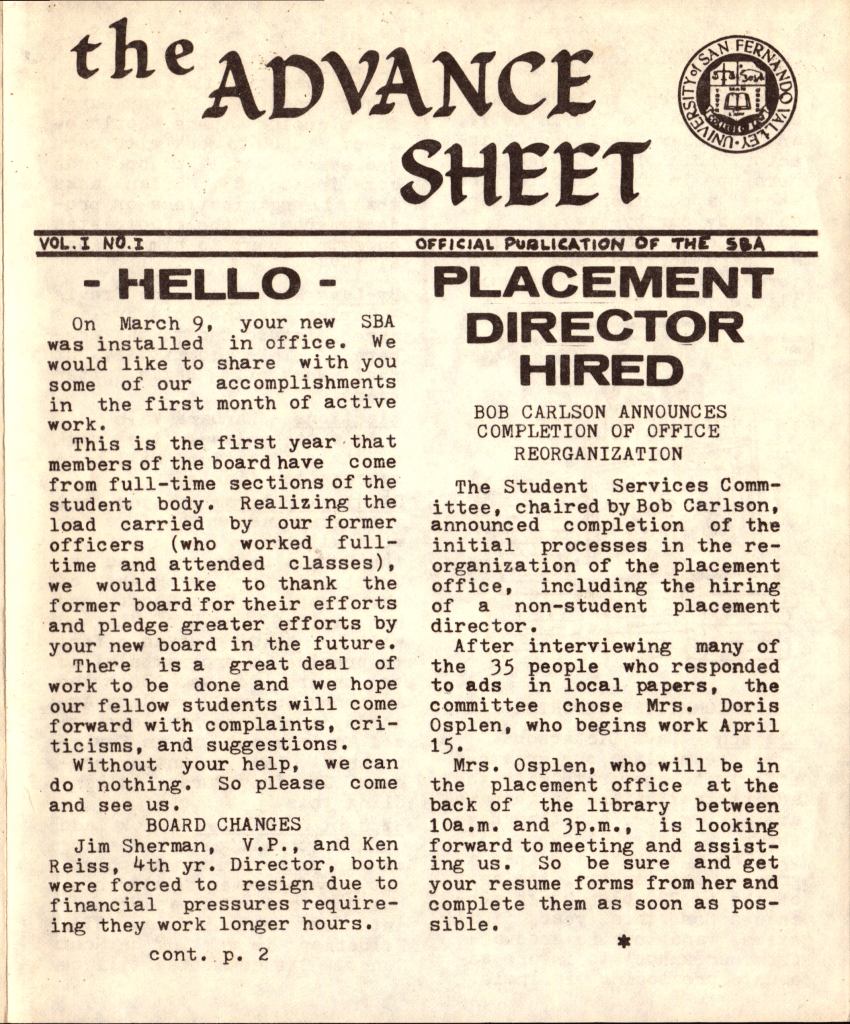
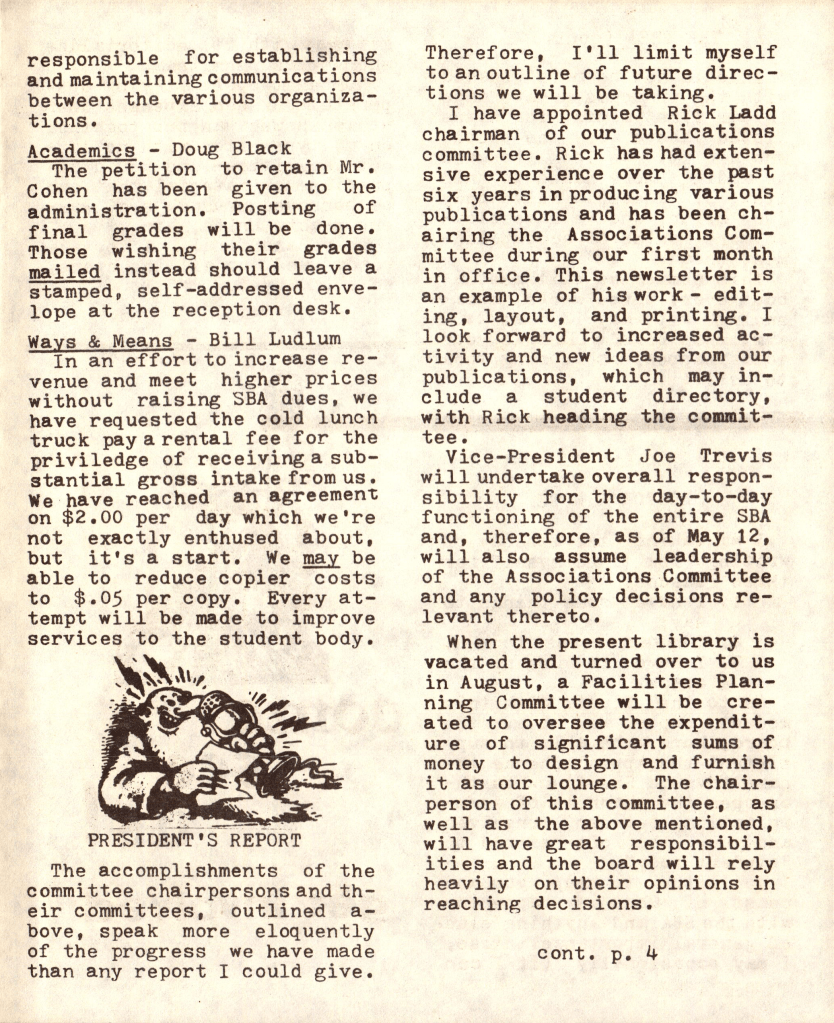
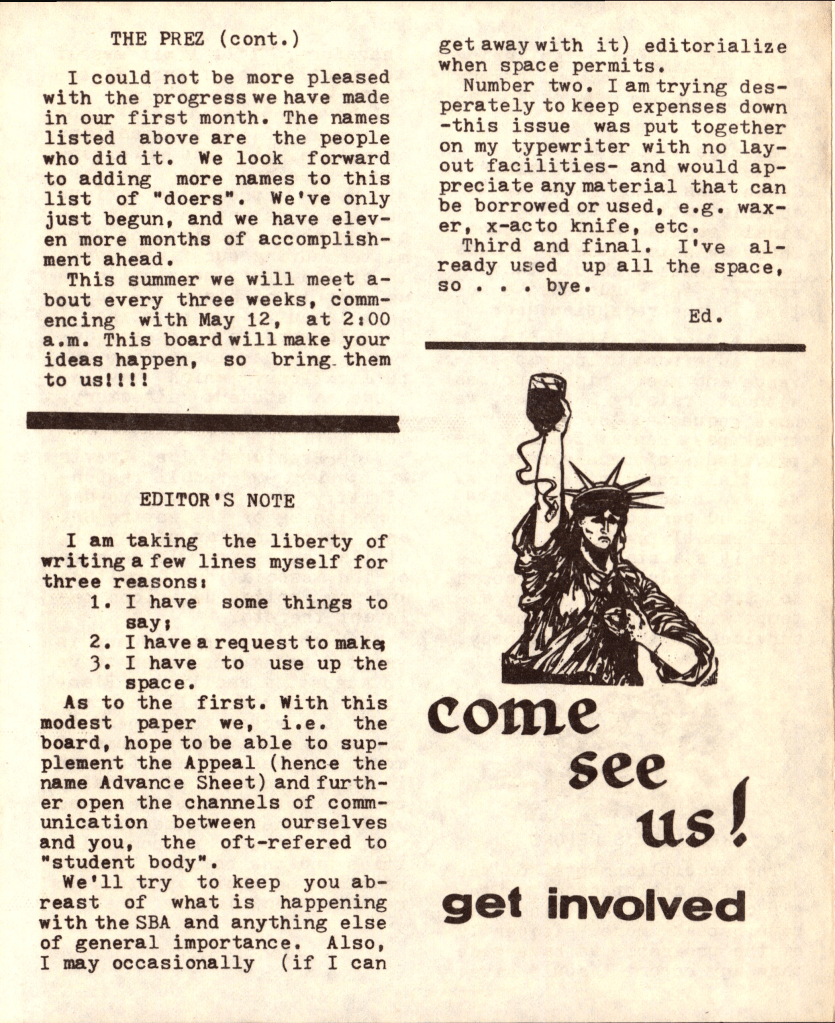
Here’s the only saved edition I have of a newsletter I put together for the Student Bar Association of the University of San Fernando Valley College of Law. I’m a bit miffed to discover I didn’t put a date on the damned thing, so I can’t be sure if I published it in 1974 or 1975. Now that I think about it, I believe I was the 2nd year, full-time representative to the Student Bar, so that would have been ’75 . . . a mere 44 years ago.
Note the simplicity. There was no computer involved in any aspect of this publication, as PCs did not exist at the time. I’m pretty sure the headlines were stick-on letters I had to apply one at a time, and the copy was all done on a typewriter, though it may have been an IBM Correcting Selectric, because I was working as a secretary/clerk in a small law office in Beverly Hills at the time.
I’m surprised the paper held up as well as it has over all these years. It’s yellowed a bit, but it was still reasonably malleable; not brittle and parchment-like, as I suspect my father’s newsletter would be if I could find them. Then again, they’d be around 75 years old now.
I have also found a bunch of newsletters I created for Rocketdyne, as well as menus and promotional items I designed over the years, when I wasn’t working at Rocketdyne. I’ve also found some strange things I created as jokes during my tenure at what we called “The Rock.” I intend on sharing all of them.








 Systems Savvy